




No CrossRef data available.
Article contents
Verbal learning and memory after childhood stroke
Published online by Cambridge University Press: 01 September 2004
Abstract
Verbal learning and memory (VLM) following pediatric stroke was characterized in a cross-sectional neuropsychological and neuroimaging study of 26 subjects, aged 5 to 17, with a history of pediatric stroke and 26 age, SES, and gender matched orthopedic controls. Further comparisons were made between the VLM profiles of stroke subjects with right versus left hemisphere lesions and early (≤12 months) versus late (>12 months) strokes. Overall, stroke subjects scored significantly lower than control subjects on several VLM indices (California Verbal Learning Test–Children; CVLT–C), as well as on measures of intellectual functioning (IQ) and auditory attention/working memory (Digit Span). Subgroup analyses of the stroke population found no significant differences in VLM, Digit Span, Verbal IQ or Performance IQ when left-hemisphere lesion subjects were compared to right-hemisphere lesion subjects. In contrast, early strokes were associated with significantly fewer words recalled after delay, reduced discriminability (fewer correct hits relative to false positive errors on recognition testing), and relatively worse auditory attention/working memory scores (Digit Span). These findings indicate that pediatric stroke subjects demonstrated more VLM impairment than control subjects, and early strokes were associated with greater recall and recognition deficits. In stark contrast with adult-onset stroke, both left- and right-hemisphere lesions during childhood resulted in similar VLM performance. (JINS, 2004, 10, 742–752.)
Information
- Type
- Research Article
- Information
- Journal of the International Neuropsychological Society , Volume 10 , Issue 5 , September 2004 , pp. 742 - 752
- Copyright
- 2004 The International Neuropsychological Society
INTRODUCTION
The examination of neurocognitive functions after childhood stroke provides rich data that inform our understanding of normal and abnormal brain development and illuminates the role of hemispheric specialization and plasticity in the developing brain. Studies to date, however, have found that neural plasticity is more limited than previously thought and focal brain lesions in childhood often result in a variety of residual neurocognitive deficits. To date, investigation into neurocognitive dysfunction secondary to pediatric stroke has focused primarily on four important cognitive areas: language development and skills (Aram & Ekelman, 1987; Bates et al., 1999; Eisele & Aram, 1994; Stiles & Thal, 1993), intellectual ability (Aram & Eisele, 1994; Aram & Ekelman, 1986; Ballantyne et al., 1994), academic functioning (Aram et al., 1985), and visuospatial skills (Stiles & Nass, 1991; Stiles & Thal, 1993). Few studies, however, have examined profiles and processes of verbal learning and memory (VLM) among children and adolescents with a history of stroke.
Despite a significant body of research on language development, VLM is an under-researched topic within the childhood stroke literature. This oversight is critical because the acquisition of new information is essential for academic skill building and directly impacts the potential for remediation efforts. In part, past research was limited by a lack of standardized memory measures appropriate for pediatric populations, but recent psychometric test development has resulted in measures with normative data on both qualitative and quantitative aspects of VLM in children and adolescents (Cohen, 1997; Delis et al., 1994, 2000; Sheslow & Adams, 1990) which allow exploration of verbally mediated memory skills at a depth not previously possible.
Early studies made inferences about VLM in neurologically involved pediatric populations based on language comprehension assessments with the Token Test. Vargha-Khadem et al. (1985) found impaired Token Test performance only among those subjects with left hemisphere involvement. They hypothesized that language deficits rather than memory deficits were responsible for the observed Token Test impairment. This hypothesis was based on significant correlations between Full Scale IQ, Verbal IQ, and Token Test scores in the absence of a relationship between Digit Span (representing short term auditory verbal memory) and Token Test scores among left hemisphere lesion subjects. Because the subject pool was composed of youth with potentially diffuse or bilateral damage (e.g., head injuries and tumors), these findings are difficult to interpret. Utilizing a more homogenous sample of youth with unilateral strokes, Aram and Ekelman (1987) speculated that impaired performance on the Revised Token Test arose from attention deficits in children with right-hemisphere lesions and from memory deficits in youth with left-hemisphere lesions. Their hypothesis was based on the observation that the right-hemisphere subjects were more impulsive in their response style and asked for fewer command repetitions (putatively indicating attention deficits), while left-hemisphere subjects requested numerous command repetitions, suggesting memory deficits. It is important to note, however, that in addition to small sample sizes, these studies examined performance on a task that is dependent on multiple skills, including language comprehension, attention, verbal memory, spatial processing, and sequencing ability.
Only one published study to date has empirically addressed the effect of lesion severity and laterality on VLM in children with a history of stroke (Block et al., 1999). In addition to examining language, attention, and functional memory, these investigators assessed VLM with the California Verbal Learning Test (CVLT) for children and adults, as appropriate to each youth's age. Block et al. (1999) found evidence for subtle VLM deficits on the CVLT, attention problems (speed of information processing on the Symbol Digit Modalities Test), and functional memory impairment for tasks of everyday living (Rivermead Behavioural Memory Test) after lesions to either hemisphere. Despite the notable similarity in performance of both right and left lesion subjects, differences in VLM and attention observed between the right lesion group and their matched controls only approached significance due to the limited number of subjects, while the differences between the left lesion group and their matched controls was significant. Overall, the observed VLM deficits among children with strokes were limited to the number of words recalled during initial learning measures, with no differences noted on short- or long-delay free recall. Early lesions, occurring prior to age two, were also associated with the lowest IQ scores. The investigators had a total childhood stroke sample of only 11 subjects (7 left, 4 right hemisphere lesions) comprised of youth with ischemic CVA lesions involving the middle cerebral artery. Unfortunately, the CVLT variables explored were restricted to the recall of words on three initial learning trials (Trial 1, 1–5 total, List B) and free recall of words after short and long delays. No attempt was made to analyze process measures that may reflect underlying mechanisms of VLM impairment in this population (e.g., semantic clustering, rate of forgetting, recognition discriminability). Thus, the study was limited both by sample size and few indices of VLM. We therefore chose to examine a broader range of CVLT–C variables in order to explore the VLM profile of pediatric stroke populations.
The goals of this study were twofold. Our primary goal was to characterize the VLM profile of consecutively evaluated pediatric stoke subjects. We compared the VLM profiles, auditory attention scores, and intellectual function indices of children with unilateral strokes to those of matched control subjects. Based on prior findings in the pediatric stroke literature (Aram, 1998; Block et al., 1999), we hypothesized that youth with a history of stroke would demonstrate poorer performance relative to their matched controls, but that their VLM functioning would likely fall within normal limits. Further, because of the high number of lesions encroaching prefrontal and frontal regions in these pediatric stroke subjects (see Methods), we anticipated deficits similar to those observed among adults with frontal lesions: diminished encoding, less efficient use of encoding strategies, and greater difficulty with word retrieval in the context of normal recognition memory (Baldo et al., 2002).
Our secondary goal was to compare the VLM profiles of youth with left- versus right-hemisphere involvement and those with a history of early versus late stroke. Based on the Block et al. (1999) findings, we hypothesized that we would be unable to detect differences in VLM performance between left and right hemisphere lesion subjects. Given that data suggest cognitive compromise often occurs after early central nervous system (CNS) damage (Aram & Eisele, 1994; Block et al., 1999; Isaacson, 1975; Levin et al., 1992), we also hypothesized that early stroke onset would be associated with greater VLM deficits than late onset stroke.
We choose these comparisons because (1) left-hemisphere lesions are typically associated with language disruption and verbal memory impairments in the adult stroke literature (Delis et al., 2000; Goodglass & Kaplan, 1972; Squire, 1987); and (2) because research findings are mixed regarding the effects of early versus late brain injuries on cognitive outcomes. While greater deficits in language have been associated with later age of injury after focal stroke (Riva & Cazzaniga, 1986; Vargha-Khadem et al., 1985; Woods, 1980; Woods & Carey, 1979; Woods & Teuber, 1973, 1978), a large body of data supports the premise that (1) neurocognitive development is more adversely affected the younger the child is at the time of more diffuse neurological insults (i.e., traumatic brain injury, low birth weight, hypothyroidism, fragile X, unilateral right hemisphere disease, and exposure to prophylactic cranial irradiation, see review by Taylor & Alden, 1997); and (2) intellectual outcome is more impaired after early focal stroke (Aram & Eisele, 1994; Riva & Cazzaniga, 1986; Vargha-Khadem et al., 1985; Woods, 1980), with one exception (Goodman & Yude, 1996). As VLM is dependent on language as well as a broader range of cognitive skills (i.e., attention, memory), we hypothesized relatively greater VLM impairment in the early versus late stroke subjects.
METHODS
The research design, previously reported in detail by Max et al. (2002), is a cross-sectional study of children with a history of a single stroke and a medical control group. The study focus was on psychiatric outcome in children with strokes in addition to neuropsychological, academic, adaptive, executive, and family function outcomes. In accordance with previous studies (Riva & Cazzaniga, 1986; Woods, 1980), stroke subjects were considered to have “early” lesions if their brain lesion occurred prenatally or up to 12 months of postnatal life. The “late” lesion group consisted of children who acquired their stroke after the age of 12 months. We matched stroke and control subjects on age, gender, and SES. Further, “early” stroke subjects were matched with children who had clubfoot, with the rationale that physical deformity in both groups was an early, and frequently congenital, insult. We matched “late” stroke subjects with children who had scoliosis because these children were without physical deformity prior to their acquired disorders. See “Orthopedic Controls” for complete details about matching criteria and procedures.
Participants With a History of Childhood Stroke
Inclusion criteria for stroke cases were (1) neuroimaging documentation of a focal, non-recurrent and non-progressive supratentorial brain parenchymal lesion caused by a stroke before age 14; (2) subjects aged 5–19 years at the time of the assessment; (3) ≥1 year since stroke; and (4) English as first language. The following exclusions were applied: (1) neonatal bleeds (e.g., intraventricular hemorrhages, germinal matrix hemorrhages) potentially associated with prematurity; (2) neonatal watershed infarcts associated with hypoxia; (3) hemoglobinopathies; (4) progressive neurometabolic disorders; (5) Down's syndrome and other chromosomal abnormalities; (6) malignancy; (7) congenital hydrocephalus; (8) shunts; (9) congenital and acquired CNS infections; (10) clotting factor deficiency; (11) stroke in a pregnant minor; (12) previous organ or bone marrow transplant; (13) cerebral cysts; (14) trauma; (15) transient ischemic attack; (16) moya-moya; (17) severe and profound mental retardation; (18) quadriplegia, triplegia, or diplegia diagnoses; (19) syndromic vascular malformations (excluding A-V aneurysm ruptures); (20) systemic lupus erythematosis; and (21) multiple lesions (unless in close proximity).
We studied 29 subjects with confirmed unilateral lesions. Three stroke subjects and their controls are not included in this manuscript because their age ranges (i.e., 17 years old or older) at assessment were outside the available normative data for the neuropsychological measures reported. The final stroke sample for this study included 26 youth, including 16 with early lesions and 10 with late lesions. Table 1 provides specific lesion data for all of the 26 stroke subjects. The mechanisms of stroke were occlusive in 19 cases and hemorrhagic in 7 cases. Occlusive etiology included 14 idiopathic cases, 1 case possibly linked to comorbid ulcerative colitis, and 4 cases in subjects with congenital heart disease (3 after cardiac surgery or catheterization and 1 after varicella zoster infection). Hemorrhagic etiology included 4 cases of arteriovenous malformation rupture, 1 case with a ruptured angioma, and 2 idiopathic hemorrhagic cases. We defined several anatomical regions of interest in our cohort guided by research on various domains of memory functioning and related neuroanatomical correlates in adult stroke patients, e.g., prefrontal, striatal, mesial temporal, ventrolateral frontal, and dorsolateral frontal cortical areas. Prefrontal–striatal involvement (PFS) occurred in 17/26 subjects. Prefrontal lesions were defined as occurring anterior to the motor strip and striatal lesions consisted of the caudate nucleus and/or lenticular nucleus. The PFS lesions in the sample included the following anatomical sites (Damasio & Damasio, 1989): F01, F03–04, F06–07 (Brodmann areas 24, 6, 8–10, 44–46), the prefrontal portion of F08 (Brodmann area 6), F11–13 (Brodmann areas 10–13, 47, basal forebrain), and basal ganglia areas BG1–4 (caudate nucleus and lenticular nucleus). Mesial–temporal involvement, another region of interest with regard to memory function, only occurred in 3 subjects who did not also have concomitant PFS lesion involvement. Comparisons between youth with ventrolateral frontal cortex involvement (areas 12, 47, 45) could not be made with those youth who had dorsolateral frontal cortex involvement (areas 9, 46) because there was complete overlap between these two groups (i.e., all subjects with ventrolateral frontal lesions also had dorsolateral frontal lesions; see Owen, 1997; Petrides, 1994). Sixty-nine percent of early onset stroke subjects had PFS involvement (11/16) and 60% percent of late onset stroke subjects had PFS involvement (6/10, see Table 1).
Lesion data for stroke subjects

Orthopedic Controls
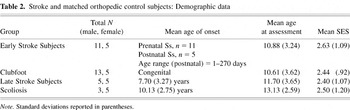
The control subjects were children with either congenital clubfoot or scoliosis who were individually matched to stroke subjects according to age of onset of stroke (i.e., early vs. late). Controls were not matched with stroke subjects on IQ (see Discussion) but were matched for SES (using the Hollingshead Four Factor Index, 1975; see Measures below), which is related to IQ. Control subjects were matched within 2 levels of the relevant stroke subject: 14 subjects had identical SES levels, 30 were matched within one SES level, and only 8 subjects (four pairs) required matching within two levels. Other matching variables included gender, ethnicity, and age within 1 year. Age matching had to be extended to 16 months in only 2 cases. The controls were excluded if there was evidence of acquired or congenital CNS injury that may be part of a broader (e.g., neuromuscular) syndrome unrelated to the common idiopathic syndromes. We matched early stroke subjects with clubfoot youth and late stroke subjects with youth who had scoliosis for all but two children with late stroke onset. We were unable to find 2 males with scoliosis to match children aged 3 and 5 years at the time of their stroke and aged 6 and 8 years respectively at the time of the assessment, because scoliosis that presents this young is often associated with cardiac or neurological disorders in the case of infantile idiopathic scoliosis, and juvenile idiopathic scoliosis is less common than adolescent idiopathic scoliosis (Winter & Lonstein, 1999). Therefore, these two late-onset stroke subjects were matched with children with clubfoot, which resulted in slightly uneven groups (see Table 2).
Stroke and matched orthopedic control subjects: Demographic data

Forty-three subjects (including all stroke subjects) were recruited from one university hospital, and 9 subjects were recruited from a second university hospital due to the relocation of the principal investigator.
The stroke (all stroke subjects) and orthopedic (combined clubfoot and scoliosis) groups were not significantly different on matching variables, including age at assessment, race, and SES. Age means (SD) of stroke (early and late) and orthopedic (clubfoot and scoliosis) subjects were 11.2 (3.4) and 11.4 (3.5), respectively (df = 50, t = .203, p = .8). SES means (SD) of stroke and orthopedic subjects were 2.54 (1.07) and 2.46 (.99), respectively (df = 50, t = −.270, p > .7). There were a total of 16 males in each of the stroke and control groups and 24 Whites and 2 biracial children in each of the stroke and orthopedic groups. Table 2 presents demographic data for each of the four subgroups.
There were no significant gender differences between the two orthopedic control groups, [χ2(1, N = 26) = 2.82, p = .10]. Mean age at assessment of clubfoot and scoliosis subjects did not differ significantly [10.61 (3.6) and 13.1 (2.6), respectively; df = 24, t = −1.767, p = .1]. SES was also comparable, with means of clubfoot and scoliosis subjects falling at 2.44 (.92) and 2.50 (1.20), respectively (df = 24, t = −.130, p = .9). No significant differences emerged on estimated IQ indices. Estimated VIQ scores for clubfoot and scoliosis youth were 102.33 (12.71) and 105.50 (10.84), respectively (df = 24, t = −.611, p = .6). Clubfoot and scoliosis subjects had PIQ estimated scores of 99.06 (17.26) and 104.88 (12.82), respectively (df = 24, t = −.851, p = .4).
Next, we directly compared demographic and neurological characteristics between our early and late stroke subgroups. The early and late stroke subgroups did not differ in terms of gender [χ2(1, N = 26) = .91, p = .34]. The mean age at assessment of early and late stroke subjects did not differ significantly [10.88 (3.2) and 11.7 (3.7), respectively; df = 24, t = −.601, p = .6]. SES means of early and late stroke subjects were comparable at 2.63 (1.09) and 2.40 (1.08), respectively (df = 24, t = .515, p = .6). Although there were fewer hemorrhagic strokes in the early stroke relative to the late stroke group [χ2(1, N = 26) = 4.40, p = .04], no group differences emerged on lesion laterality [χ2(1, N = 26) = 1.01, p = .32], or lesion type [i.e., Putamen, MCA; χ2(3, N = 26) = .78, p = .85]. Lesion volume was analyzed using a Mann-Whitney U test because the data are non-parametric. No significant differences emerged in terms of rank ordered lesion volume (U = 36.00, p = .12; see below). Although not reported here, the same set of analyses were conducted comparing right and left hemisphere stroke subjects and no significant differences were found.
Measures
Intellectual function
The Wechsler Intelligence Scale for Children, Third Edition (WISC–III; Wechsler, 1991) was used to assess general intellectual function. IQ estimates were based on a prorated Performance IQ (PIQ: Picture Arrangement, Block Design, and Coding subtests) and Verbal IQ (VIQ: Information and Similarities subtests). In addition, we administered the Digit Span subtest of the WISC–III as a basic index of auditory attention that also captures information about working memory (digit span backwards). The Digit Span scaled score was not used to estimate VIQ.
Verbal learning and memory
The California Verbal Learning Test–Children's Version (CVLT–C) was administered, in its complete and standard form, as a measure of VLM (Delis et al., 1994). The CVLT–C has been found to be a valid and reliable measure for the assessment of memory in children and adolescents (Delis et al., 1994) and has been used in studies of pediatric populations with known or suspected central nervous system involvement (e.g., childhood stroke and head injury, fetal alcohol syndrome youth; Block et al., 1999; Jaffe et al., 1993; Mattson et al., 1996; Roman et al., 1998; Yeates et al., 1995) and language impairment (Shear et al., 1992). We present data derived from the CVLT–C computer-scoring program (Fridlund & Delis, 1994).
Guided by prior work in pediatric populations (Jaffe et al., 1993; Levin et al., 1993; Mattson et al., 1996; Shear et al., 1992; Yeates et al., 1995), we chose to include CVLT–C variables that tapped immediate learning (total words recalled from the five initial learning trials), delayed recall, and recognition memory, as well as more process-oriented measures (e.g., semantic clustering; contrast measures tapping rate of forgetting and retroactive and proactive interference). See Tables 3 and 4 for a list of assessed variables.
Comparisons between stroke and orthopedic control subjects: CVLT–C and WISC–III performance

CVLT–C and WISC–III comparisons among stroke subjects

Socioeconomic status
SES assessment was derived using the Four Factor Index (Hollingshead, 1975), which provides five levels of classification dependent on the mother's and father's educational and occupational levels.
Neuroimaging
MRI scans were obtained (T1-weighted volumetric mode, SPGR/40°, TR/TE = 26/7 ms, NEX = 2, X/Y/Z = 1 × 1 × 1.5 mm thickness with no skip; T2-weighted dual-echo, FSE/V, TR = 2350, TE = 17/102, NEX = 1, X/Y/Z = 1 × 1 × 5 mm thickness with 1 mm skip). All images were globally spatially normalized through transformation to the Talairach coordinate system using SN software (Lancaster et al., 2000; http://ric.uthscsa.edu/projects/). A neurologist, F.F.M., marked the lesions on hard copy films. Guided by these lesion markings, an experienced neuroanatomist “painted” each lesion using a 3-D brain-morphometrics package (Paus et al., 1996) under supervision of P.T.F. and J.L.L. Lesion volume was computed in native and Talairach coordinate systems for intersubject differences in brain size (Lancaster et al., 2000). Rank-ordered lesion volume was the variable used in analyses relevant to lesion volume because distribution was skewed. Twenty-three of 26 stroke subjects underwent research scans that were the basis of their lesion location analyses. The other 3 subjects who could not have a research MRI (due to either refusal, concern about intracerebral metallic clips or equipment failure) had lesion location determined from previous clinical CT (2) or MRI (1) scans.
Statistical Analysis
Group comparisons were made with independent sample t tests, with an alpha set at .05 due to our a priori hypotheses and the small sample size. Scores for the WISC–III are reported using standard index scores (M = 100, SD = 15), and the Digit Span subtest (not included in the prorated calculation of IQ scores) is presented as a scaled score (M = 10, SD = 3). The total number of words learned across the five learning trials for List A on the CVLT are presented in T scores (M = 50, SD = 10), all other CVLT–C indices are presented as z scores (M = 0, SD = 1). Because of the broad range of ages in this sample we chose only to analyze standardized scores rather than raw scores in order to better assess subtle differences that may occur across the age ranges. In addition, effect sizes (Cohen's d) were calculated for comparisons among stroke subjects because of small sample size.
RESULTS
Stroke and Control Group Comparisons
CVLT–C initial learning, recall and recognition
Stroke subjects' recalled fewer total words on the initial learning trials than the control subjects (p < .05). Stroke subjects also produced significantly fewer words on both long delay free (p < .05) and cued (p < .05) recall and were less able to utilize an efficient VLM strategy (utilizing semantic clusters) than their matched controls (p < .05). Stroke subjects were generally comparable to controls in terms of the consistency of their word recall and forgetting rates (long delay free recall vs. List A, Trial 5). In terms of recognition memory, no performance differences emerged between the groups on overall discriminability (i.e., endorsing targets, rejecting distractors).
CVLT–C inaccurate recall
Recall errors (i.e., perseverative responses or intrusion errors during recall conditions) were not significantly different between stroke and control subjects, although there was a trend towards a higher intrusion rate among pediatric stroke subjects (p < .08).
CVLT–C proactive/retroactive interference
While no significant differences in vulnerability to proactive interference were observed (List B vs. List A, Trial 1 recall), stroke subjects were significantly more susceptible to retroactive interference (short delay free recall vs. List A, Trial 5) than their control counterparts (p < .05).
WISC–III intellectual performance
Stroke subjects scored significantly lower than controls on estimated PIQ (p < .01) and VIQ (p < .01) indices as well as on the WISC–III Digit Span subtest (p < .05).
Table 3 presents statistics for all CVLT–C and WISC–III variables used to compare the VLM and intellectual performance of stroke and control subjects.
Stroke Subjects Comparisons
We conducted analyses comparing stroke subjects with right versus left hemisphere lesions, and early versus late onset lesions.
Lesion laterality: right versus left hemisphere stroke
CVLT–C and WISC–III: Notably, comparisons between subjects with right and left hemispheres revealed no significant differences on CVLT–C indices (see Table 4), estimated intellectual functioning, or Digit Span performance. Effect sizes were mainly trivial (three were <.1) or small (10 were between .20 and .45) (Cohen, 1988).
Stroke onset: early versus late
CVLT–C and WISC–III: Comparisons between early and late stroke subjects on the CVLT–C revealed that early stroke subjects performed significantly more poorly on long-delay free recall than late stroke subjects (p < .05) and were less able to accurately discriminate target words during the recognition condition (p = .05). Performances on total word recall for initial learning trials, other recall and recognition indices, error types (inaccurate recall), rate of forgetting, and vulnerability to proactive and retroactive interference were similar for stroke subjects regardless of the onset age of their stroke.
Early and late stroke subjects were not significantly different in their PIQ or VIQ scores, although there was a trend towards more impaired VIQ and PIQ performance among the early stroke subjects (p < .08 and .06, respectively). Significant differences were observed on the WISC-III Digit Span subtest, with early stroke subjects performing more poorly than late stroke subjects (p < .05). Most effect sizes for comparisons of early versus late strokes were medium (.50–.79) or high (≥.80) (Cohen, 1988).
DISCUSSION
As hypothesized, stroke subjects faired less well on VLM indices than did their matched controls. It is notable, however, that although the stroke subject group recalled fewer total words on learning trials when compared to their matched controls, their scores on this general index of learning fell within the low average range compared to the CVLT–C's normative sample. Upon closer inspection of both qualitative and quantitative variables, a more complete VLM profile emerged. Stroke subjects were not as efficient as control subjects at organizing words into semantic clusters to facilitate recall. Further, despite a similar ability to discriminate between target and distracter words on a recognition task, stroke subjects struggled significantly more with long delay recall (free and cued) when compared to control subjects. This suggests that the pediatric stroke group learned the target words but did not perform as well on more demanding retrieval tasks, particularly when the length of time between word presentation and recall increased. This finding is further supported by the greater vulnerability to retroactive interference observed among stroke subjects (difference between List A, Trial 5 and short delay free recall, with List B presented in the interim). The pediatric stroke profile of relatively compromised encoding (learning fewer words), less efficient use of learning strategies (semantic clustering), less benefit from semantic cues provided by the examiner (long delay cued recall) and diminished retrieval after a long delay (free and cued) are generally consistent with findings from adult patients with frontal lesions (Baldo et al., 2002). A significant number of the pediatric stroke subjects had lesion sites that included, but were not necessarily limited to, prefrontal-striatal areas. In addition to these 17 PFS subjects, 6 more subjects (3 each in the early and late stroke subject groups) had frontal–temporal lesions, for a total of 89% of our sample demonstrating either frontal or PFS lesion representation. These findings suggest that further study of the VLM patterns of PFS strokes in pediatric populations is warranted to assess how their profile compares to both matched controls and adults with frontal or, specifically PFS, lesions.
Finally, although verbal intellectual functioning was a relative strength for these youth with a stroke history, they scored significantly lower on measures of VIQ, PIQ, and attention/working memory (Digit Span) than control subjects. Consistent with other findings, our data suggest that focal brain damage in childhood results in relatively mild compromise in general intellectual functioning, auditory attention/working memory, and VLM after pediatric stroke (Bates, 1994; Bates & Roe, 2001).
Comparison With Adult Stroke Literature
In support of our expectation, no significant lateralization differences emerged between right and left hemisphere lesion subjects on indices of verbal learning and memory, intelligence, or attention/working memory (Digit Span). These findings stand in stark contrast to the adult stroke literature but are consistent with the results of the Block et al. (1999) study. These data do not support the idea that left hemisphere lesions result in greater VLM impairment than right hemisphere lesions in a pediatric stroke population. Although the source of relative impairments for left and right lesion subjects may differ (e.g., underlying language or attention deficits), clear explanations of these subtle deficits will require a larger sample. It should also be noted that, although the present study represents one of the largest pediatric stroke studies to date, it was underpowered relative to some studies in the adult stroke literature which may reduce the ability to detect potential left and right hemisphere differences in pediatric stroke subjects.
Even with the present sample size, there were, however, indications of poorer performance among earlier stroke subjects compared to youth with later stroke onset. Although youth with earlier stroke onsets had generally similar VLM profiles to their late onset counterparts, they demonstrated specific difficulty with the most demanding recall task on the CVLT–C, the long delay free recall condition. Because they were also less accurate in their recognition memory (i.e., discriminability), early stroke subjects appear to have both relatively impaired word retrieval and precise encoding (reflected by diminished recognition accuracy) compared to their late stroke counterparts, despite similar rates of learning and comparable use of semantic learning strategies. Further, there is evidence of a relatively mild compromise in general intellectual functioning (including nonverbal problem-solving and visual–spatial functioning captured by PIQ).
Limitations
First, our study is focused on understanding word-list VLM and does not include a broader exploration of memory functioning (e.g., visual memory). Second, the sample is relatively small and non-epidemiological in nature. Third, the small sample size precluded our ability to compare different stroke subgroups (focal medial temporal lobe vs. focal prefrontal, ventrolateral vs. dorsolateral frontal). Fourth, there was heterogeneity in stroke etiology. We utilized an orthopedic control group to minimize this problem. Fifth, some may consider it a limitation that we chose not to exclude stroke subjects based on their IQ scores, did not match stroke and control subjects on IQ scores, and did not use IQ as a covariate in our analyses. However, while arguments can be made that differences in VLM may be attributable to IQ or verbal IQ (VIQ) performance, it is just as likely that VLM differences may also account for VIQ performance. Indeed, Brewer et al. (2001) have argued persuasively that IQ scores are better conceptualized as outcome measures rather than causal variables in studies of children with acquired brain disorders. They noted that those processes that lead to poor performance on neuropsychological tasks also result in lower performance on IQ measures. That is, strong performance on VIQ subtests likely requires, in part, the acquisition of verbal knowledge, which is dependent upon intact VLM for optimal functioning. Despite these acknowledged limitations, our sample is among the larger number of subjects with childhood stroke, and provides an in-depth exploration of both qualitative and quantitative aspects of verbal memory utilizing well-normed measures for youth.
Implications
The mild but persistent neurocognitive deficits observed in youth with a history of stroke may be due, in part, to neuronal “misconnections” (e.g., the result of neural rewiring and/or modifications related to axonal sprouting, rerouting and weeding) that interfere with optimal neurocognitive performance in domains such as concentration, attention, learning, problem-solving, and self-regulation and monitoring (Goodman, 1989). Further the specific VLM pediatric stroke profile that emerged (diminished encoding, retrieval and semantic clustering ability but normal recognition memory) and the high number of prefrontal–striatal lesions observed during consecutive outpatient hospital evaluations, suggest that there may be rather predictable patterns of impairment after pediatric stroke. Thus, identifying subtle deficits in the neurocognitive performance of pediatric stroke subjects is important for recognizing the needs of these youth and better understanding brain-behavior relationships in this population.
Because subtle VLM deficits may go undetected in pediatric stroke patients, we do not yet know the functional implications or the variety of VLM impairments that may occur in this population. Even a relatively mild deficit during childhood may have an additive or synergistic effect during early educational experiences, with an end result of significantly less acquired knowledge. Further, remediation techniques designed to teach specific learning strategies such as the use of pneumonic devices or semantic clustering (externally reinforced until rote) and academic environments that minimize the impact of retroactive interference when teaching new or complex skills and concepts may be effective memory tools for this population.
Directions for Future Research
While the current study provides initial clues about the complex and subtle patterns of VLM deficits that exist in pediatric stroke populations, more research is needed to evaluate a broader range of memory functioning in this population. In addition to examining logical verbal memory (e.g., stories), it would be useful to compare hemispheric and age of onset differences in quantitative and qualitative aspects of visual and verbal memory. Larger samples are also critically needed to compare various stroke etiologies at different developmental levels. Finally, it is essential to examine how VLM functioning translates into academic performance and functional impairment in other arenas (e.g., social) in order to design effective remediation interventions.
ACKNOWLEDGMENTS
This study was supported by a National Alliance for Research in Schizophrenia and Affective Disorders (NARSAD) Young Investigator Award and (K-08) MH 01800 (Dr. Max); and UTHSCSA portion of 5 PO2 MH52176-07 (NIMH, NIDA, NCI) (Dr. Fox).
References
REFERENCES
Aram, D.M.
(1998).
Neuroplasticity: Evidence from unilateral brain lesions in
children. In
Broman &
Fletcher (Eds.),
The changing nervous system (pp.
254–273).
London:
Oxford University Press.
Aram, D.M. &
Eisele, J.A.
(1994).
Intellectual stability in children with unilateral brain lesions.
Neuropsychologia,
32,
85–95.CrossRefGoogle Scholar
Aram, D.M. &
Ekelman, B.L.
(1986).
Cognitive profiles of children with early onset of unilateral
lesions.
Developmental Neuropsychology,
2,
155–172.CrossRefGoogle Scholar
Aram, D.M. &
Ekelman, B.L.
(1987).
Unilateral brain lesions in childhood: Performance on the Revised
Token Test.
Brain and Language,
32,
137–158.CrossRefGoogle Scholar
Aram, D.M.,
Ekelman, B.L.,
Rose, D.F., &
Whitaker, H.A.
(1985).
Verbal and cognitive sequelae following unilateral lesions acquired
in early childhood.
Journal of Clinical and Experimental Neuropsychology,
7,
55–78.CrossRefGoogle Scholar
Baldo, J.,
Delis, D.C.,
Kramer, J., &
Shimamura, A.P.
(2002).
Memory performance on the California Verbal Learning Test–II:
Findings from patients with focal frontal lesions.
Journal of the International Neuropsychological Society,
8,
539–546.Google Scholar
Ballantyne, A.O.,
Scarvie, K.M., &
Trauner, D.A.
(1994).
Verbal and performance IQ patterns in children after perinatal
stroke.
Developmental Neuropsychology,
10,
39–50.CrossRefGoogle Scholar
Bates, E.
(1994).
Modularity, domain specificity and the development of language.
Discussions in Neuroscience,
10,
136–149.Google Scholar
Bates, E. &
Roe, K.
(2001).
Language development in children with unilateral brain injury. In
C.A. Nelson &
M. Luciana (Eds.),
Handbook of developmental cognitive neuroscience (pp.
281–307).
Cambridge, MA:
MIT Press.
Bates, E.,
Vicari, S., &
Trauner, D.A.
(1999).
Neural mediation of language development: Perspectives from lesion
studies of infants and children. In
H. Tager-Flusberg (Ed.),
Neurodevelopmental disorders (pp.
533–581)
Cambridge, MA:
The MIT Press.
Block, G.W.,
Nanson, J.L., &
Lowry, N.J.
(1999).
Attention, memory, and language after pediatric ischemic stroke.
Child Neuropsychology,
5,
81–91.Google Scholar
Brewer, V.R.,
Fletcher, J.M.,
Hiscock, M., &
Davidson, K.C.
(2001).
Attention processes in children with shunted hydrocephalus versus
attention deficit-hyperactivity disorder.
Neuropsychology,
15,
185–198.CrossRefGoogle Scholar
Cohen, J.
(1988).
Statistical power analysis for the behavioral sciences.
Hillsdale, NJ:
Erlbaum.
Cohen, M.J.
(1997).
Children's Memory Scale manual.
San Antonio, TX:
The Psychological Corporation.
Damasio, H. &
Damasio, A.R.
(1989).
Lesion analysis in neuropsychology.
New York:
Oxford University Press.
Delis, D.C.,
Kramer, J.H.,
Kaplan, E., &
Ober, B.A.
(1994).
California Verbal Learning Tests, Children's Version manual.
Boston:
The Psychological Corporation.
Delis, D.C.,
Kramer, J.H.,
Kaplan, E., &
Ober, B.A.
(2000).
California Verbal Learning Test–Second Edition.
San Antonio, TX:
The Psychological Corporation.
Eisele, J.A. &
Aram, D.M.
(1994).
Comprehension and imitation of syntax following early hemisphere
damage.
Brain and Language,
46,
212–231.CrossRefGoogle Scholar
Fridlund, A.J. &
Delis, D.C.
(1994).
California Verbal Learning Test scoring assistant user's guide
(Version 1, Windows Version).
San Antonio, TX:
The Psychological Corporation.
Goodglass, H. &
Kaplan, E.
(1972).
The assessment of aphasia and related disorders.
Philadelphia:
Lea & Febiger.
Goodman, R. &
Yude, C.
(1996).
IQ and its predictors in childhood hemiplegia.
Developmental Medicine and Child Neurology,
38,
881–890.CrossRefGoogle Scholar
Goodman, R.N.
(1989).
Neuronal misconnections and psychiatric disorder: Is there a
link? British Journal of Psychiatry,
154,
292–299.Google Scholar
Hollingshead, A.
(1975).
Four Factor Index of Social Status.
New Haven, CT:
Yale University Press.
Isaacson, R.L.
(1975).
The myth of recovery from early brain damage. In
N.R. Ellis (Ed.),
Aberrant development in infancy: Human and animal studies (pp.
1–25).
Potomac, MD:
Lawrence Erlbaum.
Jaffe, K.M.,
Fay, G.C.,
Polissar, N.L.,
Martin, K.M.,
Shurtleff, H.A.,
Rivara, J.M., &
Winn, H.R.
(1993).
Severity of pediatric traumatic brain injury and neurobehavioral
recovery at one year: A cohort study.
Archives of Physical Medicine and Rehabilitation,
74,
587–595.CrossRefGoogle Scholar
Lancaster, J.L.,
Woldorff, M.G.,
Parsons, L.M.,
Liotti, M.,
Freitas, C.S.,
Rainey, L.,
Kochunov, P.V.,
Nickerson, D.,
Mikiten, S.A., &
Fox, P.T.
(2000).
Automated Talairach atlas labels for functional brain mapping.
Human Brain Map,
10,
120–131.3.0.CO;2-8>CrossRefGoogle Scholar
Levin, H.S.,
Aldrich, E.F.,
Saydjari, C.,
Eisenberg, H.M.,
Foulkes, M.A.,
Bellefleur, M.,
Luerssen, T.G.,
Jane, J.A.,
Marmarou, A., &
Marshall, L.F.
(1992).
Severe head injury in children: Experience of the Traumatic Coma
Data Bank.
Neurosurgery,
31,
435–444.CrossRefGoogle Scholar
Levin, H.S.,
Culhane, K.A.,
Mendelsohn, D., &
Lilly, M.A.
(1993).
Cognition in relation to magnetic resonance imaging in head-injured
children and adolescents.
Archives of Neurology,
50,
897–905.CrossRefGoogle Scholar
Mattson, S.N.,
Riley, E.P.,
Delis, D.C.,
Stern, C., &
Jones, K.L.
(1996).
Verbal learning and memory in children with fetal alcohol syndrome.
Alcohol Clinical Experimental Research,
20,
810–816.CrossRefGoogle Scholar
Max, J.E.,
Mathews, K.,
Lansing, A.E.,
Robertson, B.A.M.,
Fox, P.,
Lancaster, J.,
Manes, F.F., &
Smith, J.
(2002).
Psychiatric disorders after childhood stroke.
Journal of the American Academy of Child and Adolescent Psychiatry,
41,
555–562.CrossRefGoogle Scholar
Owen, A.M.
(1997).
The functional organization of working memory processes within
human lateral frontal cortex: the contribution of functional
neuroimaging.
European Journal of Neuroscience,
9,
1329–1339.CrossRefGoogle Scholar
Paus, T.,
Otaky, N.,
Caramanos, Z.,
MacDonald, D.,
Zijdenbos, A.,
D'Avirro, D.,
Gutmans, D.,
Holmes, C.,
Tomaiuolo, F., &
Evans, A.C.
(1996).
In vivo morphometry of the intrasulcal gray matter in the human
cingulate, paracingulate, and superior-rostral sulci: Hemispheric
asymmetries, gender differences and probability maps.
Journal of Comparative Neurology,
376,
664–673.3.0.CO;2-M>CrossRefGoogle Scholar
Petrides, M.
(1994).
Frontal lobes and working memory: Evidence from investigations of
the effects of cortical excisions in nonhuman primates. In
F. Boller &
J. Grafman (Eds.),
Handbook of neuropsychology (pp.
59–82).
Amsterdam:
Elsevier.
Riva, D. &
Cazzaniga, L.
(1986).
Late effects of unilateral brain lesions sustained before and after
age one.
Neuropsychologia,
24,
423–428.CrossRefGoogle Scholar
Roman, M.J.,
Delis, D.C.,
Willerman, L.,
Magulac, M.,
Demadura, T.L.,
de la Pena, J.L.,
Loftis, C.,
Walsh, J., &
Kracun, M.
(1998).
Impact of pediatric traumatic brain injury on components of verbal
memory.
Journal of Clinical and Experimental Neuropsychology,
20,
245–258.CrossRefGoogle Scholar
Shear, P.K.,
Tallal, P., &
Delis, D.C.
(1992).
Verbal learning and memory in language impaired children.
Neuropsychologia,
30,
451–458.CrossRefGoogle Scholar
Sheslow, D. &
Adams, W.
(1990).
Wide Range Assessment of Memory and Learning.
Wilmington, DE:
Jastak Associates.
Squire, L.R.
(1987).
Memory and brain.
New York:
Oxford University Press.
Stiles, J. &
Nass, R.
(1991).
Spatial grouping activity in young children with congenital right
or left hemisphere brain injury.
Brain and Cognition,
15,
201–222.CrossRefGoogle Scholar
Stiles, J. &
Thal, D.
(1993).
Linguistic and spatial cognitive development following early focal
brain injury: Patterns of deficit and recovery. In
M.H. Johnson (Ed.),
Brain development and cognition: A reader (pp.
643–664).
Malden, UK:
Blackwell Publishers Inc.
Taylor, H.G. &
Alden, J.
(1997).
Age-related differences in outcomes following childhood brain
insults: an introduction and overview.
Journal of the International Neuropsychological Society,
3,
555–567.Google Scholar
Vargha-Khadem, F.,
O'Gorman, A.M., &
Watters, G.V.
(1985).
Aphasia and handedness in relation to hemispheric side, age at
injury and severity of cerebral lesion during childhood.
Brain,
108,
677–696.CrossRefGoogle Scholar
Wechsler, D.
(1991).
Wechsler Intelligence Scale for Children–Third Edition.
New York:
The Psychological Corporation.
Winter, R.B. &
Lonstein, J.E.
(1999).
Juvenile and adolescent scoliosis. In
H.N. Herkowitz,
S.R. Garfin,
R.A. Balderston,
F.J. Eismont,
G.R. Bell, &
S.W. Wiesel (Eds.),
Rothman-Simeone, the spine
(4th ed., pp.
325–372).
Philadelphia:
W.B. Saunders.
Woods, B.T.
(1980).
The restricted effects of right-hemisphere lesions after age one:
Wechsler test data.
Neuropsychologia,
18,
65–70.CrossRefGoogle Scholar
Woods, B.T. &
Carey, S.
(1979).
Language deficits after apparent clinical recovery from childhood
aphasia.
Annals of Neurology,
6,
405–409.CrossRefGoogle Scholar
Woods, B.T. &
Teuber, H.L.
(1973).
Early onset of complementary specialization of cerebral hemispheres
in man.
Transactions of the American Neurological Association,
98,
113–117.Google Scholar
Woods, B.T. &
Teuber, H.L.
(1978).
Changing patterns of childhood aphasia.
Annals of Neurology,
3,
273–280.CrossRefGoogle Scholar
Yeates, K.O.,
Blumenstein, E.,
Patterson, C.M., &
Delis, D.C.
(1995).
Verbal learning and memory following pediatric closed-head injury.
Journal of the International Neuropsychological Society,
1,
78–87.CrossRefGoogle Scholar

Lesion data for stroke subjects
Stroke and matched orthopedic control subjects: Demographic data

Comparisons between stroke and orthopedic control subjects: CVLT–C and WISC–III performance

CVLT–C and WISC–III comparisons among stroke subjects
 You have
Access
- 69
- Cited by