


Following Russia’s invasion of Ukraine in February 2022, millions of Ukrainians fled to the neighboring countries—the largest human displacement crisis in the world today, with Romania currently hosting 157,220 Ukrainian refugees (UNHCR 2024). In Europe, the large-scale mobilization for helping these refugees was attributed to the “conscience collective” regarding Ukrainians (De Coninck Reference De Coninck2022). However, “Ukraine fatigue” (Wesolowsky Reference Wesolowsky2023) led to a decrease in help. Nine months after the invasion, 74 percent of the Romanian people believed that Romania should still welcome Ukrainian refugees, if needed (Larics 2022). One year after the war, 35 percent of Romanians did not agree with providing financial support to Ukraine, with a further 24 percent against aid (Ofiţeru Reference Ofiţeru2023).
In this context, our article focuses on crowdsourcing platforms for the support of Ukrainian refugees developed by the Romanian government and civil society. Taking them as dispositives of problem-solving and knowledge production, we investigate how meaning is built with reference to the problem of refugees and what strategies are employed to mobilize the public toward politically significant action.
We conduct our analysis within the broader framework of the sociology of public problems (Gusfield Reference Gusfield1981; Best Reference Best1987; Cefaï Reference Cefaï1996; Beciu et al., Reference Beciu, Ciocea, Mădroane and Cârlan2018; Ciocea et al. Reference Ciocea, Cârlan and Cheregi2019), informed by symbolic interactionism and French pragmatic sociology. Public problems produce modes of engagement with societal issues through symbolic negotiation of meanings. One such public problem on the permanent agenda of the Romanian media is labor migration, a phenomenon used by journalists to address broader societal issues (Mădroane Reference Mădroane2016; Vincze and Balaban Reference Vincze and Balaban2022). The Ukrainian refugee crisis reopened debates about migrants as a symbolic threat to European unity and about the implications of migration within Europe, framed in terms of security concerns and economic costs. On the other hand, the new language of humanitarianism, victimhood, and threat (Chouliaraki and Stolic Reference Chouliaraki and Stolic2017; Chouliaraki Reference Chouliaraki2021) used with regard to the refugees has informed recent debates on economic migrants as well. The Ukrainian crisis has also highlighted identity wars in former socialist countries, with the theme of a shared traumatic past being used strategically to mobilize citizens to take action (Dolea Reference Dolea2022).
Research on Solidarity with Ukrainian Refugees
Overall, studies on the topic of solidarity discourses for Ukrainian refugees can be divided into three different categories: comparative analyses of attitudes toward Middle Eastern and North African refugees and Ukrainian refugees (Yuzva and Tashchenko Reference Yuzv and Tashcenko2021; Arda Reference Arda2022; Bordrunova and Smoliarova Reference Bordrunova and Smoliarovna2022), media discourses on Ukrainian refugees as deserving of help (Zawadzka-Paluektau Reference Zawadzka-Paluektau2022; Martikainen and Sakki Reference Martikainen and Sakki2023; Palmgren et al. Reference Palmgren, Åkerlund and Viklund2023), and online networks of support for Ukrainian refugees (Bassoli and Luccioni Reference Bassoli and Luccioni2023; Carlsen et al. Reference Carlsen, Gårdhus and Toubøl2023; Grad-Rusu and Rusu Reference Grad-Rusu and Grad2023; Ye et al. Reference Ye, Jindal, Pierri and Luceri2023).
Solidarity narratives in media throughout Europe portray Ukrainian refugees as aid recipients (Zawadzka-Paluektau Reference Zawadzka-Paluektau2022); as refugees, in contrast to the out-group represented by Muslim immigrants (Palmgren et al. Reference Palmgren, Åkerlund and Viklund2023); as vulnerable, innocent victims; or as persistent/resilient people (Martikainen and Sakki Reference Martikainen and Sakki2023). Research that examines online support networks for Ukrainian refugees focuses on fundraising websites used for online financial assistance (Ye et al. Reference Ye, Jindal, Pierri and Luceri2023), organization of informal groups online (Carlsen et al. Reference Carlsen, Gårdhus and Toubøl2023), and potential drivers of citizen mobilization (Grad-Rusu and Rusu Reference Grad-Rusu and Grad2023).
Crowdsourcing Platforms as Dispositives of Meaning Making
Crowdsourcing is increasingly used as a new method of public involvement into the political process (Khoma Reference Khoma2015, 333). Literature distinguishes between crowdfunding (Lu et al. Reference Lu, Singh and Sun2014) and crowdsourcing (Gao et al. Reference Gao, Barbier and Goolsby2011) and emphasizes the strategic function of such initiatives (Rouzé Reference Rouzé2019). Migration crowdfunding, as a particular form of sociopolitical crowdfunding, is fed by “a new philosophy of cooperation and solidarity” (Khoma and Vdovychyn Reference Khoma and Vdovychyn2022, 45).
Vernacular humanitarianism (Brković Reference Brković2017), “horizontal philanthropy” (Wilkinson-Maposa et al. Reference Wilkinson-Maposa, Fowler, Oliver-Evans and Mulenga2005, xi), and volunteer humanitarianism (Sandri Reference Sandri2018), are based on “everyday humanitarian sentiments” (Fechter and Schwittay Reference Fechter and Schwittay2019) and focus on activism and advocacy. In the case of refugees, “new practices of governance” (Humphris Reference Humphris2019) arise from everyday negotiation of life in a new context, rather than an activation of rights within a formal governance system. However, politically significant hierarchies and inequalities arise even in this apparently noncompetitive, networked environment of “humanitarian governance” (Barnett Reference Barnett2013), once humanitarianism becomes professionalized and institutionalized through government involvement. Collaborative platforms are “engaging dispositives” (Peirot Reference Peirot2021), which facilitate the empowerment and emancipation of individuals. Such “event-enabling dispositives” (Alexis et al. Reference Alexis, Chevret-Castellani and Labelle2017) innovate in terms of forms of deliberation, resulting in the transformation of political action.
In this context, our analysis focuses on crowdsourcing platforms for helping Ukrainian refugees. We theorize them as dispositives that facilitate power relations and knowledge production among refugees, private donors, and institutions. This interplay between power relations and knowledge relations gives them their strategic nature (Foucault Reference Foucault1994, 299–300).
These platforms are both infrastructures developed following a set of instructions to solve an emergency in a given social context and a discursive field constituted around the problem of refugees. They are a social arena populated by a polyphony of voices coming from actors with various political agendas. Through technological mediation, they give visibility to the symbolic battles, contested problematizations, and competitive discourses about Ukrainian refugees. As infrastructures of problem-solving, they allow politically significant actions such as donating and assigning resources. As discursive fields, they lead to a reconfiguration of power relations among actors.
The strategic function of such infrastructures is reflected in their architecture: they are projected by initiators as utilitarian tools to address a specific need. In this respect, they are crisis modulated. At the same time, they represent the humanitarian imperative to the potential donors and offer a solution to a problematic situation. Their underlying assumption is that the crowd is wise enough to recognize the crisis and generous enough to participate in the resolution of the crisis. Crowdsourcing technologies are spaces that allow “affectively mediated action” (Fawzy Reference Fawzy2023, 13). They mediate the relationship between “citizens, as potential resource-holders, and disasters, as objects that require resources’ mobilization” (Asmolov Reference Asmolov2015, 2). As such, these infrastructures are discursive fields that attribute the role of subjects (the donors) in relation to the object (the refugee crisis). Their different affordances and constraints determine what information is produced about the problem, how various actors interact, and how meaning is oriented toward resolution (Jones Reference Jones2020, 712, 714). The attribution of the role of problem-solvers to initiators and donors, and of victims and aid recipients to refugees, produces meaning about the crisis that has the potential to construct the owners’ engagement with this problem in other discursive arenas as well (e.g., public policies).
Our understanding of crowdsourcing platforms as both infrastructures of problem-solving and discursive fields addresses the interest for the materiality of exchanges within the dispositive. Foucault’s definition of the dispositive as a system of relations established between discursive and nondiscursive elements that is constituted in a certain historical moment to respond to an imperative (Foucault Reference Foucault1980, 194–95) acknowledges that both discourse and nondiscourse can constitute objects of knowledge. Knowledge is “the connecting force” between linguistically and non-linguistically performed practices and materializations” (Jäger and Maier Reference Jäger and Maier2016, 114). Along with discourses and registers, societal arrangements constituted around registers (such as NGOs and political platforms) are of interest to analysts exploring how arenas of social action are connected (Gal Reference Gal2018). Taking into consideration the broader social and historical context in post-Foucauldian dispositive analysis (e.g., macroeconomic and macrosocial factors, the mechanisms used to solve the tension between center and periphery, considerations about how subjectivity is formed and contested, and how the self is positioned toward others) helps clarify the relationship between knowledge, ideology, and governance in post-socialist societies (Nowicka-Franczak Reference Nowicka-Franczak2021). The sociology of knowledge approach to discourse (SKAD) also addresses the materiality of discourses. It defines dispositives as institutional and organizational infrastructures of discourse production and problem-solving that “mediate between discourses and fields of practice” (Keller Reference Keller2011, 56), facilitating the power effects of discourse. In this sense, SKAD distinguishes between dispositives of discourse production and dispositives as infrastructures of implementation emerging out of discourse, addressing the transformation of social orders of knowledge.
Taking the inclusion of nondiscursive elements in the dispositive as “the addition that dispositive theory makes to discourse theory,” Caborn proposes a semiological approach to dispositive analysis where the heterogeneous categories of texts, action,s and objects are signifiers and the meanings attributed to actions and objects through discursivised knowledge are the signified (Caborn Reference Caborn2007, 113, 117). A semiological approach to dispositive analysis will look into the meanings attributed to the elements of the dispositive, the strategic position of signifier and signified as an object in the dispositive, as well as the accompanying discursive and nondiscursive practices. A methodological consequence is that the analyst will explore the strategic position of signs in the dispositive (who produces the knowledge, and to what end) to understand the practices associated with these signs.
From a social semiotic perspective, crowdsourcing platforms illustrate semiosis as a social action embedded in larger cultural and economic practices and power relations. Just as in linguistics the focus changes from “sentence” to “text” and “context” and from “grammar” to “discourse,” in social semiotics “the focus changes from the ‘sign’ to the way people use semiotic ‘resources’ both to produce communicative artefacts and events and to interpret them” (van Leeuwen Reference Van Leeuwen2005, 2). With this mutation, the interest of the researcher falls on the use and not on a pregiven meaning of a sign. Similarly, the grammar of language is not a set of rules but a “resource for making meanings” (Halliday Reference Halliday1978, 182).
In his proposal for a semiolinguistic analysis of discourse, Charadeau clarifies that the construction of meaning is not just related to the semantization of form but also depends on an agent who develops a project of social influence within a framework of action (Charadeau Reference Charaudeau1995, 98). Semiotization is the result of this process of transformation of the world into something signified as a consequence of the action of this agent and a process of transaction between various agents. Meanings are made in social actions and interactions, using existing, socially made, semiotic resources that change ceaselessly in their use (Kress and van Leeuwen Reference Kress and Van Leeuwen2021, xiii). Likewise, semioticians distinguish between iconicity as an act of perception and symbolism, which relies on inference and judgment from an agent (Hodge and Kress Reference Hodge and Kress1988).
Methodological Considerations
Our analysis follows the emerging literature on online communities that proposes the use of discourse analysis to complement information gathered by means of various other approaches, such as social network analysis (Moser et al. Reference Moser, Groenewegen and Huysman2013), content analysis, case studies, or ethnographies. Discourse conceptualized “as relational data that can be studied through the analysis of dialogic ties in discourse networks” (Wagner and Gonzáles-Howard Reference Wagner and González-Howard2018, 81) can reveal how users attribute meaning to their involvement in collaborative online communities.
We treat crowdsourcing platforms as dispositives that have the strategic function of solving the refugee problem. This function has both a material, nondiscursive realization (a digital tool that facilitates actors’ involvement in the crisis) and a discursive dimension (the mobilization of the knowledge produced about refugees toward an end). As a consequence, our analysis is concerned with nonlinguistic practices (the institutionalization of humanitarian initiatives) and materializations (the architecture of the crowdsourcing platforms), but also with discursive practices. We explore how actors negotiate discursively their strategic positions in the dispositive and how they attribute meaning to humanitarian action. The order of knowledge resulting from the interplay between power relations and knowledge relations transforms dispositives into infrastructures of implementation of this new order. Finally, our analysis is concerned with the materiality of discourse—how discursive practices shape the governance of refugees.
The first research question underlying our analysis is, How is meaning built on the crowdsourcing platforms? To answer this question, our analysis first distinguishes between types of crowdsourcing initiatives and types of actors. This allows us to understand how the community is distributing roles to manage the crisis and which actors have the resources to gain more visibility in this field. Second, we look at crowdsourcing websites as one connected resource for meaning making that involves text, images, videos, and calls to action. The analysis focuses on how actors make, use, and reuse semiotic choices to produce meaning in relation to the refugee crisis. To this end, we use multimodal discourse analysis (Kress Reference Kress2010, Reference Kress2012; van Leeuwen Reference Van Leeuwen2013), whose aim is to elaborate tools that can provide insight into the relation of the meanings of a community and its semiotic manifestations. A multimodal approach assumes that language, whether as speech or writing, is one means among many available for representation or for making meaning (Kress Reference Kress2010, 37). In a multimodal approach, all modes are framed as one field, as one domain. They are treated jointly as one connected cultural resource for (representation as) meaning making by members of a social group at a particular moment. From a critical discourse perspective, discourses are communicated through different kinds of semiotic resources and via different modes and are realized through different genres (Machin Reference Machin2013, 347). The text is shaped as a whole, which gives it a contextual configuration, where some bonds within which communication unfolds are coded (Ledin and Machin Reference Ledin and Machin2019, 502) involving different semiotic choices. In this respect, the crowdsourcing platform is a semiotic material designed as a whole that affords certain types of communication. The categories that we have in view in our analysis are semiotic modes (a set of socially and culturally shaped resources for making meaning), design (the forefront of essential semiotic dispositives), affordance (the potentialities and constraints of different modes), salience (the size of elements, colors and tonal contrasts), framing (the degree to which elements are meant to be read as separate items or as “belonging together”), individualization (singularity, shots that show only one person), and collectivization (expressed by a plurality of actors) (Kress Reference Kress2010).
Our second research question is, Which are the strategies employed by actors to mobilize the public toward action? To answer this question, we employ discourse analysis to understand how actors articulate discursively their ownership of various initiatives; what significance they attribute to humanitarian action; and what claims they mobilize to encourage action by the public. How various actors negotiate discursively their strategic positions in the dispositive is significant because it shows who are the producers of knowledge and to what end they direct this knowledge. Equally important is to investigate the social imaginary constructed around humanitarian action.
With these considerations in mind, we analyzed 21 crowdsourcing platforms for the support of Ukrainian refugees developed by the Romanian government and by civil society and 31 news articles about the platforms, published between February and November 2022 in the Romanian media. The first difficulty that we encountered during our corpus selection was a multiplication of crowdsourcing initiatives, very early in the refugee crisis. Calls to action were launched by actors with various degrees of legitimacy and visibility in either mainstream or social media. As a consequence, we decided to include in our corpus only “institutionalized” initiatives, meaning those that were assumed by an entity: the government, the media, NGOs, brands, experts, or influencers. A second difficulty was to identify metadiscourses about these crowdsourcing initiatives in the media. Similar to how they cover the refugee crisis, the mainstream media use an expert discourse with reference to crowdsourcing initiatives, passing on information as it is generally offered in press releases, with little editorial intervention. Coverage is information laden, with minimal use of emotions. Problematizations are absent, as is the voice of the journalist. This difficulty reflects in the number of articles we were able to include in our corpus, from an initial count of 50 articles covering the topic of crowdsourcing initiatives in the selected period. On the other hand, we found that the “about” sections on the platforms (what platform authors have to say about their own initiatives) were significant inputs for our analysis of the discursive field constituted around the problem of refugees.
Types of Crowdsourcing Initiatives and Actors
Our analysis distinguishes between six types of crowdsourcing initiatives for the Ukrainian refugees: government crowdsourcing platforms, crowdsourcing platforms initiated by experts, NGOs’ crowdsourcing platforms, social media groups, media crowdsourcing initiatives, and mixed crowdsourcing initiatives (see table 1 for further detail). The most visible crowdsourcing platforms are the ones supervised by the government: Dopomoha.ro, initiated by Code for Romania in partnership with the Department of Emergency Situations, the UN Refugee Agency, International Organisation for Migration, and the National Romanian Council for Refugees; and several spin-offs, which are interrelated and focus on various types of help: rights, obligations, and facilities for Ukrainian citizens needing temporary protection in Romania (Protectieucraina.gov.ro); accommodation (Unacoperis.ro); integrated resource management (Sprijindeurgenta.ro). The best known and practically the standard among the crowdsourcing initiatives, Dopomoha.ro, has Ukrainian, Romanian, English, and Russian versions and is regularly updated with verified information from official sources. The platform offers easy access to categories (legal status, information, stay safe, support, housing, call center, education, health, transport, and jobs). Government-supervised platforms focus on user management (all require registration) and are user-friendly and networked (i.e., they have active links to the other platforms).
Typology of Crowdsourcing Initiatives
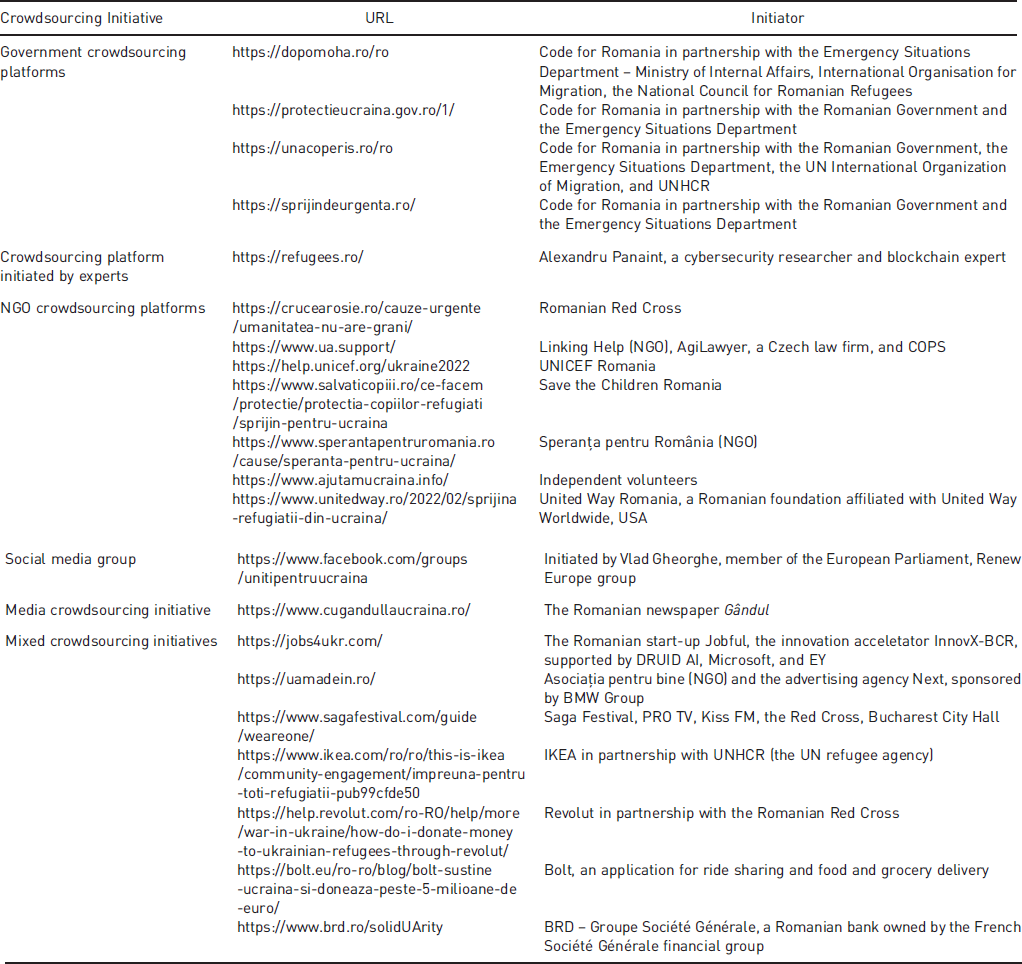
Another category is that of crowdsourcing platforms developed by experts who used their competence to cover a need very early in the crisis. Refugees.ro (the website is no longer operational) was an aggregator of resources that allowed citizens to list offers of shelter, transportation, food, and jobs for the Ukrainian refugees. The platform was designed for a transnational audience, gathering data from Romania and elsewhere in Europe.
The NGOs’ crowdsourcing platforms are initiated by prominent actors (the Romanian Red Cross, UNICEF Romania, Save the Children Romania), and various other actors with little visibility outside of these initiatives. Most use their regular online presence, with a “donate” page built into the site.
Social media groups included in the corpus were created around existing communities and managed by actors with a political interest. For instance, the group Uniţi pentru Ucraina/United for Ukraine, with around 300,000 members, was initiated by a Romanian member of the European Parliament. The posts are public and fall into several categories: essentials (offers for accommodation, demands for jobs), technicalities (questions about the government stipends), events (charitable concerts, etc.), resources (online children’s books, etc.), education, commercial aspects (advertising for businesses developed by Ukrainians living in Romania), job opportunities, and medical issues.
The media had several crowdsourcing initiatives. For instance, the Romanian newspaper Gândul created the platform Thinking of Ukraine, aggregating offers of money, food, blood or volunteering.
A special type of crowdsourcing initiative is the mixed one, combining actors from different areas. Start-ups, banks, IT firms, music celebrities, advertising agencies, and a multitude of brands collaborated to organize fundraising events. Such initiatives are carefully curated and have a distinctive layer of professionalization, which is visible in use of brand imagery, tags, and communication in line with that brand’s visibility online.
This categorization of crowdsourcing initiatives is relevant for understanding what roles are attributed to actors in the crowdfunding campaigns. The government initiatives were not the first to emerge, but they rapidly became the most visible and the most used tools. This can be partly explained in terms of resources mobilized to produce the platforms (which the government could do with the help of global aid organizations and NGOs). A means of raising awareness about the platform’s functionalities and establishing it firmly as the ultimate resource for refugees was to attribute agency to users: for instance, a separate section of the platform Dopomoha.ro directs the user to a downloadable poster and a flyer that can be printed or displayed “in crowded places that are visible to people.” Such actions give regular citizens a chance to feel involved and become nodes in this network of data sharing.
In media discourse we identified two types of actors who are distinct from the entities involved in the development of the abovementioned initiatives. We label these crowdsourcing professionals and aid entrepreneurs. Some actors have visibility because of their previous association with a cause or campaign. We call them crowdsourcing professionals because they have the mechanisms in place to mobilize people, gather resources, and, most importantly, define causes and publicize results. These professionals trade information and aim to educate their community. The second category is that of aid entrepreneurs who were previously involved in humanitarian crises throughout the world. They are facilitators between donors and refugees, and between citizens and authorities, who employ entrepreneurial skills to manage resources to reach their aim.
Such singular voices address the problem of aid in a professional, efficient, solutions-oriented manner, which runs counter to emotionally laden, spontaneous initiatives. This counterdiscourse strives to find a balance between what the people want to hear (praise for their generosity) and what needs to be done for efficiency: “They do not need what we are offering them, I do not mean to criticize, I am very proud to be a Romanian and there are so many people who want to help, but usually what we want to give is not what they need. … I think we need to educate the population about what is needed. … This is a profession which needs to be learned” (Ivanov Reference Ivanov2022).
Multimodal Semiotic Resources
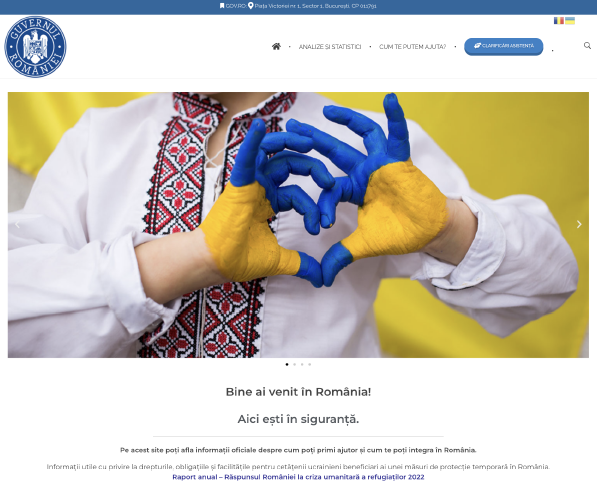
Our multimodal approach to crowdsourcing platforms focuses on how different modes of interaction are constructed. Generally, the user journey in the crowdsourcing websites is vertical, similar to personal blogs. Very rarely do platforms combine the horizontal journey, the “carousel,” with a vertical one. Donate buttons are very visible and are placed at right on the website, incorporating the golden ratio, and the layout is designed for a user-friendly experience. The overall look and feel of the crowdsourcing platforms supervised by the government is professional, which partly explains the visibility of these platforms for the intended audience. In terms of affordances, the platforms generally have a Ukrainian-language version, are regularly updated, and focus on specific types of help. The design elements make use of the symbolism of the Ukrainian flag and include traditional Romanian symbols (see fig. 1).
Protectieucraina.gov.ro website
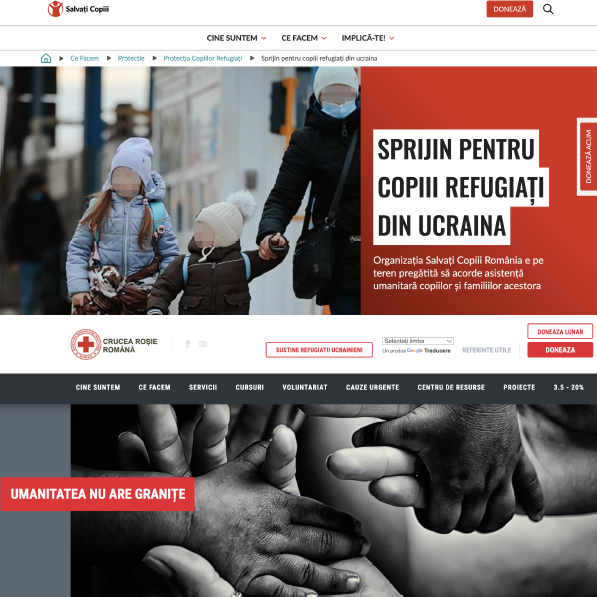
Use of infographics as semiotic resources highlighting the importance of humanitarian campaigns is quite pronounced on NGOs’ websites. For example, “7.5 million children in Ukraine are in danger!,”Footnote 1 and “More than 7.5 million children are caught in the middle of the war in Ukraine, with the risk of being separated from their families and exposed to trauma, with no medical and educational access.”Footnote 2
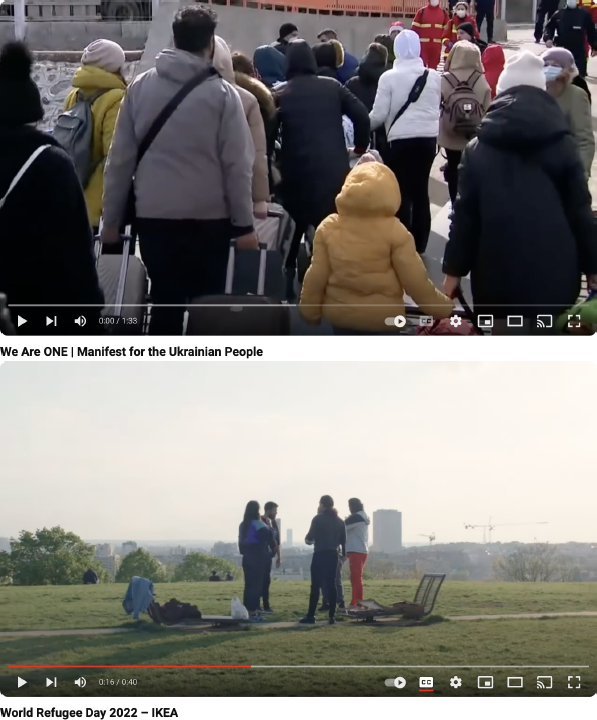
From a semiotic perspective, refugees embody two “regimes of belonging”: they are displaced subjects on “paths of exile/invasion,” with an intense experience of nomadic estrangement and nonbelonging (Leone Reference Leone2010, Reference Leone2012). Ukrainian refugees are presented as victims deserving of aid, either implicitly, through the use of symbols and visual metaphors, or explicitly, such as when emotionally laden images of Ukrainian mothers with children are selected to convey the dramatic circumstances of refugees and encourage identification with their suffering (see fig. 2). Calls to action mobilize affect through the instrumentalization of the image of the refugees. Images of Ukrainians leaving their country, usually seen from behind, are used as a visual metaphor for the status of refugees as uprooted people. On the other hand, images of refugees in an empty field become resources for communicating the idea of community and the importance of integrating refugees in the host countries (see fig. 3).
Visuals used to represent Ukrainian refugees on NGOs’ crowdsourcing platforms; top, Save the Children Romania; bottom, Romanian Red Cross.
Screenshots from the dataset of mixed crowdsourcing initiatives in Romania: top, “We Are One” campaign; bottom, “Together for All Refugees” campaign.
Mobilization Strategies in the Crowdsourcing Initiatives
We have discerned two mechanisms employed by actors to establish themselves as owners of the crowdsourcing initiatives: managing visibility and educating the public. The management of visibility is mainly done through an emphasis on the functionality of the platforms and reliability of information. For instance, Dopomoha.ro presents itself as simple, efficient, and ready to use: “One thing they need before anything else is reliable, timely and straightforward information.” On the expert platform Refugees.ro, one strategy to legitimize the initiative is to mention the institutional and media actors who published materials about the platform: the Ministry of Foreign Affairs of Ukraine, the Government of the Republic of Moldova, Bloomberg, Forbes Romania, and so on. Another strategy is to establish hierarchy in what is essentially a selfless enterprise: “Refugees.ro is one of the most important initiatives launched in support of Ukrainian people. The platform, launched on February 25, a day after the start of the war, came as a quick fix to help people who had to flee the conflict. It is the first platform in the world that focuses exclusively on Ukrainian people” (Refugees.ro). In the case of companies’ initiatives, visibility was ensured through press releases that were taken over by mainstream or business-oriented media. The public of these initiatives is the Romanian consumers of these brands; their purpose is to increase brand visibility among users and cultivate awareness among facilitators, namely, NGOs who worked at the borders in the early days of the crisis.
Educating the public to create a community of involvement and humanitarian enterprise is another mechanism to establish ownership. Code for Romania, the “independent, nonpartisan, nonpolitical, nongovernmental organization” behind Dopomoha.ro, is an arm of Commit Global, which aims to “use digital tools to solve critical global problems and build civic infrastructure.”Footnote 3 The educational aim is visible in the mission statement: technology can unlock the potential of communities as critical assets, and users can be informed about the institutions and NGOs involved in the project (through active logos on the platform).
Mixed crowdsourcing initiatives speak directly to the target audience of the brand. For instance, the charity concert We Are One, whose proceeds were donated to the Romanian Red Cross, used expert voices (national and international music celebrities) in their promotional video to invite the audience to join the cause and be part of the community of help, united around the idea that “we are one” (Saga Festival 2022). The pronoun we creates an “ambient community of affiliation” (Fawzy Reference Fawzy2023, 6), highlighting that the support for Ukrainian refugees is shared collectively between the participants.
The content flowed from the crowdsourcing website directly to YouTube (which amassed several thousand views), allowing the audience to engage with the architecture and affordances of the platform. The same logic applies to the campaign “Together for All Refugees,” launched by IKEA in partnership with UNHCR on World Refugee Day in 2022 and featuring a video posted on YouTube. The video asks, “Who has the right to feel at home?” and answers, “All of us has the right to feel at home … no matter who we are or where we come from.” The campaign presents refugee stories and invites action, asking the audience to “stay in the know” (by talking with refugees), “stay tuned” (by engaging with organizations and NGOs), and “spread awareness” (by sharing verified facts from trusted sources).
On NGOs’ platforms, mobilization for donations is done by employing copywriting techniques, which leads to a marketization of discourse: “Are you a Ukrainian refugee seeking legal help of any kind? Are you a lawyer willing to offer support to Ukrainian refugees? We will match you!” (ua.support). A different approach is taken in the UAmadein.ro campaign, which is based on a reward model, offering prizes to theUkrainian refugees who register a business idea: “Tell the Ukrainian refugees about UAmadein.ro. Next, we will help them to open a business here, in Romania” (RAN Communication 2022). The initiative is heavily gamified, with complicated “rules” and “steps.” The problem of Ukrainian refugees is constructed as an entrepreneurial opportunity, without any reference to the challenges faced by the refugees.
Calls to action from refugees themselves were slower to emerge. They are generally oriented toward medium-term solutions: opening a business in Romania, enrolling children in Romanian schools, accessing governmental or private funds, and so on. One such instance of empowerment is the Facebook group Uniţi pentru Ucraina/United for Ukraine. It serves as a platform where refugees can establish an online presence, warn each other about predators who might take advantage of refugees, and keep others informed. This shows that refugees authorize the platform and legitimize it as a site for interaction and information exchange.
A distinct mechanism for calls to action is to take advantage of the viral quality of some posts. Although we did not conduct a systematic analysis of ordinary citizens’ initiatives, these initiatives gained visibility in the Facebook groups and mainstream media that we investigated. At the beginning of the crisis, lists of various crowdsourcing initiatives were circulated incessantly on social media, even when information had become obsolete, and their immediate efficiency was doubtful (most posts were meant to inform the Romanian public, not the refugees themselves). Their potential for virality is constructed by the use of journalistic practices (documentation, use of categories, aggregation of resources, links), responding to the logic and specificity of that particular medium/platform and public, answering (or creating) an imperative (filling a void in information) and announcing the urgency of such initiatives, and using emotions (“feel good” comments, pathos): “Awful situation at the borders, I have no words for this surreal war and the dramas of so many innocent people, my heart breaks. I thought about contributing with what I know best, doing research and pooling information” (Madeline 2022).
Mobilization Strategies in the Media
In the early days of the invasion, media attention was mainly focused on the borders, and resources for covering other areas were scarce. As a consequence, the field was occupied by other actors (brands, entrepreneurs, NGOs, private citizens), and the media relied heavily on press releases. We were able to include in our corpus 31 news articles about crowdsourcing initiatives, published between February and November 2022. Typically, they are informative, announcing the initiative and including a quote from one of the stakeholders (either governmental or NGO actors).
The representatives of associations and NGOs use affect to announce the emergency of the action and mobilize the public for donating, as seen in the following Code for Romania press release ): “We are sad to find out about the civil victims in Ukraine, but also about the thousands of refugees who are terrified and flee into our country and other neighboring countries. … One thing is clear: it falls on each of us to rapidly come to the rescue of the more vulnerable. … We activated our task force, as we did two years ago and in the case of the COVID-19 pandemic, when panic, fear, uncertainly and helplessness ruled Romania” (Chirtoc Reference Chirtoc2022). When NGOs are given a voice in these media articles, they speak the language of humanitarianism, which is in line with their mission statements, as is evident in the words of the president of the For Good Association: “Their need for normality is evident, they want to settle into a life as close as possible to what they had back home” (RAN Communication 2022). The informative news articles briefly mention the cause, but do not speak about the refugees themselves. On the other hand, the refugees emerge as one collective sufferer in NGOs’ statements. Donors are invited to think about their pledge and take action based on these emotions:
They do not understand us. They feel useless, they do not know who to turn to. They do not know who to trust. Many are mothers with children. They are vulnerable people. How can we help?
Besides food and shelter, these people need information. To get their bearings. We can help, but we need to be well informed ourselves.
We have synthesized the latest information, which can be of help the moment we interact with refugees.” (Declic 2022)
This example from a blog of the Declic community (over 1 million “active members who fight for a fairer society”) illustrates how the discussion shifted in time from immediate help toward tools needed to navigate Romanian society. Donors are encouraged to be facilitators and are educated about this humanitarian enterprise.
The media do not directly launch appeals to action, and the refugees are never given a voice. This absence can be partly explained by the genre of the articles. Another is the cumulative effect of various media: the definition of the refugee was already fixed in the mind of the public through relentless coverage of the Ukrainian border on social media, TV, and official websites. As a consequence, “the refugee” is increasingly used by the media as a portmanteau word, filled by the public with stereotypical images of refugees in emotional circumstances.
Conclusion
The unexpected immediacy of the refugee as a symbolic presence in Romania has triggered problematizations about attitudes toward war migrants, about fears and threats in the national imaginary, and about the humanitarian ideals that mobilize people and the kind of society they project by virtue of this newly acquired knowledge. In the months following the invasion of Ukraine, the public arena was occupied by a variety of actors who engaged in a symbolic negotiation of the meanings attributed to the refugee crisis and proposed solutions to solve this socially problematic situation. The polyvocality of the owners of the problem created a variety of genres and narratives of solidarity and a multiplicity of instruments of civic engagement. In fact, the large-scale mobilization at the individual and national levels to support Ukrainian refugees indicated a “maturation of Romanian civil society” (Anghel and Trandafoiu Reference Anghel and Trandafoiu2022). In this context, this article analyzed the crowdsourcing platforms for the support of Ukrainian refugees developed by the Romanian government and civil society in order to see how meaning is built with reference to the problem of refugees and what strategies are employed to mobilize the public toward politically significant action.
We take these crowdsourcing platforms as dispositives that have a strategic function. They are infrastructures of problem-solving that use technology to mediate the relationship between donors and the crisis. They also function as discursive fields around the public problem of refugees, constructing a narrative about refugees, negotiating meanings of the crisis, regulating the discursive actions of participants, enacting norms, and attributing responsibilities. In short, they mediatize humanitarian action by facilitating participants’ engagement with the problem of refugees. This analytical stance allows us to address the materiality of exchanges (discursive practices included) within the dispositive. Our methodological approach is derived from a semiotic perspective on dispositive analysis. This reflects into an exploration of the positions of actors in the dispositive and of the strategies they employ to produce meaning about the crisis and mobilize donors toward humanitarian action. Our standpoint can inform further analyses of the mechanisms used by various crowdsourcing initiatives to solve other socially problematic situations.
We categorized types of crowdsourcing initiatives and types of actors, which allowed us to understand which actors are more prominent in this crisis and how they manage their visibility. We were able to discern six types of crowdsourcing initiatives: government crowdsourcing platforms, crowdsourcing platforms initiated by experts, NGOs’ crowdsourcing platforms, social media groups, media crowdsourcing initiatives, and mixed crowdsourcing initiatives. In news articles, we identified two distinct categories of actors, which we labeled crowdsourcing professionals and aid entrepreneurs.
International NGOs, associations and agencies, national institutions, experts in the field of fundraising, the media, and a multitude of brands gained visibility during the crisis. They mobilized a variety of semiotic resources to build solidarity with the refugees. Their calls to action made use of affect to gather donors into a community of belonging animated by humanitarian values. For instance, images of Ukrainian mothers and children in distressing circumstances were repeatedly employed to drive emotional involvement with the situation of refugees. At the same time, this overuse of clichéd images, together with the representation of refugees as passive aid recipients, deprives refugees of their individuality. This eventually erases emotions and, as a consequence, may even impact the end result of the call to action.
In contrast to this representation of refugees as lacking agency, facilitators and donors are highly visible in crowdsourcing initiatives. Another source for the visibility of civil society is the discourse of the media, who consensually covered NGOs’ actions as intrinsically good and indicative of the progress made by Romanian society toward a humanitarian ideal. Moreover, the media heavily relied on other actors to humanize the discourse on refugees. When NGOs’ representatives are given a voice in interviews, they aim to build empathy in the public and teach them about a humanitarian ideal. This public, however, is largely absent from the debate on refugees. Although initiators of crowdsourcing initiatives use a variety of semiotic resources and strategies to educate and mobilize the public toward humanitarian action, they do not share ownership of the problem with the public. Citizens are given access to the knowledge about refugees, but as the consumers, not the producers of this knowledge. They are highly instrumentalized as an indistinct group of donors, much like the refugees are represented as an indistinct group of distant sufferers. Their empowerment does not extend as far as participation in the deliberation. In this respect, crowdsourcing initiators and the media, who give visibility to these initiatives, have the symbolic power to produce meaning about refugees and donors alike. However, the refugee crisis helped civil society in Romania create new practices of humanitarian action and project an image of the ideal Romanian society.



