Introduction
In February 1911, the International Mixed Court at Shanghai received a petition from one Edward Evans, an established British bookseller in town. On behalf of an American textbook publisher Ginn and Co., Evans accused Commercial Press Ltd. (Shangwu yinshuguan), a Shanghai-based Chinese publishing company, of pirating one of their popular titles. Stating that such conduct had infringed on Ginn and Co.’s exclusive property rights and commercial interests, he urged the Mixed Court to punish Commercial Press and destroy all the pirate copies and printing plates they possessed.Footnote 1 The case of Ginn & Co. v. Commercial Press quickly caused a stir among Chinese publishers as well as in the foreign business community in town and beyond. Not only was it the first Sino-American copyright infringement lawsuit filed in China, but it was to take its place on the latest frontlines of ‘commercial warfare’ (shangzhan). Instead of confronting each other in the marketplace via the usual cutthroat price wars or advertising campaigns, these two distinguished textbook tycoons competed over the Chinese market in a new battleground: the court.
Since the second half of the nineteenth century, China had been seen by foreign multinational businesses as one of the most promising emerging markets in the world. The increasing presence of foreign firms in China's treaty ports and beyond after the 1880s brought about more intense and extensive interactions between foreign corporations and their local counterparts. Seeing the Chinese market as both a ‘battlefield’ and a ‘target’ of imperialist exploitation and economic nationalist resistance, and between incompatible business cultures and interests, scholars of Chinese business history have focused on commercial rivalry as the chief form of Sino-foreign business interactions. In conventional narratives, Chinese businesses have often been portrayed as ‘backward’, ‘irrational’, and thus incapable of competing with ‘modern’ Western corporations in the Sino-foreign commercial field following the Opium War (1839–1842). More recent scholarship of modern Chinese business history has challenged such a narrative by demonstrating, through archive-based research, the competitiveness of Chinese business and its flexibility in adapting to the changing economic and political conditions in China and beyond.Footnote 2 Chinese businesses in the late Qing and Republican eras did not operate exclusively according to certain ‘Chinese’ models.Footnote 3 As Sherman Cochran points out, Chinese and foreign businesses both gained advantages in seeking access to new distribution networks and expanding their manufacture and marketing operations by imitating each other's business practices.Footnote 4 Sino-foreign commercial competition in the late Qing and Republican eras was more fluid and symbiotic than scholars have previously thought.
While there is a well-established body of studies on the price wars, commercial campaigns, nationalist mobilizations, and sabotage, lawsuits between Chinese and foreign businesses as a form of Sino-foreign commercial competition have received little scholarly attention. This is likely to be due to two main reasons: first, the absence of court records, especially from the Shanghai Mixed Court where most Sino-foreign commercial dispute cases were filed, has made it difficult to reconstruct their legal interactions; second, it has been widely assumed that the Chinese were in an inferior position at the Mixed Court, as China's ‘judicial sovereignty’ was impaired by the clause of extraterritoriality. The commercial treaties the Qing government signed with imperialist powers after military defeats subsequent to the Opium War are commonly labelled as ‘unequal’ because they granted foreigners extraterritorial legal and commercial privileges, and disadvantaged the Qing and its subjects in an international system of law with which they were not familiar.Footnote 5 Re-examining extraterritoriality in China's local contexts, Pär Cassel has recently argued that it was not an alien product imposed on China but a set of practices profoundly influenced by Qing precedents and legacies of legal pluralism.Footnote 6 While the treaties seemingly gave foreigners greater leverage and better protections in the Chinese market, recent studies show how they could also be employed and manipulated by the Chinese to advance their interests.Footnote 7 As scholars of Chinese legal history shift their focus from the letter of the law to the actual uses and understandings of the law to illustrate the complex interplays between Chinese law and society, Chinese individuals or communities, as legal and economic actors, have been given more agency in recent case-based studies.Footnote 8 If ordinary Chinese could actively engage with and employ the state's law and communal customs—and often with a certain level of proficiency in domestic settings, as these case-based studies have shown—it would not be surprising to see that, when facing foreign counterparts, Chinese businesses had similar strategies and utilized any available legal resources to advance and protect their economic interests in international rivalries.
Anchored in the recent revisionist scholarship in both modern Chinese business and legal history, this article uses the legal dispute between Ginn and Co. and Commercial Press as a case study to further explore the intersections between the law and business in modern China at a micro-level and, at the same time, within global processes. Drawing from government, company, and guild archives, as well as personal papers and legal documents, it traces the unfolding of the competition and the development of the strategic responses of these companies in trying to capture new product markets (textbooks in English) and geographical markets (China) from the 1900s to the 1930s. Although the absence of the Mixed Court archives might have prevented historians from reconstructing the lawsuit from the most ‘direct’ and ‘first-hand’ materials, the records produced by individuals and institutions involved in the case and its aftermath allow me to look into the otherwise rarely seen ‘behind the senses’ negotiations before, during, and after the lawsuit took place. By reconstructing their interactions from the ground up, over the course of two decades, this article situates the 1911 lawsuit in the two companies’ longer-term competition over the textbook market in China and, at the same time, examines how legal complications arising from the case shaped the developing business dynamics between the two companies.
The complicated relationship between Ginn and Co. and Commercial Press reveals that the Chinese market was more than a field of ‘commercial warfare’, it was also a site of knowledge exchange and interdependent collaboration. I will show how a legal dispute served as both a battlefront in Sino-foreign business rivalry as well as a testing ground for both parties to collect information and understand their competitor. I argue that the managers of both Ginn and Co. and Commercial Press, as well as their colleagues in Shanghai, New York, and London, were agile, flexible, and realistic economic actors who did not subscribe to any particular political or legal agenda. They collaborated with each other to gain access to new networks and clients, and mutually adapted to each other's business practices to advance their interests. The alliance between Ginn and Co. and Commercial Press was unexpected and entangled, yet both sides depended on each other to gain an advantage in the globalizing Chinese textbook business.
Competing for an emerging textbook market
Textbooks (jiaokeshu) for standardized school curriculums were a new breed of books for the Chinese. From the second half of the nineteenth century, like the political and cultural elites in many non-Western nations, Chinese officials and the gentry had begun to see education as an essential means by which the empire would survive in the increasingly competitive arena of nation states. Following the global trend of mass schooling and general education, the Qing court and its reform-minded elites, alongside foreign missionaries, started to found ‘new style’ schools (xinshi xuetang) that taught Western curriculums from the 1860s onwards. In 1905, the Qing state launched a top-down, full-scale education reform aimed at cultivating modern citizens. The centuries-old civil service examination system was abolished for good, and a new school system modelled on that of the Japanese was introduced. Instead of climbing the ladder of success by devoting their life to passing exams, students would enrol in and work their way up through primary and advanced elementary schools, middle schools, high schools, and colleges. Instead of the state-authorized version of Four Books and Five Classics, they would be exposed to a new set of staple subjects, such as foreign languages (especially English), mathematics, sciences, geography, and world history.
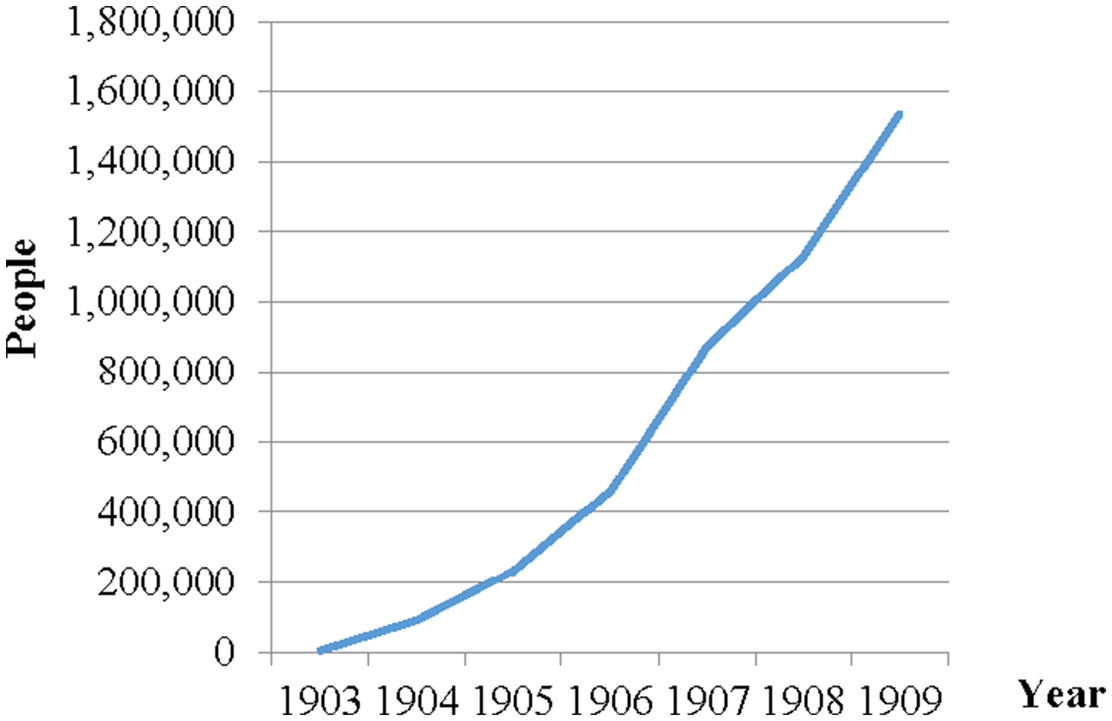
The profound cultural impact of the introduction of this new education system at the turn of the twentieth century has been well-studied,Footnote 9 but its economic consequences are equally noteworthy. Between 1902 and 1909, as the establishment of ‘new-style’ schools was expedited across the empire, the number of students increased from 7,000 to 1.6 million. And the number continued to grow into the 1920s (see Figure 1). Students enrolled in these ‘new-style’ schools might have comprised just a small proportion of China's school-age population at the time, but nevertheless, they created an unprecedented and urgent demand for textbooks and thus a new and growing market for textbooks. For instance, according to the Ministry of Education's first empire-wide education survey, new schools spent nearly one million silver taels on books in the 1906–1907 academic year alone.Footnote 10
The number of students in China, 1903–1910.

Such high demand for textbooks gave rise to a new generation of Shanghai-based print capitalists who would dominate China's book market in the first half of the twentieth century.Footnote 11 Among them, Commercial Press were the most successful. Founded by four former Chinese employees of a missionary publishing house in 1897, it started out as a small printing shop in the Shanghai International Settlement. When the Qing government began to institutionalize universal schooling as part of its state-building initiative, this small firm seized its opportunity. With the help of Japanese capital and advisers, as well as the sociocultural connections of their Chinese editors, Commercial Press promptly began to supply textbooks for the new school curriculum. In 1904, after the Qing state signalled a full-scale education reform, it rushed to compile and publish the first set of modern textbooks for elementary schools in China—the Most Up-to-Date Textbooks (Zuixin jiaokeshu). In less than a week, 4,000 thousand copies of the first edition were sold.Footnote 12
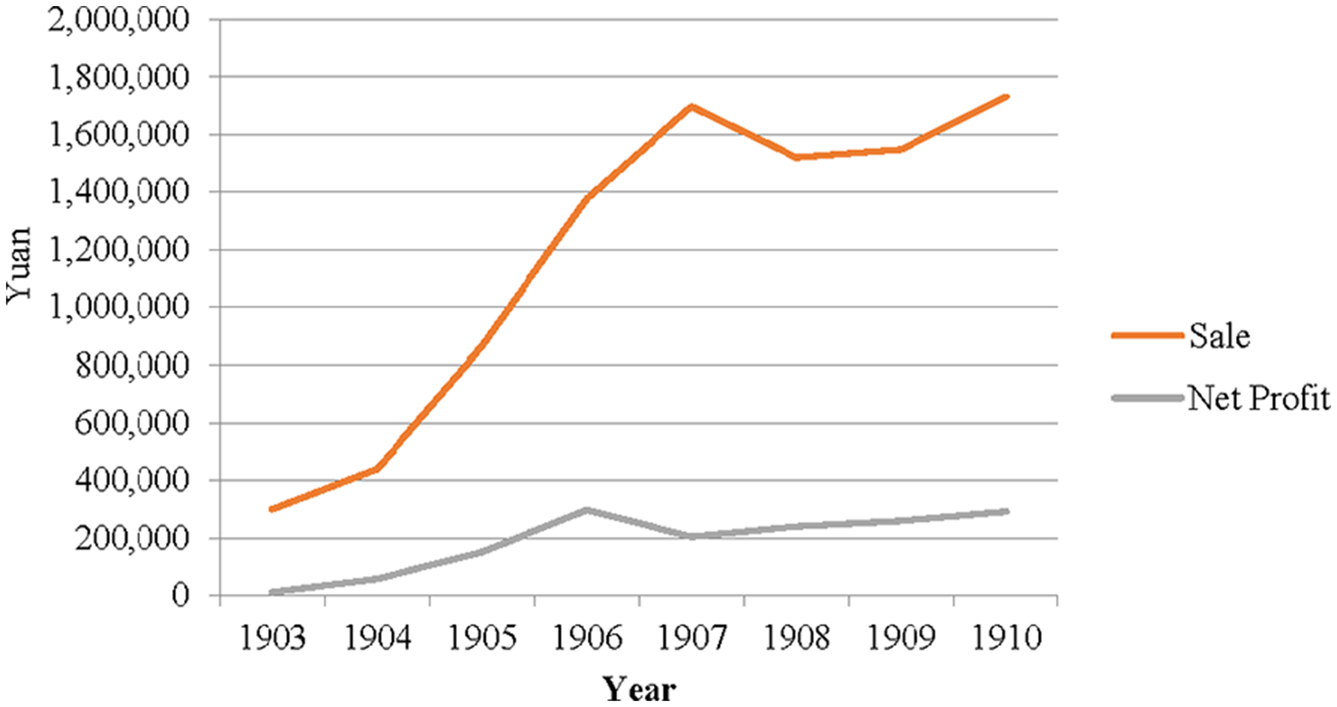
As Figure 2 shows, as the number of students increased from 1905 to 1907, the sales volume of Commercial Press books also grew sharply. Sales doubled between 1904 and 1905 and increased by another 60 per cent between 1905 and 1906. One board member remarked on Commercial Press's 1905 financial statement, saying that he had never seen the sales of any company in the book trade expand like this. If their business kept growing at this pace, he predicted, ‘The future prosperity [of Commercial Press] would be boundless!’Footnote 13
Commercial Press's annual sales, 1903–1910.

By 1910, Commercial Press had transformed into an impressive corporation equipped with the largest printing press in China, a school-like editorial department, and more than 20 branches across the empire. It was estimated that they had cornered approximately half of China's domestic textbook market. Nevertheless, this leading publishing enterprise was limited in their ability to compile original textbooks on their own. Their early Chinese volumes and self-cultivation textbooks, as Tarumoto Teruo points out, were close imitations, if not translations, of certain Japanese textbooks at the time, and their Chinese-English primers and readers, which helped the firm to earn substantial profit in the formative years, were direct reprints of the Indian Reader series to which Chinese annotations had been added.Footnote 14
As English became a popular subject in the new curriculum for Chinese students, the demand for English reading and grammar textbooks increased. In high schools and middle schools, it was not uncommon to use foreign-language textbooks for more specialized subjects, such as sciences and world history. For instance, when Arthur Judson Brown visited a modern middle school for Manchu Banner boys in Beijing, he was impressed that the textbooks they were using were all in English.Footnote 15 This is partly because good textbooks on such subjects in Chinese were yet to become available and partly because instructors, especially in missionary schools, were foreigners themselves or former study-abroad students who had learned those subjects in foreign languages.
Noting the Chinese demand for English readers and primers as well as textbooks in English, Commercial Press decided to import the latest textbooks from Britain and the United States, as they could not compile their own. In 1908, Commercial Press approached Ginn and Co. through a Qing diplomat in Washington and expressed interest in representing this leading American textbook provider.
Ginn and Co. was founded by Edwin Ginn (1838–1914) in Boston in 1867. By the late nineteenth century, the company had published over 800 titles, established offices in major cities such as New York, Philadelphia, Chicago, and San Francisco, and provided textbooks to all school levels nationwide. In 1900, they also started to expand overseas, primarily targeting places under American influence, such as the Philippines, Cuba, Haiti, and Latin America. Building on their experiences of providing textbooks for different American states and altering their content to meet local curriculum guidelines, in addition to directly exporting English and mathematics primers, Ginn and Co. modified or translated some of their titles to accommodate local needs. In 1906, to better facilitate the company's growing international operations, a Foreign Department was formally established in the New York office. Commercial Press's inquiry from Shanghai intrigued this company as was actively seeing new markets. This move encouraged it to look eastwards, across the Pacific, for future business opportunities.
Ginn and Co.’s different partners debated whether to authorize this unknown Chinese firm as their local agent. While some considered it might be worth trying, George A. Plimpton (1855–1936), the head of the New York office and leader of the firm, was reluctant to do so. If the Chinese demand for textbooks in English was as high as Commercial Press described, he argued, what Ginn and Co. needed to do was to send their people to China directly, so as to not let ‘other people’ take their books and ‘build up a trade on them’.Footnote 16 Responding to Commercial Press's request, he made it clear that Ginn and Co. would only allow the Press to become their agent if they agreed to work solely for them. Commercial Press declined such terms and, in revenge, decided to simply reprint Ginn and Co.’s textbooks.Footnote 17
After publishing a modified edition of Ginn and Co.’s English grammar textbook, Commercial Press reprinted P. V. N. Myers’ A General History for College and High Schools, one of Ginn and Co.’s popular titles, in the winter of 1910. One thousand copies of this reprint were sold in just two months.Footnote 18 This impressive volume of sales indicated that Commercial Press had made a wise business move and there was indeed a sufficient demand in China for cheap textbooks in foreign languages. Meanwhile, Edward Evans, the owner of Evans and Sons, a major importer of foreign books in Shanghai and Ginn and Co.’s local agent, noticed the devastating decline of the once ‘satisfactory’ sales of A General History. After Commercial Press's cheaper facsimile hit the market, he testified, Evans and Sons was unable to sell a single copy of the book.Footnote 19 Feeling the consequences of Commercial Press's act of revenge, Ginn and Co. and Edward Evans went to the Mixed Court and sued Commercial Press for copyright infringement.
Confronting the loophole in the ‘unequal’ Sino-American Treaty
On 29 March 1911, Commercial Press was summoned to the Mixed Court to appear before Pao Yi, the Chinese senior magistrate, and Paul Jameson, the American assessor and vice-consul general in Shanghai. Since both the plaintiff and the defendant were leading publishers in their own countries, for foreign and Chinese business communities in Shanghai, this case was more than a lawsuit over the copyright of a history textbook. It was the latest battle in the Sino-foreign ‘commercial warfare’ that would shape the future of the foreign-language textbook market in China. Seeing it as a landmark case in the making, the American consul general in Shanghai believed the decision in this case would be likely to become a precedent for future cases against Chinese piracy in the Mixed Court. Thus he was eager to ensure that the ruling would be favourable to the Americans.Footnote 20 Chinese publishers and booksellers also realized that if Commercial Press lost, they might no longer be able to reprint foreign books without consequences. Petitioning the Shanghai circuit intendant two days after Evans filed the lawsuit, the Shanghai Booksellers’ Trade Association (Shanghai shuye shanghui), the civil organization of Chinese booksellers in town, aggressively urged the Chinese government to condemn such an accusation for the sake of ‘the development of commerce and education in China’.Footnote 21 Other foreign publishing firms suffering from Chinese piracy, such as MacMillan and Co. and Longman, meanwhile kept their eyes on the development of this case; they were prepared to take legal action if the ruling proved unfavourable to Ginn and Co.Footnote 22
The developments in this much-anticipated first courtroom hearing surprised everyone. Ginn and Co.’s attorney T. R. Jernigan, a renowned commercial lawyer in town who had also served as the American consul general in Shanghai between 1893 and 1897, made his case forcefully.Footnote 23 Presenting both an authentic copy of Ginn and Co.’s General History and an almost identical reprint produced by Commercial Press to the court, he testified that the defendant had deliberately infringed the plaintiff's copyright.Footnote 24 Edward Evans also testified that his business had been devastated by this local reprint. Facing their accusation, Commercial Press's attorney W. S. Fleming, a successful Shanghai-based American lawyer, gave a straightforward and somewhat unexpected reply: ‘If it will save the time of the Court, I admit that we published the book.’ Following Fleming's bold statement, Xia Ruifang, the manager and a co-founder of Commercial Press, explained in detail that the company had reprinted General History the year before with the aim of providing a cheaper alternative to the majority of Chinese students, who could not afford imported American books.Footnote 25
Commercial Press admitted to reprinting Ginn and Co.’s General History without hesitation because the company believed they had a legal right to do so. Like other cases involving the Chinese and foreigners under the jurisdiction of the International Mixed Court at Shanghai (1867–1927), this case would have been judged according to applicable Chinese laws, international treaties, or the local rules and regulations of the International Settlement—and the ruling would have been made jointly by a Chinese magistrate and a foreign assessor named by the consulates.Footnote 26 China's first copyright law—Da Qing zhuzuoquan lü (Copyright Law of the Great Qing Empire)—had been promulgated just a few months before and copyright protection for foreign authors and publishers was nowhere to be found in it, making it irrelevant to this case. In addition, since neither the United States nor Qing China was a signatory, the Berne Convention for the Protection of Literary and Artistic Works, the international treaty governing international copyright protection since 1886, also could not be used.Footnote 27 The only legal clause applicable in this case was Article XI in the Renewed Sino-American Treaty of Commercial and Navigation of 1903 (the 1903 Sino-American Treaty hereafter). This particular clause was the first and only legislation that formally defined international intellectual property protection in China at the time, but it was phrased in such a manner that it did not prohibit the unauthorized reprinting of most foreign books in China.
Article XI of the 1903 Sino-American Treaty was part of the foreign powers’ efforts at the turn of the twentieth century to incorporate China into the emerging international copyright regime which aimed to empower Western copyright holders to protect their interests beyond their national boundaries in the globalizing cultural market.Footnote 28 Although this was just a clause in a trade treaty between the United States and China, under the Most-Favored-Nation principle, it would enable American as well as other foreign publishers to take legal action against Chinese piracy. However, the copyright protection Article XI provided was not universal. It merely acknowledged the copyright of a particular type of literary work:
… Therefore the Government of China, in order to secure such benefits in the United States for its subjects, now agrees to give full protection, in the same way, and manner and subject to the same conditions upon which it agrees to protect trade-mark, to all citizens of the United States who are authors, designers or proprietors of any books, map, print or engraving especially prepared for the use and education of the Chinese people, or translations into Chinese of any book, in exclusive right to print and sell such book, map, print, engraving or translation in the Empire of China during ten years from the date of registration…Footnote 29
It is not entirely clear whether, when negotiating the terms of the 1903 Sino-American Treaty, the treaty commissioners assumed that the Chinese would and/or could consume only literary and artistic works tailor-made for them. Perhaps their intention was to allow the Chinese to freely translate and reproduce general knowledge from the West to enhance the ‘awakening of China’ and increase American cultural influence in China, similarly to the Boxer Indemnity Scholarship programme.Footnote 30 In any case, by granting copyright protection only to works ‘especially prepared for the use and education of the Chinese people’, this clause created a loophole for the Chinese to ‘legitimately’ make unauthorized reprints of almost any foreign books which were prepared for general readership in their home countries. Indeed, the 1903 Sino-American Treaty might be regarded by scholars as one of the ‘unequal treaties’ China signed with foreign powers under military pressure. The copyright clause in this treaty, as Wu Lin-Chun's recent study suggests, might put the foreign powers at a disadvantage because this clause operated against their interests.Footnote 31
As a result of this loophole in Article XI, Commercial Press did not consider reprinting of General History to be a violation of Ginn and Co.’s copyright in China. Ginn and Co. originally published this work in 1899 for American college and high school students, and it only found its way to the Chinese market in 1908 or thereabouts. Since it was not a book ‘especially prepared for the use and education of the Chinese people’, it was not eligible for the copyright protection granted by the 1903 Sino-American treaty.
Realizing that the only applicable legal clause for this case was not favourable to his clients, from the very beginning, Jernigan defined Commercial Press's reprinting of General History as a deliberate infringement of private property rights, a violation of the general moral principle that ‘governs fair dealing and safety in business’. In opening the case for the plaintiffs on 29 March 1911, he urged the Court not to confine itself to the legal technicality but instead to engage directly with Article XI. The principle that ‘protects one in the enjoyment of his labour is too well grounded in the common sense of honor … for all business’, he argued. Since the ‘literary piracy and theft’ committed by Commercial Press was ‘in disregard of rights and honor’ and ‘universally condemned as wrong’, he further stated, ‘no Court should feel for a moment the necessity of being authorized by treaty before preventing a continuance of the injustice complained of’.Footnote 32
Commercial Press's other attorney Alexander Ting (Ting Rong, 1880–1957),Footnote 33 on the other hand, argued that the reprinting of General History was not only legitimate but also a noble and patriotic act, committed for the greater good of the Chinese nation. Ting, a young Chinese lawyer who had received his legal training in England, stated that Commercial Press had been providing ‘excellent works’ to schools all over the empire at ‘moderate prices’ because of their ‘public-spirited concern for the advancement of education in China’. He provided a pamphlet which listed, along with General History, over 170 foreign textbooks Commercial Press planned to republish in China with the sanction of both the Ministry of Education (Xuebu) and the Ministry of Foreign Affairs (Waiwubu). While Jernigan employed the right of natural property as a higher legal principle to get around the problematic treaty, Ting introduced the Qing imperial government as an even higher authority to present Commercial Press's reprinting scheme as a state-endorsed enlightenment project.Footnote 34 Since there was nothing in China's copyright law and international treaties that prevented Commercial Press from reprinting foreign books, Ting argued, what Commercial Press had done could not be labelled a crime. It was an act of private enterprise to help the Chinese gain access to Western knowledge so that China could develop itself. If English-speaking countries regarded themselves as fair and civilized, he further stated, they should show their generosity and sympathy toward this underdeveloped country, instead of harshly accusing Commercial Press of piracy.Footnote 35 It is worth noting that this kind of ‘catching-up’ argument is still popular in developing societies when faced with accusations of intellectual property rights piracy by companies in the developed world.
For Paul Jameson, the American assessor at the Mixed Court, however, this case ‘[could] not be decided upon any consideration of sympathy or ethics’ if the Qing and the Powers considered the Mixed Court to be an independent legal institution. In a report to the American Peking Legation, he stated that he and the Chinese magistrate considered the core issue of this case to be whether, under the current Sino-American Treaty, Ginn and Co. had a legal right that Commercial Press had violated.Footnote 36 When the second session took place two days later, W. S. Fleming proclaimed that Ginn and Co. had not acquired nor were they entitled to any copyright over General History in China, simply because it was not a book ‘especially prepared for the use and education of the Chinese people’. The book was printed and published in the United States long before Evans and Sons had started to sell it in China. It was written in English, not a Chinese word could be found in it, and only nine out of the 800 pages of this book were devoted to the history of China. All of this, Fleming insisted, showed that when the author and Ginn and Co. prepared this book, ‘they never dreamed that the book would find any market in China’. The chief, if not the sole, readership they had in mind was ‘college and high school’ students in the United States rather than those in China. If Ginn and Co. and other American publishers considered Article XI flawed and problematic, Fleming further suggested, they should request that the American government negotiate a new treaty with China to extend copyright protection, instead of asking the Mixed Court to manipulate the current treaty in their interests. By ‘crying piracy and charging lack of commercial morality, throwing mud and heaping abuse’, he concluded, Ginn and Co. would still ‘not create a right where none exists by law’. The Mixed Court, therefore, could not be asked to punish the defendants, since ‘no right [had] been infringed and no wrong [had] been committed’.Footnote 37
Attempting to reverse the course of the case, Jernigan employed a Chinese perspective to reframe his argument of copyright as a universally honoured natural property right. In his concluding speech, he brought up a recently developed legal convention in China to prove that it was possible for the Chinese government to acknowledge the copyright of American books in China and for the Mixed Court to punish Chinese pirates. In 1896, when Jernigan was still the American consul general in Shanghai, he had urged the Shanghai circuit intendant to grant copyright protection to a Shanghai-based American missionary press called the Society for the Diffusion of Christian and General Knowledge among the Chinese (‘Guangxuehui’ in Chinese). As a result, the intendant had issued a copyright proclamation by twisting a traditional reprint prohibition order originating in late-imperial China.Footnote 38 Based on this proclamation, the Mixed Court charged and fined two Chinese booksellers who had pirated books produced by this missionary press. From then on, this kind of individually granted copyright proclamation was commonly issued by Chinese officials to both foreign and Chinese publishers. Jernigan argued that this locally developed practice indicated that Chinese authorities and merchants understood and respected the ‘rules that govern fair dealing in business’, such as copyright, and enforced it without recourse to the treaty. Quoting a petition Commercial Press had submitted to local officials requesting this kind of copyright proclamation, he went one step further by trying to show that the defendants also believed that ‘it [was] a rule that to produce another's book is strictly prohibitory’. ‘Now,’ however, he declared, ‘the plaintiffs desire to avail themselves to the rules invoked by the defendants in their behalf when it served their interest to invoke it.’Footnote 39 Jernigan attempted to incorporate natural law principles and Chinese local practices to make a case that Commercial Press had knowingly violated Ginn and Co.’s copyright and thus should be penalized. However, he still could not disprove that General History was not a book ‘especially prepared for the use and education of the Chinese people’.
Both the Chinese magistrate and the American assessor preferred to decide the case according to Article XI of the 1903 Sino-American Treaty and dismissed Ginn and Co.’s accusation against Commercial Press. Amos P. Wilder, the American consul general in Shanghai, however, had a different opinion. He wanted his subordinate Jameson to rule in favour of Ginn and Co. to save the ‘commercial world's’ interests in China, regardless of what the treaty said. Under pressure, Jameson motioned for a delay of decision at the Mixed Court, and in early May, he submitted an independent report to the American Peking Legation asking for Washington's further instruction. He insisted that as a foreign assessor in the Mixed Court, he should act as an independent judge, rather than as the consulates’ mouthpiece. In his opinion, according to the ‘plain’ and ‘straightforward’ Article XI, Ginn and Co. were not entitled to copyright privileges for General History in China. Thus it would be a serious mistake to force the magistrate to override the treaty in a case in which the law was entirely in the Chinese favour. All American cases and interests, he warned his superiors, might face being blocked by the magistrate and the Shanghai circuit intendant in the Mixed Court in the future.Footnote 40
Jameson's report/complaint was forwarded to Washington. In the summer of 1911, the Department of State informed the Peking Legation that after studying the history of the Mixed Court, they had concluded that the only judge at that court was the Chinese magistrate. Since assessors like Jameson were not judges de jure, they should obey the orders of the consuls general in asserting or objecting to the magistrate's decision.Footnote 41 Realizing that the Chinese magistrate Pao Yi had firmly decided to dismiss the accession of piracy against Commercial Press, and there was nothing to be done to reverse this ruling, the Department of State decided to secure American copyright in China by applying extra political pressure on the Qing government. In August, it instructed its Far Eastern Division to sound out the Qing's Ministry of Foreign Affairs about the possibility of the American government reopening a copyright conversation to fix the loophole caused by Article XI in the long run. To recover the profit Ginn and Co. believed they had lost due to Chinese piracy for the moment, it also ordered the Peking Legation and Shanghai Consulate to pressure the Chinese authorities into ordering Commercial Press to ‘discuss’ with Ginn and Co. how to share their profit from reprinting.Footnote 42
Wrestling beyond the court
According to the sparse Chinese scholarship, the copyright war between these two companies lasted for only a few months in 1911, from its beginning—Evans’ discovery of the Chinese piracy and filing the lawsuit—to its end—Magistrate Pao's ruling in favour of Commercial Press. The story they tell is how Commercial Press's attorneys cleverly employed the ‘unequal’ treaty to defend the Chinese booksellers’ interests at the Mixed Court.Footnote 43 China's right to freely reproduce the majority of Western texts in the name of education and development was secured. This was, for them, a truly exceptional victory in the diplomatic and business history of modern China. In diving into these two companies and their leaders’ records, however, it is obvious that the 1911 lawsuit in Shanghai was neither the first confrontation between Ginn and Co. and Commercial Press nor the grand finale of their copyright dispute. It was just one episode in their decade-long wrestling match over the potential profit they expected to gain from the emerging foreign-books market in China.
Although the North China Daily News presented the situation as if Ginn and Co. were confronting the problematic Article XI for the first time in the Mixed Court hearing, both parties, in fact, were fully aware of the treaty loophole before the lawsuit, as they had had an intense exchange about it in 1910. Learning from Edward Evans that Commercial Press had started to systematically reprint Ginn and Co.’s books after they turned down Commercial Press's request to represent them in China, George Plimpton consulted his lawyer about possible legal means to put a stop to this. To his disappointment, he was informed that there were no generally recognized international legal grounds for them to prohibit Commercial Press's piracy, since neither the United States nor China was a member of the Berne Convention. In the spring of 1910 Plimpton then threatened Commercial Press, stating that if they were not willing to share the profit from reprinting Ginn and Co.’s books, he would establish a printing facility in China to produce even cheaper copies locally to compete with Commercial Press.Footnote 44 Their answer came that winter, when Zhang Yuanji passed through New York during his grand Euro-American tour. Although in principle Zhang did not wholeheartedly support the firm's reprinting scheme, he stood firmly behind the pride and interests of Commercial Press when he visited Plimpton in his Fifth Avenue office. Zhan told Plimpton that, after studying the Sino-American Treaty of 1903, Commercial Press were confident that there was little chance for Ginn and Co. to win if they went to court. He further declared that it were also impossible for Ginn and Co. to compete with Commercial Press in China by just printing their textbooks locally, because Commercial Press had the most extensive book distribution network in the country. The only way to stop them from reprinting Ginn and Co.’s books, Zhang advised Plimpton, was for him to allow Commercial Press to be their exclusive agent in China.Footnote 45
In the spring of 1911, when Ginn and Co. took legal action in Shanghai to stop Commercial Press's piracy, the outcome was just as Zhang had predicted. The Mixed Court made its ruling according to the flawed copyright clause in the 1903 Sino-American treaty and the copyright infringement charges against Commercial Press were dismissed. Just as the American consul and Shanghai booksellers had foreseen, the ruling in this case became a precedent for future Sino-foreign copyright disputes. From 1910 through to the 1940s, Article XI would be used again and again by Chinese publishers as the most powerful justification for their unauthorized reproduction of foreign books, images, and music that were not ‘especially prepared’ for the Chinese.
Ginn and Co. did not withdraw from the Chinese market after their defeat in the Mixed Court. Soon after the ruling, they started to employ alternative tactics to recover the profit lost to Chinese piracy, such as urging the American government to intervene. In early September 1911, under American political pressure, the Ministry of Foreign Affairs and Shanghai daotai urged Commercial Press to ‘discuss’ with Ginn and Co. how to share the profit from reprinting General History and other books, but the Commercial Press refused to start such a ‘conversation’. They insisted that they would only agree to settle the dispute if Ginn and Co. could propose a satisfactory agency deal.Footnote 46 The suggested conversation never took place because the political pressure put on the Chinese government and Commercial Press was soon interrupted by the 1911 Revolution. The Department of State's attempts to enter into a new copyright negotiation to revise Article XI was interrupted first by the political chaos and civil wars that followed the revolution and then refused by the successive governments that nominally controlled China.Footnote 47
Though Ginn and Co. lost the lawsuit, as the case unfolded they gained a better understanding of China's book market and publishing industry. In his testimony, the manager of Commercial Press explained that they could sell the pirated General History for 20 per cent less than the authentic copies, mainly because of cheap printing costs in China. The investigation into this case revealed the entire list of those Ginn and Co. books that Commercial Press had reprinted and the local prices (20 to 50 per cent less) of these pirated copies. The American consul general in Shanghai, in his report to Washington on copyright in China, stressed two important pieces of information of interest to Ginn and Co. and other American publishers: the cheap labour and printing costs in China, as well as the ‘awakening of China’. There was indeed a great demand in China for good textbooks in English.Footnote 48 The pamphlet Alexander Ting presented in the Mixed Court to prove that Commercial Press's reprinting scheme was endorsed by the Qing authority listed 170 titles Commercial Press planned to pirate. I believe it could have been used to help the American publishers to develop a better sense of what would sell in China as well as what Chinese readers were looking for.Footnote 49 It is possible that the Department of State passed this information to Ginn and Co. as some of their post-lawsuit business decisions corresponded to the suggestions Wilder made in his report. After learning how cheap printing costs were in China, and how big the potential market for textbooks in English might be, some of Ginn and Co.’s partners even suggested that they should enter the Chinese market directly to compete with Commercial Press. Some suggested sending their agent from Manila or New York to Shanghai to set up a Chinese office,Footnote 50 or even to send out the plates of their books and have them printed there.Footnote 51 However, none of these suggestions seems to have materialized.
What Ginn and Co. eventually did to protect their commercial interests in China was to modify a few introductory textbooks for the Chinese market. By inserting notes, introductions, and instructions in Chinese, they hoped to turn these textbooks, initially written for the American market, into ones ‘especially prepared for the use and education of the Chinese’, so that these ‘Chinese editions’ could successfully obtain the copyright privileges promised in Article XI of the 1903 Sino-American Treaty. Ginn and Co. first planned to adapt their popular Prince's Grammar for Chinese students by hiring an American-educated Chinese teacher in Shanghai to insert a few notes in Chinese in the autumn of 1911. Believing that there must be millions of Chinese students studying English in China, Plimpton optimistically estimated such a book might be able to bring their company enough profit to give the partners ‘some jelly to put between our bread’.Footnote 52 Sceptical about this rosy idea about China, their editor-in-chief insisted that ‘so long as copyright conditions remain as they are at present, there seems to me very little encouragement for us to try to get into this market’.Footnote 53 Apparently the partners’ optimistic belief in the Chinese market overcame the editor-in-chief's reservations about the lack of sufficient copyright protection. In the first decade of the twentieth century, Ginn and Co. went on to commission several academics teaching in China to adapt another handful of textbooks for the Chinese.Footnote 54
Meanwhile, Ginn and Co.’s Foreign Department also managed to develop some business in China by approaching schools and teachers directly through correspondence. Evelyn W. Hughan, the head of the Foreign Department and Plimpton's sometime secretary, was in charge of the correspondence operation.Footnote 55 She built a low-cost direct sales network in China by sending greeting letters, samples, and gifts to schools in China, mainly those run by American missionaries or those associated with the YMCA, an organization with which Ginn and Co. had close ties for years. This operation expanded slowly but steadily. By the end of 1915, Hughan was regularly corresponding with about 300 schools in China. Eventually Hughan's Chinese mailing list had grown so much that she had to ask Plimpton for extra help to manage it.Footnote 56
Despite these efforts to grow their business in China, the greatest challenge Ginn and Co. faced there remained Commercial Press's piracy. According to Plimpton, as soon as one of their books sold well, it was pirated and republished in China by Commercial Press. Between 1906 and 1919, he estimated that Commercial Press had pirated at least 15 of their elementary textbooks and earned more than $155,000, which was equivalent to 50 per cent of Ginn and Co.’s total net sales in China during the same period.Footnote 57
Searching for alternative solutions
Ginn and Co. were not the only victim of Commercial Press's piracy scheme, and Commercial Press, not the only publisher systematically reprinting foreign textbooks in China. For Anglo-American publishers who entered the Chinese market or planned to do so in the 1910s, Chinese piracy was undoubtedly their major concern. Bringing Chinese pirates to court, as Ginn and Co.’s 1911 lawsuit had proved, was not a feasible solution. Article XI of the 1903 Sino-American Treaty, ironically, became the amulet of Chinese publishers. Throughout the 1910s, the Shanghai Booksellers’ Guild not only repeatedly lobbied against any American attempts to revise it but also published documentation of noticeable Sino-foreign copyright infringement cases to ‘teach’ its members how to take advantage of the flawed treaty. Despite Ginn and Co.’s experience, a number of American publishers sued Commercial Press and other Chinese publishers at the Shanghai Mixed Court, but they, too, were unable to get favourable rulings.Footnote 58
While the treaty and formal copyright law seemed to be failing to provide meaningful protection, the extra-legal copyright regime established by Chinese publishers via the Shanghai Booksellers’ Guild worked well, by-and-large. From 1905, Chinese booksellers in Shanghai had utilized the traditional trade guild and employed a customary informal mechanism to register books, settle ownership disputes, and crack down on pirates on their own.Footnote 59 However, this organization was exclusively Chinese. In 1914, several American and British authors, publishers, and book dealers based in Shanghai came up with an intriguing alternative to protect their copyright on their own: they set up the International Publishers’ Association—ironically, a copycat of Shanghai Booksellers’ Guild—to protect their copyright against local piracy. They planned to establish a self-regulated copyright register among the Association members and periodically issue catalogues of registered books. In their prospectus and news releases, the International Publishers’ Association proclaimed that both foreign and Chinese publishers, ministers, educators, and statesmen all strongly supported their objectives. The influence of their Chinese members ‘probably represents 80 per cent of the Chinese publishing community’, they promised their new members, so the organization would be ‘strong enough’ to stop infringements of foreign publishers under the rules of the local guild.Footnote 60
The Association claimed that ‘publishers of the Western World’ realized the importance of collaborating with the ‘publishers of the Far East’ to protect their copyrights in China after ‘a test case was brought by an American firm to obtain redress for what was considered to be a direct piracy of one of their books’.Footnote 61 The ‘test case’ they referred to here was undoubtedly that of Ginn and Co. v. Commercial Press. After the case ‘failed to obtain a verdict in [the American's] favor’, they felt that injustice had been done to the American copyright holders and realized that, in reality, the Chinese government did not grant protection to foreign copyright holders.Footnote 62 For a short period, some Western publishers decided to withhold the supply of new Western books from China ‘until more just treatment could be assured’. After this negative campaign turned out to be wholly ineffective, the Association decided to adopt a different tactic to combat piracy and work with Chinese publishers to establish a publishers’ association in Shanghai.Footnote 63 This also does not seem to have been successful, however, because, according to the Shanghai Booksellers’ Guild's petition protesting against this association, no Chinese publisher in Shanghai joined it.Footnote 64
Foreign booksellers in China may have suffered most directly from this situation since importing foreign books to sell in China's local market was the major part of their business. Taking Ginn and Co.’s main local agent, Evans and Sons, as an example, in 1916, even though they cheerfully reported to Ginn and Co. that ‘business [was] doing well’ despite the ‘upset’ conditions in China,Footnote 65 their company was not in good shape. In fact, Edward Evans was trying to sell his whole operation to Commercial Press. But as the parties could not agree on the price, a deal could was not reached.Footnote 66 Attempting to make a comeback, Evans and Sons levelled an attack on Commercial Press at the beginning of 1917. They wrote first to major publishers in the English-speaking world informing them that their books had been reprinted by this notorious Chinese pirate, and then launched a price-cutting campaign to compete with Commercial Press's Foreign Book Department.Footnote 67 Evans and Sons seems to have lost the price war: by the summer, they had started to miss payments to Ginn and Co.Footnote 68
Seeing Chinese piracy as the ultimate threat to their business, in 1917–1918, Evans and Sons reached out to the British Chamber of Commerce (Shanghai) and the American Chamber of Commerce (Shanghai), as well as individual American and British publishing companies, urging them to join forces against Commercial Press. For instance, they sent pleading letter after pleading letter along with a list of Macmillan's books that had been pirated by Commercial Press to Macmillan and Co., a leading British publishing house, with the intention of increasing their awareness of this issue. In 1918, the British Chamber of Commerce and the American Chamber of Commerce together prepared to ‘bring pressure to bear on Chinese firms responsible for piracies by advising all foreign merchants to abstain from all dealing with such Chinese firms’.Footnote 69
The general boycott against Commercial Press and other Chinese pirates, however, was not realized as Edward Evans had anticipated. While Edward Evans was trying to convince Macmillan and Co. to join his operation to suppress Commercial Press, Macmillan and Co. and Commercial Press continued doing business with each other. On average, Commercial Press ordered $1,000–$2,000 worth of books from Macmillan and Co. every few months in 1917–1918. Although they were aware that Commercial Press might import small numbers of their books to sell while pirating their titles on a large scale, they seemed to be willing to accept this reality and had little interest in taking legal action against their pirate/client. In their reply to the British Chamber of Commerce (Shanghai), George Macmillan made it very clear that, since in reality there was no effective copyright protection for foreign books in China unless such legal arrangement was made, foreign publishers were ‘powerless there’. Replying to Edward Evans, the company representative also made a similar point: unless the boycott would generate the making of a new law, they believed ‘little or nothing [could] be gained by such action’. For that reason, they declined to join the British Chamber of Commerce's boycott and would still ‘supply [their] publications to any person who might order from [them]’.Footnote 70
Edward Evans’ effort to mobilize major foreign publishers to boycott Commercial Press and other Chinese publishers might not have worked as well as he had hoped, but his accusation of piracy against Commercial Press seemed to be successful in making enough noise to injure their reputation. In March 1917, when Zhang Yuanji and Gao Fengchi, the two leading figures of the firm, had a meeting with the staff of their Foreign Book Department, Gao thought to some extent this piracy accusation could be used as Commercial Press's bargaining chip. When dealing with foreign companies that were not interested in doing business with them, he advised the Foreign Book Department to threaten to ‘reprint their most popular titles’.Footnote 71 However, in June, the head of the department, Zhou Xisan, reported to Zhang Yuanji, who was in charge of the firm's publishing, editing, and marketing, that many foreign publishers preferred to work with Evans and Sons because Commercial Press had a reputation for piracy. To deal with this problem, Zhang instructed Zhou to express some good intentions to those publishers whose books they had been pirating: Commercial Press were willing to stop reprinting pirated books, as long as the publishers were prepared to improve their business arrangements.Footnote 72
The problem was getting worse. In December 1918, Commercial Press were informed by their legal advisers that several foreign publishers were preparing to take joint legal action against them for piracy.Footnote 73 Then, in early spring of 1919, the American Peking Legation, the consul general in Shanghai, and the American Chamber of Commerce formally complained to China's Ministry of Foreign Affairs and the Chamber of Commerce in Shanghai about Chinese piracy of American textbooks.Footnote 74 Evans and Sons also urged Ginn and Co. to take this chance to re-file their case against Commercial Press in Shanghai.Footnote 75
On the one hand, Commercial Press co-founder Gao Fengchi was willing to join forces with the Shanghai Booksellers’ Trade Association and appeal to the Ministry of Foreign Affairs. They argued that according to the ruling of Ginn and Co. v. Commercial Press in 1911, Chinese publishers had the right to reprint foreign books that were originally published for a general readership. Based on this precedent, they urged the Chinese government to dismiss the American publishers’ false accusations of piracy.Footnote 76 On the other hand, Zhang Yuanji and Commercial Press's Foreign Books Department were trying to avoid 1911 case being reopened by agreeing with Ginn and Co. to resolve their dispute outside of the courtroom. Ginn and Co.’s residential agent in the Philippines, Hugo Miller, travelled to Shanghai in mid-April to discuss possible settlements with Commercial Press. After two months of negotiation, in June Commercial Press decided to concede. They reached a tentative agreement with Miller: they would stop reprinting Ginn and Co.’s books and even pay some royalties in exchange for a ten-year agentship in China.Footnote 77
For Evans and Sons, the agreement between Commercial Press and Hugo Miller posed a serious threat to their existence. If Ginn and Co. authorized Commercial Press to be their agent in China, it would be difficult for Evans and Sons, a small bookshop with 50 salespeople, to compete with Commercial Press, a firm with 20-plus branches and an extensive, nationwide distribution system. If making a deal with Commercial Press could successfully solve the piracy problem, other foreign publishers might decide to follow Ginn and Co.’s footsteps. Sooner or later, Commercial Press would replace Evans and Sons as Ginn and Co.’s and maybe also other foreign publishers’ main agents in China. To stop Commercial Press and Ginn and Co. from coming to a formal agreement, Edward Evans' son J. J. Evans wrote to George Plimpton in late September, urging him to taking legal action once more against Commercial Press. He attributed the recent decline of their business to Commercial Press's piracy schemes and warned Plimpton that the Chinese company was not a trustworthy business partner. Pointing to the recent success of a foreign copyright holder in the Mixed Court in suing Chinese pirates for fraud, Evans suggested Plimpton adopt this new tactic and request a rehearing of the 1911 case. By labelling Commercial Press's pirated edition of General History ‘a fraud upon the public’, Evans believed that they would have a great chance of winning the case without engaging with the problem of Article XI.Footnote 78
Plimpton, however, was not interested in facing Commercial Press in court again. He had a better idea: he would go to China to handle the piracy problem in person.Footnote 79
Partnering with a pirate
George Plimpton had been thinking of travelling to China to familiarize himself with the Chinese market since 1915, but the plan had been postponed due to the ongoing civil wars and uncertain political situation in China.Footnote 80 It was only in December 1919 that Ginn and Co.’s partners finally decided that it was safe enough for him to take the trip to East Asia on behalf of the company. Accompanied by his wife Fanny and son Francis, he departed from New York on 16 January 1920, travelled through Canada and Japan, and eventually arrived in Shanghai on 14 March. Although he planned to visit colleges in major cities as well as several political figures during his stay in China to build connections and find potential clients, the top priority of this trip was to come to an arrangement with Commercial Press whereby they would stop pirating Ginn and Co.’s books. And as soon as he arrived in Shanghai, he ‘found them ready to talk business’.Footnote 81
That said, Commercial Press were ready to talk business in the Chinese way. When Zhang Yuanji, now Commercial Press's director and manager,Footnote 82 showed up on the afternoon of 15 March at the Palace Hotel at the Bund where the Plimptons were staying, young Francis T. P. Plimpton (1901–1983) was surprised to learn that the pirate his father had come all the way to deal with was taking them out as their tour guide.Footnote 83 In the following five days, in-between the negotiation meetings, Zhang and the staff of Commercial Press entertained the Plimptons intensively with great hospitality: a special visit to Lee Van Ching, the most famous curio shop in Shanghai; a lavish dinner banquet in Yipingxiang, the city's most prestigious Chinese restaurant; a personal tour of Commercial Press's headquarters, school, library, and plant by Zhang himself; a family party hosted by the firm's editor-in-chief; and even a Chow Men eating competition between Francis and the editor-in-chief's wife.Footnote 84
The short trips that the Plimptons made to nearby Suzhou, Hangzhou, and Nanjing took place under the meticulous care of Commercial Press's staff. Zhang Yuanji designated a young member of the Foreign Books Department named Wu Dongchu to accompany them as their full-time guide.Footnote 85 Commercial Press's local branch managers welcomed the Plimptons at the train stations upon their arrival at each destination and showed them their branch storefronts. George Plimpton later told his partners that Commercial Press's staff in various branches was ‘most kind’,Footnote 86 but for young Francis, their ‘Commercial Press friends’ were maybe a little too accommodating. He thought that these staff members had been detailed to not let the Plimptons ‘out of their sight’; at one point he even noted: ‘I am not sure whether they slept on our doorstep that night or not.’Footnote 87
What Commercial Press were attempting to display through such hospitality was not just their goodwill, but also the great scale of their capital and business assets. According to Francis, Plimpton was buttered up by Commercial Press's flattering approach, addressed in terms such as ‘the venerable Mr. Plimpton, a symbol of longevity and happiness’,Footnote 88 but he must also have realized that it would be the most profitable option for Ginn and Co. to appoint Commercial Press, the company that had the largest printing plant in East Asia and an extensive distribution network all over China, as their chief agent in China.
After four meetings—between banquets, parties, and private tours—Plimpton agreed to concede to Commercial Press. He offered them an agency deal that was more generous than the one Hugo Miller had proposed the previous summer: he would allow Commercial Press consignment privileges on half of their Ginn and Co. purchases, based upon Commercial Press sales for the previous year. For instance, if Commercial Press sold $20,000 worth of books in one year, Ginn and Co. would let them have $10,000 worth on consignment the next year.Footnote 89 Commercial Press would promise to make a $20,000-value purchase as soon as the agreement was signed to get this business going. Ginn and Co. would also pay Commercial Press an additional bonus and they would cover all the promotion and advertising expenses of Ginn and Co.’s books in China.Footnote 90
Before Gorge Plimpton left Shanghai for other major cities in China in late March, an agreement between these two companies was signed.Footnote 91 As he reported to his partners later, he considered the arrangement with Commercial Press ‘a very great victory’ and it ‘alone well worth the trip’.Footnote 92 While the Plimptons continued their trip in northern China, Zhang Yuanji sent George Plimpton rare books, Chinese paintings, and a Buddhist statue as gifts, introduced him to well-known politicians and educators, and made sure that Commercial Press's branch managers were looking after him and his family.Footnote 93 On 3 April, Commercial Press fulfilled their promise and had Hugo Miller witness the destruction of a collection of electroplates and glass plates that were used for reprinting certain Ginn and Co. publications. Zhang reported to Plimpton that the destruction of their pirated plates would ensure a ‘pleasant and mutually profitable’ relationship between the two companies in the future.Footnote 94
By the end of April, these two companies were considering the joint publication of some bilingual books. After visiting various schools and politicians in China, Plimpton realized that ‘there was a strong demand in China for a book on citizenship’. So he proposed to Zhang that they co-publish a book modelled after Grace A. Turkington's My Country: A Textbook in Civics and Patriotism for Young Americans to ‘develop national feelings of the best sort’ in the hope of uniting the politically divided north and south China.Footnote 95 Zhang and Commercial Press's editing department enthusiastically agreed to co-publish this book which they believed would ‘train up the Chinese students to be ideal citizens’.Footnote 96 In July, the relationship between Ginn and Co. and Commercial Press went one step further. Wu Dongchu, the young man who had accompanied the Plimptons as their local guide, was sent to New York to ‘study’ the American book trade with Ginn and Co.Footnote 97 When Wu returned to Shanghai a year later, he brought back a walking stick George Plimpton had hand-picked for Zhang Yuanji as well as Ginn and Co.’s trust.Footnote 98 He would later take over Commercial Press's Foreign Book Department and become a pioneer in introducing modern business management to Chinese readers.
Conclusion
This article aimed to explore China's complex reaction to the emerging international copyright regime and a globalizing market for textbooks in the early twentieth century by looking at the intriguing relationship between Chinese publishers and their foreign counterparts. China's modernization reforms at the turn of the twentieth century, especially the establishment and expansion of the modern education system, created an unprecedented market for publications, notably textbooks on so-called ‘Western knowledge’ for new schools. As local print capitalists made their fortune by producing textbooks on the sciences, history, and foreign languages to meet increasing domestic demand, European and American publishers also had their eyes on this emerging textbook market in China. Several leading publishing firms in the English-speaking world, such as Ginn and Co. and American Books in the United States, and Macmillan and Longman in Britain, had been expanding their businesses beyond national limits in the second half of the nineteenth century. These publishers—all well-established textbook providers in their own countries—sold books to schools and readers in the formal and informal American and British empires as modern education systems were established there. They also targeted newly established nation states, as well as old empires that were launching modern state-building projects, to export their curriculums and textbooks. For these publishers, China at that time was an emerging and promising market only if they could find a safe way to enter it. The increasing Chinese pirating of their textbooks in the early twentieth century revealed two critical factors: there was indeed a considerable demand in China for textbooks in English, and if they wanted to thrive in the Chinese market, they needed to find a way to protect their copyright.
As I argue in this article, the lawsuit between Ginn and Co. and Commercial Press was never just about the cheap reprints of General History Commercial Press published in China without Ginn and Co.’s authorization. What this American publisher and their Chinese counterpart, as well as the business communities and political powers behind them, were competing over in the court were the profit deriving from the emerging English-textbook market in China. These two companies and their lawyers were rational players who adopted legal ideas and strategies that would best serve their interests at any given moment. While the conventional assumption is that the Qing Chinese could not appreciate the concept of copyright because China was forced to adopt this alien doctrine at gunpoint,Footnote 99 this article has revealed a more complex picture. It was the Chinese publishers who embraced the trade treaty Qing China signed under international pressure, because there was a loophole that they were able to exploit to their advantage. On the other hand, in the 1911 lawsuit, the American company's lawyers, as well as the advocates of the International Publishers Association in 1914, abandoned the seemingly ‘modern’ copyright treaty clause and employed local legal customs and regulation mechanisms, because that was what actually functioned on the ground. As Cochran's research suggests, there was not a presupposed fine line dividing the ‘Chinese social network’ and the ‘foreign corporate organization’: Chinese and foreign corporations in China were open to experimenting with new forms of organizations based on their experiences and they adopted whatever worked.Footnote 100 Commercial Press and Ginn and Co. did the same. Neither side subscribed to any particular legal ideology or agenda for or against copyright. What the Chinese companies and their foreign counterparts shared was their interest in sustaining and expanding their business in the Chinese market.
This lawsuit was a ‘frontline’ issue for these two companies’ long competition in China's emerging foreign-language textbook market, but it was also a moment of learning for both parties. Through the lawsuit, Ginn and Co. confirmed the potential of the Chinese market and acquired more knowledge about the Chinese publishing industry. They only started to seriously cultivate the Chinese market after their loss in the courtroom. Although their business in China experienced stable growth in the first decade of the twentieth century, they were unable, as Zhang Yuanji had predicted, to ‘enter’ the Chinese market through their limited existing missionary connections.
Commercial Press, on the other hand, also learned how to utilize the flawed treaty and their reprinting scheme in different ways to advance their commercial interests. Understanding that it was unpunishable by the current international treaty but hated by foreign publishers, Commercial Press used pirating as a means to get revenge on Ginn and Co. when their first contact failed and later as a threat to intimidate those who were not interested in doing business with Commercial Press. When the tide was turning against them, they offered to stop their unauthorized reprinting in exchange for generous business deals. They knew that even though they might not have the same capacity as their American and British counterparts to produce textbooks on English, the sciences, and world history, they had other advantages their foreign competitors wished to have, such as their social connections and distribution network. By examining their negotiations with Ginn and Co., we have seen how Commercial Press used these local advantages as well as their piracy scheme as bait to lure foreign firms into making more advantageous business deals.
Both parties had advantages over their counterparts and, to a certain extent, the partnership they eventually formed in the 1920s enabled them to access each other's experience and networks. To gain a beneficial advantage in the globalizing Asian textbook business, both sides became interdependent on each other. Without the partnership, Ginn and Co. would have had less access to the local Chinese market and would have had to continue battling with Commercial Press's piracy scheme. Similarly, with the agentship deal with Ginn and Co. in hand, Commercial Press could redeem their international reputation as they increased their overseas business dealings and used their partnership with Ginn and Co. as an example when negotiating with other foreign publishers in copyright disputes.Footnote 101
For Ginn and Co., taking their Chinese pirate on as a business partner might have been the best way for them to settle a legal dispute that the trade treaties could not solve and, at the same time, to gain a market share in the Chinese foreign textbook market. Despite the fact that this unusual partnership formed in the early 1920s between Ginn and Co. and Commercial Press might have signalled the end of the copyright war between these two companies, it did not save other American publishers from Commercial Press's piracy operation. In 1923, G. and C. Merriam Company sued Commercial Press in Shanghai for pirating their Webster's Collegiate Dictionary and violating their trademark. The charges against Commercial Press were dismissed once again because of the copyright clause of the 1903 Sino-American Treaty. In the autumn of 1924, A. L. Priddy, an accountant of Ginn and Co., sent George Plimpton a newspaper article in the Boston Globe Sunday Magazine entitled ‘Chinese are Stealing Our School Books’.Footnote 102 Its author described how Commercial Press, the largest publishing company in East Asia, had been ruthlessly reprinting American textbooks and making considerable profit. He warned American publishers to beware of this notorious Chinese pirate. Of course, Ginn and Co. no longer had this worry, as the pirate was now their partner.Footnote 103
Since China's economic reform in the late 1970s, commercial interactions between Chinese and foreign businesses have intensified, and China has become one of the most tempting new markets for multinational corporations. Chinese intellectual property piracy is once again becoming a heated issue in Sino-foreign commercial relations. Despite legislation that conforms to the Berne Convention and WTO rules, the enforcement of intellectual property rights protection in China has not been stable or predictable. Some local pirates have benefited from the state's economic nationalism-inspired development policies. It is not uncommon to see Chinese courts selectively ‘stick to the letter of the law’ and rule in favour of local pirates, an example of which is the never-ending case of Jordan v. Qiaodan.Footnote 104 As formal legal action against Chinese intellectual property rights infringements do not necessarily yield satisfactory outcomes for international businesses eager to make money in China, the entangled partnership that Ginn and Co. and Commercial Press formed a century ago might serve as a reminder of how they might handle their pirate competitors.