

%20--%3e%3c!DOCTYPE%20svg%20PUBLIC%20'-//W3C//DTD%20SVG%201.0//EN'%20'http://www.w3.org/TR/2001/REC-SVG-20010904/DTD/svg10.dtd'%3e%3csvg%20version='1.0'%20id='Layer_1'%20xmlns='http://www.w3.org/2000/svg'%20xmlns:xlink='http://www.w3.org/1999/xlink'%20x='0px'%20y='0px'%20width='64px'%20height='64px'%20viewBox='5.5%20-3.5%2064%2064'%20enable-background='new%205.5%20-3.5%2064%2064'%20xml:space='preserve'%3e%3cg%3e%3ccircle%20fill='%23FFFFFF'%20fill-opacity='0'%20cx='37.785'%20cy='28.501'%20r='28.836'/%3e%3cpath%20fill='%23595959'%20d='M37.441-3.5c8.951,0,16.572,3.125,22.857,9.372c3.008,3.009,5.295,6.448,6.857,10.314%20c1.561,3.867,2.344,7.971,2.344,12.314c0,4.381-0.773,8.486-2.314,12.313c-1.543,3.828-3.82,7.21-6.828,10.143%20c-3.123,3.085-6.666,5.448-10.629,7.086c-3.961,1.638-8.057,2.457-12.285,2.457s-8.276-0.808-12.143-2.429%20c-3.866-1.618-7.333-3.961-10.4-7.027c-3.067-3.066-5.4-6.524-7-10.372S5.5,32.767,5.5,28.5c0-4.229,0.809-8.295,2.428-12.2%20c1.619-3.905,3.972-7.4,7.057-10.486C21.08-0.394,28.565-3.5,37.441-3.5z%20M37.557,2.272c-7.314,0-13.467,2.553-18.458,7.657%20c-2.515,2.553-4.448,5.419-5.8,8.6c-1.354,3.181-2.029,6.505-2.029,9.972c0,3.429,0.675,6.734,2.029,9.913%20c1.353,3.183,3.285,6.021,5.8,8.516c2.514,2.496,5.351,4.399,8.515,5.715c3.161,1.314,6.476,1.971,9.943,1.971%20c3.428,0,6.75-0.665,9.973-1.999c3.219-1.335,6.121-3.257,8.713-5.771c4.99-4.876,7.484-10.99,7.484-18.344%20c0-3.543-0.648-6.895-1.943-10.057c-1.293-3.162-3.18-5.98-5.654-8.458C50.984,4.844,44.795,2.272,37.557,2.272z%20M37.156,23.187%20l-4.287,2.229c-0.458-0.951-1.019-1.619-1.685-2c-0.667-0.38-1.286-0.571-1.858-0.571c-2.856,0-4.286,1.885-4.286,5.657%20c0,1.714,0.362,3.084,1.085,4.113c0.724,1.029,1.791,1.544,3.201,1.544c1.867,0,3.181-0.915,3.944-2.743l3.942,2%20c-0.838,1.563-2,2.791-3.486,3.686c-1.484,0.896-3.123,1.343-4.914,1.343c-2.857,0-5.163-0.875-6.915-2.629%20c-1.752-1.752-2.628-4.19-2.628-7.313c0-3.048,0.886-5.466,2.657-7.257c1.771-1.79,4.009-2.686,6.715-2.686%20C32.604,18.558,35.441,20.101,37.156,23.187z%20M55.613,23.187l-4.229,2.229c-0.457-0.951-1.02-1.619-1.686-2%20c-0.668-0.38-1.307-0.571-1.914-0.571c-2.857,0-4.287,1.885-4.287,5.657c0,1.714,0.363,3.084,1.086,4.113%20c0.723,1.029,1.789,1.544,3.201,1.544c1.865,0,3.18-0.915,3.941-2.743l4,2c-0.875,1.563-2.057,2.791-3.541,3.686%20c-1.486,0.896-3.105,1.343-4.857,1.343c-2.896,0-5.209-0.875-6.941-2.629c-1.736-1.752-2.602-4.19-2.602-7.313%20c0-3.048,0.885-5.466,2.658-7.257c1.77-1.79,4.008-2.686,6.713-2.686C51.117,18.558,53.938,20.101,55.613,23.187z'/%3e%3c/g%3e%3c/svg%3e)
%20--%3e%3c!DOCTYPE%20svg%20PUBLIC%20'-//W3C//DTD%20SVG%201.0//EN'%20'http://www.w3.org/TR/2001/REC-SVG-20010904/DTD/svg10.dtd'%3e%3csvg%20version='1.0'%20id='Layer_1'%20xmlns='http://www.w3.org/2000/svg'%20xmlns:xlink='http://www.w3.org/1999/xlink'%20x='0px'%20y='0px'%20width='64px'%20height='64px'%20viewBox='5.5%20-3.5%2064%2064'%20enable-background='new%205.5%20-3.5%2064%2064'%20xml:space='preserve'%3e%3cg%3e%3ccircle%20fill='%23FFFFFF'%20fill-opacity='0'%20cx='37.637'%20cy='28.806'%20r='28.276'/%3e%3cg%3e%3cpath%20fill='%23595959'%20d='M37.443-3.5c8.988,0,16.57,3.085,22.742,9.257C66.393,11.967,69.5,19.548,69.5,28.5c0,8.991-3.049,16.476-9.145,22.456%20C53.879,57.319,46.242,60.5,37.443,60.5c-8.649,0-16.153-3.144-22.514-9.43C8.644,44.784,5.5,37.262,5.5,28.5%20c0-8.761,3.144-16.342,9.429-22.742C21.101-0.415,28.604-3.5,37.443-3.5z%20M37.557,2.272c-7.276,0-13.428,2.553-18.457,7.657%20c-5.22,5.334-7.829,11.525-7.829,18.572c0,7.086,2.59,13.22,7.77,18.398c5.181,5.182,11.352,7.771,18.514,7.771%20c7.123,0,13.334-2.607,18.629-7.828c5.029-4.838,7.543-10.952,7.543-18.343c0-7.276-2.553-13.465-7.656-18.571%20C50.967,4.824,44.795,2.272,37.557,2.272z%20M46.129,20.557v13.085h-3.656v15.542h-9.944V33.643h-3.656V20.557%20c0-0.572,0.2-1.057,0.599-1.457c0.401-0.399,0.887-0.6,1.457-0.6h13.144c0.533,0,1.01,0.2,1.428,0.6%20C45.918,19.5,46.129,19.986,46.129,20.557z%20M33.042,12.329c0-3.008,1.485-4.514,4.458-4.514s4.457,1.504,4.457,4.514%20c0,2.971-1.486,4.457-4.457,4.457S33.042,15.3,33.042,12.329z'/%3e%3c/g%3e%3c/g%3e%3c/svg%3e)
%20--%3e%3c!DOCTYPE%20svg%20PUBLIC%20'-//W3C//DTD%20SVG%201.0//EN'%20'http://www.w3.org/TR/2001/REC-SVG-20010904/DTD/svg10.dtd'%3e%3csvg%20version='1.0'%20id='Layer_1'%20xmlns='http://www.w3.org/2000/svg'%20xmlns:xlink='http://www.w3.org/1999/xlink'%20x='0px'%20y='0px'%20width='64px'%20height='64px'%20viewBox='5.5%20-3.5%2064%2064'%20enable-background='new%205.5%20-3.5%2064%2064'%20xml:space='preserve'%3e%3cg%3e%3ccircle%20fill='%23FFFFFF'%20fill-opacity='0'%20cx='36.924'%20cy='28.403'%20r='28.895'/%3e%3cpath%20fill='%23595959'%20d='M37.442-3.5c8.99,0,16.571,3.085,22.743,9.256C66.393,11.928,69.5,19.509,69.5,28.5c0,8.992-3.048,16.476-9.145,22.458%20C53.88,57.32,46.241,60.5,37.442,60.5c-8.686,0-16.19-3.162-22.513-9.485C8.644,44.728,5.5,37.225,5.5,28.5%20c0-8.762,3.144-16.343,9.429-22.743C21.1-0.414,28.604-3.5,37.442-3.5z%20M12.7,19.872c-0.952,2.628-1.429,5.505-1.429,8.629%20c0,7.086,2.59,13.22,7.77,18.4c5.219,5.144,11.391,7.715,18.514,7.715c7.201,0,13.409-2.608,18.63-7.829%20c1.867-1.79,3.332-3.657,4.398-5.602l-12.056-5.371c-0.421,2.02-1.439,3.667-3.057,4.942c-1.622,1.276-3.535,2.011-5.744,2.2%20v4.915h-3.714v-4.915c-3.543-0.036-6.782-1.312-9.714-3.827l4.4-4.457c2.094,1.942,4.476,2.913,7.143,2.913%20c1.104,0,2.048-0.246,2.83-0.743c0.78-0.494,1.172-1.312,1.172-2.457c0-0.801-0.287-1.448-0.858-1.943l-3.085-1.315l-3.771-1.715%20l-5.086-2.229L12.7,19.872z%20M37.557,2.214c-7.276,0-13.428,2.571-18.457,7.714c-1.258,1.258-2.439,2.686-3.543,4.287L27.786,19.7%20c0.533-1.676,1.542-3.019,3.029-4.028c1.484-1.009,3.218-1.571,5.2-1.686V9.071h3.715v4.915c2.934,0.153,5.6,1.143,8,2.971%20l-4.172,4.286c-1.793-1.257-3.619-1.885-5.486-1.885c-0.991,0-1.876,0.191-2.656,0.571c-0.781,0.381-1.172,1.029-1.172,1.943%20c0,0.267,0.095,0.533,0.285,0.8l4.057,1.83l2.8,1.257l5.144,2.285l16.397,7.314c0.535-2.248,0.801-4.533,0.801-6.857%20c0-7.353-2.552-13.543-7.656-18.573C51.005,4.785,44.831,2.214,37.557,2.214z'/%3e%3c/g%3e%3c/svg%3e)
%20--%3e%3c!DOCTYPE%20svg%20PUBLIC%20'-//W3C//DTD%20SVG%201.1//EN'%20'http://www.w3.org/Graphics/SVG/1.1/DTD/svg11.dtd'%3e%3csvg%20version='1.1'%20id='Layer_1'%20xmlns='http://www.w3.org/2000/svg'%20xmlns:xlink='http://www.w3.org/1999/xlink'%20x='0px'%20y='0px'%20width='64.000977px'%20height='64px'%20viewBox='0%200%2064.000977%2064'%20enable-background='new%200%200%2064.000977%2064'%20xml:space='preserve'%3e%3cg%3e%3ccircle%20fill='%23FFFFFF'%20fill-opacity='0'%20cx='32.064453'%20cy='31.788086'%20r='29.012695'/%3e%3cg%3e%3cpath%20fill='%23595959'%20d='M31.943848,0C40.896484,0,48.476562,3.105469,54.6875,9.314453C60.894531,15.486328,64.000977,23.045898,64.000977,32%20s-3.048828,16.457031-9.145508,22.513672C48.417969,60.837891,40.779297,64,31.942871,64%20c-8.648926,0-16.152832-3.142578-22.513672-9.429688C3.144043,48.286133,0,40.761719,0,32.000977%20c0-8.723633,3.144043-16.285156,9.429199-22.68457C15.640137,3.105469,23.14502,0,31.943848,0z%20M32.060547,5.771484%20c-7.275391,0-13.429688,2.570312-18.458496,7.714844C8.381836,18.783203,5.772949,24.954102,5.772949,32%20c0,7.125,2.589844,13.256836,7.77002,18.400391c5.181152,5.181641,11.352051,7.770508,18.515625,7.770508%20c7.123047,0,13.332031-2.608398,18.626953-7.828125C55.713867,45.466797,58.228516,39.353516,58.228516,32%20c0-7.3125-2.553711-13.484375-7.65625-18.513672C45.504883,8.341797,39.333984,5.771484,32.060547,5.771484z%20M44.117188,24.456055%20v5.485352H20.859863v-5.485352H44.117188z%20M44.117188,34.743164v5.481445H20.859863v-5.481445H44.117188z'/%3e%3c/g%3e%3c/g%3e%3c/svg%3e)
Introduction
Today, in the UK, homelessness is a hot topic. In 1960, it was not. One memory of my first few weeks in London in 1971 was of large numbers of men sleeping on the streets ‘under the arches’ in Charing Cross. Very few people at the time really seemed to view this as a problem. The prevailing view was that most homeless people were alcoholics who had chosen to live like that. There was, therefore, nothing you could do for them, so it was pointless to try. Unbeknown to me, there were thousands more homeless men (and some women) living in the deteriorating remnants of the workhouse system and nineteenth-century dosshouses for the poor. Insofar as homelessness and mental illness were thought of at all, they were seen as different phenomena, with little or no connection between them. Back then, mental health professionals were preoccupied with new developments in pharmacological and group interventions – and, of course, the issue of mental hospital beds, which had been closing since 1955.
Background
There is a historically documented association between homelessness and mental illness.1 In England and Wales, throughout the nineteenth century some 20–25 per cent of all known pauper lunatics had been accommodated in workhouses rather than asylums.2 However, in 1960 the stereotype of the single homeless man (for most homeless people at that time, then as now, were men) was that of the alcoholic. Most were not sleeping out on the street but were accommodated in one of the many large hostels for homeless men (and a few women) that punctuated the urban landscape.
Little research had been done in this area by psychiatrists or anyone else. Americans had suggested in 1939 that mental illness was more common in what they called ‘the disorganised community’.3 Two roughly equivalent descriptive classifications of the homeless were constructed, describing three categories of itinerant workers, itinerant non-workers and non-itinerant non-workers. An American sociologist called these respectively hobos, tramps and bums;4 and, thirty years later, a French psychiatrist described such groups as ‘errants, vagabonds and clochards’.5 These arbitrary and stigmatising classifications served neither to clarify issues nor to provoke further thought or research. The few academic papers concerning the mental health of homeless people were focused on alcohol problems.
Hostels for the homeless were situated in the middle of working-class areas of housing. Local people had learnt to tolerate rather than love them. They might be ‘reception centres’ (see below), Salvation Army hostels or Rowton hotels, established in Victorian times for the working poor. There was usually no formal connection between these institutions and local health services, apart from the occasional appointment of a visiting GP at some of the larger hostels, such as the Camberwell Reception Centre. Their residents were often as hidden in these institutions as they would have been in any of the large mental hospitals.
The first sign of interest was a UK paper in 1956, which looked at psychiatric admissions to a south London observation ward.6 Of these admissions, 8 per cent were of ‘no fixed abode’, a synonym for homelessness which continues to be used (and misused) to this day. This was a much higher proportion than would have been expected from the numbers of homeless men in the local area. A third were diagnosed as suffering from schizophrenia, mostly with delusional ideas; and those with this diagnosis tended to be living in the most impoverished circumstances, such as night shelters, rather than common lodging houses. The author suggested that
When he falls ill, the down and out should, ideally, be treated in a separate institution … where his environment was as near his normal habitat as possible. He would then be more likely to stay … it would be an advantage if he could be committed to the institution for a definite period, and as so many appear in court, this should be possible.
This was the first clear acknowledgement of excess morbidity for psychosis in the homeless and the first call for a specialist service – but one that remained unheard for thirty years.
The 1948 National Assistance Act, passed by Attlee’s Labour government, had formally abolished the Poor Law system that had existed for four centuries, where the only recourse for the indigent had been the workhouse. The Act established a safety net for those who could not work and could not pay national insurance contributions (such as the physically handicapped, unmarried mothers – and the homeless).
As part of this effort, it also established the National Assistance Board (NAB) so that ‘persons without a settled way of living may be influenced to lead a more settled way of life’. In other words, it aimed to reduce or abolish homelessness. The Casual Wards of the old workhouses were rebranded as ‘reception centres’ to provide temporary accommodation The high levels of employment at the time and the provisions of the new welfare state meant that demand for such beds plummeted and the NAB closed 136 of the 270 centres it had taken over. By 1970, there were just seventeen left. However, echoes of the workhouse remained. There was still a ‘work task’ that had to be completed before an individual could leave after an overnight stay, and conditions were still miserable. A study of reception centres as late as 1968 revealed that residents had suffered from severe malnutrition.7 Conditions in other large hostels were often no better.
The Act did theoretically have the power to keep people off the streets, but problems remained. In 1966, a pair of Birmingham psychiatrists reported that 23 per cent of men admitted to their urban acute psychiatric ward were of no fixed abode and that this proportion seemed to be rising quickly.8 Of these homeless patients, 74 per cent had had previous hospital admissions. The authors were driven to comment that ‘Their plight is evidence that the initial enthusiasm evoked by the new act (1959 Mental Health Act) for the discharge of psychotics into the community was premature and has resulted in the overwhelming of community services’. However, they acknowledged that this was not the whole story. They noted the housing shortage created by the closure of ‘lodgings available for persons of no fixed abode’.
In 1968, Griffith Edwards and his team interviewed the entire population of the Camberwell Reception Centre – one of the largest homeless hostels in the country.9 He found that 25 per cent of the residents had been previously admitted to a mental hospital – and this was equal to the proportion of those with alcohol problems. This was, perhaps, the first epidemiological evidence to challenge the idea that alcoholism was the cardinal mental health problem of the homeless man.
Although we are focusing on homeless men, it is worth mentioning the furore that was stirred up in 1966 by a BBC television play called Cathy Come Home. It portrayed a young working couple who, due to accidents and the rigidity of legislation and provision, move from a settled, self-sufficient domesticity to street homelessness and separation from each other and from their children. This created a media storm and encouraged support for Shelter, a housing charity that had been formed just before the programme was broadcast. It also prompted the foundation of the housing charity Crisis and was named in 2005 as the UK’s most influential TV programme of all time.10
Yet, for all the concern this programme aroused, the only practical difference it really made was that homeless fathers could now stay with their wives and children in hostels. It did not really touch the single homeless person. One specific problem was the limited access to medical care in these institutions. This meant that mental health needs would not usually be identified unless the person were to behave in a violent or disruptive way. The subsequent response would usually have been ejection from the hostel rather than a referral for a medical assessment.
At the end of the decade, a survey of a Salvation Army hostel in 1969 noted that it had been ‘conducted in an area with good psychiatric after-care services and an active local authority Mental Health Department. There is one psycho-geriatric hostel and one hostel for the subnormal, but no hostel for discharged psychiatric patients.’11 The Salvation Army was serving as an unacknowledged, de facto aftercare service for many patients discharged from psychiatric wards (see Figure 26.1). They concluded: ‘In our survey, 34 per cent of the residents had been in mental hospitals and 20 per cent were schizophrenic. It is surely not right to unload onto a voluntary organization, whose function is not to act as a therapeutic agency, patients who still need community care?’ Willing but untrained housing workers were shouldering the burden of supporting those who should have been supported by mental health services.
Salvation Army hostel, 1985
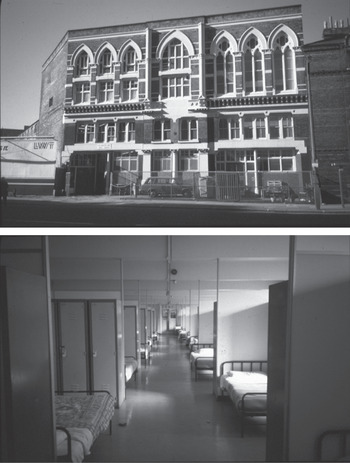
1970s
Occasional enthusiasts continued to take an interest. A doorstep survey of two Salvation Army hostels for men found that 15 per cent of the residents had a diagnosis of schizophrenia and 50 per cent had a personality disorder.12 On this occasion, both hospital and community care were criticised: ‘The small number of schizophrenics who were receiving treatment suggests both a failure of community care and inappropriately early discharge.’
David Tidmarsh and Suzanne Wood restated the idea that there might be ‘a need for services for the destitute men and women at present residing in common lodging houses and reception centres’.13 They showed that, on a given night, around 150 men, mostly with schizophrenia and without contact with services, were sleeping in the Camberwell Reception Centre. Ironically, this ‘invisible asylum’ was just over a mile from the Maudsley Hospital, a major centre of British psychiatry.
Robin Priest’s 1976 Edinburgh survey took a more sophisticated approach. He compared a general survey of the homeless population with those who were admitted to psychiatric hospital.14 He noted the unusually high prevalence of schizophrenia in the homeless population (32 per cent) but also that the prevalence of schizophrenia was greater in the general homeless population than in the subgroup that had presented to psychiatric services for treatment. Homeless men outside hospital were more likely to suffer from schizophrenia than those in hospital. So those with schizophrenia appeared to be less likely than their peers with other diagnoses to find their way to hospital treatment.
In 1977, parliament passed the Housing (Homeless persons) Act.15 For the first time, this placed a statutory duty on local authority housing departments to permanently house some categories of homeless people, if that person had been found to be:
In priority need (including vulnerability).
Unintentionally homeless – that they had not made themselves homeless.
Connected to the area – ‘local connection’.
It sought to provide for:
Those in ‘priority need’ for rehousing, regarded as ‘fully homeless’ and deserving of support. These were households with, or about to include, a dependent child.
‘Vulnerable’ lone people, or households without children, who could not reasonably be expected to fend for themselves, such as frail older people or those made homeless by an emergency – such as a fire or flood. Such households could be rehoused in local, funded social housing.
Under these criteria, people who were homeless, but did not appear particularly vulnerable (and did not have dependent children) were viewed as being able to support themselves. They came to be known as ‘single homeless people’ or as ‘non-statutory homeless people’, as they fell outside the main provisions of the new legislation and so were only entitled to advice and assistance from the local housing department. Homeless mentally ill people should have fitted well into the ‘vulnerable’ category, but three issues complicated matters, each of which I saw operating during my years of clinical practice:
It was often hard to establish vulnerability in someone with a mental health problem, especially if they were not in contact with a psychiatric service.
If, as a consequence of their mental illness, someone had behaved badly, not paid their rent or had neglected the care of their accommodation, it was easy for them to be viewed as having made themselves ‘intentionally homeless’. They would then find themselves outside the provisions of the Act.
Even if a person had been sleeping on the street in an area for many years, it could be argued that, as they did not have an address, then they did not have a local connection – and so, again, they fell outside the scope of the Act.
Moreover, the Act was only a general statute. A Code of Guidance was provided, but this left considerable room for interpretation. If you could not make your case, you were excluded from the provisions of the Act. This was particularly problematical with the criterion of not having made yourself intentionally homeless, containing as it did an echo of the notion of the ‘undeserving poor’. The effectiveness of such provision was further challenged, in 1995, when it was ruled that local authorities could discharge their obligation by providing merely temporary accommodation.16
1980s
The Thatcher government of the 1980s created the right for tenants in England and Wales to buy their council flat. This was couched in terms of extending to everyone the right to have your own home, even those on low incomes. Although it was seen by many as a cynical attempt to buy working-class votes for the Tory party, it proved popular with those at whom it was aimed.17 However, it also kick-started a drastic reduction in the social housing available to those who could not afford commercial rents, either because they were not employed or because they could not earn enough, even in full-time jobs. Thereafter, homelessness increased. Households accepted for assistance under the terms of the 1977 Act doubled from 53,110 households in 1978 to 112,730 in 1987 – and this rose to a peak of 144,780 in 1991.
At the same time, a silent and unpublicised process had begun – the closure of the large old hostels for homeless men and women. Much was written both for and against the closure of mental hospitals from the 1960s to the 1980s, and it was a matter of public knowledge and open debate. However, over the years from 1980 to 1995, the traditional large hostels for the homeless were also closed, with little public discussion or debate. This affected not only the Department of Health and Social Security (DHSS) reception centres/resettlement units but also Salvation Army hostels, Rowton houses and night shelters. The closures took place for a variety of reasons, similar in many ways to those leading to the closures of mental hospitals.
In London, in 1981, there were 9,751 bed spaces in the wider network of direct-access hostels, 6,000 of these in large, traditional hostels for the homeless. The London Boroughs Association (LBA) described them as ‘at once a resource and a problem’:18 a resource because of the shelter provided; a problem because of the often-appalling physical conditions and catastrophically inadequate staffing. This was illustrated by a crisis in 1983, when local authorities directed the owners to improve conditions in three Rowton houses – and the company promptly threatened to evict all the residents.19 The local authorities subsequently bought the three hostels, intending to close them within five years.
Nationally, the DHSS had wanted to close resettlement units for some time.20 It took the view that centrally funded institutions were inappropriate in an age of local social services and housing departments. Such large institutions were also seen as unsuitable places for influencing people ‘to lead a more settled way of life’, to use the original words of the NAB. So the decision was taken to close all the resettlement units and to replace them with locally run projects, with a system of grants to encourage voluntary sector organisations and local authorities to take on this task.21 The closures started with the Camberwell Reception Centre, the largest of the old NAB reception centres, in September 1985.
The LBA report had recommended the opening of 600 beds each year to replace the old hostels but acknowledged the financial and planning difficulties that such schemes faced. Belated enforcement of fire regulations led some hostels to reduce in size and others to close. By 1985, the numbers of direct-access bed spaces had declined to 4,885 and, by 1990, to around 2,000.22 The 900 beds of the Camberwell Reception Centre, all direct-access, were replaced by only 62 direct-access bed spaces, the rest being in specialist, referral-only, units. Across the board, 75 per cent of direct-access hostel spaces were lost during the 1980s. There was much good practice in the resettlement schemes for the existing residents of these hostels; but the loss of direct access beds without much in the way of equivalent provision did make it harder for a street homeless person, without resources, to get accommodation for the night.
There was, however, some official and academic interest now developing. Helping Destitute Men was a book written by a psychiatrist and a nurse and published in 1980. It commented on the presence of mental disorders in St Mungo’s hostels but did not remark on them further, focusing instead on the sensible notion of rehabilitation for homeless hostel residents rather than simple containment.
Single and Homeless was a major report, commissioned by the Department of the Environment in 1982.23 It covered a wide range of data and listed mental illness as a single category with no further details. It reported levels of mental illness which, if they included depression and anxiety, would have been unremarkable in a primary care sample. However, the methodology used meant that it would probably have missed much of the psychosis present in hostels. Their profiles of ‘types of homeless people’ included a drinker but no one with a mental illness. So an opportunity was missed for increasing awareness of the connection between homelessness and mental illness. However, across the Atlantic, there was a burgeoning literature developing which drew a strong connection between their process of deinstitutionalisation and excess rates of mental illness among their homeless populations.24
In the middle of this decade, and while this process of closure was going on, another Salvation Army hostel was found to have a third of both its residents and new arrivals with a diagnosis of schizophrenia;25 however, some change was coming. In 1987, an outreach team to the large hostels in Lewisham and North Southwark in south London was established. The Psychiatric Team for Single Homeless People (PTSHP) consisted of two nurses, one psychologist, an occupational therapist and a trainee psychiatrist (me).26 It provided a service to several of the large hostels that would soon be closing, but the question was asked, would this extra effort – or outreach as it has come to be known – be worth it? To answer this question, referrals were randomised into a treatment group – to whom the team would provide a clinical service – and an advice group – whom the team would assess and then advise the hostel nurse as to appropriate referrals to make. At the end of both three months and the year, the numbers remaining in the treatment group were significantly higher – as one would have hoped.
1990s
By 1990, Jeremy Corbyn – at that time a rebellious backbencher – was challenging Mrs Thatcher in parliament over the increasing levels of London street homelessness.27 Although many felt that this was a consequence of the psychiatric deinstitutionalisation, the evidence suggested that it had more to do with the hostel closures of the 1980s.28 The homeless mentally ill were clearly vulnerable both to deficits in health care and to inadequacies in other systems, such as housing. Whatever the cause, the Conservative government then decided to fund the Central London Homeless Mentally Ill initiative.29 This consisted of several multidisciplinary mental health outreach teams in five locations across central and east London. Their scope was widened beyond hostels and incorporated the ideas of assertive outreach – but the work was directed at those who were not in touch with services at all.30 Nurses, social workers and psychiatrists found themselves working in homeless day centres, squats, parks and even on the streets. This proved successful and three of the original teams are still functioning.
One of these, the START team, in south London, established a close working relationship with Thames Reach, a local homelessness charity (see Figure 26.2). Independently of the NHS, they had set up three housing projects in the same area, specifically for people with severe mental health problems who were sleeping out. The stage was set for a rich collaboration between the two agencies. A person with schizophrenia who was sleeping out could now be offered a small flat to move into without going through the usual accommodation ‘ladder’ – an almost ‘housing first’ set-up.31

A Labour government came to power in 1997 with a rather different set of ideas about social problems. Essentially, they drew on the notion of ‘social exclusion’, derived from French social science ideas about the nature of poverty.32 This term might be assumed to be part of a set of left-wing or even socialist views of poverty. However, this version was, perhaps, a more a liberal-democratic idea. It viewed the marketplace as the weighted centre of society – and proposed, at least in part, to ‘improve’ the marginalised so that they can now play a full (or fuller) part in society. So, although society may be reshaped to include the individual, there was also an emphasis on reshaping the individual to conform to society. Homelessness was defined as an element of social exclusion and major policies were put in place to counteract it,33 including the formation of a Rough Sleepers Unit in 1999, with a target of reducing the number of rough sleepers by two-thirds by 2002. The target was met in 2001 and there were no increases in the number of people sleeping rough in England until 2010; but, of course, in the years since 2010 there has been marked deterioration.
2000s
There were few further important political or legislative changes during the first decade of the twenty-first century. Yet, professionally, those providing mental health services to homeless people began to look beyond psychosis and substance abuse. Psychologists came to the table and Nick McGuire in Southampton pioneered the use of cognitive behavioural therapy (CBT) in high-risk homeless populations.34 John Conolly set up an outreach psychotherapy and ‘pre-psychotherapy’ service in Westminster;35 and the notion of the psychologically informed environment began to be explored. Given the reluctance of many homeless and socially excluded people to engage with mental health services, it made more sense to provide psychological services in hostels and housing projects.36 Other major cities such as Sheffield, Birmingham and Liverpool also set up mental health outreach teams for their homeless populations.
Conclusion
Attitudes and practices did change significantly between 1960 and 2010. Both homelessness and mental illness became increasingly matters of concern – and the high levels of mental disorder among homeless people were recognised.
At the beginning of this period, there was probably less visible street homelessness but this was because homeless people and people with mental illnesses were both, to a large extent, hidden. From the mid-1980s, increased recognition of the problem produced a range of high-quality and effective projects. Although these were mainly focused on psychosis, in the latter part of this period the psychological needs of those homeless people without psychosis were at last recognised and addressed, often using the explanatory idea of complex trauma.
Those of us working in the field have, I think, developed novel, flexible and user-centred services. What we have not been able to do is to change the economic and social forces that force people with mental disorders onto the street; and, perhaps, we have not changed the practice of psychiatry to the degree we would have wished. Patients are still discharged from psychiatric wards to the street and there is evidence that the majority of referrals to specialist mental health teams have previously been in touch with psychiatric services.37 There is still much work to be done, especially as we have seen the subsequent years of austerity undo many of the achievements accomplished during the period described.
Key Summary Points
Homelessness and mental health problems have been historically associated, but before the 1980s this connection was not generally recognised.
For many people with mental health problems, the large hostels for the homeless formed a parallel system of institutionalisation to that of mental hospitals. Unlike mental hospitals, they were generally situated within working-class areas of housing.
Attitudes and practices changed significantly between 1960 and 2010. Both homelessness and mental illness became increasingly matters of concern – and the high levels of mental disorder among homeless people were recognised.
In 1990, homelessness and mental illness became a political issue because of the increasing numbers of people visibly sleeping out in London. Although it was linked to psychiatric deinstitutionalisation, the evidence suggested that it had more to do with the closures of the large hostels in the 1980s.
From the mid-1980s, increased recognition of the problem produced a range of high-quality and effective projects which provided better access to mental health care for homeless people. These were initially focused on psychosis. In the latter part of this period, the psychological needs of those homeless people without psychosis were at last recognised and addressed, and the explanatory framework of complex trauma was introduced.
The ‘driver’ factors that create homelessness have remained substantially unaddressed.


 Open access