Introduction and aims
In conjunction with the growing trend in Europe to include voluntary associations in welfare work, voluntary social work is becoming an integral component of the existing structures of Danish public welfare provision (La Cour, Reference La Cour, Andersen N and Sand2012). The Danish welfare state is increasingly dependent on volunteers who are intended to help solve future welfare challenges (La Cour and Højlund, Reference La Cour and Højlund2008). Of particular interest in this regard is the challenge of an ageing society consisting of an increasing number of older people who need care (Lilburn et al., Reference Lilburn, Breheny and Pond2018).
In this article, we explore a newly established initiative called Elderlearn, which engages frail older people as volunteer language teachers for foreigners learning Danish (Elderlearn, 2018). As such, Elderlearn aims to turn the volunteer–recipient relationship upside down: it promotes the capabilities of frail older citizens, instead of positioning them solely as recipients of welfare services and volunteer work. At the same time, Elderlearn promotes itself as an association that counteracts senior loneliness, thus endorsing the idea that engagement and empowerment are key to a good quality of life. Instead of directly addressing the loneliness of senior citizens, Elderlearn endeavours to engage frail, older people in language teaching, and thereby enable agency and autonomy despite decline and frailty. We propose that Elderlearn is engaging in the emergence of a different kind of older subject: that frail older people can be engaged, internationally oriented cultural teachers. This, we suggest, also calls for a discussion regarding agency and dependency in the fourth age.
In the first part of the article, we present the Danish context and the Elderlearn initiative, review literature relating to volunteerism and the fourth age, and describe our theoretical and methodological choices. Our study is based on the research question: what constitute good social relationships between Danish-language students and older volunteers, and how are such relationships created? In the second part of the article, we present how the ‘double’ volunteering aspect of Elderlearn creates blurry relationships that surpass the immediate volunteer–recipient bond. In other words, the older volunteers and Danish-language students go beyond a conventional giver–receiver relationship to create relationships that have less-distinct boundaries, but create a richer experience: both parties give and receive. In the third part of the article, we demonstrate how this blurring of relationship boundaries connects the involved subjects to their local communities, to Denmark, to languages and to their international history.
Elderlearn
Elderlearn has existed since September 2017; in its first seven months, it focused on residents at nursing homes. By the beginning of this study, Elderlearn had just begun to broaden their volunteer group to consist of both nursing home residents and home care recipients (Fournier et al., Reference Fournier, Reventlow and Lassen2019). The students, who often get involved in the programme in order to both learn Danish and combat senior loneliness, are foreigners who attend Danish courses at a level where they are able to participate in basic conversations. Through such means, by the time of writing Elderlearn has expanded to several Danish municipalities, and has managed to create a lot of attention about both the capacities of frail older people in Denmark as well as the unused resources of immigrants attempting to become part of Danish society.
The research project was initiated in collaboration with Elderlearn. Elderlearn is partly financed by private funds (which have also funded this collaboration) but aims to obtain funding directly from municipalities which wish to use their services. It builds on the idea that the changing demography, with an ageing population and many foreigners in Denmark, holds the potential to enable mutual learning between the two growing population groups.
Policies of old age in Denmark
In the Danish welfare state, the population has universal rights to health care, basic pensions and home care financed through taxes. Despite cutbacks and an increase in economic scarcity policies since the 2008 recession, Denmark has a high level of citizen satisfaction, security and public trust (Bjørnskov and Svendsen, Reference Bjørnskov and Svendsen2013). Funding of old-age services has been restored to some extent in recent years after a decade of cutbacks, but in the same period the ageing population has increased. This has led to a decrease in the percentage of seniors receiving home care, which, combined with ageing-in-place politics, has resulted in most older people living at home and only moving to nursing homes if they are very frail (Jakobsen, Reference Jakobsen2016). In general, there has been an increasing focus in Danish health policy on prevention, health promotion and active ageing, leading to initiatives such as preventive home visits (Otto, Reference Otto2013), activity centres (Lassen, Reference Lassen2014, Reference Lassen, Loffeier, Majerus and Moulaert2017) and reablement programmes (Aspinal et al., Reference Aspinal, Glasby, Rostgaard, Tuntland and Westendorp2016; Schwennesen, Reference Schwennesen2017). Of particular interest for this article, a range of policy programmes, municipal initiatives and non-government organisations engage volunteers in activities in the old-age sector, especially at nursing homes, in order to increase the quality of life of senior citizens (Scheele et al., Reference Scheele, Vrangbæk and Kriegbaum2019). This forms part of a wider European tendency to rethink the relationship between civil society and care environments (e.g. Hämel, Reference Hämel2016; Lassen, Reference Lassen, Jensen, Lassen, Wingender, Møller and Nørtoft2018), which links to the European Union's ambition to promote intergenerational solidarity and older people's societal participation (European Commission, 2011) through policies of active ageing in order to transform old age (Lassen and Moreira, Reference Lassen and Moreira2014).
Volunteering
Through the transformations described above, senior volunteers become a potential resource for ageing societies (Blix and Hamran, Reference Blix and Hamran2018; Lilburn et al., Reference Lilburn, Breheny and Pond2018), and governmental institutions are supporting the participation of older people in European countries (e.g. European Commission, 2018). Longevity is increasing and seniors are enjoying relatively good health for longer periods of time after retirement, which also allows older people to remain productive members of society (Erlinghagen and Hank, Reference Erlinghagen and Hank2006). Furthermore, research shows the beneficial effects of volunteering among older adults, as volunteer work is associated with improved quality of life (Cattan et al., Reference Cattan, Hogg and Hardill2011), better psycho-social, physical and cognitive health, improved life satisfaction, enhanced social support and delayed mortality (Wilson, Reference Wilson2000; Anderson et al., Reference Anderson, Damianakis, Kröger, Wagner, Dawson, Binns, Bernstein, Caspi and Cook2014). Studies indicate that volunteer work among older people is motivated by the desire to help others, to find a peer group, to offset losses associated with retirement or decline in health (Barlow and Hainsworth, Reference Barlow and Hainsworth2001), wanting to give something back to the community and/or the availability of time (Narushima, Reference Narushima2005).
Denmark has one of the highest participation rates in volunteer work compared to other countries in Western Europe (Erlinghagen and Hank, Reference Erlinghagen and Hank2006). In the age group of people 70 years and above, 44 per cent have performed volunteer work within the last year (Hjære and Jørgensen, Reference Hjære and Jørgensen2017), making it the age group with the highest share of volunteers in the Danish population. However, older people with poor physical and mental health and mobility are less likely to engage in volunteer work (Principi et al., Reference Principi, Chiatti, Lamura and Frerichs2012): among Danish non-volunteers 13 per cent report that they do not volunteer because they have a sickness or a handicap (Hjære and Jørgensen, Reference Hjære and Jørgensen2017), which highlights the barriers they experience that prevent them from volunteering. At the same time, there is a wide range of volunteer social activities intended to help frail older people. Hence, senior citizens are regarded as both relevant givers and recipients of voluntary social work with both giver and recipient benefiting from the activities, which has also been thoroughly described in the literature (e.g. Stephens et al., Reference Stephens, Breheny and Mansvelt2015). These co-produced initiatives to improve levels of physical and/or social activity among older people are prominent in Denmark (Scheele et al., Reference Scheele, Vrangbæk and Kriegbaum2019).
As such, Elderlearn has been created in a country with a strong tradition of volunteering. However, most of the volunteers and the initiatives promoting volunteerism are in the second and third ages. In this regard, Elderlearn endeavours to engage an older and frailer part of the population. As both giver and recipient seem to benefit from volunteering, this should also be seen as a way to support participation in the fourth age, and to alleviate loneliness by creating engagement, social relationships and, ultimately, a different kind of frail, older subject.
The fourth age, autonomy and dependency
Since Peter Laslett's (Reference Laslett1987) seminal work on the third age as a new cultural phenomenon, wherein old age is divided into two distinct life phases – the third age as the healthy, active and fit new old age, and the fourth age as the frail and decrepit period before death – the fourth age has become a feared social imaginary (Gilleard and Higgs, Reference Gilleard and Higgs2010) that constitutes a profound otherness (Gilleard and Higgs, Reference Gilleard and Higgs2011). As such, the fourth age has been carved out as a period of life solely defined by frailty (Gilleard and Higgs, Reference Gilleard and Higgs2011) and formed in clinical discourses and geriatric medicine (Pickard, Reference Pickard2014). In times where successful ageing is ‘a contemporary obsession’ (Lamb, Reference Lamb2017) and active ageing programmes are heavily invested in by international policy organisations (Lassen and Moreira, Reference Lassen and Moreira2014), a normativity is established separating those successful in continuously demonstrating fitness, and those failing and in decline (Gilleard and Higgs, Reference Gilleard and Higgs2014).
In this separation between the third and the fourth age, the continuity during the lifecourse and identity is overseen. As Susan Pickard (Reference Pickard2018) has shown, studies on the lived experience of frailty do not suggest a clear phenomenological rupture between different life phases. Instead, the complex processes of ageing, health and illness are interwoven in the everyday lives of older people, and are seen as a continuous process. When there is no clear rupture, the division between an active, engaged and healthy third age subject, on the one hand, and a frail, disengaged, abject fourth age identity, on the other hand, is also challenged. In this line of thought, the frail older subject, although in need of care and welfare services, and with no possibilities of executing autonomous care, still maintains decisional autonomy (Collopy, Reference Collopy, Gamroth, Semradek and Torquist1995). As such, dependency and autonomy are not opposites (Fine and Glendinning, Reference Fine and Glendinning2005); rather, autonomous decisions can be taken by dependent subjects, and independence is in many ways relative (Hillecoat-Nallétamby, Reference Hillecoat-Nallétamby2014).
With this, we wish to explore how Elderlearn enables a specific kind of subjectivity in the fourth age, and how dependency, agency and autonomy appear when frail, older people engage as volunteering language teachers. Exactly because Elderlearn breaks with conceived ideas of agency and volunteer work, and because both parties are explicitly addressed as the giver and the recipient, a kind of blurry volunteering appears that allows the frail older people to reattach to their life histories and to society, and through this appear as frail and attached subjects.
Theoretical framework
We take inspiration from the sociology of attachments as described by Gomart and Hennion (Reference Gomart and Hennion1999), who argue that to emerge as a subject that can act and be acted upon – and in our case, is able to engage in an international relationship – one has to attach oneself to a set of assisting and constraining elements such as social relationships, techniques, abilities, objects and events. As such, the emerging subject is not an individual in the sense of a separated entity with inherent capacities. Rather, the subject is a network that emerges through her or his attachments.
In our case, Elderlearn is a specific arrangement to which the older person attaches her- or himself. Such attachment requires constraining oneself to a set of rules, i.e. speak Danish, follow guidelines for meeting frequency and be open towards the other. This formalisation of the relationship enables the meeting between two strangers to become an event that demands engagement. Moreover, it demands the persons involved to engage in each other's lives and histories. As the persons involved have different backgrounds, this engagement transgresses national boundaries, and requires of the older person to relate her or his own history to that of the foreigner.
Following this line of thought, Elderlearn allows frail older people to emerge as engaged subjects by becoming reattached to their lives and interests, as they are seen through the eyes of the foreign students who are learning Danish. The subject emerging is a network of synchronic and diachronic attachments. As such, establishing social relationships is about creating attachments with the world and history around us; and the lack of such attachments is what has allowed some of the older persons in our study to become lonely. They have become frail older persons cared for by the Danish social services. While this caring has been crucial for their survival, it also risks impeding them from their attachments with the world. They become cared for, instead of caring for. With the attachments arranged through Elderlearn, new friendships, subjectivities and substitute grandchildren/grandparents can emerge.
Methodology
Sampling and research participants
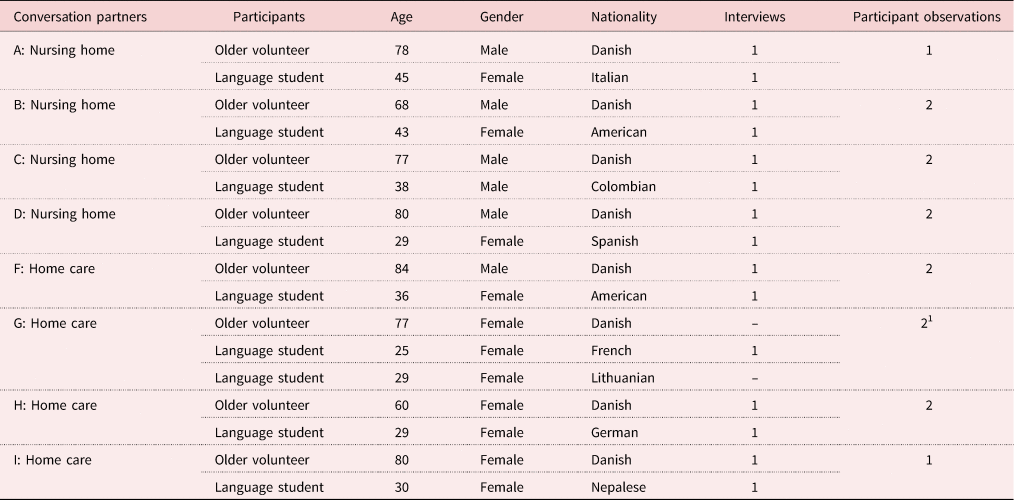
Our methodological approach is ethnographic, and thus consists of qualitative techniques for collecting and producing social life in different settings (Ehn et al., Reference Ehn, Löfgren and Wilk2015). The empirical data are comprised of participant observations (N = 14) and semi-structured interviews (N = 15) among conversation partners in Elderlearn that consist of an older person and a Danish-language student. The study was approved and journalised (504-0039/18-4000) by the Danish data protection agency and researchers ensured anonymity for participants, who signed informed consent ensuring their awareness of research purposes. NBF conducted the fieldwork between March and August 2018. She followed eight pairs of older volunteers and students in the Municipality of Copenhagen: four pairs include an older volunteer who is a resident at a nursing home and four pairs include an older volunteer who receives home care.
We used a form of purposive sampling (Bernard, Reference Bernard2017), which also included random selection. The criteria for participants to become part of the study was to be newly involved in the Elderlearn initiative. We started collecting data in March 2018, and the following four pairs starting in Elderlearn within each of the two volunteer groups (home care recipients and nursing home residents) were included. This ensured that the pairs had not been selected as exemplary pairs by the Elderlearn association, as we wanted to follow pairs that established a good relationship as well as pairs that did not. Because we acknowledge that our research was conducted in collaboration with the Elderlearn association, we needed to ensure that we did not portray only the most successful, thriving pairs. While we wanted a spread in gender, socio-economic status and origin of Danish-language students, the limited scope of participants and our insistence that we did not want Elderlearn to pick ideal participants outweighed a widespread of participants (see Table 1). Eight of the nine Danish students were female (which most Danish students in Elderlearn are in general) and five of the eight language teachers were male. Five of the nine Danish students came from European countries, three from the Americas and one from Nepal. The mean age of the older volunteers is 75.5 years and the mean age of the students is 33.8.
Overview of informants and fieldwork

Note: 1. First encounter with both Danish-language students.
Data collection and research design
NBF conducted two participant observations with each pair, one during their first encounter and another in a one-month follow-up visit. Hence, the conversation partners were new to Elderlearn at the beginning of the fieldwork and we were able to follow the relationships as they developed. Because Elderlearn encourages the participants to meet once a week, we were also able to gain insights into the relationship they were establishing, as each pair had had about four meetings at the time of the second participant observation.
As NBF participated in situations focused on conversation, she would participate in the conversation while allowing the participants to control the topic and flow of the conversation. As such, according to James Spradley's (Reference Spradley2016: 58) scale of involvement in participant observations, NBF would moderately participate and try to balance her role as both outsider and insider. This was particularly important because NBF participated in the first visit, and participants should gain a level of knowledge about each other that could be used and further developed in subsequent meetings without NBF's participation. During the participant observations, the researcher took photographs to supplement her field notes. In between the two participant observations, each participant was interviewed individually in either English or Danish.
The semi-structured interviews were structured around four themes: (a) the visits and their significance; (b) the social relationships of the pairs; (c) the issue of volunteer work in practice; and (d) the issues of social relationships in general, life changes and loneliness. The protocol was mildly adjusted after the first interviews, but the overall structure remained the same throughout the study. This protocol allowed research participants to describe their subjective experience of the initiative, before we probed into specific issues regarding volunteering, social relationships and loneliness. As we will show in the analysis, this exploratory design led to participants describing a subtle and blurry kind of volunteering.
Of the eight pairs, three stopped meeting during the first month, which means that no follow-up participant observations were conducted among these three conversation partners (pairs A, G and I). In all cases, however, it was possible to interview participants about their meetings anyway, which included consideration of and experiences related to the ending of the visits.
Besides fieldwork among the conversation partners in Elderlearn, three care workers were interviewed. All three had experience referring older people to Elderlearn. The interviews with care personnel were semi-structured and evolved around their work with senior citizens in general and in relation to Elderlearn, as well as the relevance of Elderlearn to the senior citizens they were caring for.
The study was designed as a qualitative study for several reasons. Firstly, the size of the Elderlearn initiative did not allow us to study large numbers of participants. Secondly, qualitative research is ideal to explore and describe in depth complex phenomena such as the emergence of social relationships. Thirdly, the interactions among people and their understandings of those are difficult to measure meaningfully in a quantitative manner (Creswell, Reference Creswell2013: 48).
Qualitative fieldwork requires a constant reflexivity concerning the researchers’ distance from and participation in the field (Davies, Reference Davies2008); during our fieldwork and meetings with Elderlearn, we emphasised the research's independence from Elderlearn. We held monthly sparring sessions with Elderlearn, but in our daily research kept our distance from the work and development of Elderlearn. In this way, we endeavoured to maintain the impartiality of the research, while being attentive to the fact that it was conducted in the context of a co-operative project with and about Elderlearn. During the fieldwork, the difference from and distance between Elderlearn and the researcher were also emphasised to the informants through participant information and consent forms. However, some participants during the first encounters in particular were confused about the researcher's role in relation to Elderlearn's project. In such cases, the researcher spent extra time explaining the research project to the informants. In this kind of research, it is important to remember that actions and knowledge are not produced in a vacuum. Rather, they are framed by the cultural notions of both actors and interpreters (Sunderland and Denny, Reference Sunderland and Denny2007), and reflexivity about the context of the production of data has been a central part of method and analysis in this study.
Analytical strategy
All interviews have been transcribed verbatim, and transcriptions, field notes and photographs taken during fieldwork have been thematically coded. While the themes emerged from the material, they were also generated through ongoing discussions between the authors throughout the fieldwork period. During three data-based analytic workshops, the themes in this paper were developed and explored mainly through inductive coding (Strauss and Corbin, Reference Strauss and Corbin1998), where we constantly compared materials and research participants’ ways of thinking. Several themes emerged in this process, but as we will show in the analysis, the links between blurry forms of volunteering, renewed attachments to the world and an internationally oriented old-age subject kept emerging in our data, and enabled us to articulate a different kind of old-age subjectivity. After two of the data-based analytic workshops, the ongoing analysis was presented and discussed with the manager of Elderlearn as well as with the research project's advisory board. These discussions contributed to the analysis and linked it to broader trends in ageing studies and the Danish administration of old-age programmes, and enabled Elderlearn to learn from the research findings and adjust the initiative accordingly.
The analysis was inspired by the Scandinavian ethnological approach to cultural analysis deriving from social anthropology (e.g. Ehn et al., Reference Ehn, Löfgren and Wilk2015). This approach focuses on mundane tasks and routines, and links them to the way they both reproduce themselves and society, are formed by the material settings they are performed in and penetrated by several, often non-coherent, ideologies. This approach is particularly useful in our study in the way that it enables us to relate the lived experiences at nursing homes or in home care settings to discourses and ideologies of the fourth age, and the particular subjectivities such ideologies enact. With this approach, we have explored how the relationships in Elderlearn are made more robust through material artefacts, localities, care settings, and ideas of active citizenship, old age and international consciousness. As such, we relate the specificities of everyday life at nursing homes or in home care settings to wider cultural and social phenomena. As we were particularly aware of these phenomena, the analysis was not solely inductive, but also relied on deductive processes (Graebner et al., Reference Graebner, Martin and Roundy2012).
As described in the theoretical framework, the sociology of attachment conceptualises the ways particular subjectivities emerge through engagements between people, collective techniques and materialities (Gomart and Hennion, Reference Gomart and Hennion1999; Hennion, Reference Hennion2007). We propose that this idea of attachment can be used in studies of the fourth age and social relationships. Because the sociology of attachment describes engagement with the world as something that is only possible through collective techniques, and subjectivity as something that emerges from this engagement, we find this theory to be of much use in our analysis.
Two themes, ‘blurry volunteering’ and ‘renewed attachments and international subjects’, are central to the engagements in social relationships in Elderlearn, enabling a specific kind of subjectivity in the fourth age to emerge. As described above, links between these themes consistently appeared during the analytical process and the following sections will therefore unfold these central analytical themes.
Blurry volunteering
[The intent of Elderlearn is] to create something, you know, utilise the resources here and there, and then create something from it, you know. One must say that there are foreigners that have to learn Danish. [And] There are some senior citizens who want to give something of themselves, and in that way you have created something and added it together … Everyone gets happy. (Home care worker)Footnote 1
The visits between the older volunteer and foreign-born language students are thought to be rewarding for both parties. However, the reciprocal concept of the relationships developed in Elderlearn exceeds the mere notion of gaining something by being part of a volunteer–recipient relationship. The definition of volunteer social work typically has a unidirectional dimension because it is based on a formal clarification of the direction regarding who the care is aimed at (La Cour and Højlund, Reference La Cour and Højlund2008), that is, from a volunteering subject to a receiving object. The boundaries in the relationships created in Elderlearn form a volunteer–volunteer rather than a volunteer–recipient relationship. Therefore, it becomes harder to distinguish who is giving care to whom. As we will demonstrate in the following analysis, the volunteering in Elderlearn is blurry.
For some of the conversation partners, the volunteer–volunteer bond is evident as both parties give something specific to the other. The older volunteers are giving their time, involving the language students in their culture and language, and helping them speak better Danish. The students are providing company, giving the older volunteer something to do during the day, while also sharing information about their home country and their own culture. In this way, both parties feel useful: each is helping and caring for the other.
However, many conversation partners are ambivalent about defining their relationship as one based on volunteering. One example is conversation partners F, an American woman who visits an 84-year-old Danish man. Danish-language student F has a Danish husband, but he has lived most of his life abroad, so she does not consider him a real Dane, she tells older volunteer F with a smile during their first encounter. She and her husband have lived in several countries, and she still travels a lot with her work, but now they have decided to live in Denmark.
Older volunteer F has lived in the same apartment for more than 50 years. He has been married twice, but both wives passed away several years ago. Now he rather enjoys living alone and playing by his own rules. Since he has been alone, he has travelled a lot, and it does not take long before pair F starts talking about their travels and their different experiences around the world. Most of their talks evolve around travelling at first, and through this topic they discuss international politics and events, the differences between Denmark and the United States of America, and historical events that have influenced the various places they have visited. Student F wants to buy an apartment, so the older volunteer also gives her advice on the particulars of the Danish real-estate market and different possibilities for obtaining a home loan. Since they happen to live near one another, they also talk about their favourite places to walk in the area, different things to do close by and the older volunteer tells the student what the community was like in the past.
While these two people do not think they have anything in common, they both enjoy talking to one another. Student F does not think of herself as visiting an older person to keep him company, but rather that they are equal partners who both make an effort to understand one another and have an enjoyable conversation. She is thankful that the older volunteer patiently listens to her level of Danish and gives his time. However, she would not like it if he considered himself a volunteer in the unilateral sense, because she thinks this does not match the concept of their being equal partners. In the older volunteer's case, he does not consider himself as helping student F other than with the things she asks about concerning Denmark. He also thinks that her Danish has improved during the visits, so in hindsight, he says he might be helping a bit. He does not think that student F is helping him either, but on the other hand, he enjoys the time they spend together, he likes that he has someone to talk to and hear about new things in their conversations. Thus, these conversation partners have different perceptions of their relationship, but will not say that they are directly helping the other party or doing volunteer social work.
Most participants find it misleading to define either of the parties as ‘real’ volunteers. First, as there is a two-directional dimension of care, there is no clear recipient and therefore the roles in the relationship are more nuanced. One Danish-language student said:
…with volunteering sometimes the power dynamics can be different, the dynamics in general can be different and certainly the roles are different and often more clearly defined you know, the boundaries of the roles, you are the giver and this person is the receiver, and in this case I really do feel like there is more reciprocity. (Danish-language student F)
The blurry volunteering and reciprocity make the relationship more equal. Both parties give and take and enter into the relationship with different motivations. For the Danish-language students, the motivation to meet is to speak and improve their Danish:
[I am not a volunteer] because volunteers are also completely unselfish. I also get some out of it as well. I mean I don't want to see it as a volunteering thing. I want to see it more like I hope to build a friendship with someone. I didn't sign up because I wanted to volunteer. I signed up because I wanted to improve my Danish quite frankly and if she would only speak English to me I don't know if I would do it. (Danish-language student H)
Because there is this fixed rationale for her participation, student H does not want to regard her visits as volunteering. Most Danish-language students reject the idea of volunteering because they do not have an altruistic reason for meeting up with the older volunteer, but perceive their reasons as more egocentric. At the same time, however, they also perceive, or at least hope, that the older volunteer gets something out of it as well: ‘I think the wind blows both ways … He feels like he is helping me and he gets something out of the feeling of being able to help someone’ (Danish-language student B). For the older volunteers, it is more an exchange than volunteering. They find the visits interesting as they get to know new things and hear stories and experiences that are very different from their own lives.
Furthermore, the constellation of ‘giving both ways’ in the visits removes the focus from who is helping whom or even makes it unclear if one is actually helping the other:
I would describe it as she is visiting me and we talk, and it's not like I'm helping her with something. Nothing other than what she asks about, something here in Denmark that she does not know, right? I know everything about things like that, how it works here. (Older volunteer F)
We just had a nice time together. But I do think that I improved her Danish skills and that's very natural. (Older volunteer A)
I just think, it's like he is my neighbour and we get to know one another and use it for the same purpose, but it's not [volunteer] work. (Danish-language student D)
The older volunteers use the skills, language and knowledge they already have and share that with an engaged visitor. Hence, they think describing their role as a volunteer or a helper might be exaggerating, as they feel that the effort they put into it does not deserve to be labelled volunteer work.
In studies of the relationships created in home visiting services (e.g. Fournier, Reference Fournier2018; Lilburn et al., Reference Lilburn, Breheny and Pond2018), a central characteristic of the relationship is that the older volunteers adopt a professional approach in their role as visitors. Through scheduled visits and volunteer courses they feel equipped to create a room of trust for an isolated older person. But the aspects of this professional approach are not apparent in the older volunteers in Elderlearn: they do not regard their meetings with the Danish-language students as a specific teaching situation or as social work that meets another person's needs. For most participants, the visits are not volunteering, because it is not like a scheduled work day when one activates certain skills, it is a nice way of getting to know somebody completely different from themselves.
Barlow and Hainsworth (Reference Barlow and Hainsworth2001) found in their study of older volunteers that volunteering provides a feeling of being back in a ‘work’ environment, a feeling of ‘taking part’ and meeting similar people, together with the realisation that they have the ability and skills for the volunteer activities. This is different from the way volunteering is perceived in Elderlearn. However, when talking with the older volunteers in Elderlearn about volunteering, these ideas of volunteer work often emerge and are compared to what they are doing in Elderlearn. For them, this structured type of volunteering is something that belongs to the past:
Previously I was a volunteer … but that's not something I do anymore, in my age. I'm too tired for that (laughs). No, I don't know if it's volunteer work. (Older volunteer I)
The two-way benefit is important for the relationship between participants. For conversation partners A, the relationship did not last past the second visit. Language student A had at the time of the study just started a new part-time job in Danish, which took more energy than she expected it would. Older volunteer A enjoyed her visits. One of his reasons for moving to a nursing home was that he would have other people around him instead of sitting home alone. However, he is often bored, as he perceives the people living at the nursing home as older than he: ‘older in the sense that they do not follow what is happening [outside the nursing home]. It's in the most boring sense of the concept of a nursing home: that one is being nursed’ (older volunteer A). With visits from student A, he felt a breath of fresh air from the outside world.
At their first encounter, the pair began to talk easily and understood each other. Student A liked visiting the older volunteer and hearing about his past life. She felt the older volunteer really enjoyed having company. However, she did not feel that she was improving her Danish. Further, she also felt she got more practice of the language in her new working environment than by visiting the older volunteer. She would still have liked visiting him, but the main reason would be to keep him company and she could not find the time to do this. First, she felt she did not benefit by improving her Danish, and second, she had expected the conversation to be different: ‘to talk about other topics than day-to-day life and routines that would be nice … because in the long run it [the meeting] is also a lot about Danish culture, Danish nowadays situations, political, social…’ (Danish-language student A). The student did not perceive her conversations with the older volunteer as going beyond everyday chitchat. Her rationale for participating in Elderlearn was not only to learn the Danish language, but also to learn more about the country, and she did not think visiting older volunteer A provided her with this.
Hence, for the relationship to become ‘good’ and continue, both parties have to feel the reciprocity and the benefits of participating; they rarely participate in Elderlearn solely to give something to the other. Thus, the relationships created in Elderlearn emerge as blurry volunteering.
Elderlearn enables participants to go beyond the notion of volunteering and helping while still defining parts of their encounters as having the very same aspects. The volunteer–recipient bond is surpassed: sometimes it evolves into a volunteer–volunteer bond, but oftentimes the nature of the relationship changes to friendships or substitute grandparent/grandchildren. Moreover, the attachments to the life histories and the surrounding world transgress the formality of the relationship and thereby renew the values and relevance of the histories. The blurriness of the volunteering and the international contextualisation of the life histories generates constructive relationships through which new attachments to language, history and place across nationalities and generations are based on the common ground of speaking Danish. Such attachments produce new subjects, where frail older people emerge as teacher-integrator-citizens and foreigners emerge as student-companion-citizens. We analyse these emerging subjects further in the next section.
Renewed attachments and international subjects
Attachments express our ways of both making and being made by the relationships and objects that hold us together (Hennion, Reference Hennion2017). As such, attaching is a collective technique in which subjectivities are not pre-established, but where the involved actors have to make them appear together (Hennion, Reference Hennion2007). In this section, we explore the subjectivities that emerge in those encounters that work well between Danish-language students and older volunteers that are generated by objects, past experiences, knowledge, and international differences and similarities. Like pair F described in the previous section, many participants do not think they have anything in common. Yet, while age, experiences, nationality, traditions, culture – and language – differ, both volunteers and students find ways to relate across these differences:
…we have been brought up in two different worlds, right. And today she lives in her world and I live in mine, right. So there isn't much in common. That's obvious. But still there's a lot in common and the commonalities appear if you get some discussions about what happens in the world. (Older volunteer A)
Attachments to another world, as older volunteer A describes it, are created through the meetings. The participants hear and learn something new through their relationships, which gives them a new pair of eyes with which to view their world.
When two Elderlearn participants meet one another, the conversations often have an international flavour. These conversation partners come from different countries and have different travel experiences. With conversation partners D, the global outlook became very evident, as the language student is from Spain and the older volunteer has a Mexican wife and lived in Mexico for several years. Even though they are both fluent in Spanish, their conversations are mostly in Danish – except if the student does not understand or if the older volunteer feels like a quick Spanish brush-up. They discuss Spanish writers, the political situations in Spain and Mexico, as well as Spanish names, their origin, meaning and different Danish parallels. Whereupon the conversations broaden:
So we talk about everything, not only about the Danish culture or the Mexican culture, but he also knows about North America and South America and Asia, and he tells me where he worked in different countries. (Danish-language student D)
Older volunteer D has Parkinson's disease; he can have difficulties speaking and walking, and is in a wheelchair. As things are, he rarely leaves the nursing home and most of his family live abroad. Through the meetings with student D, he emerges as an international citizen and becomes reattached to his work and to past everyday life in different countries.
The older volunteers emerge as international citizens in different ways through their meetings. Older volunteer A knows French because he had a summer house in France and German because he once worked in Germany. He has experienced first-hand how much it improved his language to talk to citizens fluent in the language he was learning. Conversation partners C talk about different car brands. Because the first car the older volunteer owned was a German car, he tells about his visit to Germany after the Second World War where he saw industrial production in a car factory and the damage done by the war. Older volunteer F has Turkish neighbours, and Turkish cuisine is one of student F's favourite. They compare meals that the older volunteer gets from his neighbour to the meals the student eats when she visits Turkey. In this way, the countries of the world play an important role in the meetings: they help establish an international consciousness in the meetings. Oftentimes, the older volunteers have had many international experiences (jobs, travels, friends, spouses, wars, etc.) during their lifecourse. A fact that is often overseen when older people are placed in a nursing home and become cared for. Elderlearn helps to highlight this international aspect in the lives of the participants. They re-emerge as international subjects.
While creating global attachments and an international consciousness, the participants also create various attachments to Denmark. Even though global aspects are a big part of the meetings, the central motive for the Danish-language students is to improve their Danish, and through this also become more immersed in Danish culture and traditions: ‘I think I'm missing like 80 per cent of the whole culture. I have no idea because I don't speak Danish’ (Danish-language student C). The older volunteers become gateways not only to the Danish language, but also to Danish history and culture. Even though the conversations of pair D evolve around worldwide and especially Spanish issues, the meetings are always grounded in Danish:
…I don't know that many Danish people … also those I know are all the same age, younger ages, so I wanted to know Danes at another place [in another generation]. Because I just think that it could be another way to get to know that culture and the Danes. (Danish-language student D)
Danish language, traditions, history, everyday life, culture, geography, movies, etc. are discussed when the participants in Elderlearn meet. The Danish-language students get to meet an ‘average Dane’ (Danish-language student H) and have the opportunity to observe tacit and implicit Danish norms and values. The older volunteers’ everyday lives in Denmark and life stories become exotic as they are different from the students’ lives in their home countries, and hereby the students learn more about the country to which they have moved. When older volunteer C talked with language student C about his job and past life, the student asked questions and wanted details about how he worked and where he drove when he was a truck driver. During their first meeting, it became clear that the older volunteer has an extensive knowledge of Danish road systems and geography from driving around in his truck every day at work. Now, he is living in a nursing home and has early Alzheimer's. He reported that he does not feel he is as interesting as he used to be: ‘And I can't imagine that there are that many who are particularly interested in what I have been driving for 35 years as a driver’ (older volunteer C). Even his children think they have heard the same old story one too many times, he said during his interview and laughed. However, the old stories take on a new value when they are told to student C, who feels that he gains new insights: ‘Danish is what I get from visiting [older volunteer C]. When I say Danish I mean everything … the language and his expressions and the culture and everything you know’ (Danish-language student C).
The older volunteers emerge as Danish specialists or gatekeepers to the ‘average’ Denmark. Furthermore, not everything that the older volunteers take for granted with regard to cultural norms or well-known traditions are evident to the language students. Therefore, the older volunteers sometimes have to describe concepts and experiences they have not thought about as different or weird to a person who may find it very different from what they are used to. For instance, when older volunteer C showed photographs of his daughter's wedding, the student asked about well-known Danish wedding traditions that were illustrated in the photographs, which the older volunteer then explained in greater detail.
The older volunteers get to see Denmark and the culture they grew up in through different eyes; in this context, their life experiences become cultural carriers. The international consciousness and attachments to Denmark develop as the meetings proceed. For these attachments to appear, the conversation partners also create attachments through interlinguistic competences. When the pairs meet for the first time, the forms of Danish they speak can be very different from one another; typically, they find it hard to understand what the other person is saying. It takes time and effort to find a way to understand the other:
In the beginning I didn't really understand. But was just the way that she speaks, right. I couldn't really grasp it, but I can now. (Older volunteer F)
Accents, dialects, diseases, mumbling and talking fast make it hard to understand one another, and the participants have to learn how to talk to their partners. Lessons such as ‘one should rephrase instead of just repeat what was just said when the other does not understand’ are learned during the visits. The Danish-language students feel they improve their Danish through the visits: they gain what has been termed ‘communicative competences’ in their second language (e.g. Savignon, Reference Savignon2018) that extend beyond grammar to the socio-cultural contexts of language (Berns, Reference Berns1990). But the communicative competences of the older volunteers are also improved: they feel they improve both understanding and being understood. That the conversation partners understand each other better as time goes by causes the older volunteers to rethink their perceptions about helping the language students with their Danish (see the example of older volunteer F in the earlier section), which generates a reflexive process of how to talk Danish in the most effective way in this context.
However, it can be difficult to develop these interlinguistic competences that are typically a part of good social relationships in Elderlearn. Conversation partners B meet regularly and intend to continue their meetings. But after two months they still have problems understanding one another. Student B usually understands more when other people speak to her in Danish than when she speaks with older volunteer B:
I don't know if maybe he doesn't dumb down his vocabulary when talking to me. If I ask him you know, he will just keep saying the same sentence over and over. (Danish-language student B)
She does not think that he is changing his way of speaking keeping in mind that her Danish is not as good as his. However, older volunteer B is very aware that she finds it hard to understand him, and he is ‘expecting from myself to be able to give something to her’ (older volunteer B), but he finds it challenging and wonders if he is any good at it. He therefore does not experience himself as helping student B as much as he would like to, even though the student finds their meetings very helpful. Sometimes the older volunteer also has a hard time understanding student B, but he does not tell her because he does not want to hurt her feelings. Hence, there are many misunderstandings during their meetings and it can be hard for them to keep the conversation going. At the last participant observation, they discussed whether the meetings helped student B and if they wanted to continue. They also discussed how they could understand one another better by using prepared questions written in Danish or by writing words down in order to develop their interlinguistic competences and improve their meetings through other kinds of attachments.
The international and interlinguistic consciousness as well as the attachments to Denmark are attached to different materialities in the meetings. The participants often use objects to understand one another:
I think he [the older volunteer] doesn't understand everything, but he kind of gets the connections and I don't understand everything but I try to make the connections and then he also has a lot of like props like the maps and the books and the pictures. There's a lot of context in his house. (Danish-language student C)
Conversation partners C use many objects in their conversations to explain themselves. Older volunteer C brings out a map of Denmark to show where he is from or brings out photographs and photo albums when he talks about specific events in his family. The objects help the conversation partners understand one another and attach the conversation to Denmark. Conversation partners F also show each other photographs, mostly from their travels around the world; Danish-language student F also has a book with old pictures from their neighbourhood, which she shows the older volunteer so he can tell her more about their shared hometown.
For conversation partners H, their common neighbourhood in Copenhagen has become a regular part of their meetings. They attach their relationship to the locations that the language student frequents and the history of those places provided by the older volunteer, who has lived in the neighbourhood for about 40 years. Every time they meet they go out to cafés or restaurants nearby. Older volunteer H has difficulty walking, so she rarely goes out alone and never goes to new places, because she does not know if she will be able to come back and forth, or if the seating arrangements will fit her fragile back. With student H, she experiences the local community again. They go to places she has been before and she tells student H about the history and past experiences she had at that spot; and student H takes her to new places, where she has usually assessed beforehand if the seating arrangements will accommodate the older volunteer. In this way, they both show each other parts and temporalities of the city where they have not been before, visit new places, and share experiences and memories.
The Elderlearn programme brings the outside world to care communities, and the older volunteers get involved with the world in different and unexpected ways. The older volunteers reattach to their past histories and identities, and through this reattachment also renew their engagement with the world. They emerge as guiding subjects with international perspectives and cultural value, and surpass both their status as objects for volunteering as well as their newly gained status as volunteering subjects.
Discussion and concluding remarks
Through the meetings in Elderlearn, nursing home residents and home care receivers emerge as blurry volunteers. It can be argued that volunteering has little to do with this – why do relationships between people from inside and outside the care system have to be articulated as volunteering with the connotations and formalities it produces? We argue, however, that it would be difficult in a Danish care setting to frame this as beyond the purview of volunteering. While the programme entails volunteering because this designation fits the municipal administrative boxes, it is also a key selling point for Elderlearn. It is entitled volunteering because old-age care and volunteering in Denmark are so closely linked, and because the state and the municipalities invest a lot of funds in volunteering initiatives. Moreover, articulating the older people in this study as volunteering teachers and the foreigners as their students enables us to talk about the competences and resources that frail older people continue to have, despite their being in the position of receiving care.
Hence, this is not a paper about frailty and decline, it is about personal identities and life histories that are often rendered invisible when older people become part of formal care settings. We all know that former generations have travelled the world, participated in wars and built the societies we are part of, but we seldom become attached to those histories. In this way, framing frail older participants as volunteers enables us to look at them as subjects reattached to their life stories, interests, conversational skills, political beliefs, international consciousness and interlinguistic competences. We consider these subjectivities of the older participants as they are seen by and interacted with by foreigners eager to learn the Danish language and the traditions and history of the country in which they now live. The older volunteers emerge as international citizens when attachments to other countries and other worlds are created in the meetings, and their old stories gain new value in international and integrative contexts. Furthermore, their life experiences become cultural carriers: by introducing the Danish-language students to both language and culture, they emerge as Danish specialists who are capable of giving the students insights that foreigners otherwise can find difficult to achieve. Thus, frail older people become competent teacher-integrator-citizens to the Danish-language students, who, in turn, become both learners and companions.
The articulation of a particular kind of older subject emerging through Elderlearn, which is both dependent on welfare services and an engaged and autonomous subject, touches upon a key debate in the field of social gerontology regarding the relationship between autonomy and independence (e.g. Hillecoat-Nallétamby, Reference Hillecoat-Nallétamby2014), or what Collopy (Reference Collopy, Gamroth, Semradek and Torquist1995) has termed the relationship between decisional and executional autonomy. What initiatives such as Elderlearn bring to light is that care-receivers are not only able to maintain decisional autonomy – despite relying on others to execute – but they can also become reattached to former identities and emerge as new autonomous subjects. As Fine and Glendinning (Reference Fine and Glendinning2005) have argued, frail older people's dependencies do not need to deny them their attainment of autonomy.
However, one of the reasons that some informants might have difficulty seeing the efforts of the language teachers as volunteering might have to do with exactly this dilemma. Many of the older volunteers were recruited rather passively to Elderlearn, as they were asked by care personnel to participate and stated, for example, that ‘I am just sitting here anyway and looking, so it is all right if someone comes by’ (older volunteer F). As care personnel often control the daily schedules of nursing home residents and know when they attend gymnastics, have meals and take naps, etc., the co-ordination of meetings often go through the care personnel, which means that the care relationship between care personnel and recipient constitute a particular subject–object relationship. While the objects of care would subsequently emerge as reattached subjects, this status as the object of care would at times prevent them from being seen as volunteers in the eyes of the care personnel in particular. Indeed, while the care environment produces particular care directions and kinds of relationships, often the participants in Elderlearn were able to surpass these and create different care directions and different relationships.
In short, to answer our research question: good social relationhips in Elderlearn are constituted through the blurry volunteering that surpasses the subject–object relations of volunteering and causes new subjectivities to emerge. Such good relationships are created through interlinguistic competences and use of various materials, objects and the local community. The subjects that emerge in Elderlearn do so through the older volunteers’ reattachments with their abilities, relational skills, views and histories, as these gain new significance as cultural carriers that are dense with keys to the Danish language, Denmark and the Danes.
Acknowledgements
We owe many thanks to the Fonden Ensomme Gamles Værn for funding this collaboration and to Andreas Reventlow, the founder of Elderlearn, for the collaboration. Also, we would like to thank the Copenhagen Centre for Health Research in the Humanities (CoRe) at the Saxo Institute, University of Copenhagen, for hosting this project and providing research support. Furthermore, thanks to the Centre for Healthy Aging, funded by the Nordea-Foundation, which has supported AJL while writing this article. But most of all, thanks to the volunteers (teachers and students) and care personnel in the Municipality of Copenhagen for allowing us access to the field.
Financial support
This work was supported by Fonden Ensomme Gamles Værn. For announcements of funding, see https://www.egv.dk/projekter/368-elderlearn-nar-svaekkede-aeldre-mennesker-bliver-frivillige (accessed 20 September 2019).
Conflict of interest
As the project was conducted in collaboration with the Elderlearn association, we needed to take measures when designing the project. These have been described in the methodological section of the article. In particular, we needed to sample in a way that ensured that the Elderlearn association did not pick the most successful participants, thereby biasing the data.