Introduction
Ireland has over the last decade been transformed from a country of devastatingly high emigration into a country with the fourth-highest net migration rate in the EU (Eurostat and European Commission, 2007). Before the mid-1990s, the vast majority of immigrants into Ireland were of English or Irish background. In so far as immigrants were admitted to Ireland to undertake specialist work, the potential employers were required to demonstrate that no Irish citizen was available to do the work in question. Immigration has increased dramatically since the mid-1990s largely as a result of brisk economic and employment growth. Between the years 1995 and 2005, the Irish population increased by over a half a million with net migration responsible for over half of this growth (NESC, 2006). In 2006, almost one in ten persons in Ireland was an immigrant (CSO, 2006).
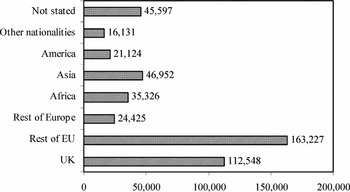
The Census of Population 2006 (CSO, 2006) indicates that while most of the recently arrived immigrants are from the new EU member states (Poland and the Baltic states in particular), a large proportion also originates from Africa and Asia.
Nationality of non-Irish residents, 2006
Source: Census of population 2006, CSO, Dublin.

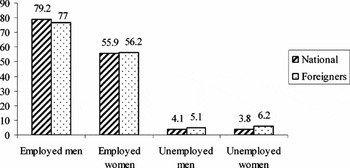
Un/employment rates of Ireland nationals and foreigners
Source: Labour Force surveys, Eurostat, quoted in OECD/SOPEMI (2002).

The majority of these new immigrants have slotted into the manifold jobs that the Irish economy has yielded across several different sectors. Indeed, Ireland was one of only three EU countries to offer unrestricted access to their labour markets to the citizens of the ten new EU member states in 2005. Figures from the OECD and SOPEMI (2002) indicate that the labour market participation rates of immigrant men and women are strikingly similar to those of their Irish counterparts.
The health and social care sectors have been among the most significant employers of migrant workers. While there are currently no statistics available on the proportion of migrant workers in the health and social care sectors, their strong presence in care-related jobs is evident to even a casual observer. A shortage of Irish workers has necessitated their employment in both the formal (Timonen et al., Reference Timonen, Doyle and Prendergast2006b) and, according to anecdotal reports, informal domiciliary care sector.Footnote 1 A survey by the Irish Nursing Home Organisation found that 43 per cent of private sector care workers were non-Irish nationals. The highest percentage of non-national staff was found in Dublin and the surrounding counties where on average 74 per cent of staff were originally from another country (INHO, 2006). Similar to recent developments in the UK and elsewhere, the increased reliance on migrant care workers (see Ungerson, Reference Ungerson2003; Kofman et al., Reference Kofman, Raghuran and Merefield2005; Timonen et al., Reference Timonen, Convery and Cahill2006a) is in part related to the greater emphasis placed on community care services and the introduction of cash-for-care packages which has brought about an expansion of the domiciliary care workforce (Timonen et al., Reference Timonen, Doyle and Prendergast2006b). Coinciding with this, demand for long-term care within the institutional sector still remains high. Given both these considerations, an expansion of the care workforce into the foreseeable future seems inevitable. Acknowledging the integral role migrant workers already play within the Irish social care sector, it is likely that they will continue to be a vital pool of workers within the Irish long-term care sector. Immigration has thus been a core component of Ireland's economic and employment policies, and, by extension, of its social care policy. However, as this article shows, other branches of national policy-making, notably health and social policy, are yet to be readjusted in the light of large-scale immigration.
In the light of the large number of migrant workers in Ireland in general and the care sector in particular, the relationship of migrant workers with the welfare state and their experience of social security have become important issues. The purpose of our study was to find out more about the extent to which migrant workers are anchored into the system of social protection, and their subjective perceptions about the benefits and services that they received, or expected to receive. If the rights and entitlements of migrant care workers were very different from those of Irish-born workers, this clearly would be unjust, and even a recipe for conflict. We wished to gain an understanding of the migrant care workers' understandings, experiences and aspirations regarding their social security and the Irish welfare state. Our primary purpose lay in gaining an insight into the ways in which migrant workers thought of, and arranged for, their own and their families' protection against social risks understood broadly to comprise both the ‘traditional’ or ‘old’ social risks of unemployment, sickness/disability and old age, and also the ‘new’ risks that arise from the need for services such as childcare.
While the main aim of the project was to explore a hitherto unknown area and to focus on the subjective understandings of migrant workers, we also wanted to produce findings of relevance to others interested in conducting further qualitative and quantitative studies on the topic of migrants and the welfare state.
Immigrants' rights to social security
With some notable exceptions (such as Kvist, Reference Kvist2004; Sainsbury, Reference Sainsbury2006; Morissens and Sainsbury, Reference Morissens and Sainsbury2005; Steinhilber, Reference Steinhilber2003), there is little research on the interplay of welfare regimes and migrants' rights and social protection. Sainsbury's (Reference Sainsbury2006) comparative analysis of the social security rights of immigrants in three different welfare regimes (the liberal represented by the US, the conservative represented by Germany and the social democratic represented by Sweden) analysed how the interplay of welfare and immigration policy regimes can impact on the social rights of immigrants. She argues that access to social security benefits on the basis of citizenship, residence or employment- or insurance-based contributions can serve to advantage or disadvantage the social security and welfare of migrants. In the US, for example, legislative changes introduced from the mid-1990s restricted migrants' access to social security and means-tested benefits. Greater financial obligations conferred on employers sponsoring migrant workers restricted migrants' access to the labour market in general. Sainsbury comments that ‘the rationale behind the reforms reflected the liberal ideological preoccupation of economic incentives, the emphasis on self-reliance, and the fear of free-riders’ (2006: 233). The outcomes of these reforms included the withdrawal of benefits from more than one million non-citizens and the introduction of new elements of stratification among immigrants, whereby those employed in higher-skilled occupations received greater levels of social protection.
In a comparative analysis using data from the Luxembourg Income Study, Morissens and Sainsbury (Reference Morissens and Sainsbury2005) found that migrant households across six countries had limited access to insurance benefits, such as unemployment benefits and pensions, in comparison with citizen households. While social assistance payments and means-tested benefits were found to constitute a larger proportion of migrant households' income-packages compared with citizens households, migrants (particularly non-EU and migrants from less-industrialised countries) were less likely to enjoy an acceptable standard of living. Furthermore, in instances where benefits were the main source of income, the probability of being poor was greater than for citizens (Morissens and Sainsbury, Reference Morissens and Sainsbury2005).
Steinhilber (Reference Steinhilber2003) also offers an informative analysis of the interplay of migration policies and welfare regimes and their effect on the social and economic situation of migrant women. His review of 25 countries comments on the ‘feminisation’ of labour migration and the tendency for increasing numbers of migrant women to work in low-skilled jobs, frequently in domestic settings. Considering the advantages and disadvantages of different welfare systems and types of social protection, he concludes that, in general, universal or residence-based benefits offer more protection to migrant women than employment- and contribution-based payments. He contends that ‘this is due to the lower positions that a majority of female migrants have on the labour market, as well as the fact that the migration process itself constitutes a break in the employment history with negative consequences in employment-based social security schemes’. Steinhilber deduces that where social security protection is interlinked with employment-based contributions, the large numbers of female migrants who work informally or illegally are considerably disadvantaged and vulnerable. In order to ensure entitlement to long-term social security benefits such as pension benefits, it is particularly important that this group accesses legal employment (Steinhilber, Reference Steinhilber2003).
While this literature provides us with a greater understanding of migrants' social security rights in the context of different welfare regimes, it offers little insight into migrants' subjective understandings and experiences of the welfare state. In contrast, a large body of literature outlines the general population's sentiments towards the welfare state. For example, framing their discussion within the concepts of ‘trust’ and ‘risk’ in the British context, Taylor-Gooby et al. (Reference Taylor-Gooby, Hartley, Munro and Parker1999) and Taylor-Gooby (Reference Taylor-Gooby2005) argue that the public's confidence in the welfare state and public institutions have been undermined in recent decades. This lack of confidence is argued to be a consequence of globalisation, enhanced perceptions of risk and increasing mistrust of political experts and professionals (Taylor-Gooby et al., Reference Taylor-Gooby, Hartley, Munro and Parker1999). In both studies, survey respondents and interviewees perceived a retrenchment of the welfare state and underscored the importance of securing individualised protections. Attitudes, however, were ambivalent. The majority, while acknowledging the greater expectation to safeguard against personal risks, were generally suspicious of private sector alternatives and believed that the government should play a stronger role in the provision of welfare protection. Research by Dean and Melrose (Reference Dean and Melrose1999) also found that interviewees had ambivalent attitudes towards the welfare state but generally regarded public services such as the state pension, the National Health Service and the education system as social rights to which citizens should be entitled. Given the similarities between the Irish and British welfare states, it is possible (although, in the absence of research on this topic, far from certain) that similar ambivalences towards the welfare state could be detected among the general population in Ireland. Interestingly, as the discussion below shows, our analysis of attitudes among a sample of migrant workers in Ireland detected similar patterns of ambivalence towards the welfare state.
Migrants care workers' social protection in Ireland
While classification of the Irish welfare system is somewhat problematic, it is usually placed in the liberal regime. The picture is even less clear-cut with respect to the social rights of migrants. Access to social security schemes in Ireland is dependent on a number of factors including nationality, legal status, occupation and employment-related insurance contributions (PRSI). Refugees with convention status are entitled to the same social security benefits as Irish nationals. Migrants from the European Economic Area have more rights than those from outside the EEA, while persons on work authorisation visas have more rights as compared with those on permit schemes (ICI, 2005). The higher levels of protection offered to EU migrants results from EU Regulation 1408/71 which aims to secure mobility of labour by coordinating social security systems. According to Kvist, four principles underpin these regulations, namely that ‘[1] national states cannot discriminate against resident EU-nationals from other countries in the field of social security; [2] migrant workers can take out their benefit in a different country to the one where the right was earned; [3] eligibility periods at different times can be aggregated; and [4] the setting of benefits can be accumulated on the basis of the time spent in the respective countries’ (2004: 304).
Perhaps as a safeguard against so-called ‘welfare shopping’ in the wake of Ireland's decision to place no restrictions on the entry into its labour market of citizens of the ten new member states, a number of legislative changes were introduced which restricted access to social security benefits to newly arrived migrants (these restrictions also apply to Irish nationals). The Social Welfare (Miscellaneous Provisions) Act (2004) stipulated that persons not habitually resident in Ireland for two years were deemed not entitled to a range of means-tested benefits including Unemployment Assistance, Old Age (Non-Contributory) Pension, Widow's (Non-Contributory) Pensions, Carer's Allowance, One Parent Family Payment, Supplementary Welfare Allowance and Children's Allowance (Fanning, Reference Fanning, Fanning and Rush2006). Clarification of EU law (1408 of 1971) meant that the conditions laid out under the act did not apply to EU citizens (Fanning, Reference Fanning, Fanning and Rush2006). Nonetheless, the two-year habitual residency stipulation is still applicable to non-EU immigrants (Fanning, Reference Fanning, Fanning and Rush2006). Furthermore, stipulations of minimum employment-based social insurance contributions restrict access to benefits such as Sickness Benefit and Unemployment Benefit. Health care is accessible on the basis of residence and means-testing.
As far as we are aware, there is no pre-existing information on migrant care workers and their social security protection in the Irish context. We deemed this topic highly important given that the price, availability and quality of care are closely related to the supply of care workers, their conditions of employment and their social rights. As such, the quality of the social rights of migrant care workers is consequential not just for the workers themselves but also for the care recipients and the social care system. With this in mind, the main research questions we address in this article are:
• What are migrant (care) workers' subjective understandings of ‘social security’?
• What are migrant (care) workers' experiences of the Irish welfare state?
• What do these workers expect and aspire to by way of their future social security?
• What are their attitudes towards the welfare state?
Qualitative research methods were chosen for the following reasons. First, given the paucity of knowledge about virtually all aspects of migrant workers' lives in Ireland, our study was exploratory in character, and as such pointed in the direction of qualitative methods. Second, our chosen subject matter is not easily quantifiable, concerning subjective understandings and expectations regarding social security and protection against social risks. Third, the absence of a sampling frame appropriate for a quantitative study made sampling for a quantitative study highly problematic. In order to make the selection and analysis of data more manageable, we narrowed the focus to (non-medical) care workers in the eldercare sector and sampled purposively across the three ‘sectors’ of formal institutional care, formal domiciliary care and informal (‘grey market’) domiciliary care.
A total of 40 migrant care workers were interviewed from across the four regions of EU Europe, non-EU Europe, Africa and Asia. Thirty-two workers were employed in the formal care sector and eight worked in the informal care sector. These sources of variability were expected to link into variability in the extent of workers' anchoring into ‘standard social protection’. Non-probability sampling methods were used to select 40 migrant care workers. In order to combat over-dependence on any one source, respondents were accessed via more than 20 different organisations. When this and networking supplies were exhausted, we recruited the remainder of the sample through care sector employers, taking care to minimise the role of the employers in selecting the respondents. The semi-structured interviews conducted by the authors lasted between one and two hours. Where consent was granted by the interviewee, the interviews were audio-recorded and transcribed. In the handful of cases where permission to tape-record the interview was declined, extensive hand-written notes were taken. The method of analysis adhered to the framework approach as characterised by Pope et al. (Reference Pope, Ziebland and Mays2000).
The main strength of our study lies in the fact that it is the first foray (in the Irish context) into a complex area and as such has the potential both to shed light on a hitherto poorly understood topic and to generate hypotheses and further research questions for future (qualitative and quantitative) research. The main limitations of the study are related to the fact that its findings may not be generalisable and are of uncertain transferability. The focus of the study was migrant care workers currently in employment; it is conceivable that their experiences and attitudes may differ significantly from non/unemployed migrants. Furthermore, due to the possibility of social desirability effects having been at play, some of the information obtained (such as concerning the receipt of benefits) may be unreliable.
Understandings of ‘social security’
We were cognisant, from the start of the project, that ‘social security’ and the ‘welfare state’ are unfamiliar and even threatening concepts for people outside the narrow circle of social policy experts. With this in mind, we used several illustrations and descriptions of what was meant by the concept and the opening and guiding questions were phrased in a simple manner. For example, we asked ‘What would you do if you got sick?’ instead of ‘Are you entitled to sickness benefits?’. Instead of asking about the Irish welfare state in general, we asked about their experience and thoughts on the health care system, childcare, unemployment benefits and so on and what assistance they believed the Irish government offered to people like them.
While in virtually all instances interviewees gave much attention to their employment security and rate of pay, remarkably less attention was given to the long-term formal social protection to which they may be entitled. A majority of respondents did not conceive social security as being associated with traditional state-based social protection. This was particularly true for those who hoped to return to their country of origin and for those who came from a less industrialised country. Many contrasted the standards of living and governmental social supports in their home country with those in Ireland. For these interviewees with children in Ireland (who generally wanted to remain living in Ireland), social security was construed as being associated with better education and health care in Ireland which in turn contributed to an improved standard of living for them and their children. For interviewees who intended to return home after a specific period (usually from either Europe or South Asia), the issue of formal social protection was largely regarded as not being of any relevance since in their estimations they would not need to claim an old age pension in Ireland and in the event of long-term unemployment would return to their home country.
In many cases, especially among the non-European migrant workers, social security was understood as something collective, pertaining to the extended family. This collective security was evidently of greater concern to many of the interviewees than their individual, entitlement-based security. An important part of collective security was investment in one's children's education, or sometimes in the education of other relatives' children whose future earnings potential was seen as being of benefit and security to the interviewee:
I'm planning to stay here for as long as I'm still able to work, cause even though my children are already finished [education], I have my brother and sisters' children, that I would like to support and help. . . [eventually] I can go back home . . . they can support me.
In these cases, naturally, social security is a misnomer: rather, these interviewees existed in a pre-social policy state, where individuals (and their families) are the sole source of their own (and their families') security.
While the majority tended to think of social security as emerging from investments other than ‘traditional’ social security entitlements, European (and a proportion of Filipina) interviewees associated their security with investment in real estate in the country of origin. For these workers the decision to come to Ireland was made on the basis that higher salaries in Ireland would allow them in a short number of years to purchase (usually without a mortgage) either a property that they could return to live in, or a property they could rent:
I came here to get an apartment in Poland . . . It took two years to buy the apartment. I won't get a job with the same wages when I go home, it will be a lot lower, but I don't mind, I will feel a lot more secure since I will have my own apartment and some savings.
Similarly, another Lithuanian interviewee who had purchased three apartments in her country of origin with the help of her earnings abroad commented:
[I have] lots of private savings . . . we came from such a society [former communist country] where if you will not help yourself nobody will help . . . you may not eat but you will save . . . we do not save in banks . . . mostly people are buying real estate. [Owns three apartments in Lithuania]
Private individual savings rather than any entitlements to benefits that they may have acquired or accumulated through residence or formal benefit systems were often seen as being of greater importance than entitlements to formal social protection. Arranging for an income in old age through means other than a conventional pension was common, most frequently through unspecified ‘savings’, in many instances to be accumulated at a later stage when the interviewee expected to have a more secure financial situation. A number of older interviewees (South Asian and one European) explained that their decision to come to Ireland was made on the basis of the assumption that they could accumulate savings for their retirement; something which would be impossible in their home country:
[M]ost of [us] are happy here in Ireland [because] we can save more.
A small number of interviewees (generally younger, that is, mid 20s to mid 30s) were clearly not concerned about their current or future (social) security but rather adopted an insouciant attitude, thinking that provisions against inability to work were not of concern to them. These workers were not concerned with their fully commodified status, believing that their health and energy levels were sufficient to sustain them in the wage labour nexus:
I'm not worried about that [pension, sickness benefits etc.] . . . I'm thinking that I'm still strong.
This insouciant attitude may be merely a reflection of their age or lack of knowledge of formal entitlements. Even among those who had lived in Ireland for several years, many remained poorly informed about their entitlements, often justifying this on the grounds of limited language skills. For example, the majority of the interviewees were unaware of their eligibility to sickness benefits once they had paid the necessary number of pay-related social insurance contributions. Instead of relying on the formal benefit structure, many chose to devise their own plans for coping with periods when they were unable to work:
You need to . . . plan for your sick days you know and you need to plan for example once every three months for example just to get an idea of that I have two days of where I won't be able to work. You know it would be once every four or five months but it can happen.
I have been six years here, I haven't taken any sick days, but I didn't take them because I wasn't sick, [but rather] because I knew if I don't work, I would be short of money . . . it doesn't matter how you feel, you need to work.
Experiences of the Irish welfare state
Unsurprisingly, the analysis of our data indicated considerable variation in experiences of the Irish welfare state by the legal status and provenance of the migrant worker. Almost half of the interviewees had in the past or were at the time of interview receiving one or more social security benefits. A higher proportion of the interviewees of African origin had experience of means-tested benefits, while universal benefits such as child benefit were received by both European and African interviewees. All interviewees who had children living in Ireland were aware of the availability of the childcare payment (a flat-rate universal payment paid in addition to the child benefit for children aged under five), with nine of the interviewees availing themselves of the payment. This is not surprising given that childcare benefits in Ireland are considered a right of the child and thus determined by the residency of the child as opposed to the parent (Steinhilber, Reference Steinhilber2003). Illustrative of their low level of anchorage to the Irish social protection system is the fact that universal child benefits were the only benefit received by any of the interviewees of South Asian origin.
The public health system of Ireland can be accessed for a nominal charge by any person resident in the country, including those on employment permits, working visas and work authorisations. Health care is free for means-tested medical cardholders. Apart from those (for the most part African) interviewees who had accessed maternity services, the majority of interviewees had no personal experience of health services in Ireland. Indeed, many European migrant workers were regularly accessing services in their country of origin, due to the perceived low quality and high cost of such services in Ireland:
I don't get sick in Ireland 'cause its expensive, that's my attitude, and everything I need to do, I do at home [country of origin], like teeth, because in Ireland, when they get sick I hear from my co-workers they wait for ages, they pay huge amounts, and it's really bad.
Two of the eight informal care workers interviewed were claiming social security benefits, one of whom was getting a weekly disability allowance, local authority housing, a medical card and the child benefit. The remaining six interviewees indicated that they were not eligible to receive any welfare benefits and were aggrieved by their illegal work status. With either legal status or language difficulties making employment in the formal sector difficult, recourse to the informal sector was viewed as the only available option and, as one Filipina carer despondently surmised:
because I am not allowed to work [in the formal economy], I must be happy [with my current informal carer role]. I have no choice.
All but two of the African interviewees had originally come to the country seeking asylum and had been granted refugee status. This group tended to have extensive experience of refugee-specific and means-tested provisions which they generally considered good. Upon ‘graduating’ from welfare dependence to work, these individuals had come to have less contact with the social protection system, and had come into contact with different types of provisions (for instance, many were in the process of attempting to access affordable housing):
[when we were asylum seekers] they were giving us money for food . . . paying our rent . . . [but subsequently] my husband . . . decided we should stop taking the money because . . . you realise it is good for you to work . . . so we just decided one day when I had my last baby, let's stop this money, and see if we can [manage].
In contrast to the more extensive and varied experience of the Irish welfare state among those with refugee status, those who had entered the country with work permits (that is, the sole official purpose of working for a specific employer) tended to have very limited experience or knowledge of the Irish welfare state, and indeed were often resigned to limited involvement with social protection, as evidenced by the following quotes from interviews with work permit holders:
I don't know if I'm [eligible] . . . now that I'm unemployed, do I get something, do I have to apply for that?
Because we are not Irish, they cannot pay for our pension; when I was having my interview, they told me, it's up to me to save my pension and really we can't complain about it, because we are not Irish . . . we will work until we feel tired, and then . . . I think I must go back home.
Underscoring the importance of employer-sponsored (non-statutory) benefits in liberal welfare regimes (Steinhilber, Reference Steinhilber2003; Sainsbury, Reference Sainsbury2006) and the fact that the nature of their employer can greatly influence the long-term social security of care workers, interviewees employed in the public sector were afforded most benefits and protection. All of these workers had been informed by their employer how to access sickness benefits and were covered for employment-related accidents; five such workers were making pension payment contributions. Securing a job in the public sector was the stated goal of a number of care workers employed in the private sector who were aware of the improved employment conditions and social security they would enjoy in the former. However, the expansion of the private long-term care sector in Ireland may mean that increasing numbers of workers will not be able to benefit from such employer-sponsored benefits, resulting in the need to secure either individualised protection such as personal savings-based pension or health insurance or lack protection against the social risks of ill health and unemployment.
Work in the care sector is often precarious. Typically, there is no guarantee of continuity of employment and in the domiciliary care sector the availability of work is frequently dependent on the care recipients' health and their ability to remain at home, or in the case of institutional care the changing number and profile of the residents in the nursing home. The combination of qualifying periods required by many employers and irregular part-time employment contracts creates difficulties for many care workers to gain eligibility to some employment-based benefits such as sickness and unemployment benefits. Conceivably, it is for this reason that in some cases the interviewee's relationship to the welfare state can only be characterised in terms of complete dissociation from it:
You see all this [entitlements to benefits], I don't really know that. I just work and I don't understand how they do these things. I don't know anything about it. Yeah, I've never thought about it at all. Me, I'm just working.
Employers played an important role in mediating access to information about social security and could in extreme cases block access to benefits or neglect their responsibilities in a way that resulted in an inability to claim benefits. Carers who were employed informally or who were sponsored by the client or client's family were often found to have loosely defined employment contracts. In many instances, there was no written contract and the expectation was that the carer should be flexible with respect to hours of work and work duties. Work-related benefits were largely at the discretion of the employer and in the majority of cases (particularly for those working informally), there was no entitlement to holiday or sick pay and no guarantee of employment-related insurance. Many of the carers employed directly by families or the care recipient did not receive wage slips and blindly assumed that their employer was paying pay-related social insurance on their behalf. In two instances, the ramifications of this unquestioning trust became apparent on termination of the work contract and the carers' attempt to access unemployment benefits. In both instances, the care workers were informed that their employer had not paid pay-related social insurance, thus making them ineligible. In one instance, no PRSI payments had been made at any point; in the other, PRSI payments were only intermittent and did not cover the three years of employment. The Filipina carer quoted below had faced a similar situation with respect to disability benefits. Here and in other cases, work contacts (both fellow workers and benevolent employers) were central to negotiating access to benefits and services:
I slipped [while working in a client's home] and hurt my back. I had to wait for two years to get an operation . . . it was someone, a friend [another ‘employer’ whose shirts respondent used to iron once a week] and he took care . . . wanted to help me because he had pity on me. And he approached his friend [a hospital doctor] to see if they could help me in my condition.
Expectations of future social security/anchoring into the Irish welfare state
Those without (pension) entitlements (or only the entitlement to PRSI-based pensions, of which they were sometimes not aware or did not realistically stand to benefit from due to the intention to return to a non-EU country in older age) were usually aware of the ‘need’ to get pension coverage, or even fervently wished for it, but also believed that this was probably not a realistic prospect for them:
Oh no, we don't go with that [pension]. . .with all the employers I had we didn't discuss about the pension . . . how I wish I could do . . . how I wish I can get something like insurance for my future, but I'm just praying that maybe some day I will have that or I could do that.
A small number of (mostly European) workers indicated that they could claim back their PRSI contributions once they returned home and indicated that they would use this as pension savings. Cognisant of the need to bolster financial reserves for their retirement years, many of the older interviewees were saving the majority of their weekly earnings. Among a number of these interviewees, there was a perception that personal saving accounts were more accessible and permitted greater levels of financial control than pension saving accounts. These savings accounts were not necessarily conceived as serving the same functions as a pension fund but instead were looked upon as generic long-term/crisis/security savings. In the absence of a crisis, however, this accumulated money was viewed as potentially serving the same function as a pension:
Yes, it's mostly for the pension . . . And it's also just proper savings just in case something big happens and, I don't know, I have an accident . . . although I have private insurance which is good as well, but it's also something you need to make sure you know. But it's a long-term saving, so that's good.
For many, career progression was very important, and clearly of greater concern than their social security, although these two naturally often go hand in hand as many benefits in Ireland are occupational: that is, related to one's specific employment. Securing long-term residency was the main objective of most South Asian workers who were employed on a work permit. To be eligible they must have been working in Ireland for a minimum of five years. Once residency was acquired, the assumption was that employment in either a better-paid health care post or in a different employment sector could be secured.
Only a small number had taken out purely private insurances such as private health insurance (n = 5) or were paying into a private pension fund (n = 2). For others (who saw the value of pension schemes), putting aside a proportion of monthly earning was seen as financially difficult. For those with no entitlements, or with only patchy entitlements, ‘hoping’ that nothing adverse would happen and preparedness to ‘just get on’ if something did happen were the only bulwarks against social risks:
I just hope that these things [sickness, disability, unemployment] won't happen but it does happen so we are not in control of the condition or situation. No matter what we have to accept it, it's a fact.
While avoidance of recourse to benefits was seen as a feasible (if arduous) ‘solution’ at present, many workers worried about the future, in particular the possibility of a serious accident that would limit their ability to earn an income:
We just make ourselves as healthy as possible and have savings [but] what will be the future in ten, fifteen years if I got sick, what would I get if I had an accident, these kind of things worry me, who are we going to call if there is an accident in our working place . . . who will support.
These findings find resonance in Taylor-Gooby et al.'s (Reference Taylor-Gooby, Hartley, Munro and Parker1999) work, suggesting that the strategies devised by migrants to safeguard against personal future risks may not be dissimilar from those employed by the general population. Reminiscent of the sentiments quoted above, Taylor-Gooby et al., commenting on British respondents' strategies in safeguarding against unemployment, the need for long-term care or securing housing argue that:
[m]ost of those interviewed were devising pragmatic strategies to secure housing despite market uncertainties, to deal with care costs or to cope with the need for adequate income while unemployed. They tend to rely on savings, relatives or the hope that the need will not arise in their case. They are aware of the risk associated with these strategies but typically assume that they will be able to manage problems as they arise. (1999: 192)
Attitudes towards the Irish welfare state
Proud independence and even detachment from the welfare state characterised the attitudes of the majority of the interviewees:
The only benefit [tax credit] we [she and husband] get is mortgage interest relief.
My focus is that I have come to Ireland to contribute to the economy, so I am not interested in anything free, 'cause when you start depending you can't be free.
Statements made by several of the interviewees hinted at a strong undercurrent of scepticism and disapproval towards other migrants' relationship with the welfare state. Some suggested that current social protection policies could lead to the emergence of a disenfranchised, marginalised new population of Irish welfare dependents. They argued that, ironically, payments provided as a buffer against poverty (to refugees in particular) may create greater levels of dependency and disadvantage. Anecdotes of neighbours, friends and acquaintances who purposely remained unemployed in order to receive social security benefits were relayed:
[Welfare is] making people more dependent on the government, for those who are not working they get more. People who are working are paying taxes and paying for their own things. There should be a limit, to make people to be responsible.
I am not racist, but you just don't give money to the asylum seekers . . . They should earn money, and here you are, you are working hard, and you do your overtime, and you will only get a percentage of your overtime, so all the money goes to them.
Sometimes, it's a good system and sometimes it's bad, 'cause some people are taking advantage of it, they open their own business, they are on the disability allowance, and they travel, they go places, they have two cars, even they get corporation house and they rent it, they are taking advantage, especially the refugees.
In contrast to ‘the others’ who were not working yet received seemingly generous benefits, many interviewees perceived themselves as struggling due to the need to finance all expenses, and many aspects of health care, themselves:
Last year my four boys were sick, they had chickenpox; oh God, for one month I was taking them to the GP. €200 for the four of them, all the medicines I had to buy, it's really difficult.
Everybody is scared of going to work full-time . . . you can't afford to pay your housing . . . and you can't afford to feed your children, to pay the bills.
Nonetheless, frequently interviewees' attitudes towards the welfare state could be categorised as ambivalent or, more positively, as highly sophisticated. While some criticised fellow migrants accessing unemployment benefits or abusing the welfare system, a significant proportion simultaneously indicated that they would like to receive additional social security benefits, such as local authority housing and a medical card. A number mentioned that policies which aimed to better support low-income earners (‘honest hard workers struggling’) should be introduced. Furthermore, a large proportion indicated that they intended to become better informed about the Irish welfare system and any employment or tax-based benefits they may be eligible to receive. One care worker (originally from Kurdistan), who worked informally and received a number of means-tested benefits, believed both she and her husband were deserving of such benefits. Both had previously, unsuccessfully, attempted to seek formal employment and in the light of the limited employment opportunities (due to discrimination) available to them, believed they were entitled to government support, even when it was drawn illegally. Research by Dean and Melrose (Reference Dean and Melrose1999), Taylor Gooby et al. (Reference Taylor-Gooby, Hartley, Munro and Parker1999) and Taylor Gooby (Reference Taylor-Gooby2005) suggests that such contradictory sentiments are frequently expressed by the general population, too, where people's support of the welfare state is not necessarily motivated by an altruistic sense of solidarity, but instead by an individualistic desire to safeguard against one's own risks. In a striking parallel to the case referred to above, Taylor-Gooby et al. (Reference Taylor-Gooby, Hartley, Munro and Parker1999) found that reliance on the welfare state for those defrauding the system was justified by economic necessity and the perceived injustices they encountered.
Concluding remarks
While our study focused on migrant workers in a specific sector and in a single country, we believe that many of our findings could be replicated among migrant workers in other sectors (such as catering, construction) or indeed in other liberal welfare states. The analysis points to a number of issues that merit greater attention. We believe (and future comparative quantitative and qualitative research should further examine whether this is indeed the case) that migrants' legal status and provenance are of importance in explaining their relationship with the welfare state and the way in which they go about arranging for their protection against social risks. The expected length of stay in the country is also consequential: while some migrant workers operate on the assumption that their stay (in Ireland) is of short duration and geared exclusively towards employment (and career progression), others are certain or almost certain that their stay in the country is of a long-term nature. The sector of employment is also an important influence on the relationship with and experiences of the welfare state: clearly, workers in the informal sector do not expect to have any relationship with the official welfare state except in cases where they are claiming benefits and working informally. Studies with large and diverse samples should be developed in order to establish the variability in the experiences and attitudes of immigrants by ethnicity, gender, parental status, education, citizenship status and other possible sources of variance.
Our exploratory study of migrant workers' social security yielded a number of interesting findings. Many relied extensively or exclusively on non-welfare state sources of security such as private savings or investment in real estate. The clear majority could be characterised as highly ‘commodified’ as they were fully or largely reliant on their waged employment and had limited alternative sources of security. Aspirations were focused on work and career progression, which were seen as the main sources of security for themselves and their families. The primacy of collective (transnational) security was evident, especially among non-European migrant workers. The majority of our respondents were very poorly informed of their actual or potential entitlements in Ireland, and many were reluctant or unable to access benefits. Indeed, the rejection of ‘dependence’ on the welfare state and the related negative views of those who were seen as ‘dependent’ emerged as strong themes. As a small qualitative study we were not in a position to differentiate empirically key differences by gender, nationality and so on. However, in general we found that support for the welfare state was weakest among newly arrived young migrants or migrants who did not intend to remain living in Ireland (in our sample this group consisted mostly of European or South Asian migrants).
A number of our findings relating to different component parts of formal social protection may also ring true for migrant workers employed in other liberal welfare regimes. Our results find resonance in Steinhilber's (Reference Steinhilber2003) and Sainsbury's (Reference Sainsbury2006) writings cited above, which suggest that low levels of social welfare protection, coupled with an absence of employer-sponsored benefits generate a need for individual pension savings, private health insurance and the accumulation of savings to safeguard against periods of unemployment and sickness and the eventuality of old age. As Steinhilber (Reference Steinhilber2003) notes, stipulations of continuous pay-related social insurance contributions disadvantage part-time workers or those employed on an irregular basis (as was the case for all agency care workers interviewed) and those who may need to take extended breaks from work to care for children or ageing relatives. In this sense, class stratification of migrants may be accentuated whereby those in high-skilled and better-paid professional jobs are granted more benefits and social protection as compared with those in low-skilled jobs who only after certain preconditions have been met will be granted (comparatively low) levels of formal protection.
The fact that nearly all of the respondents were highly critical of means-tested benefits for ‘welfare dependants’ also reflects the general climate of attitudes in liberal welfare states that are arguably ‘designed’ to foster such sentiments. Indeed, we cautiously hypothesise, in the light of findings from surveys of welfare state attitudes conducted with general population samples in another liberal welfare state (the UK) that the attitudes and experiences of migrant workers may not differ very significantly from those of the Irish-born population (particularly younger Irish workers and those working in the care sector and other relatively low-waged sectors). Both groups tend to aspire to better employment-related or private security, support the limited universal elements of the welfare state (such as child benefits) and reject the means-tested ones. It is possible that the liberal (Irish) welfare state and not the characteristics of the migrant workers is the most powerful attitude-shaping influence in operation. As a liberal welfare state, it is intended to foster independence of the welfare state, encourage the use of alternative (individual and family-based) sources of security and give rise to the kind of sceptical attitudes that many of our interviewees expressed towards reliance on (means-tested) benefits. While research by Taylor-Gooby (Reference Taylor-Gooby2005) and Taylor-Gooby et al. (Reference Taylor-Gooby, Hartley, Munro and Parker1999) serves as useful point of reference to corroborate this hypothesis, further comparative research is required to substantiate this thesis.
Despite this hypothesised similarity in the attitudes of migrant workers and the Irish-born population, it is important not to lose sight of the extent to which many migrant workers are detached from and unable to access formal social protection. The Irish State is at present clearly operating on the assumption that the presence of (most) migrant workers in the country will be of a short-term nature and therefore of little long-term interest for the social policy system of the country. While this article highlights migrant workers' loose attachment to systems of social protection and their ambivalent attitudes towards the rights of fellow migrants, it is possible that these perceptions are mutable and changeable over time. The recentness of migrants' presence in Ireland may also be one causal explanation for their poor anchorage to the Irish welfare state. In short, migrants' relationships with social protection are highly complex; as such we strongly believe that further qualitative and quantitative (including longitudinal) research is required to provide a greater understanding of their relationship to the welfare states that are becoming long-term or permanent homes to increasing numbers of migrants.
Acknowledgements
An earlier version of this article was presented at the ESPAnet conference in Vienna in September 2007: we wish to thank session participants for their helpful comments.