Introduction
Attention deficit hyperactivity disorder (ADHD) is a highly heritable condition (Faraone & Mick, Reference Faraone and Mick2010; Larsson et al. Reference Larsson, Asherson, Chang, Ljung, Friedrichs, Larsson and Lichtenstein2013) with genetic factors explaining 60–90% of the variance and environmental influences accounting for the remainder. Childhood maltreatment (CM) is an enviromental risk factor for ADHD in children (Briscoe-Smith & Hinshaw, Reference Briscoe-Smith and Hinshaw2006; Ouyang et al. Reference Ouyang, Fang, Mercy, Perou and Grosse2008; Stevens et al. Reference Stevens, Sonuga-Barke, Kreppner, Beckett, Castle, Colvert, Groothues, Hawkins and Rutter2008; Sugaya et al. Reference Sugaya, Hasin, Olfson, Lin, Grant and Blanco2012), and adults (Rucklidge et al. Reference Rucklidge, Brown, Crawford and Kaplan2006; Singer et al. Reference Singer, Humphreys and Lee2012) but the extent to which this association is causal or indicative of familial confounding remains unclear.
CM increases the risk for multiple adverse outcomes, including psychiatric disorders (Gilbert et al. Reference Gilbert, Widom, Browne, Fergusson, Webb and Janson2009), poorer educational attainment (Nikulina et al. Reference Nikulina, Widom and Czaja2011) and reduced economic productivity (Currie & Widom, Reference Currie and Widom2010). It also affects working memory, executive and emotional control (Gould et al. Reference Gould, Clarke, Heim, Harvey, Majer and Nemeroff2012), inhibitory network connectivity and response inhibition (Elton et al. Reference Elton, Tripathi, Mletzko, Young, Cisler, James and Kilts2014) – all neurocognitive factors associated with ADHD.
Most prior studies have been unable to rule out the potential effect of familial (genetic and environmental) confounding. This is an important limitation as genetic factors may contribute to both physical abuse and neglect in children with ADHD (Jay Schulz-Heik et al. Reference Jay Schulz-Heik, Rhee, Silvern, Lessem, Haberstick, Hopfer and Hewitt2009). Thus, it is not clear if maltreatment is causal to ADHD; or if any association may derive from genetically driven familial effects. Previous literature has demonstrated a substantial role of genetic influences on a wide range of environmental measures between 7% and 39%, around 29% for self-report measures (Kendler & Baker, Reference Kendler and Baker2007). As maltreatment in humans naturally cannot be studied by randomized controlled trials, alternative approaches, such as multiple quasi-experimental, observational studies are needed in order to infer causality (Shadish et al. Reference Shadish, Cook and Campbell2001). Twins are a natural experiment, sharing both family environment and genes; monozygotic (MZ) twin pairs have identical genomes, whereas dizygotic (DZ) twins share on average 50% of their segregating genes. The twin design allows analysis of the influence of unmeasured genetic and environmental confounders underlying the association between CM and ADHD.
A recent twin study found the association between CM and violent offending explained by unmeasured familial confounding (Forsman & Langstrom, Reference Forsman and Langstrom2012). However, Kendler et al. (Reference Kendler, Bulik, Silberg, Hettema, Myers and Prescott2000) reported that the association between childhood sexual abuse in women and psychiatric disease in adulthood did in part reflect causal influences of maltreatment experience. Similarly Alemany et al. (Reference Alemany, Goldberg, Van Winkel, Gasto, Peralta and Fananas2013) found childhood adversity to be partly causal for psychotic symptoms later in life. One previous adoption study found severe institutional deprivation associated with inattention/overactivity even after controlling for unmeasured familial confounding (Stevens et al. Reference Stevens, Sonuga-Barke, Kreppner, Beckett, Castle, Colvert, Groothues, Hawkins and Rutter2008), indicating that CM may represent a causal risk factor for ADHD-like traits.
In the present study we used a large population-based twin sample to estimate the magnitude of the associations between various forms of CM and ADHD symptoms in adults. We then explored the possible role of familial confounding for the observed associations. Given that previous research has produced conflicting results regarding the extent to which different aspects of CM are associated with ADHD (Zeanah et al. Reference Zeanah, Egger, Smyke, Nelson, Fox, Marshall and Guthrie2009; Humphreys & Zeanah, Reference Humphreys and Zeanah2015) we also analysed associations for neglect and abuse separately.
Method and materials
Sample
Data was drawn from the population representative Swedish Twin Registry, The Study of Twin Adults: Genes and Environment (STAGE; Lichtenstein et al. Reference Lichtenstein, Sullivan, Cnattingius, Gatz, Johansson, Carlström, Björk, Svartengren, Wolk, Klareskog, De Faire, Schalling, Palmgren and Pedersen2006). The study population includes adult twins born in Sweden, between 1959 and 1985, where both individuals survived their first birthday. The population has been described in detail elsewhere (Furberg et al. Reference Furberg, Lichtenstein, Pedersen, Thornton, Bulik, Lerman and Sullivan2008; Capusan et al. Reference Capusan, Bendtsen, Marteinsdottir, Kuja-Halkola and Larsson2015). The STAGE study has been reviewed and approved by the regional ethics committee of the Karolinska Institutet, Stockholm, Sweden. All subjects provided informed consent.
25 321 twins participated in the STAGE study, 18 167 subjects providing information about ADHD symptoms; 7281 (40.1%) males (mean age = 34.0, s.d.=7.6, range = 19–47 years) and 10 886 (59.9%) females (mean age = 33.6, s.d. = 7.6, range = 19–47 years). Zygosity was established using standard physical similarity questions, previously validated through genotyping (Lichtenstein et al. Reference Lichtenstein, Sullivan, Cnattingius, Gatz, Johansson, Carlström, Björk, Svartengren, Wolk, Klareskog, De Faire, Schalling, Palmgren and Pedersen2006). Zygosity was unknown for 456 individuals. The sample included 17 711 twins, 5420 complete pairs (10840 individuals), with known zygosity: 2667 MZ male, 2209 DZ male, 4223 MZ female, 3153 DZ female, and 5459 DZ opposite-sex twins.
Measures
ADHD
Symptoms were assessed with 18 self-report items according to DSM-IV (APA, 2000) ADHD criteria [nine hyperactive/impulsive (HI), nine inattentive (IN) items], with three response options (0 = ‘no’, 1 = ‘yes, to some extent’, 2 = ‘yes’). Items were summed to create an ADHD symptom score, which was used in the main analyses as a standardized continuous variable. Similarly, for HI and IN, we used symptom scores on the respective ADHD symptom scales. Data on functional impairment or childhood onset were not available.
For descriptive purposes (see Table 1), we used a norm-based approach to define diagnosis equivalent cut-offs for ADHD, as suggested by Barkley et al. (Reference Barkley, Fischer, Smallish and Fletcher2002) and described in previous studies (Friedrichs et al. Reference Friedrichs, Igl, Larsson and Larsson2012; Capusan et al. Reference Capusan, Bendtsen, Marteinsdottir, Kuja-Halkola and Larsson2015).
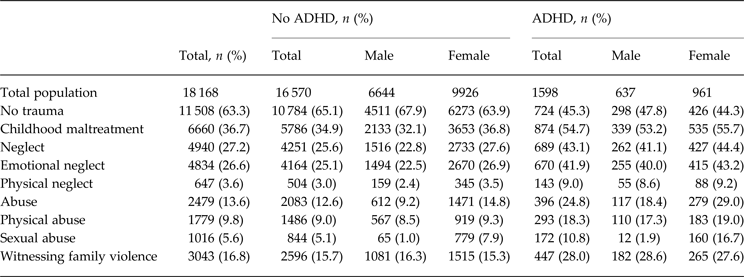
Distribution of childhood maltreatment before age 18 in the population by ADHD symptoms and gender

ADHD, Attention deficit hyperactivity disorder.
CM
CM was assessed retrospectively using self-report items from the Life Stressor Checklist – Revised (LSC-R; Wolfe, Reference Wolfe1997), as described previously (Magnusson et al. Reference Magnusson, Lundholm, Goransson, Copeland, Heilig and Pedersen2011; Forsman & Langstrom, Reference Forsman and Langstrom2012). The STAGE data collection included five CM items, determined with yes/no question(s) as follows: (1) Emotional neglect assessed by: ‘Have you ever been emotionally abused or neglected? For example, being frequently shamed, embarrassed, ignored, or repeatedly told that you were “no good” ’; (2) Physical neglect by: ‘Have you ever been physically neglected? For example, not fed, not properly clothed, or left to take care of yourself when you felt you were too young or ill’; (3) Physical abuse by: ‘Have you ever been physically abused – for example, hit, choked, burned, or beaten or severely punished, for example, locked up in a closet, tied up, or chained – by someone you knew well such as a parent, sibling, boyfriend or girlfriend?’; (4) Sexual abuse assessed by the questions: ‘Were you ever touched or made to touch someone else in a sexual way, because you felt forced in some way or threatened by harm to yourself or someone else?’ and ‘Did you ever have sex because you felt forced in some way or threatened by harm to yourself or someone else? By sex, we mean orally, anally, and/or genitally’. If any of these two questions were answered with ‘yes’, sexual abuse was set ‘yes’; and (5) Witnessing family violence assessed by one question: ‘When you were young, before age 18, did you ever observe physical violence between family members? For example, hitting, kicking or punching’. Subsequent questions were asked to specify when respective maltreatment first occurred by intervals 0–6, 7–12, 13–15, 16–18 or > 18 years.
CM was defined when any item above was answered yes at age under 18. Early childhood maltreatment was defined if maltreatment first occurred before age 7.
CM variables were sub-classified as follows: childhood neglect was defined if emotional or physical neglect or both were present before age 18; childhood abuse if physical and/or sexual abuse were present; while early childhood abuse, respectively early childhood neglect required these adverse experiences to occur before age 7. Neglect and abuse overlapped to a considerable extent, before age 18 years (tetracoric correlation overlap = 0.58), and also before age 7 years (tetracoric correlation = 0.75).
Statistical analysis
We used linear regression models to examine the association in the population between CM and adult ADHD symptoms, used as a standardized continuous variable, by comparing individuals exposed to maltreatment with unexposed individuals. We controlled for the potential confounders sex and age when completing the questionnaire, and for lack of independence of twin data using a cluster-robust sandwich estimator. Regression coefficients and 95% confidence intervals (CIs) were calculated based on robust standard errors.
To assess to what extent the association was due to genetic/familial confounding we used conditional linear regression (within twin-pair analysis), for the association between CM and adult ADHD symptoms within DZ respectively MZ twin pairs discordant for CM. If the association between CM and ADHD in adults mostly reflects causal effects, we would expect the associations to be similar in the population and within DZ (fraternal) and MZ (genetically identical) twin pairs, as genetic similarity between subjects is of no consequence in this case. However, decreasing associations between exposure and outcome, compared to the population association levels, within DZ twin pairs sharing 50% segregating genes and further within MZ twin pairs (in principle genetically identical), suggests confounding by genetic and/or family environmental factors (McGue et al. Reference McGue, Osler and Christensen2010). If the association was entirely due to familial confounding, we would expect zero association within genetically identical MZ pairs. If, however, the association between CM and adult ADHD was partly causal and partly confounded by genetic or family environmental factors, the association would be positive within MZ twin pairs, but lower than that observed for comparisons with unrelated subjects, as well as compared to the within DZ pair association. We also analysed HI and IN ADHD symptom scores separately using the same methods, to determine possible differential association with CM.
Because prior research suggests that type of CM may influence strength of the association with ADHD symptoms (Humphreys & Zeanah, Reference Humphreys and Zeanah2015), we performed sensitivity analyses for neglect and abuse. Our hypothesis was that familial confounding will play an important role in the association, but possibly less so for physical and sexual abuse, in younger children. We also performed a sensitivity analysis, to isolate the effect of maltreatment before age 7. As recall of maltreatment early in life could be influenced by re-traumatization, we controlled for subsequent maltreatment between ages 7 and 18 years.
Results
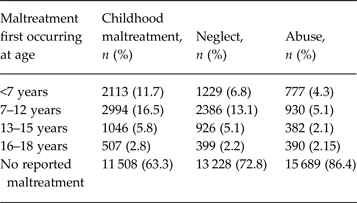
The distribution of CM in the population, by ADHD symptom status and sex is presented in Table 1. Over one third (36.7%) of our total sample, in contrast to over half (54.7%) in the ADHD group reported at least one form of CM before age 18. A substantial subgroup, 26.6% (41.9% in the ADHD group) reported emotional neglect. Abuse was less common: physical abuse 9.8%, sexual abuse 5.6%, and witnessing family violence 16.8% in the population. All forms of CM were more common in the ADHD group compared to the non-ADHD group. Women reported sexual abuse more often than men, both in the whole population 7.9% compared to 1.0%, and in the ADHD group 16.7% compared to 1.9%, respectively (Table 1). Most CM first occurred prior to puberty (Table 2). Participant, born before 1980 (age at data collection >25 years) reported slightly less CM, compared to younger twins [odds ratio (OR) 0.85, 95% CI 0.75–0.97].
Distribution in the population by age at first occurrence of all childhood maltreatment (emotional and physical neglect, physical and sexual abuse, and witnessing family violence), as well as neglect (emotional, physical), and abuse (physical, sexual) separately

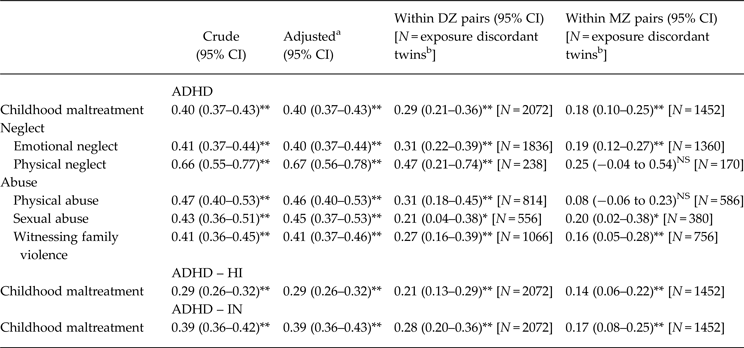
Linear regression (Table 3) revealed an association between CM and ADHD symptoms in adults, with an estimated regression coefficient 0.40 (95% CI 0.37–0.43). Thus individuals exposed to CM had ADHD scores 0.40 s.d. higher than non-exposed individuals. Adjustments for sex and age did not influence the observed association. Separate analysis by sex did not reveal any differences as indicated by overlapping confidence intervals. All subsequent analyses include both males and females and are controlled for sex and age.
Association between adult ADHD symptoms and childhood maltreatment before age 18. Regression coefficients, with 95% confidence intervals from linear regression analysis, crude and adjusted for sex, age and substance misuse, as well as within DZ and MZ twin pairs and for HI and IN ADHD symptom dimensions

ADHD, Attention deficit hyperactivity disorder; CI, confidence interval; DZ, dizygotic (fraternal) twins; MZ, monozygotic (genetically identical) twins; HI, Hyperactive/impulsive symptom dimension; IN, Inattentive symptom dimension.
a Adjusted for sex and age at answering the questionnaire.
b Exposure discordant twins, number of individual twins (participants) from exposure discordant twin pairs in analysis.
NS p > 0.05, * p < 0.05, ** p < 0.01.
Within twin-pair analyses, presented in Table 3, with number of DZ and MZ twins included in the analysis, showed decreasing estimates for DZ pairs (regression coefficient 0.29, 95% CI 0.21–0.36) and MZ pairs (regression coefficient 0.18, 95% CI 0.10–0.25), indicating familial confounding. Nevertheless, the estimates for MZ remained statistically significant, and confidence intervals between DZ and MZ pairs were overlapping, which is consistent with the interpretation that the effects of maltreatment on ADHD scores is partially causal and cannot be entirely explained by familial (genetic and/or environmental) confounding. Similar pattern of results emerged for different types of maltreatment as well as for HI and IN ADHD symptoms respectively (Table 3).
Sensitivity analyses
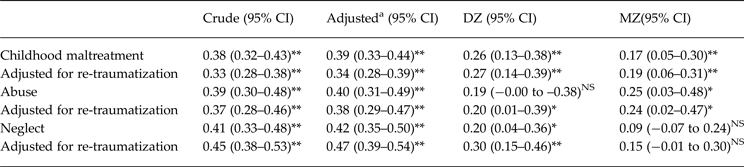
We examined the association between CM before age 7 and ADHD symptoms in adults, controlling for later re-traumatization (Table 4). A similar pattern of results was observed within DZ and MZ twin pairs discordant for the exposure, as in the main analyses (see Table 3), supporting familial confounding and a causal effect associated with early CM, before age 7.
Association between ADHD symptoms in adults and childhood maltreatment before age 7, as well as for abuse and neglect separately, adjusted for re-traumatization after age 7. Regression coefficients, with 95% confidence intervals from linear regression analyses, crude, adjusted for sex, age, and within DZ and MZ twin pairs

ADHD, Attention deficit hyperactivity disorder; CI, confidence interval; DZ, dizygotic (fraternal) twins; MZ, monozygotic (genetically identical) twins.
NS p > 0.05, *p < 0.05, **p < 0.01.
a Adjusted for sex and age at answering the questionnaire.
We then examined the associations for neglect and abuse before age 7. The associations decreased in within twin-pair analyses for DZ and MZ twins (Table 3), for abuse to a point estimate of 0.08 (CI 0.06–0.23), while for physical neglect, the estimate is 0.25, and similar though wider CI (0.04–0.54), due to fewer exposed, and thus lower power, suggesting familial confounding. Within pair estimates for MZ twins were more than zero, for both estimates and statistically significant for abuse (physical and sexual), which is consistent with a causal interpretation. Although estimates were similar for neglect, estimates within MZ twin pairs were not significant (Table 4). It is unclear if this is due to the limited sample size, or if in the case of neglect at such young age, associations are entirely due to familial confounding.
Discussion
Consistent with previous child (Briscoe-Smith & Hinshaw, Reference Briscoe-Smith and Hinshaw2006; Ouyang et al. Reference Ouyang, Fang, Mercy, Perou and Grosse2008) and adult (Rucklidge et al. Reference Rucklidge, Brown, Crawford and Kaplan2006; Sugaya et al. Reference Sugaya, Hasin, Olfson, Lin, Grant and Blanco2012) research, we found that CM was associated with elevated levels of ADHD symptoms in adults. We extend this work by demonstrating that the observed association between CM and ADHD symptoms in adults is partly causal in nature and partly due to familial confounding.
Specifically, our finding that MZ twin-pair estimates remained >0 provides a basis to infer a causal effect of CM on ADHD symptoms in adults. This is consistent with a study on early institutional deprivation and inattention/overactivity symptoms (Stevens et al. Reference Stevens, Sonuga-Barke, Kreppner, Beckett, Castle, Colvert, Groothues, Hawkins and Rutter2008) and with similar findings for other psychiatric conditions (Kendler et al. Reference Kendler, Bulik, Silberg, Hettema, Myers and Prescott2000; Alemany et al. Reference Alemany, Goldberg, Van Winkel, Gasto, Peralta and Fananas2013). Experiencing maltreatment has been suggested to lead to neurocognitive changes that may be adaptive for the child in the short term but which instantiate latent vulnerability to psychiatric disorders (McCrory & Viding, Reference McCrory and Viding2015). Increased vulnerability to ADHD symptoms following maltreatment could arise as a result of alterations in neural pathways implicated in cognitive processes underlying ADHD, such as executive and emotional control, working memory and error processing (Gould et al. Reference Gould, Clarke, Heim, Harvey, Majer and Nemeroff2012; Lim et al. Reference Lim, Hart, Mehta, Simmons, Mirza and Rubia2015), and alterations in inhibitory network connectivity and impulse control (Elton et al. Reference Elton, Tripathi, Mletzko, Young, Cisler, James and Kilts2014). Maltreatment is also associated with epigenetic changes influencing the expression of genes potentially implicated in neurocognitive processes underlying ADHD (Roth & Sweatt, Reference Roth and Sweatt2011; Romens et al. Reference Romens, McDonald, Svaren and Pollak2015). While these preliminary findings suggest possible causal mechanisms, further longitudinal, clinical and functional neuroimaging research is necessary to elucidate how CM may increase levels of ADHD symptoms and also how ADHD in adulthood may differ based on aetiology. Furthermore, although several studies conclude that for research purposes, ADHD can be regarded as a continuum in the population (Thapar & Cooper, Reference Thapar and Cooper2016), and ADHD symptoms in the population share genetic factors with the clinically diagnosed ADHD (Martin et al. Reference Martin, Hamshere, Stergiakouli, O'Donovan and Thapar2014), it will be important to expand and replicate current findings in a clinically diagnosed sample of adults with ADHD. This is especially important as emerging evidence from a recent longitudinal study (Moffitt et al. Reference Moffitt, Houts, Asherson, Belsky, Corcoran, Hammerle, Harrington, Hogan, Meier, Polanczyk, Poulton, Ramrakha, Sugden, Williams, Rohde and Caspi2015), suggests that adult ADHD cases may be different from childhood onset cases. Also, present results could be conflated by unknown environmental risk factors, potentially influencing both ADHD and maltreatment, affecting the causal interpretation.
Our twin analyses, however, also revealed that the association between CM and ADHD symptoms in adults is partly due to familial factors, as indicated by attenuation of estimates within DZ and MZ twin pairs. This is in line with a previous sibling study reporting familial confounding in the association between physical punishment and ADHD (Whitmore et al. Reference Whitmore, Kramer and Knutson1993). This familial confounding could be due to different types of gene–environment correlations (r GE). Passive r GE, in which parents’ genes are correlated with both their children's genes and the environment they create (Neiderhiser et al. Reference Neiderhiser, Reiss, Pedersen, Lichtenstein, Spotts, Hansson, Cederblad and Ellhammer2004; Plomin et al. Reference Plomin, Defries, Knopik and Neiderhiser2013) may be one explanation for the identified familial confounding. Passive r GE has been found to explain part of the intergenerational transmission of externalizing behaviours (Bornovalova et al. Reference Bornovalova, Cummings, Hunt, Blazei, Malone and Iacono2014). Other possible explanations could be non-passive r GE: evocative and active. Evocative r GE occurs when genetic characteristics in the child evoke a certain response from the environment. It is of little importance for severe maltreatment (physical or sexual abuse) according to Jaffee et al. (Reference Jaffee, Caspi, Moffitt, Polo-Tomas, Price and Taylor2004, Reference Jaffee, Caspi, Moffitt, Dodge, Rutter, Taylor and Tully2005), but may play a role in corporal punishment in conduct disorder (Jaffee et al. Reference Jaffee, Caspi, Moffitt, Polo-Tomas, Price and Taylor2004), as well as for the association between hostile parenting style and ADHD symptoms (Harold et al. Reference Harold, Leve, Barrett, Elam, Neiderhiser, Natsuaki, Shaw, Reiss and Thapar2013). Our assumption based on this previous literature was that abuse will more likely be due to idiosyncratic events children could be exposed to and therefore less influenced by genetic factors. In contrast, we found similar patterns of association for the different variables. We cannot however draw any more specific inferences, given lower power, when maltreatment variables were examined separately. However a recent international study (Lansford et al. Reference Lansford, Godwin, Uribe Tirado, Zelli, Al-Hassan, Bacchini, Bombi, Bornstein, Chang, Deater-Deckard, Di Giunta, Dodge, Malone, Oburu, Pastorelli, Skinner, Sorbring, Tapanya and Pena Alampay2015) reported that externalizing behaviour in children, and also parents’ belief in the necessity of using corporal punishment as well as parents’ perception of the normativeness of corporal punishment in their community, predicted maltreatment, suggesting an interplay between r GE mechanisms and cultural aspects and societal norms. In Sweden corporal punishment has been illegal since 1979, the end of the period during which the participants in the current study were born (1959–1985). This possibly explains the somewhat higher prevalence of maltreatment in this population. Attitudes in society changed gradually over several decades from the 1960s to the 1990s (Durrant, Reference Durrant1999). Slightly fewer twins born before the law was changed reported CM, compared to twins born after. As such, we consider it likely that harsh physical punishment was also reported as maltreatment, especially in our younger group. The difference could, however, also be due to the fact that participants in their early 20s easier recall and report events occurring before age 18, compared to older subjects. Evocative r GE is a factor, that may contribute to our results, but we cannot exclude that changes in attitudes also may influence recall and thus our estimates.
Active r GE, where a child selects certain environments as a result of genetically influenced characteristics, represents another potential mechanism. This process is probably less relevant for maltreatment of children before age 7, who are less likely to actively choose harmful environments, unless parenting is insufficient (Jaffee et al. Reference Jaffee, Caspi, Moffitt, Polo-Tomas, Price and Taylor2004; Jay Schulz-Heik et al. Reference Jay Schulz-Heik, Rhee, Silvern, Lessem, Haberstick, Hopfer and Hewitt2009). However, adolescents with ADHD, characterized by impulsivity, low tolerance to boredom, and a higher risk for substance use, may be more prone to select potentially dangerous environments increasing the risk of physical or sexual violence. In light of this putative mechanism, we analysed the effect of CM before age 7 and controlled for later re-traumatization. The pattern of results were similar to that observed in the main analyses, indicating that this form of reversed causation (i.e. adolescent with ADHD actively seeking more harmful environments), cannot entirely explain the observed associations. Clearly future longitudinal, genetically informative studies with prospectively recorded CM are necessary to further investigate mechanisms leading to the observed associations.
Limitations
Similarly to other population-based epidemiological studies, data regarding both ADHD and CM were based on self-report questionnaires. Information on childhood onset of ADHD symptoms as well as the degree of any functional impairment was not available. As our material is population-based and diagnoses were not clinically confirmed, it is possible that the ADHD symptoms group partly cover both subthreshold cases, where ADHD symptoms are present, without reaching a clinical diagnosis and possible phenocopies, where symptoms of inattention and hyperactivity are related to other conditions, such as post-traumatic stress disorder. Longitudinal clinical and population/registry studies are necessary to further clarify the specificity of our findings.
Another important limitation is that CM is retrospectively reported. However retrospectively recorded CM displays acceptable psychometric properties (Hardt & Rutter, Reference Hardt and Rutter2004), although traumatic events tend to be underreported. Use of retrospectively recorded maltreatment data is also supported by a longitudinal study showing that prospectively and retrospectively assessed CM were equally associated with elevated the risk for psychopathology (Scott et al. Reference Scott, McLaughlin, Smith and Ellis2012). The large number of twins discordant on emotional neglect and witnessing family violence, could in part be due to differences in the perception of neglect, rather than the actual experience. Some aspects of maltreatment, such as emotional neglect are more likely to be missed by self-report (Shaffer et al. Reference Shaffer, Huston and Egeland2008), may be more influenced by raters’ perception, as well as recall bias (MacDonald et al. Reference MacDonald, Thomas, Sciolla, Schneider, Pappas, Bleijenberg, Bohus, Bekh, Carpenter, Carr, Dannlowski, Dorahy, Fahlke, Finzi-Dottan, Karu, Gerdner, Glaesmer, Grabe, Heins, Kenny, Kim, Knoop, Lobbestael, Lochner, Lauritzen, Ravndal, Riggs, Sar, Schafer, Schlosser, Schwandt, Stein, Subic-Wrana, Vogel and Wingenfeld2016). However, there is some evidence that perception of maltreatment is important in the prediction of emotional problems later in life (McGee et al. Reference McGee, Wolfe, Yuen, Wilson and Carnochan1995).It has been suggested in clinical populations, that individuals with ADHD have difficulties recalling their childhood. However recall bias does not seem to be specific for the ADHD population. Similar problems have been described in several epidemiological studies, regarding recalls of childhood experience (Coughlin, Reference Coughlin1990).
In contrast to earlier research conducted in Swedish youth (Cater et al. Reference Cater, Andershed and Andershed2014), according to which most victimization of youth occurred in adolescence, we found that first maltreatment most commonly occurred before puberty, in the 7–12 years age group. This has to be regarded in the context of self-reported data, where potential for recall bias may influence memory and reporting of traumatic events.
The prevalence of maltreatment in our population was relatively high 36%, compared to only 16% in British youth (May-Chahal & Cawson, Reference May-Chahal and Cawson2005), probably due to methodological differences, and differences in definition of maltreatment variables, and may limit generalizability of certain results. For instance a high proportion (27%) in the Swedish population reported emotional neglect, thus increasing overall estimates for CM. This variable was not included in the British study, a methodological difference that could explain the lower estimates for CM. Results for physical abuse in our data (9.8%), were lower compared to estimates in Swedish study on adolescents (15.2%) (Annerback et al. Reference Annerback, Wingren, Svedin and Gustafsson2010), but comparable with British data (7%). The level of reported sexual abuse of 5.6% was within the range for prevalence reported in Nordic countries, for both men and women (Kloppen et al. Reference Kloppen, Haugland, Svedin, Maehle and Breivik2016), but lower than 11% in British youth. Results for the association with ADHD symptoms were similar for different forms of maltreatment (physical and sexual abuse) as for CM in general, which indicate that this limitation probably is of less importance.
Our study does not rule out reverse causation. As data was not available we do not know whether trauma occurred before or after debut of ADHD related problems. Evocative and active r GE constitute possible contributing mechanisms. Trauma in older children, and adolescents could at least in part be seen as the result of ADHD-related behaviours, such as impulsivity, inattention, and lack of executive control, which increases risk for potentially harmful and traumatic situations. Another limitation is that we were unable to explore the role of gene–environment interaction (G × E) underlying CM and ADHD. Earlier studies have suggested G × E to underlie the association between conduct disorder and CM (Jaffee et al. Reference Jaffee, Caspi, Moffitt, Polo-Tomas, Price and Taylor2004); however, this could later not be replicated (Kieling et al. Reference Kieling, Hutz, Genro, Polanczyk, Anselmi, Camey, Hallal, Barros, Victora, Menezes and Rohde2013; Haberstick et al. Reference Haberstick, Lessem, Hewitt, Smolen, Hopfer, Halpern, Killeya-Jones, Boardman, Tabor, Siegler, Williams and Mullan Harris2014). The role of this latter mechanism is still unclear for ADHD.
Finally, these results will have been influenced by the limitations inherent in a within twin-pair design. Specifically the factors leading to differences in exposure may also account for differences in outcome (McGue et al. Reference McGue, Osler and Christensen2010). Moreover, a within twin-pair design cannot identify the relative importance of different types of r GE.
In conclusion, our findings indicate for the first time that the association between CM and ADHD symptoms in adults are in part causal and in part attributable to familial confounding. Delineating the nature of this causal relationship is a key task for future research to improve interventions for adults who have experienced CM and present with ADHD symptoms.
Acknowledgements
We acknowledge financial support from the Swedish Research Council – 2014–3831 (Henrik Larsson), and Swedish Research Council funding for clinical research in medicine (ALF grant) – LIO-440851 (Andrea Capusan, Ina Marteinsdottir).
Declaration of Interest
Andrea J. Capusan has received speakers’ fees from Lundbeck, Sweden, outside the submitted work. Henrik Larsson has served as a speaker for Eli-Lilly and has received a research grant from Shire; both outside the submitted work.
Ralf Kuja-Halkola, Preben Bendtsen, Ina Marteinsdottir, Essi Viding, and Eamon McCrory report no potential conflicts of interest.