INTRODUCTION
Rapid germination and seedling emergence are critical factors for successful plant establishment. This is especially true under drought conditions prevailing in arid and semi-arid regions, where poor establishment is a major constraint for crop production (Harris et al., Reference Harris, Joshi, Khan, Gothkar and Sodhi1999). In Jordan, field crops such as wheat and chickpea are amongst the most important rainfed crops grown in dryland areas and are generally sown in November at the beginning of the rainy season. However, it is very common in this region to have a short period of initial rain followed by a dry period of 3–5 weeks. Therefore, if plants achieve rapid germination and establishment during the first rains, then the seedlings are able to develop while the soil conditions are still good and thus are better able to survive the cold stress and dry conditions that may follow (Bort et al., Reference Bort, Araus, Hazzam, Grando and Ceccarelli1998; Klein et al., Reference Klein, Mufradi, Cohen, Hebbe, Asido, Dolgin and Bonfil2002). Another problem faced by many growers in Jordan is that seeds of high value crops such as pepper and watermelon are usually slow and erratic in germination. This problem is usually evident under normal as well as under stressed conditions. However, it is particularly common at sub-optimal temperatures that prevail in the area in late winter and early spring, leading to a serious constraint on efficient management of nurseries and large-scale farms for crop production.
We were not concerned in this work with the various well-known seed priming methods that could be used to enhance seed germination and stand establishment. These have been reviewed extensively in the literature, for example in Ashraf and Foolad (Reference Ashraf and Foolad2005), Khan (Reference Khan1992), McDonald (Reference McDonald, Black and Bewley2000), Pill (Reference Pill and Bastra1995) and Taylor et al. (Reference Taylor, Allen, Bennett, Bradford, Burris and Misra1998). Our aim in this study was to test the ultrasound (US) technique in seed germination. This technique is unique among existing seed pretreatment methods in that it is simple, cheap, environmentally friendly and multifunctional. Therefore, attempting to set the stage for its use in Jordan and similar countries seemed to be worthwhile.
Ultrasound is a novel physical method that involves the application of sound frequencies in the inaudible range (20–100 kHz) to interact with the materials. Besides the vast number of applications in chemical and applied industries, this technique has several emerging applications in the field of agriculture and food industry (Benedito et al., Reference Benedito, Carcel, Gonzalez and Mulet2002; Gaba et al., Reference Gaba, Kathiravan, Amutha, Singer, Xiaodi, Ananthakrishnan, Dutta and Ibaraki2008; Mason and Povey, Reference Mason and Povey1998). Ultrasound treatment to stimulate germination has been investigated in many seed types including carrot, radish, maize, barley, rice and sunflower (Aladjadjiyan, Reference Aladjadjiyan2002; Carbonell et al., Reference Carbonell, Martinez and Amaya2000; Flórez et al., 2006; Hebling and da Silva, Reference Hebling and da Silva1995; Miyoshi and Mii, Reference Miyoshi and Mii1988; Shimomura, Reference Shimomura1998; Shors et al., Reference Shors, Soll, Daniels and Gibson1999; Yaldagard et al., Reference Yaldagard, Mortazavi and Tabatabaie2008a; Reference Yaldagard, Mortazavi and Tabatabaie2008b). Results of these investigations indicated that the effects of US on seed germination depend on frequency and exposure time and appear to vary widely between the different species and cultivars.
To our knowledge, the literature on the use of US to enhance seed germination of our crops of interest, such as chickpea, wheat, pepper and watermelon, is rather scarce. Therefore, this research aimed to determine whether US irradiation is usable as a seed priming method for these crops. The feasibility of this method was evaluated under favourable (20 °C) and unfavourable (15 °C) germination temperatures. Additionally, as the US machine used in this study was a simple cleaning devise where US irradiation takes place in a water bath, we also ran parallel treatments in which seeds were soaked in water only. This was important in order to eliminate the effect of water in the US treatments. These soaking in water only treatments eventually provided additional insights on the effects of hydropriming on the germination of these seeds as well.
MATERIALS AND METHODS
Seed materials
Seeds of local cultivars of chickpea (Cicer arietinum) cv. Jubeiha 2 and wheat (Triticum aestivum) cv. Hourani were obtained from the National Center for Agricultural Research and Extension, Amman, Jordan. Pepper (Capsium annuum) cv. Mustang (Tezier, France) and watermelon (Citrullus vulgaris) cv. Sugar Delicata (Sakata, USA) were donated by the Agricultural Materials Co. (Miqdadi), Amman. Seeds were produced the same year that they were used.
Instrumentation
Ultrasonic irradiation was produced by a bench-top bath sonicator (3069 USC3, Rapidograph Inc., NJ, USA) mainly designed for cleaning purposes with 100 watt output, 40 kHz frequency, 220 V 50 Hz power supply and 176 × 164 × 100 (height) mm tank dimensions.
Seed treatment
All tests were performed on samples (60 seeds for each treatment) dispersed in 100 ml of distilled water with direct sonication for 0, 5, 10, 15, 30, 45 and 60 min. To rule out the effect of water in these tests, a control replicate of each test was soaked in a similar volume of water but without sonication. Water circulating in ultrasonic equipment as well as in the water bath was kept at 25 ± 1 °C. Two sets of experiments were performed under different germination temperatures (15 or 20 °C) as described below. The experiment was repeated twice with four replicates for each treatment.
Determination of seed moisture content
Seed moisture content (SMC) was determined for 10 seeds taken from each sample immediately after treatment. These seeds were blotted on a filter paper to remove excess water, weighed, oven dried at 105 °C for 72 h and then weighed again. Moisture contents of these seeds were estimated as percentages.
Germination tests
Germination tests were performed immediately after treatment under laboratory conditions. Seeds were placed between folded germination filter papers (Albet 150, Albet LabScience, Germany) moistened with distilled water inside labelled plastic boxes (17 × 11 × 7 cm). These boxes were put in an incubator at 15 or 20 °C. Germination counts and characterization of seedlings were made daily until germination ceased (8 days for chickpea, wheat and watermelon; and 12 days for pepper). The total number of seeds that germinated to normal seedlings were evaluated at the end of test period according to the criteria of AOSA (1986) and expressed as germination percentage (GP). Speed of germination, the average number of days required for seeds to germinate, was expressed as the germination rate index (GRI) (Maguire, Reference Maguire1962):

where x: number of days after seeding.
Statistical analysis
Data were subjected to analysis of variance (ANOVA) using JUMP 5.0 (SAS Institute, Cary, NC, USA). Data for seed moisture content were analysed as outlined for a completely randomized design. The design for standard germination was a split-split arrangement in a completely randomized design with four replications. The main factor was the treatment, the split factor temperature and the split-split factor duration. The effect of treatment, temperature, duration and their interaction was calculated using the Student t-test at ≤0.05 probability level.
RESULTS
Effects on germination percentages
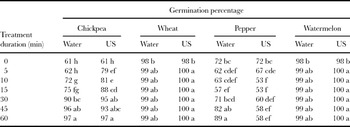
US versus water treatment: Table 1 shows effects of the different durations of US treatment compared to water soaking on the GP of the four tested crops. For chickpea seeds, the GP value in both the water and US treatments increased with increasing treatment duration, reaching the limit (>90%) at 30 min. This GP value was approximately 50% above that of the control seeds (61% GP).
Germination percentages of chickpea, wheat, pepper, and watermelon seeds exposed to different durations of two treatments: seeds soaked in water (Water) or soaked in water in ultrasonic device (US).

Means within columns indicated by different letters are significantly different according to Least Squares Means Differences (Student's t-test) (p = 0.05).
Wheat and watermelon seeds showed a similar germination pattern in all treatments. Non-treated seeds of both crops germinated quite well (98% GP). However, a short duration (5 min) of either treatment raised the GP to the maximum limit (100%).
Only water soaking treatment was successful in improving the GP of pepper seeds, with the highest GP (82–89%) achieved by 45 min treatment. Alternatively, longer than 5 min of US treatment had a negative impact on pepper GP, producing significant decreases of about 12–19% compared to the control.
US treatment and germination temperature: The effect of interaction between treatment type and germination temperature on the GP was most pronounced for US-treated chickpea seeds (Figure 1). When the temperature was changed from 15 to 20 °C, the GP of these seeds increased from 74 to 96% (~30% increase), with the latter value being the highest among all treatments. When considering US exposure time in data analysis, a positive effect of the high temperature was found for all treatment durations except for 60 min (data not shown). At the latter duration, maximum GP (100%) was achieved irrespective of germination temperature. In contrast, the GP of water- and non-treated chickpea seeds was unaffected by temperature being in the range of 75–79% and 56–65%, respectively. The GP in the water treatment was significantly higher (>20%) than in the control (Figure 1). However, this GP value was equal to that in the US treatment at 15 °C, but 34% lower than that at 20 °C.
Germination percentages (GP) of chickpea, wheat, pepper and watermelon seeds soaked in water (Water) or in water in ultrasonic device (US) and incubated at 15 or 20 °C. Means represented by bars indicated by different letters are significantly different according to Least Squares Means Differences (Student's t-test) (p = 0.05).

The GP of wheat, watermelon and pepper was little affected by germination temperature (Figure 1). As indicated for wheat and watermelon, the higher temperature slightly increased the GP (<3%) in the control and water treatments to a level equal to that reached in the US treatment. For pepper seeds, however, US treatment had a negative impact on GP, producing an 8–22% decrease at both temperatures.
Effects on germination rate index
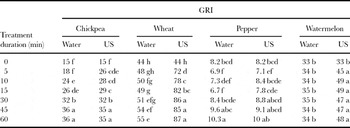
US versus water treatments: A GRI increase was noted in US treatments of all tested crops except pepper (Table 2). For chickpea, the GRI in both US and water treatments increased with increasing treatment duration, reaching an equal level (GRI = 32) at 30 min. The highest GRI (35–36), however, was obtained at 45 min (and after) in both treatments, reaching 133% above control (GRI = 15).
Germination rate index (GRI) of chickpea, wheat, pepper, and watermelon seeds exposed to different durations of two treatments: seeds soaked in water (Water) or soaked in water in ultrasonic device (US).

Means within columns not followed by same letters are significantly different according to Least Squares Means Differences (Student's t-test) (P = 0.05).
Both water and US treatments significantly increased the GRI of wheat, albeit to a higher extent by the latter treatment. Of all US durations, the highest GRI (>80) was obtained by 30 min (or longer) treatment. In the water treatment, the maximum GRI was in the range of 50–55, obtained at 30 min and after. This GRI value is approx. 35% lower than that achieved by US at the same time period.
Only US treatment produced a GRI increase for watermelon seeds. The GRI of this crop reached the maximum (>45) after only 5 min treatment and remained constant thereafter. This GRI was 30% higher than that of the control (GRI = 33) or water treatment (GRI = 34–35). In the latter treatment, the GRI value was equal at all durations.
Neither US nor water had a significant effect on the GRI of pepper seeds. However, a marginal increase was noticed in both treatments as duration time increased.
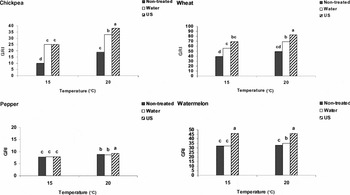
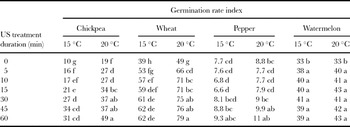
US treatment and germination temperature: The interaction effects of treatment type × germination temperature on the GRI of the four crops are shown in Figure 2. For chickpea, in control, water and US treatments GRI at 15 °C and 20 °C rose from 10 to 19 (90% increase), from 25 to 33 (32% increase) and 25 to 38 (52%), respectively. At 20 °C, 30 min (or longer) of US treatment was required to attain maximum GRI (Table 3).
Germination rate index (GRI) of chickpea, wheat, pepper, and watermelon seeds soaked in water (Water) or in water in ultrasonic device (US) and incubated at 15 or 20 °C. Means represented by bars indicated by different letters are significantly different according to Least Squares Means Differences (Student's t-test) (p = 0.05).

Germination rate index of chickpea, wheat, pepper, and watermelon seeds exposed to different durations of ultrasound (US) treatment and incubated at two germination temperatures; 15 or 20 °C.

Means within columns not followed by same letters are significantly different according to Least Squares Means Differences (Student's t-test) (P = 0.05).
The GRI of wheat had a similar pattern to chickpea, being higher at 20 °C than at 15 °C in the US and water treatments but not in the control. Also, US treatment of wheat seeds produced the highest GRI at both 15 and 20 °C (69 and 83, respectively) (Figure 2). At 15 °C, however, the GRI (69) was not significantly different from that in the water treatment (56). At 20 °C, on the other hand, it was 20% higher. Ultrasound treatment duration of 30–60 min (at 20 °C) was required to achieve the maximum GRI (Table 3).
There was no effect of temperature on the GRI of watermelon seeds in any of the treatments. In general, US treatment (for 5 min or longer) produced >40% increase above the control and water treatments at both temperatures (Figure 2, Table 3). For pepper seeds, a slight but significant GRI increase in the range of 0.8 (water) to 1.4 (US) was noted at 20 °C compared to 15 °C (Figure 2).
Effects on seed moisture content
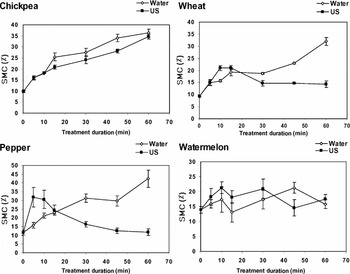
Both water and US treatments had a similar effect on the SMC of chickpea (Figure 3). Before any treatment, seed moisture was 9.9%. With increasing treatment time, seed moisture had a progressive increase, reaching approximately 35% at 60 min in both treatments. However, 15–45 min soaking produced a 3–6% higher SMC than that of US treatment.
Seed moisture content (MC) on a wet-weight basis of chickpea, wheat, pepper, and watermelon seeds soaked in water (Water) or soaked in water in ultrasonic device (US) for 0–60 min. Bars are standard error of the mean (n = 4).

The SMC of wheat and pepper seeds followed a completely different pattern (Figure 3). In the control seeds, SMC was 9.2 and 11.5%, respectively. With short US treatment (10 min), the SMC of these crops increased significantly to 21.2 and 15.7% (in water treatment) and to 21 and 30.6% (US treatment), respectively. However, further US treatment (15 min onward) of these seeds, caused a gradual decrease in the SMC, ending at 14.3 and 11.8%, respectively. In contrast, longer water treatment of these seeds lead to a continued increase in their SMC eventually reaching 32 and 42.4%, respectively.
Watermelon seeds behaved similarly to wheat and pepper seeds. With short durations (5–10 min) of either water or US treatment, the moisture content of these seeds rose from 13.9% in the control to 17.3 and 21.3%, respectively (Figure 3). However, with longer durations of either treatment these SMC levels remained unchanged.
DISCUSSION
Different mechanisms have been proposed for the biological action of US on seed germination. It is generally believed that US exerts its major effects by inducing acoustic cavitations (transient or collapse cavitations), which brings about temperature and chemical effects on cells or tissues (Gaba et al., Reference Gaba, Kathiravan, Amutha, Singer, Xiaodi, Ananthakrishnan, Dutta and Ibaraki2008; Joersbo and Brunstedt, Reference Joersbo and Brunstedt1992; Moussatov et al., Reference Moussatov, Granger and Dubus2005; Suslick, Reference Suslick1990). An example of such effects is the enhanced rate of enzyme-catalyzed reactions such as the hydrolysis of starch by α-amylase, an enzyme that plays a key role in seed germination of cereals (Apar et al., Reference Apar, Turhan and Özbek2006). By the same token, Yaldagard et al. (Reference Yaldagard, Mortazavi and Tabatabaie2008a) indicated that mild US irradiation on barley seeds produced an accelerated germination proportional to an increase in α-amylase activity. Another possible mechanism for US enhancement of seed germination is the mechanical or shear effects due to the large and rapid oscillations in bubble size (microstreaming), which leads to disruption of plants cell walls, thereby increasing water uptake by the cell/seed (Baker et al., Reference Baker, Robertson and Duck2001; Gaba et al., Reference Gaba, Kathiravan, Amutha, Singer, Xiaodi, Ananthakrishnan, Dutta and Ibaraki2008). In the present study, US treatment increased the moisture content of all tested seeds during the early periods of treatment. This result supports the hypothesis that US increases water uptake by seeds.
The GRI increase in US-treated chickpea seeds was not due to US treatment. This is because a similar GRI increase was attained by water soaking; thus, it was most likely due to the effect of water rather than to sonication per se. Hydration of seeds by soaking in water for various periods without allowing radicle emergence, a process called ‘hydropriming’, is one method of seed priming (imbibition in water or osmotic solutions followed by redrying), which generally accelerates germination rates upon subsequent re-imbibition (Ashraf and Foolad, Reference Ashraf and Foolad2005; Khan, Reference Khan1992; McDonald, Reference McDonald, Black and Bewley2000; Taylor et al., Reference Taylor, Allen, Bennett, Bradford, Burris and Misra1998). In general, the beneficial effects of seed priming are suggested to be due to the initiation of metabolic activity and induction of the DNA cell cycle events leading to improved rate and uniformity of seed germination (McDonald, Reference McDonald, Black and Bewley2000).
Results of this study reiterated the benefits of hydropriming on the germination rate of chickpea and wheat seeds, albeit for wheat, to a lesser extent than in the US treatment. These results are in agreement with previous reports that indicated the benefits of hydropriming for several crops (such as chickpea, wheat, rice and maize) as enhanced germination and seedling establishment lead to faster development and higher yields (Harris et al., Reference Harris, Raghuwanshi, Gangwar, Singh, Joshi, Rashid and Hollington2001; Reference Harris2006; Kaur, et al., Reference Kaur, Gupta and Kaur2005). Consequently, these reports recommended hydropriming in the form of soaking seeds overnight in water, surface-drying and then sowing them as ‘on-farm’ seed priming for these crops. This study, however, showed US treatment of wheat as well as watermelon seeds prior to sowing, for only 30 and 5 min, respectively, could increase GRI to the maximum level. Hence, US priming as performed in this study could provide a faster on-farm priming method of these crops. This is especially true as the US device used in this study is simple, affordable and durable so it can be easily adopted by the average farmer.
Unlike in the US treatment, watermelon seeds did not respond to water soaking even at the longest duration (60 min). This is probably because this 60-min period was not long enough to overcome the mechanical resistance imposed by the hard thick seed coats of these seeds (Zheng et al., Reference Zheng, Li, Xu, Adkins, Navie and Ashmore2007). Extending the duration of water treatment should be tried to see if germination rate could be further enhanced. In this regard, salt priming (osmopriming) of watermelon seeds has been suggested to be more successful than hydropriming (Demir and Kazim, Reference Demir and Kazim2004). In this study, results indicated that US treatment for as little as 5 min also offers a practical priming option to speed up germination of watermelon seeds.
In addition to reducing germination time for chickpea seeds by water treatment, this study indicated an increase in their GP (60% above control) as well. Similar increase in GP was also obtained for water-treated pepper seeds. There are several indications that seed priming involves many physiological mechanisms including repair of deteriorated seed parts that might have accumulated in some seeds during development, thereby the seeds regain their ability to germinate (Burgass and Powell, Reference Burgass and Powell1984). Alternatively, water soaking could have improved germination by removing residual amounts of water soluble germination inhibitors from seed coats or by reducing leakage of metabolites from the seeds (McDonald, Reference McDonald, Black and Bewley2000).
The beneficial effects of US and water treatment on the germination rate of chickpea and wheat seeds were observed at both unfavourable (15 °C) and favourable (20 °C) germination temperatures, with greater benefits obtained at the latter. For watermelon seeds, on the other hand, US improvement occurred equally at both temperatures. These results are consistent with findings for other agricultural crops that priming in general can improve germination in unfavourable environmental conditions, such as suboptimum temperatures (Korkmaz, Reference Korkmaz2006; Welbaum and Bradford, Reference Welbaum and Bradford1991). Thus, US priming can also be a practical option for overcoming sluggish germination at the low germination temperatures that sometimes prevail in the area.
In this study, the moisture content of US-treated seeds of wheat and pepper increased at shorter treatment durations (5–10 min) but decreased afterwards. One possible explanation could be that the mechanical effects (microstreaming) produced by sonication for short periods were enough to produce small holes in the seeds coats which accelerated the imbibition of water through the pericarp, consequently causing a significant rise in their seed moisture. However, prolonged exposure of these seeds to US irradiation might have lead to much cell wall disruption that allowed greater accessibility of cell membranes to the effects of US, thus increasing their permeability and finally leading to post treatment water leakage (Baker et al., Reference Baker, Robertson and Duck2001). Such effects on cell membranes could also explain the negative impact of US on pepper seed germination. It is possible that the conditions of US exposure employed in our tests were too extreme to be tolerated by the small and fragile seeds of pepper leading to lysis of cells.
Results of this research indicated that US treatment effectively enhanced speed of seed germination of chickpea, wheat and watermelon (but not pepper) to varying degrees. This increase in speed of germination could have a positive impact on the success of early field establishment of these crops leading to higher yields. In addition, these profitable effects of US were obtained at both favourable and unfavourable temperatures, thus expanding the temperature range at which germination may occur. As such, this technique may also be very useful for plant propagators in nurseries to achieve fast seedling establishment of watermelon. Further investigation is needed to determine US effects on these crops in the field.