Introduction
Polypropylene (PP), a thermoplastic resin prepared by propylene, possesses many advantages, including excellent mechanical properties, simple processing, and low price, which make PP one of the fastest growing and most promising resin among the five general synthetic resins of PP, polyethylene, polyvinyl chloride, polystyrene, and ABS resin [Reference Wang, Niu and Li1, Reference Zhou, Zhao and Xin2, Reference Misztal-Faraj3, Reference Chen, Dai, Yang, Huang, Zhang and Wang4, Reference Latiff, Mohamad, Jeefferie, Nasir, Siti Rahmah, Mahamood, Chua Abdullah and Ab Maulod5]. Up to now, PP has shown great development potential in the automotive sector [Reference Tate, Adams and Burns6], pipeline transportation [Reference Guidetti, Rigosi and Marzola7], tableware [Reference Valentina, Ignazio, Santina, Urszula and Marco8], and many other fields. However, the toughness of pure PP is poor, especially at low temperature and high strain rate, which have limited its application in engineering [Reference Zhang and Xin9, Reference Kotek, Raab, Baldrian and Grellmann10, Reference Wei, Zhang, Chen, Liang, Yang, Wang and Liu11]. Therefore, many methods have been proposed to tackle this challenge.
As we all know, PP is a semi-crystalline polymer with five crystal forms of α, β, γ, δ, and quasi-hexagonal [Reference Busico and Cipullo12, Reference Claudio and Finizia13]. Among these crystal forms, β-crystal has excellent toughness; its toughening effect could be attributed to the morphology of spherulites and phase transformation [Reference Kotek, Raab, Baldrian and Grellmann10, Reference Aboulfaraj, G’Sell, Ulrich and Dahoun14]. Therefore, β-crystal PP has received considerable interests ever since the discovery of β-crystal formation [Reference Wei, Zhang, Chen, Liang, Yang, Wang and Liu11, Reference Zhao, Cai and Xin15, Reference Kang, He, Chen, Yu, Chen, Yang, Cao and Xiang16, Reference Varga and Menyhárd17, Reference Cao, Feng and Wu18, Reference Sun, Li, Yao and Hu19, Reference Stocker, Karakaya, Schürmann, Rabe and Schlüter20]. However, due to its lower stability than other crystals such as α-crystals, β-crystals can only be formed under specific conditions such as quenching the melt to a particular temperature range [Reference Keith21], shear or elongation of the solution [Reference Varga and Karger-Kocsis22], or adding β-nucleating agent [Reference Wang, Niu and Li1, Reference Kotek, Raab, Baldrian and Grellmann10, Reference Wei, Zhang, Chen, Liang, Yang, Wang and Liu11, Reference Claudio and Finizia13, Reference Aboulfaraj, G’Sell, Ulrich and Dahoun14, Reference Zhao, Cai and Xin15, Reference Kang, He, Chen, Yu, Chen, Yang, Cao and Xiang16, Reference Varga and Menyhárd17, Reference Cao, Feng and Wu18]. Among these methods, the addition of β-nucleating agents is the most effective to obtain a high level of β-crystals. Meanwhile, β-nucleating agent also shows many advantages such as easier operation procedure, less usage amount, more stable β-crystal yield, and higher β-nucleation efficiency [Reference Yang, Chen, Liang, Zhang and Mai23, Reference Yang, Li, Chen, Yang, Huang, Liu and Wang24, Reference Zhang, Chen, Wang, Guo and Mai25]. Among all compounds acting as β-nucleating agents which have been reported, the first effective β-nucleating agent is γ-quinacridone, which is reported by Leugering in the 1960s [Reference Leugering26]. However, γ-quinacridone is a dye material, whose intrinsic color limits further applications. Meanwhile, several two-component β-nucleating agent, namely, suberic acid and its salts [Reference Li, Hu, Ji, Huang and Zhou27], glutaric acid and its salts [Reference Dou28], and pimelic acid and calcium stearate [Reference Varga29], were reported. These β-nucleating agents have been categorized as a class containing certain salts of Group IIA metal elements and complexes of dicarboxylic acids. Unfortunately, the content of β-crystal in the above nucleating agent is low; moreover, α-crystal is always formed along with the formation of β-crystal, which prevents PP from increasing the impact strength. Therefore, a highly active β-nucleating agent for PP crystalization is highly expected. Recently, many researchers found that zinc adipate prepared by in situ method can serve as highly active and selective β-nucleating agent to apply adipic acid and zinc oxide together to prepare zinc adipate as β-nucleating agent for PP [Reference Yang, Zhang, Qin, Xin, Zhao, Chen and Zhou30, Reference Zhao, Gong, Yu, Xin, Sun, Zhou and Shi31, Reference Yang, Xin, Zhao, Shi, Zhou, Zhou and Ye32], and it is found that the dispersibility of zinc adipate formed by in situ method in melt extruder was superior than that of solution method, leading the rationale that zinc adipate prepared by in situ method displayed better nucleating effect than the solution method. However, systematically, studies are still missing, especially the effects of different kinds of zinc compound and the molar ratio of adipic acid to zinc compound on zinc adipate as β-nucleating agents. It is important to understand the optimal formula of zinc adipate as β-nucleating agents for PP, which will increase the high impact of industrial application of zinc adipate as β-nucleating agents.
Based on the comparison of existing research studies, it is believed that due to the low decomposition temperature of zinc hydroxide (125 °C), zinc hydroxide is easily decomposed into zinc oxide formation, with a small degree of polymerization at the processing temperature (230 °C). Compared with directly using ZnO particles, which may cause the steric hindrance, so it can easily react with the adipic acid and improve the dispersibility of zinc diacid in PP, therefore, zinc hydroxide is selected as the zinc source of zinc adipate in this work. Additionally, the preparation of zinc adipate as β-nucleating agents by in situ method with adipic acid and zinc hydroxide has rarely been reported, so the preparation of zinc adipate by in situ method using zinc hydroxide and adipic acid as precursor was the focus of this study. Meanwhile, both zinc oxide and zinc hydroxide were used as zinc source to study the effects of different compounds on zinc adipate as β-nucleating agents. Furthermore, the evaluation also been performed to the zinc adipate as β-nucleating agent prepared by as commercial available β-nucleating agent (named CNA). Then, the molar ratio between adipic acid and zinc compound was systematically studied. Finally, the effects of optimum ratio of β-nucleating agent on the mechanical properties, crystallization properties, crystal morphology, and nonisothermal crystallization kinetics of PP were systematically investigated as well.
Results and discussion
Structural characterization of zinc-type β-nucleating agent
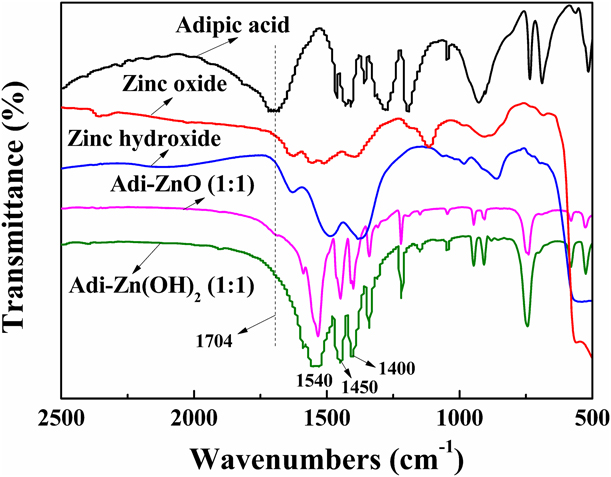
The FTIR spectras of adipic acid, zinc oxide, zinc hydroxide, and zinc-type β-nucleating agent [Adi-ZnO (1:1) and Adi-Zn(OH)2 (1:1)] are shown in Fig. 1. As shown in Fig. 1, the FTIR spectras of Adi-ZnO (1:1) and Adi-Zn(OH)2 (1:1) were identical, which indicated that the structure of Adi-ZnO (1:1) and Adi-Zn(OH)2 (1:1) was the same. By comparing the FTIR spectra of adipic acid, zinc oxide, and zinc hydroxide, two new characteristic bands appeared in the FTIR spectras of Adi-Zn(OH)2 (1:1) and Adi-ZnO(1:1) at 1540 and 1400 cm−1, and the characteristic bands at 1540 and 1400 cm−1 were attributed to the antisymmetric stretching vibration and the symmetric stretching vibration peak of C=O bond in the carboxylate, respectively. Moreover, the characteristic band of Adi-Zn(OH)2 (1:1) and Adi-ZnO(1:1) around 1450 cm−1 was attributed to the vibration absorption peak of Zn–O bond, which proved that Adi-Zn(OH)2 (1:1) and Adi-ZnO (1:1) prepared by the in situ method were zinc adipate. Compared with that of Adi-ZnO (1:1), the stretching peaks of C=O (carbonyl group in adipic acid) at 1704 cm−1 of Adi-Zn(OH)2 (1:1) were almost vanished, which demonstrated that the reaction of adipic acid in Adi-Zn(OH)2 (1:1) was more complete during in situ reaction.
FT-IR spectra of zinc-type β-nucleating agent.

Effect of zinc-type β-nucleating agent on mechanical properties of PP
It is important to study the effect of β-nucleating agent to correlate to the mechanical properties of PP. As we all know, the mechanical properties are determined by the nucleating properties of nucleating agents. To further study the application of zinc-type β-nucleating agent, the commercially available β-nucleating agent (CNA) was used as a reference. The effect of mass fraction of β-nucleating agent [CNA, Adi-ZnO (1:1) and Adi-Zn(OH)2 (1:1)] on the mechanical properties of PP was explored and shown in Fig. 2.
The influence of concentration of β-nucleating agent on the mechanical properties of PP. (a) Impact strength of PP, (b) tensile strength of PP, and (c) flexural modulus of PP.

As shown in Fig. 2(a), the impact strength of nucleated PP all showed a tendency to increase first and then decrease. It was observed that the PP nucleated by Adi-ZnO (1:1) [PP/Adi-ZnO (1:1)] and Adi-Zn(OH)2 (1:1) [PP/Adi-Zn(OH)2 (1:1)] exhibited higher impact strength than the PP nucleated by CNA (PP/CNA) in the range of concentration of β-nucleating agent. Meanwhile, compared with other β-nucleating agents, Adi-Zn(OH)2 (1:1) showed more superior β-nucleation performance, and the maximum impact strength of Adi-Zn(OH)2 (1:1) was 33% and 10% higher than that of PP/CNA and PP/Adi-ZnO (1:1), respectively. Furthermore, the maximum impact strength of PP/Adi-Zn(OH)2 (1:1) was 2.3 times higher than the impact strength of pure PP. For Adi-Zn(OH)2 (1:1), it showed better nucleating performance than Adi-ZnO (1:1). It is possibly because the decomposition temperature of zinc hydroxide was low (125 °C). During processing temperature (230 °C), zinc hydroxide was first decomposed to form ZnO particles with a small degree of polymerization. Compared with the directly added ZnO particles, due to the small volume of the decomposed ZnO, the steric hindrance suffered during the movement was correspondingly low, and it could easily move around and react with the molten adipic acid (the melting temperature of adipic acid was 152 °C), which fully improved the dispersibility of zinc diacid in PP. Therefore, the nucleation performance of Adi-Zn(OH)2 (1:1) was better than that of the ZnO particles in situ formed by zinc adipate.
Although β-crystal could obviously improve the toughness, the “soften” behavior of β-crystal PP also caused a moderate decrease in intensity and stiffness. It could be seen from Figs. 2(b) and 2(c) that the tensile strength and flexural modulus of nucleated PP all showed a tendency to decrease first and then increase. Because of the conflict between rigidity and toughness, it was difficult to improve both of them at the same time. In addition, since the impact strength of PP/Adi-Zn(OH)2 (1:1) was higher than that of PP/CNA, the PP/Adi-Zn(OH)2 (1:1) showed lower rigidity.
Based on the above analysis, Adi-Zn(OH)2 (1:1) has better and optimal β-nucleation performance than CNA and Adi-ZnO (1:1), which confirmed the selection of adipic acid and zinc hydroxide as our main focus. Then, the molar ratio of adipic acid to zinc hydroxide was investigated and prepared into corresponding β-nucleating agent. Finally, the effects of prepared β-nucleating agent on the mechanical properties, and crystallization properties of PP were systematically investigated.
Effect of different ratios of adipic acid and zinc hydroxide on the mechanical properties of PP
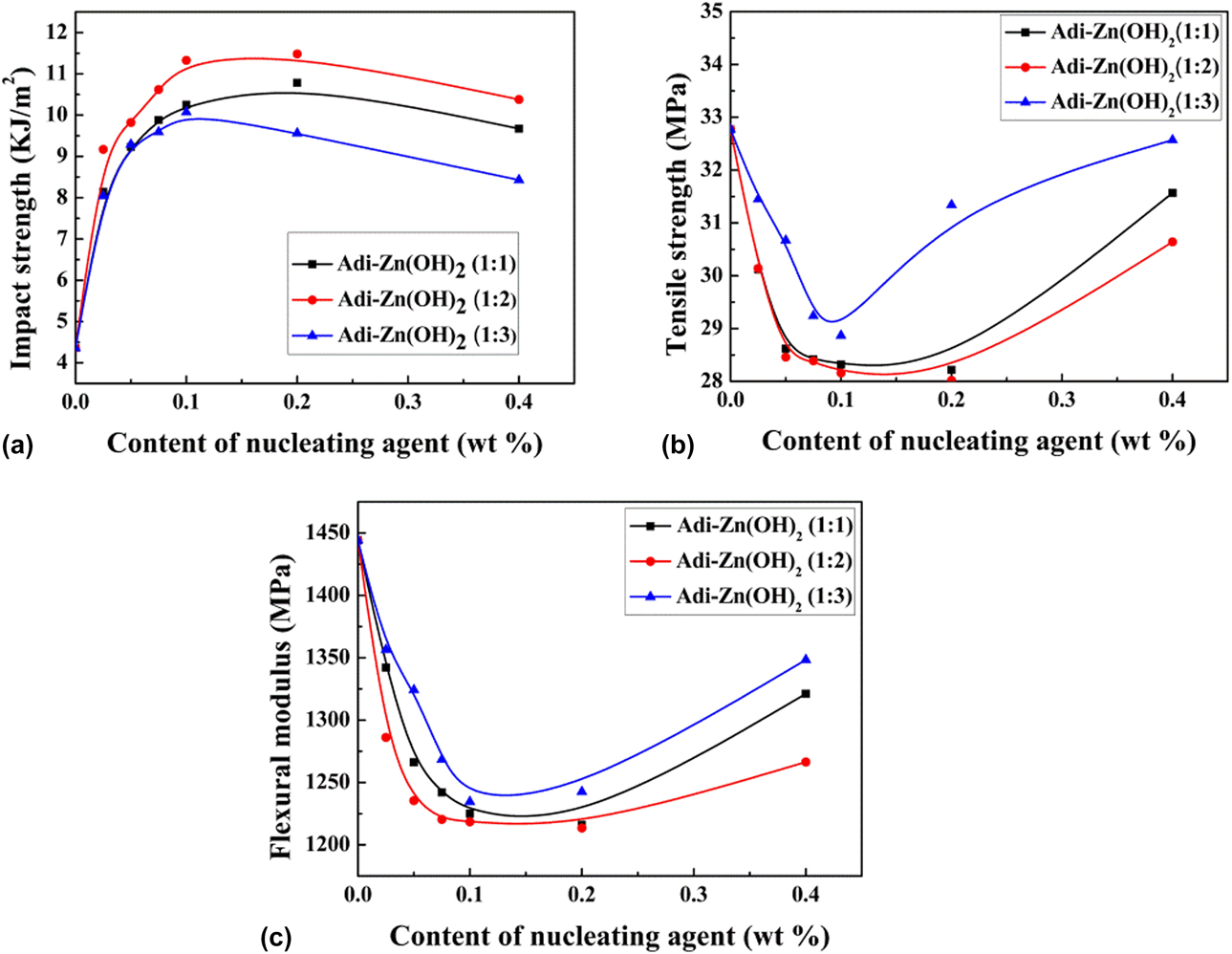
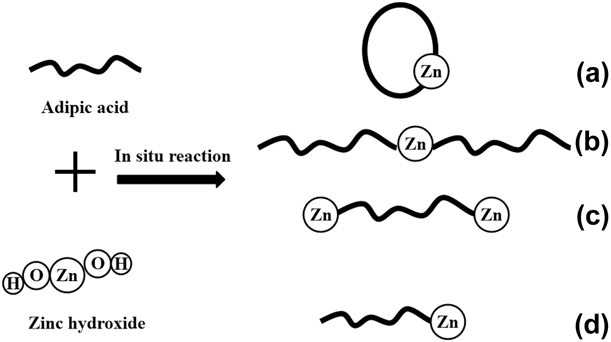
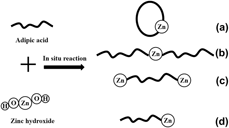
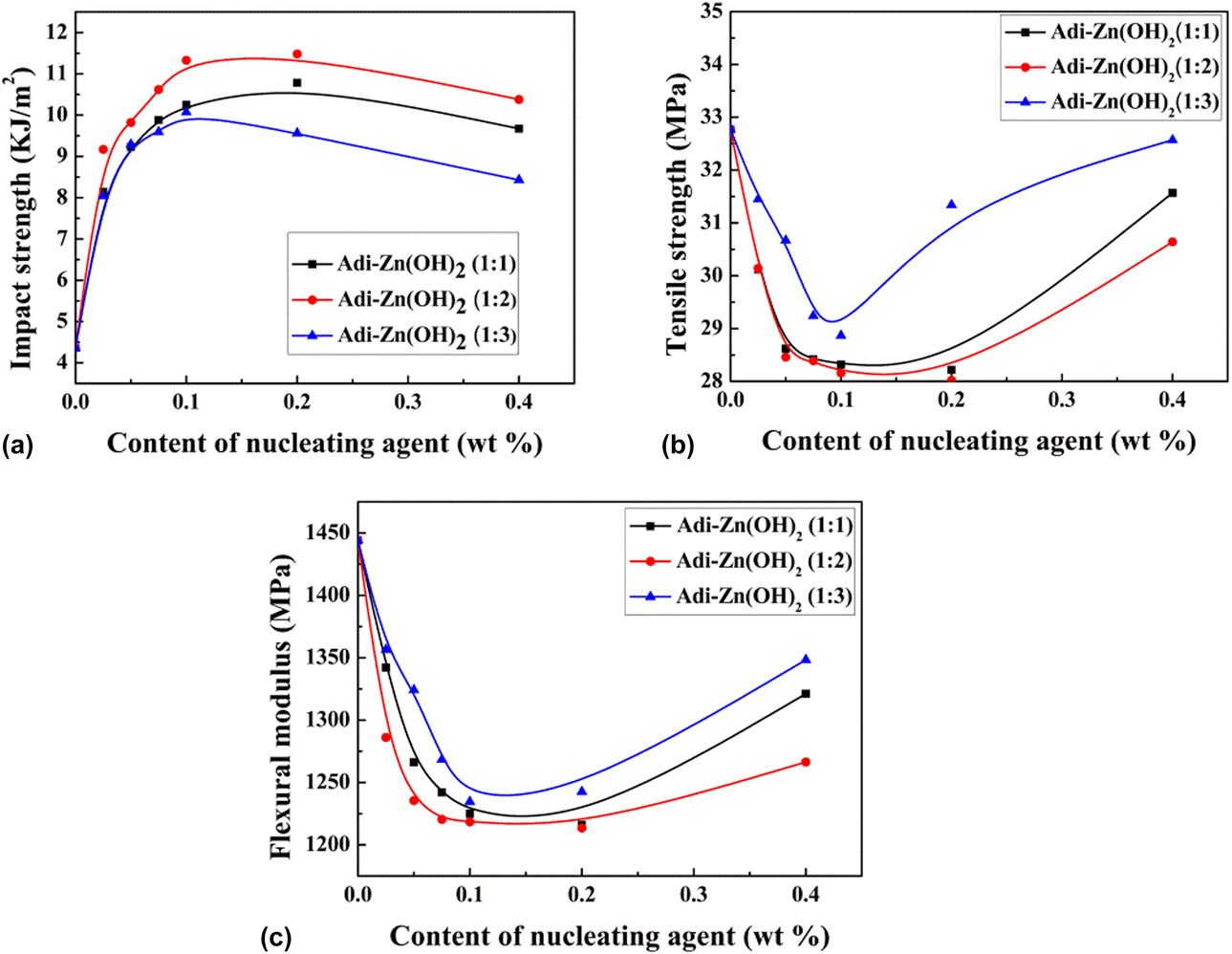
The effects of different ratios of adipic acid and zinc hydroxide on mechanical properties of PP were fully explored [Figs. 3(a)–3(c)]. It showed that with the increase of β-nucleating agent, the impact strength of nucleated PP all increased dramatically to the maximum value, and then decreased gradually [Fig. 3(a)]. At the concentration of 0.2 wt%, the impact strength of PP/Adi-Zn(OH)2 (1:2) increased about 2.6 times of pure PP. It also can be found that the impact strength of PP/Adi-Zn(OH)2 (1:2) was significantly higher than that of both PP/Adi-Zn(OH)2 (1:1) and PP/Adi-Zn(OH)2 (1:3), the maximum impact strength of PP/Adi-Zn(OH)2 (1:2) (0.2 wt%) was 6 and 14%, higher than the maximum impact strength of PP/Adi-Zn(OH)2 (1:1) (0.2 wt%) and PP/Adi-Zn(OH)2 (1:3) (0.1 wt%), respectively. The reason for the above results could be explained as following: when adipic acid and zinc hydroxide were added in an equal molar ratio, the resultant (zinc adipate) in a molten state might exist in four forms as shown in Fig. 4. When zinc adipate was present in the form of Fig. 4(a), although adipic acid and zinc hydroxide can react exactly, the reaction-generated zinc adipate had a cyclic structure with large steric hindrance, which was disadvantageous for its dispersion and nucleation. When zinc adipate was present in the form of Fig. 4(b), the consumption of adipic acid was high, and there are still a large number of zinc compounds (such as Zn(OH)2, ZnO, or Zn2+) in the system, resulting in a small amount of zinc adipate. In addition, the resultant was a long-chain structure with a large steric hindrance, which was also disadvantageous for the dispersion and nucleation of zinc adipate. When zinc adipate was present in the form of Fig. 4(c), the consumption of zinc compound was excessive, and a large amount of adipic acid remained in the system, and the amount of zinc adipate formed was small. When zinc adipate was present in the form of Fig. 4(d), it was an ideal state, but the likelihood of its formation was low. However, when adipic acid and zinc hydroxide were added in a molar ratio of 1:2, most of the zinc adipate formed in the system existed in the form of Fig. 4(c), and the zinc adipate had a shorter segment and had the stronger ability to diffuse in the molten state, resulting in better dispersion of zinc adipate. Moreover, when zinc adipate was present in the form of Fig. 4(c), more nucleation sites were formed, so its nucleation process becomes more feasible. When adipic acid and zinc hydroxide were added at a molar ratio of 1:3, excessive zinc hydroxide would affect and further hinder the movement of the molecular segments, and the ability to discharge the segments into the crystal lattice would be weakened, eventually leading to the nucleating properties of zinc diacid reduction. Additionally, it is found from Figs. 2(a) to 3(a) that the maximum impact strength of PP/Adi-Zn(OH)2 (1:2) was about 42% higher than the maximum impact strength of PP/CNA, which was further shown that Adi-Zn(OH)2 (1:2) could significantly improve the impact toughness of PP leading to potential application value. Similarly, the increase of impact strength was premised on the sacrifice of tensile strength and flexural modulus, so Figs. 3(b) and 3(c) displayed that PP/Adi-Zn(OH)2 (1:2) had the lowest tensile strength and flexural modulus compared with other nucleated PP.
Effect of different ratios of adipic acid and zinc hydroxide on the mechanical properties of PP. (a) Impact strength of PP, (b) tensile strength of PP, and (c) flexural modulus of PP.
The form of zinc adipate that may be present in the molten state. (a) Represented the annular structure with great motion resistance, (b) represented the long-chain structure in which a large amount of zinc compound does not participate in the reaction, (c) represented the short-chain structure in which a large amount of adipic acid does not participate in the reaction, and (d) represented the ideal short-chain structure.

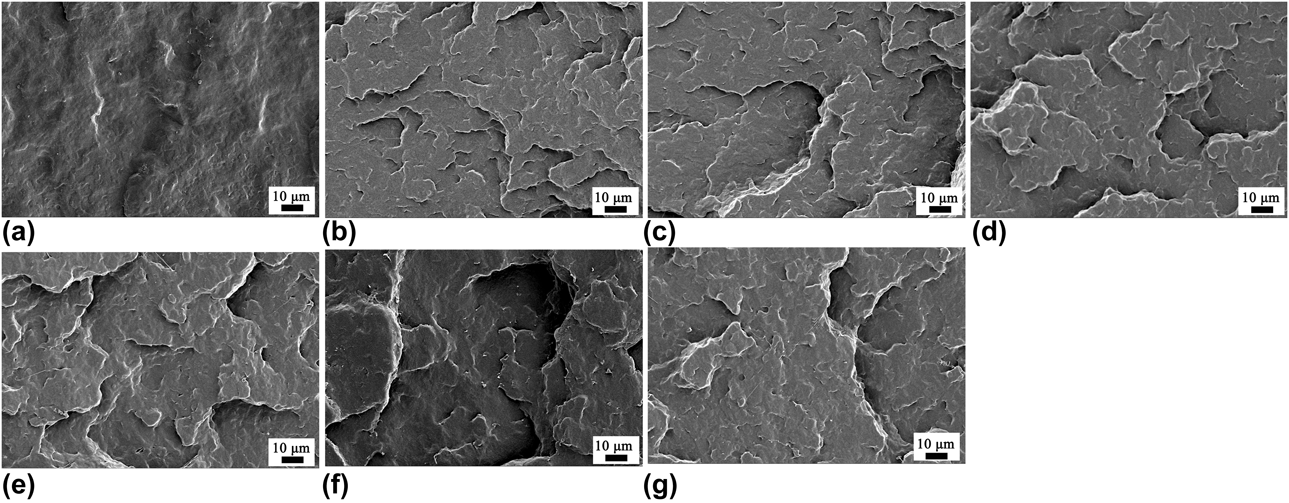
To further analyze the toughening effect of β-nucleating agent on PP, scanning electron microscope (SEM) was used to characterize the fracture morphology of pure PP and nucleated PP. As could be seen from Fig. 3, Adi-Zn(OH)2 (1:2) had the best nucleation performance, so we studied the effect of different additions of Adi-Zn(OH)2 (1:2) on the fracture surface of PP, as shown in Fig. 5. It could be seen that the fracture surface of pure PP was relatively flat and smooth; i.e., it exhibits the typical surface feature of brittle fracture mode. With the addition of Adi-Zn(OH)2 (1:2), the fracture surface of nucleated PP become uneven and rough, indicating that its fracture mode was ductile fracture. In addition, when the addition amount of Adi-Zn(OH)2 (1:2) was 0.2 wt%, the cross-sectional morphology of PP became coarser and the pits were larger, which was consistent with the highest impact strength of PP/Adi-Zn(OH)2 (1:2) (0.2 wt%) in Fig. 3. Therefore, it could be visually seen from Fig. 5 that the addition of a nucleating agent could significantly increase the impact strength of PP.
SEM image of the fracture surface of the impact spline of pure PP and nucleated PP. (a) Pure PP; (b), (c), (d), (e), (f), and (g) represented that the content of Adi-Zn(OH)2 (1:2) was 0.025 wt%, 0.05 wt%, 0.075 wt%, 0.1 wt%, 0.2 wt%, and 0.4 wt%, respectively.

Effect of different ratios of adipic acid and zinc hydroxide on the β-crystal content of PP
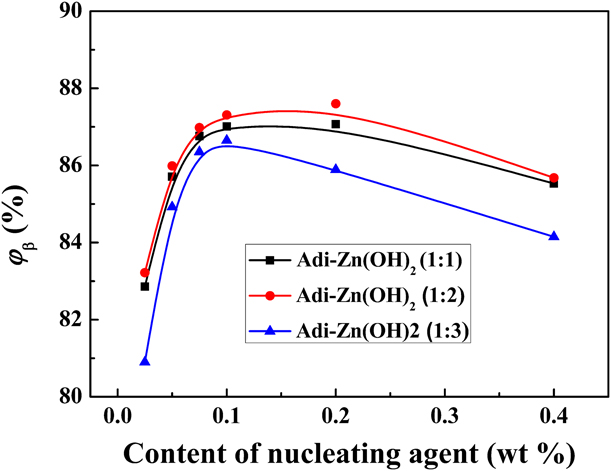
The β-crystal form is a loosely arranged structure and easily form into a continuous fibrous structure when it is impacted by an external force, which can effectively absorb an external force and increase the impact strength of the polypropylene (PP) [Reference Yang, Wu, Xiang and Cao33]. Therefore, the content of β-crystal is an important indicator for evaluating the impact strength of PP. According to relevant literature reports [Reference Yang, Wu, Xiang and Cao33, Reference Shi, Zhang, Liu, Nie and Wang34, Reference Li and Cheung35], the melting curve of differential scanning calorimetry (DSC) was often used for the calculation of β-crystal content of PP and the method has matured. The effect of different molar ratios of adipic acid and zinc hydroxide on the melting behavior of PP was explored and shown in Fig. S1 (shown in Supplementary materials), and results showed that the melting peak of α-crystal was gradually decreased after the addition of the nucleating agent; however, the melting peak of β-crystal was gradually increased, which indicated that the nucleating agent could effectively promote PP to form more β-crystal. Meanwhile, the value of φβ could be calculated according to Eqs. (2) and (3), and the relationship of the content of Adi-Zn(OH)2 and φβ is shown in Fig. 6.
Effect of content of nucleating agent on β-crystal content of PP.
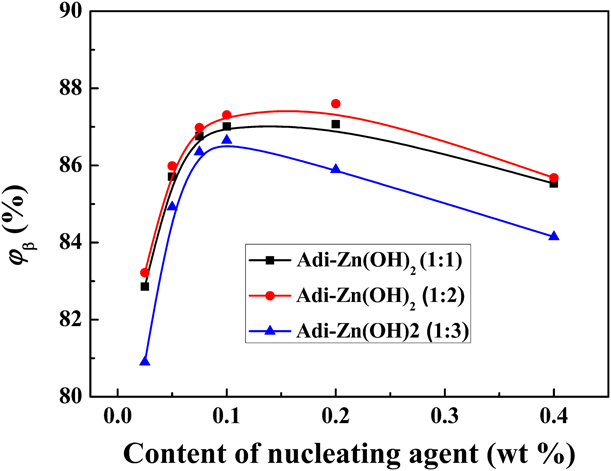
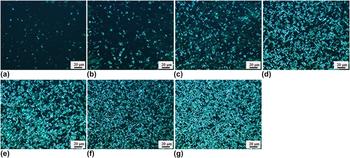
As shown in Fig. 6, with the increase of content of zinc hydroxide, the φβ of nucleated PP all first increased dramatically and then decreased gradually. Meanwhile, the largest φβ = 88.05% was obtained at 0.2 wt% content of Adi-Zn(OH)2 (1:2), which was consistent with the trend of impact strength. In addition, β-nucleating agent affected not only the β-crystal form but also the crystal morphology of PP. According to Figs. 3(a) and 6, Adi-Zn(OH)2 (1:2) possessed the best β-nucleation performance, so the polarized optical micrographs of nucleated PP with different concentrations of Adi-Zn(OH)2 (1:2) and pure PP were studied, and the results are shown in Fig. 7.
Isothermally crystallized polarized optical microphotographs. At 145 °C for 240 s, (a) pure PP; (b), (c), (d), (e), (f), and (g) represented that the content of Adi-Zn(OH)2 (1:2) was 0.025 wt%, 0.05 wt%, 0.075 wt%, 0.1 wt%, 0.2 wt%, and 0.4 wt%, respectively.
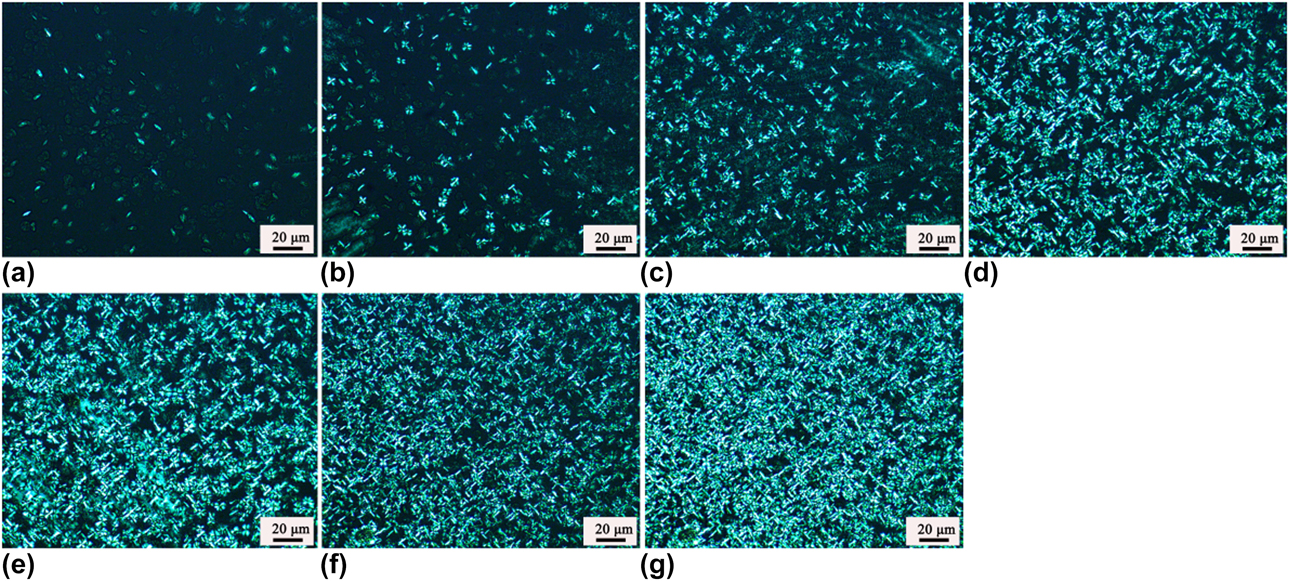
It could be seen from Fig. 7 that the number of spherulites of pure PP was the least when isothermally crystallized at 145 °C for 240 s; besides, the amount of spherulites increased with the increase of the content of Adi-Zn(OH)2 (1:2). As we all know, the crystallization process included nucleation and crystal growth [Reference Kadam, Kramer and Horst36, Reference Chuah, Gan and Chee37]. For pure PP, the formation of crystal nuclei was difficult, and the growth mode of spherulites was mainly homogeneous nucleation, followed by the process of grain growth, which would lead to smaller crystal nuclei and slower growth rate of crystal nuclei compared with nucleated PP. For nucleated PP, nucleating agent could act as a nucleation site, which resulted in a large number of crystal nuclei and increased the number of crystal. Furthermore, it could be seen from Fig. 7 that Adi-Zn(OH)2 (1:2) could shorten the crystallization time of PP when crystallization was performed at the same time and temperature.
Nonisothermal crystallization kinetics
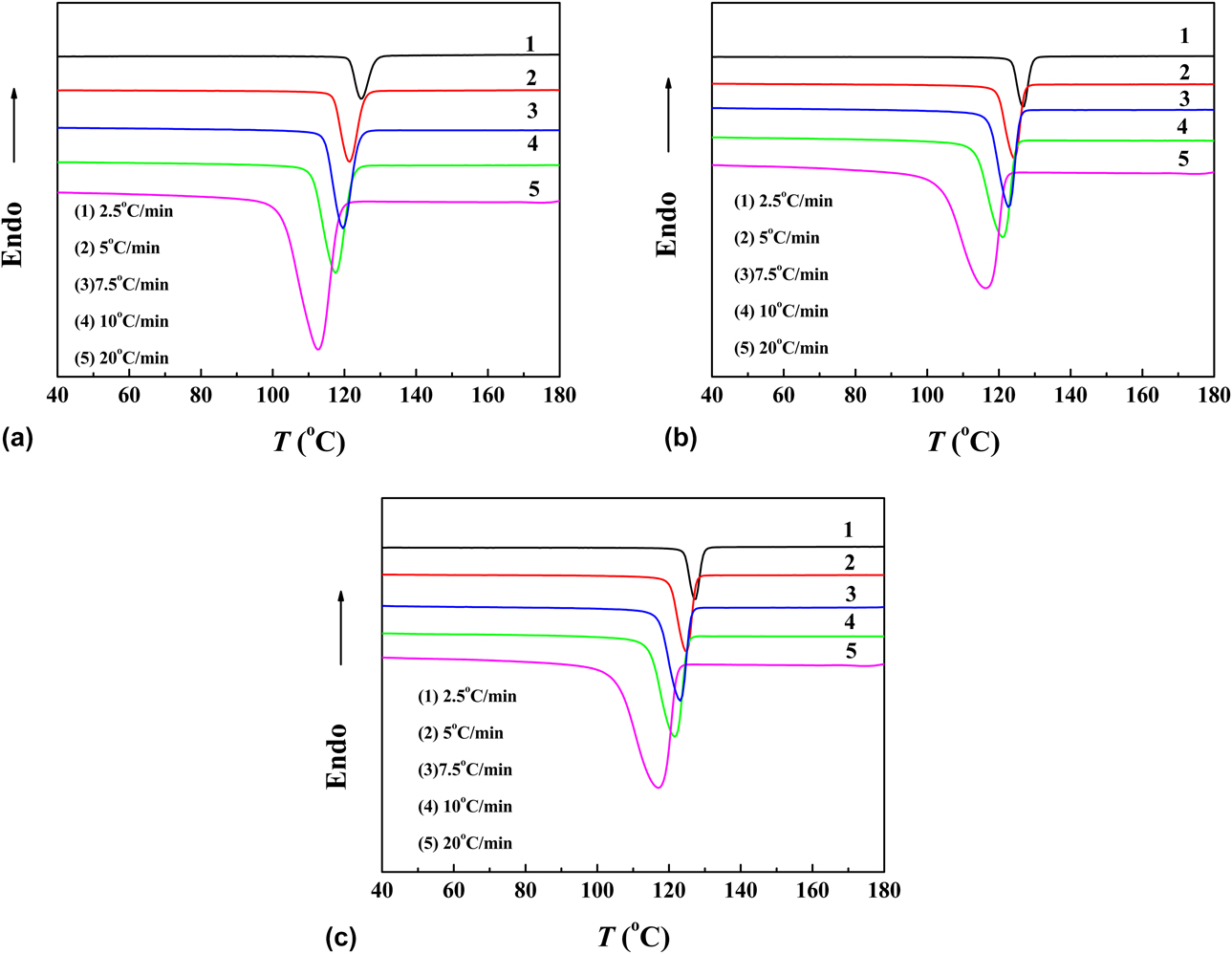
The crystallization process of semi-crystalline polymers has a significant effect on its mechanical properties, so it is of great significance to study the crystallization process of polymers [Reference Li, Hu, Ji, Huang and Zhou27, Reference Chuah, Gan and Chee37, Reference Vyazovkin, Burnham, Criado, Pérez-Maqueda, Popescu and Sbirrazzuoli38, Reference Gonzalez-Calderon, Vallejo-Montesinos, Almendarez-Camarillo, Montiel and Pérez39]. The actual process is usually carried out under nonisothermal crystallization conditions. To further study the nucleation of Adi-Zn(OH)2 (1:2) and guide processing applications, it is necessary to study the nonisothermal crystallization process. The 0.1 wt% and 0.2 wt% content of Adi-Zn(OH)2 (1:2) were chosen to consider the fact that their nucleated PP all showed better impact strength at the content. The nonisothermal crystallization of PP and nucleated PP were carried out by DSC at the cooling rate of 2.5–20 °C/min. The cooling curves of pure PP and nucleated PP are shown in Fig. 8.
Cooling curves of pure PP and nucleated PP at different cooling rates. (a) Pure PP; (b) 0.1 wt%, Adi-Zn(OH)2 (1:2); and (c) 0.2 wt%, Adi-Zn(OH)2 (1:2).
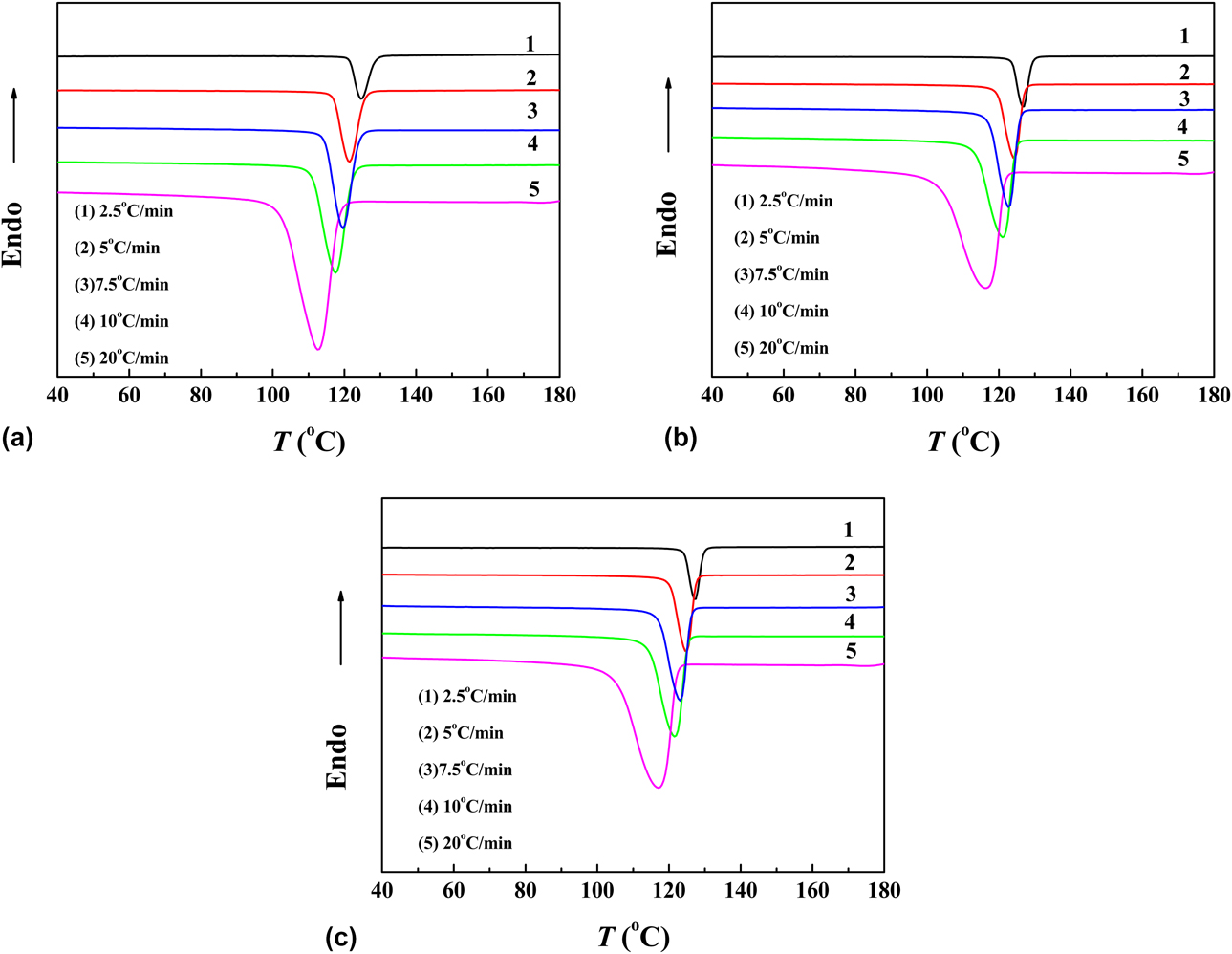
It could be seen from Figs. 8(a)–8(c) that as the cooling rate increased, the crystallization peak of pure PP and nucleated PP all became wider, and the T p shifted toward the direction of low temperature. The above experimental results could be determined by the process of the PP segment entering the crystal lattice required a certain time [Reference Chuah, Gan and Chee37, Reference Zhao and Xin40]. When the cooling rate was relatively fast, the temperature at which the molecular chain discharged into the crystal lattice was lower, and the temperature that PP reached the maximum crystallization rate was also lower, resulting in a lower T p. Meanwhile, the activity of molecular chain was poor at lower temperatures, and the degree of crystallization was different, so the higher the cooling rate, the broader the crystallization peak. In addition, to further compare the crystal peak temperature changes for pure PP and nucleated PP at different cooling rates, their crystal peak temperatures were calculated according to Fig. 8 and are shown in Fig. S2 (which is shown in Supplementary materials). It could be found that after Adi-Zn(OH)2 (1:2) was introduced, the T p of PP could be effectively increased, indicating that the addition of Adi-Zn(OH)2 (1:2) could crystallize at a higher temperature and improve the nucleation efficiency. Integrating the DSC curve of Fig. 8, the crystalline weight fraction (X w(T)) could be obtained and is shown in Fig. S3 (which is shown in Supplementary materials).
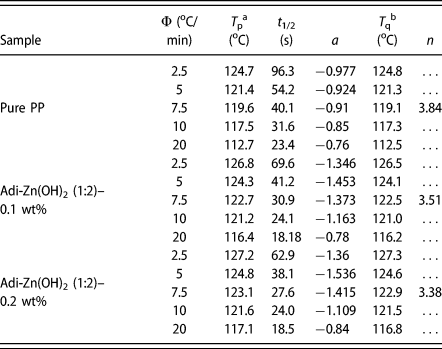
According to Fig. S3, the t 1/2 could be obtained by the formula t 1/2 = (T 0 − T)/Φ [where T 0 represented initial crystallization temperature and T represented the crystallization temperature when X w (T) reached 50% and Φ represented cooling rate]. The calculated t 1/2 is shown in Table I.
Nonisothermal crystallization kinetics parameters for pure PP and nucleated PP.

T pa was determined by Fig. 8; T qb was calculated by Caze method; t 1/2 represented the semi-crystallization time; Φ represented the rate of temperature drop; n was the Ozawa index; T q represented the crystallization peak temperature; a represented empirical constants without specific physical meaning.
X w (T) could be converted to X v (T) by Eq. (1) [Reference Chuah, Gan and Chee37]:
 $${X_{\rm{v}}}\left( T \right) = {{{{{X_{\rm{w}}}\left( T \right){\rho _{\rm{a}}}} \over {{\rho _{\rm{c}}}}}} \over {1 - \left( {1 - {{{\rho _{\rm{a}}}} \over {{\rho _{\rm{c}}}}}} \right){X_{\rm{w}}}\left( T \right)}}\quad ,$$
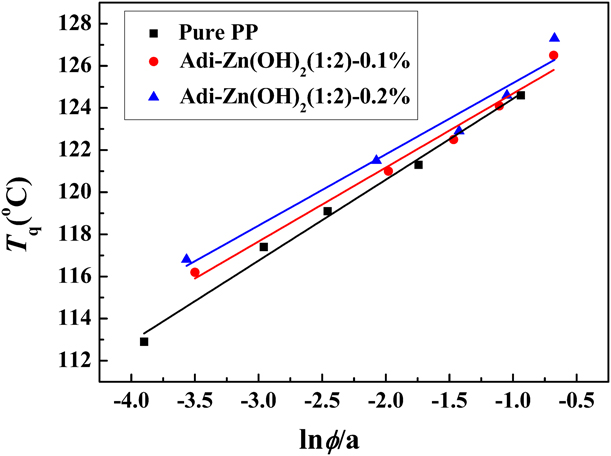
where ρa and ρc represented the bulk density of PP in an amorphous and crystalline state (α-crystals or β-crystals), respectively. The value of ρa was 0.0.852 for PP. The value of ρcα and ρcβ was 0.936 [Reference Bartczak, Morawiec and Galeski41, Reference Bassett, Block and Piermarini42] and 0.922 [Reference Turner-Jones and Cobbold43, Reference Samuels and Yee44], respectively. According to Eqs. (1) and (9), the relationship between ln[−ln(1 − X v(T))] and T could be obtained and is shown in Fig. S4 (which is shown in Supplementary materials, Plots of ln(−ln(1 − X v(T)) versus T for pure PP and nucleated PP. Figure S4(a) pure PP; Fig. S4(b) 0.1 wt%, Adi-Zn(OH)2 (1:2); Fig. S4(c) 0.2 wt%, Adi-Zn(OH)2 (1:2), which showed that they all had a good linear correlation, and the slope and intercept of the line represented the kinetic parameters a and −aT qb, respectively. Their values are shown in Table I. According to Eq. (10), the relationship between ln Φ/a and T qb could be obtained, which is shown in Fig. 9.
Plots of T q versus ln Φ/a for pure PP and nucleated PP.
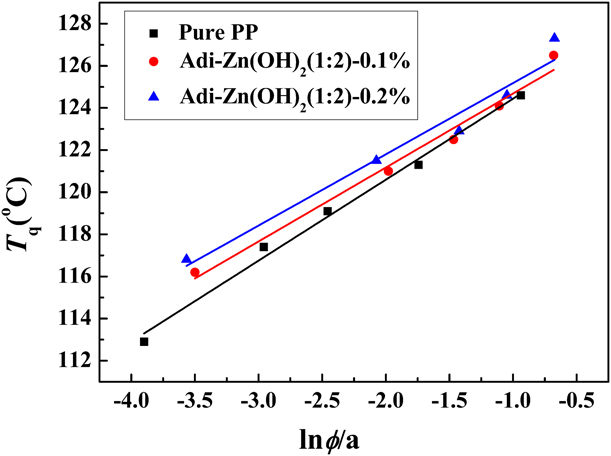
It could be seen from Fig. 9 that ln Φ/a and T qb showed a good linear correlation, the slope of the line was n, and its values were shown in Table I. It could be concluded from Table I that the values of T pa and T qb were very similar, indicating that it was effective to study the nonisothermal crystallization kinetics of PP by the Caze method [Reference Chuah, Gan and Chee37, Reference Cai, Zhao, Shen and Xin45]. After the addition of Adi-Zn(OH)2 (1:2), the t 1/2 of nucleated PP was significantly shortened, which revealed that Adi-Zn(OH)2 (1:2) was a kind of high-efficiency β-nucleating agent and could rapidly increase the crystallization rate. It could also be found that the n of pure PP was 3.84 and closed to 4, indicating that the spherulite growth occurred with homogeneous nucleation and three-dimension spherical growth. The n of pure PP less than 4 might be caused by heterogeneous nucleation due to the factors such as residual catalyst in the production process and foreign impurities introduced during processing. After adding Adi-Zn(OH)2 (1:2), the n of nucleated PP kept falling. When the contents of Adi-Zn(OH)2 (1:2) were 0.1 wt% and 0.2 wt%, the value of n decreased from 3.84 of pure PP to 3.51 and 3.38, respectively. It indicated that Adi-Zn(OH)2 (1:2) acted as a heterogeneous nuclei in nonisothermal crystallization and the growth of spherulites was still three dimensional. Therefore, in the presence of Adi-Zn(OH)2 (1:2), the nucleation type of PP changed from homogeneous nucleation to heterogeneous nucleation, whereas the crystal geometry of nucleated PP remained unchanged.
Conclusions
In this work, the effects of different kinds of zinc compound on zinc adipate as nucleating agent was studied, and the prepared nucleating agent of zinc compound was compared with CNA. Then, the novel highly efficient β-nucleating agent system of Adi-Zn(OH)2 (1:2) was obtained after studying the effects of nucleating agent at different ratios of adipic acid and zinc hydroxide with regard to mechanical properties and β-crystal content of PP. Finally, the effects of Adi-Zn(OH)2 (1:2) on the crystallization behavior and nonisothermal crystallization kinetics of PP were investigated. The main conclusions were summarized as follows:
(1) When the molar ratio of adipic acid to zinc compound was 1:1, Adi-Zn(OH)2 (1:1), it shows more excellent β-nucleation than Adi-ZnO (1:1) and CNA. The maximum impact strength of PP/Adi-Zn(OH)2 (1:1) (0.2 wt%) was 33 and 10% higher than the maximum impact strength of PP/CNA (0.075 wt%) and PP/Adi-ZnO (1:1) (0.1 wt%), respectively. Furthermore, the maximum impact strength of PP/Adi-Zn(OH)2 (1:1) was 2.3 times as of the impact strength of pure PP.
(2) The optimum molar ratio of adipic acid to zinc hydroxide was found to be 1:2, and the maximum impact strength of PP/Adi-Zn(OH)2 (1:2) (0.2 wt%) was 6 and 14% higher than the maximum impact strength of PP/Adi-Zn(OH)2 (1:1) (0.2 wt%) and PP/Adi-Zn(OH)2 (1:3) (0.1 wt%), respectively. At the concentration 0.2 wt%, the impact strength of PP/Adi-Zn(OH)2 (1:2) increases about 2.6 times than that of pure PP, and was 42% higher than the maximum impact strength of PP/CNA. Meanwhile, the φβ values of PP/Adi-Zn(OH)2 (1:2) increased firstly and then decreased gradually with the increasing of Adi-Zn(OH)2 (1:2) concentration. The φβ value of PP/Adi-Zn(OH)2 (1:2) at the concentration of 0.4 wt% reached 88.05%.
(3) The crystallization behavior which studied by DSC and polarized optical microscopy (POM) showed that Adi-Zn(OH)2 (1:2) could greatly increase the T p of PP and shorten the crystallization time of PP. In addition, the Caze method was used to study the nonisothermal crystallization kinetics of pure PP and nucleated PP, and the results displayed that Adi-Zn(OH)2 (1:2) could rapidly increase the crystallization rate and shorten the t 1/2 of PP. Meanwhile, the addition of Adi-Zn(OH)2 (1:2) did not change the geometry of PP crystal, but changed the nucleation type of PP crystal, and the nucleation mode of PP was changed from homogeneous nucleation to heterogeneous nucleation.
Materials and methods
Materials
The PP was provided from Petrochina Company Limited Lanzhou Chemical Research Center, Lanzhou, China (trade name T30S, MFR = 3.0 g/10 min); zinc oxide was analytical graded and obtained from Sinopharm Chemical Reagent Co., Ltd., Zhejiang, China; zinc hydroxide was analytical grade and obtained from Tianjin Guangfu Fine Chemical Research Institute, Tianjin, China; antioxidants (1010 and 168) were purchased from Sinopharm Chemical Reagent Co. Ltd., Zhejiang, China; and CNA was obtained from Shanxi Provincial Institute of Chemical Industry, Shanxi, China.
Preparation of zinc-type β-nucleating agent
Referring to the relevant literature [Reference Varga29], adipic acid and zinc oxide (molar ratio was 1:1) were finely ground and mixed evenly in a mortar. Then, the sample was transferred to a 200 mesh sieve for screening and collected sample with the particle size of less than 200 mesh, the sample was denoted as Adi-ZnO (1:1). When the molar ratio of adipic acid to zinc hydroxide was 1:1, the sample was denoted as Adi-Zn(OH)2 (1:1) under the same preparation conditions above. Similarly, when the molar ratio of adipic acid to zinc hydroxide was changed to 1:2 or 1:3, the samples were obtained under the same conditions and denoted as Adi-Zn(OH)2 (1:2) and Adi-Zn(OH)2 (1:3), respectively.
Sample preparation
The β-nucleating agent (CNA and zinc-type β-nucleating agent), antioxidant (Irganox 1010 and 168, 0.1 wt% and 0.2 wt% of PP, respectively), and the PP powders were dry-blended by high-speed mixer (GRH100, Fuxin Hongqi Plastic Machinery Factory, Liangning, China) for 2 min. Then, the mixture was extruded by a twin-screw extruder (ZSE-34, Leicester Group, Berlin, Germany) through a strand die and pelletized. The pellets were molded into standard test specimens by an injection-molding machine (UN-100, Liuzhou Plastic Machinery Factory, Guangxi, China). The concentrations of the β-nucleating agent (CNA and zinc-type β-nucleating agent) were 0.025, 0.05, 0.075, 0.1, 0.2, and 0.4 wt%, respectively.
Characterizations of zinc-type β-nucleating agent
The prepared zinc-type β-nucleating agent was heated on a heat carrier at 230 °C and ground to simulate shear during extrusion. Then, the test sample was prepared based on pure potassium bromide (KBr). First, a certain amount of dried KBr and zinc-type β-nucleating agent was grinded with agate mortar and then pressed it to homogeneous round slice under the pressure of 10t with 5 min. Finally, the prepared samples were determined with Fourier transform infrared spectroscopy (FTIR) (Nicolet NEXUS 670, American Nicolet Corporation, Madison, Wisconsin).
Mechanical properties
Measurements of mechanical properties, such as tensile strength, were performed on an Instron 5566 dynamometer under GB/T 1040.1-2006 method, and the testing speed was 50 mm/min. Izod impact tests were performed using a Tinius Olsen apparatus according to the GB/T 1843-2008 method. Flexural modulus tests were performed on an Instron 5566 dynamometer under GB/T 9341-2008 method, and the testing speed was 2 mm/min. Each sample was measured 5 times and averaged.
Scanning electron microscope
Scan electron microscopy (ULTRA plus, Carl Zeiss AG, Jena, Germany) was used to investigate fracture morphology of pure PP and nucleated PP. The extruder samples of pure PP and nucleated PP were cut into slices, and sputter coated with platinum, then the fracture morphology of pure PP and nucleated PP were characterized by SEM.
Differential scanning calorimetry
DSC (DSC 214 Polyma, NETZSCH Scientific Instruments Trading Ltd., Berlin, Germany) was carried out to measure the melting and crystallization behavior of PP, which was used to study the crystallization peak temperature (T cp) and β-crystal content. Temperature was calibrated by using indium as a standard medium before measurements. First, 5.0 mg of the sample was heated to 200 °C to eliminate thermal and mechanical history. Then, measurements were carried out on the heating and cooling rate of 20 °C/min under nitrogen atmosphere. Finally, T cp and β-crystal content were measured according to the melting and crystallization curve of DSC.
The T cp was determined from the crystallization curves. β-crystal content was estimated from the melting curve by the following expression [Reference Yang, Wu, Xiang and Cao33, Reference Shi, Zhang, Liu, Nie and Wang34, Reference Li and Cheung35]:
 $${\varphi _\beta } = {{{X_\beta }} \over {{X_\alpha } + {X_\beta }}}\quad ,$$
where φβ stands for the β-crystal relative content (%), X α is the crystallinity of α-crystal (%), and X β represents the crystallinity of β-crystal (%). X α and X β were calculated as follows:
 $${X_{\rm{i}}} = {{\Delta {H_{\rm{i}}}} \over {\Delta H_{\rm{i}}^0}} \times 100\% \quad ,$$
where ∆H i and  $\Delta H_{\rm{i}}^0$ represent the apparent and completely crystalline heats of fusion, respectively. The
 $\Delta H_{\rm{i}}^0$ of completely crystallized α-PP and completely crystallized β-PP were 177 J/g and 168 J/g, respectively.
Polarized optical microscopy
The crystallization morphologies of pure PP and nucleated PP were detected with the aid of a hot-stage polarizing microscope (DM2500P, Leica Instruments (S) Pte Ltd., Moscow, Germany). The extruded samples were placed between two microscopy slides, and then melted and pressed at 200 °C for 5 min to eliminate the trace of crystals. Then, the samples were rapidly cooled to 145 °C with the cooling rate of 100 °C/min. The samples were maintained at 145 °C until the crystallization process was completed, then the crystallization morphology was observed.
Nonisothermal crystallization theory
The Avrami equation has been widely used in the study of isothermal crystallization of polymers, which is Eq. (4):
 $$1 - {X_t} = \exp \left( { - {Z_t}{t^n}} \right)\quad ,$$
where n represents the Avrami index, which is related to the nucleation mechanism and the mode of crystal growth; Z t represents the crystallization rate constant, which is determined by the rate of nucleation and grain growth; and X t represents the relative crystallinity at time t.
The semi-crystallization time (t 1/2), the time that relative crystallinity reach 50%, can be obtained according to Eq. (5):
 $${t_{{\rm{1/2}}}} = {\left( {{{\ln 2} / {{Z_t}}}} \right)^{1{\rm{/}}n}}\quad .$$
The Avrami equation has been extended by Ozawa to develop a simple method to study the non-isothermal crystallization of polymers [Reference Ozawa46], which is Eq. (6):
 $${X_{\rm{v}}}\left( T \right) = 1 - \exp \left( { - {k_t}{n \over \Phi }} \right)\quad ,$$
where X v(T) represents the volume fraction of the crystal at time T; Φ represents the rate of temperature drop; n is the Ozawa index, which reflect the dimension of crystal growth; K t represents cooling function, and the function is only related to temperature. Ozawa proposed the assumption that the value of n was independent of temperature change in the process of deriving the equation. However, many studies have proven that the n and temperatures were related, and the Ozawa equation didn’t accurately describe the nonisothermal crystallization process of polymers.
Caze et al. [Reference Cazé, Devaux, Crespy and Cavrot47], put forward a new method to modify Ozawa equation. They found the shape of the crystallization exothermic peak was Gaussian, and then assumed a linear correlation between ln K T and temperature (T), which was only necessary to consider the point of the maximum value in the crystallization curve and the point with the maximum rate of change. Based on the theory of the Caze method, Chuah et al. [Reference Chuah, Gan and Chee37] proposed Eq. (7):
 $$\ln {K_T} = a\left( {T - b} \right)\quad ,$$
where a and b represent empirical constants without specific physical meaning, if the extreme point of the ∂X v(T)/∂T curve appeared at the position of the crystallization peak temperature (T q), which meant  ${\left[ {{{{\partial ^2}{X_{\rm{v}}}\left( T \right)} / {\partial {T^2}}}} \right]_{{T_{\rm{q}}}}} = 0$. It could be obtained Eq. (8):
 $${K_T}\left( {{T_{\rm{q}}}} \right) = {\Phi ^n}\quad .$$
Equation (9) could be obtained based on Eqs. (6)–(8):
 $$\ln \left[ { - \ln \left( {1 - {X_{\rm{v}}}\left( T \right)} \right)} \right] = a\left( {T - {T_{\rm{q}}}} \right)\quad .$$
According to Eq. (9), a straight line could be obtained by plotting T as the abscissa and ln[−ln(1 − X v(T))] as the ordinate, and the slope and intercept of the line were a and −aT q, respectively. When T = T q, Eq. (10) could be obtained according to Eqs. (8) and (9):
 $${T_{\rm{q}}} = {{n\ln \Phi } \over a} + b\quad .$$
Therefore, the parameter n could be obtained from a linear graph of T q and ln Φ/a according to Eq. (10).
Supplementary material
To view supplementary material for this article, please visit https://doi.org/10.1557/jmr.2019.251.
Acknowledgments
This work was supported by the National Natural Science Foundation of China (51563015).