Surgical site infection (SSI) is a common postprocedure complication estimated to occur 157,000 times Reference Magill, Edwards and Bamberg1 per year in the United States. In addition to direct negative patient outcomes, SSIs are one of the most common healthcare-associated infections and account for $3.2 billion in attributable cost per year in acute-care hospitals, increased hospital length of stay by an additional 11 days. Reference Klevens and Edwards2,Reference Zimlichman, Henderson and Tamir3 They are also the most frequent cause of unplanned readmissions after surgery. Reference Merkow, Ju and Chung4 SSIs are often preventable by adhering to established recommendations, which includes administration of preoperative antibiotic prophylaxis.
Beta-lactam antibiotics are often the first-line therapy for the prevention and treatment of infections due to their efficacy, spectrum of activity, and tolerability. However, reported penicillin allergies are common and are a limiting factor for their use. In these settings, prescribers also frequently avoid cephalosporins due to concerns for possible cross reactivity. As a result, penicillin–allergic patients are less likely to receive guideline-recommended antibiotics and are more likely to be treated with alternative antibiotics. Reference van Dijk, Gardarsdottir and Wassenberg5
Cefazolin monotherapy is a common regimen for surgical prophylaxis, given its activity against methicillin-susceptible staphylococci, streptococci, and some enteric gram-negative bacteria. Alternative antibiotic regimens in the setting of a β-lactam allergy (BLA) are typically more complicated, which may lead to delays in administration. Two retrospective cohort studies demonstrated an increased risk of SSI among surgery patients with a reported BLA. Reference Blumenthal, Ryan and Li6,Reference Lam, Tarighi and Elligsen7 This risk has been attributed to the receipt of second-line perioperative antibiotics. We sought to directly assess the appropriateness of preoperative antibiotic prophylaxis in patients with a BLA label compared those without a BLA label.
Methods
This investigation was a single-center, retrospective, matched cohort study of adult patients. Adult inpatients aged >18 years were screened if they underwent a clean or clean-contaminated knee replacement, hysterectomy, colon surgery, or coronary artery bypass graft between July 1, 2018, and June 30, 2019. Procedures were identified using NHSN operative procedure categories: coronary artery bypass (CBGB), colorectal surgery (COLO), hysterectomy (HYST), and knee replacement (KPRO). Patients were excluded if there was insufficient data for matching. Patients with a BLA label at the time of the procedure were matched to patients without a BLA label based on procedure type, age (±10 years), and BMI (±5 kg/m2). When multiple potential matches were available, a random number generator was used to select the patient to be included.
The primary end point of the study was the rate of appropriate preoperative antibiotic prophylaxis. This end point was a composite requiring appropriate antibiotic selection and appropriate timing prior to incision based on institutional guidelines (Appendix 1 online). Secondary end points included SSI based on NHSN definitions, 8 length of stay, 90-day readmission, acute kidney injury, 30-day all-cause mortality, and new-onset colonization or infection with vancomycin-resistant enterococci (VRE), extended spectrum β-lactamase producers (ESBL), carbapenem-resistant Enterobacteriaceae (CRE), or C. difficile with 90 days after the procedure. Subgroup analyses were also performed comparing mild-to-moderate or intolerances versus severe β-lactam reactions.
Severe IgE-mediated reactions included anaphylaxis, angioedema, difficulty breathing, urticaria, and hives. Severe non-IgE–mediated reactions included Stevens-Johnson syndrome, toxic epidermal necrolysis, and skin sloughing. 9 Mild-to-moderate reactions included rash, dizziness, and itching. Intolerances were defined as nausea, vomiting, diarrhea, constipation, headache, and photosensitivity. Reference Blumenthal, Ryan and Li6 Patient-specific risk factors for MRSA requiring modification of preoperative antibiotics included history of MRSA infection or colonization, receipt of chronic hemodialysis, previous hospitalization for >48 hours within 90 days, and current hospitalization >72 hours. Reference Bratzler, Dellinger and Olsen10 AKI was defined as ≥50% increase or 1.5-fold baseline SCr increase within 48 hours. Reference Moore, Hsu and Liu11
Categorical variables were compared using the Fisher exact test or the Pearson χ2 test, as appropriate. The Shapiro–Wilks test was used to test for normality. Normally distributed continuous variables were compared using the Student t test; continuous variables not normally distributed were compared using the Mann–Whitney U test. All tests of significance were 2-tailed and a P ≤ .05 was considered statistically significant. Statistical analyses were performed using STATA version 15.0 software (StataCorp, College Station, TX). In a prior internal evaluation, the preoperative guideline compliance rate ranged from 76% to 92%. Consequently, if the estimated rate of appropriate preoperative antibiotics among patients with no BLA label is 85% and the rate among patients with BLA label is 70%, then 120 patients in each arm (240 total) would be required to achieve 80% power and alpha 5%.
Results
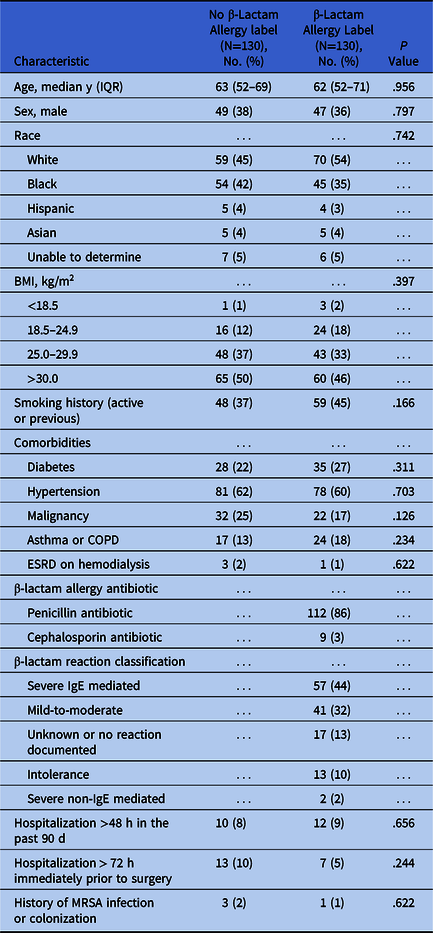
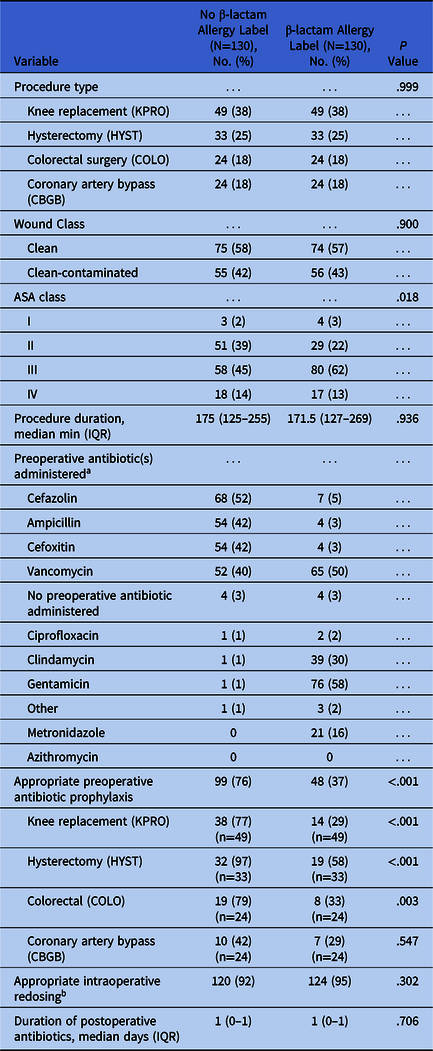
During the study time period, 867 procedures were identified. Among these, 160 patients had a BLA label at the time of the procedure and 130 matches were made. Overall, 30 patients with a BLA label were unable to be matched due to lack of a patient without a BLA who met matching criteria for procedure (n = 8), age only (n = 5), and BMI only (n = 5). Also, 12 patients were unable to be matched because of age and/or BMI (ie, patient could be matched by age or BMI, but not both). Baseline patient characteristics were similar between the 2 groups (Table 1). Few patients in the entire cohort had patient-specific MRSA risk factors, such as history of MRSA infection or colonization (1.5%), previous hospitalization (8.4%), hospitalization >72 hours immediately prior to surgery (7.7%), and end-stage renal disease (ESRD) requiring chronic hemodialysis (1.5%). Among patients with a BLA, severe IgE-mediated reaction (44%) was most the common reaction type, followed by mild-to-moderate reaction (32%), unknown (13%), and intolerance (10%). Knee replacement (38%) was the most common procedure, followed by hysterectomy (25%), colorectal procedure (18%), and CABG (18%). Some procedure characteristics varied between the 2 groups (Table 2). More patients with a BLA label had an ASA score of 3 at the time of the procedure. Additionally, more patients with a BLA label received non–β-lactam antibiotics, such as clindamycin and vancomycin, as preoperative antibiotic prophylaxis.
Demographic and Clinical Characteristics Among Surgical Patients Based on Absence or Presence of a β-Lactam Allergy Label

Note. IQR, interquartile range; BMI, body mass index; COPD, chronic obstructive pulmonary disease; ESRD; end-stage renal disease; MRSA, methicillin-resistant Staphylococcus aureus.
Procedure and Perioperative Antibiotic Characteristics Among Surgical Patients Based on Absence or Presence of a β-Lactam Allergy Label

Note. IQR, interquartile range.
a Not mutually exclusive.
b Includes patients who received redosing at the appropriate time interval, had lack of redosing was appropriate (eg, based on renal function) or the case was not long enough to require redosing.
Receipt of appropriate preoperative antibiotic prophylaxis was significantly higher among patients without a BLA label (76% vs 37%; P < .001). This difference was driven by improved antibiotic selection among patients without a BLA label (84% vs 57%; P < .001). Appropriate antibiotic timing (independent of selection) was similar between the 2 groups (90% vs 91%; P = .833). Upon evaluation of each procedure, significantly higher rates of appropriate preoperative antibiotic prophylaxis were observed for all subgroups except for coronary artery bypass graft, which had low rates among patients without and with a BLA label (42% vs 29%; P = .547) (Table 2).
Among the 54 patients with mild-to-moderate reactions or intolerances to β-lactams, 29 (53%) patients received a full antibiotic regimen that would have been appropriate only if the patient had a severe BLA. These patients were considered to have received an inappropriate regimen because they should have received preferred therapy, including a β-lactam antibiotic. Patients with a mild-to-moderate reaction or intolerance were less likely to receive appropriate preoperative antibiotic prophyalxis compared to patients with a severe or unknown reaction (7% vs 58%; P < .001).
Without taking into account actual administration of the antibiotic, patients without a BLA label were also more likely to have the appropriate antibiotic regimen ordered in the electronic medical record (87% vs 65%; P < .001). Moreover, 39 patients (30%) with a mild-to-moderate reaction or intolerance had an antibiotic regimen meant for patients with a severe β-lactam allergy ordered. Also, 9 patients (7%) with a BLA label should have received MRSA coverage based on patient-specific risk factors. Among patients who had the appropriate regimen ordered, patients with a BLA label were more likely to have an antibiotic administration omitted (44% vs 4%; P < .001), but delays in antibiotic administration were similar in both groups (11% vs 11%; P = .999).
Overall, 43 patients (17%) would have required modification of preoperative antibiotics based on patient-specific MRSA risk factors; 26 patients without a BLA label and 17 patients with a BLA label (P = .181). The difference in appropriate preoperative antibiotic prophylaxis remained when removing the requirement to modify antibiotics based on patient-specific MRSA risk factors (80% vs 39%; P < .001). The median vancomycin administration start time prior to incision was similar in both groups (82 vs 70 min; P = .151) and the median dose was 1,500 mg in both groups (P = .122). When excluding deviations due to omissions or delays with vancomycin administration, appropriate preoperative antibiotic prophylaxis was still higher among patients without a BLA label (95% vs 42%; P < .001).
No differences among rates of SSI (2% vs 1%; P = .999), length of stay (3 vs 3 days; P = .226), readmission (11% vs 14%; P = .450), acute kidney injury (1% vs 2%; P = .999), mortality (2% vs 1%; P = .999), and new onset colonization or infection with VRE, ESBL, CRE, or C. difficile (4% vs 2%; P = .250) were observed between patients without a BLA compared to those with a BLA label, respectively.
Discussion
In this study, patients without BLA labels were more likely to receive appropriate preoperative antibiotics compared to those with BLA labels. We were able to attribute this to 2 primary patterns in antibiotic prescribing and administration. First, antibiotic prescribing was inappropriate among 39 patients (30%) with a BLA label due to misinterpretation of the BLA label. Patients with a mild-to-moderate reaction or intolerance were treated as though they had severe BLAs. Secondly, among patients with a BLA label who had the appropriate antibiotics ordered, 37 patients (44%) did not receive the entire multipart preoperative antibiotic regimen. Gentamicin was the most common antibiotic omitted.
Several studies have evaluated the impact of reported a BLA label on SSI risk. Blumenthal et al Reference Blumenthal, Ryan and Li6 evaluated >8,000 patients who underwent 9,004 procedures and discovered a 50% increased odds of SSI among patients with a reported penicillin allergy, attributed to the receipt of second-line perioperative antibiotics. Lam et al Reference Lam, Tarighi and Elligsen7 conducted a retrospective cohort study of >3,500 surgical procedures and found that a reported β-lactam allergy was also associated with a significant increase in SSI risk (adjusted odds ratio, 1.61; 95% confidence interval, 1.04–2.51; P = .03). Reference Lam, Tarighi and Elligsen7 Our study outcomes are unique for several reasons. First, our retrospective evaluation included matched patients to reduce potential differences in recommended antibiotic regimens and SSI risk. Additionally, our primary outcome was appropriate preoperative antibiotics. We detailed information on antibiotic prescribing, administration, and classified allergic reactions. Consequently, we were able to identify areas to target to optimize perioperative antibiotic use. Our findings were similar to previously published studies, including the increased likelihood of receiving vancomycin, gentamicin, and clindamycin among patients with a reported penicillin allergy, rather than cefazolin, cefoxitin, and ampicillin. Reference Blumenthal, Ryan and Li6,Reference Lam, Tarighi and Elligsen7 Furthermore, we were able to eliducate reasons for the use of these second-line agents among patients with BLA labels because antibiotic selection was often inappropriate based on the severity of the allergy.
Additionally, Blumenthal et al Reference Blumenthal, Ryan and Li6 reported that among 95% of patients receiving vancomycin, vancomycin was not administered within the recommended time frame of 60–120 minutes before incision. We observed similar delays in vancomycin dosing in both groups, and we additionally identified the omission of gentamicin among patients with a BLA label as a contributor to inappropriate antibiotic prophylaxis. Notably, vancomycin use was high in our study and 40% of patients with no BLA label received vancomycin, compared to Blumenthal et al Reference Blumenthal, Ryan and Li6 (3%) and Lam et al Reference Lam, Tarighi and Elligsen7 (0.1%). This difference can be attributed to the inclusion of different procedures and differences in institutional guidelines because we recommend vancomycin for knee replacement and CABG procedures. We also recommend vancomycin for patients with MRSA risk factors. Our study included procedures more similar to those of Blumenthal et al Reference Blumenthal, Ryan and Li6 (most commonly hip and knee arthroplasty and hysterectomy). Lam et al Reference Lam, Tarighi and Elligsen7 included patients with a wide variety of procedures (most commonly general surgery, gynecology, and neurosurgery).
Our study has several limitations. First, this was a retrospective study, so the data were limited to documentation in the electronic medical record. It is possible that antibiotics were given but not documented. However, inaccurate documentation would have effected both groups. Second, as a single-center study, patients may have presented with adverse outcomes, such as SSIs, to other hospitals and were not captured. This factor could have reduced the rates of our secondary outcomes, but it would not have impacted our primary outcome. Additionally, institutions using different antibiotic regimens may not observe the same results. For example, our guidelines recommend the addition of ampicillin to cefoxitin for colorectal surgeries due to our concern for Enterococcus spp. This adds a layer of complexity that is particularly pertinent among patients with an allergy to penicillin. Furthermore, many of the antibiotic recommendations for patients with BLA include weight-based antibiotics, such as vancomycin or gentamicin. Although the doses are standardized using weight ranges to minimize patient-specific doses, hospitals with differing antibiotic selection and dosing recommendations may not be subject to logistical difficulties in antibiotic preparation and administration and the rate of omitted or delayed antibiotics may be reduced. Third, this study was not designed or powered to detect a difference in clinical outcomes. As previously described, studies with much larger sample sizes were able to identify important differences in SSI rates. Fourth, in this study, we did not evaluate intentional deviations from the instutional guidelines. For example, dual therapy is recommended for all knee-replacement procedures; vancomycin plus cefazolin is recommended for patients without a BLA, whereas vancomycin plus gentamicin is recommended for patients with a BLA. Surgeons may choose to omit any one of these agents, depending on the clinical scenario. We discovered that gentamicin was often being replaced by clindamycin among patients undergoing knee replacement. This represents another target for optimization. Our institutional guidelines are reviewed and updated regularly in collaboration with each surgical group and represent recommended practice at our institution.
Receiving inappropriate preoperative antibiotics carries important clinical implications, as second-line antibiotic regimens are often less efficacious than first-line antibiotics. We detected a large absolute reduction in the receipt of appropriate preoperative antibiotics among patients with a BLA. Importantly, we were able to identify specific areas of opportunity to target in order to optimize preoperative antibiotics among patients with a BLA label, specifically improving evaluation of mild-to-moderate β-lactam reactions to determine whether patients may be eligible to receive first-line therapy. Thus, hospitals should employ specific interventions to target this area. Potential strategies include obtaining a thorough allergy history with or without penicillin skin testing prior to the procedure, providing education to providers who are entering preoperative antibiotic orders and allowing pharmacists to enter or modify preoperative antibiotic orders based on a protocol. Removal of allergy labels among patients who are not truly allergic would be important if interventions targeting antibiotic prescribing at the point of order entry were not pursued. A combination of these strategies may be required to optimize the process and ensure sustainable changes.
Supplementary material
To view supplementary material for this article, please visit https://doi.org/10.1017/ice.2020.1271
Acknowledgments
Financial support
No financial support was provided relevant to this article.
Conflicts of interest
All authors report no conflicts of interest relevant to this article.