Introduction
Weed management during the summer fallow (SF) phase of the winter wheat (WW)/SF rotation is an ongoing struggle to reduce soil erosion and retain soil water for the next crop (Lyon et al. Reference Lyon, Barroso, Thorne, Gourlie and Lutcher2020; San Martín et al. Reference San Martín, Long, Gourlie and Barroso2018; Schillinger and Young Reference Schillinger and Young2004; Thorne et al. Reference Thorne, Young, Pan, Bafus and Alldredge2003; Young and Thorne Reference Young and Thorne2004). Annual precipitation in the WW/SF cropping region of eastern Washington ranges from <300 in the low rainfall zone up to 450 mm in the intermediate rainfall zone, and soil water storage during the fallow year is critical for reaching yield targets (Schillinger and Papendick Reference Schillinger and Papendick2008). Annual weeds have historically been most prevalent in the WW/SF region and perennial weed problems have primarily been limited to field bindweed (Convolvulus arvensis L.; Boldt et al. Reference Boldt, Rosenthal and Srinivasan1998; Swan Reference Swan1982). However, rush skeletonweed (Chondrilla juncea L.) is now prevalent in much of the inland Pacific Northwest (Van Vleet and Coombs Reference Van Vleet and Coombs2012) where it is a problem in cropland using a WW/SF rotation. Rush skeletonweed competes strongly for nitrogen (Myers and Lipsett Reference Myers and Lipsett1958) and can deplete soil water in the seedbed zone (McVean Reference McVean1966; grower communication). In Australia, rush skeletonweed caused total crop loss and forced growers out of business during the 1930s (McVean Reference McVean1966). Rush skeletonweed became established in eastern Washington state in the mid-1900s, with the earliest collection found near Spokane in 1938 (Schirman and Robocker Reference Schirman and Robocker1967). However, establishment in WW/SF cropland in eastern Washington became widespread only in areas that had been enrolled in the Conservation Reserve Program (CRP), which started in the mid-1980s. In the WW/SF region, the standard control strategies practiced for many years, including rod weeding in tillage based systems and herbicide applications in the more recently practiced no-till systems, have failed to control the spread of rush skeletonweed (grower communication).
Control of rush skeletonweed, based on single-season herbicide applications, have proven inadequate for long-term control, and control is difficult even with subsequent-year applications (Heap Reference Heap1993). Rush skeletonweed has been very resilient in areas where it has established as an invasive weed, and several mechanisms contribute to its success. First, rush skeletonweed is a deep-rooted perennial species that regenerates from seeds produced through apomixis, from nodes on its roots, or from the root crown (McVean Reference McVean1966; Schirman and Robocker Reference Schirman and Robocker1967). The lateral roots can spread into adjacent areas or are moved with tillage equipment. Regeneration from roots happens quickly following tillage and can occur throughout the growing season, March through October (Rosenthal et al. Reference Rosenthal, Schirman and Robocker1968; grower communication). Rush skeletonweed is an obligate long-day plant requiring 14.5-h days to induce flowering (Ballard Reference Ballard1956); however, Rosenthal et al. (Reference Rosenthal, Schirman and Robocker1968) reported both early- and late-flowering long-day phenotypes growing in eastern Washington. For either phenotype, seeds are disseminated during the summer and early fall and have the potential to germinate from fall through early spring when conditions are favorable. Second, invasive genotypes emerged from its native range across Eurasia. Of the 682 different genotypes of rush skeletonweed identified from its native range, 13 have spread to other countries and are considered invasive (Gaskin et al. Reference Gaskin, Schwarzländer, Kinter, Smith and Novak2013).
Several mechanisms have been proposed to explain success of invasive species, including preadaptation, superior competition for resources, and release from natural enemies (Ren and Zhang Reference Ren and Zhang2009). Establishment of invasive species often follows a pattern of a long lag phase before going through an exponential expansion phase (Groves Reference Groves2006). Areas first inhabited by rush skeletonweed included roadsides and disturbed areas with little or no vegetation, and then rush skeletonweed spread to rangelands, pastures, and orchards (Schirman and Robocker Reference Schirman and Robocker1967). It is likely that prior to the CRP, rush skeletonweed was in the lag phase but actively spreading into less productive rangeland and noncropland areas. The exponential phase began when fields were no longer being farmed and seedlings could finally survive their first year without being controlled with tillage or herbicides. At that point, plants could firmly root and establish in the deep productive loess soils of the region. By the time fields were taken out of the CRP, rush skeletonweed was in the exponential phase.
By 2005, CRP contracts in the region began to expire and the lands previously under contract were returned to farming (USDA-FSA 2004). Often, growers had little warning that the contracts were expiring. If the land was infested with rush skeletonweed, there was no time to apply effective treatments while still in the CRP before planting the first crop (grower communication). Products containing aminopyralid are effective for controlling rush skeletonweed in rangelands, pastures, and CRP land (Wallace and Prather Reference Wallace and Prather2010), but require at least 12 mo after application before seeding wheat. Consequently, wheat was seeded into existing rush skeletonweed infestations. Standard weed control strategies were insufficient for control, especially in the SF phase when there was no competition from the crop or other weeds (grower communication, personal observation). In the SF phase, rush skeletonweed diminished seedbed soil water, as well as deeper water, so that when winter wheat was seeded in September, there was inadequate soil water for germination. Loss of moisture was a serious problem in tilled SF systems since wheat seed was placed up to 10 cm deep in dry, loose soil. When fall rains finally wetted the seed zone, a restrictive soil crust layer, resulting from plugged pore spaces, kept seedlings from emerging (grower communication, personal observation). Soil crusting was less of a problem in no-till SF systems because the seed was never placed deeper than 5 cm (grower communication) and no-till soil is less likely to form a restrictive crust layer (Pareja-Sánchez Reference Pareja-Sánchez, Plaza-Bonilla, Concepción Ramos, Lampurlanés, Álvaro-Fuentes and Cantero-Martínez2017).
Control of rush skeletonweed during the fallow phase is clearly the weak link in managing rush skeletonweed in the WW/SF rotation. Other research has investigated herbicide efficacy with rush skeletonweed (Black et al. Reference Black, Pederson and Stephenson1998; Heap Reference Heap1993; Leys et al. Reference Leys, Amor, Barnett and Plater1990; Schirman and Robocker Reference Schirman and Robocker1967; Spring et al. Reference Spring, Thorne, Burke and Lyon2018; Wallace and Prather Reference Wallace and Prather2010) but none have focused specifically on control through the entire fallow phase of a WW/SF rotation. Our objective was to compare herbicides with known activity, or those being used by growers in the region, that may control rush skeletonweed through the fallow phase so growers can limit repeated tillage or herbicide applications. We compared three different strategies: 1) fall-applied treatments that can use the downward flow of carbohydrates into the roots, 2) spring-applied treatments that can be tank-mixed with the normal spring herbicide applications for controlling volunteer wheat and winter annual weeds, and 3) an early-summer treatment when the rush skeletonweed plants begin to bolt. We also compared yields for each treatment in the subsequent WW crop at each site to determine whether any of our treatments reduced grain yields.
Materials and Methods
Field trials were conducted at three locations in eastern Washington from fall 2017 through summer 2020 (Table 1). Information on herbicide and surfactant products used in these trials is found in Table 2. Locations used for these research trials had previously been in CRP and were infested with rush skeletonweed. The LaCrosse, WA, 2017–2019 site (LaCrosse 17) was taken out of CRP by the grower in October 2013 by burning standing biomass and then tilling with a chisel plow followed by a field cultivator and a shank application of anhydrous ammonia and liquid phosphorus and sulfur. The LaCrosse, WA, 2018–2020 site (LaCrosse 18) was taken out of CRP in 2015 with a glyphosate application in September followed by no-till seeding in October 2015. The Hay, WA, 2018–2020 site (Hay) was taken out of CRP in 2014 with a glyphosate application in July followed by burning and no-till seeding in September. Liquid fertilizer was applied with each no-till seeding operation. At each location during CRP takeout, seed was placed at a shallow depth into dry soil so germination and emergence could occur with fall rains. Following CRP takeout, The LaCrosse 17 site was managed in a 2-yr WW/SF rotation with tillage during the fallow phase; the LaCrosse 18 and Hay sites were subsequently managed in a no-till WW/SF rotation. The research trials were initiated in fields that were most commonly in a 2-yr WW/SF rotation with winter-planted wheat followed by a year of summer fallow; however, spring planted wheat sometimes followed a winter-planted wheat crop if soil moisture was adequate.
Site, soil characteristics, and herbicide application dates.

a Soil pH and soil organic matter were measured at a depth of 0 to 15 cm.
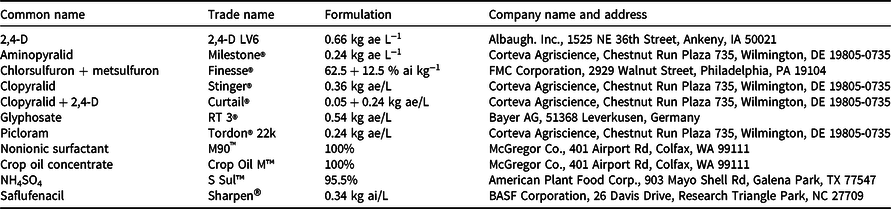
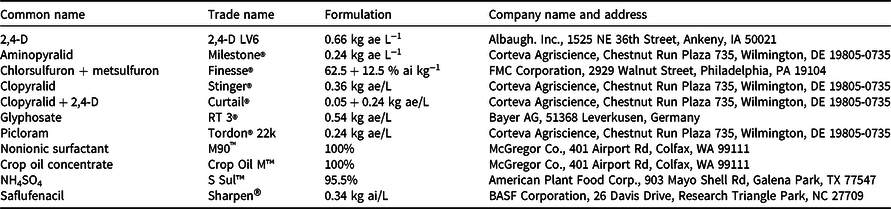
Herbicides and surfactants used in rush skeletonweed control trials in eastern Washington winter wheat/summer fallow rotations.
During our research, field operations of tillage, fertilization, and seeding were carried out by the cooperating growers. In May 2018 at LaCrosse 17, the grower chisel plowed the field and plot area and then fertilized (95-11-0-11 kg ha−1 N-P-K-S) with a combination anhydrous ammonia/liquid fertilizer applicator on 30-cm spacing. In early June 2018, the field and plot area were cross-cultivated with a field cultivator. The field and plot area were rod weeded in early August 2018 to control rush skeletonweed prior to seeding. The field and plot area were seeded September 1, 2018, to WW (‘Westbred 1783’) at 67 kg ha−1 using a John Deere® (John Deere, Moline, IL) HZ616 split-packer deep-furrow drill on 41-cm row spacing.
During the 2018–2019 SF year at both LaCrosse 18 and Hay, applications of saflufenacil plus glyphosate were applied at 50 g ae ha−1 and 2,522 g ae ha−1, respectively, and included a nonionic surfactant (0.25% vol vol−1) and crop oil concentrate (0.75% vol vol−1) in both June and August. These rates and surfactants were used to get quick burndown of the perennial rush skeletonweed as well as prickly lettuce (Lactuca serriola L.). Higher rates of glyphosate are often used with saflufenacil in the Pacific Northwest for control of prickly lettuce in no-till fallow, especially when applied with precision weed control applicators, because of the difficulty for control during SF with low rates of glyphosate (Grower communication). On September 16, 2019, the LaCrosse 18 site was seeded to WW (‘Mpress’ and ‘Norwest Duet’) at 101 kg ha−1 with a Cross Slot® (Cross Slot IP Limited, Feilding, New Zealand) drill on 25-cm spacing. Liquid fertilizer (90-10-0-15 kg ha−1 N-P-K-S) was applied with the drill. On September 18, 2019, the Hay site was seeded to WW (‘UI Magic CL+’) at 95 kg ha−1 with a Horsch® (Mapleton, ND) no-till drill on 19-cm spacing and included liquid fertilizer at a rate of 90-0-0-22 kg ha−1 N-P-K-S.
Experimental treatments (Table 3) were first applied in October 2017 at LaCrosse 17 and October 2018 at LaCrosse 18 and Hay to rush skeletonweed plants remaining in standing wheat stubble from the previous July/August harvest (Table 1). At both LaCrosse sites, plants had experienced a frost or freeze prior to application as evidenced by a dull green stem color and cessation of flowering. Plants at the Hay site were still green and actively flowering at the time of application, suggesting they did not experience the same cold temperatures. The Hay location is near the top of a ridge where frosts from cold-air drainage or accumulation do not occur. However, both LaCrosse sites are in drainages where frosts from cold-air drainage are common in the fall and spring. Herbicide treatments (Table 3) were arranged in a randomized complete block design with four replications of treatments at each location. Experimental units were plots measuring 3 m by 9.1 m. All herbicide treatments were applied with a CO2-pressurized backpack sprayer with a 3-m-wide boom at a groundspeed of 1.3 m s−1. Spray output was 140 L ha−1 at 172 kPa through six XR11002 TeeJet® nozzles (Spraying Systems, Co., Glendale Heights, IL) with a 51-cm spacing. Spring treatments were applied in April at each trial site to rosettes that had emerged through the winter. All fall-treated plots and the nontreated control plots were also sprayed with glyphosate (946 g ae ha−1) plus NH4SO4 (22 g L−1) to control volunteer wheat, winter annual weeds, and rush skeletonweed seedlings. Spring applications of glyphosate are consistent grower practice in the region for early-spring fallow weed control in either tilled or chemical fallow systems (grower communication). Summer treatments were applied in June at each trial site when the rush skeletonweed plants were beginning to bolt.
Herbicide treatments applied to rush skeletonweed in the summer fallow phase of the winter wheat/summer fallow rotations at three locations in eastern Washington. a

a Abbreviation: fb, followed by.
b Aminopyralid and chlorsulfuron + metsulfuron treatments included a nonionic surfactant at 0.25% vol vol−1. Glyphosate treatments included NH4SO4 (22 g L−1). All fall treatments and the nontreated control were followed in April with a glyphosate application (946 g ae ha−1) plus NH4SO4 (22 g L−1) to control volunteer wheat and winter annual weeds that emerged through the winter.
c Application rates for chlorsulfuron + metsulfuron are presented in g ai/ha, and treatments with sequential applications are designated by fb.
d Fall treatments were applied in October following wheat harvest; spring treatments were applied the following April; summer treatments were applied in June when rush skeletonweed was bolting during the summer fallow.
Treatment efficacy was determined by counting rush skeletonweed plants in each plot in October following wheat harvest to establish an initial density, and then in June and August of the fallow year prior to seeding winter wheat. The June and August counts represent two important decision points for growers managing fallow as to whether to apply herbicides or tillage for weed control during the fallow year. By June, weeds could have emerged since the early-spring applications, and in late-August, weeds may need to be controlled prior to fall seeding. Rush skeletonweed rosettes or bolted stems at least 2.5 cm apart in a 2-m by 8.5-m strip through the center of each plot were counted and converted to plants per square meter for analysis. Counts from June and August were then divided by the initial October counts and multiplied by 100 to show treatment efficacy as a percent of the initial density. A decrease from the initial density would be shown by a percent value less than 100.
Winter wheat was harvested in the subsequent crop to determine whether any of the fallow treatments reduced wheat yield compared with nontreated control. All trials were harvested with a research plot combine equipped with a 1.5-m header and grain bagging mechanism. Grain samples from each plot were sieved and cleaned to remove chaff, straw, and other debris and then weighed. Subsamples were assessed for test weight (kg 35.2 L−1) and grain moisture. The LaCrosse 17 grain moisture was determined gravimetrically on a wet weight basis (Hellevang Reference Hellevang1995) by weighing subsamples of approximately 400 g, oven drying the subsamples at 105 C for 120 h and then reweighing. The LaCrosse 18 and Hay grain sample moisture content was measured with a mini GAC® plus grain moisture analyzer (DICKEY-john®; Auburn, IL) calibrated for soft-white winter wheat. All wheat yields were reported on a 12% moisture basis (PURR 2014).
Statistical Analysis
Percent of initial density for each treatment for June and August were initially analyzed using the GLIMMIX procedure in SAS® (SAS Institute 2019). All data were transformed by taking the square root of each percentage to improve normality (Zar Reference Zar1999), which resulted from a range of treatment efficacies. Initial analysis showed an interaction between time, location, and treatment (P ≤ 0.001), therefore, data for June and August were analyzed separately for each location. The data were then reanalyzed with the SAS® GLIMMIX procedure with treatment as the fixed effect and block as the random effect (Stroup Reference Stroup2013) using residual solutions pseudo-likelihood (RSPL) maximum likelihood estimation (MLE), which is shown to perform better than quadrature when the distribution is reasonably symmetrical (Stroup and Claassen Reference Stroup and Claassen2020). Improvement was assessed by analyzing variance and normality of the studentized residuals for each variable with the Levene and Shapiro-Wilk tests with SAS® GLM and UNIVARIATE procedures (SAS Institute 2019), respectively. Differences between treatment lsmeans for percent of initial density at each location were compared using the Tukey adjustment (α = 0.05) and accepted only when the overall effect for treatment was significant (P ≤ 0.05). Lsmeans were back transformed for presentation.
Wheat yield data were analyzed using SAS® GLIMMIX procedure with RSPL MLE for each location due to an interaction (P < 0.001) between location and treatment. Yield data satisfied variance and normality assumptions and were analyzed without transformation with treatment as a fixed effect and block as a random effect. At Hay, the plot area at wheat harvest contained a nonuniform infestation of annual grass weeds. A visual estimation of percent annual grass weed cover at harvest was applied as a covariate to correct for yield loss due to grass weed competition. Lsmeans for each experimental treatment within location were compared only to the nontreated control for their respective location using a global contrast statement (COMPARE) in the model.
Results and Discussion
Nontreated Control Treatment
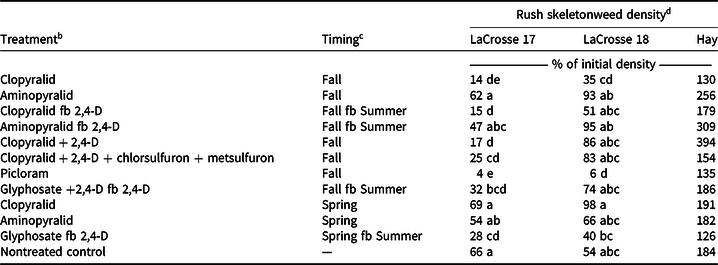
Rush skeletonweed densities at the beginning of each trial averaged 4.9, 3.8, and 1.9 plants m−2 for the LaCrosse 17, LaCrosse 18, and Hay sites, respectively. The nontreated control plots were managed through the course of the trials to reflect the growers’ management of the fields in which they were situated. The early-spring glyphosate treatment at each location controlled all volunteer wheat, winter annual weeds, and rush skeletonweed seedlings, but did not control rush skeletonweed rosettes that had formed though the fall and winter (personal observation). Therefore, rush skeletonweed seedlings were not observed contributing to the population density through the fallow year because they were easily controlled by early-spring glyphosate treatment and did not reestablish during the rest of the fallow period. The LaCrosse 17 site was tilled and fertilized in May and cross-cultivated in early June, which would have terminated the growth of all remaining rosettes growing in the plots and substantially reduced the presence of aboveground plant material. By the June census, in the nontreated control plots, rosettes had reemerged and were beginning to bolt since the previous tillage operation and averaged 26% of the initial density (Table 4). The early-spring glyphosate treatment at LaCrosse 18 and Hay had no detectable effect on reducing established plant density by June as densities averaged 105% and 481% of initial densities for each location, respectively. By the August census, densities at both the LaCrosse 18 and Hay sites had decreased to 54% and 184% of initial densities, respectively, (Table 5) as a result of the June chemical fallow treatments (saflufenacil plus glyphosate). The patterns of rush skeletonweed density in the nontreated control treatments through the fallow year were similar to what was observed in the fields surrounding the trials.
Rush skeletonweed density in June of the fallow year as a percent of initial density at three experimental locations. a
a Abbreviation: fb, followed by.
b See Table 3 for application details.
c Treatments with sequential applications are designated by fb.
d Means followed by the same letter at each site are not different (α = 0.05).
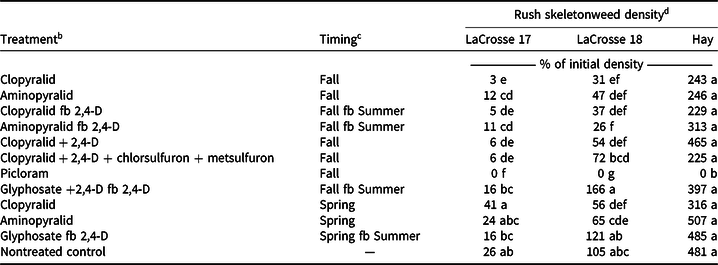
Rush skeletonweed density in August of the fallow year as a percent of initial density at three experimental locations. a

a Abbreviation: fb, followed by.
b See Table 3 for application details.
c Treatments with sequential applications are designated by fb.
d Means followed by the same letter at each site are not different (α = 0.05).
Herbicide Treatments
Picloram applied in the fall provided complete control of rush skeletonweed at the June census at all three sites (Table 4). Picloram has long been known to be very active on rush skeletonweed, which is likely due to long soil persistence as well as better leaf penetration and root activity (Greenham Reference Greenham1973; Keys and Friesen Reference Keys and Friesen1968; Schirman and Robocker Reference Schirman and Robocker1967; Shaner Reference Shaner2014). Fall-applied clopyralid, clopyralid plus 2,4-D, and clopyralid followed by 2,4-D in summer reduced the percent of initial density of rush skeletonweed compared to the nontreated control at both LaCrosse sites; however, these treatments were not effective at Hay (Table 4). Both clopyralid and picloram have been recommended for control of rush skeletonweed (DiTomaso et al. Reference DiTomaso, Kyser, Oneto, Wilson, Orloff, Anderson, Wright, Roncoroni, Miller, Prather, Ransom, Beck, Duncan, Wilson and Mann2013; USDA-FS 2017; VanVleet and Coombs Reference Van Vleet and Coombs2012;). Heap and Fischle (Reference Heap and Fischle1987) and Heap (Reference Heap1993) found good control 1 yr after treatment at two of their three sites in Australia with clopyralid at a rate similar to what was used in our research. Of the three genotypes found in Australia, differences in herbicide efficacy between genotypes exist and explains the reduced efficacy at their third site (Black et al. Reference Black, Pederson and Stephenson1998; Heap Reference Heap1993). In our study, plants were identified as genotype 3, a long-day flowering genotype, (JF Gaskin, personal communication), which is the most prevalent genotype in Washington State (Gaskin et al. Reference Gaskin, Schwarzländer, Kinter, Smith and Novak2013), but we found no evidence that genotype 3 is resistant to clopyralid.
At the August census, picloram continued to provide superior control of rush skeletonweed at the two LaCrosse sites; however, picloram was no longer effective at Hay (Table 5). The lack of a frost or freezing temperatures at Hay prior to the fall applications could explain the lack of control in August. Freezing temperatures in the fall change the structure of storage carbohydrates in other Asteraceae species such as Canada thistle (Cirsium arvense L.), dandelion (Taraxacum officinale F.H. Wigg.), and chicory (Cichorium intybus L.; Van den Ende and Van Laere Reference Van den Ende and Van Laere1996; Wilson and Michiels Reference Wilson and Michiels2003; Wilson et al. Reference Wilson, Martin and Kachman2006). Wilson et al. Reference Wilson, Martin and Kachman2006 found that fall applications of synthetic auxin herbicides are more effective for control of Canada thistle following freezes, than if applied before freezing temperatures, by reducing the breakdown of long-chain fructans into short-chain fructans and sucrose, which help protect the roots from freezing in the winter.
At LaCrosse 17, rush skeletonweed control with fall-applied treatments containing clopyralid was intermediate in that control was less than or similar to picloram but was better compared with the nontreated control (Table 5). At the LaCrosse 18 site, rush skeletonweed control with treatments containing clopyralid was inconsistent, where some treatments resulted in control similar to picloram, others were similar to the nontreated control. Aminopyralid no longer controlled rush skeletonweed at any location at the August census.
Wheat Yield
Visual observations during the growing season found no indications of yellowing, stunting, or trapped heads. Overall, only two treatments were associated with yields different from the nontreated control. At LaCrosse 17, the fall-applied glyphosate plus 2,4-D yielded 1,530 kg ha−1, which was greater than 1,140 kg ha−1 for the nontreated control. At LaCrosse 18, the spring-applied aminopyralid treatment yielded 5,640 kg ha−1, which was smaller than 6,360 kg ha−1 for the nontreated control. At LaCrosse 17, the average yield was about 80% less than either LaCrosse 18 or Hay, because of a drift event when the wheat was in the boot stage from an aerial application in a neighboring field. Before the drift event, no crop injury symptoms were observed from the previous SF treatments. Average yields in the region range from 3,000 to 4,000 kg ha−1. In our study, LaCrosse 17, LaCrosse 18, and Hay averaged 1,234, 6,200, and 5,260 kg ha−1, respectively. High yields in our study would indicate the wheat was highly competitive and would explain why the yield of the nontreated control, or other treatments with poor rush skeletonweed control, were not lower (data not shown). The high yields at LaCrosse 18 and Hay were due, in part, to approximately 130 mm of precipitation that fell from April through June in 2020 as the wheat kernels were developing and filling and is about 40% of the average annual precipitation for the area and well above average for the April through June time period.
Of the treatments labeled for wheat or fallow, which excludes aminopyralid, none yielded less than the nontreated control, including picloram. Picloram has been used in the region in spot-spray applications for field bindweed control at rates so high that crop yield was substantially reduced for years following the applications (grower communication, personal observation). Consequently, there is widespread grower reluctance to apply picloram, even though it is labeled for use in fallow and has the potential to control rush skeletonweed. Previous research has shown wheat injury and reduced yield when picloram is applied to the growing crop (Heering and Peeper Reference Heering and Peeper1991; Nalewaja Reference Nalewaja1970), or up to 30 d prior to seeding (Ogg and Young Reference Ogg and Young1991); however, we applied picloram 11 mo prior to seeding. Research has shown that picloram can have a long half-life, but the exact time depends on many factors including soil management, vegetation, and application rate (Altom and Strizke Reference Altom and Strizke1973; Keys and Friesen Reference Keys and Friesen1968; Passos et al. Reference Passos, Souza, Silva, Saraiva, da Silva, Zanuncio and Goncalves2018). We found no perceptible crop injury or yield loss from the picloram applications postharvest in the fall.
Controlling rush skeletonweed through the fallow year has been a substantial problem for growers in the region who have taken land out of CRP infested with rush skeletonweed. Even though research has shown some herbicides to be effective for control, none have focused on control through the entire fallow period. Our research focused on fallow year control in the WW/SF rotation, but our results illustrated the magnitude of the problem. Control of rush skeletonweed was 100% when picloram was applied in the fall after wheat harvest through June of the SF period. Fall-applied clopyralid, clopyralid followed by 2,4-D in the summer, and clopyralid plus 2,4-D provided acceptable control of rush skeletonweed through June at two of three sites. By August of the fallow year, no treatments provided acceptable control at Hay. Fall-applied picloram and clopyralid provided the best control of rush skeletonweed at the two LaCrosse sites throughout the fallow period. Spring-applied treatments were largely ineffective for the control of rush skeletonweed in fallow. In the subsequent wheat crop following the fallow period, rush skeletonweed density remained low at 12% of initial density in the picloram-treated plots at both LaCrosse sites but was 53% of initial density in the picloram treated plots and similar to the nontreated control at Hay (data not shown). For long-term control, it appears that one approach would be picloram applied postharvest in the fall following a frost or light freeze; effective burn-down treatments in June and August, if needed, prior to winter wheat seeding to preserve soil moisture; then planting and fertilizing winter wheat at optimum times and rates to promote establishment of a competitive wheat crop. Clopyralid, in various products, is labeled in wheat and if applied correctly can provide some control or suppression before the next fallow year (Spring et al. Reference Spring, Thorne, Burke and Lyon2018). Long-term control of rush skeletonweed in WW/SF systems will likely require consistent effort over several crop rotation cycles.
Acknowledgments
This research was partially funded by an endowment from the Washington Grain Commission and by the U.S. Department of Agriculture–National Institute of Food and Agriculture, Hatch project 1017286. The field studies were conducted on land graciously made available to the authors by RR Dorman Farms, Terry Miller, and Casey Holling. We are grateful to Dr. Henry Wetzel and Jacob Fischer for assistance in field research activities. No conflicts of interest have been declared.