Implications
Rumen development of calves directly affects the growth and development of the calf late production performance as well as health status, so researches about rumen development of calves have always been an important part of ruminant nutrition research. The results of the present study proved calcium propionate (CaP) could be used as feed additive to promote rumen fermentation and rumen development of calves. In addition, our study found the mechanism that the improved rumen epithelium development was associated with increased propionate by CaP supplementation in the rumen of calves through stimulating the messenger RNA (mRNA) expression of G protein-coupled receptor 41 (GPR41) and GPR43.
Introduction
Volatile fatty acids (VFAs) are a group of short-chain fatty acids, including acetate, propionate and butyrate, etc., that are produced by microbial fermentation in the rumen of ruminants and supply 70% to 80% of energy to ruminants (Bergman, Reference Bergman1990). In addition to being produced in the rumen, VFAs stimulate the growth of rumen epithelium in ruminants (Sakata and Tamate, Reference Sakata and Tamate1979; Lane and Jesse, Reference Lane and Jesse1997; Gorka et al., Reference Gorka, Kowalski, Pietrzak, Kotunia, Kiljanczyk, Flaga, Holst, Guilloteau and Zabielski2009; Malhi et al., Reference Malhi, Gui, Yao, Aschenbach, Gäbel and Shen2013). Volatile fatty acids are not only an important source of energy, but also they act as signaling molecules on the surface of cells, facilitating the regulation of cell proliferation and differentiation, apoptosis, immune response, lipid metabolism and nutrient absorption (Roy et al., Reference Roy, Kien and Bouthillier2006). G protein-coupled receptors (GPRs) are integral membrane proteins that possess seven membrane-spanning domains or transmembrane helices (Venkatakrishnan et al., Reference Venkatakrishnan, Deupi, Lebon, Tate, Schertler and Babu2013). G protein-coupled receptors are activated by an external signal in the form of a ligand or other signal mediator. Propionate is able to stimulate the orphan receptors GPR41 and GPR43 (Brown et al., Reference Brown, Goldsworthy and Barnes2003). Another study found that propionate is the most potent agonist of GPR41 and GPR43 of the various VFAs (Poul et al., Reference Poul, Loison, Struyf, Springael, Lannoy, Decobeeq, Brezillon and Detheux2003).
Propionate acts as a signaling molecule to induce preadipocyte differentiation (Lee and Hossner, Reference Lee and Hossner2002; Xiong et al., Reference Xiong, Miyamoto and Shibata2004; Hong et al., Reference Hong, Nishimura, Hishikawa, Tsuzuki, Miyahara, Gotoh, Choi, Feng, Chen, Lee, Katoh, Roh and Sasaki2005), and it stimulates adipogenesis of cultured bovine intramuscular cells through stimulating GPR41 mRNA expression (Wan, Reference Wan2009). Yonezawa et al. (Reference Yonezawa, Haga, Kobayashi, Katoh and Obara2009) found that that GPR41 mainly mediated short-chain fatty acids signaling in bovine mammary epithelial cells, but not GPR43. Wang et al. (Reference Wang, Akers and Jiang2012) provided the presence of GPR43 in rumen epithelium but not in the islets of Langerhans in cattle. Therefore, GPR41 and GPR43 have tissue specificity and may play different roles in different organs or tissues.
Propionate, the main component of VFAs in the rumen, is the primary precursor for ruminant gluconeogenesis and supplies up to 90% of a ruminant’s glucose (Bergman, Reference Bergman1975). Calves fed a mixture of steam-flaked corn and extruded soybean had a greater concentration of propionate but displayed no changes in concentration of other VFAs (Xie et al., Reference Xie, Meng, Liu, Wu, Li, Ren and Li2013), suggesting that higher propionate concentration may indicate better rumen development. In addition, it was suggested that propionate supplementation can increase proliferation of rumen epithelial cells (Sakata and Tamate, Reference Sakata and Tamate1979). Despite the data supporting propionate as a factor contributing to rumen development, the mechanism by which propionate may improve rumen development is unknown.
Calcium propionate is approved by the World Health Organization (WHO) and the United Nations Food and Agriculture Organization (FAO) as a food and feed additive to inhibit mold (Alexandria, Reference Alexandria2002). Calcium propionate is dissociated to Ca2+ and propionic acid in the rumen aqueous solutions. Adding CaP to the diet of ruminally cannulated Chinese Simmental steers promoted rumen fermentation (Liu et al., Reference Liu, Wang, Guo, Yang, Dong, Huang, Yang and He2009). We hypothesized that supplementation with CaP could improve propionate concentration and the mechanism of improved rumen epithelium development was associated with increased propionate in the rumen of calves through stimulating the expression of GPRs including GPR41 and GPR43.
Material and methods
The experiment was conducted at the experimental farm of the China Agricultural University and Beef Cattle Research Center in Daxing District, Beijing, China. Experimental procedures involving animals complied with the guidelines approved by the Animal Welfare Committee of China Agricultural University (permit number: DK1519).
Animals and experimental design
In total, 44 male Jersey calves were included in the experiment (average age and BW upon arrival: 7±1 days and 23.1±1.2 kg, respectively). All calves were purchased from the Sanyuan Xinlvzhou Dairy Farm to obtain a uniform group of calves of similar age. In the initial 3 days of life, all calves received colostrum only (2.0 l twice daily) via an esophageal feeding tube. After 3 days weaning from colostrum, calves were readily drinking milk from buckets and displayed no apparent health problems. Calves were selected and transported to the China Agricultural University Beef Cattle Practical Education Base, located in Daxing District, Beijing. Upon arrival, calves were divided into three groups of 18 animals based on initial BW, and were then housed in individual pens (1.5×2.5 m; bedded with wood shavings). Nose-to-nose contact between calves was minimized by pen arrangement. The calves were assigned randomly to one of three treatment groups: (1) control without CaP supplementation (Con), (2) 5% CaP supplementation (5% CaP) and (3) 10% CaP supplementation (10% CaP). Calcium propionate supplementation was determined on a dry matter (DM) basis of milk, milk replacer and starter ration, respectively. The CaP (purity=99.26%) used in this experiment was purchased from Dongxin Chemical Plant (Tengzhouzhongxin Co. Ltd, Shandong, China).
Diets and feeding management
The duration of the experiment was 160 days and was divided into three stages: Stage 1 (days 0 to 30), Stage 2 (days 31 to 90) and Stage 3 (days 91 to 160). Calves were provided fresh water ad libitum throughout the experiment. In Stage 1, calves were fed milk at a daily rate of 10% of initial BW. The weight of calves and DM of milk were measured on weekly intervals to adjust the amount of milk required and CaP supplementation per calf. The milk was bucket-fed at 39°C in three equal feedings per day (0630, 1430 and 2030 h) during Stage 1. To guarantee the quality of the milk, milk was purchased daily from Sanyuan Lvmuyuan Dairy Farm, located <2 km from the experimental facility. Calcium propionate was supplemented by mixing with milk. During Stage 2, calves received a commercial milk replacer (Nutrifeed, Inc., Friesland Campina, The Netherlands) containing 22% CP and 18% crude fat. The milk replacer was reconstituted with water at 40±1°C. The replacer concentration in the liquid diet was 12.5%. In Stage 2, the milk replacer powder was fed at 1.5% of initial BW as recorded at the beginning of Stage 2. All calves were bucket-fed the milk replacer at 39°C three times per day (0700, 1400 and 2100 h) during Stage 2. After milk replacer feeding, a starter ration was made available to each calf. The detailed procedure of starter feeding is as follows: first, 100 g starter ration was provided to each calf per day; if this amount was consumed then an additional 100 g was provided. Daily feed intake for each calf was recorded and calves were weighed at monthly intervals. Calcium propionate was supplemented through mixing with milk replacer powder and starter ration. Stage 3 lasted from 91 to 160 days and all calves were weaned from milk replacer at the beginning of this stage. The starter ration feeding schedule continued unchanged from Stage 2. To prevent rumen acidosis and facilitate animal welfare, all calves in Stage 3 were supplied an equal amount of chopped alfalfa hay after starter ration. In Stage 3, CaP supplementation was made into pellets through mixed with the starter ration.
Feed analysis
Samples of the milk replacer, starter feed and alfalfa were analyzed for DM, CP, crude fat, ash, calcium and phosphorus by Association of Official Analytical Chemists (1990) methods. Feed samples were also analyzed for NDF and ADF content, as described previously (Van Soest et al., Reference Van Soest, Robertson and Lewis1991). The ingredients of the starter ration and the nutrient composition of milk replacer, starter ration and alfalfa hay are listed in Table 1.
The ingredients of calves starter ration and the nutrient compositions of milk replacer, starter ration and chopped alfalfa hay

DM=dry matter; NEm=net energy for maintenance; NEg=net energy for growth.
1 The premix was formulated to provide 100 g calcium, 40 g phosphorus, 150 g salt, 18 000 IU vitamin A, 4000 IU vitamin D3, 800 IU vitamin E, 4000 mg Fe, 300 mg Cu, 2100 mg Zn, 2000 mg Mn, 5000 mg S, 25 mg I, 10 mg Se and 20 mg Co per kilogram of DM.
2 Calculated based on NRC (2000).
Sampling procedures
There were three stages in this experiment, 0 to 30, 31 to 90 and 91 to 160 days. At the end of each stage, six calves were randomly selected to slaughter from each treatment group. Transportation and slaughter procedures met current welfare guidelines. Stunning was performed with a captive bolt and was followed by jugular exsanguination. The gastrointestinal tract and internal organs were immediately harvested, emptied and rinsed with cold water. A tissue sample from the dorsal sac of the rumen was collected and fixed in 10% formalin solution for analysis of papillae length (PL), papillae width (PW) and rumen wall thickness (RWT). Additional tissue samples were obtained from the same locations (1 cm2). Samples were placed in 2 ml sterile tubes (Corning® cryogenic vials, catalog no. 430659; Corning Inc., New York, NY, USA) and were transferred into liquid nitrogen after detachment from the muscle layers. Samples were stored at −80°C for molecular and biological analyses. Rumen contents were filtered through four layers of cheesecloth and rumen fluid samples were collected.
Morphometric and histomorphometric analyses
Photographs of all rumen epithelium samples were taken with optical microscopy (Olympus BX40; Olympus, Tokyo, Japan) at 4× magnification. The PL and PW of 30-day calves were measured by standard hematoxylin–eosin (H&E) procedure, as described previously (Malhi et al., Reference Malhi, Gui, Yao, Aschenbach, Gäbel and Shen2013). In brief, all samples were dehydrated sequentially in an ethanol series (50% to 100%), then embedded in paraffin, sectioned at 6.0-μm thickness and finally stained with H&E. For each rumen segment, six transverse sections were prepared and 10 to 15 papillae were measured by NIS-Elements F2.20 Nikon software with optical microscopy at 40× magnification (Nikon Eclipse TE2000-s; Nikon, Tokyo, Japan). The PL and PW of 90- and 160-day calves were measured directly using a sliding caliper. In total, 15 papillae from each sample were measured. Rumen wall thickness was determined three times for each sample. The average of the measurements was used for further statistical analysis.
Evaluation of rumen fermentation
The pH values of rumen fluid were immediately determined after slaughter (Eutech Instruments, pH Spear; Thermo Fisher Scientific Inc., Shanghai, China). Rumen fluid (15 ml) samples were acidified with 3 ml of 25% metaphosphoric acid and 3 ml of 0.6% 2-ethylbutyric acid (internal standard). Samples were stored at −20°C before analysis of VFA and NH3 content. Samples were subsequently centrifuged twice at 3750×g for 10 min at 4°C to obtain a clear supernatant. The VFA profile was determined by capillary gas chromatography, as previously described (Erwin et al., Reference Erwin, Marco and Emery1961), and NH3–N concentration was determined using a phenol-hypochlorite assay based on the method described by Broderick and Kang (Reference Broderick and Kang1980).
Total RNA extraction, complementary DNA synthesis and quantitative real-time PCR
Total RNA was extracted from homogenized ruminal tissue of 160-day calves using the TRIzol reagent (BioTeke Corporation, Beijing, China). The concentration and integrity of total RNA was determined using an Agilent 2100 Bioanalyzer and Agilent RNA 6000 Nano Kit (Agilent Technologies, Inc., CA, USA) and sample purity was detected using a K5500 trace spectrophotometer (Merinton, MI, USA). All samples had an absorbance ratio (260 : 280) between 1.80 and 2.16, indicating high RNA purity. Complementary DNA (cDNA) was synthesized from 2 μg RNA using a super RT Kit PR6601 (BioTeke Corporation) according to manufacturer’s recommendations. Quantitative real-time PCR (qRT-PCR) was used to analyze the expression of GPR41 (accession number: NM_001145233), GPR43 (accession number: NM_001163784), cyclin D1 (CCND1; accession number: NM_001046273), cyclin-dependent kinase 4 (CDK4; accession number: NM_001037594) and the housekeeping gene, glyceraldehyde-3-phosphate dehydrogenase (accession number: U85042), which was used as an endogenous control. The primers used for qRT-PCR were performed as shown in Table 2. Real-time PCR was carried out in a total volume of 10 μl containing 5 μl Roche FastStart Universal SYBR Green Master (ROX), 0.5 μl cDNA template, 0.75 μl forward primer, 0.75 μl reverse primer and 3 μl ddH2O. Quantitative RT-PCR was carried out using the ABI7500 detection system (Applied Biosystems, Life Tech, CA, USA) with the thermal cycling variables recommended by the manufacturer: one step at 95°C for 30 s, 40 cycles of denaturation at 95°C for 10 s, annealing at 60°C for 20 s and extension at 72°C for 20 s. Post-PCR melting curves confirmed the specificity of the single target amplification and the expression of each gene was determined in triplicate. The relative expression values were calculated by using the formula (
 $2^{{{\minus}\Delta \Delta C_{t} }} $
) as described by Livak and Schmittgen (Reference Livak and Schmittgen2001), where C
t
is the cycle threshold.
Primers used for quantitative real-time PCR analysis of rumen epithelium in calves

F=forward primer; R=reverse primer; GPR41=G protein-coupled receptor 41; GPR43=G protein-coupled receptor 43; CCND1=cyclin D1; CDK4=cyclin-dependent kinase 4; GAPDH=glyceraldehyde-3-phosphate dehydrogenase.
Statistical analysis
The effects of dietary CaP supplementation on rumen fermentation and rumen papillae development of calves were evaluated using ANOVA of the GLM procedures using SAS 9.0 (SAS Institute Inc., 2002). The differences between groups were analyzed in terms of the least square group means using a t-test. Differences were considered significant at P<0.05, a tendency toward significance at 0.05<P<0.1, and not significant at P>0.1.The qRT-PCR data are presented as relative fold-change values to the mean value of control group. The fold-change value was more than two times, the differences were considered significant; the fold-change value was less than two times, no significant was considered.
Results and discussion
Rumen fermentation
Rumen pH is an important indicator of proper rumen fermentation and health. Decreasing rumen pH is caused by VFA accumulation in the rumen when the rate of microbial VFA production exceeds the rate at which VFA can be absorbed across the ruminal epithelium. Acidosis is characterized by a decrease in pH, caused by a shift in the balance of rumen micro-organisms (Krause and Oetzel, Reference Krause and Oetzel2006). In the present study, rumen pH was not changed by CaP supplementation (P>0.05, Tables 3 to 5) and was maintained in the normal range, indicating that animals did not experience rumen acidosis and that rumen fermentation was functioning normally.
Effects of calcium propionate (CaP) supplementation on rumen fermentation in calves after 30-day feeding

CON=control treatment without CaP supplementation; 5% CaP=5% CaP supplementation (dry matter (DM) basis); 10% CaP=10% CaP supplementation (DM basis); TVFAs=total volatile fatty acids.
a,bValues with different superscript letters within a row represent significant differences (P<0.05).
The rumen, a digestive organ found in ruminants, utilizes feed to produce VFA through rumen microbial fermentation. Tamate et al. (Reference Tamate, McGilliard, Jacobson and Getty1962) found that direct infusion of VFA in milk into the rumen promoted earlier growth of rumen epithelium. In accordance with this previous report, we observed that CaP supplementation improved rumen development in calves in the 30-day group, and that the level of CaP supplementation was positively correlated with rumen development (Table 6). An increasing tendency of acetate concentration (P=0.0632), propionate concentration (P=0.0903) and isobutyrate concentration (P=0.0591) in calves was observed in the 30-day group supplemented with CaP (Table 3), which could be contribute to enhanced rumen epithelium development through CaP supplementation. Moreover, the accumulative effects of acetate, propionate and isobutyrate contributed to significant greater total VFA (P=0.0370) in the 10% CaP group compared with the Con group in calves of the 30-day feeding group (Table 3).
Supplementation with 10% CaP reduced the amount of ammonia nitrogen in calves of the 90-day feeding group (P=0.0013; Table 4). In Stage 2, the calves received milk replacer and start ration, which have high level CP, leading to the imbalance of energy and nitrogen ratio so that the rumen microbe could not utilize all ammonia from protein degradation resulting in higher ammonia and pH value in rumen. Calcium propionate supplementation could balance the energy and nitrogen, increase protein utilization, leading to reducing ammonia and pH value in rumen (Table 4). In agreement with our study, Liu et al. (Reference Liu, Wang, Guo, Yang, Dong, Huang, Yang and He2009) also reported that high protein utilization was observed in the CaP supplementation group. The acetate, propionate and butyrate content increased in the CaP supplementation groups, but were not significant (P>0.05; Table 4). In Stage 2, the high-concentrate diets consisting of milk replacer supplied abundant ruminal propionate, and adding CaP did not significantly increase ruminal propionate concentration, or the concentration of other VFAs. Similarly, in our previous study, there was no significant effect of CaP supplementation on rumen fermentation in finishing steers fed a high-concentrate diet (Zhang et al., Reference Zhang, Meng, Lu, Cui and Ren2015).
Effects of calcium propionate (CaP) supplementation on rumen fermentation in calves after 90-day feeding

CON=control treatment without CaP supplementation; 5% CaP=5% CaP supplementation (dry matter (DM) basis); 10% CaP=10% CaP supplementation (DM basis); TVFAs=total volatile fatty acids.
a,bValues with different superscript letters within a row represent significant differences (P<0.05).
In Stage 3, when the energy concentration in the diets became lower as diets were changed from milk replacer+starter to starter+alfalfa, adding 5% CaP supplementation increased propionate content compared with the Con group (P=0.0029, Table 5), resulting in additional energy for calves. In agreement with the present study, it was previously reported that the rumen propionate concentration of cannulated Chinese Simmental steers fed with maize stover and concentrate was increased with CaP supplementation (Liu et al., Reference Liu, Wang, Guo, Yang, Dong, Huang, Yang and He2009). However, supplementation with 10% CaP did not significantly increase propionate content compared with the Con group (Table 5). A possible reason is that the increased propionate in the 10% CaP group could stimulate propionate receptor and enhance the velocity of emptying feed in the rumen (Anil and Forbes, Reference Anil and Forbes1980), leading to increased nutrient flow into the intestine. This could indicate better intestinal development, which we observed in calves of the 10% CaP supplementation group in Stage 3 at 160 days (Zhang et al., Reference Zhang, Wu, Chen, Zhang, Jiang, Meng and Zhou2017).
Effects of calcium propionate (CaP) supplementation on rumen fermentation in calves after 160-day feeding

CON=control treatment without CaP supplementation; 5% CaP=5% CaP supplementation (dry matter (DM) basis); 10% CaP=10% CaP supplementation (DM basis); TVFAs=total volatile fatty acids.
a,bValues with different superscript letters within a row represent significant differences (P<0.05).
Rumen epithelium development
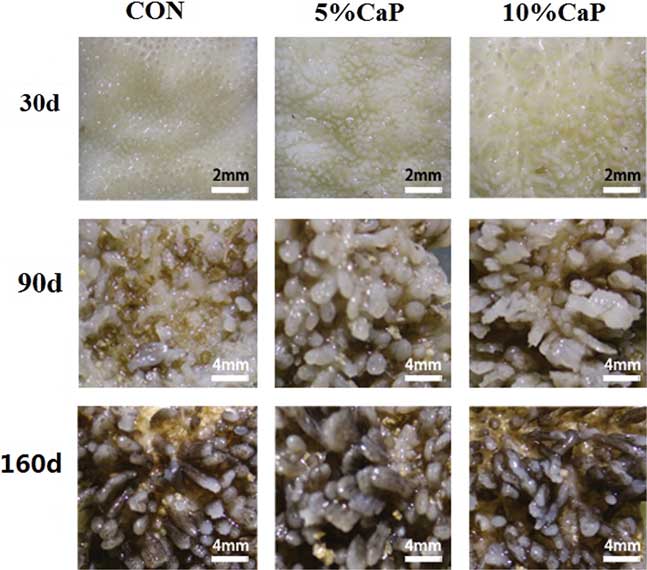
The rumen epithelium of calves in Stage 1 showed almost no development, and it was difficult to observe the papillae. The calves at 90 days in Stage 2, the length and width of papillae demonstrated substantial development. The rumen epithelium of calves after 160-day feeding showed the best development, compared with calves after 30- and 90-day feeding, reflected in higher length and width of papillae (Figure 1). Rumen wall thickness, PL and PW were summarized in Table 6. Supplementation with CaP increased the RWT in calves after 30-day feeding (P=0.0085) and 90-day feeding (P=0.0126). Calcium propionate supplementation improved rumen PL and PL was positively correlated with the level of CaP supplementation (P=0.0012), however there was no significant effect seen on the PW of calves after 30-day feeding (P=0.2754). For calves in Stage 2, after 90-day feeding, adding CaP improved rumen PL (P=0.0016), and adding 10% CaP increased the PW (P=0.0293). The rumen PL of calves in the 5% CaP supplementation group was greater than the other two groups (P<0.001), and no significant differences were observed between Con and 10% CaP groups in calves after 160-day feeding. However, supplementation with 10% CaP increased the PW in calves after 160-day feeding (P=0.0025).
(colour online) The effects of calcium propionate (CaP) supplementation on development of calf rumen epithelium. Micrographs of typical papillae samples of calves from different treatments of the 30-, 9- and 160-day feeding stages, respectively. CON=without CaP supplementation; 5% CaP=5% CaP supplementation; 10% CaP=10% CaP supplementation.

Effects of calcium propionate (CaP) supplementation on rumen epithelium development in different stages calves

CON=control treatment without CaP supplementation; 5% CaP=5% CaP supplementation (dry matter (DM) basis); 10% CaP=10% CaP supplementation (DM basis); RWT=rumen wall thickness; PL=papillae length; PW=papillae width.
a,b,cValues with different superscript letters within a row represent significant differences (P<0.05).
Rumen epithelium plays an important role in absorption of VFAs (Penner et al., Reference Penner, Aschenbach, Gabel, Rackwitz and Oba2009), regulation of the protons to prevent severe cytosolic acidosis (Gäbel et al., Reference Gäbel, Aschenbach and Muller2002) and nitrogen transportation and urea recycling (Abdoun et al., Reference Abdoun, Stumpff and Martens2006; Penner et al., Reference Penner, Aschenbach, Gabel, Rackwitz and Oba2009). Development of papillae is a critical part of the normal growth of stratified rumen epithelium, as papillae are the major absorptive structure in the rumen and are essential for nutrient utilization (Graham and Simmons, Reference Graham and Simmons2005). Rumen PL and PW are usually used to evaluate the rumen development (Lesmeister et al., Reference Lesmeister, Tozer and Heinrichs2004; Xiao et al., Reference Xiao, Alugongo, Chuang, Dong, Li, Yoon, Wu and Cao2015). Hamada (Reference Hamada1976) found that infusion of short-chain fatty acids into the rumen increased rumen PL in lambs. Supplementation with propionate and butyrate salt also promotes the growth of rumen epithelium (Sander et al., Reference Sander, Warner, Harrison and Loosli1959; Gilliland et al., Reference Gilliland, Bush and Friend1962; Tamate et al., Reference Tamate, McGilliard, Jacobson and Getty1962).
In agreement with previous studies, this present study demonstrated that rumen epithelium development is associated with the concentration of VFAs in the rumen of calves after 30- and 90-day feeding. Calves supplemented with 5% CaP had a greater concentration of propionate and showed better rumen development compared with the Con and 10% CaP groups after 160-day feeding, in agreement with a previous study in our lab (Xie et al., Reference Xie, Meng, Liu, Wu, Li, Ren and Li2013). These data suggest that propionate, rather than other VFAs, plays an important role in stimulating the growth of rumen epithelium.
Gene expression of rumen epithelium
As the 5% CaP supplementation group in feeding 160-day calves demonstrated the increased proprionate concentration and most robust improvement in rumen epithelial development, samples from the calves in the 160-day feeding group were evaluated to investigate the mechanism of propionate as a signaling molecule in the stimulation of rumen epithelium development. Gene expression analyses were performed on samples from these groups.
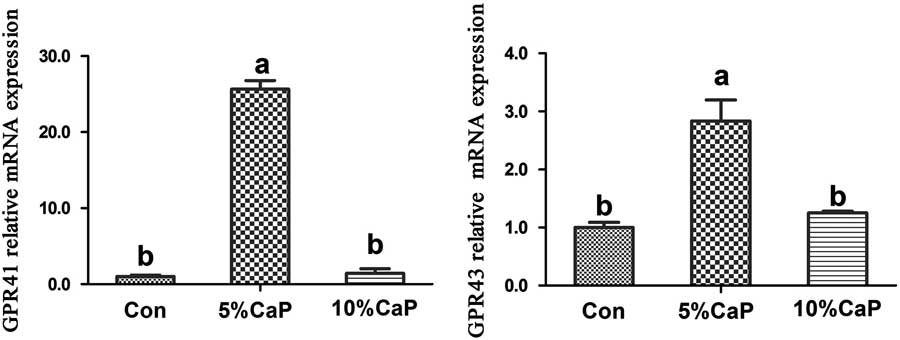
In the present study, the mRNA expression of GPR41 and GPR43 of rumen epithelium supplemented with 5% CaP were greater than the control group and 10% CaP group in feeding 160-day calves (Figure 2). Highly consistent results among propionate concentration, PL and the mRNA expression of GPR41 and GPR43 indicated that improved rumen epithelium development was associated with increased propionate by CaP supplementation through stimulating the mRNA expression of both GPR41 and GPR43. According to the present study, both GPR41 and GPR43 were expressed in rumen epithelium, whereas in terms of the relative mRNA expression of GPR41 and GPR43 with 25.67 and 2.84-folds, respectively, compared with the Con group (Figure 2) suggested propionate possibly preferred to stimulate GPR41 to improve rumen epithelium development.
Relative messenger RNA (mRNA) expression of G protein-coupled receptors 41 (GPR41) and 43 in rumen epithelium of 160-day feeding calves from 5% and 10% calcium propionate (CaP) supplementation groups compared with the control (without CaP supplementation (Con)) group. 5% CaP=5% CaP supplementation; 10% CaP=10% CaP supplementation. Letters a, b above column represent significant differences which the fold-change was more than two times.

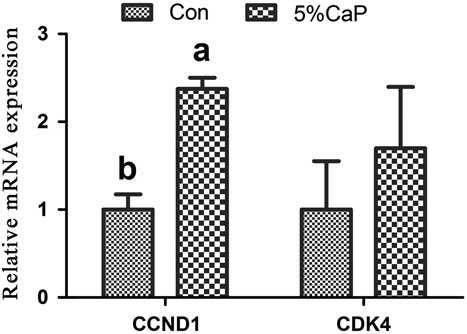
The mRNA expression of CCND1 in the 5% CaP group was higher than in the Con group, although adding 5% CaP did not increase the mRNA expression of CDK4 (Figure 3). It was previously reported that increased papillae growth in the rumen of goats was associated with transient increases in CCND1 mRNA expression after ruminal butyrate infusion (Malhi et al., Reference Malhi, Gui, Yao, Aschenbach, Gäbel and Shen2013). Cyclin D1 and CDK4 are key factors that promoting the transition from G0/G1 to S phase (Malhi et al., Reference Malhi, Gui, Yao, Aschenbach, Gäbel and Shen2013). Cyclin D1 binds with CDK4 to form a complex that promotes cell cycle transition from the G1 ‘checkpoint’ to the S phase (Mathew et al., Reference Mathew, Ranganna and Yatsu2010). The increasing mRNA expression of CCND1 and constant level of CDK4 in the present study in response to CaP supplementation was in agreement with earlier observations, which CDK protein levels often remained unchanged throughout the cell cycle (Noble et al., Reference Noble, Endicott, Brown and Johnson1997), whereas those of CCND1 can fluctuate (Pardee, Reference Pardee1989; Baldin et al., Reference Baldin, Lukas, Marcote, Pagano and Draetta1993).
Relative messenger RNA (mRNA) expression of cyclin D1 (CCND1) and cyclin-dependent kinase 4 (CDK4) in rumen epithelium of 160-day feeding calves from 5% calcium propionate (CaP) supplementation group compared with the control (Con) group. Letters a, b above column represent significant differences which the fold-change was more than two times.

Conclusions
Dietary supplementation with CaP promotes rumen fermentation and improves development of rumen epithelium in calves. The results of feeding 160-day calves suggest that propionate plays an important role in improving rumen epithelium development with higher PL and CCND1 mRNA expression. The mechanism by which propionate improves rumen epithelium development in calves may be by stimulation of GPR41 and GPR43 mRNA expression.
Acknowledgments
This work was supported by the National Natural Science Foundation of China (grant number 31372335) and the Fund for Modern Agro-Industry Technology Research System (Beef Cattle and Yaks) (grant number CARS-38).
Declaration of interest
The authors declare that there are no conflicts of interest.
Ethics statement
Experimental procedures involving animals complied with the guidelines approved by the Animal Welfare Committee of China Agricultural University (permit number: DK1519).
Software and data repository resources
The data was totally shown in the manuscript and no supplementary material was deposited in an official repository.