INTRODUCTION
Coastal lagoons are shallow aquatic ecosystems which represent the interface between coastal terrestrial and marine ecosystems. They can be permanently open or intermittently closed off the adjacent sea by deposition barriers. Due to their interface location, between land and sea and low depth, they are under heavy natural constraints (Kjerfve, Reference Kjerfve and Kjerfve1994; Gamito et al., Reference Gamito, Gilabert, Marcos, Pérez-Ruzafa, Gönenç and Wolflin2005; Richards et al., Reference Richards, Wares and Mackie2010; Canu et al., Reference Canu, Solidoro, Umgiesser, Cucco and Ferrarin2012). Considering their physicochemical characteristics, lagoons are very dynamic and may also be considered as highly variable environments (Gonzalez-Wanguemert et al., Reference González-Wangüemert and Pérez-Ruzafa2009, Reference González-Wangüemert and Vergara-Chen2014; Vergara-Chen et al., Reference Vergara-Chen, González-Wangüemert, Marcos and Pérez-Ruzafa2010a) that provide essential habitats for nursery and recruitment of several marine species, which could allow admixture of different genetic pools, thus increasing population genetic diversity of marine species in coastal marine habitats (Pampoulie et al., Reference Pampoulie, Gysels, Maes, Hellemans, Leentjes, Jones and Volckaert2004; Arnaud-Haond et al., Reference Arnaud-Haond, Vonau, Rouxel, Bonhomme, Prou, Goyard and Boudry2008; González-Wangüemert et al., Reference González-Wangüemert, Cánovas, Marcos and Pérez-Ruzafa2009, Reference González-Wangüemert, Domínguez-Godino, Giménez-Casalduero and Serrão2014; González-Wangüemert & Pérez-Ruzafa, Reference González-Wangüemert and Pérez-Ruzafa2012; González-Wangüemert & Vergara-Chen, Reference González-Wangüemert and Vergara-Chen2014). Given the importance of coastal lagoons as nursery and settlement habitats of marine species and the decline they have experienced by natural and anthropogenic disturbances, recent population genetics studies have allowed insights on spatial patterns of genetic diversity in inshore lagoons. In general, it seems that genetic diversity of organisms inhabiting lagoons will be influenced by different levels of gene flow (González-Wangüemert et al., Reference González-Wangüemert, Cánovas, Marcos and Pérez-Ruzafa2009; Vergara-Chen et al., Reference Vergara-Chen, González-Wangüemert, Marcos and Pérez-Ruzafa2010a, Reference Vergara-Chen, González-Wangüemert, Marcos and Pérez-Ruzafa2010b), reproductive strategy (González-Wangüemert & Pérez-Ruzafa, Reference González-Wangüemert and Pérez-Ruzafa2012), genetic drift linked to large variation in reproductive success (Marino et al., Reference Marino, Barbisan, Gennari, Giomi, Beltramini, Bisol and Zane2010), particular geographic features such as extra gene flow barriers, habitat discontinuities and degree of isolation (Milana et al., Reference Milana, Franchini, Sola, Angiulli and Rossi2012; González-Wangüemert et al., Reference González-Wangüemert, Giménez-Casalduero and Pérez-Ruzafa2006, Reference González-Wangüemert, Cánovas, Marcos and Pérez-Ruzafa2009; Vergara-Chen et al., Reference Vergara-Chen, González-Wangüemert, Marcos and Pérez-Ruzafa2013; González-Wangüemert & Vergara-Chen, Reference González-Wangüemert and Vergara-Chen2014) and colonization patterns of lagoons from the open sea (González-Wangüemert et al., Reference González-Wangüemert, Domínguez-Godino, Giménez-Casalduero and Serrão2014). In some cases, lagoon populations seem prone to loss of genetic diversity due to genetic drift and local selection, although these processes can lead to genetic differentiation between populations inhabiting different lagoons and thus promote the overall genetic diversity of lagoon species (Tarnowska et al., Reference Tarnowska, Chenuil, Nikula, Féral and Wolowicz2010). Furthermore, previous studies have found interrelation between genetic patterns and environmental factors (González-Wangüemert et al., Reference González-Wangüemert, Cánovas, Marcos and Pérez-Ruzafa2009; Vergara-Chen et al., Reference Vergara-Chen, González-Wangüemert, Marcos and Pérez-Ruzafa2010a, Reference Vergara-Chen, González-Wangüemert, Marcos and Pérez-Ruzafab; Vasileiadou et al., Reference Vasileiadou, Sarropoulou, Tsigenopoulos, Reizopoulou, Nikolaidou, Orfanidis, Simboura and Kotoulas2012; González-Wangüemert & Vergara-Chen, Reference González-Wangüemert and Vergara-Chen2014), confirming the hypothesis that higher genetic diversity is expected in the populations of the species occurring in coastal lagoons rather than of those occurring in the nearshore marine environments (Abbiati & Maltagliati, Reference Abbiati and Maltagliati1992).
In this study, we focus on the spatial distribution of genetic diversity and population differentiation in the edible cockle (Cerastoderma edule Linnaeus, 1758) at a microgeographic scale. Cerastoderma edule is one of the most common and widely spread bivalves inhabiting tidal flats along the European coast. Occurring from Norway to Senegal, this ubiquitous species can be found in estuaries and coastal lagoons, particularly in sandy mud, sand or fine gravel (Dabouineau & Ponsero, Reference Dabouineau and Ponsero2009; Malham et al., Reference Malham, Hutchinson and Longshaw2012). Cockles are characterized as being highly euryhaline and eurythermic (Russell, Reference Russell1971). Depending on the geographic region, reproduction can occur once or throughout the year (Dabouineau & Ponsero, Reference Dabouineau and Ponsero2009). Fertilization occurs in the water column and planktonic larval duration can reach 30 days, being strictly related with temperature (Dare et al., Reference Dare, Bell, Walker and Bannister2004). Warm temperatures enhance growth and development, decrease mortality and favour better recruitment (Krakau et al., Reference Krakau, Jacobsen, Jensen and Reise2012). This species plays a significant ecological role in reducing particulate organic matter under a wide range of salinity and temperature and simultaneously has an important commercial value for the shellfish industry (Dabouineau & Ponsero, Reference Dabouineau and Ponsero2009). The FAO indicates that this species is commercially fished in the British Isles, the Netherlands and France (http://www.fao.org/fishery/species/3535/en). In the Netherlands about 30 ships specialize in C. edule, catching ~2,500,000,000 specimens each year. The global captures of cockles have decreased from 18,924 tons in 2002 to 7,181 tons in 2012 according to the FAO's statistics (http://www.fao.org/fishery/species/3535/en), thus it is necessary to implement protection and fisheries management measures. Despite its commercial importance, few studies regarding population genetics in C. edule have been carried out (Beaumont et al., Reference Beaumont, Day and Gade1980; Hummel et al., Reference Hummel, Wolowicz and Bogaards1994; Beaumont & Pether, Reference Beaumont and Pether1996; Krakau et al., Reference Krakau, Jacobsen, Jensen and Reise2012; Coscia et al., Reference Coscia, Robins, Porter, Malham and Ironside2013; Martínez et al., Reference Martínez, Méndez, Insua, Arias-Pérez and Freire2013) and none of these at a small geographic scale in coastal lagoons.
In coastal lagoon populations, genetic diversity and the extent of microgeographic scale of genetic structure can be determined by environmental heterogeneity, habitat discontinuities and population dynamics that affect natural selection, gene flow and genetic drift (González-Wangüemert et al., Reference González-Wangüemert, Giménez-Casalduero and Pérez-Ruzafa2006, Reference González-Wangüemert, Cánovas, Marcos and Pérez-Ruzafa2009; Angeletti et al., Reference Angeletti, Cimmaruta and Nascetti2010; Marino et al., Reference Marino, Barbisan, Gennari, Giomi, Beltramini, Bisol and Zane2010; Tarnowska et al., Reference Tarnowska, Chenuil, Nikula, Féral and Wolowicz2010; Cimmaruta et al., Reference Cimmaruta, Angeletti, Pontremolesi and Nascetti2011; González-Wangüemert & Pérez-Ruzafa, Reference González-Wangüemert and Pérez-Ruzafa2012; Milana et al., Reference Milana, Franchini, Sola, Angiulli and Rossi2012; Vergara-Chen et al., Reference Vergara-Chen, González-Wangüemert, Marcos and Pérez-Ruzafa2013; González-Wangüemert & Vergara-Chen, Reference González-Wangüemert and Vergara-Chen2014). Here, we aim to contribute to the knowledge about population genetics in coastal lagoons by investigating the genetic diversity of C. edule, a commercially important shellfish species, collected at different localities in the Ria Formosa lagoon, dealing with the appraisal of genetic variability at a small geographic scale. The main goal of the present paper is to determine the genetic diversity and population structure of C. edule at a fine spatial scale in the Ria Formosa lagoon and to assess the importance of coastal lagoons to harbour genetic diversity of species to later export to open sea.
MATERIALS AND METHODS
Study area
The Ria Formosa is a shallow, coastal lagoon system with a mesotidal regime (Newton & Mudge, Reference Newton and Mudge2003), highly productive, permanently connected to the sea, with strong tidal influence (Falcão & Vale, Reference Falcão and Vale1990). This lagoon, classified as a natural park of internationally recognized importance (Sousa-Leitão & Baptista-Gaspar, Reference Sousa-Leitão and Baptista-Gaspar2007; Vânia et al., Reference Vânia, Ullah, Teixeira, Range, Erzini and Leitão2014), is an important focus for intertidal bivalve fisheries (Chícharo & Chícharo, Reference Chícharo and Chícharo2001). It is a sheltered barrier island system extending for about 55 km along the south coast of Portugal, with a width of up to 6 km (Figure 1). The lagoon comprises approximately 170 ha of wetlands which include mainland, back barrier lagoons, inlet deltas, barrier islands, barrier platforms and is connected with the ocean by six outlets (Pilkey et al., Reference Pilkey, Neal, Monteiro and Dias1989; Pacheco et al., Reference Pacheco, Ferreira, Williams, Garel, Vila-Concejo and Dias2010). The system has semi-diurnal tides with amplitudes that range from 0.7 m (neaps) to about 3.5 m (spring), with 50–75% of the water volume being exchanged each tide (Águas, Reference Águas1986). The water temperature varies between 12 − 13°C in winter to 27 − 28°C in summer. Variations of salinity are small due to the low freshwater input into the lagoon, ranging between 35.5 and 36.9 psu (practical salinity units) all year (Ribeiro et al., Reference Ribeiro, Monteiro, Monteiro, Bentes, Coelho, Gonçalves, Lino and Erzini2008), with exception for surface waters for brief periods after heavy winter rainfall where salinity can drop to 25 psu (Pilkey et al., Reference Pilkey, Neal, Monteiro and Dias1989).
The Ria Formosa coastal lagoon (south Portugal) showing sampling locations (red dots) for Cerastoderma edule: Quinta do Lago (QL), Faro West (FW), Faro (FA), Olhão (OL), Fuzeta (FZ) and Tavira (TV).

Field sampling procedures
Cerastoderma edule was sampled inside the coastal lagoon with 39 individuals collected in Quinta do Lago (QL), 32 in Faro West (FW), 18 in Faro (FA), 27 in Olhão (OL), 28 in Fuzeta (FZ) and 25 in Tavira (TV) (Figure 1). Foot muscle tissue samples were removed from each individual and stored in 100% ethanol until subsequent genetic analysis.
DNA extraction
DNA extractions were made using a protocol adapted from Sambrook & Russell (Reference Sambrook and Russell2001). For each individual a small piece of tissue was crumbled and left incubating overnight at 55°C in a solution containing 600 µl of cell lysis buffer (0.5 M Tris, 0.1 M EDTA, 2% SDS, pH 8.8) and 10 µl of Proteinase K (25 mg ml−1) (step 1). The next day, 400 µl of protein precipitation solution (5 M ammonium acetate, pH 8.0) was added to the tube, mixed for 5 min by inversion and centrifuged at 13,000 rpm for 30 min (step 2). The supernatant was transferred to a new tube and 600 µl of isopropanol at −20°C was added. It was stored at −20°C for approximately 2 h followed by 30 min centrifugation at 13,000 rpm. The supernatant was discarded and 1 ml of 70% EtOH at −20°C was added to the pellet followed by 30 min centrifugation at 13,000 rpm. The supernatant was once more removed and the DNA pellet was left to dry at 35°C for 30 min and resuspended in 50 µl H2O. In order to quantify DNA concentration, a NanoDrop® ND-1000 spectrophotometer (NanoDrop Technologies) was used. A working solution of 0.25 ng DNA (1/400 dilution) was made for samples with initial concentration over 100 ng and stored at −20°C.
PCR and sequencing
The universal primers HCO2198 (5′-TAAACTTCAGGGTGACCAAAAAATCA-3′) and LCO1490 (5′-GGTCAACAAATCATAAAGATATTGG-3′) (Folmer et al., Reference Folmer, Black, Hoeh, Lutz and Vrijenhoek1994) were used to amplify a 590 bp fragment of the mitochondrial cytochrome oxidase I (COI) gene. PCR amplifications were performed using 25 µl reactions (14.8 µl H2O, 2.5 µl amplification buffer, 2.5 µl of the above primers (10 mM), 1 µl MgCl2 (50 mM), 0.2 µl dNTPs (10 mM), 1 µl DNA and 0.5 µl DNA polymerase (Ecogen), using a Applied Biosystems® 2720 Thermal Cycler. The amplification of the COI fragment was made as follows: denaturation at 95°C for 3 min; then 40 cycles of denaturation at 94°C for 45 s, annealing at 45°C for 1:10 min, and an extension at 72°C for 5 min; followed by a final extension at 72°C for 5 min. A 4 µl sample of each PCR product was mixed with 3 µl of GelRed™ (Gene Target Solutions) and this was run in a 1.5% agarose gel for 40 min at 115 V. The products of successful amplifications were sent for sequencing by the molecular biology services of the Center of Marine Sciences-CCMAR (ccmar.ualg.pt/cts).
Data analysis
The sequences were aligned using Seaview software v. 4.5.0 (Gouy et al., Reference Gouy, Guindon and Gascuel2010) and the chromatograms analysed using FinchTV software v.1.3.1 (Geospiza Inc., Seattle, WA). Genetic diversity was estimated from haplotype (h) and nucleotide (π) diversities using the DnaSP software v. 5.10.1 (Rozas et al., Reference Rozas, Sánchez-DelBarrio, Messeguer and Rozas2003). The genetic differentiation between populations was calculated as a pairwise F ST matrix using ARLEQUIN software v. 3.5 (Excoffier & Lischer, Reference Excoffier and Lischer2010). The sequential Bonferroni correction for multiple comparisons (Rice, Reference Rice1989) was applied to all probability values from F ST estimates to compensate for possible type I errors resulting from multiple pairwise comparisons. Populations were spatially clustered using correspondence analysis (CA) conducted with BiodiversityR package in R software (R Development Core Team, 2008), which uses the haplotype frequencies as variables in order to visualize similarities among locations. Genetic population structure was further explored among sampled sites with the analysis of molecular variance (AMOVA), also implemented in ARLEQUIN. A statistical parsimony network of the haplotypes was estimated using TCS software v.1.21 (Clement et al., Reference Clement, Posada and Crandall2000). Neutrality tests and mismatch distribution analyses were made in ARLEQUIN to infer population expansion events and to test the deviations from a strictly neutral model of evolution using Tajima's D (Tajima, Reference Tajima1989) and Fu's F s (Fu, Reference Fu1997) neutrality tests. The significance of Fu's F s and Tajima's D were tested by random permutations using 10,000 permutations. Mismatch distributions for pooled populations were also calculated based on 10,000 permutations.
RESULTS
Genetic diversity
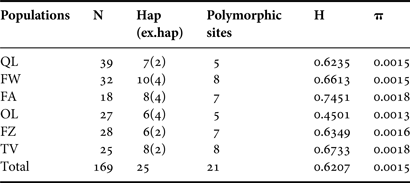
A total of 590 bp of COI sequences were obtained for 240 individuals sampled from six locations in the Ria Formosa coastal lagoon. All COI haplotypes obtained were registered in GenBank (accession numbers from KJ659783 to KJ659807). From 21 polymorphic sites, a total of 25 haplotypes were revealed. Two haplotypes (COI-1 and COI-2) were present in all localities, five haplotypes were shared between two to five populations, and 18 were singletons. FW showed the highest number of haplotypes (10) among all the sampled sites. FA showed the highest haplotype diversity (0.7451), although presenting just eight haplotypes and OL showed the lowest haplotype diversity (0.4501) (Table 1).
Molecular diversity indices for populations of Cerastoderma edul e from the Ria Formosa coastal lagoon (southern Portugal) using 590 bp of mtDNA COI. Populations are abbreviated as follows: Quinta do Lago (QL), Faro West (FW), Faro (FA), Olhão (OL), Fuzeta (FZ) and Tavira (TV).
N, sample size; Hap, number of haplotypes; ex.hap, in parentheses, the number of exclusive haplotypes; H, haplotype diversity; π, nucleotide diversity.
Population genetic structure
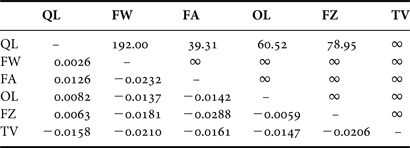
The analysis of molecular variance (AMOVA) considering a first comparison between confined sites (TV, FW, QL) and non-confined localities (FZ, OL, FA) yielded a value of FCT = 0.00524 (P = 0.30792). A second AMOVA to compare western (FA, FW, QL) and eastern (FZ, OL, TV) localities pointed to a value of FCT = −0.00337 (P = 1.000). Both AMOVA tests pointed to non-significant differences among or within the established groups. All of the variance was explained by the variability between individuals within populations in each group. The exact test of population differentiation for the COI gene revealed no significant differences between the six lagoon locations (P = 0.3127). Even if some F ST values indicated a weak differentiation, e.g. between QL and FA (F ST = 0.0126), the P value was not significant, and no differentiation was detected among sampled sites (Table 2) indicating high gene flow among localities. The number of migrants per generation agreed with the previous results showing the maximum value of connectivity (∞) between all the sampled sites, with the exception occurring among QL and four localities (FW, FA, OL and FZ) (Table 2).
F ST values (below diagonal) and number of migrants (above diagonal) for Cerastoderma edule based on COI mtDNA region among six localities in the Ria Formosa coastal lagoon (southern Portugal). Populations are abbreviated as follows: Quinta do Lago (QL), Faro West (FW), Faro (FA), Olhão (OL), Fuzeta (FZ) and Tavira (TV).
The correspondence analysis (CA) using the COI haplotype frequencies showed a score of 55.58% of the total variance for the two first ordination axes, revealing a weak scale genetic structure which shows three major groups: (i) FA on the negative side of Axis I; the Axis II allows discrimination of (ii) OL and FA on the negative side and (iii) the remaining localities (FW, FZ, QL and TV) on the positive side (Figure 2).
Correspondence analysis (CA) of mtDNA COI haplotype frequencies of Cerastoderma edule populations within the Ria Formosa coastal lagoon (south Portugal). Populations are abbreviated as follows: Quinta do Lago (QL), Faro West (FW), Faro (FA), Olhão (OL), Fuzeta (FZ) and Tavira (TV) (see Figure 1). The two first ordination axes explained the 55.58% of the total variance.
The statistical parsimony network of the COI data reveals that the most common haplotype (COI-1) has a central position with the remaining haplotypes closely connected to it, showing a typical star phylogeny. One more haplotype (COI-2) was shared among all the localities. Five haplotypes (COI-3, COI-4, COI-5, COI-12 and COI-16) were shared among some localities. Exclusive haplotypes were presented in all the locations: QL (2), FW (4), FA (4), OL (4), FZ (2) and TV (2) (Figure 3). The majority of the singletons occupied a distal position in the network, this being an indication of more recent haplotypes in accordance with the Posada & Crandall (Reference Posada and Crandall2001) criteria.
Statistical parsimony network based on mtDNA COI sequence haplotypes of Cerastoderma edule populations within the Ria Formosa coastal lagoon (south Portugal). The circles represent haplotypes and each of them is defined by its corresponding number. The haplotype with the white number represents the predicted ancient haplotype. Connection lines between circles represent one mutational step. The black dots correspond to mutational steps. The area of each circle is proportional to haplotype frequency.
Historical demography
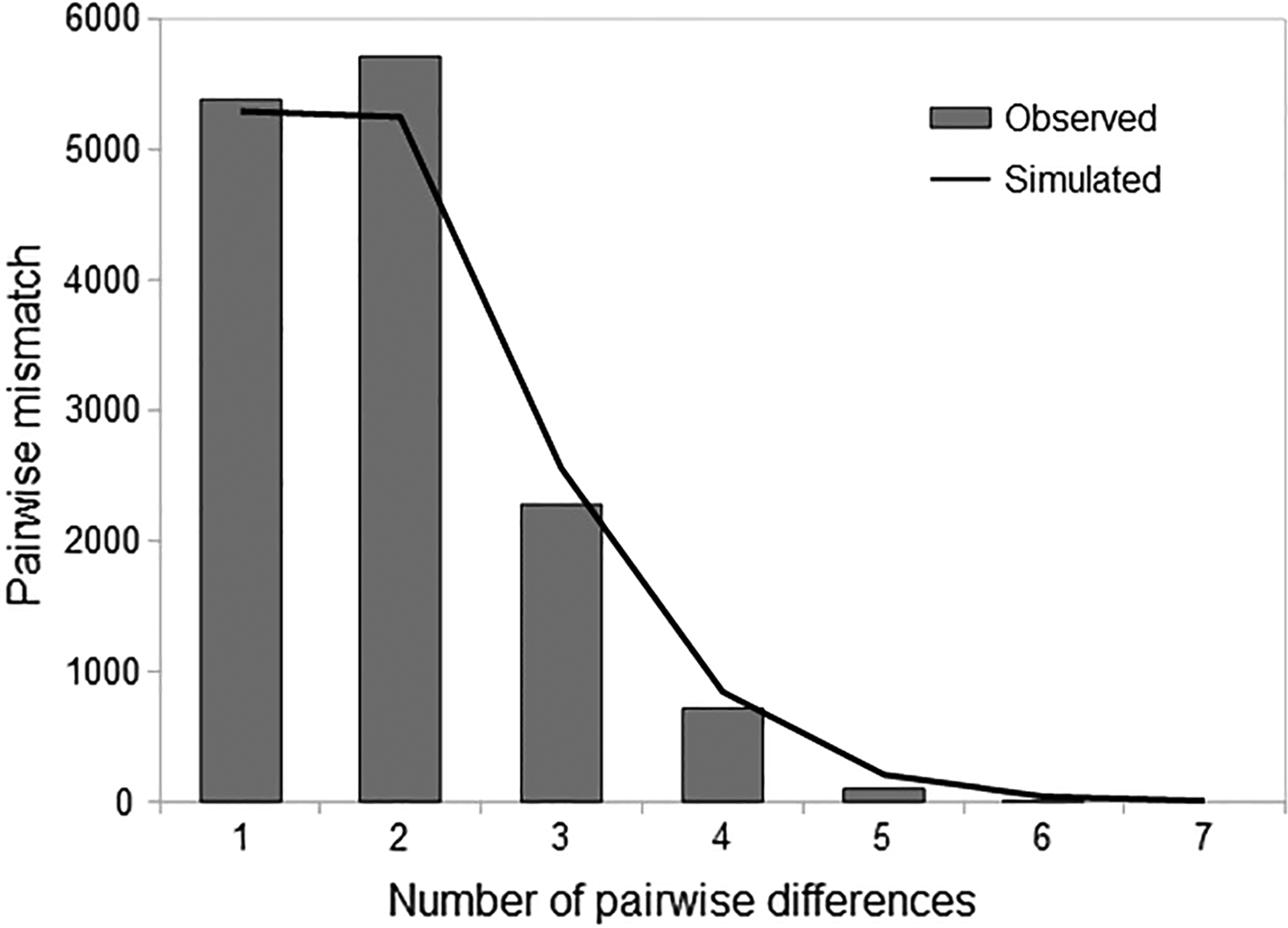
Given the absence of significant population differentiation among localities, we pooled all individuals to construct a mismatch diagram (Figure 4). This analysis using COI data showed a skewed unimodal distribution related to recent bottleneck or sudden population expansion. The data set exhibited negative and significant Tajima's D (D = −2.0703; P = 0.0020) and Fu's F s (F s = −28.3702; P = 0.0000) values supporting a sudden population expansion which was corroborated by non-significant values for sum of squares distances (SSD) (SSD = 0.0015; P = 0.3000).
Pairwise mismatch distributions of haplotypes of Cerastoderma edule within the Ria Formosa coastal lagoon (south Portugal) based on mtDNA COI sequences. All samples were pooled owing to the lack of genetic structure.
DISCUSSION
Our mitochondrial DNA survey of C. edule at a fine spatial scale revealed a high to medium haplotype diversity, low nucleotide diversity values and the occurrence of 25 different haplotypes within the Ria Formosa coastal lagoon. These values were similar or higher than those found by recent studies carried out with this species over broad geographic scales of hundreds and thousands of kilometres (Ladhar-Chaabouni et al., Reference Ladhar-Chaabouni, Hamza-Chaffai, Hardivillier, Chénais and Denis2010; Krakau et al., Reference Krakau, Jacobsen, Jensen and Reise2012; Martínez et al., Reference Martínez, Méndez, Insua, Arias-Pérez and Freire2013). Our analysis showed low nucleotide diversity compared with previous studies of C. edule (Ladhar-Chaabouni et al., Reference Ladhar-Chaabouni, Hamza-Chaffai, Hardivillier, Chénais and Denis2010; Krakau et al., Reference Krakau, Jacobsen, Jensen and Reise2012; Tarnowska et al., Reference Tarnowska, Krakau, Jacobsen, Wołowicz, Féral and Chenuil2012; Martínez et al., Reference Martínez, Méndez, Insua, Arias-Pérez and Freire2013), probably because our samples come from recently spread populations that colonized the lagoon system of Ria Formosa. The combination of high haplotype diversity and low nucleotide diversity, as observed in our data, could be a signature of a rapid demographic expansion from a small effective population size (Avise et al., Reference Avise, Neigel and Arnold1984; Grant & Bowen, Reference Grant and Bowen1998; Avise, Reference Avise2000; Dodson et al., Reference Dodson, Tremblay, Colombani, Carscadden and Lecomte2007; Winkler et al., Reference Winkler, Souissi, Poux and Castric2011). This hypothesis is corroborated by our Tajima's D, Fu's F s, SSD values and the haplotype network obtained.
The previous study with this species carried out by Krakau et al. (Reference Krakau, Jacobsen, Jensen and Reise2012) using COI sequences showed that the highest values of haplotype diversity (H D) were found at coastal bays and estuaries from the Northeastern Atlantic Ocean (Bodø, Norway, H D = 0.931; Sylt, Germany, H D = 0.901; Arendal, Norway, H D = 0.868; Norsminde, Denmark, H D = 0.863); however, the marine populations of C. edule from the Portuguese coast close to our lagoonal populations in Ria Formosa showed lower values of haplotype diversity (Lisbon H D = 0.511 and Lagos H D = 0.429) than ours (Ria Formosa average H D = 0.6207). Also in these Portuguese localities (Lisbon and Lagos) only three and six haplotypes were found, respectively; all our localities from Ria Formosa showed between six and 10 haplotypes in each. The same pattern was found for the number of polymorphic sites, this being higher in each sampled population from the Ria Formosa populations than the other two Portuguese localities studied by Krakau et al. (Reference Krakau, Jacobsen, Jensen and Reise2012). Therefore, considering these data, we could assume that our lagoonal localities are showing a higher genetic diversity than marine populations from the Portuguese coast. It is also important to stress that although the work of Krakau et al. (Reference Krakau, Jacobsen, Jensen and Reise2012) was carried out in several localities at a large spatial scale showing high values of genetic diversity in the northern populations, comparisons among different lagoons and several localities inside each lagoon were not included; the authors did not consider the analysis of microgeographic genetic variation in C. edule, assuming genetic homogeneity inside each sampled coastal bay, estuary or lagoon
Sequences of a particular fragment of the mitochondrial COI have been employed in a number of studies to investigate genetic structuring and demographic history in populations of marine bivalve species, in which the observed values of haplotype diversity (h) and nucleotide diversity (π) were lower than those recorded for C. edule in the present study. For example, lower diversity values were recorded in other bivalve species: Amusium pleuronectes with h = 0.237, π = 0.0006 (Mahidol et al., Reference Mahidol, Na-Nakorn, Sukmanomon, Taniguchi and Nguyen2007), Ruditapes decussatus at h = 0.486 and π = 0.011 (Gharbi et al., Reference Gharbi, Chatti, Said and Van Wormhoudt2010), Scrobicularia plana with h = 0.52, π = 0.0016 (Santos et al., Reference Santos, Cruzeiro, Olsen, Van der Veer and Luttikhuizen2012), Donax serra with h = 0.30, π = 0.001 (Bezuidenhout et al., Reference Bezuidenhout, Nel and Hauser2014), Crassostrea iredalei with h = 0.565, π = 0.0018 (Zainal Abidin et al., Reference Zainal Abidin, Mustaffa, Rahim, Nair, Naim and Nor2014) and Gemma gemma with values of h = 0.314, π = 0.0012 (Zhang et al., Reference Zhang, Geller and Vrijenhoek2014). In our study of C. edule, estimates of haplotype and nucleotide diversity were higher than those recorded in these studies using marine samples. In general, coastal lagoons can generate greater genetic diversity. We also noticed that the contribution of genetic diversity in lagoons is focused on new haplotypes of recent generation, which can be exported to marine populations by tides (in the case of Ria Formosa, tides allow higher water turnover up 70%) and the currents generated in the main communication channels between the lagoon and the open sea. Further, we could argue that several COI haplotypes observed in Ria Formosa could be singletons and recent haplotypes. Although there are no studies focusing on the assessment of coastal lagoons as hotspots of genetic diversity, several species with large populations have showed higher genetic diversity promoted by gene flow and admixture of different genetic pools (Gamfeldt & Källström, Reference Gamfeldt and Källström2007; Garant et al., Reference Garant, Forde and Hendry2007; Canestrelli et al., Reference Canestrelli, Aloise, Cecchetti and Nascetti2010; Crawford & Whitney, Reference Crawford and Whitney2010; Aguirre & Marshall, Reference Aguirre and Marshall2012). Thus, our results point towards an admixture between differentiated larvae and recruits, and high genetic exchange could be the main cause of the high levels of genetic diversity observed in most lagoonal samples from Ria Formosa.
Comparison of COI sequences between samples showed a lack of genetic structuring, as suggested by non-significant values of F ST, exact test and AMOVA results. These results are indicative of high levels of gene flow over a small geographic range, preventing the formation of genetically isolated gene pools, which may be explained by the existence of a planktonic stage in shellfish larvae (Marín et al., Reference Marín, Fujimoto and Arai2013). However, previous studies addressing the assessment of genetic diversity at a local scale have found significant genetic differentiation in another bivalve species as Mytilus edulis (Ridgway, Reference Ridgway2001), Gemma gemma (Casu et al., Reference Casu, Maltagliati, Cossu, Lai, Curini Galletti, Castelli and Commito2005), Chlamys farreri (Zhan et al., Reference Zhan, Hu, Hu, Zhou, Hui, Wang, Peng, Wang and Bao2009), Macoma balthica (Luttikhuizen et al., Reference Luttikhuizen, Drent, van Delden and Piersma2003; Becquet et al., Reference Becquet, Lasota, Pante, Sokolowski, Wolowicz and Garcia2013) and Placopecten magellanicus (Owen & Rawson, Reference Owen and Rawson2013). These studies show several factors playing important roles in defining population differentiation over much smaller distances than generally assumed, including temporal variation in the abundance, distribution and mixed genetic composition during recruitment (Casu et al., Reference Casu, Maltagliati, Cossu, Lai, Curini Galletti, Castelli and Commito2005), habitat fragmentation over a fine geographic scale caused by marine currents (Zhan et al., Reference Zhan, Hu, Hu, Zhou, Hui, Wang, Peng, Wang and Bao2009), historical population divergence after the last glacial maximum (Luttikhuizen et al., Reference Luttikhuizen, Drent, van Delden and Piersma2003) and selection by environmental conditions (Ridgway, Reference Ridgway2001; Becquet et al., Reference Becquet, Lasota, Pante, Sokolowski, Wolowicz and Garcia2013).
A recent study conducted in the closely related species Cerastoderma glaucum in the Mar Menor coastal lagoon (southeastern Spain) showed high haplotype diversity (with 39 haplotypes) and significant genetic differentiation between samples from closely situated localities using the COI gene (Vergara-Chen et al., Reference Vergara-Chen, González-Wangüemert, Marcos and Pérez-Ruzafa2013). In that study, authors correlated the C. glaucum genetic structuring pattern with a discontinuous gene flow and/or with extreme population dynamics (irregular recruitment and mortality). The current study on C. edule revealed 25 haplotypes and lack of genetic differentiation over short distances. The contrasting patterns of the genetic differentiation present among these two related species can reside in their dispersal abilities; indeed any autonomous long-distance dispersal in C. glaucum is restricted to one-week pelagic larvae (Barnes, Reference Barnes1980; Vergara-Chen et al., Reference Vergara-Chen, González-Wangüemert, Marcos and Pérez-Ruzafa2013). Conversely, the dispersal in C. edule may last up to four weeks, primarily by pelagic larvae and secondarily by drifting juveniles (Krakau et al., Reference Krakau, Jacobsen, Jensen and Reise2012). This high dispersal capacity of the C. edule may normally substitute local losses from close sites, leaving few traces in the genetic structure of the population. However, previous studies on this species considering a larger scale (along the European Atlantic coast) found a significant global F ST value which revealed existence of genetic structure (Krakau et al., Reference Krakau, Jacobsen, Jensen and Reise2012; Martínez et al., Reference Martínez, Méndez, Insua, Arias-Pérez and Freire2013). Cerastoderma edule from the Iberian peninsula conform to a panmictic population, different from those of other European localities, this being partially explained by a combined effect of isolation by distance and the existence of hydrographic barriers constraining its gene flow (Chust et al., Reference Chust, Albaina, Aranburu, Borja, Diekmann, Estonba, Franco, Garmendia, Iriondo, Muxika, Rendo, Rodríguez, Ruiz-Larrañaga, Serrão and Valle2013; Coscia et al., Reference Coscia, Robins, Porter, Malham and Ironside2013; Martínez et al., Reference Martínez, Méndez, Insua, Arias-Pérez and Freire2013). When analysing our data at a small spatial scale in Ria Formosa, we observed that Faro and Olhão were the samples that appeared more distant from the remaining lagoon localities according to correspondence analysis. Faro and Olhão most likely present a high connectivity with populations outside the lagoon, exchanging more haplotypes with outside populations than with local lagoon sites, as a consequence of their location near to the two main channels (Pacheco et al., Reference Pacheco, Ferreira, Williams, Garel, Vila-Concejo and Dias2010). On the other hand, the localities situated in the extremes of the lagoon (QL, FW, FZ and TV), due to the low volume of water being exchanged in these sites, had a lower connectivity among each other and consequently could present a most ancient gene pool.
The COI haplotype network shows a star-like shape, with a tight assemblage of haplotypes, mainly separate for just one or two mutational steps. This network is characterized for having a central haplotype and several rare variations, which is normally consistent with a scenario of recent population expansion. Expansion was corroborated by Tajima's D, Fu's F s and SSD. Our results provide evidence of genetic homogeneity of C. edule at a small geographic scale and the retention of new mutations (e.g. exclusive haplotypes) as an unequivocal support for rapid population expansion after a period of low effective population size (Avise et al., Reference Avise, Neigel and Arnold1984; Stamatis et al., Reference Stamatis, Triantafyllidis, Moutou and Mamuris2004; Bezuidenhout et al., Reference Bezuidenhout, Nel and Hauser2014).
High to moderate values of haplotype diversity were detected in all localities in Ria Formosa except for Olhão that showed the lowest haplotype diversity value. Overfishing of cockles may be especially evident in this locality and perhaps could cause a decrease of local genetic variation. Fishing has genetic impacts in marine populations caused by selection and genetic drift, leading to loss of genetic diversity in both small and large overfished populations (Beverton, Reference Beverton1990; Smith, Reference Smith1994; Ryman et al., Reference Ryman, Utter and Laikre1995; Hauser et al., Reference Hauser, Adcock, Smith, Bernal Ramírez and Carvalho2002; Kenchington, Reference Kenchington, Sinclair and Valdimarsson2003; Kenchington et al., Reference Kenchington, Heino and Nielsen2003; Pérez-Ruzafa et al., Reference Pérez-Ruzafa, González-Wangüemert, Lenfant, Marcos and García-Charton2006; Allendorf et al., Reference Allendorf, England, Luikart, Ritchie and Ryman2008; González-Wanguemert et al., Reference González-Wangüemert, Fernández, Pérez-Ruzafa, Giacalone, D'Anna and Badalamenti2012). In this sense, a recent meta-analysis has confirmed that overfishing drives the decay of genetic diversity of marine populations and such reductions of genetic diversity may lead to long-term effects on their evolutionary potential and adaptive ability, that will probably continue unless populations are allowed to recover (Pinsky & Palumbi, Reference Pinsky and Palumbi2014). In Ria Formosa, cockles have traditionally been harvested with a harvesting-knife, however, over recent years there has been an increase in the use of a hand-dredge to exploit cockle beds (Sousa-Leitão & Baptista-Gaspar, Reference Sousa-Leitão and Baptista-Gaspar2007). Introducing the hand-dredge in the cockle fishery may lead to the overexploitation of the cockle populations (Sousa-Leitão & Baptista-Gaspar, Reference Sousa-Leitão and Baptista-Gaspar2007). Additional information (fisheries statistics) to explain the low genetic diversity detected in Olhão would be necessary. But if genetic diversity loss is demonstrated in any exploited populations of cockles in Ria Formosa, then new strategies for management would be needed to conserve or recover natural levels of genetic diversity.
In conclusion, the existence of a high overall number of haplotypes and high values of haplotype diversity of C. edule in most localities inside the Ria Formosa lagoon is consistent with the hypothesis that higher genetic diversity is expected in populations occurring in coastal lagoons (Abbiati & Maltagliati, Reference Abbiati and Maltagliati1992; Vasileiadou et al., Reference Vasileiadou, Sarropoulou, Tsigenopoulos, Reizopoulou, Nikolaidou, Orfanidis, Simboura and Kotoulas2012). These results suggest that lagoons could be acting as a source of new haplotypes and enhancing adaptation to the highly variable conditions. The Ria Formosa lagoon is an excellent model to address adaptation to local environmental conditions since organisms inhabiting this lagoon face wide variations of temperature over a small geographic scale. Besides, cockle populations suffer fishing pressure that could cause changes in their genetic diversity. We should highlight the role of the lagoon environmental conditions in shaping the genetic diversity of C. edule, increasing their standing genetic variation and adaptive potential for ecological response to a highly variable environment. Further studies using microsatellite markers are required to validate the mitochondrial DNA results and assist in the sustainable fisheries management of this resource. Understanding these evolutionary and ecological processes in coastal lagoons can also improve the conservation strategies aiming to preserve lagoonal ecosystem functioning and its biodiversity (Garrido et al., Reference Garrido, Pe'rez-Bilbao, Benetti and Grillo2011; Beer & Joyce, Reference Beer and Joyce2013).
FINANCIAL SUPPORT
This study received partial financial support from the Séneca Foundation, Agencia Regional de Ciencia y Tecnología de la Región de Murcia, Spain (11881/PI/09). The first author (CVC) was supported by the Sistema Nacional de Investigación (SNI contract 32-2013) of the Secretaría Nacional de Ciencia, Tecnología e Innovación (SENACYT), Panama. The second author (FR) was financed by the European Union through an Erasmus Mundus Grant. The third author (MGW) was supported by Fundação para a Ciência e Tecnologia (FCT) postdoctoral grant (SFRH/BPD/70689/2010).