In 2010, the offshore oil rig Deepwater Horizon blew up killing eleven people and spilling tens of millions of gallons of oil into the Gulf of Mexico. As I mourned the death and injuries of the people who worked on the rig, I pondered that an accident or spill of this magnitude had not occurred on an offshore oil platform in waters of the United States for years. As a scholar of the 1969 Santa Barbara blowout, I considered the number of spills that occurred in the open ocean in the late 1960s and early 1970s and the paucity of large spills in the last few decades. I watched as the emergency responders confronted some of the same scenarios as the Santa Barbara responders.Footnote 1 With the need to save lives taking priority over stopping the spill, the Deepwater Horizon rig workers and emergency responders did not attempt to plug the well in the first hours of the catastrophe. Because of this and other technical issues, the well spewed oil for eighty-six days as the general public watched the spectacle on the internet. The spilled oil created enormous slicks that the current, wind, and waves chaotically moved in the Gulf of Mexico. The emergency responders attacked the slicks with dispersants, booms, and skimmers to hinder its movement toward Gulf Shore communities. Ultimately, like all spills that occur in the open ocean, the responders were unable to predict, model, or control the oil floating on the Gulf’s waters.Footnote 2
As the Trump administration works to expand the number and location of offshore oil exploration and production in federal tidelands, understanding the history of oil-spill control technology and the impediments to developing effective technologies in the early years of federal tideland development needs to be explored. This history shows that oil companies have few technologies to contain, disperse, and remove oil from the open ocean. But at the same time, history reveals that the oil companies’ ideas of prevention quickly changed because of their lack of technology success. In response to early spills in the late 1960s and early 1970s, the oil companies invested millions of dollars into research and development on technologies that they hoped would contain, disperse, or remove oil after it spilled. Federal agencies agreed with this reactive policy. The oil companies’ goal was to develop technologies to keep the oil away from shores, beaches, and wetlands where the public and the news media could see it and its effects. The oil companies believed that with economic and technological investments they would find methods to contain, disperse, and remove spilled oil in the open ocean. The federal government agreed with this plan since it wanted to shield the public from the harmful effects of the offshore oil drilling.
In this article, I explore the rapid change in policy developed through communication between the oil companies, government agencies, and researchers as the oil companies realized that they could not “prevent” the large spills from reaching populated and species-rich areas. For a few years, the meaning of prevention was fluid. In the oil companies’ eyes, prevention meant keeping already spilled oil off beaches and shores and away from areas that were easily accessible to the public and the news media. It did not mean stopping spills before they happened. Or minimizing the amount spilled. In the early 1970s, little money or effort was spent on technologies to prevent spills. Only after spill-response technologies failed in laboratories and the world’s waters did the oil companies and the federal government begin to fund studies to prevent spills before they happened.
The rapid change and the lack of direct government intervention along with its inherent conflicts are two factors that are particular to this policy change. The rapid change is in contrast to typical policy changes that tend to occur incrementally and slowly since the many disparate participants in the policy process must negotiate the changes.Footnote 3 In this case, the parties are Congress, the oil industry, the federal agencies that enforce the laws, and the general public. Each of these groups usually have differing agendas and priorities that cause the slow change. These differing agendas can be political and make problem solving difficult and slow. For example, federal tidelands oil policy has remained contentious since Congress, the states, the executive branch, the oil companies and environmental groups have differing objectives. Many state governments want federal tidelands development to be banned, while other states welcome the development and the tax money. The position of the executive branch and Congress has flip flopped over the decades.Footnote 4 The oil industry’s stance changes with oil prices fluctuations, royalties, and technology. Environmental groups want tidelands development banned in federal waters. These differing positions and aims have slowed, if not stopped, the creation of meaningful and effective federal tidelands policy.Footnote 5
In the case of oil spills in the open ocean, conflict took a back seat since the parties had the same objective—preventing oil spills from reaching beaches and shores. The lack of direct government intervention also allowed the oil industry to cooperatively work with federal and state government agencies with little threat of enforcement. During this time, Congress and the Nixon administration were creating the infrastructure to implement federal environmental policy and the agencies that would enforce the many new laws. In 1969 and 1970, oil-spill enforcement was performed by the same agency—the Department of Interior—that leased the tidelands and pushed for more offshore wells for energy production and federal royalties. In December 1970, the Nixon administration created the U.S. Environmental Protection Agency (USEPA) to manage the myriad new congressional laws. As USEPA ramped up to regulate environmental pollution, the oil industry was determined to find a technical solution to oil spills.
Without the power structures inherent in many policy issues, the oil industry along with the federal government and the general public were able to concentrate on their shared goal. The shared goal focused the conversations on technical information involved with oil-spill technology. The technical information informed the decisionmakers and conveyed to them the magnitude of the problems and consequences of failure or success.Footnote 6 The increased knowledge of the state of the problem and its integration with the common goal allowed for learning and ultimately quick policy change. Since the exchange of technical information was the reason for the policy transformation, I explore the rhetoric from three oil-industry-sponsored conferences and American Petroleum Institute technology review documents from 1969 to 1973 to show the abrupt change in ocean spill prevention policy. As the researchers increasingly communicated their technological failures, presentations at the biennial spill conference mirrored an increase in “real” prevention strategies and technologies (i.e., those that prevented spills before they happened). The oil industry, in cooperation with federal and state governments, created internal policies that minimized oil pollution in the ocean without additional regulations and enforcement.Footnote 7 Proactive approaches to spills from platforms and tankers in the open ocean came to the forefront of the oil-spill policy agenda. Unfortunately, they could not guarantee that catastrophic spills would disappear.
The technological optimism of the oil companies’ ability to contain, disperse, and remove oil from the oceans and the federal government’s desire to shield the spilled oil’s effect from the public coexisted in a time and place where the unbridled approach to progress seemed limitless. The first oil-spill meeting occurred fewer than five months after the astronauts walked on the moon. If technology could get us to the moon; oil spills could be contained. Technological optimism was at its zenith in other aspects of federal policy. Environmental laws such as the Clean Air Act of 1970 and the Clean Water Act of 1972 relied on technology-based controls to reduce pollution. In addition, both laws predicted that air and water pollution would be eradicated by the mid-1980s. These policy decisions occurred at a time when the American public was becoming more aware of increasing pollution. It was not just the oil companies who believed technology could create a better and cleaner world. Chemical companies, such as Dow and Dupont, marketed dibromochloropropane (DBCP) and DDT among other pesticides to control pests.Footnote 8 Scientists would later reveal that DDT, DBCP, and other pesticides caused cancer and were mutagenic. Like the pesticide manufacturers that were unable to eliminate human exposure to pesticides and its resulting effects, the oil companies would find that they were unable to stop the oil spilling from their wells and ships from reaching the beaches. But, unlike the silent and deadly poisons of pesticides, it is impossible to hide the presence of dead and dying oil-covered birds and oil’s impact on the aesthetics of beaches and shores. Oil’s visibility made the dynamics between the policy process of oil pollution quite different than the politics of invisible pollution from pesticides and its inherent scientific uncertainty. The oil industry needed to find a solution that stopped its visible pollution from polluting beaches and shores. The inability to control and hide oil along with technological failures forced the oil companies to reconsider their idea of prevention.
In the article, I use the language of the researchers from three oil-spill conferences and two other symposiums to show that their technological failures forced the oil industry to concede that the technology to contain, disperse, and remove oil was not a simple technological problem. I will convey the frustrations and lack of progress made as the oil industry pumped money into oil-spill research. They came to realize that optimism does not overcome technical failures. As Congress and the general public was changing their attitude toward excessive pollution, I will show the changes in the researchers’ thinking about oil spills. In three short years, they came to understand that they needed to concentrate on the technology that stopped spills before they happened. Oily beaches and birds cannot be hidden behind rhetoric and failed experiments.
The Oil and Water Interface: The Vexing Problem
Understanding the behavior of oil remains oil-spill researchers’ most vexing challenge. On the theoretical front, understanding oil’s behavior in water proves extremely complicated. As researchers know, oil and water repel each other. In calm conditions, oil, the less dense of the two liquids, remains on top with little or no mixing. On the open ocean, the winds, current, and waves force it to combine and emulsify so that the two liquids get along well enough to undermine the human forces that try to collect and remove the oil. The inability to model the behavior of water and oil in the open ocean makes it impossible to predict its movement. The Deepwater Horizon oil-spill response was no different than other spills from tankers, pipeline ruptures, blowouts, and other causes of spills in the open ocean. The responders in conjunction with the federal government chased the oil around the Gulf with booms and skimmers or applied dispersants to break up large slicks and hopefully cause the oil to sink and be metabolized by microorganisms. Gulf Coast residents waited as oil floated in the Gulf and haphazardly coated the Gulf Coast beaches and closed their important fisheries, oyster beds, and shrimping areas.
The problem of modeling and understanding oil’s movement on the open ocean has perplexed the oil industry since the oil companies began to drill for oil in open waters. Spilled oil in water is quite different than oil spillage on land. Oil on land does not spread into an infinitesimally thin layer on the soil and spread for miles; instead on land it pools into puddles and seeps into soils at rates that are affected by the type of soil. On land, the oil industry can hide its errors behind beauty strips or fences so the public may not be aware of the damage to ecosystems and aquifers or remove contaminated soil after industrial activities are complete. They hoped to create a situation similar in the ocean where the public’s aesthetics of the ocean was not compromised and people’s knowledge of the pollution was not realized. The large spills endangered the oil industry’s ability to create beauty strips that blinded the community and the wider public from their activities.Footnote 9 In the aftermath of the Deepwater Horizon spill, the federal investigation concluded “the oil-spill removal organizations were quickly out-matched. While production technology had made great advances … spill-response technology had not… . Though incremental improvements in skimming and booms had been realized … the technologies used in response to the Deepwater Horizon and the Exxon Valdez oil spills were largely the same.”Footnote 10 As a researcher of the response to the Santa Barbara Oil Spill, I would hazard to state that the technologies remained the same from 1969—more than forty years before the Deepwater Horizon catastrophe.
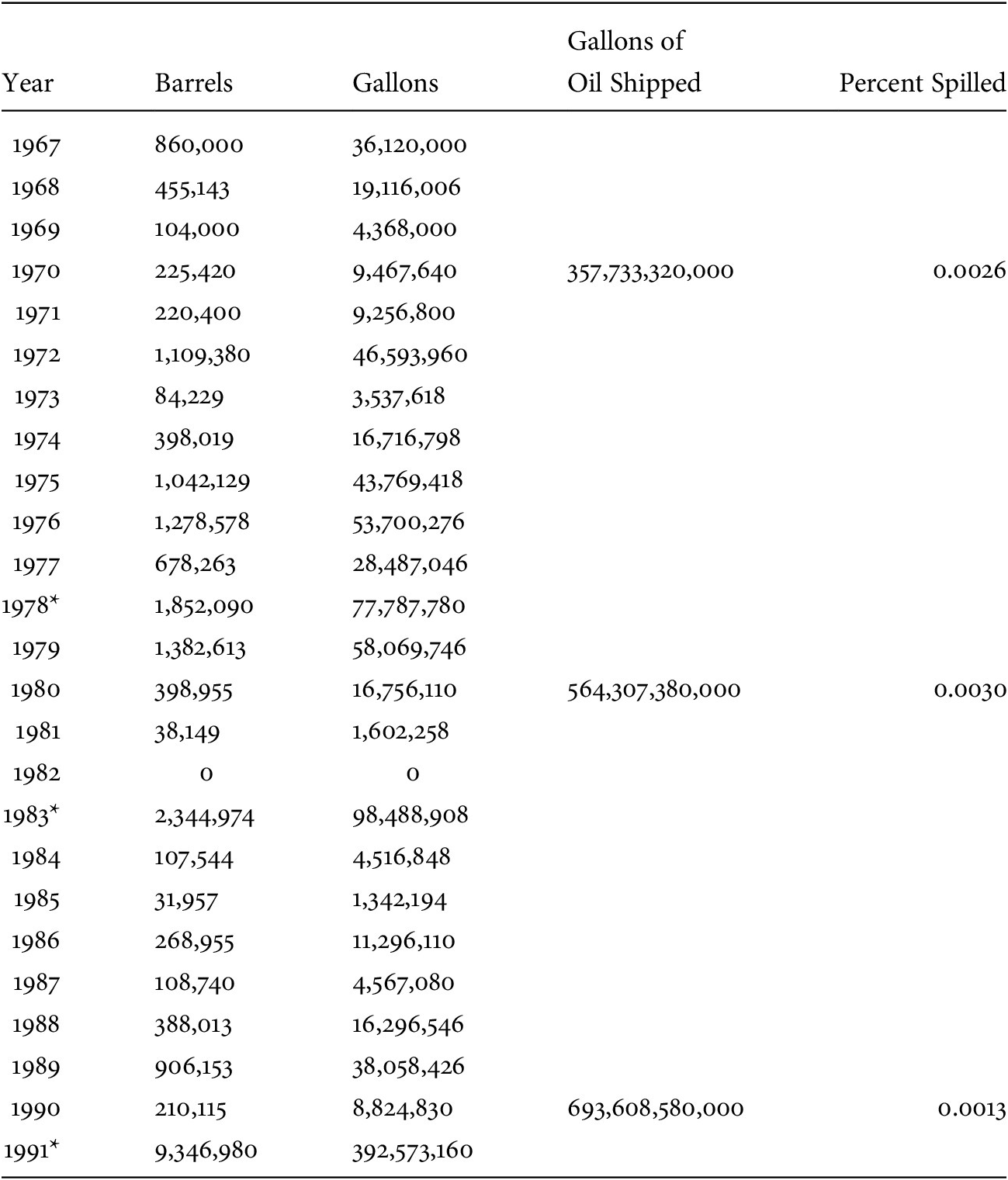
In the late 1960s, large oil spills off the Cornish coast in England and the Santa Barbara coast in the United States laid bare the inadequacies of the oil industry’s ability to contain and control oil in the open ocean. Since then the frequency of large oil spills from both tankers and offshore drilling platforms has decreased as the number of offshore rigs and supertanker size and movements has dramatically increased (Table 1). This decrease in accidents and the subsequent increase in prevention technology and training can be traced to the failed responses to large spills during the 1960s and the early 1970s and the resulting negative media coverage and pressure from governments, citizens, and insurers. In the United States and Britain, the media splashed pictures of dying, oil-covered birds and blackened beaches onto newspaper and magazine covers and television broadcasts while oil companies involved with offshore drilling and ocean transport struggled with containment and removal methods. Kathryn Morse revealed that the oiled birds became a rallying point for citizens’ desire to protect the environment.Footnote 11 Eventually these photographs helped motivate the offshore oil industry to rethink their approach to oil spills. Before these early catastrophic spills, the oil industry believed that spills were an “inevitable consequence of the dependence of a rapidly growing population on a largely oil based technology.”Footnote 12 Therefore, researchers and policymakers concentrated on containment, dispersal, and removal (CDR) technology research and development with virtually no emphasis on technology that prevented spills. Spills were a “natural” consequence of oil production, transport, and use.Footnote 13
Catastrophic Oil-Spill Quantities and Gallons of Oil Shipped (1967–1991)

* Oil Spills of more than one million barrels.
Sources: United Nations Conference on Trade and Development, “Review of Maritime Transport, 2006” (New York, 2006). Herbert C. Curl, Kenneth Barton, and Lori Harris, Oil Spill Case Histories, 1967–1991: Summaries of Significant U.S. And International Spills [in English]. Report (Seattle, 1992).
The oil companies’ reactive approach to oil spills on water brought the spotlight onto their failures to prevent large oil spills.Footnote 14 As an oil industry representative remarked, “Few people, if any, foresaw the need to develop the capability to deal with oil spills of such magnitude as the Torrey Canyon.”Footnote 15 But as oil demand grew, the probability of large spills escalated with it. These spills washed up on sensitive coastal areas and their prolonged presence brought public, media, and government attention to the lack of technology to control spills. The technological failures created a negative feedback loop for the oil industry. Higher demand increased the number of spills that polluted coastlines and beaches. These oily coasts brought further attention that continued to expose the lack of technological progress in spill containment and removal.
In 1966, the Corps of Engineers estimated that 2,000 oil spills occurred in U.S. waters—only 287 were reported to the U.S. Coast Guard.Footnote 16 By 1968, boat owners and industry notified the U.S. Coast Guard of 714 oil spills; most of these spills did not exceed 1,000 barrels (42,000 gallons).Footnote 17 A Coast Guard official estimated that vessels spilled approximately 580 million gallons per year in the oceans.Footnote 18 Max Blumer, a former Shell geochemist estimated that 1 trillion gallons of oil spilled into the world’s ocean per year.Footnote 19
Moreover, catastrophic spills forced the oil companies to begin investing money into CDR technology. Before these and other catastrophic spills, it was assumed that oil spills and discharges were small enough to rely on dilution and natural attenuation, but in some cases companies needed to intervene before oil reached drinking water sources and other sensitive areas. In the early 1960s, dilution—that is, doing nothing— tended to be the most frequent response to spill cleanup. When doing nothing was not an option, the offshore oil companies focused on developing dispersants, booms, skimmers, and destruction methods such as burning to manage the water pollution. Each technology concentrated on a different method to minimize the amount of pollution reaching shores and beaches, but each had its own drawbacks. Dispersants caused the oil to break up into smaller slicks that theoretically allowed for better degradation by microorganisms and minimized large slicks from hitting beaches, shores, and wetlands. But its toxicity concerned scientists. Booms or barrier devices floated on top of the water and stopped the floating oil from moving past the obstruction. They performed most effectively on still waters but failed in the open ocean and on fast-moving rivers. Skimmers removed the floating oil and a thin water layer, but, like booms, worked best on calm waters. Burning of spilled oil involved setting the oil on fire with or without a burning agent. Burning agents included kerosene and other flammable agents, which sometimes were more toxic than the oil.
Oil Companies Initial Response
The U.S. offshore oil industry’s first chance to publicly respond to the technology failures of the Santa Barbara spill occurred during Senate hearings on water-pollution legislation. During the hearings, federal officials and oil industry representatives described the types and usage of CDR technologies. The technologies’ failures did not alter their belief that they would ultimately be successful. American Petroleum Institute’s (API) Vice President of Environmental Affairs Peter Gammelgard stressed that most industrial facilities have the ability to handle small spills, but the ability to contain large slicks remained “unsolved.”Footnote 20 Gammelgard explained to the senators that the oil industry had created programs to clean up small to medium spills. His examples excluded large spills. Senate Air and Water Pollution Subcommittee chair Edmund Muskie (D-ME) immediately questioned the exclusion of large spills and API’s commitment to anticipate and consider large spills in its research program. Gammelgard responded with a list of emerging technologies that researchers had begun developing. The technologies were the same technologies that failed during the Torrey Canyon, Santa Barbara, and other spills.
Muskie and Robert Dole (R-KS) met Gammelgard’s explanation of emerging technologies with skepticism. Both Dole and Muskie, who visited Santa Barbara during the spill, knew of their failure; nevertheless, they allowed Gammelgard to explain the booms, dispersants, and other technologies. After his explanation, Dole responded with “the boom story is always the same. The oil either went over or under the boom.” Muskie asked, “Why hasn’t something been done to develop the technology so that it would be useful in the open sea of in rough water?” Gammelgard responded with a commitment to invest in companies that were developing better technology.Footnote 21
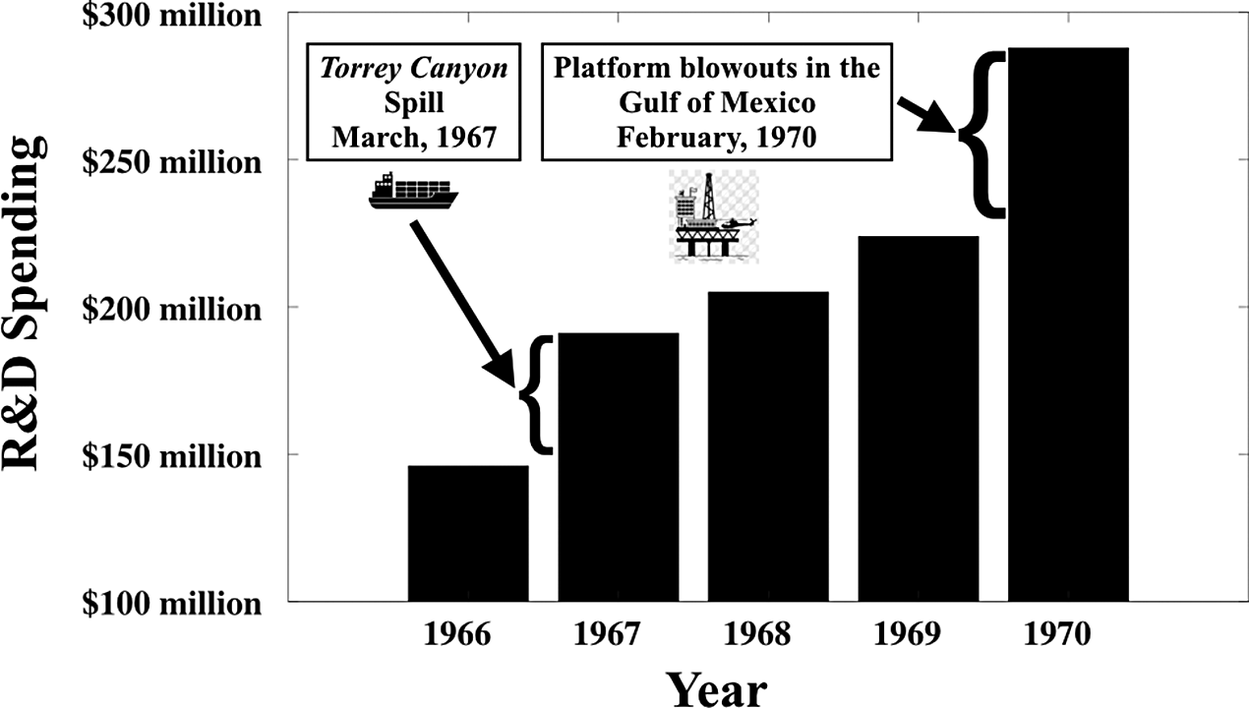
The API had increased its funding of CDR technologies. In 1966—the year before the Torrey Canyon grounding—the oil companies spent $145.7 million on projects that minimized water pollution. These costs included research and development, equipment, operation and maintenance, and administrative costs. By 1970, one year after the spill, oil companies’ spending almost doubled to $288.3 million (Fig 1.).Footnote 22 In addition, the federal government quickly added more than nine million dollars to its oil-pollution prevention and control research budget.Footnote 23 At first, the increase in funding and communication did not change the reactive approach to oil spills; the investment continued to solely fund CDR technology research and development. Researchers believed that CDR technologies were the only answer to handling these inevitable spills. From the funding agencies and the researchers’ perspective, these large spills did not dispel their faith and optimism in available and emerging technologies.
Water Pollution Research and Development Expenditures (1966–1970). Source: Crossley Surveys Inc. “Report on Air and Water Conservation Expenditures of the Petroleum Industry in the United States 1966–1970.” (Washington D.C., 1971).

The First Oil-Spill Prevention and Control Conference: 1969
With the increased funding and public awareness, the API and the Federal Water Pollution Control Administration (FWPCA) planned a conference to communicate and share the progress being made in improving CDR technologies.Footnote 24 The Joint Conference on Prevention and Control of Oil Spills showed that the federal government, oil companies, and researchers were interested in the topic. The organizers expected approximately three hundred people to attend the December 1969 gathering in New York City. Approximately eleven hundred did.Footnote 25 The larger than expected attendance reflected the heightened concern about oil spills precipitated by the Santa Barbara spill. The conference advanced the oil companies’ optimistic view that it possessed the ability to develop effective CDR technology. Kerryn King, a Texaco executive, opened the inaugural conference by stating that “nowhere before has a better qualified group of experts assembled” to review the present state of CDR technologies and to determine the efforts and directions needed to solve the oil-spill problem.Footnote 26 Of course, the API considered prevention those measures that contained or removed oil prior to it reaching beaches or coasts. Texaco had hired King to create more robust in-house public relations capabilities. Prior to joining Texaco, King was employed by Hill & Knowlton, a public relations firm. Hill & Knowlton was on the front line of science-denial strategies. The firm’s founder created the strategy for cigarette companies to convince the public that smoking was not harmful.Footnote 27 The conference brought together attendees from international oil companies, United Kingdom, U.S. state and local government agencies, consultants, the U.S. Navy, the Coast Guard, universities, and nongovernmental organizations and almost every industrial sector associated with oil production and refining. King’s welcoming words show that prevention of spills before they happened did not play a primary role in API’s agenda for the conference.
King’s enthusiasm carried over to the senior representatives from the oil industry and governments. The speakers set the research and response agendas. Each speaker, including people involved with the failures of the Torrey Canyon and Santa Barbara spills, described plans for removal and containment methods. One of the first federal representatives, FWPCA Acting Technical Support Director Kenneth Biglane, had extensive experience with offshore oil activities. He came from a family of oil workers and started his career as a roustabout, which led him to earn a graduate degree in aquatic biology from Louisiana State University. Over his twenty-year government career, he witnessed large chemical spills including the Torrey Canyon and the Ocean Eagle grounding cleanups.Footnote 28 Biglane believed the meeting was “timely and should be of immediate value” since nations “still cannot mount sufficient technical or operational responses to positively control large spills of oil once it has been spilled to the aquatic environment.” Biglane’s colleague Allen Cywin, the Director of Applied Science and Technology, detailed myriad agencies that were involved with oil-spill research. With this investment in technology research and development, he recognized the problem—the lack of effective CDR technology—but confidently stated, “We are now beginning to look in the right places for the answers.” After enduring the “Santa Barbaras,” he believed that “the spirit of the great American system” could “improve our capability to prevent as well as clean up oil slicks before they reach shore.”Footnote 29
United States oil industry representatives trumpeted the successes in CDR technology and their ability to develop effective technologies. Louis P. Haxby, the chair of API’s Subcommittee on Oil Spills Cleanup and the Manager of Environmental Conservation at Shell Oil Company, noted that oil companies and governmental agencies were finding success in containing small spills in harbors and along rivers and streams. He also recognized that technology to contain larger spills was “to say the least, primitive.” Recalling NASA’s success in landing three astronauts on the moon in July 1969, Haxby remarked, “In an age when we can reach the moon, we should be able to do better than this.”Footnote 30 Like the NASA scientists who refused to see the empty miles between earth and the moon as a chasm that could not be crossed, he believed that the same “can do” attitude and scientific know-how could be used to breach the gulf between their present knowledge and the day when oil could be easily contained and removed from the ocean.
Haxby did not allow the lack of effective technology to be called failures. In fact, he believed that the question was whether “we are willing to commit the necessary resources of money and scientific skill to get the job done.” His analogy of the lack of technology and the beginning of the race to the moon influenced the remainder of his presentation. Like the quick response to the launch of Sputnik, he described how the API organized his subcommittee and committed to spend $1.2 million on technologies to develop new methods for spill containment and removal within four weeks of the Santa Barbara spill. API’s research included basic research and design of new methods to handle up to 12-foot waves and 40 mile per hour winds.Footnote 31 A later presentation would show that existing methods could not withstand 2-foot waves and 20 mile per hour winds.Footnote 32
Haxby’s statement reflected that the oil companies did not fully understand the oil-water interface, nor did it understand how to develop standard laboratory and field methods to test the emerging CDR technologies. The oil-water interface remained researchers’ most vexing challenge. The millions of dollars invested by the oil industry and governmental agencies came up against the realities of the oil-water problem. As one researcher remarked, the behavior of oil on water “is determined by many factors, an understanding of which is beyond the scope of this paper.”Footnote 33 Using their limited knowledge, they derived complex equations that attempted to model these processes.Footnote 34 On a practical level, researchers concentrated on dispersants, barriers, and skimmers. The lack of understanding became apparent in two aspects of their tests. In some cases, criteria for determining the technology’s effectiveness proved almost impossible to develop. Problems the researchers thought would be easily solved in the laboratory proved unworkable. Other researchers had a rough time determining what represented a successful technology. Nowhere was this truer than when researchers developed pilot and full-scale prototypes of their lab scale technologies.
Regardless, the researchers believed that CDR technologies would provide the solution to remedying large oil spills. Most experts did not consider that spills could be avoided with technology and worker training. One of the technologies that took center stage at the conference was dispersants. Researchers considered dispersants an attractive technology since they hindered large oil slicks from getting to beaches and shores, allowed the oil to sink so that microorganisms could potentially degrade them more quickly and in most conditions could be easily applied. Many researchers believed these advantages outweighed dispersant’s toxicity to marine life. Interestingly, researchers did not address that dispersants did not directly remove oil from water. A British marine biologist concluded that highly toxic dispersants could be used in deep waters since dilution into the water column allowed for the oil to have “little risk to marine life.”Footnote 35 Gerard Canevari, a world-renowned expert on dispersants from Esso Research and Engineering Company, remarked that society did not have a choice between a “clean water environment versus a marine environment with chemically dispersed oil droplets.”Footnote 36 Instead, “the choice is between a large, damaging, cohesive slick—which we are unable to remove from the sea—versus chemically dispersed oil droplets.”Footnote 37
Two studies presented during the conference showed the great lengths that scientists reached to find methods to test the effectiveness of dispersants but also showed the basic limitations for testing dispersant effectiveness. In one presentation, two federal environmental scientists attempted to simulate open ocean conditions to determine dispersant’s effectiveness on crude and refined oil. After the first twenty-four trials did not exhibit any reproducible results, the researchers made changes and performed myriad variations of the standard test. The extensive changes did not derive an effective dispersant or even a reproducible application method. With their lack of understanding of the complex problems surrounding dispersant use, they concluded that additional research was needed.Footnote 38 The second dispersant presentation detailed attempts by oil industry scientists to develop a standard laboratory test for dispersant effectiveness. Like the government scientists, they were stymied by the lack of consistent and reproducible results, but they continued to modify the tests to determine the best laboratory method. Although the retests also failed, they remarked, “When we got our test results, our confidence, although not broken, was severely bent.”Footnote 39
With dispersant research taking the prominent role at the conference, containment and removal technologies took a smaller but still critical place for methods to contain and remove oil spills. Researchers touted the use of booms to contain oil spills, but unlike the dispersant researchers, boom scientists attempted to develop models of oil-water interaction and its containment by booms. These generalized models gave boom developers theoretical information to ascertain their booms’ limitations.Footnote 40 The speakers believed the need for the booms to perform in 40 mph winds and at least ten-foot waves and two-knot currents was an easily solvable problem. With a Coast Guard–sponsored boom-design competition and the existing research, the authors expressed confidence that the designers would develop an effective boom system by spring 1970.Footnote 41 Near the end of the presentations on CDR technologies, two presentations focused on technologies that removed oil from water.Footnote 42 U.S. and Dutch researchers introduced skimmers and absorbents. Since these techniques are removal technologies, the percentage of oil removal determined success. Like the dispersant and boom researchers, they failed to find adequate and effective technologies in open ocean conditions, but they did find some success in harbors and in other secluded areas.Footnote 43
Throughout these talks, “prevention” signified limiting the spread of oil so that it did not reach beaches or shores or negatively affect marine organisms. The researchers did not explain how techniques like dispersants would not harm marine organisms. Tellingly, only one of the participants discussed ways of preventing spills from occurring in the first place. A Humble Oil drilling superintendent proved the exception. He spoke of a hands-on training program for drilling personnel to understand the causes of well kicks and the response actions to prevent blowouts.Footnote 44 James V. Langston, an expert on well-control practices, did not have any statistics showing that the program prevented blowouts, but he concluded that the training program was “invaluable.”Footnote 45
After three days of presentations, the conference ended where it began with confident remarks from the oil industry and the federal government. Although most presentations showed the lack of successful CDR technologies for oil spills, Mobil Oil Corporation’s Coordinator of Air and Water Conservation Curtis G. Cortelyou and the FWPCA Chief of Agriculture and Marine Pollution Henry A. Bernard continued the excitement for oil-spill technology’s future. They acknowledged that the science and engineering of oil spills had a long way to go, but they were certain that knowledge was “growing rapidly.”Footnote 46
Dispersant Technology: The Favored Technology?
The prominent role of dispersants at the conference mirrored the oil companies’ funding of research and development of effective dispersants.Footnote 47 In April 1970, the Interior Department and the API co-sponsored a smaller conference to share the latest information on dispersants. The emphasis on dispersants again revealed that the oil companies and the federal government agreed that prevention entailed the ability to stop oil from coating beaches and shores, not polluting the ocean. The conference aimed to increase knowledge of dispersant effectiveness and its proper use. The Industry Government Seminar Oil Spill Treating Agents Conference included spirited discussions on dispersant effectiveness. Scientists presented research results on dispersants in both laboratory and field settings. Again, Shell’s Haxby and Mobil’s Cortelyou expressed confidence that effective dispersants would be developed that were nontoxic. Haxby believed that government and industry had a “moral” responsibility to allow the application of dispersants.Footnote 48 Cortelyou, who ended the earlier conference on a positive note, acknowledged that individual opinions differed on the effective dispersant use. He stated, “Some of the government scientists here today have strong reservations about the use of dispersants at any time.” Even with these reservations, Cortelyou still felt “very optimistic” about their use.Footnote 49
Unlike oil industry executives, government officials began to express skepticism toward this view of dispersants and other CDR technologies, but they did not go so far as to champion prevention. Thomas A. Murphy, who would become USEPA’s Office of Research and Monitoring Chief, changed his positive tone from the earlier conference to voice doubts that standard test methods for determining dispersant effectiveness could be developed.Footnote 50 Based on the lab failures, he questioned the desirability of dissolving oil into the water and the harmlessness of oil in the ocean ecosystem.Footnote 51 FWPCA’s Biglane went a step further, stating that dispersants spread the oil throughout the water column, which allowed the oil to come in contact with more marine species. Therefore, they believed that researchers were placing their faith with a technology that did not solve the oil spill problem.Footnote 52
At the 1969 conference, the API promised delivery of two reports detailing types of CDR technology in the few weeks after the conference.Footnote 53 The reports were not published until May 1, 1970, approximately five months after the conference. The first report, “Oil Spill Treating Agents: A Compendium,” primarily focused on dispersants.Footnote 54 Some of the document’s claims are difficult to comprehend in light of well-established scientific understanding.Footnote 55 Battelle included dispersants that had proved more toxic to marine organisms than the spilled oil with minimal information on other dispersants’ toxicity and no claims that it should not be used on beaches and shores.Footnote 56 Based on these limitations, it appeared that the API rushed to publish the document to provide some type of guidance to the attendees at the 1969 conference.
The second publication showed that the talks at the 1969 conference were indicative of the lack of understanding and inability to model oil’s behavior on water throughout the industry. API charged Battelle to review the available methods manufacturers used to test for effectiveness. Oil Spill Treating Agents Testing Procedures: Status and Recommendations identified the challenges associated with developing effective techniques to address the growing emphasis on oil-spill response. In the introduction, they got directly to the problem. The “crisis environment” created by the larger spills had shown that there was a “dearth of information.” But at the same time, the “public pressures” along with increased commercial competition and funding forced an “immature” industry to develop methods that did not adequately test the technology’s effectiveness.Footnote 57 With these statements, the authors proceeded to discuss the testing standards’ status for seven treating agent types over two hundred pages.
Prevention Starts to Make Waves
The documents reviewing CDR technologies were published at the same time citizens were taking to the street for Earth Day. This event brought millions of people to protest pollution, discuss solutions to slow the increasing air and water pollution, and educate people on ways to minimize or stop pollution. Along with Earth Day, 1970 brought the passage of the National Environmental Policy Act (NEPA) and the Water Quality Improvement Act (WQIA). The laws prioritized environmental protection in the federal government. The Senate and others continued to press for additional environmental protection laws. Muskie, who was critical of the federal government’s participation in the December 1969 API conference, used his influence to pass the WQIA, which specifically pressured the oil industry to find solutions to oil pollution.Footnote 58 The law resulted in more scrutiny during oil exploration, production, and transportation and the federal government held vessels and facilities liable for cleanup costs up to $14 million and $8 million, respectively. In a separate move, the Interior Department promulgated Outer Continental Shelf rules that required prior review of plans for exploration, drilling, and development and removal of any spills. On the state level, Florida, Maine, Massachusetts, and Washington enacted oil pollution standards and provided for strict liability—liability that is imposed without a finding of fault.Footnote 59 Finally, in December 1970, Nixon decoupled oil exploration and production from oil-spill response planning with the creation of the U.S. Environmental Protection Agency. The oil companies began to experience direct pressure to take effective action against oil spills in the ocean and in other waterways from both federal and state governments. Additionally, the liability requirements forced the oil companies to consider insurance pressures.
In response to these impending regulations and greater interest from the general public, the oil companies amped up their activities to develop CDR technologies in conjunction with the newly created USEPA. First, they worked with the newly created USEPA to make the joint conference a biennial event. Showing that governmental relations were becoming more important, the API moved its offices from New York to Washington and increased its technology development budgets.Footnote 60
The Dawn of Prevention: The Second Oil Spill Conference
As API planned for the second joint conference with USEPA, the oil industry’s confident words began to clash with reality.Footnote 61 Two large spills occurred in the Gulf of Mexico, which showed that the API’s investment of hundreds of millions of dollars into research to contain, disperse, or remove oil from the open ocean showed little to no progress. Moreover, increased governmental and public pressure to find a solution allowed for increased skepticism of finding a simple solution. The conference’s move to Washington revealed the new prominence of the federal government in oil-spill research. At the December 1971 conference, scientists and policymakers made sixty-five presentations—a 50 percent increase from 1969—over three full days. The proportion of participation by oil company representatives decreased substantially, showing that the oil industry no longer could promise swift action and simple results. Kerryn King, the former Hill & Knowlton official, did not attend the conference. The proportion of consultants and other private industry representatives increased considerably since these groups provided more scientific information on CDR technology development. The conference had moved from a public relations spectacle to a scientific and policymaking conference.
But as at the 1969 conference, the most vexing problem continued to be the inability to understand the oil-water interface. Their technological optimism was failing. As one researcher pointed out, “wind and wave forces add considerable complexity to the situation.”Footnote 62 The inability to understand the interface affected every type of CDR technology. The more they studied the problem, the less they understood the interface. For example, the waves and wind caused the dispersants to change the physical properties of the water-oil mixture. Theoretically, dispersants forced the oil to break up into millions of individual droplets, which allowed microorganisms to degrade the oil or retarded the ability of the oil to coat the beaches and coasts. Unfortunately, the wind and wave action created a mousselike mixture that proved impossible to contain or break up, and a gooey, oil mousse coated the beaches.
Dispersants remained a popular subject. While most presentations deemed dispersants a viable solution, the presenters questioned the reliance on this technology. Other researchers continued to believe that dispersants could assist in controlling spills regardless of their problems. The same Battelle research group that wrote the Oil Treating Agent reports again observed that no existing test method was “capable of reproducibly and accurately measuring the effectiveness or toxicity of an oil spill treating agent”—including dispersants.Footnote 63 More troubling, the researchers ascertained that the toxicity tests did not give an accurate measure of dispersant toxicity. Specifically, no tests for determining sublethal effects of the dispersants were available.Footnote 64 In a separate study, Battelle researchers performed a complex study of CDR technology effectiveness. Using assumptions that were refuted in the prior paper, including an understanding of the toxicity of dispersants, the researchers established that chemical dispersant use was the most effective method to control and remove oil from the ocean and must have a role in the spill cleanup.Footnote 65
This inability to determine the effectiveness of CDR technologies did not force researchers to question their sole reliance on postspill technologies. The researchers continued to chart their progress, but unlike earlier studies, they began to doubt that a solution would be found soon. Their conclusions were more specific about stating the problems with their studies. As researchers began to realize that a single technology did not have the answer to the oil-spill problem, they performed more studies that integrated removal and containment technologies to create a program that gave responders better tools to control spills. Three researchers from Esso Petroleum Company reviewed the limitations of each readily available spill technology and used this information to develop an integrated approach. Their goals involved “recovering as much oil as possible in a form in which it can easily be disposed of.”Footnote 66 Most interestingly, they did not use dispersants in any of the situations. They ended by stating that “there is no single cleanup method, no matter how sophisticated, which does not benefit from being combined into an integrated operation.”Footnote 67 There would be no magic bullet. Two rig accidents in 1970 had proved that reality in the Gulf of Mexico.
These unenthusiastic conclusions were consistent with the new awareness of the political, legal, and monetary issues involved with oil spills. William K. Tell, Texaco’s associate general counsel, was the first speaker at this second biennial conference. Unlike Kerryn King, the executive involved with public relations who opened the first conference, Tell summarized myriad laws and regulations that now governed oil exploration, production, and transportation. He advised the attendees that his summary of laws conceived in April 1971 had the potential to be out of date by the time of the conference in June 1971. The offshore oil companies had new motivations to develop effective CDR technologies—Congress, the USEPA and the avalanche of environmental protection laws and regulations that codified the goal of minimizing pollution reaching beaches.Footnote 68 Tell complained of the “lack of adequate technical data on the precise harmful effects of various pollutants.” He warned that these capricious decisions forced by “heavy public pressure” increased the chances that the cost of these measures would end “America’s industrial revolution.”Footnote 69 This veiled threat to the attending USEPA representatives and congressional aides showed that offshore oil companies still considered spills and pollution a part of their regular operations.
Gordon W. Paulsen, one the of foremost authorities on maritime law and a partner with Haight, Gardner, Poor and Havens, a maritime law firm, continued with these threats, saying that any regulation that imposed absolute liability would hinder America’s progress. He quoted Sylvia Porter—the thrice weekly financial columnist for the New York Post, “Are you, a consumer prepared to pay for the staggering costs of not only cleaning up today’s environmental mess, but also preventing furthering air, water and other types of pollution. YOU HAVE to pay for them, you know, in one guise or another. There is no one else but YOU to pay for them. NO ONE.”Footnote 70 These oil company representatives did not yet consider stopping spills before they happen as a solution to minimizing costs and providing environmental protection.
Regardless of the threats, the technological failures forced the oil representatives to seriously consider prevention for the first time. They were beginning to understand that the ocean did not allow for an effective beauty strip to hide behind. When researchers at the 1971 conference spoke about or at least mentioned prevention in their presentations, they meant real prevention of oil spills. Prevention meant preventing spills from ships, supertankers, platforms, and other equipment. In addition, their belief that the robust dispersant effectiveness would negate its toxicity on marine organisms came into question. Gerard Canevari, who emphasized in earlier conferences that oil spills were a fact of the oil-based society, now stressed that prevention was “a major effort in the industrial and governmental communities.”Footnote 71 Moreover, he stated that toxicity of dispersants could not be separated from the environmental aspects.
With the researchers taking notice of increased environmental protection laws and regulations and the lack of advances in CDR technology, the offshore oil companies were forced to substantially increase the amount of money directed toward real prevention techniques—those that prevented spills before they happened. This type of funding was a turnaround for the API. The organizers finally understood two and a half years from the catastrophic spill at Santa Barbara and the 1970 Gulf spills that research progress, governmental regulations, and increased liability did not stop or effectively contain or remove oil from the open ocean. Only real prevention technology and training could stop oil from reaching the beaches and ultimately save money and protect the environment. The reactive approach of the API, the oil industry, and the federal government had to change. The lip service that researchers, oil industry executives, and government employees gave to “prevention” turned into advances in prevention technologies. They presented information that showed that funding was beginning to trickle to prevention techniques. At the conference, six presentations specifically concentrated on preventing spills before they happen. They spoke of fail-safe design, personnel training, and leak-prevention systems. Researchers from Arthur D. Little, Inc., and the Massachusetts Water Pollution Control Division emphatically stated that “clearly, the most desirable and effective means of preventing oil pollution is to stop spillage.”Footnote 72 Government agencies and oil-based organizations focused on training employees to understand how to prevent spills. The researchers pressed for increased equipment inspections to detect leaking equipment, employee training on leak- and spill-prevention techniques prior to their beginning work on offshore platforms, and development of high-level alarms so that personnel did not overfill tankers during loading operations.Footnote 73
Conclusion
The six prevention presentations at the second Prevention and Control of Oil Spills Conference foreshadowed the exponential growth in prevention funding and studies performed in the next two years. At the third biennial conference in March 1973, prevention took center stage. An entire session on the first day included thirteen presentations on prevention from researchers, oil industry executives, and governmental representatives. These presentations examined many aspects of prevention, including training, equipment inspections, designs of prevention systems, and, most importantly, commitment from the oil companies to continue the investment. The oil industry and government officials realized that they could not find a foolproof solution to stop oil from reaching beaches and coasts after a spill or accident. The failures drove the oil companies to create robust policies and programs that address preventing spills before they happened.Footnote 74 Congress, federal agencies, insurers, and the general public did pressure the oil companies, but ultimately it was technology’s failures that forced the oil companies to change their policies. The oil industry could not hide their failures from the public, their insurers, and governmental agencies. The changes did decrease the number and quantity of spills as the movement of oil in the ocean skyrocketed. The policy change occurred quickly since the participants used their shared objective to open communication that allowed the flow of technical information to trump their existing policy disagreements in other areas. In addition, their failures could not be hidden. Oily birds and beaches forced quick action. This is ultimately a story of failures—technological, ecological, economic, and governmental.Footnote 75 None of the groups could find a solution to the problem; therefore, they realized they needed to prevent the problem from happening. This is ultimately about a technological failure that could not be hidden but, most importantly, neither could the source of the failure. Everyone saw the oil and knew where it came from.
Do institutions need these conditions to make rapid policy changes? Maybe. In the case of the Montreal Protocol, the flow of technical information that showed that chlorofluorocarbons (CFCs) were the cause of the ozone hole, along with photos of its existence, quickened the pace of international cooperation and agreement. Unfortunately, pesticides, greenhouse gases, and criteria air pollutants are invisible; humans only experience their effects. Therefore, it is easy to find conflict in policy solutions. CFC and oil-spill prevention policy show that the free flow of technical information along with visual evidence quickens policy solutions. We cannot see the greenhouse gases that cause climate change; therefore, it is easier to sow uncertainty into policy discussions, which hinders the flow of technical information and the corresponding failures to minimize or mitigate greenhouse gas emissions. Many of the images and technical information associated with climate change and pesticide use concentrate on the effects of the pollution. Maybe the disparate groups working to create meaningful policy change need to find images that show the source of pollution. This may be difficult with invisible pollutants, but it is not impossible, as shown in the CFC example. The oil industry and governmental institutions could not hide from the spilled oil; therefore, ways must be found to visually show the source of our invisible but catastrophic environmental issues so we can get past the uncertainty and get to quick solutions.