Implications
Gastrointestinal nematodes are a major health problem for small ruminants in humid, tropical and subtropical regions of the world. The drugs that are commonly used to treat these parasites have become increasingly ineffective due to the development of drug resistance by the parasites. Some tropical sheep breeds have been shown to possess genetically mediated resistance to these parasites. The Djallonké sheep of Burkina Faso is potentially one such breed. Resistant breeds, or resistant individuals within the breeds, can be used in selective breeding programs to enhance parasite resistance and reduce the need for frequent drug treatments.
Introduction
Gastrointestinal parasitism is one of the most serious constraints affecting small ruminant production worldwide (Charon, Reference Craig2004; Belem et al., Reference Bishop, de Jong and Gray2005). Economic losses are caused by decreased production, costs of prevention and treatment and deaths of the most susceptible animals. Losses can be particularly severe in pasture-based production systems in high-rainfall tropical and subtropical regions. Control of gastrointestinal nematodes (GIN) is thus critical to intensification of small ruminant production in pastoral production systems.
Control of GIN traditionally relies on anthelmintic treatment, grazing management or a combination of the two (Tembely et al. Reference Traoré, Tamboura, Kaboré, Royo, Fernández, Älvarez, Sangaré, Bouchel, Poivey, Francois, Toguyéni, Sawadogo and Goyache1996). However, during the last few decades, intensive, frequent and sometimes inappropriate use of anthelminthic drugs has led to development of drug resistance in many parasite populations (Craig, Reference Doyle and Eady1993; Shalaby, Reference Shapiro and Wilk2013), thereby reducing the effectiveness of pharmacological GIN control (Waller, Reference Whitlock1994; Sheferaw and Asha, 2010). Anthelminthic drug use is also costly for smallholders in developing countries, and effective grazing management may be impractical due to inadequate control of pasture access and stocking rates in extensive and often communal grazing conditions that are common in sub-Saharan Africa (Baker et al., Reference Baker, Nagda, Rodriguez-Zas, Southey, Audho, Aduda and Thorpe2003).
Resistance to anthelmintics in populations of GIN has led to corresponding interest in identifying animals with genetically mediated resistance or tolerance to GIN (Overend et al., Reference Shalaby1994). Genetic variation among and within breeds in resistance to GIN has been documented in small ruminants (Bishop et al., Reference Box and Cox1999). Estimated breeding values for fecal egg counts (FEC) are available in Australia, New Zealand, the USA and the UK (Doyle and Eady, Reference D’Agostino and Stephens2001; Notter, Reference Ouédraogo-Koné2011; Signet Breeding Services, Reference Sotomaior, Rosalinksi-Morais, Barbosa da Costa, Maia, Monteiro and Van Wyk2014). Selection for parasitic resistance is expected to result in production of animals that require fewer drug treatments, thus lowering the cost of parasite control and reducing potential for drug contamination of meat, meat products and the environment (Bishop et al., Reference Box and Cox1999). Resistant breeds and individuals can be identified by recording traits that are indicative of resistance to GIN or, potentially, by identification and use of molecular markers associated with parasitic resistance. The aim of the current study was thus to screen a relatively large and diverse sample of Djallonké lambs for their response to natural infection with Haemonchus contortus under typical management and grazing conditions in southern Burkina Faso.
Material and methods
Sampling site
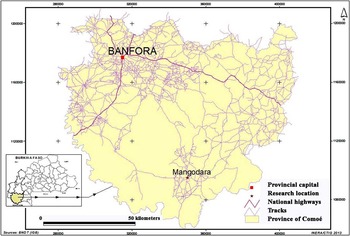
This study was conducted in Comoé province, in the Cascades Region of Southern Burkina Faso (Figure 1). This region is part of the Sudan-Guinea Savannah biome (World Bank, Reference Bambou, Cei, Camous, Archimède, Decherf, Philibert, Barbier, Mandonnet and Gonzalez-Garcia2009), is located in Burkina Faso between ~9°3′ and 11°3′N latitude, and has an average annual rainfall of 900 to 1200 mm and temperatures that commonly range from 17°C to 35°C.
Map of the sampling site.

Breed and animal management
The Djallonké breed (Supplementary Figure S1) is a short-eared, small-horned sheep of the West African Dwarf sheep type. The breed is common in the Sudan-Guinea Savannah region along the Atlantic coastline of Africa from Guinea Bissau to the Democratic Republic of the Congo and has been described phenotypically (Traoré et al., Reference Urquhart, Jarrett, Jennings, McIntyre, Mulligan and Sharp2008) and genetically (Álvarez et al., Reference Álvarez, Traoré, Tamboura, Kaboré, Royo, Fernández, Ouédraogo-Sanou, Sawadogo and Goyache2009). In southern Burkina Faso (Ouédraogo-Koné, Reference Overend, Phillips, Poulton and Foster2008), animals typically graze native pasture without supplementation for 8 to 14 h/day during the rainy season. Grazing time is generally not restricted during the dry season. Use of fodder crops and conserved forages is negligible.
Djallonké lambs (n=434) were sampled from 40 households. All but two of the households were located on the outskirts of the town of Mangodara in southern Burkina Faso, and all were located within 15 km of Mangodara. Ewes and lambs from these households had been herded by their owners in a common grazing area surrounding Mangodara. The grazing area contained a natural mixture of grasses such as Pennicetum pedicelatum and Andropogon gayanus, shrubs such as Acacia dudgeon, and fodder trees such as Afzelia africana and Pterocarpus erinaceus. Ewes and lambs were housed at night and allowed to graze during the day from ~0800 h until 1600 h. Lambs were weaned (i.e. no longer housed with their dams at night) at 1.5 to 2 months of age, but ewes and lambs were still herded together during the day. Lambs were trekked to a common location in Mangodara at an average age of 3.8 months (range of 2 to 6 months; SD of 0.8 months) for use in the study. Lambs were subsequently managed as a single group and herded on the same common grazing area used by their original owners.
Systematic deworming of small ruminants is not practiced in the study area, and lambs were not dewormed by their owners before the study began. Lambs therefore had similar levels of previous exposure to parasite infection, and H. contortus on the common grazing area were considered to represent a single nematode population. Lambs were dewormed with levamisole at the manufacturer’s recommended dose of 7.5 mg/kg when they arrived at the common location to remove existing GIN and prepare lambs for natural re-infection. Resistance to levamisole has not been documented in local populations of H. contortus, and levamisole is considered to be effective in the region (Lompo, Reference Malan, Van Wyk and Wessels2014). However, fecal samples were collected from 10% of lambs 10 days after deworming to confirm that the dewormer was effective; FEC for these samples were all 0. Tsetse flies were present in the study area and risk of trypanosomiasis was correspondingly high. Lambs were therefore treated with diminazen aceturate (3.5 mg/kg) when they arrived at the common location to free them from trypanosomes and treated 2 weeks later with isometamidium chloride (1 mg/kg) to protect them from trypanosomes for up to 6 months.
Data collection
Body weights, FEC, packed cell volume (PCV), and FAffa MAlan CHArt (FAMACHA©) scores were recorded at 28 and 35 days after deworming (Supplementary Figure S1) to characterize the response of the lambs to re-infection with H. contortus. The parasite load on the pastures was not explicitly assessed, but H. contortus is the most prevalent GIN in the study area (Belem et al., Reference Bishop, de Jong and Gray2005), and the study was carried out during the rainy season (June through August), when parasite challenge is seasonally high. Previous studies of both natural and artificial infections of lambs of resistant and susceptible genotypes with H. contortus (Vanimisetti et al., Reference Waller2004b) indicated that elevated FEC can be detected by 21 to 28 days after either artificial infection or a return to infected pastures and that FEC means are typically near maximum by 35 days after infection. Getachew et al. (Reference Goosens, Osaer, Kora, Jaitner, Ndao and Geerts2015) also reported that Menz and Washera sheep in Ethiopia that were artificially infected with H. contortus had dangerously high levels of FEC by 28 days after infection. Evaluation of lambs as 28 and 35 days after return to infected pastures was thus anticipated to result in development of measureable levels of infection without unduly increasing risks of morbidity and mortality.
Body weights were measured using a 50-kg weighbridge with a sensitivity of 50 g. Blood samples were collected from the jugular vein, and PCV were determined using the procedure outlined by Murray et al. (Reference Notter1983). Fecal samples were obtained from the rectum, and total strongyle FEC were determined using a modified McMaster technique (Whitlock, 1948) with a sensitivity of 50 eggs/gram of feces. The FAMACHA scores were determined by a single technician using the procedures and eye-color chart recommended by Van Wyk and Bath (Reference Vanimisetti, Andrew, Notter and Zajac2002). DNA samples for each lamb were obtained from leukocytes using the MasterPure DNA Purification kit (Illumina Inc., San Diego, CA, USA) following manufacturer’s instructions and stored to allow future study of possible genetic markers for resistance to GIN.
Statistical analysis
In most cases, FEC are not normally distributed, and a normalizing transformation is commonly applied to FEC before statistical analysis. In order to characterize the distribution of FEC in our data, FEC were expressed as residual deviations from sex and measurement time subclass means, and the Univariate Procedure of SAS (version 9.2) was used to test normality of the residuals and assess skewness (ω) and kurtosis (κ). The initial assessment was followed by comparison of alternative Box–Cox normalizing transformations of the form [(FEC λ −1)/λ] (Box and Cox, Reference Burke, Kaplan, Miller, Terrill, Getz, Mobini, Valencia, Williams, Williamson and Vatta1964) for each sex and measurement time. Optimum values of λ for values between −2 and 2 were determined using a maximum-likelihood criterion (Draper and Smith, 1981) in the TransReg Procedure of SAS.
Transformed FEC, BW, PCV and FAMACHA scores were analyzed with a repeated-measure analysis in the Mixed Model Procedure of SAS. The model included fixed effects of sex, measurement time (the repeated factor) and sex×measurement time interaction and a random animal effect. The FEC were transformed as LFEC=ln(FEC+25). Least-square means for LFEC (
 $\overline{{{\rm LFEC}}} $
) were back-transformed as
 $\big( {e^{{\overline{{{\rm LFEC}}} }} \,{\minus}\,25} \big)$
for reporting. Standard errors of back-transformed least-squares means were approximated by assuming that SE of
 $\overline{{{\rm LFEC}}} $
were approximately equal to coefficients of variation of back-transformed means. Residual correlation coefficients among BW, FEC, PCV and FAMACHA eye scores at 28 and 35 days after deworming were computed using the GLM Procedure of SAS after adjusting for effects of sex. Only lambs present at both 28 and 35 days were included in these analyses, but supplemental analyses including five lambs that died between 28 and 35 days were also conducted and compared with the original analyses.
The distribution of FAMACHA scores was tabulated for each sex and measurement time. Associations of FAMACHA scores with BW, FEC and PCV were assessed by adding effects of FAMACHA score and its interactions with sex and measurement time to the repeated-measures model. The five lambs that died between days 28 and 35 were included in these analyses to increase variation in PCV, FEC and FAMACHA scores.
Results
Lamb mortality and body weight changes
Mortality from the beginning of the trial until day 28 was 4.4% (n=19 of 434 lambs; 10 males and nine females), and 1.2% of remaining lambs (n=5) died between days 28 and 35. Lambs that died were not necropsied. However, lambs that died between 28 and 35 days were all males with FAMACHA scores of 3 or 4 and, in comparison with surviving males, had lower BW (10.4±1.5 kg v. 13.8±0.2 kg; P<0.05) and PCV (18.6±3.9% v. 35.3±0.8%; P<0.001) and higher untransformed FEC (2820±820 v. 880±161; P<0.05) at 28 days. These five lambs exhibited sub-mandibular edema (‘bottlejaw’) characteristic of clinical parasite infection and therefore presumably died from causes associated with, or exacerbated by, parasite infection.
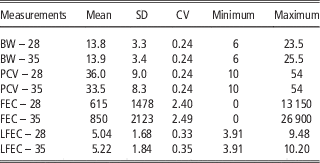
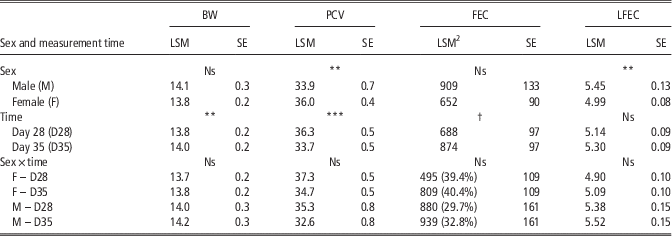
Descriptive statistics and least-squares means (Tables 1 and 2) demonstrated that BW increased from 13.8±0.2 kg to 14.0±0.2 kg between 28 and 35 days after deworming (P<0.01), but effects of sex and sex×measurement time interaction were not significant (Table 2). Re-infection of Djallonké lambs with H. contortus thus did not result in losses in BW between 28 and 35 days.
Means, standard deviations, CV and minimum and maximum values for BW (kg), packed cell volume (PCV; %), fecal egg counts (FEC) and natural logarithm of FEC [LFEC=ln(FEC+25)] for Djallonké lambs at 28 and 35 days after dewormingFootnote 1

1 n=410 lambs with records at both 28 and 35 days.
Least-squares means (LSM) and standard errors for BW (kg), packed cell volume (PCV; %), fecal egg counts (FEC), and natural logarithm of FEC [LFEC=ln(FEC+25)] by sex and measurement time for Djallonké lambs at 28 and 35 days after dewormingFootnote 1

***P<0.001, **P<0.01, † P<0.10; Ns: not significant.
1 n=410 lambs with records at both 28 and 35 days.
2 Tests of significance for effects influencing FEC are approximate because of departures from normality for the distribution of FEC. Values in parentheses are frequencies of individuals with FEC=0 for each sex and measurement time.
Indicators of resistance to gastrointestinal nematodes
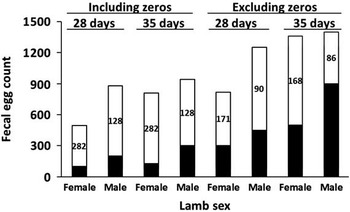
The PCV declined from 36.3% to 33.7% between days 28 and 35 (P<0.001; Table 2). Males had lower PCV than females (33.9% v. 36.0%; P<0.01), and this effect was consistent across measurement times. The average (±SD) FEC (Table 1) increased from day 28 (615±1478 epg) to day 35 (850±2123 epg). Statistical analysis of FEC was complicated by the non-normal distribution of FEC, as shown by comparison of means and medians for FEC by sex and measurement time (Figure 2). As expected, the distribution of FEC was skewed to the right (ω=6.70; P<0.001) and leptokurtic (κ=67.34; P<0.001) and departed significantly from normality based on tests provided in the Univariate Procedure of SAS (Shapiro and Wilk, Reference Sheferaw and Asha1965; D’Agostino and Stephens, Reference Draper and Smith1986). Optimal estimates of λ from Box–Cox transformations were close to 0 (−0.1<λ<0.1) for both sexes and measurement times. The Box–Cox transformation is undefined at λ=0, but asymptotically approaches a logarithmic transformation as λ approaches 0. We therefore applied logarithmic transformations of the form [ln(FEC+k)] for k=1, 10, 25, 50, 75 and 100 to FEC data and tested skewness and kurtosis of transformed variables. None of the transformations simultaneously accounted for both skewness and kurtosis. Skewness was minimized at k=10 (ω=0.11; P>0.05), but kurtosis, while greatly reduced, remained significant (κ=−1.27; P<0.01). By contrast, kurtosis was minimized at k=100 (κ=−0.12; P>0.05), but skewness, while greatly reduced, remained significant (ω=0.80; P<0.01).
Means (total column heights) and medians (solid column heights) by sex and measurement time for fecal egg counts for Djallonké lambs measured at 28 and 35 days after deworming, and including or excluding zero fecal egg counts. Numbers of observations are shown within the columns.

Effects of sex and measurement time were evaluated using a repeated-measures ANOVA after transforming FEC values as LFEC=ln(FEC+25). This value for k provided reasonable reductions in both skewness and kurtosis and greatly improved normality of the FEC distribution. Comparisons of results of alternative repeated-measures analyses indicated that the value of k used to transform FEC had essentially no effect on the significance of effects of sex and measurement time. Sex effects on LFEC were significant (P<0.01; Table 2). Back-transformed means were 208±27 for males and 122±10 for females. The mean increase in back-transformed LFEC between 28 days (146±13) and 35 days (175±16) was also substantial but, because of large variation among lambs in FEC, was not significant (P=0.11). No sex×measurement time interaction was observed for LFEC. Inclusion of FEC records for the five male lambs that died between 28 and 35 days of age in the data did not affect the significance of fixed effects; however, back-transformed means for LFEC in male lambs at 28 days in Table 2 increased to 237 epg and the corresponding mean for PCV declined to 34.7%.
Inspection of the distribution of FEC revealed both clumping of records at FEC=0 and right skewness for nonzero FEC records, which explains the inability of simple transformations to successfully normalize the FEC distribution and suggests the presence of two populations of lambs (i.e. those with detectable v. undetectable FEC). Frequencies of records with FEC=0 for each sex and measurement time (Table 2) show that ~40% of female and 30% of male lambs did not have detectable FEC (P=0.02 by χ 2). Of the 149 lambs with FEC=0 at 28 days, 85 (57%) also had FEC=0 at 35 days. Of the 261 lambs with FEC>0 at 28 days, 71 (27%) had FEC=0 at 35 days.
When the repeated-measures analysis was applied to only records with FEC>0, differences in PCV between sexes and measurement times were essentially identical to those in Table 2, indicating that the decline in PCV between 28 and 35 days was not affected by the incidence of detectable FEC. Sex×measurement time interaction was likewise not significant, and differences between males and females were similar to those in Table 2. However, time effects on LFEC were large (P=0.001) for lambs with detectable FEC. Means for LFEC increased from 6.12±0.07 at 28 days to 6.48±0.08 at 35 days, corresponding to a predicted increase of 43% in back-transformed FEC. In addition, the significant increase in BW from 28 to 35 days in Table 2 was not observed for lambs with detectable FEC. Means for BW for these lambs were 13.8±0.2 kg at both 28 and 35 days. Comparisons of BW, PCV and gains in BW between 28 and 35 days between lambs with and without detectable FEC revealed no differences between lambs with (n=261) and without (n=149) detectable FEC at 28 days. However, at 35 days, lambs with FEC=0 (n=156) had lower FEC at 28 days (back-transformed means of 88±13 v. 246±26; P<0.001), more rapid BW gains (0.34±0.09 v. 0.07±0.07 kg; P=0.02), and greater BW at 35 days (14.5±0.2 v. 13.7±0.3 kg; P=0.03) compared with lambs with FEC>0 (n=254). Positive growth was thus observed for the entire group of lambs, but a measurable negative effect of elevated, v. undetectable, FEC on growth was also present. Infection status at 28 days did not affect BW gain, but lambs that were infected at 35 days after deworming experienced negative effects on BW gain. The capacity to avoid infection with GIN, or bring new infections under control by 35 days after deworming, thus positively affected lamb growth.
Correlations among measured variables
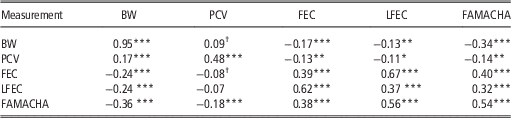
Residual correlations (r) among measured traits (Table 3) revealed positive correlations between measurements taken on the same trait at 28 and 35 days. Repeatabilities were 0.95 for BW, 0.48 for PCV, 0.39 for FEC, 0.37 for LFEC and 0.54 for FAMACHA scores (all P<0.001) and indicate that, despite considerable variation in PCV and, particularly, FEC, individual differences among lambs were repeatable among measurement times. The FAMACHA scores were negatively associated with PCV (P<0.001) at both 28 (r=−0.14) and 35 days (r=−0.18) and positively associated with LFEC at these ages (P<0.001; r=0.32 and 0.56, respectively). Correlations between FAMACHA scores and BW were moderately large (P<0.001) and negative (−0.34 at 28 days and −0.36 at 35 days).
Residual correlation coefficients among BW, packed cell volume (PCV), fecal egg counts (FEC), natural logarithm of FEC [LFEC=ln (FEC+25)], and FAffa Malan CHArt (FAMACHA) scores for Djallonké lambs evaluated at 28 (above the diagonal) and 35 (below the diagonal) days after deworming and after correcting for sex effects; repeatabilities for the same measurement at 28 and 35 days are shown on the diagonal

† P<0.10, *P<0.05, **P<0.01, ***P<0.001.
Associations between FAffa Malan CHArt scores and other measured variables
FAffa Malan CHArt scores of 1 and 2 were most common at both 28 (38.8% and 41.8%, respectively) and 35 days (36.5% and 45.5%, respectively). Fewer than 20% of the lambs had FAMACHA scores of 3 or 4 (17.3% and 1.4%, respectively, at 28 days and 16.6% and 0.7%, respectively, at 35 days), and scores of 5 did not occur. Scores of 3, 4 and 5 indicate detectable levels of anemia. The distribution of FAMACHA scores did not differ between measurement times (P>0.05 by Fisher’s exact χ 2-test).
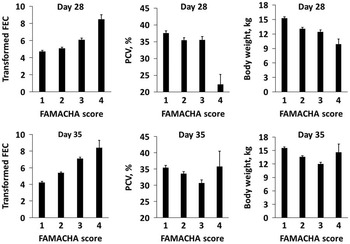
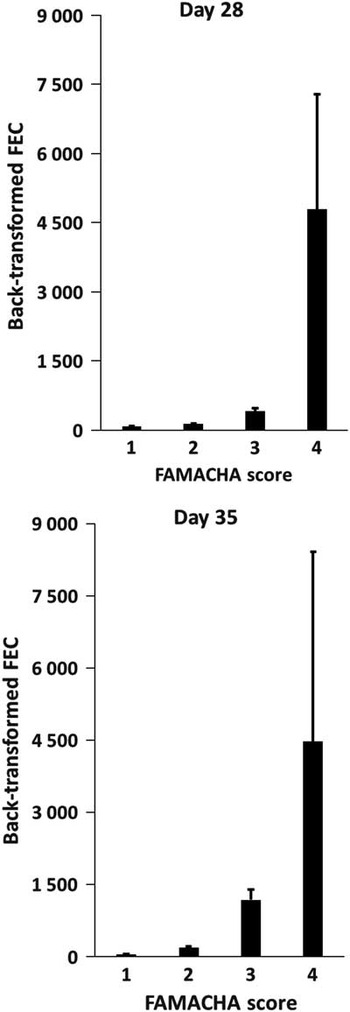
When effects of FAMACHA score were added to the statistical model, and lambs that died between 28 and 35 days were included in the data, FAMACHA score×measurement time interaction was significant for LFEC and PCV and sex×time interaction was significant for LFEC. Sex×FAMACHA score×time interaction was also significant for BW. Least square means for FAMACHA scores at 28 and 35 days are shown in Figure 3 for LFEC, PCV and BW. Increases in FAMACHA score were associated with corresponding increases in back-transformed FEC (Figure 4), consistent with the positive and highly significant (P<0.001) associations between these variables in Table 3. FAffa Malan CHArt scores were also significantly associated with PCV (P<0.001), but the pattern of association differed between measurement times (P=0.04 for FAMACHA score×measurement time interaction). At 28 days after deworming, no significant differences in PCV were observed among lambs with FAMACHA scores of 1, 2 and 3, but the small number of lambs with a FAMACHA score of 4 had much lower PCV than the other lambs. This group included three of the five lambs that died between 28 and 35 days. By contrast, at 35 days, a significant linear decline in PCV was observed for FAMACHA scores of 1, 2 and 3. The mean PCV for the small number of lambs with FAMACHA score of 4 was higher than expected, but had a large standard error, and this group of lambs did not differ significantly from any of the other FAMACHA-score groups. Finally, BW was significantly associated with FAMACHA score (P<0.001) at both measurement ages and declined in an approximately linear manner as FAMACHA scores increased from 1 to 3. At 28 days after deworming, this linear association between BW and FAMACHA score was maintained for lambs with a FAMACHA score of 4. However, 35 days after deworming (and following the death of five small, apparently highly parasitized lambs), remaining lambs with FAMACHA scores of 4 were not different in BW from lambs in the other FAMACHA-score groups.
Least-squares means for log-transformed fecal egg counts (FEC), packed cell volume (PCV) and BW by FAffa Malan CHArt (FAMACHA) score for Djallonké lambs evaluated at 28 and 35 days after deworming.

Least-squares means for fecal egg counts (FEC) after back-transformation from the logarithmic scale for Djallonké lambs evaluated at 28 and 35 days after deworming.

Discussion
Previous studies have suggested that West African populations of Djallonké sheep are relatively resistant to GIN (Belem et al., Reference Bishop, de Jong and Gray2005; Kaboré et al., Reference Kaplan, Burke, Terrill, Miller, Getz, Mobini, Valencia, Williams, Williamson, Larsen and Vatta2007). However, these studies were often conducted under conditions that included concurrent infection with trypanosomes, and trypanosomiasis has been shown to predispose animals to infection with GIN (Kaufmann et al., Reference Lompo1992; Goosens et al., Reference Houdjik, Jessop and Kyriazakis1997). Djallonké sheep, and other local breeds of sheep, goats and cattle in the region, have documented levels of tolerance to trypanosomes (Food and Agriculture Organization of the United Nations, Reference Getachew, Alemu, Solkner, Gizaw, Hailé, Gosheme and Notter1980), and reports of resistance to GIN must therefore be interpreted in the context of associated infection with, or freedom from, trypanosomes. Lambs in the current study were exposed to trypanosomes before being transferred to Mangodara, but were then treated to control trypanosomes. Our results thus address resistance to GIN infection independent of acute effects of trypanosomiasis.
Following deworming and return to infected pastures, ~65% of the lambs had measureable FEC by 28 days after deworming. A similar level of infection was observed at 35 days after deworming. The incidence of infection was ~10% higher for male lambs than for female lambs at both sampling times, and, among affected lambs (i.e. those with FEC>0), male lambs had higher FEC than female lambs. Male lambs also had lower PCV than female lambs, regardless of infection status. Sex effects on PCV and FEC similar to those observed in this study were reported by Urquhart et al. (Reference Van Wyk and Bath1996), who postulated that greater parasite susceptibility could be mediated by androgen hormones in males, in contrast to stimulatory effects of estrogen on immune responses in females. The anticipated greater lean tissue growth potential and associated protein requirements of growing male lambs may also lead to greater competition for available dietary protein to meet requirements for growth and immune function in males compared to females (Houdjik et al., Reference Kaboré, Tamboura, Belem and Traoré2001). The decrease in PCV between measurement times that was observed in this study was consistent with results reported by Burke and Miller (Reference Charon2002) in Dorper and other hair sheep breeds, Bambou et al. (Reference Belem, Kaboré and Bessin2013) in Creole sheep, and Getachew et al. (Reference Goosens, Osaer, Kora, Jaitner, Ndao and Geerts2015) in Ethiopian Menz and Washera sheep. Standard deviations indicated high variability in the Djallonké breed for both FEC and PCV, similar to that reported by Getachew et al. (Reference Goosens, Osaer, Kora, Jaitner, Ndao and Geerts2015) in Ethiopian Menz and Washera lambs experimentally infected with H. contortus.
As a group, these Djallonké lambs gained weight between 28 and 35 days after deworming, but growth was restricted in more highly parasitized individuals. A similar pattern of change in BW was reported for Djallonké sheep artificially infected with L3 larvae of H. contortus (Lompo, Reference Malan, Van Wyk and Wessels2014). Although PCV declined over time, mean levels remained high (above 32%) and total mortality during the study was modest, at 5.5%.
Use of FAMACHA scores to identify animals that would benefit from anthelmintic treatment was proposed by Malan et al. (Reference Murray, Trail, Turner and Wissocq2001) and Van Wyk and Bath (Reference Vanimisetti, Andrew, Notter and Zajac2002) and evaluated by Kaplan et al., (Reference Kaufmann, Dwinger, Hallebeek, van Dijk and Pfister2004), Burke et al. (Reference Burke and Miller2007) and Getachew et al. (Reference Goosens, Osaer, Kora, Jaitner, Ndao and Geerts2015). Gastrointestinal blood loss caused by blood-feeding GIN such as H. contortus has been shown to coincide with progressive increases in the incidence of subclinical and clinical anemia and associated changes in the color of the ocular mucous membranes. Increases in FAMACHA score are therefore anticipated to correspond to increases in severity of GIN infection.
In the current study, FAMACHA scores of 1, 2 and 3 were relatively frequent but scores of 4 were rare and scores of 5 did not occur. At both 28 and 35 days after deworming, a significant positive linear association was observed between the FAMACHA score and the logarithm of FEC (Figure 3), corresponding to an exponential increase in predicted FEC. This exponential relationship resulted in notably higher predicted FEC for lambs with FAMACHA scores of 4 (Figure 4), confirming that lambs with scores of 4 or more required treatment. The overall correlation between FEC and FAMACHA scores, however, was only ~0.4 and, while highly significant, accounted for only 16% of observed variation in FEC.
In these data, the correlation between FAMACHA scores and PCV averaged only −0.16 and, although highly significant, was considerably lower than that between FAMACHA scores and FEC. At 28 days after deworming, a clear reduction in PCV was observed only for lambs with a FAMACHA score of 4. In contrast, at 35 days after deworming, a negative linear relationship was observed between FAMACHA score and PCV for lambs with FAMACHA scores of 1, 2 and 3, but this relationship did not extend to lambs with a FAMACHA score of 4. We believe this result was, at least in part, associated with the death of a few of the smaller, more highly parasitized lambs but survival of larger lambs with similar high GIN loads.
Body weights were negatively associated with FAMACHA scores and FEC and positively associated with PCV. We believe that associations between BW and GIN resistance mainly reflect greater vulnerability of smaller lambs to GIN infection, but, once infected, this effect may be accentuated by negative direct effects of parasitism on additional gains and future BW in smaller lambs. Vanimisetti et al. (Reference Vanimisetti, Greiner, Zajac and Notter2004a) reported that BW has favorable phenotypic correlations (P<0.01) with LFEC (−0.20) and PCV (0.26) in 386 lambs of a susceptible temperate sheep type maintained in drylot and challenged by artificial infection with H. contortus at ~130 days of age. This result is consistent with results of the current study and suggests that management interventions that increase lamb BW should have favorable effects on LFEC and PCV. These results are also consistent with observed effects of protein intake on GIN susceptibility in sheep (Houdjik et al., Reference Kaboré, Tamboura, Belem and Traoré2001).
Animals in our study area were not regularly dewormed, and multiple factors act to limit animal performance in the region. However, parasite infections are considered to have a negative impact on animal performance and welfare during the rainy season. Tamboura et al. (Reference Tembely, Lahlou-Kassi, Rege, Mukasa-Mugerwa and Baker2006) monitored FEC, PCV and BW in 1 to 2-year-old sheep in central Burkina Faso and reported that FEC increased rapidly to a mean of ~500 egg/gram of feces during the rainy season. Body weights and PCV were at their lowest levels late in the rainy season, despite greater forage production, and treatment with anthelmintics improved BW at the end of the rainy season.
Patterns of association among FAMACHA scores, FEC, PCV and BW in our study were similar to those reported by Burke et al. (Reference Burke and Miller2007). A relatively strong relationship between FAMACHA scores and PCV has commonly been reported in sheep and goats (Kaplan et al., Reference Kaufmann, Dwinger, Hallebeek, van Dijk and Pfister2004; Burke et al., Reference Burke and Miller2007; Sotomaior et al., Reference Tamboura, Kaboré and Nikiema2012). However, in contrast with results from the current study, associations between FAMACHA scores and FEC were often (Kaplan et al., Reference Kaufmann, Dwinger, Hallebeek, van Dijk and Pfister2004), though not always (Burke et al., Reference Burke and Miller2007), weaker than those between FAMACHA scores and PCV.
Conclusions
Fecal egg counts increased and PCV decreased following deworming and subsequent natural GIN challenge in Djallonké lambs in the Sudan-Guinea Savanna region of Burkina Faso, and PCV were higher and FEC were lower in females. The mean FEC increased in association with increases in FAMACHA score, and the correlation between FAMACHA score and FEC was positive and highly significant. The FAMACHA scores could thus assist in identification of animals that would benefit from anthelmintic treatment. Negative associations of BW with both FEC and FAMACHA scores further suggests that BW is an easily measured predictor of the general ability of Djallonké lambs to control GIN burdens and that management interventions that improve BW should also reduce GIN susceptibility. The relatively low incidence of measurable infection in these lambs suggests that strategic deworming based on FAMACHA scores and low BW would allow treatment of the most vulnerable lambs, and would be expected to improve animal productivity, reduce death losses and delay or prevent development of drug resistance in GIN populations. In addition, the high variability in FEC and PCV observed in this study and the modest favorable associations between these variables and BW indicates opportunity to use selective breeding to increase resistance to GIN in Djallonké sheep. However, recording of health-related traits such as FEC and PCV under field conditions is challenging, and identification of genetic markers associated with resistance to parasitic diseases has potential to enhance resistance to GIN in Burkina Faso sheep breeds.
Acknowledgement
This study was funded by Joint FAO/IAEA Coordinated Research Project D3.10.26 and by Fond Compétititif National of Burkina Faso (CNRST/PPAAO). The authors gratefully acknowledge the cooperation of the Mangodara sheep breeders who contributed to the study.
Supplementary material
To view supplementary material for this article, please visit https:/doi.org/10.1017/S1751731116002640