Introduction
The significance of dementia care-giving
Dementia can be defined broadly as a clinical syndrome most common in older people characterised by cognitive decline with multiple aetiologies, that is sufficiently severe to interfere with social or occupational functioning (Chertkow et al., Reference Chertkow, Feldman and Jacova2013). Dementia may also involve behavioural and psychological symptoms (BPSD), such as aberrant motor behaviour, anxiety, irritability, depression, disinhibition and sleep changes (Cerejeira et al., Reference Cerejeira, Lagarto and Mukaetova-Ladinska2012). Given the extent of functional impairment it creates, the World Health Organization has stated that dementia ‘poses one of the greatest societal challenges for the 21st century’ (Moore et al., Reference Moore, Patterson, Lee, Vedel and Bergman2014).
In 2010, there were over 500,000 Canadians with dementia, with an annual incidence of approximately 100,000 (Alzheimer Society of Canada, 2010). In 2011, informal (i.e. unpaid, typically family membersFootnote 1) care-givers in Canada provided approximately 1 billion hours of unpaid care work, a figure expected to double by 2031 (Manuel et al., Reference Manuel, Garner, Finès, Bancej, Flanagan, Tu, Reimer, Chambers and Bernier2016). Compared to care-givers of people with other conditions, care-givers of older people with dementia may experience greater stress, care-giving intensity and feelings of captivity (Bertrand et al., Reference Bertrand, Fredman and Saczynski2006). As dementia progresses, functional dependence increases and challenging behaviours can emerge, often resulting in care-giver depression and anxiety (Aguglia et al., Reference Aguglia, Onor, Trevisiol, Negro, Saina and Maso2004). As a result, care-givers of people with dementia are frequently ‘hidden victims’ of the condition (Zarit et al., Reference Zarit, Orr and Zarit1985).
Care-giving stress is a dynamic phenomenon, varying over time and influenced by factors including care-giver health, educational attainment and cultural background (Schulz and Sherwood, Reference Schulz and Sherwood2008; Brodaty and Donkin, Reference Brodaty and Donkin2009). Moreover, many care-givers of people with dementia experience positive feelings such as being needed, appreciated and important, as well as strengthened relationships with loved ones (Ontario Dementia Caregiver Needs Project et al., Reference Dupuis, Epp and Smale2004; Tarlow et al., Reference Tarlow, Wisniewski, Belle, Rubert, Ory and Gallagher-Thompson2004; Hilgeman et al., Reference Hilgeman, Allen, DeCoster and Burgio2007). A study of Canadian care-givers of people with dementia found that 73 per cent could identify at least one specific positive aspect of care-giving (Cohen et al., Reference Cohen, Colantonio and Vernich2002a).
Formal support services available to support care-givers of people newly diagnosed with dementia include government-funded and privately purchased home-care services as well as free programmes provided by the voluntary sector (Leino-Kilpi et al., Reference Leino-Kilpi, Roe, Soto, Saks, Stephan, Zwakhalen, Zabalegui and Karlsson2016). In Canada, for instance, the Alzheimer Society's (AS) First Link™ programme facilitates early referral of dementia care-givers to peer support and education programmes (McAiney et al., Reference McAiney, Hillier, Stolee, Harvey and Michael2013). Care-givers also rely on informal sources of support such as family (e.g. adult children, siblings, etc.), friends and faith communities (Farran et al., Reference Farran, Paun and Elliott2003; Donnellan et al., Reference Donnellan, Bennett and Soulsby2015; Smith-Carrier et al., Reference Smith-Carrier, Pham, Akhtar, Seddon, Nowaczynski and Sinha2017). These sources of support can mitigate burden and improve the care individuals provide (Zarit et al., Reference Zarit, Gaugler and Jarrot1999; Farran et al., Reference Farran, Paun and Elliott2003; Winslow, Reference Winslow2003; Donnellan et al., Reference Donnellan, Bennett and Soulsby2015).
Care-givers and comprehensive geriatric assessment clinics
In Ontario, a network of Regional Geriatric Programs established in several areas, including the one in which our study was set, help to co-ordinate local specialised geriatric services. This includes a number of comprehensive geriatric assessment (CGA) clinics. For the most part, these clinics accept referrals from primary care physicians, and provide consultations and co-management for a range of geriatric syndromes, including dementia. Available studies suggest that outpatient geriatric assessment can lead to improved diagnosis of cognitive impairment, and improved functional ability (Silverman et al., Reference Silverman, Musa, Martin, Lave, Adams and Ricci1995; Boult et al., Reference Boult, Boult, Morishita, Dowd, Kane and Urdangarin2001; Cohen et al., Reference Cohen, Feussner, Weinberger, Carnes, Hamdy, Hsieh, Phibbs, Courtney, Lyles, May, McMurtry, Pennypacker, Smith, Ainslie, Hornick, Brodkin and Lavori2002b).
Given the chronic scarcity of geriatric specialists, comparing the performance of different geriatrician-led models of care of older people with dementia, including CGA clinics, is essential. For the reasons discussed above, the wellbeing of care-givers is an important outcome (Soobiah et al., Reference Soobiah, Daly, Blondal, Ewusie, Ho, Elliott, Yue, Holroyd-Leduc, Liu, Marr, Basran, Tricco, Hamid and Straus2017). However, care-giver burden in the CGA clinic context has received relatively little research attention. As a result, it is difficult to assess the relative performance of CGA clinics as regards this important metric.
Strategies to evaluate and mitigate stress in dementia care-givers must be grounded in a rich and specifically qualitative understanding of care-giving as it is experienced in particular contexts (Thompson et al., Reference Thompson, Spilsbury, Hall, Birks, Barnes and Adamson2007). The experience of care-givers in the CGA clinic context may differ from other care-giver populations in significant ways. For instance, a CGA clinic visit may elicit different concerns and require different forms of support than in the case of a care recipient's discharge from an inpatient medical unit, a situation in which immediate concerns such as appropriate placement might predominate.
Furthermore, by the time they are referred to the clinic, many care-givers may already be confronting significant BPSD and be highly aware of the care recipient's vulnerabilities. In addition, clinics like ours with an exclusively outpatient care delivery model necessarily exclude the severely frail, e.g. those who cannot get out of bed, whose care-givers may experience more and/or different forms of burden.
Moreover, the interventions that CGA clinics can offer to mitigate care-giver burden differ from those available in the inpatient setting. For instance, many clinics, including the one examined in our study, offer dedicated case managers who can serve as a single point of contact for care-givers as they navigate the health and social care systems. The amount of time available for a comprehensive, geriatrician-led multi-disciplinary geriatric assessment may help to surface care-giver concerns that may not come to light in the setting of a stay on, for example, an acute medicine unit. Finally, many clinics are able to offer longitudinal follow-up and co-management with frequent re-evaluation. The opportunity to build a trusting relationship with staff may open up opportunities for care-giver support that do not exist elsewhere.
Accordingly, this qualitative study, the first to examine specifically the experiences of care-givers in the CGA clinic context, had two primary objectives. First, we sought to understand better the educational and support needs of family care-givers of people diagnosed with dementia attending an outpatient geriatric assessment clinic. Second, we sought to document which educational and support resources they attempted to access, as well as the challenges they experienced in doing so. To capture these experiences in rich qualitative detail, we employed thematic analysis of semi-structured interviews.
It was our intention that, in addition to its research relevance, our study would help us to identify ways of improving the care our own clinic provides. Like many CGA clinics, our mandate includes care-giver empowerment and education, and working to assist care-givers in seeking and making best use of available resources, rather than directly providing or co-ordinating community supports. As such, we chose to focus on educational and support-seeking needs and experiences because of their particular relevance to CGA clinics like ours.
Design and methods
This study received approval from the Hamilton Integrated Research Ethics Board, Hamilton, Ontario, Canada. Our study was set in a university-affiliated hospital-based multi-disciplinary outpatient CGA clinic (‘the Clinic’) in Hamilton, Ontario, Canada. Most people attending the Clinic are referred by primary care physicians for assessment and management of geriatric concerns such as cognitive decline, suspected dementia, polypharmacy, decreased mobility and other forms of functional decline.
Recruitment
We included all family care-givers who identified themselves as the primary care-giver (hereafter ‘care-giver’) of an individual previously diagnosed with dementia at the Clinic (hereafter ‘care recipient’). Only those care-givers who were supporting care recipients who resided in a personal residence were included. Thus, care-givers of care recipients residing in an assisted living facility, or formally diagnosed with dementia before attending the Clinic, were excluded. Care-givers of care recipients attending a follow-up assessment were told about our research study and asked if they were interested in hearing more. If so, a research assistant not involved in the care recipient's care described the study and obtained informed consent.
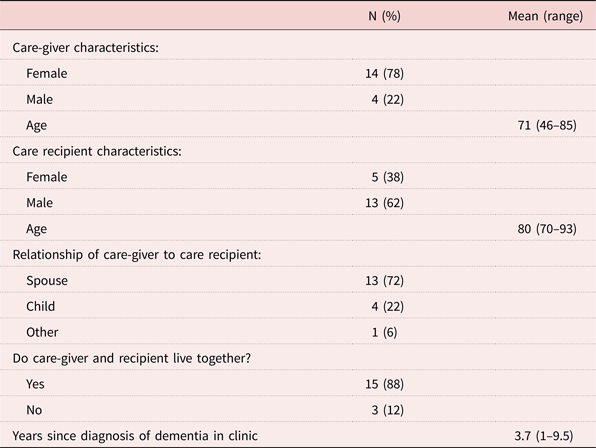
We recruited a convenience sample of 18 care-givers accompanying community-dwelling older people previously diagnosed with dementia at the Clinic. Table 1 displays demographic characteristics of the 18 care-givers and their care recipients. A majority (78%) of care-givers were female, with a mean age of 71. A majority (62%) of care recipients were male, with a mean age of 80. The majority (72%) of care-givers were the spouses of their care recipient, and the majority of all care-givers (88%) lived with their care recipient. Years since diagnosis with dementia ranged from one to 9.5, with a mean of 3.7 years.
Demographic characteristics

Data collection
One of two investigators (MW-P, PAM) interviewed consenting care-givers over the telephone using a semi-structured interview guide, which is included in the online supplementary material. Topics covered in the interview guide included:
• Educational materials and information received at the Clinic at the time of diagnosis.
• Care-givers’ needs for information and experiences in accessing that information.
• Care-givers’ efforts to make contact with health care, government or voluntary-sector organisations.
• Care-givers’ outreach to or from support networks such as family, friends and religious communities.
• Care-givers’ opinions about which sources of information they found most valuable.
All consenting care-givers received a Can $20 gift card for a coffee chain to compensate them for their time. To avoid coercion, it was explained to participants that they would receive the card whether or not they completed the interview. Ultimately, all 18 participants were successfully interviewed.
Interviews lasted between 30 and 90 minutes, and were recorded, transcribed and anonymised. We also gathered demographic details, including care-giver and care recipient age, gender and relationship to one another; living arrangements (i.e. whether care-giver and care recipient co-habit) and years since being diagnosed with dementia. The care-giver was also asked to estimate how many hours he or she spent weekly assisting the care recipient with basic or instrumental activities of daily living (ADLs and IADLs, respectively). Finally, care-givers estimated how many hours of support they received weekly from each of several sources, such as publicly funded personal support workers (PSWs), and family and friends.
Analysis
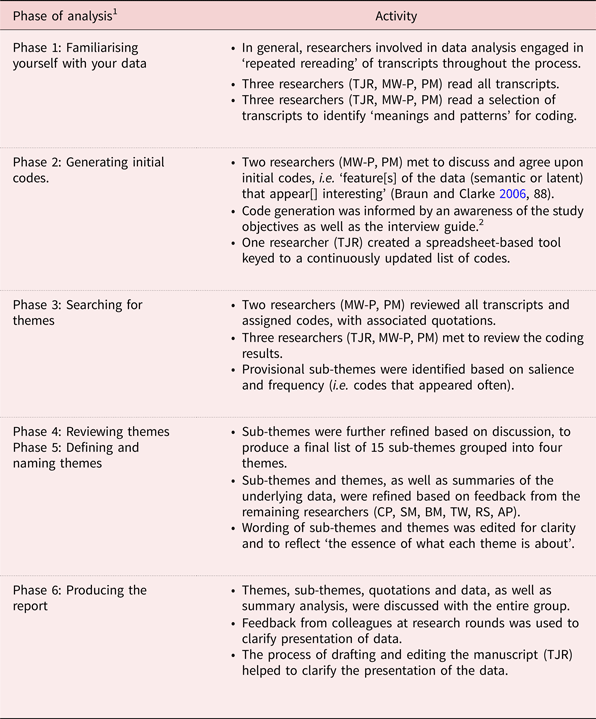
Our study employed thematic analysis, informed by Braun and Clarke's (Reference Braun and Clarke2006) six-phase guide. Our approach is depicted in detail in Table 2. Of note, we worked iteratively, revising codes, themes and sub-themes based on interim findings and discussions (Fereday and Muir-Cochrane, Reference Fereday and Muir-Cochrane2006).
Thematic analysis process

Notes: 1. Per Braun and Clarke (Reference Braun and Clarke2006). 2. See the online supplementary material.
Findings
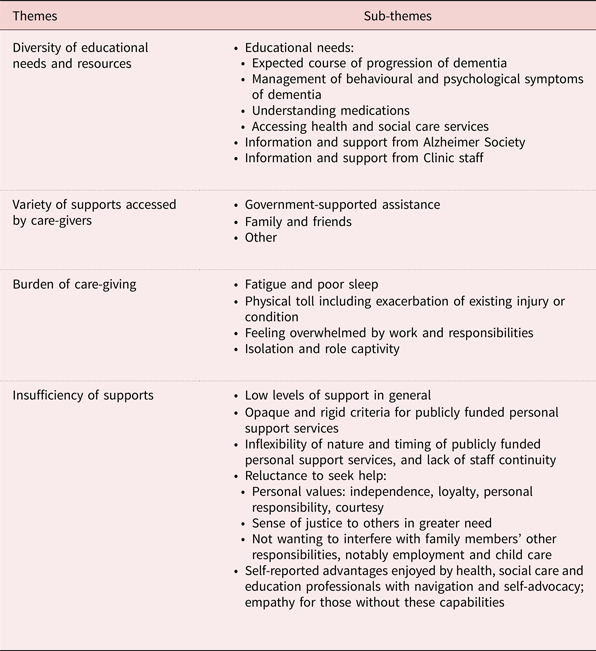
Saturation was achieved with a sample of 18 participants. Themes and sub-themes are summarised in Table 3. Four common themes were apparent in care-givers’ narratives about their educational and support experiences:
(1) Diversity of educational needs and resources: care-givers sought information and education on a wide range of topics from a variety of sources.
(2) Variety of supports: support with care-giving activities came from several different sources.
(3) Burden of care-giving: some care-givers experienced physical and emotional difficulties, and worried about how their own poor health might affect their ability to provide care.
(4) Insufficiency of support: in absolute terms, care-givers received surprisingly little external support. Many found the health and social care systems inflexible and difficult to navigate.
Themes and sub-themes from care-giver interviews

Diversity of educational needs and resources
Care-givers learned about diverse topics relevant to dementia care-giving from a variety of sources, principally the AS, the internet and Clinic staff. Most care-givers recognised knowledge as a major need, and many participants emphasised knowledge-seeking as an important part of the care-giving experience. As one care-giver put it:
I think that [information] resources for the care-giver are even more important than for the clients, quite honestly, because the care-giver is probably under more pressure, a person with dementia doesn't even feel the pressure. (Participant 13: 76-year-old wife of an 86-year-old man)
When asked to identify which subjects they most wanted to learn about since the diagnosis of their care recipient with dementia, and about which they had sought the most information, care-givers’ comments converged around four major informational needs.
First, care-givers wanted to know about the expected progression of the condition and ‘what to expect’ in order to prepare themselves psychologically, and avoid being caught off guard by unexpected changes:
[I wanted to] look at what I'm going to plan and so I'm not caught by surprises even though I still got caught with surprises because there's no real prediction as to what's going to happen next. I was more prepared to meet the challenges. And the education aspect to me is very critical. (Participant 8: 83-year-old husband of a 79-year-old woman)
Second, they wanted advice about how to manage actual or anticipated BPSD (e.g. agitation, vocalising, shadowing, etc.):
I guess one of the most important things is … the changes and how to react to them because you're used to a certain personality and then when that changes you react the way you normally would not realising a lot of the time that it's part of … the disease that is causing this. (Participant 6: 67-year-old wife of a 70-year-old man)
I think the biggest problem I have right now is understanding how to deal with [the care recipient's anger]. It doesn't happen every day but it's there and it does happen often and it's awful. How do I … sidestep it? How do I go around it? How do I calm him down? (Participant 25: 69-year-old wife of a 70-year-old man)
Third, care-givers needed information about their care recipients’ medications:
[The Clinic geriatrician] explained the drugs to me and what they do … I've often wondered, ‘What the heck's this for?’ I thought it was [for the] heart. [But they told me] ‘Well, it's blood pressure [medication].’ (Participant 25: 69-year-old wife of 70-year-old man)
Finally, they needed to know how to access health and social care services:
I moved from [one region to another]. They do different things in different places. There's different resources everywhere so it's like a learning curve … I just came across a boundary here in [the province in which the Clinic is located] and I have to learn the whole thing and I'm medical and I did support people with dementia but here in [my new community] I had to learn a whole new gamut of how to do things and where to look for things. (Participant 11: 61-year-old wife of an 80-year-old man)
Well I just think the [government agency that co-ordinates personal support services] needs to be on top of it and come back down to the houses more often and inform people what's going where you know and how they can do things. Like I'm in the dark here half the time. I don't know what I'm supposed to be doing or not doing. (Participant 15: 76-year-old wife of an 82-year-old man)
Information and support from the AS
When a person is diagnosed with dementia at the Clinic, a case manager sends a referral on behalf of their care-giver to the local AS's First Link™ programme. A First Link™ co-ordinator then contacts the care-giver within a few weeks of the referral to provide advice and encouragement, answer questions, and inform the care-giver about the AS's various resources and support groups. Many care-givers availed themselves of AS services, and found speaking with AS staff and volunteers, and meeting with peers, to be very helpful, particularly as regards understanding and managing BPSD, and also in terms of finding a peer support group:
I think finally I phoned [AS] when I had a problem with his behaviour again … He wanted money in his pocket … And he was so upset about not having money that he thought he was poor and I didn't know how to react to it. I tried to put fake money and he knew that it was fake … That's when I went to [AS] to see how they would approach, how they would help me. (Participant 11: 61-year-old wife of an 80-year-old man)
I spoke with [name of AS volunteer] over the phone. [They] gave me some suggestions you know just as far as you know dealing or you know what to expect … It was just his moods and that kind of thing. So that was very helpful. Now we are since attending sessions, both of us at the Alzheimers Society, which deal with different topics. (Participant 6: 67-year-old wife of a 70-year-old man)
Roughly half of the care-givers used the internet as part of their self-directed learning regarding both dementia in general and BPSD in particular. Most of the care-givers using the internet were between 60 and 80 years of age, with one individual over the age of 80. A variety of online resources were consulted, with the Canadian and American Alzheimer Societies’ sites being the most frequently mentioned:
I went online and my daughter went online and we found sheets of paper on Alzheimer's and you know what it is and what it's not. What it does and what it doesn't do … I printed it all off and you know we can read it off and anytime that I want to update myself you know I just look at it again and keep myself updated. (Participant 15: 76-year-old wife of an 82-year-old man)
I went into a number of computer programs … looking up computer data like exercises, routines. What I found very helpful knowing the seven stages of Alzheimer's and the potential forecast, what to look for. (Participant 8: 83-year-old husband of a 79-year-old woman)
However, certain care-givers were sceptical about the reliability of the information they found online, and were not always sure how to assess its accuracy:
It was, it was difficult to separate the wheat from the chaff. I was actually overloading myself with information. As you know with computers sometimes you just got to reach in and you gotta reach out so I had to learn to separate fact from fiction. (Participant 8: 83-year-old husband of a 79-year-old woman)
You know it's really, it's too hard to go by you know by the internet like you don't know what is right and what is wrong. Like sometimes they've just got stuff there that you can't really trust. (Participant 1: 69-year-old wife of a 70-year-old man)
Several care-givers who were ambivalent about the reliability of online information identified the need for a single trustworthy repository of information, whether online or in hard copy:
But I think there's a lot of resources already offered with information. And just maybe like one central resource where you could find out about you know care-givers or how to … I don't know access programmes and things like that. (Participant 24: 52-year-old daughter of 84-year-old woman)
Information and support from the Clinic staff
Care-givers felt that Clinic staff were helpful in informing them about medications, recommending resources and in recapping the key points addressed during visits, sometimes in writing. Certain care-givers occasionally called the Clinic between visits to clarify medications and details of treatment, as well as receive psychological support:
[The Clinic case manager] wrote out a synopsis of what transpired and I read it and go back and reread it and find it really helpful … So I found that to be very enlightening. (Participant 25: 69-year-old wife of 70-year-old man)
Some, but not all, care-givers recalled receiving written educational materials from the Clinic at the time the diagnosis was made and/or at follow-up visits:
I got some pamphlets that describes [sic] the stages, the beginning stage, middle stage and [end] stage, that kind of thing. And so yea that is helpful because I recognise it. (Participant 14: 84-year-old wife of an 87-year-old man)
I can't remember receiving very much at all … I might have got some leaflets and things but at the moment I can't recall it … But sometimes I stop and pick up things when I'm at [the facility where the Clinic is located]. (Participant 23: 84-year-old wife of a 90-year-old man)
Certain care-givers also felt that the Clinic was helpful in linking them with community support services:
I just now [have help] recently from because the [Clinic] phoned [the publicly funded PSW co-ordination service] and has offered me a PSW and last week I had the PSW here for the first time in all these years for three hours. (Participant 14: 84-year-old wife of an 87-year-old man)
Variety of supports accessed by care-givers
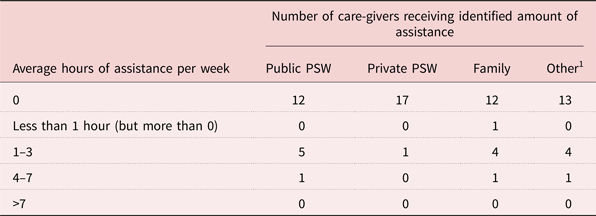
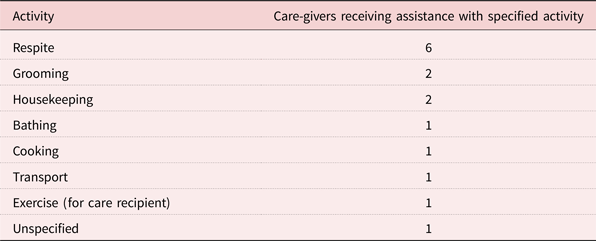
Tables 4–6 display care-givers’ estimates of average hours per week of support with care-giving activities received from various sources. Care-givers received assistance from publicly funded PSWs (N = 6), family members (N = 6), privately paid housekeepers (N = 2), private respite workers (N = 2) and the local municipally funded transportation service (N = 1). By far the most common use of outside support services was for respite care (N = 6), followed by assistance with care recipient's personal grooming (N = 2) and housekeeping (N = 2). Only one care-giver reported hiring a PSW.
External assistance received

Sources of external assistance

Notes: PSW: personal support worker. 1. Housekeeping; private respite care service; municipally funded transportation service.
Types of assistance received

Government-supported assistance
The province (i.e. sub-national jurisdiction) in which the Clinic is located provides regionally administered home-making and personal support services free of charge to eligible individuals, up to a regulatory maximum of 120 hours in the first month of service and 90 hours per month thereafter. The amount of support received is based on a needs assessment by a care co-ordinator from the regional administration:
And then I have a PSW, he comes in three times a week, three hours all total and he'll help with showers, too, and stuff, and help him shave. (Participant 9: 71-year-old wife of an 80-year-old man)
The [publicly funded PSW] comes in for three hours on Thursday while I get a chance to go off and do my grocery shopping. (Participant 15: 76-year-old wife of an 82-year-old man)
Many care-givers found the services themselves useful:
Before [receiving publicly funded support services] I couldn't do anything because, I couldn't even look and anticipate anything now at least I can do that … I'm getting the care in home for that whereas if I couldn't do it with that I wouldn't be able to do any kind of a life with myself. (Participant 11: 61-year-old wife of an 80-year-old man)
I must say I am very happy with my PSW. She's a very nice lady. [Care recipient] responds to her well. She responds well to [care recipient]. And she is, we have a good rapport. (Participant 14: 84-year-old wife of an 87-year-old man)
Only one care-giver hired privately paid PSWs. Two care-givers employed housekeepers while two care-givers occasionally used a private respite care service:
[One not-for-profit health-care organisation] ha[s] a little bit like a seven-bed unit there that you can take your family member to sleep if … you need somebody like to look after them so you can get a good night's rest for $40 a night. (Participant 1: 69-year-old wife of a 70-year-old man)
[W]e get now 30 hours a month [of private in-home respite care]. And what they do is just kind of monitor him, assist him to go to bed, help him with suppers, that was needed, that was the time-frame and just communicate with him if need be. (Participant 11: 61-year-old wife of an 80-year-old)
Support from family and friends
Care-givers sought support from family, friends, peers, health-care professionals and spiritual leaders:
I can talk to the case manager [at the Clinic] but I also have lots of family members here that I can talk to … My Pastor at church knows the situation and I could talk to him about it. (Participant 19: relative (other) of 72-year-old woman)
Most of the time I keep it together and I'm fine but every once in a while I'll sit down at the computer and type to two or three friends and at the end of it thanks a lot for listening. You don't need to worry about me I just needed to get that off my chest. And I move on. (Participant 21: 69-year-old wife of a 71-year-old man)
Several care-givers found it useful to talk to other people living in similar circumstances, including in the setting of peer support groups such as those organised by the local chapter of the AS:
And I'm in [a] care-givers group that meets twice a month … And I love the ladies that are there and we're all dealing with our husbands so it's … beneficial because we can all share and also be sounding boards for one another. (Participant 21: 69-year-old wife of a 71-year-old man)
One-third of care-givers received care-giving assistance from spouses, siblings, children, other relatives or friends. Of these care-givers, all but one received three or fewer hours per week of help. The most common type of support provided by this group was respite care:
And my sister … gives me some [respite care], if I need to go somewhere for a longer period. And my brother invites us up to his house like often, every couple weekends or so… (Participant 24: 52-year-old daughter of 84-year-old woman)
Only two reported receiving help with ADLs from family:
I do have meals, my daughter will make meals for us and send them in … And [my daughters] … will frequently just drop in to visit but they will basically clean the house. (Participant 8: 83-year-old husband of a 79-year-old woman)
Burden of care-giving
Many care-givers found care-giving to be emotionally and physically burdensome. For some, this burden diminished their quality of life and, in some cases, affected their ability to provide care. Some care-givers described how the physical work of providing care to their family member was taking its toll on their health. In some cases, care-givers worried that a pre-existing condition might increase the health risks associated with care-giving. Fatigue was widely reported, because of physical effort as well as disrupted sleep:
I'm not the best but, I just am, I'm just exhausted. There's nothing. I've done this for so many years that's all. But I will wait and I hope that I will get a call that they have found a spot [in a long term care home] for [care recipient] … If I'm still around, I know I will recover. (Participant 14: 84-year-old wife of an 87-year-old man)
It was very tough. I don't even know how I did it because he used to wake me up every hour on the hour actually and I don't know how I managed but I did it. (Participant 9: 71-year-old wife of an 80-year-old man)
After they have given you the education, the problem that you are dealing with is not so much whether you know what to do or not, it's just whether you have enough energy to do it. (Participant 1: 69-year-old wife of a 70-year-old man)
Some care-givers were concerned about the physical toll of care-giving, including the risk of exacerbating an existing injury or condition:
I try not to help him moving because I had back surgery and so I try to save my back … if I hurt my back, then we're in trouble. (Participant 2: 75-year-old wife of a 75-year-old man)
Even a care-giver like myself … I'm young and I think … I'm OK now … But with everything, I have stress now in my neck, my jaw, my head, I grind my teeth, I need a guard, all these are since [the care recipient was diagnosed with dementia] and that's all a part of the stress. (Participant 11: 61-year-old wife of an 80-year-old man)
Many care-givers described the emotional strain of providing care to a family member with dementia. Several reported feeling overwhelmed by the work and the vast responsibilities involved in care-giving:
I was suffering from depression … I couldn't cope with taking care of family and dealing with a stressful full-time job. (Participant 12: 46-year-old daughter of a 93-year-old man)
[H]e doesn't like to do anything, he likes to be looked after … And … that has been a great difficulty for me. But I can't have this discord in my marriage. I just give in and I think, ‘OK, I won't ask [him to do it]. OK, I'll just do it myself, I won't ask him because he doesn't [want to].’ (Participant 14: 84-year-old wife of an 87-year-old man)
Several care-givers found the care-giver role to be isolating and restrictive of their former autonomy, and used metaphors reflecting a sense of feeling trapped, a well-recognised phenomenon known as ‘role captivity’ (Bertrand et al., Reference Bertrand, Fredman and Saczynski2006):
I feel a little isolated because my husband can't go far and he can't, we can't travel at all in our old age and we have time on our hands and sometimes it gets depressing. I feel cabin bound … I'm used to being in a position where I can pretty much control my own life but I don't feel I can now. (Participant 13: 76-year-old wife of an 86-year-old man)
I didn't cope well … I felt like, I felt like I was kind of in a prison all weekend long because my husband goes to day programme Monday to Friday … so I was fine to do … any necessary things for the house and stuff like that but then on the weekend and evening time I was just stuck in the house. (Participant 11: 61-year-old wife of an 80-year-old man)
When asked about the factors that they felt might diminish their burden, several care-givers expressed a need for greater public recognition of the contributions of care-givers of people with dementia, as well as validation of their individual efforts:
Basically there are two things that we need. We need to be listened to, and we need to be told, ‘[Y]ou're doing a wonderful job. You're trying so hard. That's great’ … Care-givers need to be encouraged, and people don't realise that. (Participant 14: 84-year-old wife of an 87-year-old man)
I'd like to see … the geriatric people involved in more public education … More public. Out in the public. Or even more newspaper articles on dementia. Stories. People understand stories. (Participant 19: relative (other) of 72-year-old woman)
Insufficiency of supports
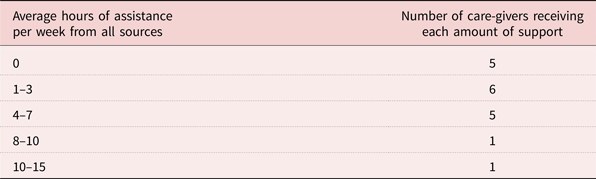
In absolute terms, care-givers reported surprisingly low levels of external support. Many noted there appeared to be a mismatch between available services and their care recipient's requirements. As reflected in Table 4, two-thirds of care-givers reported receiving an average of three or fewer hours of help in total from all sources per week, including government, family and the voluntary sector. This group included three care-givers of a care recipient with severe ADL impairment. Only one care-giver received more than ten hours of assistance in total from all sources combined per week.
As mentioned, provincial regulations provide for 120 hours of publicly funded home-making and personal support services free of charge in the first month of service and 90 hours per month thereafter. None of the six care-givers receiving these services was receiving the allotted maximum number of hours. The most any care-giver received was 11 hours per week, while five received three or fewer hours per week of assistance.
Numerous care-givers criticised the process of obtaining publicly funded assistance. They found the needs assessment process to be convoluted and opaque, and felt that eligibility criteria were inflexible:
To get anything done you have to call you know your case worker, the case worker has to come back to the house. Everything takes time to even just to like get some information on say respite care, get yourself on a list … and the [care co-ordinator] has to come to the house, they've got to assess you again. Then they … say [the contracted provider] will get in touch with you and then it takes another four weeks. (Participant 12: 46-year-old daughter of a 93-year-old man)
We were just told that … [the care recipient] didn't qualify for the help because they had to have three things she needed help with which was bathing, dressing and … it just wasn't enough to have somebody come in. (Participant 22: 65-year-old son of 90-year-old woman)
Many care-givers who were able to access publicly funded assistance encountered difficulty getting help with the right activities at the right time of day, and were frustrated by the perceived inflexibility about the scope of services provided by PSWs:
Now for bathing and all that I bathe him in the morning so when the PSWs come in he's already clean but I know technically they're supposed to be doing [that]. But because they're not here that early … we cannot wait until 12:00 for them to bathe him so I just take him and shower him in the morning. (Participant 1: 69-year-old wife of a 70-year-old man)
[O]bviously [the PSWs will] say they'll come at this time and then they don't show up at that time and various things like that. (Participant 19: relative (other) of 72-year-old woman)
[The PSW is supposed to come in for] one hour in the morning to assist with shaving. But he comes in for like ten minutes and he leaves. I'm going to be frank about it, the person's awful … [H]e keeps saying oh [the care recipient is] drowsy or just sits there and then he doesn't engage with him, he doesn't talk to him … he doesn't do anything [except] shave [the care recipient]. (Participant 12: 46-year-old daughter of a 93-year-old man)
Other care-givers were concerned about the lack of continuity of staff:
Usually it's the same guy that comes all the time which is good because [the care recipient is] familiar with him, you know. He's comfortable with him. When [the usual PSW is] not there then the new person comes and it doesn't work out so well. (Participant 6: 67-year-old wife of a 70-year-old man)
Many care-givers, including some that were heavily burdened, did not seek help. Values such as independence, loyalty, personal responsibility and courtesy to others played a role:
I just felt [that the care recipient's dementia is] something that we need to deal with ourselves here at home for the time being. When it gets unbearable then I guess I would … reach out more. (Participant 13: 76-year-old wife of an 86-year-old man with moderate IADL dependence)
[Our adult children] don't bathe [the care recipient], they don't feed him, nothing … And I don't ask that of them. He's my responsibility … So my son is here to keep an eye on him but not to … do anything for him. (Participant 14: 84-year-old wife of an 87-year-old man)
I've always been the type of person that doesn't like to disturb other people's life. Like I don't like to ask. There's only certain ones I will go to for that. (Participant 25: 69-year-old wife of 70-year-old man)
Other participants declined to seek help out of a sense of justice:
And the reason I haven't [begun to use outside services] [is that] I've been able to manage without it, and I think, I have the attitude that [the agency providing publicly funded support services] are strapped very thin and if somebody else can use the time they deserve to get it. I prefer that they get the time rather than me using it. (Participant 8: 83-year-old husband of a 79-year-old woman)
Well since [the care recipient is in a day programme] already twice a week and I get a PSW once a week I feel that it's not fair to other people if he will take up another spot in [another day] programme because there's a waiting list, you see, for this programme that he's in… (Participant 14: 84-year-old wife of an 87-year-old man)
While many care-givers were close with their extended family, and had adult children nearby, many did not feel that their families were active participants in the day-to-day care of their care recipient:
Obviously family are interested and concerned but … that's just family talk. There's nothing anybody can really do … [W]e just talk about it. (Participant 2: 75-year-old wife of a 75-year-old man)
Well we have [care recipient's] brother … next door and … I'm not sure if he really understands the situation … [W]e have a circle of friends where we meet regularly. But … it's not a situation where I can just call up and say, you know, ‘Could you help with this?’ (Participant 6: 67-year-old wife of a 70-year-old man)
Many care-givers were conscious of imposing on family members, acknowledging the constraints on their availability, notably the employment and child-care responsibilities of adult children:
[Our adult children are] willing to help but they're all busy, they're young and they're working hard. I'm kind of an independent sort. (Participant 13: 76-year-old wife of an 86-year-old man)
[Our daughter] is a single mom. She holds down three jobs and I am definitely not going to ask her to help out with her dad. I don't do that. (Participant 14: 84-year-old wife of an 87-year-old man)
Well [our adult children] come if it's absolutely necessary but they all work so, you know, they can't just drop everything. (Participant 15: 76-year-old wife of an 82-year-old man)
Despite the small degree of family member involvement reported, no care-giver voiced overt disappointment with the level, type and quality of assistance provided by family.
Given this complexity of accessing needed supports, several care-givers with background in fields such as health care, social care and public education felt they were at an advantage in navigating the system and advocating for themselves, and expressed empathy for those without this capability:
[I'm formerly a] medical [provider], I'm used to [the social care system]. But can you imagine someone who isn't medical to have to go through that process? … [It's] totally challenging. (Participant 11: 61-year-old wife of an 80-year-old man)
I read quite a bit and so I know, having a health background I tend to know where the services are and how to access them. (Participant 19: relative (other) of 72-year-old woman)
Discussion
Our qualitative study provides a number of insights to inform evaluative and interventional research and improve the support offered to care-givers of people diagnosed with dementia at outpatient CGA clinics, which represent one of the most prominent geriatrician-led models of specialised care of older people.
Our study reveals that care-givers of people with dementia attending our CGA clinic experience similar psychological and physical burden to those who receive care in other settings. Many exhibited role captivity, reflected in statements about feeling trapped or imprisoned by the interminable demands of the care-giving role. This confirms that impact on care-givers is an important clinical outcome in the outpatient clinic setting, and must be included in educational and interventional research.
As observed in other settings, many care-givers acknowledged positive attributes of the care-giving experience (Tarlow et al., Reference Tarlow, Wisniewski, Belle, Rubert, Ory and Gallagher-Thompson2004). These attributes included the satisfaction of accepting a responsibility. Of note, however, in contrast to care-givers in other studies, none of our participants expressed that care-giving conferred self-affirmation or an improved outlook on life generally. This suggests that, in the CGA clinic context, opportunities exist to reinforce positive attributes of care-giving.
Interventions that may be well-suited to supporting care-givers in the outpatient environment, even in the setting of a relatively brief clinic visit, include instruction in particular approaches such as using activities, adaptive equipment or the use of cueing to prevent and manage BPSD; instruction in cognitive reframing or other positive coping techniques; and self-care or relaxation training (Committee on Family Caregiving for Older Adults et al., Reference Schulz and Eden2016).
While varying remarkably in educational needs and learning strategies, significant areas of convergence existed. Consistent with previous qualitative studies, our participants expressed a high degree of interest in learning about expected symptoms, health conditions, and changes in behaviour and relationships (Kernisan et al., Reference Kernisan, Sudore and Knight2010; Dillon et al., Reference Dillon, Prorok and Seitz2013). Consequently, clinics with limited time and resources to dedicate to care-giver support may wish to focus on psycho-education (e.g. education about the condition, stress reduction and support, providing information about resources) and skills training targeting these issues.
Several care-givers relied on the internet to learn about dementia and care-giving. While the abundance of online resources was daunting for some, several care-givers viewed internet resources with a critical eye. This is reassuring in light of a recent review finding that the quality of information provided by Canadian dementia websites varied considerably (Dillon et al., Reference Dillon, Prorok and Seitz2013). Rather than developing their own educational materials, clinics may consider instead familiarising themselves with reliable sources to which care-givers can be directed. One example is the McMaster Optimal Aging Portal website, which includes resources curated by portal staff on the basis of use of evidence, development process and usability. The Portal also includes expert summaries of current research for patients, care-givers and health-care professionals (McMaster University, nd). Additionally, clinics could select a list of trusted websites appropriate to different levels of health literacy.
As a whole, care-givers received what the authors considered to be a surprisingly small amount of support from external sources, including not just publicly funded home-care, but also families (including adult children living nearby) and privately paid care-givers. Over 60 per cent of care-givers received three or fewer hours of assistance per week. This included a number of older people caring for spouses with what struck the authors as a high degree of functional dependence.
This deficit was particularly clear in the case of publicly funded home-care. Care-givers received far less than their statutory entitlement, with most getting three or fewer hours per week. That being said, an interesting aspect of our study was that care-givers appeared less frustrated by the total quantity of care provided than by the lack of transparency and seemingly arbitrary limits on the types of assistance provided, as well as logistical considerations such as timing and continuity of staffing.
This further supports existing research concluding that person-centred care can be enhanced not just by an absolute increase in hours of care, but by giving care professionals greater flexibility and autonomy in how they provide care (Patmore and McNulty, Reference Patmore and McNulty2005). Simple examples could include allowing a home-care worker who arrives to find that a care recipient has already been fed and bathed to spend their shift playing a game of cards with a care-giver, helping them schedule health-care visits or setting them up with online grocery shopping.
As other commentators have observed, such changes may require a deliberate institutional shift in focus away from risk avoidance and central control, and towards increased professionalisation and social esteem of home care. High-level attention to dysfunction in the social care labour markets in many countries is also important (Howes, Reference Howes2008).
Our care-givers described accessing dementia care support systems as unpredictable and time-consuming. Many care-givers felt ill equipped to navigate and advocate for themselves within the social care system. These findings resemble other studies, in which some care-givers used the metaphor of navigating a ‘maze’ (Peel and Harding, Reference Peel and Harding2014). Various explanations have been offered for this phenomenon. These include care-givers’ lack of awareness of sources of help with dementia, notably community support services (Denton et al., Reference Denton, Ploeg, Tindale, Hutchison, Brazil, Akhtar-Danesh, Quinlan, Lillie, Millen Plenderleith and Boos2008; Ploeg et al., Reference Ploeg, Denton, Tindale, Hutchison, Brazil, Akhtar-Danesh, Lillie and Plenderleith2009).
It is important to note that the home-care system in the study's jurisdiction is undergoing significant changes, due in part to concerns about accessibility and efficiency. Making performance and availability data, as well as particular policy details, easily accessible to the public (e.g. in a single online repository) would help to enhance care-giving policy analysis, research, quality improvement, clinical care and advocacy.
While publicly funded resources were limited and difficult for many to access, several care-givers were hesitant to ask for assistance from nearby grown children with significant work and family commitments. This hesitancy is reflected in a study of older people, living in the same community as our participants, who had fallen and visited the Emergency Department (Miller et al., Reference Miller, Sinding, Griffith, Shannon and Raina2016). However, in some cases, this reluctance extended to accessing publicly funded services as well. Some studies have shown that care-givers from different cultural backgrounds vary in their use of and requests for services, perhaps attributable to differing care-giving beliefs and practices (Asai and Kameoka, Reference Asai and Kameoka2005; Hsueh et al., Reference Hsueh, Hu and Clarke-Ekong2008; Herrera et al., Reference Herrera, George, Angel, Markides and Torres-Gil2013).
An interesting and unique set of findings is several care-givers’ altruistic concern for fairness in allocation of social care resources, and empathy for the needs of non-family others. It would be interesting to explore the motivation of such behaviour, which could include cultural or generational beliefs, or the widespread public acceptance of the egalitarian principles emphasised (though often unfulfilled) by Canada's distinctive single-payer health-care system.
Interestingly, several of our participants who were retired health or social care system professionals felt that their training helped them navigate the system, and expressed empathy for those lacking this advantage. The impact of health-care training on the care-giving experience remains little explored in the literature. In addition to understanding the unique experiences of this group, the specific skills and insights employed by those more at ease in the social care system may shed light on to the most important navigational competencies, and merit further study.
Limitations
Methodological limitations of our study included the use of a convenience sample. A purposeful sampling strategy might have led to a selection of participants with elements of similarity and difference that could have led to different and potentially richer insights.
We did not employ standardised, validated instruments, such as self-report questionnaires, to evaluate the level of assistance that care recipients required with ADLs and IADLs, or the amount of assistance care-givers provided with the same (Lawton and Brody, Reference Lawton and Brody1969; Katz et al., Reference Katz, Downs, Cash and Grotz1970). However, in general, our sample included care recipients with a range of abilities and needs, and was similar in size to those found in other similar qualitative studies (Prorok et al., Reference Prorok, Horgan and Seitz2013).
We did not gather clinical information about a number of known or potential confounders, including the severity of care recipients’ BPSD, or care-givers’ cultural background, income or level of education (Pinquart and Sörensen, Reference Pinquart and Sörensen2004). Finally, our sample included care-givers with a wide range of years of care-giving experience (between one and 9.5 years), whose needs may differ considerably.
Implications for practice and policy
Our study reinforces the need to improve publicly funded social care systems to better support care-givers. In particular, a streamlined and flexible needs assessment process, and more flexible and responsive timing of home-care services is indicated. In CGA clinics, greater health-care provider involvement in helping care-givers locate and navigate support resources would be valuable. This would require providers themselves to have better understanding of the social care system, which is not yet considered a core competency in most health professions.
Information resources should be tailored to the specific needs and interests of care-givers, and attention should be paid to critically appraising the quality of materials made available on the internet. Finally, and perhaps most fundamentally, it is critical for clinic personnel to ask about and monitor care-givers’ emotional and physical wellbeing, identify care-giver burden and ask care-givers if there are aspects of the experience that they consider to be positive attributes.
Conclusion
Our study of the educational and support needs of care-givers of people with dementia attending a CGA clinic reveals a resilient and creative population in immediate need of further support and resources. It suggested that many of their needs can appropriately be addressed in an outpatient setting through measures such as situational counselling, psycho-education and guidance about accessing reliable online information. Our findings underscore that care-givers’ experiences and narratives offer many possible solutions, and that a patient- and family-centred approach to research, policy and clinical practice is not just an ethical but also a pragmatic imperative.
Supplementary material
The supplementary material for this article can be found at https://doi.org/10.1017/S0144686X18000971.
Acknowledgements
An abstract presenting the preliminary findings of this study appears in the proceedings of the American Geriatrics Society Annual Scientific Meeting held in San Antonio, Texas, in May 2017 (Ringer et al., Reference Ringer, Wong Pack, Miller, Patterson, Marr, Misiaszek, Woo, Sztramko, Vastis and Papaioannou2017). The authors wish to acknowledge the assistance of the clinical and administrative staff of the Centre for Healthy Ageing at St. Peter's Hospital in Hamilton, Ontario with the recruitment of study participants. The authors also thank the study participants for so generously sharing their experiences.
Author contributions
The conception and design of study was by TJR, MW-P, PM, CP, BM, SM, TW and AP. TJR, MW-P, PM and PGV acquired the data. Analysis of data was conducted by TJR, MW-P, PM, CP, BM, RS, AP and PGV, with all the authors involved in the interpretation of the data. The manuscript was drafted by TJR, MW-P and PM with revision of the manuscript for important intellectual content and final approval of version to be published completed by all the authors.
Financial support
This work was supported by the following sources: Alzheimer Society of Brant, Haldimand Norfolk, Hamilton Halton, Ontario, Canada; GERAS Centre, St. Peter's Hospital/Hamilton Health Sciences, Hamilton, Ontario, Canada; Michael G. DeGroote School of Medicine MD Undergraduate Program, Hamilton, Ontario, Canada. No funding body played any role in the design, execution, analysis and interpretation of data, or writing of the study. All authors were affiliated with the GERAS Centre at the time of the study. The GERAS Centre's support of the study consisted of operational funding for the work of MW-P, PGV and PM in their capacity as paid researchers at the GERAS Centre.
Conflict of interest
The authors declare they have no competing interests. TJR discloses that he serves as Special Advisor to the National Institute on Ageing, Ryerson University, Toronto, Ontario, Canada; that he has received compensation for research activities for the National Institute on Ageing; and that he has provided management consulting services to public-sector and health-care clients in the 24 months preceding the initial submission of this article. He has never provided services to for-profit health-care organisations, providers, insurers, or pharmaceutical or medical device companies. None of his clients has an actual or potential pecuniary or other interest in this study, nor played any role in its design or execution.
Ethical standards
This study received approval from the Hamilton Integrated Research Ethics Board, Hamilton, Ontario, Canada (Project No. 1370).