Introduction
Hallucinations and delusions are cardinal diagnostic features of psychotic illness, but epidemiological studies of population cohorts indicate that psychotic symptoms are not pathognomonic for psychotic disorder. Rather, psychotic symptoms are distributed along a continuum in the population: lifetime prevalence of psychotic disorders in the general population (3%; Perala et al. Reference Perala, Suvisaari, Saarni, Kuoppasalmi, Isometsa, Pirkola, Partonen, Tuulio-Henriksson, Hintikka, Kieseppa, Harkanen, Koskinen and Lonnqvist2007) is exceeded by the median prevalence of subclinical psychotic-like experiences (PLEs: 5–8%; van Os et al. Reference van Os, Linscott, Myin-Germeys, Delespaul and Krabbendam2009), with marked variation across countries (0.8–31%; Nuevo et al. Reference Nuevo, Chatterji, Verdes, Naidoo, Arango and Ayuso-Mateos2010) and higher rates among youth (van Os et al. Reference van Os, Linscott, Myin-Germeys, Delespaul and Krabbendam2009). Nevertheless, subclinical psychotic symptoms or PLEs in the general population are associated with significantly poorer health status (Nuevo et al. Reference Nuevo, Chatterji, Verdes, Naidoo, Arango and Ayuso-Mateos2010) and lower quality of life (van Os et al. Reference van Os, Hanssen, Bijl and Ravelli2000). They also share genetic, sociodemographic, environmental and biological risk factors with schizophrenia (Kelleher & Cannon, Reference Kelleher and Cannon2011). Although psychotic symptoms present in many conditions during development that do not progress to psychotic disorder (Arango, Reference Arango2011), several prospective cohort studies indicate that juvenile presentation of psychotic symptoms increases risk for the development of psychotic disorders in adulthood. For example, children reporting psychotic symptoms at age 11 years during diagnostic interview by a clinician had a 16-times greater risk of a schizophreniform diagnosis at age 26 years (Poulton et al. Reference Poulton, Caspi, Moffitt, Cannon, Murray and Harrington2000), and adolescents self-reporting auditory hallucinations on questionnaire at age 14 years experienced a two- (females) to five-times (males) greater risk of non-affective psychoses at age 21 years (Welham et al. Reference Welham, Scott, Williams, Najman, Bor, O'Callaghan and McGrath2009). By contrast, another prospective cohort study indicated that adolescents' self-reports of auditory and visual hallucinations on questionnaire (assessed at age 11–18 years) predicted past-year diagnoses of depressive, anxiety and substance use disorders, but not psychotic disorders, 8 years later (assessed at age 19–26 years), although sample size and longitudinal sample attrition rendered the study underpowered to detect a relationship between hallucinations and later psychotic disorder (Dhossche et al. Reference Dhossche, Ferdinand, Van der Ende, Hofstra and Verhulst2002). Screening community samples of children for the presence of PLEs may thus offer a means of identifying individuals at risk for psychosis during the pre-prodromal period, prior to the marked deterioration of functioning that immediately precedes transition into illness, and improve prospects for preventive intervention (Keshavan et al. Reference Keshavan, Delisi and Seidman2011).
Methodological issues, particularly study cohort and design factors, contribute to variation in rates of psychotic symptoms reported in the general population (Linscott & van Os, Reference Linscott and van Os2010). Assessment of self-reported experiences by questionnaire or lay interview may elicit greater false positives than clinical interview (van Os et al. Reference van Os, Linscott, Myin-Germeys, Delespaul and Krabbendam2009). However, a previous study indicated that apparently ‘false-positive’ cases (i.e. those self-reporting definite or probable PLEs subsequently rated as clinically not relevant by clinicians) nevertheless experienced a 25-fold increased risk of psychotic disorder after 3 years (Bak et al. Reference Bak, Delespaul, Hanssen, de Graaf, Vollebergh and van Os2003). Arguably, a greater rate of false positives than false negatives is the preferred outcome of general population screening to identify cases that require detailed clinical assessment and/or closer monitoring over time. A recent study of a small community sample of youth without psychotic disorder (aged 11–13 years) indicated variable criterion validity among seven self-report PLE questionnaire items in terms of their specificity, sensitivity and positive (PPP) and negative predictive power (NPP) for definite psychotic symptoms as verified by diagnostic interview (Kelleher et al. Reference Kelleher, Harley, Murtagh and Cannon2011). The best-performing screening item, which assessed auditory hallucination-like experiences (‘Have you ever heard voices or sounds that no-one else could hear?’; endorsed by ~16%), had high PPP and NPP for any clinically verified psychotic symptom at interview (100% and 88% respectively). Items that assessed visual hallucinations (‘Have you ever seen things other people could not see?’; 82% PPP and 80% NPP) and paranoid thoughts (‘Have you ever thought that people are following or spying on you?’; 80% PPP and 79% NPP) also performed well. Poorest performance was observed for ‘Have you ever had messages sent just to you through TV or radio?’ (40% PPP and 71% NPP).
In the general adult population, correlated but separable dimensions (latent constructs) underlie PLEs, depression and mania (Krabbendam et al. Reference Krabbendam, Myin-Germeys, De Graaf, Vollebergh, Nolen, Iedema and Van Os2004); and a psychotic-like dimension is distinct from the well-established internalizing and externalizing psychopathology dimensions (Markon, Reference Markon2010). During adolescence, PLEs and depression are co-occurring phenomena that do not predict one another over time (Wigman et al. Reference Wigman, Lin, Vollebergh, van Os, Raaijmakers, Nelson, Baksheev and Yung2011). The aim of the present paper was to examine the latent construct(s) underlying PLEs in the general child population, and to determine the extent to which a psychotic-like construct (PSY) was differentiable from childhood internalizing and externalizing symptom dimensions. The study further used item response theory (IRT) to determine the psychometric properties of each of nine self-report items used previously to screen community samples of children aged 9–11 years for PLEs (Laurens et al. Reference Laurens, Hodgins, Maughan, Murray, Rutter and Taylor2007, Reference Laurens, Hodgins, Taylor, Murray, David, McGuffin and Kapur2011). Unlike classical methods, IRT accounts explicitly for individual variation in latent construct severity, and in the way each questionnaire item measures the latent (or unobservable) construct. Each PLE item was evaluated for how it assessed (or represented) the latent construct in the general child population, and indices of the overall functioning of the PLE questionnaire were also determined.
Method
Participants
Children aged 9–11 years were recruited from 73 primary schools located in the Greater London area (predominantly inner-city). Collaborating schools were sampled to span the range of socio-economic disadvantage represented in London schools (as indexed by the percentage of enrolled children eligible to receive free school meals), and to encompass both state and religious schools of varying enrolment size. A total of 7966 children (49% female) completed questionnaires, constituting 95% of eligible children (4% of parents, and 1% of children, refused the child's participation; no information was available concerning reason for refusal). The mean age of the child sample was 10 years 5 months (s.d.=9 months), with 96% of the sample aged between 9.00 and 11.99 years. School-level data, rather than individual-specific data, were used to index socio-economic status and ethnic diversity in the sample. On average, 31% of children (range 2–62%) in participating schools were eligible to receive free school meals (cf. Greater London average of 25% and England average of 16%; Office for National Statistics). As is characteristic of inner-city London, school enrolment was ethnically diverse: on average, 25% of children were of white British ethnicity (cf. Greater London average of 37%; England average 80%), with the remainder of black (45%), Asian (11%), other white (9%) or other (10%) ethnicities.
Measures
PLEs
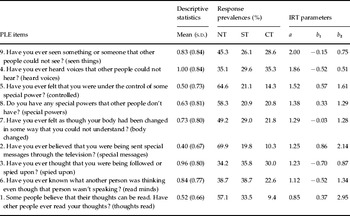
PLE items included five questions adapted from the Diagnostic Interview Schedule for Children (Costello et al. Reference Costello, Edelbrock, Kalas, Kessler and Klaric1982), and an additional four items to assess a broader range of PLEs (Laurens et al. Reference Laurens, Hodgins, Maughan, Murray, Rutter and Taylor2007, Reference Laurens, West, Murray and Hodgins2008, Reference Laurens, Hodgins, Taylor, Murray, David, McGuffin and Kapur2011). These items are reproduced in full in Table 1. Each PLE item was rated on a three-choice response scale: ‘0=not true’, ‘1=somewhat true’ or ‘2=certainly true’.
Descriptive statistics, prevalence (detailed by response option), and item response theory (IRT) parameter estimates for the nine psychotic-like experience (PLE) items. Items are rank ordered from the most discriminating item to the least (parameter a); item administration order within the questionnaire is indicated by the item number assigned to each item

s.d., Standard deviation; NT, not true; ST, somewhat true; CT, certainly true; a, discrimination parameter; b 1 and b 2, difficulty parameters.
Internalizing and externalizing psychopathology
The Strengths and Difficulties Questionnaire (SDQ; Goodman, Reference Goodman1997) is a widely used screening instrument assessing problem behaviours and personal competencies during childhood, with established reliability and validity (Goodman, Reference Goodman2001). The SDQ comprises 25 items assessing four domains of childhood psychopathology [Emotional Symptoms (ES), Conduct Problems (CP), Hyperactivity-Inattention (H-I), and Peer Relationship Problems (PRP)] in addition to personal strengths [Prosocial Behaviour (PB)]. The five subscales each comprise five items, with each item rated on a three-choice response scale: ‘0=not true’, ‘1=somewhat true’ or ‘2=certainly true’. Adequate psychometric properties for the self-report SDQ have been established down to age 8 years (Muris et al. Reference Muris, Meesters, Eijkelenboom and Vincken2004). Typically, a five-factor model of the SDQ corresponding to the five subscales is derived (Stone et al. Reference Stone, Otten, Engels, Vermulst and Janssens2010), although an alternative three-factor model comprising internalizing (encompassing the ES and PRP items), externalizing (encompassing the CP and H-I items) and PB may be more appropriate in epidemiological (non-clinical) samples (Goodman et al. Reference Goodman, Lamping and Ploubidis2010).
Children further indicated their sex, and their dates of birth and questionnaire completion (to derive the child's exact age at assessment).
Procedure
The Joint South London and Maudsley and the Institute of Psychiatry National Health Service (NHS) Research Ethics Committee granted ethical permission for the study. Questionnaires were completed independently and anonymously by children in the classroom, with items read aloud to children by a researcher. All enrolled children present in class on the day of questionnaire administration were eligible to participate, excepting children judged by their class teacher to be insufficiently proficient in English to complete questionnaires (~0.3% of enrolled children). Information concerning the research was issued to all parents and teachers at least 2 weeks prior to the research session, allowing sufficient time for children or parents to withdraw consent for participation in the research.
Statistical analysis
A three-tiered method was used to evaluate the psychometric properties of the PLE items within an IRT framework. First, the latent structure underlying the PLE and the SDQ items was assessed. This determined whether unidimensional (rather than multidimensional) IRT methods were appropriate for evaluating the PLE items. Furthermore, simultaneous assessment of the structure of the PLE and the SDQ items provided an index of the discriminant validity of the PLE questionnaire. Second, the IRT properties of each of the PLE items were evaluated to show how each item assessed a latent PSY. Third, the test characteristics of the PLE questionnaire were calculated to provide overall indices of how the questionnaire assessed the latent construct.
Examining the latent structure underlying the PLE and SDQ items
Using a robust weighted least squares estimator in the Mplus version 6.0 statistical software package (Muthén & Muthén, 1998–Reference Muthén and Muthén2010), exploratory and confirmatory factor analyses (EFA, CFA) were conducted to evaluate the latent structure underlying the PLE and SDQ items. Initially, a quartimin rotator was used to extract one to six factors to explain the co-occurrence of the questionnaire items (Jennrich & Sampson, Reference Jennrich and Sampson1966). The Tucker–Lewis index (TLI; Tucker & Lewis, Reference Tucker and Lewis1973) and the comparative fit index (CFI; Bentler, Reference Bentler1990) were used to assess the relative fit of the factor models in comparison to a baseline model, and the root mean square error of approximation (RMSEA; Steiger, Reference Steiger1990) was used to assess the discrepancy between the estimated and observed polychoric correlations of the items. Based on the findings of the EFA and the existing psychometric literature concerning the SDQ, a series of CFAs were specified. Detail regarding the various EFA and CFA models examined is provided in the Results section and in the online supplementary material.
Determining the IRT parameters of the PLE items
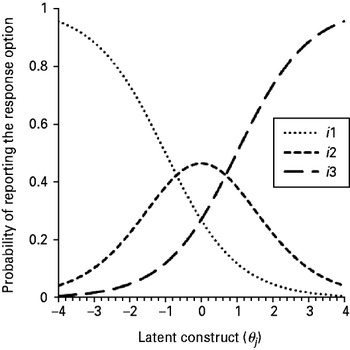
The Samejima (Reference Samejima1969) IRT graded response model was used to evaluate how each of the PLE items assessed the latent construct underlying these items (PSY). An example of how the Samejima IRT model describes the statistical relationship between the child, PSY and a PLE item is illustrated in Fig. 1. Specific detail of the likelihood that endorsement of a PLE item will be associated with particular levels of construct severity can be gleaned from the relationship plotted in the figure. IRT uses two main indices to describe this statistical relationship. The discrimination (or ‘a’) parameter describes the ability of each of the PLE items to distinguish between similar degrees of PLE severity. Two difficulty (or ‘b’) parameters are derived for the three-response PLE items: b 1 indexes the point along the latent construct at which individuals with latent severity equal to or greater than this point of severity have a 50% or greater likelihood of selecting the first response option (‘not true’); b 2 indexes the point on the latent construct at which the probability of endorsing the third (‘certainly true’) response option is 50%. Multilog version 7.03 (Thissen et al. Reference Thissen, Chen and Bock2003) was used to calculate the discrimination and difficulty parameters of each of the PLE items.
Category response functions of a hypothetical psychotic-like experience (PLE) item i that was measured using three response categories (i1, i2, i3). This item had a discrimination parameter (a) of 1 and difficulty parameters (b 1 and b 2) of −1 and 1. The vertical axis of this figure indexes the likelihood (ranging from 0 to 1) that a child will report that they have experienced the respective response option (i.e. ‘not true’, ‘somewhat true’ and ‘certainly true’). The horizontal axis indexes the distribution of the latent construct, PSY severity, measured by the PLE items. This latent psychological construct is typically referred to as theta (θ j ), and is measured on a standard normal metric. Each of the three trace lines represents one of the three response options that were used to assess the PLE items. The trace line labelled i1, which represents the first response option for PLE item i (‘not true’), has a greater likelihood of being endorsed by children with lower degrees of PSY severity, and this likelihood decreases with increasing PSY severity. In other words, if a child has a low degree of PSY severity, it is more likely that they will report that they have not experienced the respective PLE item by answering ‘not true’ on the PLE item. As would be expected, the trace line i2, which represents the second response option for PLE item i (‘somewhat true’), peaks in the mid-range of PSY severity, and the trace line i3, which represents the third response option for PLE item i (‘certainly true’), peaks in the high range of PSY severity. Thus, if a child experienced an average or a high degree of PSY severity, it would be expected that they would endorse the second and third response categories of the PLE item respectively.

Item information functions (IIFs) were derived to index the precision of each PLE item in capturing PSY severity, with peaked item information curves providing greater precision of measurement of the underlying latent construct than items with flatter curves. The IIFs were estimated using marginal maximum likelihood methods (Thissen et al. Reference Thissen, Chen and Bock2003).
Evaluating the test information function (TIF) for the PLE questionnaire
The TIF plots the precision of measurement associated with PSY severity. Larger values on the function indicate levels on the latent construct where more precise measurement or more information is gathered by the nine-item scale, whereas smaller values indicate points on the latent construct where the scale provides little information or precision of measurement. As a result, TIFs are generally humped (peaked) curves. The TIF was estimated using marginal maximum likelihood methods (Thissen et al. Reference Thissen, Chen and Bock2003).
Results
Prevalence of the PLE item responses
The prevalence of each of the PLE item response categories is provided in Table 1. The prevalence of a ‘certainly true’ response on each PLE item ranged from 9% to 35%. Overall, 66% of children reported at least one ‘certainly true’ response across the nine PLE items included in the questionnaire.
IRT analysis of the psychometric properties of the PLE items
Latent structure underlying the PLE and SDQ items
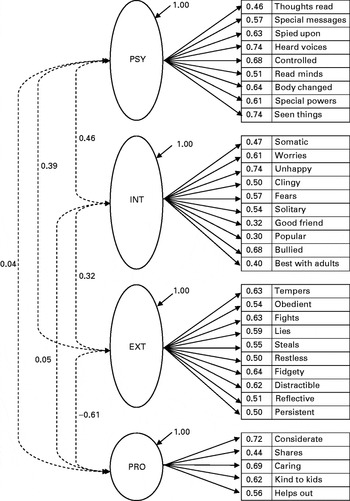
The model fit indices of the EFAs and CFAs on the PLE and SDQ items are provided as online supplementary material (Table A1). The EFAs revealed that four or five latent constructs explain the co-occurrence of the PLE and SDQ items (eigenvalues: 6.49, 4.10, 2.57, 1.65, 1.19 and 1.07 respectively). On the basis of the EFA, and guided by the extant psychometric literature on the SDQ (Goodman et al. Reference Goodman, Lamping and Ploubidis2010; Stone et al. Reference Stone, Otten, Engels, Vermulst and Janssens2010), four CFAs were specified. Although unlikely to provide an ideal fit for the data, model 1 used a single factor to explain the co-occurrence of the PLE and SDQ items. This most parsimonious model, which assumed a single undifferentiated psychopathology construct in the population, was used as the baseline standard model. Model 2 explained the co-occurrence of the questionnaire items with reference to six first-order factors, and provided a better fit of the data than model 1. This included one factor that explained the co-occurrence of the PLE items (PSY), and the remaining factors reflected the established SDQ subscales (ES, PRP, CP, H-I, PB). However, the ES and PRP subscales, and the CP and H-I subscales, exhibited high correlations (0.74 and 0.78 respectively). This implied that two broader dimensions of psychopathology underlay these SDQ subscales. Accordingly, two subsequent confirmatory models were specified: model 3 explained the co-variation of the ES and PRP subscales, and the CP and H-I subscales, using two correlated hierarchical constructs that were conceptualized as internalizing and externalizing psychopathology respectively (Krueger, Reference Krueger1999; Goodman et al. Reference Goodman, Lamping and Ploubidis2010; Kessler et al. Reference Kessler, Ormel, Petukhova, McLaughlin, Green, Russo, Stein, Zaslavsky, Aguilar-Gaxiola, Alonso, Andrade, Benjet, de Girolamo, de Graaf, Demyttenaere, Fayyad, Haro, Hu, Karam, Lee, Lepine, Matchsinger, Mihaescu-Pintia, Posada-Villa, Sagar and Ustun2011; Lahey et al. Reference Lahey, Van Hulle, Singh, Waldman and Rathouz2011). Both constructs covaried with the PSY and PB dimensions. Finally, model 4 used two first-order factors, again conceptualized as internalizing and externalizing psychopathology, to explain the co-occurrence of their respective SDQ items. Again, these constructs covaried with the PSY and PB dimensions. Models 2, 3 and 4 each provided similar and acceptable fits of the data, according to the definitions of Hu & Bentler (Reference Hu and Bentler1998). Based on the parsimony of the model, and given the magnitude of the relationship between the hierarchical and first-order latent constructs in model 3 (loadings ranged between 0.77 and 0.96), model 4 (CFI=0.86, TLI=0.92, RMSEA=0.05) was accepted as the best explanation of the covariation of the PLE and SDQ items in this London community child sample.
The standardized factor loadings in model 4 for each PLE and SDQ item are detailed in Fig. 2. All were significant at the p<0.05 level. Of particular interest to the current investigation, factor loadings on PSY ranged from 0.46 to 0.74, indicating that all items loaded on the one factor within the moderate to strong range. Items with the strongest loadings were ‘seen things’ and ‘heard voices’ (each 0.74). The items with weakest loadings on the factor were ‘read minds’ and ‘thoughts read’ (0.57 and 0.46 respectively).
Four-factor model derived from confirmatory factor analysis (CFA) of the psychotic-like experiences (PLEs) and Strengths and Difficulties Questionnaire (SDQ) items, indicating standardized factor loadings for each item and inter-construct correlations. PSY, Psychotic-like construct; INT, internalizing construct; EXT, externalizing construct; PRO, prosocial construct.

Item response characteristics
The IRT parameters for each of the nine PLE items, ranked by the most discriminating (i.e. largest a values) to the least discriminating, are presented in Table 1. In support of the CFA, the most discriminating items along the latent construct are ‘seen things’ and ‘heard voices’, with a parameter values of 2.00 and 1.86 respectively. Thus, these are the two items best able to discriminate children with higher levels of PSY severity from children with lower levels of PSY severity. The least discriminating items were ‘read minds’ and ‘thoughts read’, with a parameter values of 1.12 and 0.85 respectively. This indicates that these items do not discriminate as effectively between children at high and low levels of PSY severity relative to the other items.
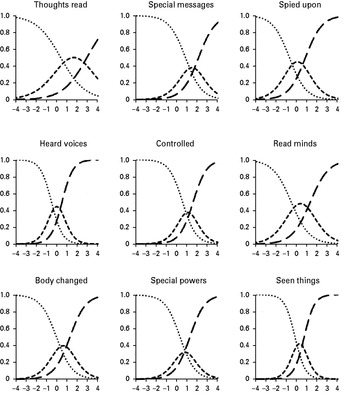
The category response functions of the PLE items are presented in Fig. 3, providing a graphical representation of the a, b 1 and b 2 IRT parameters presented in Table 1. The most discriminating items, ‘seen things’ and ‘heard voices’, are those with the steepest curves. Furthermore, it can be seen that these two items discriminate along the full range of the underlying latent construct. That is, the likelihood of endorsing the ‘not true’ response option peaks at lower levels of the construct; as PSY severity level moves towards the mean, the likelihood of endorsing the ‘somewhat true’ response option peaks; and finally, as the severe range is approached, the likelihood of endorsing the ‘certainly true’ response option peaks. These curves confirm that these two items are particularly good indicators of PSY severity in children aged between 9 and 11 years.
Matrix plot of the category response functions for each of the nine psychotic-like experience (PLE) items, presented according to their order of administration on the questionnaire. The estimated latent construct (θ j ) is plotted along the horizontal axis, and the probability of endorsing each response option (ranging from 0 to 1) is indicated along the vertical axis. The ‘not true’ response option is shown by the dotted line, the ‘somewhat true’ response option by the short-dashed line, ‘certainly true’ response option by the long-dashed line.

The majority of the remaining items tend to discriminate between children showing higher levels of PSY severity, particularly ‘thoughts read’, ‘special messages’, ‘controlled’ and ‘special powers’. This is indicated by the response option trace lines crossing consistently at the upper level of the latent construct (i.e. indicating the point at which an option becomes more likely than another; as indexed by the positive b 1 and b 2 IRT parameters). For the item ‘special powers’, the likelihood of endorsing the ‘somewhat true’ option offers no discriminating ability relative to ‘not true’ and ‘certainly true’ response options because the likelihood of endorsing ‘somewhat true’ never exceeds the likelihood of endorsing the other response options along the full range of the construct.
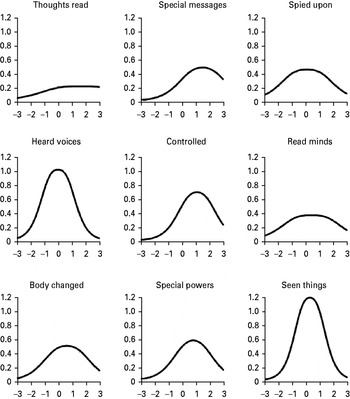
Fig. 4 presents the IIFs for each of the nine PLE items. These curves indicate the amount of information provided about the latent construct by each item (indicated on the vertical axis). The items ‘seen things’ and ‘heard voices’ provide the most information about the latent construct, and this information is greatest around the mean levels of the construct (i.e. their peaks occur within the mean range). The other items provide a moderate amount of information about the construct, at slightly higher than mean levels on PSY severity (i.e. their peaks are distributed above mean levels). The items ‘thoughts read’ and ‘read minds’ provide the least information about the construct, as indicated by their relatively low, flat curves.
Matrix plot of the item information functions (IIFs) for the nine psychotic-like experience (PLE) items in children aged 9 to 11 years. For each function, the horizontal axis indicates the distribution of the latent construct (θ j ) in scale scores (ranging from −3 to 3), and the vertical axis indicates the item information available at a specific scale score. The items are presented in order of administration on the questionnaire.

Test information characteristics
Fig. S1 in the online supplementary material indicates that the PLE questionnaire provided the most information (and the highest precision of measurement) around 0.5 s.d. above the mean on the latent PSY. Thus, the scale provides more information for slightly more severe cases than for less severe cases. However, the wide TIF indicates that the PLE items have relatively good measurement precision between −2 and 2 s.d. from the mean of the latent construct, thus providing information about the majority of the population.
Discussion
This study explored the latent structure underlying items assessing PLEs, internalizing and externalizing psychopathology, and personal competencies in a general child population aged 9–11 years. The nine self-report PLE items constitute a simple checklist to elicit information from the general paediatric population concerning a range of hallucination- and delusion-like experiences that correspond to symptoms reported by individuals with psychotic illnesses, particularly schizophrenia. CFAs indicated a best-fitting four-factor model encompassing PSY, internalizing, externalizing and prosocial dimensions. Thus, PLEs and internalizing and externalizing difficulties in children cannot be understood as reflecting a single undifferentiated psychopathology, but instead represent separable but correlated dimensions that might share some aetiological influences (Lahey et al. Reference Lahey, Van Hulle, Singh, Waldman and Rathouz2011). The PLE items each loaded on the single PSY, and together were able to provide information about the majority of the population, with measurement precision achieved between −2 and 2 s.d. from the mean of the latent construct.
This study further examined the psychometric properties of each PLE item. The IRT model indicates how the probability of endorsing a particular item varies as a function of underlying latent construct severity. Among the nine PLE items, the questions assessing visual and auditory hallucination-like experiences were the most capable of assessing the latent construct. These two questionnaire items previously also showed strongest criterion validity for psychotic symptoms elicited by diagnostic interview among 11–13-year-olds (Kelleher et al. Reference Kelleher, Harley, Murtagh and Cannon2011). These two most discriminating items provided most information around mean (mid) levels of PSY severity, whereas the remaining items provided most information at slightly above mean levels, thus tapping a more severe expression of PSY. These variable item parameters imply that PLE items may be used in different capacities in research and clinical settings. For example, items tapping mid-levels of a latent psychological construct may be most appropriate for community screening, where the interest lies in determining population variation in mental health vulnerability. That is, the items ‘seen things’ and ‘heard voices’ offer the best means of identifying a child with illness vulnerability with expediency. Thus, they might be used as initial screening questions within the general population to best discriminate children with and without PLEs. The other scale items, which discriminated better at the higher levels of the construct (i.e. detected children with higher levels of PSY severity), could be used to distinguish the upper severity levels of the construct among children who screen positive on the ‘seen things’ and ‘heard voices’ items. The item with the poorest item parameters was ‘thoughts read’. In its current form, this item would be the first candidate to remove if seeking to shorten the scale because of the relatively little information it provides regarding the latent PSY severity and its relatively poor discriminating ability. However, this item might be retained if the purpose of the tool is to serve as a clinical checklist identifying a range of experiences. Revision of the item wording might improve its IRT parameters. The remaining items all provided useful and discriminating characteristics in this population of children aged between 9 and 11 years.
An advantage of IRT over classical test theory is that the psychometric properties of the questionnaire and the individual items are relatively sample independent (Embretson & Reise, Reference Embretson and Reise2000; Streiner, Reference Streiner2010). Thus, the PLE items may be expected to perform similarly among other paediatric samples of similar age. However, the nine PLE items constituted a brief checklist to assess a range of hallucination- and delusion-like experiences only. Longer and more comprehensive assessment instruments have been used with general population samples of adolescents and adults to assess a broader range of positive, and also negative, PLEs (e.g. the Community Assessment of Psychic Experiences; Stefanis et al. Reference Stefanis, Hanssen, Smirnis, Avramopoulos, Evdokimidis, Stefanis, Verdoux and van Os2002). Factor analysis of such instruments reveals multiple (correlated) latent dimensions underlying both positive and negative PLEs that relate differentially to depressive symptoms (Armando et al. Reference Armando, Nelson, Yung, Ross, Birchwood, Girardi and Fiori Nastro2010; Barragan et al. Reference Barragan, Laurens, Navarro and Obiols2011). Such instruments are not readily utilized with children. The unidimensional PSY underlying PLEs in the present study may reflect the relatively brief checklist of items assessed and/or a relatively undifferentiated latent PSY prior to adolescence.
An important strength of the current study was the sampling of 95% of the total eligible population of children aged 9–11 years, thereby assessing the full spectrum of experience distributed within the general population. Within the sample, 78% of children lived in inner-city London communities categorized among the most deprived 11% of all English local authorities according to the The English Indices of Deprivation 2007 (Noble et al. Reference Noble, McLennan, Wilkinson, Whitworth, Barnes and Dibben2008), and among the lowest scoring 5% of English local authorities on the Local Index of Child Well-Being (Bradshaw et al. Reference Bradshaw, Bloor, Huby, Rhodes, Sinclair and Gibbs2009). These communities are characterized by an increased incidence of schizophrenia (Kirkbride et al. Reference Kirkbride, Fearon, Morgan, Dazzan, Morgan, Murray and Jones2007) and a high prevalence of self-reported PLEs among the general adult population (e.g. >20%; Morgan et al. Reference Morgan, Fisher, Hutchinson, Kirkbride, Craig, Morgan, Dazzan, Boydell, Doody, Jones, Murray, Leff and Fearon2009). Thus, elevated rates of positive endorsement of PLE items were anticipated in this sample of 9–11-year-olds (Laurens et al. Reference Laurens, West, Murray and Hodgins2008, Reference Laurens, Hodgins, Taylor, Murray, David, McGuffin and Kapur2011). The most common experience (‘heard voices’) was reported as ‘certainly true’ by approximately a third of children, whereas almost two-thirds of children reported a ‘certainly true’ response to at least one of the nine PLE items included in the scale. High rates of self-reported PLEs in childhood may also imply that subthreshold experiences of this nature are not intrinsically pathological in childhood, but rather, that such experiences may constitute part of the spectrum of normative development. Investigation of the factors contributing to persistence versus discontinuity of these experiences from childhood is needed, as has recently been examined in adolescent populations (De Loore et al. Reference De Loore, Gunther, Drukker, Feron, Sabbe, Deboutte, van Os and Myin-Germeys2011; Mackie et al. Reference Mackie, Castellanos-Ryan and Conrod2011). Furthermore, the utility of the present study is inherently limited in providing no indication of whether the latent construct assessed using the PLE items is sensitive or specific in predicting later transition to psychotic, relative to other psychiatric, illnesses in later adolescence or adulthood. This will require longitudinal tracking of the children.
Whether elevated PLE prevalence in childhood is part of normative development, or predicts later psychotic disorder, is pertinent to current debate concerning the existence of a psychosis continuum in the general population. Several recent works have emphasized the need to distinguish the apparent phenotypic continuum of psychotic-like experiences in the general population from a discontinuous population structure comprising individuals with and without psychotic disorders (David, Reference David2010; Lawrie et al. Reference Lawrie, Hall, McIntosh, Owens and Johnstone2010; Linscott & van Os, Reference Linscott and van Os2010). Kaymaz & van Os (Reference Kaymaz and van Os2010) propose that, despite the phenotypic continuum of subthreshold psychotic experiences, a latent categorical structure may distinguish two groups in the population: that is, one categorical group comprising individuals who present psychotic experiences in the context of cognitive and motivational impairments (associated with high probability of need for care), and the other group presenting psychotic experiences of potentially different origin (associated with lower likelihood of need for care). Thus, PLEs might confer risk of later psychotic illness only in the context of additional psychosis risk markers and/or the absence of protective factors. The high prevalence of PLE endorsement among this sample of 9–11-year-old children inevitability limits the specificity of these items in predicting later psychotic disorder, and implies that, alone, self-reported PLEs at this age may have limited utility as risk markers for psychosis. We have proposed previously that PLEs, presented in conjunction with other putative antecedents of schizophrenia (e.g. social, emotional or behavioural problems, and delays/abnormalities in motor and language development), might confer greater specificity and sensitivity for predicting later schizophrenia (Laurens et al. Reference Laurens, Hodgins, Maughan, Murray, Rutter and Taylor2007, Reference Laurens, West, Murray and Hodgins2008, Reference Laurens, Hodgins, Taylor, Murray, David, McGuffin and Kapur2011). Recent data indicate that children presenting a combination of PLEs and other putative antecedents of schizophrenia display abnormalities of brain structure and function that are similar to those observed in patients with schizophrenia (Cullen et al. Reference Cullen, Dickson, West, Morris, Mould, Hodgins, Murray and Laurens2010; Laurens et al. Reference Laurens, Hodgins, Mould, West, Schoenberg, Murray and Taylor2010; MacManus et al. Reference MacManus, Laurens, Walker, Brasfield, Riaz and Hodgins2011).
The present study identifies child self-report questionnaire items assessing clinically subthreshold PLEs that might be used in longitudinal epidemiological research to differentiate developmental trajectories to psychotic and other psychiatric illnesses. The nine PLE items may be used in prospective cohort studies beginning in childhood to ascertain the stability of PLEs as children transition into adolescence, and to characterize the potentially normative developmental aspect of PLEs. Among the nine items, those assessing visual and auditory hallucination-like experiences are of greatest use for population screening to identify children who may merit more detailed clinical assessment (including ascertainment of the presence of other risk markers for schizophrenia) and/or longitudinal monitoring for the persistence of these PLEs into adolescence and young adulthood.
Note
Supplementary material accompanies this paper on the Journal's website (http://journals.cambridge.org/psm).
Acknowledgements
We thank the children and caregivers who participated in this study, and the researchers and students who contributed to data collection. The research was supported by funding awarded to K.R.L. from a National Institute for Health Research Career Development Fellowship (CDF/08/01/015), a Bial Foundation Research Grant (36/06), a National Alliance for Research on Schizophrenia and Depression (NARSAD) Young Investigator Award (2005), and the British Medical Association Margaret Temple Award for schizophrenia research (2006). M.J.G. is supported by the Australian Research Council (FT0991551). K.R.L. is affiliated with the National Institute for Health Research Specialist Biomedical Research Centre (BRC) for Mental Health at the South London and Maudsley NHS Foundation Trust and the Institute of Psychiatry, King's College London, UK.
Declaration of Interest
None.