INTRODUCTION
The botanical composition, the ensilability and the nutritive value of herbage are strongly dependent on the grassland management system. Grass swards heavily fertilized with nitrogen (N) or intensively managed grass–clover mixtures usually show high crude protein (CP) contents and buffering capacity (BC) coinciding with relatively low sugar contents, these factors being known to reduce ensilability (McDonald et al. Reference McDonald, Henderson and Heron1991; O'Kiely & Muck Reference O'Kiely, Muck, Cherney and Cherney1998) and to cause an inefficient microbial nitrogen (MN) utilization in the rumen (Nolan & Dobos Reference Nolan, Dobos, Dijkstra, Forbes and France2005). In comparison, herbage from long-term permanent grassland, in particular under a low-input management, often contains a high proportion of non-leguminous forbs. There is some indication that the silage fermentation and silage quality of non-leguminous grassland forbs are different compared with grasses, and that this is obviously related to their different chemical compositions including secondary plant products (Isselstein & Daniel Reference Isselstein and Daniel1996; Weissbach Reference Weissbach1998).
Information on the feeding value and the ruminal efficiency of utilization of grassland forbs is generally scarce. However, the few available studies showed considerable forage potential of some species (Meister & Lehmann Reference Meister and Lehmann1988; Derrick et al. Reference Derrick, Moseley and Wilman1993; Wilman & Riley Reference Wilman and Riley1993). In Europe, low-input grassland management is gaining increasing importance in farming practice and grassland forbs are increasingly contributing to the swards; therefore there is the need to investigate the characteristics of swards containing a high proportion of forbs and their utilization by ruminants. Due to their lower protein content when grown under low-input conditions, it is hypothesized that such forbs would significantly affect silage quality and ruminal microbial metabolism. An experiment was set up where the two of the most widely spread forbs in temperate grasslands, dandelion (Taraxacum officinale Web.) and ribwort (Plantago lanceolata L.), were used in mixed swards with perennial ryegrass and white clover in order to test their effect on the nutrient content and the substrate quality of silage for rumen microbes. The results were compared with pure grass swards or grass–clover mixtures. Therefore, grass monocultures, grass and white clover mixtures and grass, white clover and forbs mixtures were established in the field. The herbage from the swards was ensiled in laboratory silos and the silage quality analysed. Ruminal fermentation pattern and microbial protein (MP) synthesis were measured employing the artificial rumen system RUSITEC.
MATERIALS AND METHODS
The silages were made from herbage grown in a field experiment on the experimental farm Reinshof of the University of Göttingen, Germany (51°32′N, 9°56′E, altitude 156 m asl). Herbage was classified according to their different species compositions: GN signified ryegrass (Lolium perenne) receiving 50 kg of mineral fertilizer N/ha/cut; GC signified non-fertilized mixture of perennial ryegrass and white clover (Trifolium repens) and GCF signified a non-fertilized mixture of ryegrass with white clover, dandelion (T. officinale) and ribwort (P. lanceolata). Nitrogen fertilizer on GN plots was applied 2 months prior to the harvest. The field experiment was a randomized block design with four replications. The swards were cut four times per year. For this investigation, herbage samples were taken 4 years after the establishment of the swards. The swards were harvested as first-cut herbage in May (spring) and as fourth-cut herbage in September (summer). The spring cut was taken 6 weeks after the resumption of the vegetative growth, while the summer cut was taken 2 months after the previous cut. The botanical composition of the herbage was determined using a subsample of c. 500 g fresh herbage separated manually into its different components, i.e. ryegrass, white clover, dandelion, ribwort and others. For silage preparation, the harvested swards were chopped to 10 mm lengths and wilted indoors until a dry matter (DM) content of more than 200 g/kg DM was achieved; however, wilting lasted no longer than 12 h. The herbage was then transferred into 2-litre laboratory silos, which were kept in an airconditioned chamber at a constant temperature of 20°C in darkness for up to 60 days. Prior to ensiling, the fermentation properties of a dried (60°C) and ground subsample of the fresh herbage were assessed by measuring the BC according to Weissbach (Reference Weissbach1967) and the water-soluble carbohydrate content (WSC) using anthrone (Naumann & Bassler Reference Naumann and Bassler1997).
Silage DM was determined by drying at 103°C for 48 h. CP was analysed in the fresh samples. For crude ash (CA), ether extract (CL), neutral detergent fibre (NDF) and acid detergent fibre (ADF), the samples were oven-dried at 60°C and ground to pass through a 0·5-mm sieve. CP, CA and CL were analysed according to the standard Weende procedure (Naumann & Bassler Reference Naumann and Bassler1997). The NDF and ADF determinations followed the procedure of Van Soest et al. (Reference Van Soest, Robertson and Lewis1991). Non-fibrous carbohydrates (NFC) were calculated as the residual fraction, by subtracting CA, CP, CL and NDF (each in g per kg DM) from 1000 g DM (National Research Council, USA 2001). Condensed tannins were determined according to the method of Porter et al. (Reference Porter, Hrstich and Chan1986). Oven-dried samples were also analysed for nitrogen fractions delivering buffer-soluble nitrogen (B1), protein (N×6·25) insoluble in buffer, but soluble in neutral detergent solution (B2), protein insoluble in neutral detergent solution (B3), and acid detergent insoluble protein (C) (Licitra et al. Reference Licitra, Hernandez and Van Soest1996).
The rumen simulation technique followed the same procedure described by Czerkawski & Breckenridge (Reference Czerkawski and Breckenridge1977), simultaneously operating six fermenters of 1100-ml capacity each. The inoculum was obtained from three rumen-fistulated Jersey cows of approximately 600 kg live weight. Each animal was fed 5–7 kg DM grass hay and two portions of 0·25 kg of a commercial mineral- and vitamin-supplemented concentrate for cattle (type MLF 26, HEMO Mohr GmbH, Scheden, Germany; declared to contain per kg air-dried substance: 200 g CP, 7 g Ca, 4 g P, 2 g Na, 10 000 IU vitamin A, 1250 IU vitamin D3). Each fermenter was filled with 750 ml rumen fluid and 250 ml buffer solution (McDougall Reference McDougall1948). The buffer flow rate was adjusted to 600 ml/day, equivalent to dilution rates of 0·55/day. Each of the three treatments (silage variants) within a field block was randomly supplied to two fermenters within one RUSITEC run.
Experiment I
The study comprised eight identical RUSITEC runs, including four blocks for the spring- and summer-cut silages, respectively. The daily feed rations were supplied in nylon bags with a pore size of 100 μm. At the start of each incubation series, two nylon bags, one containing solid rumen contents and the other the fresh silage sample, were introduced. On the second day, the bag containing the solid rumen contents was replaced by a new bag filled with fresh silage. Thereafter, one of the two bags per fermenter was alternately exchanged daily, ensuring a 48 h incubation time for each bag. The daily DM supply per fermenter consisted of silage (9 g) and 0·15 g mineral mixture (type Movikalin 22/3, HEMO Mohr GmbH; declared to contain per kg air-dried substance: 220 g Ca, 110 g Na, 30 g Mg, 30 g P, 4000 mg Mn, 8000 mg Zn, 80 mg I, 60 mg Se, 80 mg Co, 500 000 IU vitamin A, 62 500 IU 133 vitamin D3).
Each run lasted for 13 days, comprising 8 days of adaptation followed by a 5-day collection period. During the collection periods, fluid samples of 10 ml were drawn daily directly from each fermenter for the determination of pH and ammonia nitrogen concentration before the replacement of the feed substrate. Ammonia nitrogen was determined by means of an electrode (NH 1100, Schott; calibrated daily with serial dilutions of an NH4Cl stock solution) connected to a pH meter (CG 817, Schott). The fermentation gases were collected daily in gas-proof bags and quantified by a corresponding replacement of water. The methane content of the fermentation gases was analysed in replicate samples by gas chromatography on a packed Porapak Q column (80/100) at 80°C injection port and detector temperature and 40°C column temperature (isothermal). The gas chromatograph was equipped with a thermal conductivity detector (Shimadzu C-R 1B); argon served as the carrier gas.
For protozoa counting, 2 ml samples of fermenter fluid were taken daily, immediately before the substrate exchange. The fluid samples were carefully mixed with 2 ml of a solution of 0·6 g methyl green (E. Merck, Darmstadt, Germany), 6 g NaCl and 100 ml formaldehyde (350 g/l) and 1000 ml aqua bidest (Millipore-purified water). Portions of the samples were then transferred by pipette into a 0·98 mm deep McMaster counting chamber. Microscopic counting without quantification of the different types of protozoa was performed using a 16/0·35 objective (Carl Zeiss, Germany).
The effluent was collected daily in an Erlenmeyer flask, containing 2 ml of 1% HgCl2 to stop bacterial activity. Aliquot portions (10%) of the daily effluent of each fermenter sampled during the collection periods were stored frozen and, after thawing, served for the preparation of pooled samples per fermenter for the analysis of short-chain fatty acids (SCFA) by gas chromatography. Replicate samples of each fermenter were submitted to a combined internal/external standard procedure for SCFA using a packed column (10% Carbowax 20 MTPA SP1000 with 1% H3PO4 on Chromosorb WAW, 80/100). The temperature of the injection port and detector was adjusted to 200°C, and that of the column to 120°C (isothermal). The gas chromatograph was equipped with a flame ionization detector (Shimadzu GC 14B), and hydrogen served as the carrier gas.
The apparent disappearance of DM, organic matter (OM), CP, NDF and ADF was calculated from the composition of the silages before and those of the solid residues after incubation.
Experiment II
Samples of spring-cut silage of the four field replications were mixed within the three silage types (GN, GC and GCF, respectively) and submitted to the same incubation procedure as for Expt I. Microbial growth was determined according to the method of Carro & Miller (Reference Carro and Miller1999) using 15N as a tracer. Three identical incubation runs were carried out independently. In each run, two fermenters received one of the three silages delivering data of six fermenters per silage for the three runs. On days 7 and 8 of the adaptation period, the effluent and the solid residues after 48 h of incubation were collected for the measurement of the background 15N abundance. After sampling and feeding the fermenters on day 8, a dose of 2 mg 15N-urea (95% enriched; Chemotrade NC1655C, Leipzig, Germany) was administered to each fermenter to label instantaneously the ammonia pool. Then, from day 9 to 13, a solution of 15N-urea was added to the infusion buffer at a daily rate of 1·2 mg 15N-urea for each fermenter. On days 9, 10 and 11, samples of effluent and solid residues were collected for the determination of ammonia, SCFA as well as substrate disappearances, and gas was collected and analysed as described for Expt I. On days 12 and 13, aliquot amounts of effluent and 48 h solid residues of the 2 days were mixed to total digesta for each fermenter by means of a stomacher (Stomacher 400). One portion was acidified and stored at −20°C until NH3-N and 15N enrichment determination. Another portion of the reconstituted digesta was stored at −20°C and lyophilized to determine non-ammonia nitrogen (NAN) and 15N enrichment. A third portion was used to isolate total bacteria (TB) by repeated differential centrifugations, all three sample preparations exactly following the procedure of Carro & Miller (Reference Carro and Miller1999). Samples of all three fractions, each representing approximately 0·5 mg N, were transferred into tin cups and measured for 15N enrichment in a mass spectrometer (Finnigan MAT Delta, Bremen, Germany) connected to an elemental analyser (Fison 1108, Rodano, Milano, Italia).
MN flow (mg/day) was calculated by multiplying total NAN production by the proportion of MN in NAN, this proportion being estimated by dividing 15N enrichment of NAN by 15N enrichment in TB. The proportion of MN derived from NH3-N was estimated by the quotient of 15N enrichment in TB and enrichment in NH3-N.
Statistical analysis
The data for Expts I and II and for the spring and summer cuts were analysed separately. Data (pH, ammonia, methane and protozoa counts) were determined daily in RUSITEC and averaged per fermenter within block. Apparent disappearance of substrate (OM, CP, NDF and ADF) and SCFA per fermenter within block were determined in pooled samples of solid residues contained in the nylon bags after incubation and of pooled aliquots of the fermenter effluents obtained during the collection periods respectively. In Expt I, the data of duplicate fermenters within block were averaged, while in Expt II each fermenter was considered individually. Accordingly, consistent numbers of four and three replicate values per target variable and treatment of Expts I and II, respectively, were submitted to the statistical analysis (general linear models (GLM) procedure of SPSS version 12.0) according to the randomized block design model.

where μ is the overall mean, B i the effect of the ith replication (i=1, …, 4 resp. 1, …, 3), T j the effect of the jth treatment/silage type (j=1, …, 3) and E ij the residual term. Comparisons between means of the three sward treatments within season were performed by the Tukey test. Significance was set at the P<0·05 level.
RESULTS
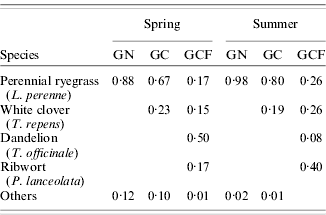
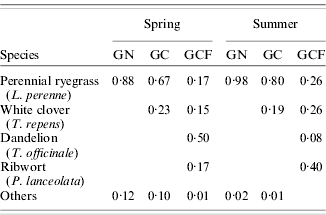
The average botanical composition of the harvested swards is shown in Table 1. GN was dominated by perennial ryegrass at both harvest times. The proportion of ryegrass increased, while that of white clover as well as that of the unidentified remainder species decreased in the summer-cut compared with the spring-cut GC. In comparison, in GCF, the proportions of ryegrass, white clover and ribwort were elevated at the expense of dandelion in the summer cut.
Plant species in the swards (proportion of DM yield)
The ensilability of the herbage was assessed by the WSC and the BC. The WSC content for GN, GC and GCF was 139, 173 and 145 g/kg DM for the spring-cut herbage and 44, 60 and 70 for the summer-cut herbage, respectively. In summer, the GN and the GCF values were significantly different (P<0·05). The BC values were 48, 48 and 58 g lactic acid/kg DM for the spring-cut herbage and 80, 77 and 76 for the summer-cut herbage for GN, GC and GCF, respectively. There was no significant sward effect, either in spring or in summer.
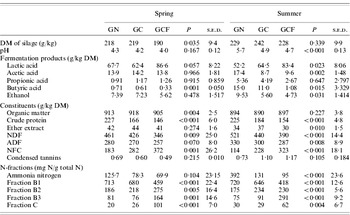
The results of silage quality and composition of the silages are shown in Table 2. Despite prewilting the harvested swards for some hours, the DM contents of all silages were comparatively low. Silages of spring-cut herbage reached lower pH values than those of summer-cut herbage. Summer-cut GN, in particular, exhibited a higher pH than the other two silages of the same cutting date. Without ammonia nitrogen, the total fermentation products formed during the ensiling process constituted 0·08–0·10 of the silage DM. At both cutting dates, the GCF resulted in the highest concentrations of lactic acid coinciding with the lowest contents of butyric acid and ethanol, whereas the latter two undesirable fermentation products occurred in particularly high levels in summer-cut GN. Summer-cut silages also contained relatively high amounts of propionic acid.
DM content, fermentation characteristics and chemical composition of the silages (means of four values per silage type; s.e.d., standard error of differences of means within row, d.f.=6)
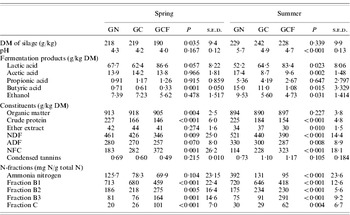
In the spring-cut silages, the CP declined in the order GN>GC>GCF. GCF was also lower in NDF compared with GN and GC, whereas NFC increased in the opposite direction to CP. Summer-cut silages showed decreasing contents of CP and NDF in the order GN>GC>GCF. GN contained more ADF than GC and GCF. As in spring-cut silages, NFC increased from GN<GC<GCF though at a lower level and also resulted in somewhat higher levels of condensed tannins than spring cuts.
Spring- and summer-cut silages exhibited declining mean proportions of ammonia nitrogen and buffer-soluble nitrogen fraction B1 in the order GN>GC>GCF, whereas the less soluble nitrogen fractions B2 and B3 as well as fraction C were increased almost inversely. Ammonia nitrogen reached an extremely high proportion of total nitrogen in the GN summer-cut silage. The ratios between fractions B1 and B2 amounted to nearly 4:1 in GN, 3:1 in GC and less than 2:1 in GCF. Moreover, GCF protein contained especially high proportions of low degradable fraction B3 and undegradable protein fraction C. For summer-cut GCF, fraction B3 reached an even higher level than fraction B2.
RUSITEC Experiment I
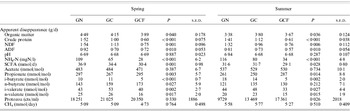
The apparent disappearance of OM, CP, NDF and ADF as well as fermentation characteristics in RUSITEC are shown in Table 3. Due to the large concentrations of non-protein nitrogen and easily soluble protein fraction (B1), GN released the highest amounts of nitrogen and the apparent CP disappearance declined in both the spring- and summer-cut silages in the order GN>GC>GCF. A similar sequence occurred for NDF disappearance, where only the difference between summer-cut GC and GCF was not statistically significant. ADF showed higher disappearance in GN-fed fermenters than in those supplied with GCF of both cutting dates and than those receiving spring-cut GC.
Substrate disappearance in 48 h, pH values and daily ammonia nitrogen concentration, SCFA production, protozoa counts and daily methane release in the RUSITEC system in experiment I (means of four values per silage type; s.e.d., standard error of differences of means within row, d.f.=6)

Ammonia nitrogen concentrations in the liquid phase of the RUSITEC fermenters were significantly reduced in the order GN>GC>GCF for both cuts. Fermenters supplied with GCF produced less SCFA than those receiving GN or GC. The molar proportions of acetate were generally lower and those of n-butyrate higher for the spring-cut than for the summer-cut supplied fermenters. With spring-cut silages, GCF led to the lowest molar proportions of iso-butyrate and n-valerate, GC resulted in the lowest and highest proportions of propionate and iso-valerate, respectively, and n-butyrate ranged in the order GN<GC<GCF. In the fermenters receiving summer-cut silages, GCF produced the highest proportions of propionate and the lowest proportions of iso-butyrate, iso-valerate and n-valerate.
The protozoa counts did not differ in the fermenters supplied with spring-cut silages. With summer-cut silages, they were lower but increased in the order GN<GC<GCF. The daily methane release was not significantly affected by the different silages even though the fermenters receiving GCF tended to have the lowest values.
RUSITEC Experiment II
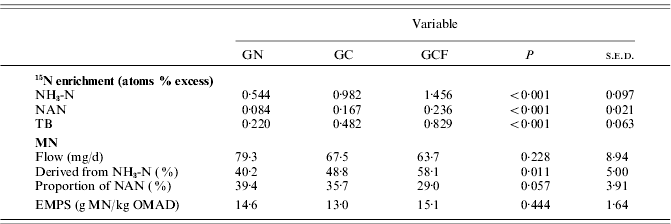
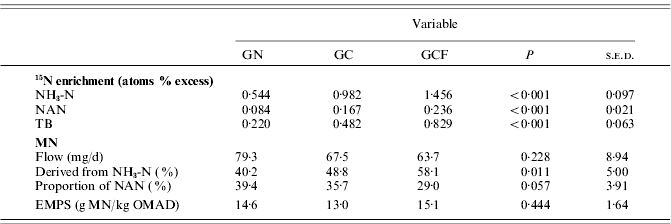
The level of substrate disappearance, NH3-N concentration and SCFA production, as well as SCFA composition, were similar to those of Expt I (data not shown). Fermenters receiving GC produced less NAN than those fed with GCF (Table 4). The level of 15N enrichment was highest in NH3-N, followed by TB and finally NAN. It increased in all three fractions in the order GN<GC<GCF. MN flow was not significantly different between fermenters fed with the three silages but tended to decline in the sequence GN>GC>GCF. The proportion of MN derived from NH3-N clearly increased in the opposite direction and the proportion of NAN originating from MN was significantly lower with GCF than with GN. The efficiency of microbial protein synthesis (EMPS) was not different between the three treatments but tended to the lowest value in GC-fed fermenters.
15N enrichment of ammonia nitrogen, non-ammonia nitrogen (NAN) and total bacteria (TB) as well as microbial nitrogen (MN) flow, proportion of MN in the NAN fraction and efficiency of microbial synthesis (EMPS; mg MN/g OMAD) in the RUSITEC system after infusion of 15N-urea as a marker (means of six values per silage type; s.e.d., standard error of differences of means within row, d.f.=10)
DISCUSSION
The proportional botanical composition of the swards showed a broad and intended variation with almost pure grass swards in the monocultures, c. 0·20 white clover in the two species mixtures, and c. 0·50–0·65 non-legume forbs in the grass–clover–forbs mixtures. Fertilized grass monocultures and unfertilized grass–clover mixtures containing 0·20 of white clover are very common in farming practice, whereas such high proportions of non-legume forbs in permanent grasslands are rare. However, the grass–clover–forb treatment can still be seen as a model that shows the potential effects of grassland forbs on silage and rumen fermentation. The high CP content of the pure grass silages was obviously due to an excessive supply of fertilizer nitrogen. Although such practice causes nitrogen emissions and environmental pollution and should thus be avoided, heavy fertilization including organic manuring is still a frequent practice in intensive dairy farming with high stocking rates.
A common feature of the three silages of both cuts was the inverse relationship between CP content, CP solubility and NH3-N levels on the one hand and NFC content on the other. At the same time, the relatively high content of lactic acid indicates favourable fermentation conditions for lactic acid bacteria in all three silages. However, taking proportions of 0·10 NH3-N of total nitrogen and 0·03 butyric acid in DM as the tolerance threshold for high quality silage (Pahlow et al. Reference Pahlow, Rammer, Slottner and Tuori2002; Deutsche Landwirtschafts-Gesellschaft 2006), only three of the investigated silages including the two GCF treatments reached this standard.
Higher contents of water-soluble carbohydrates and lower BC may explain the lower pH values observed in spring- compared with summer-cut silages. At both harvesting times, the lowest pH values associated with the highest lactic acid and lowest NH3-N as well as butyric acid contents were determined for GCF. The extremely high level of NH3-N in summer-cut GN reflects a strong proteolytic activity, which in connection with the high butyric acid content of this cut indicates the presence of fermentation by undesired clostridial species (Pahlow et al. Reference Pahlow, Rammer, Slottner and Tuori2002). In addition, as both the butyric and propionic acid contents of the silages in the summer cuts are reduced in the sequence GN>GC>GCF, it may be assumed that particularly propionic acid-producing clostridia are actively involved in the fermentation (Schlegel Reference Schlegel1987).
In RUSITEC, fermentable energy and nitrogen availability are interrelated determinants for microbial activity and growth. Carbohydrates are the most important sources of fermentable energy and NH3-N, as well as non-NH3-N, serves as a nitrogen source for the rumen microbes. Taking total SCFA production as an index for microbial energy metabolism, significantly lower amounts of substrate were used in fermenters fed with GCF instead of GN or GC. These differences were also reflected in apparent fibre disappearances. The decreasing apparent disappearance of CP from GN>GC>GCF was associated with declining levels of NH3-N in the fermenter fluid. A value of 50 mg NH3-N/l rumen fluid is regarded to be enough to support maximal microbial activity (Satter & Slyter Reference Satter and Slyter1974). This level was reached or exceeded in GN- and GC-supplied fermenters, but values well below this threshold occurred during the 24 h feeding cycle with GCF. Moreover, taking the proportions of iso-butyrate and iso-valerate as an indicator (France & Dijkstra Reference France, Dijkstra, Dijkstra, Forbes and France2005), the fermentation of protein and the release of non-NH3-N, which may stimulate non-structural-carbohydrate- and fibre-fermenting bacteria (Russell et al. Reference Russell, O'Connor, Fox, Van Soest and Sniffen1992; Carro & Miller Reference Carro and Miller1999; Newbold Reference Newbold1999; Demeyer & Fievez Reference Demeyer and Fievez2004), were also lowest in the fermenters receiving GCF. The numerical decline in MN flow in the sequence GN>GC>GCF observed in Expt II point to an increasingly limiting availability of energy and nitrogen. It may be speculated that higher nitrogen availability would elevate the microbial utilization of GCF carbohydrates.
The decline of NH3-N concentrations in fermenters fed with GN, GC or GCF was inversely associated with increasing proportions of MN derived from NH3-N, indicating a more efficient utilization when this source of nitrogen shortened. However, the efficiency of microbial protein synthesis (EMPS) was not significantly different between fermenters supplied with the three silages. The MP (equal to MN×6·25)/kg organic matter apparently digested (OMAD) can be calculated for fermenters fed with GN, GC and GCF as 91, 81 and 94 g, respectively. Similar EMPS values were observed in a RUSITEC study using the same method of measurement and feeding grass hay and sugar-beet pulp as substrate (Carro & Miller Reference Carro and Miller1999). Much higher substrate disappearances and EMPS values derived from continuous (15NH4)2SO4-infusion and 15N-enrichment in MN of approximately 120 g MP/kg OMAD have been reported for RUSITEC supplied with silages of ryegrass or red clover (Jaurena et al. Reference Jaurena, Moorby and Davies2005). In another RUSITEC study applying the same tracer method, silages of conventional grass, high-sugar grass or red clover led to EMPS values in the range of 21–24 g MN corresponding to 131–150 g MP/kg OMAD without significant differences between the silages (Merry et al. Reference Merry, Lee, Davies, Dewhurst, Moorby, Scollan and Theodorou2006). In both of these studies (Jaurena et al. Reference Jaurena, Moorby and Davies2005; Merry et al. Reference Merry, Lee, Davies, Dewhurst, Moorby, Scollan and Theodorou2006), herbage was treated with an inoculant before being ensiled, which may have contributed to relatively high substrate disappearances and hence high amounts of fermentable energy. High EMPS values in the range of 141–286 g MP/kg OMAD were also measured by means of a 15N dilution technique in RUSITEC fermenters fed with 16 different total mixed, dairy cow rations containing – among other ingredients – variable proportions of different silages (Boguhn et al. Reference Boguhn, Kluth and Rodehutscord2006). Substrate disappearances (OMAD) reported by these authors were relatively low and – since OMAD poses as divisor in the calculation – this may have contributed indirectly to the high values for EMPS. There was no direct relation between the proportions of different silages in the total mixed ration (TMR), e.g. silages of grass, maize, beet pulp, alfalfa, maize cob or brewers grain, and EMPS values (Boguhn et al. Reference Boguhn, Kluth and Rodehutscord2006). Taking the present results together with those cited above, well documented in vivo effects, showing lower EMPS and MN flow for legume silage in comparison with grass silage (Givens & Rulquin Reference Givens and Rulquin2004; Merry et al. Reference Merry, Lee, Davies, Dewhurst, Moorby, Scollan and Theodorou2006), are less clear in RUSITEC. Presumably, not only biological but methodological factors too are crucial for the large variation of reported EMPS values (Broderick & Merchen Reference Broderick and Merchen1992; Demeyer et al. Reference Demeyer, Van de Woestyne, Prins, Abel, Flachowsky, Jeroch and Molnar1995).
The three spring-cut silages – though differing in their botanical and chemical composition – must have offered almost similar amounts of utilizable substrate for protozoa, whereas in summer-cut-supplied fermenters, the substrate for protozoa constituted an increasingly less limiting factor in the order GN>GC>GCF. In the rumen, protozoal activity is closely related to methanogenesis (Newbold et al. Reference Newbold, Lassalas and Jouany1995). Secondary plant constituents such as condensed tannins have been shown to reduce protozoa concentration (Makkar et al. Reference Makkar, Becker, Abel and Szegletti1995) and methane release (Tavendale et al. Reference Tavendale, Meagher, Pacheco, Walker, Attwood and Sivakumaran2005). However, the actual differences in protozoa counts between the fermenters fed with summer-cut herbage and the concentrations of antimethanogenic substances in the three silages were obviously too small to affect methanogenesis in RUSITEC. The present results agree with observations in sheep, showing that considerable seasonal or fertilizer-induced changes in the clover proportion of a mixed grass–clover pasture were not reflected in rumen methanogenesis (Mbanzamihigo et al. Reference Mbanzamihigo, Fievez, Da Costa Gomez, Piattoni, Carlier and Demeyer2002).
Implications
In the present study, irrespective of the fact that the spring cuts were more suitable for ensiling than the summer ones, the swards that contained forbs produced a higher silage quality than those of heavily N-fertilized pure grass or mixtures of grass and clover. Though the species composition was changed from a dandelion-dominated sward when harvested in spring to a ribwort-dominated one in summer, the advantage of both forb-rich mixtures for ensiling was accompanied by a lower content of soluble CP coinciding with a higher content of NFC.
For the rumen microbes, more fermentative energy and nitrogen were provided on average by the N-fertilized grass silage than the grass–clover mixture, simultaneously releasing a higher ammonia surplus in relation to the microbial requirement. The grass–clover mixtures produced less NAN than grass–clover–forb mixtures. NAN in fermenters receiving grass silage contained more MN than those receiving silage of grass–clover mixtures and grass–clover–forb mixtures in particular. If fed to the animal as a single feedstuff, the efficiency of nitrogen utilization would be improved with silage of the grass–clover mixtures compared with that of N-fertilized grass. Silage of forb-rich swards was least utilizable by the rumen microbes. It should, therefore, be combined with other feed components in order to ensure a sufficient availability of N-sources for a high fermentative degradation of carbohydrates. Forb-rich silage would provide a high proportion of ruminally undegraded protein (UDP). If this UDP was postruminally utilizable, such silages would present a potential resource for improving the nitrogen efficiency in ruminant nutrition. This needs to be considered in further investigations.
This study was supported by a fellowship of the German Academic Exchange Service (DAAD) for the first author and by funds of research project 03OE388 in the frame of the German Federal Program Organic Farming of the German Federal Institute of Agriculture and Nutrition (BLE). The authors thank Rolf Jeromin and Bernardo Lenz for their support in the laboratory and Teresa Gatesman for checking the English content of this paper.