Introduction
Dignity is an important concept for medical practice, especially in the field of palliative care. To understand and promote patient dignity, Chochinov et al. (Reference Chochinov, McClement and Hack2015) developed a single item tool designed to probe patient personhood, the Patient Dignity Question (PDQ) — “What do I need to know about you as a person to give you the best care possible?” This tool has been translated and validated to European Portuguese (PDQ-PT) — “O que precisamos saber sobre si enquanto pessoa para podermos dar-lhe o melhor cuidado possível?” (Julião et al., Reference Julião, Courelas and Costa2018). The PDQ was designed to elicit a brief conversation (10–20 min), after which a one to three paragraph written summary are prepared. Patients are then given the opportunity to read their PDQ summary for the purpose of determining its accuracy and the need for any corrections. Additionally, patents are offered the opportunity to decide if they wished to have their written summary placed on their medical chart.
In a cross-sectional study in Canada (Chochinov et al., Reference Chochinov, McClement and Hack2015), 93% of patients reported that feeling the information obtained by the PDQ was important for health care providers (HCPs) to know and 99% would recommend it to others. In the same study, 90% of HCPs indicated that they learned something new about their patients, and 59% indicated that the PDQ influenced their degree of empathy (Chochinov et al., Reference Chochinov, McClement and Hack2015). A Portuguese study by Julião et al. (Reference Julião, Courelas and Costa2018) performed in non-institutionalized active elderly showed that answering the PDQ-PT captured their essence as a person, heightened their sense of dignity, and prompted HCPs to gain appreciation regarding their patient's suffering.
To date, no studies have examined the application of the PDQ in the context of primary care (PC). Our objective was to study the acceptability and the feasibility of the PDQ-PT in a small sample of palliative patients cared for in the PC setting.
Methods
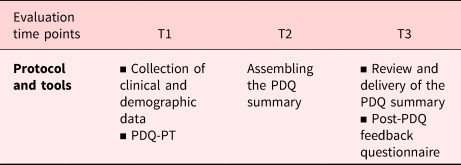
A cross-sectional study using a convenience sample of 20 palliative patients cared for in a PC unit located in Lisboa, seen between February 2018 and April 2019. The inclusion criteria included: being 18 years old or older; having palliative care needs evaluated by clinical consensus and verified using the NECPAL-CCOMS-ICO-α-PT (André, Reference André2018); having no palliative care follow-up in secondary or tertiary palliative centers; the ability to read and speak Portuguese; being cognitively intact, and the ability to provide written informed consent. After being deemed eligible and obtaining the written informed consent, participants entered the first study phase in which they were asked to fill out the sociodemographic questionnaire. After completing the latter, each patient answered the PDQ-PT. The Principal Investigator (PI) then produced a written PDQ summary comprised of one to three paragraphs. A second research contact was arranged to deliver of the summary within 15 days, inviting the patient to evaluate its accuracy and complete a feedback questionnaire comprised of 19 items rated on a Likert scale: 1 “strongly disagree”–7 “strongly agree,” regarding their perceptions of the PDQ-PT process and summary (Table 1).
Investigation protocol for each participant

PDQ-PT, Patient Dignity Question-Portuguese version.
Statistical analysis
The statistical analysis included the descriptive analysis of participants’ sociodemographic and health status characteristics. To assess the acceptability and feasibility of the PDQ-PT, measures of central tendency were used. The data analysis was performed using the Statistical Package for Social Sciences (SPSS®) software 25.0 for Windows®.
Ethical approval
This study received an ethical approval from the Ethics Committee of the Administração Regional de Saúde Lisboa e Vale do Tejo (12160/CES/2017), the Ethics Committee from the Lisbon Academic Medical Centre (IFA-M/2018-02-01), and the Portuguese Data Protection Authority (Autorização n° 10501/ 2017).
Results
Participants
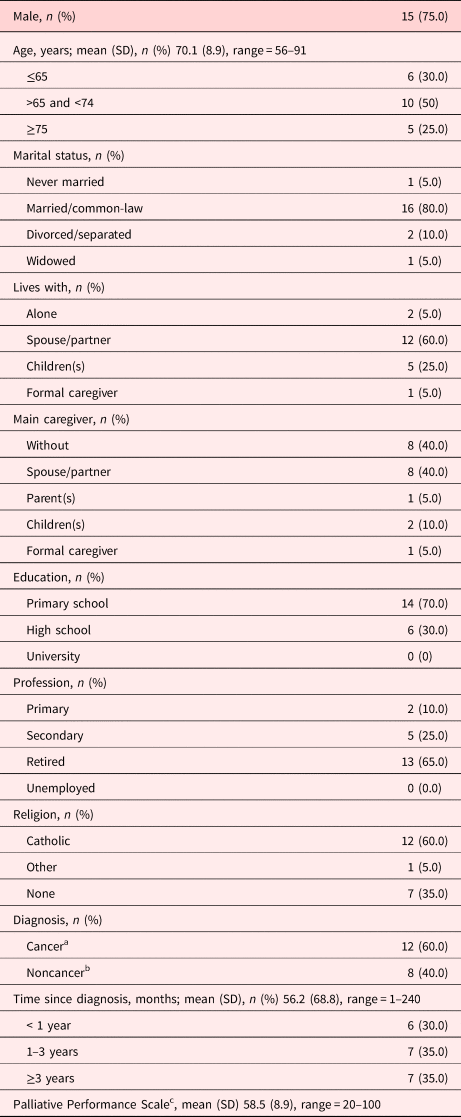
Twenty-nine eligible patients were invited to take part in the study, all of whom agreed to do so. Nine were excluded (four died, three deteriorated clinically, and two were not able to read and sign the informed consent), leaving a final sample of 20 participants (the response rate of 69%). Seventy-five percent of our sample were male. The average age was 70 years old (range, 56–91 years old). The majority of participants was married (80%) and Catholic (60%) (Table 2).
Summary characteristics of participants (N = 20)

PC, palliative care; SD, standard deviation.
a Lung, n = 4; colon, n = 1; esophagus, n = 1; stomach, n = 1; liver, n = 1; larynx, n = 1; pancreas, n = 1; skin, n = 1; Hodgkin's lymphoma, n = 1. Metastatic tumor n = 9. Undergoing cancer treatment, n = 12.
b Chronic obstructive pulmonary disease, n = 3; congestive heart failure, n = 2; lateral amyotrophic sclerosis, n = 1; hepatic cirrhosis, n = 1; post-stroke, n = 1.
c Palliative Performance Scale scores: 100% = healthy, 0% = dead.
Acceptability and feasibility
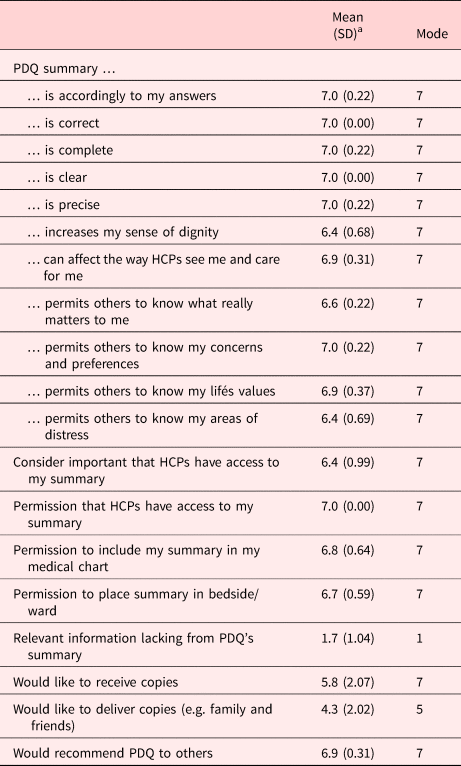
All patients found the PDQ-PT summary accurate (7.0, SD = 0.22), precise (7.0, SD = 0.00), and complete (7.0, SD = 0.22) and did not report that there was any information lacking in the PDQ summary (1.7, SD = 1.04). Eighty percent wished to receive a copy of the summary, 100% would recommend the PDQ to others, and 100% would want a copy of the summary placed into their family physiciańs medical chart and would wish to have it placed at their bedside/ward if they were hospitalized (6.7, SD = 0.59). Participants strongly felt that the PDQ summary heightened their sense of dignity (6.4, SD = 0.68) and considered it important that HCPs have access to the PDQ summary (6.4, SD = 0.99) and that it could affect the way HCPs see and care for them (6.9, SD = 0.31), allowing professionals to know about what really matters to them (6.6, SD = 0.61), their life's values (6.9, SD = 0.37), concerns and preferences (7.0, SD = 0.22), and main areas of distress (6.5, SD = 0.69) (Table 3). Participants felt that PDQ responses were critical for HCPs to know, wished to have their summaries placed in their medical chart (6.7, SD = 0.59), and wanted to receive copies. They did not show a strong desire to deliver it to family or friends (4.3, SD = 2.02). When analyzing the column of modes in Table 3, we can find the answer “7 — strongly agree” as the most frequent value, reaffirming the strong acceptance of the PDQ and its protocol. The post-PDQ question regarding the necessity to add additional information to the PDQ summary revealed a mode = 1, showing that the creation of the summary accurately captured the content of the interview. Although a formal qualitative content analysis was not undertaken, responses to the PDQ-PT included statements of patients’ values, pride, wishes, and expressions of love.
Participants’ appreciations on PDQ and PDQ summary (N = 20)

HCPs, health care professionals; PDQ, Patient Dignity Question.
a Responses rated on a Likert scale: 1 “strongly disagree”–7 “strongly agree.”
On average, it took 7 min (3–42 min) to respond to the PDQ-PT. The mean time to prepare the PDQ summary was 10 min (5–22 min).
Discussion
Eliciting personhood in the medical practice increases the likelihood that patients feel cared about and, therefore, satisfied with the medical attention they receive.Footnote 1 Taking an interest in who they are, what matters to them, and how they want to be seen enhances trust, allowing patientś disclosure of various personal aspects that may influence medical decision making, thus improving diagnostic accuracy and patient safety (Maguire et al., Reference Maguire, Faulkner and Booth1996; Sage, Reference Sage2003; Thom et al., Reference Thom, Hall and Pawlson2004; Chochinov, Reference Chochinov2007; Pichert et al., Reference Pichert, Hickson, Moore, Henriksen, Keyes and Grady2008; Lopez et al., Reference Lopez, Bertram-Farough and Heywood2017). The PDQ offers a simple and effective means of placing personhood on the clinical radar.
To the best of our knowledge, this is the first study examining the PDQ in palliative care patients cared for in the PC setting, after our published preliminary results (Lemos Caldas and Julião, Reference Lemos Caldas and Julião2018). Our results show that the PDQ-PT is well accepted and feasible to use in patients with palliative care needs being cared for by family doctors in the PC setting. In this study, the PDQ-PT showed substantial patient acceptability. Patients reported that the summary was accurate, precise, and complete. All participants would recommend the PDQ to others, want a copy of the summary placed on their family physiciańs medical chart, and give permission to place it at their bedside or ward if they had a hospital admission. They strongly felt that the PDQ summary heightened their sense of dignity, considered it important that HCPs have access to the PDQ-PT summary and that this information could affect the way HCPs see and care for them, through knowing their personal values, concerns and preferences, and main areas of distress.
Like any study, ours had limitations. Firstly, we used a convenience sample consisting primarily of older patients. As such, future research using the PDQ within younger cohorts deserves further examination. Secondly, we acknowledge our small sample size; larger samples may allow pre- and post-testing of formal measures of dignity related distress (Chochinov et al., Reference Chochinov, Hassard and McClement2008). Finally, the majority of our participants had malignancies; it is essential to explore in the utility and acceptability of this clinical tool in other terminal conditions, such as chronic organ failure.
We believe that future studies investigating the PDQ's utility and efficacy in the PC clinical setting should include: (1) developing multicentric randomized controlled trials comparing the PDQ-PT with standard care; (2) studying how the PDQ affects the way HCPs see and care for their palliative care patients, shifting their attitudes from a biomedical model to one based on respect, compassion, and personhood; and finally (3) how the PDQ affects HCPs’ emotional connectedness with patients nearing death.
In the PC setting, the PDQ-PT seems to be a promising tool to be implemented and may enhance patient/doctor relationships, allowing a new perspective on how professionals perceive and respond to personhood within the clinical setting.
Acknowledgments
We thank to every patient and family physician willing to participate in our study. We thank the Direction of the USF Travessa da Saúde and the ACeS Loures Odivelas for allowing this project.