Introduction
In his portrait of Pierre Verger, the Swiss anthropologist Alfred Métraux wrote: “Photographer, ethnographer, and babalawo,” (…) “what a Renaissance man!.”Footnote 1 Pierre Fatumbi Verger was indeed an ethnographer, a historian, a sensitive photographer, a man of culture, a passionate scholar, a globetrotter, and an Ifá diviner. In this article, I explore Verger’s work and his position in relation to the study of religion in the African context.
Because of his eclectic attitude and his militant position regarding the ethnological subject, the theoretical framework of his work is quite complex. The present that he observed and studied was affected by dramatic changes and, Verger claimed, the world of knowledge was threatened by the hegemony of dominant cultures and religions. His aim was to give voice to the subaltern and marginal people.
In Africa he looked to identify the cultural roots of Afro-Brazilian culture, while in Brazil he sought to ascertain what had survived the middle passage. Due to the dual perspective he adopted, his work was replete with historical references. Indeed, in order to achieve his purpose and to prove the historical depth of African systems of belief he used historical sources widely. Nevertheless, Verger’s prime aim was not to analyze the processual nature of African religions but to exalt the resistance of Afro-Americans in a social and political hegemonic and oppressive context. On the two shores of the Atlantic he assumed two different perspectives: in Africa his claims went toward pure tradition, in Brazil he emphasized the “modernity” of African religions, which proved able to survive the Atlantic passage.
In an effort to distill the pure tradition, he followed, as we will see, the same theoretical path as the first Christian missionaries, but being aware of the misleading power of texts, he tried deliberately not to betray local informants and to give space to non-textual dimensions. His deep involvement in Vodun ritual practices allowed him to develop a sensibility able to go beyond textual hegemony.
In my opinion, this is the main reason for reconsidering Pierre Verger’s methodological approach and his writings. He did not adopt a systematic methodology, and many of his academic friends reproached him for this, but his perspective was innovative and not subjugated to the theoretical and ideological constrains of past or contemporary literature.
Basing myself on his Notes sur le culte des Orisa et Vodun à Bahia, la Baie de tous les Saints, au Brésil et à l’ancienne côte des esclaves en Afrique published by the IFAN in 1957, I seek to focus on the impact of Verger’s work on studies of African religions, on Vodun in particular and on his contribution to the invention of an “African traditional religion” paradigm. To understand and analyze the genealogy and dynamics of the African system of beliefs it is crucial to deconstruct this paradigm.Footnote 2 It is the outcome of the intersection between academic efforts to compare and categorize religions and the privileged status accorded to the Judeo-Christian tradition.
The first issue to approach relates to the term religion itself, which is absent from the languages of many people who practice what scholars define as religion. The crucial problem is one of definition and translation, a complex legacy of the efforts of the early first missionaries to translate Christian words and concepts into appropriate terminology in local languages. To understand, translate, and catalogue the “other,” missionaries needed to deal with durable and unchanging concepts and traditions. The consequence was to position local belief systems within static structures, differentiating between “pure religion” and what was considered “just magic,” witchcraft, or superstition, and between what was traditional and what was not.
The colonial administrators incorporated the cultural translation efforts of those missionaries into their own work. In order to understand, control, and rule the population, they formulated traditional religion in terms of an a-historical paradigm that they could confront. Power and religion were, indeed, intimately interconnected in the local political system, and extrapolating from the social and dynamic context, claiming religions had a static nature, was a way to weaken, deny, or refuse the political standing of religion.Footnote 3
In the 1950s and 1960s, the translation enterprise found new enthusiasm. It followed two main streams: the intellectual one that chose the term “tradition” to dismiss derogative definitions such as “primitive” or “tribal,” while the second expressed itself in the increasing number of independent African churches which articulated a popular translation of Christianity.Footnote 4
The “invention” of African traditional religionFootnote 5 aimed to escape the dichotomy between “great religions” and “primitive” ones,Footnote 6 adopting a more respectful definition of those religions labeled as primitive. The hegemony of the Judeo-Christian tradition also implied the prevailing of text over practices or other forms of non-textual expression and the consequent reduction of local systems of beliefs to texts.Footnote 7 The outcome was the marginalization of the bodily and non-doctrinal forms of religious expression.
Within this general framework, certain aspects of African religions proved to be more translatable than others. The construction of homologies between Christianity and Yoruba belief systems is a good example of this process. Generally speaking, all the practices the missionaries defined as magic were assimilated into the generic idea of evil. For instance, Esu, the Yoruba trickster deity (called Egun by the Fon and Ewe-speaking people), was transformed into Satan. In contrast, the Ifá divination system, already influenced by Muslim cosmological concepts, was favored by the encounter with missionaries, who recognized in it an approach closer to the Christian one. Indeed, Ifá was a male-dominated cult, possession did not occur during the ceremonies, and, claiming a hegemonic position over all other cults, it introduced the idea of a strict link with a superior god.Footnote 8 Furthermore, the wide corpus of poems and songs that went with the divination practices were collected and translated to form a coherent text. Ifá has been totally disconnected from its historical path, and despite Islamic influences and the effects of the Christian encounter it is today considered the stronghold of Yoruba and Fon tradition.
As propagated by missionaries, colonial administrators, and scholars, this kind of cultural translation was one imposed from “above,” achieved through the selection, exclusion, and promotion of certain forms of religious expression at the expense of others. The selection agenda changed over time, of course, reflecting different political priorities.
Verger was among those scholars whose purpose was to valorize the local system of beliefs, creating a positive image of African religions and emancipating them from the Christian churches.Footnote 9 However, Verger carried out the selection process, which in his case meant identifying uncontaminated ritual practices. His avoidance of beliefs he considered spoiled by Christianity – both from above and below – was consistent with his efforts to regain their past integrity. Again, the consequence was the de-historization and de-politization of African religions, encouraging a reification of religious forms.
Methodological Issues: The Historical Gaze
In this section, I will focus on Verger’s methodological perspective, which combined the use of historical sources with an emic approach to the field. The aim of Notes sur le culte des Orisa et Vodun was to make a comparative analysis between “African sources” and “Brazilian remains.” During his various trips between Brazil and Africa, he mainly investigated relations between the Vodun of the Casa das Minas temple in Maranhão and those of the royal family of Abomey, collecting an impressive amount of material and data.
As remarked by Monod in his introduction to Verger’s thesis, Verger’s aim was modest compared with that of other doctoral scholars. His study was just the “accumulation of original and authentic materials” and not a systematic and well-structured monograph, based on a strong and coherent theory. Indeed, in order to construct a “giant dossier” he combined a review of the existing literature with comparative historical and ethnographical data, including an extensive collection of texts (songs and oriki) from both Brazil and Africa. For Monod, the creation of an archive was not in itself a work of scholarship, but we would argue, following Seiderer,Footnote 10 referring to Derrida, that the archive “articulat[es] the fiction and the subjectivity in relation to the reality that it seizes, centers, and interrupts,” always going beyond the simple storage of documents. The accumulation of data allowed Verger to deepen the historical continuities of the religious practices he was interested in, and it brought him closer to what he felt to be the “facts.”
Notes sur le culte des Orisa et Vodun is a rich review of the literature produced on Slave Coast religious systems of belief since the earliest travelers began to be interested in this topic. Unlike the standard model of an academic essay, Verger did not write a series of chapters developing an overall argument. Instead, he used a technique similar to “montage,” juxtaposing various quotes, comments, and perspectives by various travelers, traders, missionaries, and anthropologists. In doing so, he produced a creative set of connections between various periods which, in turn, generates an image of a changing world, imposing a historical and comparative perspective, and emphasizing the genealogy of the concepts and paradigms he wanted to research.
Verger’s work is important for at least three reasons. First, highlighting historical reports, it is a useful working tool for researchers, including, primarily, anthropologists, whose views are sometimes influenced too much by the a-historical observation of current practices, resulting in rather “flat” views of religion and religious phenomena. Secondly, the temporal sequence implicitly suggests that the perspective on so-called traditional religion changed over time, depending on the political, economic, and social context. Finally, alongside each citation, Verger juxtaposes a brief presentation of its author: traveler, trader, slave trader, adventurer, Catholic or Protestant missionary, African priest, or anthropologist. In doing so, he sets the quotes in their historical and political context, thereby forcing the reader to confront the subjectivity of the scholar’s gaze. Although Verger’s purpose was to discover the origin of that line of continuity that enabled some divinities to survive the middle passage, at the same time the different points of view and perspectives he chose underlined the inconsistency of assertive statements.
Furthermore, Verger was able to build up a complex dialogue between the authors, for example in a long section devoted to fetishism and entitled “Extrait de quelques textes sur le ‘fétiches’.”Footnote 11 Here he starts by quoting texts written by the first sailors to see Africa, before moving on to an analysis of the important work of Pieter de Marees,Footnote 12 showing the genealogy and the connection between a number of important authors, all of them either quoting de Marees openly or simply copying him verbatim. The notion of fetish elaborated by de Marees, otherwise known as Artus of Dantzig, was an inspiration to Pierre d’Avity.Footnote 13 DapperFootnote 14 quoted d’Avity without mentioning de Marees. Thomas AstleyFootnote 15 published several extracts from Sieur Villault de Bellefond,Footnote 16 who had copied lengthy passages from de Marees without acknowledging him as the source.
This dense network of references, cross-references, and citations shows how important authors and editors merely quoted other authors without having their own opinion on or experience of African belief systems. Moreover, Verger drew attention to the religious affiliation of the authors. For instance, Thomas Astley was an anti-Catholic who loathed the aggressive attitude of Catholics toward fetishism, such as Père Labat,Footnote 17 whose behavior, according to Astley, was not so different from that of the indigenous people.
Although Verger’s main objective was to achieve a satisfactory definition of Vodun and Orisa, in the process of pursuing this he asserted the uncertainty of anthropological prejudices, focusing on the development of the intellectual discourse on religious notions. He assumed a critical, comparative, and historical perspective, anticipating what became a key topic in anthropological practice. Because he commented on them, his work was not just a collage of texts. Above all, the manner in which he chose his subjects and his argumentation emphasized the construction of his own discourse. Even more important, he highlighted the historical genealogies of a number of important notions and discourses built around African religions.
Methodological Issues: The Emic Perspective
Verger was considered an intellectual, an artist, and a globetrotter rather than an academic proper. Because of his eclectic gaze and empathic engagement with the people and the practices that were the object of his studies – he was initiated into the Fa divination system and introduced to Shango rituals – he lost the support of academia. However, he gained the respect of African dignitaries and priests. Actually, Verger was proud of his marginal and liminal position. During an interview he declared:
I never did ethnographic research in the true sense; I never asked people questions and wrote down the answers on paper, on what I would have liked to hear them to say. That would have meant that I had a theory to begin with and I was doing a study to confirm whether my theory was correct (…) which is what ethnologists and anthropologists usually do.Footnote 18
Obviously, his methodological approach to fieldwork was radically different. He never positioned himself as a neutral observer; instead, he was one of the few scholars to develop participant observation. Actually, he preferred observation to questions, practices to words, and involvement to mere presence.
In the 1950s, during his research trip to Benin, Alfred Métraux noted in his journal some revealing events that occurred during his African stay and his encounter with Verger. Métraux expressed his own discomfort and disappointment with Verger’s anthropological integrity. Being initiated into Vodun, Verger was aware that certain boundaries were not to be crossed. Vodun is based on secrets, and every practitioner knows the threshold one can or cannot pass.Footnote 19 Furthermore, cosmological knowledge is acquired over the years in an everlasting process of acquisition. In this context Verger combined the consciousness of his ritual position within Vodun with his intellectual prerogative. All these ethical issues hindered Métraux in his own research.
The two were in Ouidah when Métraux noted: “We were told of a Zangweto [sic] ceremony that would take place this very evening. Not without hesitation, Verger invited me along, provided I do not seek to penetrate the secrets.”Footnote 20 On another occasion, Verger opposed Métraux’s desire to visit Wagilé’s grave, because “he seems to believe that we would commit something wicked.”Footnote 21 Métraux did not hide his disappointment and his general sense of intellectual superiority, which became evident during their visit to a woman in Ouidah. Here Métraux remarked on Verger’s excessive involvement in local practices: “They served us some water, and, as soon as Verger had finished his pagan show, the woman brought us her son’s Fa.”Footnote 22
Verger’s emic approach was not valued by his academic friends and it also caused him some ethical problems. Being initiated into the Fa divination system and into the Shango cult, Verger pushed his ethnographic field experience to the extreme, opening his mind to different research insights and perspectives. His main concerns therefore were how to remain close to his sources and informers without betraying them, and how to encapsulate and explain both the continuity and change between Africa and America using just words. In this, Verger was a forerunner of what was to become a core problem in the study of African religions: the translation and interpretation of meanings, carried on through the exclusion and inclusion of what was presumed to be aberrant or pertinent.Footnote 23 Actually, the hegemonic Judeo-Christian approach forced the non-text-based religions into a coherent discourse, where words replaced bodies, dances, and the practitioner’s sensuous presence. In this way, the idea of doctrine was emphasized at the expense of practices and practices reduced to text. For scholars, Africans came to be seen as those who had practices but did not elaborate a religious theory, or as those who had obscure beliefs that could be dismissed anyway. Much efforts was made to systematize African belief systems into a coherent apparatus, sometimes reducing them to some sort of primitive philosophy, just a different way of not having to attribute to them the status of religion.Footnote 24 In judging the validity of African cosmological utterances, scholars, like missionaries before them, neglected the fact that a practitioner could be knowledgeable about how to live religiously without being able to articulate that knowledge system as such. For instance, in Vodun practice cosmological knowledge is not a prerequisite to participation. On the contrary, being an esoteric religion the knowledge is withheld from most practitioners, who express their religiosity though practices.Footnote 25
Verger was forced to face this kind of issue. On the one hand his aim was to valorize African and Afro-Brazilian belief systems, on the other he refused to reduce their religiosity to text. He believed photography was a good instrument to achieve his purposes and to come closer to the phenomenon observed, and to “reality.” Photos did not force him to ask people questions, nor to translate their answers, and, as explained in the introduction to Notes sur le culte des Orisa et Vodun, they helped to construct an easy and immediate link between African and Brazilian peoples.Footnote 26 To create a bridge between the two shores of the Atlantic, he chose to share and compare songs, poems (oriki), and photos. The photos were able to capture “true” practices, to discover the similitude and the African influences on Brazilian religious practices (as for instance in Dieux d’Afrique), something that would otherwise have been difficult to disclose using just words.
If the camera gave him the illusion of being free from any prejudice and from manipulating reality, writing remained problematic: “His slowness to produce was notorious among his academic friends.”Footnote 27 In 1952, after a lunch with Paul Mercier and Georges Balandier, Métraux noted: “We talk about Verger who, we are all sure, will never write anything.”Footnote 28
For Verger, the writing technique he chose in Notes sur le culte des Orisa et Vodun, where he juxtaposed quotes, his own commentary, original songs, and oriki, was the most effective way to achieve a result close to the one he attributed to photography.
Flux and Reflux
If Verger’s first ethical problem was to remain faithful to his informants, the second was linked to the desire to valorize Afro-American subaltern culture. In Brazil, racism and an increasing hegemonic modernism were causing the desertion of such “retrograde practices” as those found in Africa. The aim of Verger’s militant anthropology was to document the Afro-American agency and its capacity to culturally survive the Atlantic passage. As he wrote in the introduction to his Notes:
There are not many countries like Bahia, where the slaves’ descendants have preserved the pride of their African origins and have not tried to deny their traditions, adopting those of the ruling class in order to achieve social improvement (…) during hard times, their Orisa and Vodun are for them a safer support against distress and humiliation while in the happy moments they give them the exciting feeling of their [connecting with their] roots.Footnote 29
For Verger, Africa was where one could verify the strength and pride of its descendants in the Americas, and their agency in preserving traditions despite the cultural and physical violence they suffered and the increasing demand to conform to the social hegemonic context.Footnote 30
From his point of view, it can be said that to the extent there was militant and political engagement, and syncretism in Brazil was a form of resistance, in Africa it was a sign of cultural degeneration. Verger had some difficulty in comprehending and justifying the blending of African religious practices with other religions, such as the “universal ones.” Indeed, in Africa, Verger was looking for the pure traditions and the ancient knowledge not yet corrupted by hegemonic religions. He collected past literature on African fetishism because, in his opinion, it would help to reach the original core of Africa’s system of beliefs and to valorize the historical legacy of Afro-Brazilian religion.
Unlike Herskovits, who regarded Bahia as the place to study the continuity of African culture, Verger saw “Candomblé leaders and their African interlocutors as agents active not in the preservation of crystallized traditions, but in the reinvention of ritual practices through ongoing transatlantic contact.”Footnote 31 Nevertheless, for Verger the African side was supposed to remain faithful to a common and shared past. Verger established contacts between the two sides of the Atlantic to reinforce the pride and knowledge of the Brazilian side, and for this reason Herskovits was afraid he could contaminate the original continuity he was studying.Footnote 32 As Paulina Alberto remarks: “Verger offered something substantially different from other contemporary academics in Bahia: the possibility of renewed contacts with Africa.”Footnote 33
Verger traveled from Africa to Brazil and back, and the connections he developed in Africa would later allow him to become a player in Brazilian cultural politics toward Africa. As Ana Lucia Araujo has argued, Verger remained an active transatlantic go-between for decades to come, playing an active role in the creation of museums, cultural institutions, and museum exhibitions.Footnote 34
In order to understand his position toward African Vodun, it is important to note that, probably on the occasion of his first trip to Africa (in 1949), the Candomblé groups with which Verger was in contact in Bahia gave him a Shango necklace, because they expected him to establish contact with African Vodun and Orisa communities. In the Bight of Benin, the necklace became Verger’s “passport,” and some months after his arrival he was initiated into the cult of Shango in the towns of Ifahin and Sakete, in Benin. During a later stay in Africa, he was initiated as an Ifá diviner in the Nigerian city of Ketu.
Thus Verger continued a tradition that started in Brazil, in the last years of nineteenth century. In his recent work on Verger, Jérôme SoutyFootnote 35 recalls that after the abolition of slavery, when the worship of Orisa received the status of an independent religious system, the desire to claim African identity became ever stronger. Those priests who could afford to do so undertook pilgrimages to the Republic of Benin and Nigeria. These trips were a means to legitimize and strengthen their leadership and to revitalize the mythical link with the Orisa, who, during ceremonies, were supposed to travel from Africa to Brazil in order to possess their followers. The trips became part of the initiation process and were inscribed in the founding myths of the Brazilian shrines. Even more relevant, they built strong links between the religious leaders on the two sides of the Atlantic, encouraging the process of re-Africanizing Afro-Brazilian cults: the mysticism of the valorization of Africa was then activated.Footnote 36
This challenge led to the definition of what seemed to be pure religion, because it was faithful to the African origins and in opposition to everything that was impure and syncretic. Hence the process created a dichotomy between tradition and “mélange” (where the latter assumed the meaning of modernity) in defense of the communities of African origin. For Verger, defending the traditional cults was also a way to react to the contempt of and persecution by Brazilian institutions.Footnote 37 Demonstrating the power of tradition was one way to combat the hegemonic and oppressive modernity. Nevertheless, being aware of the complexity of the Brazilian social context and of the difficulties faced by Afro-Brazilian people, in Brazil Verger gazed more benevolently upon syncretism and contamination.
On the other hand, in Africa he disconnected religion from the specific and historically based processes of power. He was not interested in contemporary and past African forms of ritual reinvention, nor in the political history of African countries. In Africa he was looking for cultural roots, and in his “Introduction” to Notes sur le culte des Orisa et Vodun he seemed almost astonished by the faithfulness of Candomblé leaders to the African ancestor cults.Footnote 38 At least two issues seem to have caused this astonishment: (1) the process of re-Africanization of Brazilian rituals, which went on for more than half a century, and (2) the fact that he himself, like so many of his scholarly contemporaries, automatically selected what was “pure” at the expense of what appeared to be contaminated. In this sense Verger contributed to the construction of the concept of “African traditional religion” as a phenomenon outside of history and politics, a past horizon that was to remain immune from past and present changes. He approached African belief systems as a static paradigm that could not be influenced in any way by either Christianity or Islam. Verger not only contributed to building “that form of life”Footnote 39 called African traditional religion, he became part of the politics of cultural heritage, so much present in Benin since the 1990s.
Verger played an important role in organizing the first edition of the Vodun festival “Ouidah 92,” held in Benin in 1993, which he photographed extensively. Some of these photos are now exhibited in the Whydah Historical Museum. He was also deeply involved in the creation of the Museum, “which crystallizes his concept of African and Afro-American culture,”Footnote 40 as he decided to juxtapose the photos he took in Ouidah with his photos of adepts in Bahia.
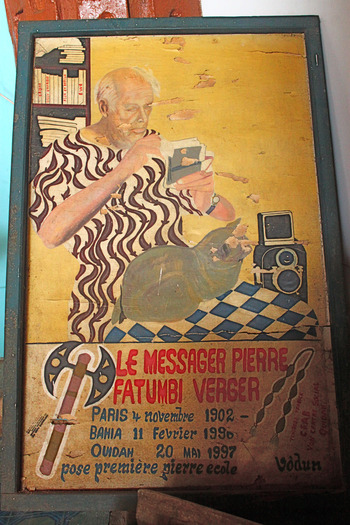
In memory of his active engagement in creating transatlantic cultural links, his painted portrait today hangs in the shrine to Dagbo Hounon, Ouidah’s very much contested Vodun supreme chief. In the painting, Verger, named “the messenger,” is depicted close to the symbols of his eclectic personality: the camera, in close up, with in the background his books, and at the bottom the cords of the Ifá divination and the Axe of Shango, his own Vodun.
Signboard - Dagbo Hounon Shrine, Ouidah, Benin. Photo by Alessandra Brivio, September 2011.

Paradoxically, Verger’s reputation appears to be greater among the people with whom he conducted fieldwork – in Brazil, Nigeria, and the Republic of Benin – than among academics in his native France. In Ouidah, his image has gained icon-like qualities and is much more than just a memorial object. This has much to do with the country’s active heritage politics, however, aiming to maintain and reinforce the bridge between Africa and the diaspora. As such, “the messenger,” the nickname bestowed on Verger in the painting, is a clear signal. Verger has become part of the process of patrimonialization, or heritage formation, a dynamic able to transform a subject into a meta-cultural product. Today, in Benin, and in particular in Ouidah, Verger’s is the name to invoke when one wants to discuss the diaspora or assert legitimacy in matters pertaining to the position of chief of all the Vodun (as is currently happening in the Dagbo Hounon succession litigation).Footnote 41
Vodun and Mawu
The topic of the High or Supreme God is one of the most controversial issues in African religious studies and it has been the subject of innumerable analyses. Again, the ideological hegemony of missionaries was so strong that for a long time anthropological studies were affected by a sort of metamorphic syndrome. In order to destroy polytheism, the primal need was to translate local belief systems and divinities in terms of Christian concepts.Footnote 42 There were many attempts to read polytheism in terms of monotheism, assuming monotheism as a pervasive reality in Africa.Footnote 43
To introduce Verger’s point of view on the argument, I will first quote an anecdote related by Métraux. The subject was Mawu, the name currently used in the Vodun area to designate the High God. Métraux and Verger were in Abomey, visiting a Vodun priest:
(Verger) expressed the desire to have information about Guédé. The priest started saying that Guédé was on the earth with Mawu, during the creation of the world. The word Mawu made Verger angry: he imagined that the unlucky priest was using Christian terms and his indignation came to a peak when the priest said that Mawu is a man. He accused him of speaking as a Christian, words that seemed to offend the priest. After this outburst, the people stopped speaking about Guédé.Footnote 44
Verger was disappointed by the priest’s cosmological ignorance, and by his detachment from the pure tradition. He knew that Mawu was one of the many Vodun worshipped in the region, but he was also aware of the shared and diffuse meaning assumed by Mawu. Perhaps his anger was amplified since, in Métraux’s presence, he would have wanted to show the originality and purity of African traditional religion. Or maybe he was just exasperated by the lack of uniformity in the Vodun religion and in the priest’s point of view.
Verger’s anger does not mean he was unable to perceive the fluid and historical nature of African Vodun but rather that he was reacting against what, in his opinion, was the overwhelming hegemony of universal religions. Unlike his colleagues, he was indeed aware of the changing ontology of Vodun, and he did not feel the need to construct cognitive structures according to which one could interpret local practices.Footnote 45 In Notes sur le culte des Orisa et Vodun, for instance, he did not use a concept such as a pantheon, which helps to underline the hierarchies between divinities. On the contrary, he wrote:
The importance of a Vodun or Orisa depends on the place. (…) There are no fixed hierarchies. They change according to the place. The local Orisa or Vodun are predominant in their country of origin. Every country is a point of convergence. The divinities coming from outside join the ones already installed and form an alliance with them.Footnote 46
In this regard, another critical point of Vodun studies in Benin was that almost all the anthropological and historical field research was carried on in Abomey, the capital of the Dahomey kingdom. For instance, both Le Herissé and Herskovits were based in Abomey, and their ethnographies on VodunFootnote 47 were dramatically influenced by the practices, the conception, and the legacy of the Abomey Royal Palace. On this subject Verger wrote: “In Abomey, the Heviossou ceremony reflects the hierarchical feature given to the country by the kings and it takes the form of a military parade,”Footnote 48 implying that in another geographical and political context the ritual practices could be considerably different.
Returning to the Mawu debate, Verger’s writing techniques proved to be very effective. Verger opened his chapter on Mawu/Olorun by writing that “in their travel reports, almost all the authors speak of the beliefs, widespread between the inhabitants of the Slave Coast and its environments, in a Supreme Being. Almost all the authors claim an outsider influence to these beliefs.”Footnote 49
Verger then analyzes the writings of the early travelers, the ones who arrived there to evangelize the idolaters and the ones who reached the coast to trade in goods or humans beings. He juxtaposes different and often contrasting opinions: the traders who were surprised by what they understood to be a stupid dependency and arbitrary relationship between men and divinities; the first missionaries who declared that it was impossible to convert those primitives, because there was no evidence of the existence of a real religion; Bosman, who was the first to provide a systematic pantheon and an embryonic religious doctrine; the late missionaries who recognized Mawu as the original High God, corrupted by the fetishist approach to life; and ethnographers, such as Maupoil and Herskovits,Footnote 50 who noticed that Mawu was just one Vodun among many; and Maupoil, who ironically stressed that Mawu actually had a female identity. Providing a diachronic analysis, Verger was able to reveal the underlining political and historical implications and to avoid the construction of a rigid structure of pre-understanding concerning such sensitive notions.
Verger concludes his chapter with a short but keen sentence: “observing the rituals during Orisa and Vodun ceremonies, it is possible to verify that the believers’ eyes are never turned toward the sky but always toward the ground. The ground that feeds, the ground that holds their ancestors’ bodies.”Footnote 51 This apparently simple observation conveys deep meaning. First of all, Verger claimed that Vodun founded their origins on ancestor worship, and that the ancestors were not linked to a metaphysical and abstract idea of the sky but to the ground, toward which men and women point their gaze. Secondly, Verger’s observation hides an important methodological indication, not at all evident in the period Verger was writing. To comprehend African religions, Verger suggested, one should focus on the practices, bodies, and gestures of those involved in religious practice rather than on the words and abstract elaborations of systematic cosmologies. However, he did not transform this important insight into a coherent theory.
Hence, I suggest, Verger’s theoretical problem was the epistemological contradiction between his sensitive approach to religious practices and his militant anthropology. They imposed on him two contrasting views when in Africa or Brazil. In Africa, refusing to analyze the conceptualization of African gods as very much influenced by specific historical conditions, he did not accept the dynamic aspects of African traditional religious belief. For Verger, the change was an uninteresting, if not a disgraceful, feature of African Vodun, because, as he understood it, it was just a sign of modern degeneration. In Brazil, on the other hand, the change was forced on the descendants of African slaves and the response was a form of cultural resistance.
Conclusion
This article claims that Verger’s contribution to studies on Vodun is, apart from a huge amount of historical and ethnographic data, essentially a methodological one. Being initiated, sensible, and compromised in the fieldwork, he gave back a vision closer to experience and to practice, and being interested in tradition he carried on a deep re-analysis of the sources and of the historical context in which those sources were produced.
Verger did not offer a theory of an organic methodology, because his goal was to accede to what he felt to be the reality; he listened to his informers, but on some occasions it was difficult for him to accept their lack of historical memory or cosmological knowledge. He might sometimes therefore have abused his ethnographic authority, and he might have betrayed his informers or manipulated their voices. As highlighted by Araujo, he contributed to the invention of tradition, for instance by exhibiting his photographs showing astonishing resemblances between Candomblé ceremonies in Brazil and Vodun ceremonies in Dahomey.Footnote 52
Aware of his position, at the border between the observer and the observed, he considered photography to be more faithful to reality than words. But as Notes sur le culte des Orisa et Vodun proved, if used for juxtaposition and not to construct a hegemonic discourse texts, too, were able to picture the processual religious phenomena.
In his discussion of African religious systems, Verger refused to see change as an actual occurrence in these systems, so contributing to the construction of African traditional religion as an a-historical paradigm. Nevertheless, his decentered vision provides us with many theoretical questions and doubts, essential to anthropological research. In religious and historical studies, the importance of his contribution is epistemological, because his work forces one to compare and analyze the process of the invention of history on both sides of the Atlantic. Even from this point of view he is both a producer of historical knowledge and a subject of historical and anthropological analysis. In his role as messenger he was indeed the historical continuation of a process started in the nineteenth century and which influenced both Africa and Brazil.
Autobiographical note
Alessandra Brivio is a post-doc fellow in Anthropology at the University of Milano-Bicocca. Her research interests are African religions and the memory of slavery in Africa. She is the author of Il vodu in Africa. Metamorfosi di un culto (Rome: Viella editore, 2012). Contact : alezup@yahoo.it