Culiseta particeps (Adams) (Diptera: Culicidae) is a large mosquito with pale-banded tarsi and dark spots on the wing created by conspicuously scaled crossveins. The larvae are often found in small residual pools of stream beds, in the shallow margins of large Typha-filled ponds, and in the backwaters of rivers often containing algae and decaying organic material (Bohart and Washino Reference Bohart and Washino1978; Schreiber et al. Reference Schreiber, Chaney, Mulla and Walton1989). In California, United States of America, C. particeps adults are found in the spring with populations peaking in April and May (Schreiber et al. Reference Schreiber, Chaney, Mulla and Walton1989). Culiseta particeps tested positive for West Nile virus in 2007 (United States Center for Disease Control 2011).
Most species of Culiseta in British Columbia, Canada lay egg rafts on the surface of semi-permanent water (Wood et al. Reference Wood, Dang and Ellis1979; Belton Reference Belton1983). Adults of Culiseta in British Columbia overwinter as females and some species such as Culiseta incidens (Thomson) are known to be multivoltine (Belton Reference Belton1983).
Apart from southern California, these mosquitoes have been found in a few isolated areas in western United States of America (Arizona, California, Oregon, Washington, and Alaska; Darsie and Ward Reference Darsie and Ward2005). The first record of this species near Canada is from Jefferson County in northwestern Washington State in 1961 (Myklebust Reference Myklebust1966; Wood et al. Reference Wood, Dang and Ellis1979). More recently, C. particeps have been collected by the Washington Department of Health as far north as the San Juan Islands in 2003 (Sames et al. Reference Sames, Duffy, Maloney, Townzen, Brauner and McHugh2007). They also have been identified near the Northern border of British Columbia from a larval collection in Ketchikan, Alaska (Bickley Reference Bickley1976).
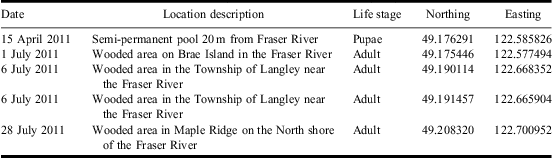
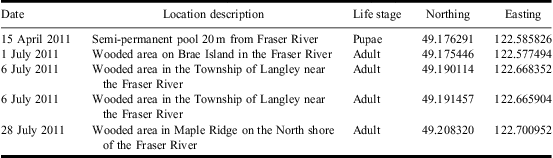
The first verifiable records of this species in Canada were collected from five different locations near the Fraser River in the Township of Langley and Pitt Meadows, British Columbia, Canada. As part of a West Nile virus monitoring program, Center for Disease Control (CDC) light traps were placed in wooded areas near the Fraser River in northern Langley and southern Maple Ridge. Permanent and ephemeral pools were also sampled throughout this area during the spring and summer. Culiseta particeps was collected from five different locations in the summer of 2011 (Table 1). On 15 April 2011, a pupa was collected from a semi-permanent pool of water roughly 50 m2 with an average depth of 0.12 m. The pupa was reared to an adult before identification. Subsequently, four more adult female C. particeps were collected using CDC light traps baited with CO2 (dry ice). On 1 July 2011, an adult C. particeps was collected from a CDC light trap in a wooded area on Brae Island in the Fraser River. Two CDC light traps set on 6 July 2011 each collected one adult C. particeps from a wooded area on the southern banks of the Fraser River near Barnston Island. A fifth C. particeps was collected on 28 July 2011 in a CDC light trap on the northern bank of the Fraser River in Pitt Meadows, British Columbia. A voucher specimen has been donated to the Spencer Entomological Collection in the Beaty Biodiversity Museum at the University of British Columbia (Vancouver, British Columbia, Canada).
Culiseta particeps collection information.
We believe these specimens fill a gap in the described range of this species. As there have been specimens identified in both the southwest coast of Alaska and northwestern Washington State, it is likely that British Columbia is part of the natural habitat range of C. particeps but was previously undetected due to low population levels.