INTRODUCTION
In many jurisdictions in Africa life imprisonment is probably the most confusing sentence, primarily because, as the House of Lords observed, “the words, which the judge is required to pronounce, do not mean what they say”.Footnote 1 Many of us should be forgiven if we thought that life imprisonment meant that a person would be imprisoned for the remainder of his life. The sentence of life imprisonment, like any other criminal penalty, should be understood literally. However, legislation in many African countries points in the opposite direction. In Uganda and Swaziland, for example, a person sentenced to life imprisonment is required to serve a maximum of 20 years.Footnote 2 In South Africa, an offender sentenced to life imprisonment is expected to be considered for parole after serving 25 years,Footnote 3 and in Botswana a prisoner sentenced to life imprisonment is expected to serve at least seven years before being considered for parole.Footnote 4 However, there are countries, such as Kenya,Footnote 5 Ghana,Footnote 6 TanzaniaFootnote 7 and Zimbabwe,Footnote 8 where life imprisonment is given its literal meaning. In these countries a person sentenced to life imprisonment is aware from the first day of his sentence that he will spend the rest of his life behind bars unless pardoned by the state president. The judge who imposes the sentence of life imprisonment knows that it means life imprisonment. Members of the public also know, or ought to know, that life imprisonment does not have any other meaning.
Unlike in the two categories of countries noted above, in Mauritius there were two types of life imprisonment (known as penal servitude for life) before 9 July 2008.Footnote 9 The first was where persons sentenced to penal servitude for life were to spend the rest of their lives in prison unless pardoned by the president. These were offenders sentenced under the Criminal Code for the offences of murder and infanticide,Footnote 10 inciting officers to mutiny,Footnote 11 taking command of the armed forcesFootnote 12 and manslaughter.Footnote 13 The second, which still applies, is where the courts have the discretion to determine what penal servitude for life should mean. In this case it could mean anything between three and 60 years.Footnote 14 It is noteworthy that all offenders, apart from those found guilty of manslaughter, who were sentenced to penal servitude for life before 2007, are allowed to apply to the Supreme Court for their sentences to be reviewed.Footnote 15 This means that different legal regimes apply to people sentenced to what appears to be the same sentence (penal servitude for life), and apparently identical sentences could mean something different depending on the circumstances at the time of their imposition. Before 2006, offenders who were serving penal servitude for life were being released after 20 years' imprisonment. But in 2006 the Supreme Court heldFootnote 16 that penal servitude for life should mean that the prisoner will spend the rest of his life in prison. The Supreme Court's ruling in this regard was overturned by the Privy Council in De Boucherville v The State of Mauritius Footnote 17 in which it was held that a mandatory sentence of penal servitude for life where a prisoner was to spend the rest of his life in prison was arbitrary and disproportionate, and thus unconstitutional for violating the offender's right to a fair hearing under section 10 of the constitution. However, the Privy Council declined to rule whether penal servitude for life without the possibility of release also violated the right not to be subjected to inhuman punishment under section 7 of the constitution.
This article considers the developments that surrounded the change of penal servitude for life from 20 years to “penal servitude proper”, and then the Privy Council's ruling that penal servitude for life where the prisoner was to spend the rest of his life in prison was unconstitutional. It argues that, although the Privy Council came to the correct conclusion, it is regrettable that it did not hold that penal servitude for life, where the offender is to spend the rest of his life in prison, amounted to inhuman punishment. It is also lamentable that the Privy Council did not mention, even in passing, Mauritius's international obligations under the African Charter on Human and Peoples' RightsFootnote 18 and under the International Covenant on Civil and Political RightsFootnote 19 to substantiate its finding that a mandatory sentence of penal servitude for life, where the prisoner could not be released, violated the right to a fair trial. Drawing on the jurisprudence of African countries and international criminal law, amongst other sources, this article argues that there is evidence that imprisonment without a real prospect of release is a cruel, degrading and inhuman punishment.
Where there are substantial and compelling circumstances to do so, Mauritian courts are also given jurisdiction to impose sentences of up to 60 years' imprisonment, in lieu of penal servitude for life for offences under the Criminal Code. This, the article argues, raises two issues which are resolved by drawing on the experience of South African jurisprudence. The first issue relates to the constitutionality of such lengthy sentences. The second relates to the likely challenges that courts will encounter in their attempt to define what amount to substantial and compelling circumstances.Footnote 20
THE ABOLITION OF THE DEATH PENALTY AND ITS IMPACT ON LIFE IMPRISONMENT
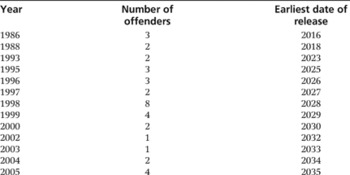
One could argue that the abolition of the death penalty is the main reason why penal servitude for life has attracted overwhelming attention in Mauritius. Before the abolition of the death penalty, an offender sentenced to penal servitude for life was to spend the rest of his life in prison, at least theoretically. This is because, although the law provided for the penalty of penal servitude for life, sections 50–52 of the Reform Institutions ActFootnote 21 and the regulations accompanying itFootnote 22 were silent on the remission of the sentence of penal servitude for life.Footnote 23 This could be interpreted to mean that the legislature thought that a sentence of penal servitude for life meant that the prisoner was to spend the rest of his life in prison unless pardoned by the president. However, the practice was different. When a prisoner was admitted to prison to serve a sentence of penal servitude for life, the prison authorities notified him of his “EDR”, or “earliest date of release”, being after 30 years' imprisonment as shown in table 1 below.
Table 1 illustrates that, by 2005, there were 37 offenders serving penal servitude for life in Mauritius.Footnote 24 The table also demonstrates that, during the time the death penalty was still lawful, very few offenders were being sentenced to penal servitude for life. This is evidenced by the fact that, in the three years preceding the abolition of the death penalty in Mauritius, only seven offenders were sentenced to penal servitude for life. On the other hand, in the first seven years after the abolition of the death penalty, 21 offenders were sentenced to penal servitude for life. However, caution should be exercised because, during this period, all the death penalty sentences were converted to penal servitude for life. However, what is clear is that, since the abolition of the death penalty, the total number of offenders sentenced to penal servitude for life has increased. This is attributable to the fact that life imprisonment is now the most severe sentence that a court can impose.
It is also important to note that, before 2007, every prisoner who was admitted to prison to serve a sentence of penal servitude for life was notified that his EDR would be after serving 30 years. This explains the last column in Table 1. However, in practice prisoners were released after serving 20 years. Another important feature to note about prisoners serving penal servitude for life in Mauritius is the manner in which they are categorized. This is determined by the danger they are considered to represent, and is used as a yardstick to assess whether or not they should be considered for early release. Of the 37 prisoners in table 1, 22 were categorized as A prisoners, six as B and 9 as C, where A represents the most dangerous category of prisoners who should not be released even once their time for release has come.
Offenders sentenced to penal servitude for life in Mauritius 1986–2005Footnote 25

As mentioned earlier, even though the law did not provide for the release of prisoners serving penal servitude for life and although prison records indicated that such prisoners' EDR would be after they had served 30 years' imprisonment, in practice the position was different. Prisoners sentenced to penal servitude for life were being released after 20 years. This is evidenced by the Supreme Court ruling in Dwarkamathsing Jeetun v the Commissioner of Police and Others in the Presence of the Attorney General,Footnote 26 in which the applicant, Mr Jeetun who had been sentenced to penal servitude for life, applied successfully to the court to order his release after serving 20 years. His application was not opposed by the respondents, one of whom was the Commissioner of Prisons. In State of Mauritius v Jeetun Footnote 27 the government, following the Supreme Court's decision in De Boucherville v Commissioner of Prisons and Others Footnote 28 (in which it was held that penal servitude for life should be given its literal meaning), argued that Mr Jeetun should be re-arrested so that he spend the rest of his life in prison. In dismissing the government's application, the Supreme Court held that the principles of “finality in legal proceedings and of the non-deprivation of the benefit of the judgement which a litigant had lawfully obtained”Footnote 29 prevented it from ordering the re-arrest of Mr Jeetun. Most importantly, the court also noted that every prisoner who had been sentenced to penal servitude for life before the abolition of the death penalty “had a legitimate expectation of being released after serving a term of penal servitude of twenty years for manslaughterFootnote 30 and this legitimate expectation grew stronger” after witnessing the release of other prisoners serving the same sentence.Footnote 31 It therefore concluded that:
“… it would be appropriate in the particular circumstances of this case to order the [Commissioner of Prisons] to treat all detainees who have been sentenced to a penal servitude for life, both before and after the coming into operation of the [Abolition of the Death Penalty] Act as if they had been sentenced to the maximum term of 20 years penal servitude the more so as the respondent [Mr Jeetun] has benefited from such an interpretation of the law which cannot now be denied to others who are either in the same situation or have subsequently been sentenced to penal servitude for life for manslaughter”.Footnote 32
One observation should be stressed from the above discussion. The meaning of penal servitude for life varied depending upon the perspective from which it was viewed and the time at which it was imposed. To a prisoner who had just been sentenced in court it meant that he was to spend the rest of his life in prison. However, on the day he arrived in prison he was told that his EDR was actually after 30 years. This meant that he had hope that he would at least be released. After he spent more time in prison he learnt that many prisoners who were serving the same sentence were actually being released after 20 years. He, therefore, knew that he would be released after 20 years. To the prison authorities it appeared that, although they knew that a prisoner serving penal servitude for life was to be released after 20 years, they had to wait for the prisoner to petition the court for his release, and then did not oppose the application. For the court, penal servitude for life meant 20 years and thus it found no difficulty in ordering the prison authorities to release a prisoner sentenced to penal servitude for life after he had served 20 years. Was this not a confusing penal regime? Indeed it was. But what caused it?
THE ROOT OF THE CONFUSION AND THE SOLUTION
It should be emphasised that the reason why prisoners serving a penalty of penal servitude for life were being released after 20 years, and why their EDR was set at 30 years, was attributable to a misinterpretation by the courts and the prison authorities of section 11 of the Criminal Code before and after 1985. Before 1985, section 11 of the Criminal Code provided:
“Penal servitude:
(1) The punishment of penal servitude is imposed for life or for a minimum term of 3 years.
(2) Where in any enactment the punishment of penal servitude is imposed without a term being specified, the maximum term for which the punishment may be imposed is 20 years.”Footnote 33
Section 11(2) of the Criminal Code was amended in 1985Footnote 34 by replacing “20 years” with “30 years”. The prison authorities believed that a life sentence was one of those sentences the term of which had not been specified within the meaning of section 11(2) of the Criminal Code. The result was that a prisoner sentenced to penal servitude for life for an offence committed before 1984 was understood to have been sentenced to 20 years, and one sentenced to the same sentence for an offence committed after 1985 was understood to have been sentenced to 30 years. This explains why, under table 1 above, every prisoner sentenced to penal servitude for life after 1985 has his EDR projected to be after 30 years. Consequently, in the cases of Dwarkamathsing Jeetun v the Commissioner of Police and Others in the Presence of the Attorney General,Footnote 35 and Ramdin v Commissioner of Police and Others,Footnote 36 when the prisoners who had been sentenced to penal servitude for life before 1985 applied to the Supreme Court to order their release after serving 20 years, the prison authorities never opposed the applications and the chief justice ordered the release of those prisoners.Footnote 37
A literal interpretation of section 11 of the Criminal Code should lead to the inevitable conclusion that the sentence of penal servitude for life (under section 11(1)) was distinct from the sentence of imprisonment contemplated under section 11(2). This is because section 11(2) of the Criminal Code anticipated cases where the term had not been specified. But life imprisonment was a specified sentence. Thus, the Supreme Court rightly held that “[t]he very wording of section 11(1) … that ‘the punishment of penal servitude is imposed for life or for a minimum term of 3 years’ indicates that penal servitude for life is a punishment for a specified term viz for life”.Footnote 38 The court succinctly concluded that: “The proposition that penal servitude for life means 20 years in relation to a crime committed before 16 March 1985, the date [act no 1 of 1985] became operative, and 30 years in relation to a crime committed after that date is therefore wrong.”Footnote 39
SUBSTITUTING PENAL SERVITUDE FOR LIFE FOR DEATH SENTENCES
There is universal agreement, at least in human rights circles, that the death penalty is a cruel, inhuman and degrading punishment.Footnote 40 Therefore, one could argue that one of the reasons which may have influenced the legislature in Mauritius to remove the death penalty from the statute books was that it was a cruel and inhuman punishment which offended the constitution.Footnote 41 When the death penalty was abolished in 1995, the Abolition of the Death Penalty ActFootnote 42 enacted two fundamental provisions relating to life imprisonment. Section 2(2) provided that “where under an enactment a Court is empowered to impose a sentence of death the Court shall instead of the sentence of death impose a sentence of penal servitude for life”. Section 2(3) provided that “where any person has been sentenced to death, and at the commencement of this Act, the sentence has not been executed, the person shall be deemed to have been sentenced to penal servitude for life and shall undergo that sentence”.
Section 2(2) was clear in the sense that it required the courts, from the coming into force of the Abolition of the Death Penalty Act, to impose a sentence of penal servitude for life in cases in which they would have imposed the death penalty. However, the problem was that the act was silent on the meaning of penal servitude for life. Arguably the legislature thought that penal servitude for life had to be given its natural meaning, or left it to the courts or the prison authorities to determine what it meant. Section 2(3), like section 2(2), was also clear in the sense that its coming into force automatically substituted all death sentences with sentences of penal servitude for life. However, the problem was that it did not expressly stipulate whether that penal servitude for life had been deemed to commence from the day when the death penalty had been imposed or the date the Abolition of the Death Penalty Act came into force. As a result of that ambiguity, prisoners, prison authorities and the Supreme Court all understood the drafters of the Abolition of the Death Penalty Act to have intended that penal servitude for life as a substitute for the death penalty was deemed to commence on the date the death penalty had been imposed. This explains why in De Boucherville v Commissioner of Prisons and Others Footnote 43 the applicant, who had been sentenced to death in 1986 for murder, unsuccessfully petitioned the Supreme Court for his early release in 2002. However, the order for his release was indirectly secured by the Supreme Court's judgement in State of Mauritius v Jeetun, in which the court held that all the detainees who had been sentenced to penal servitude for life before or after the coming into force of the Abolition of the Death Penalty Act were to be presumed to have been sentenced to 20 years' imprisonment.Footnote 44 It is therefore arguable that, when on 27 February 2007 the prison authorities told Mr De Boucherville that he was to be imprisoned for the remainder of his life, their interpretation of the Supreme Court's jurisprudence was incorrect and was justifiably challenged before the Privy Council.Footnote 45
One vital observation should be made in the light of the procedure by which penal servitude for life was directly substituted for all death sentences in Mauritius. Mauritius adopted a different approach to that adopted in South Africa, which also abolished the death penalty at around the same time. In South Africa, when the Constitutional Court declared the death penalty to be unconstitutional in the well-known case of S v Makwanyane,Footnote 46 the government responded by enacting the Criminal Law Amendment ActFootnote 47 which empowered courts to assess the case of each prisoner who was on death row and determine the appropriate sentence that should be imposed depending on the circumstances of each case. The result was that prisoners were sentenced to varying sentences, which included terms of 15, 25, 30, 40 and 50 years, but the majority were sentenced to life imprisonment.Footnote 48 I argue that, had Mauritius adopted the same approach as South Africa (by giving courts the discretion to determine the appropriate sentence that should be substituted for the death penalty), some prisoners would probably not have been sentenced to penal servitude for life. The automatic conversion of all death penalty sentences into penal servitude for life meant that prisoners were denied an opportunity to prove to courts as a mitigating factor that they were not as dangerous in 1995 as they had been at the time the death penalty was imposed. This omission, as was rightly held by the Privy Council, rendered the sentences imposed arbitrary and disproportionate.Footnote 49
THE SUPREME COURT FINALLY DEFINES PENAL SERVITUDE FOR LIFE: BUT WAS IT RIGHT?
As illustrated earlier, there was confusion over the meaning of a sentence of penal servitude for life. It was only through legal battles that prisoners, who were serving penal servitude for life sentences before the Abolition of the Death Penalty Act came into force, were able to ascertain the exact meaning of the sentence they were serving. This was achieved especially through the Supreme Court ruling in State of Mauritius v Jeetun, in which the court held that all prisoners who had been sentenced to penal servitude for life before and after the Abolition of the Death Penalty Act came into force were to be deemed to have been sentenced to 20 years because they had a legitimate expectation to that effect.Footnote 50
However, that victory came at a higher cost especially for those prisoners who were sentenced to penal servitude for life after that judgment. As mentioned earlier, in De Boucherville v Commissioner of Prisons and Others, the applicant, whose death sentence was commuted to penal servitude for life under section 2(3) of the Abolition of the Death Penalty Act, applied to the Supreme Court for his release after serving 20 years. The court, in dismissing his application, held, amongst other things, that “[t]he golden rule of interpretation remains that when a text is clear, a word must be given its ordinary dictionary meaning so that penal servitude for life can but mean that the penalty is ‘for life’. In Mauritius, therefore, penal servitude for life means that the penalty is to be served for life.”Footnote 51
In State of Mauritius v Jeetun, the applicant, basing its arguments on the ruling in De Boucherville v Commissioner of Prisons and Others to the effect that penal servitude for life should be given its literal meaning, asked the Supreme Court to order the arrest of the respondent who had been serving a sentence of penal servitude for life but had been released by order of the chief justice of the same court after he had served 20 years. The applicant contended that the decision on which the respondent's release was based was wrong. The full bench of the court, in dismissing the application, held that the De Boucherville decision was right, in that penal servitude for life should be given its literal meaning, but added that those who had been sentenced to penal servitude for life “before and after the coming into operation of [the Abolition of the Death Penalty Act should be treated] as if they had been sentenced to the maximum term of 20 years penal servitude”.Footnote 52 This was because they had “strong legitimate expectations of being released”.Footnote 53
This ruling in Jeetun remained unclear and, therefore, susceptible to at least two irreconcilable interpretations in relation to the statement “after the coming into operation [of the Abolition of the Death Penalty Act]”. The first interpretation is that the court meant those prisoners who had been sentenced to penal servitude for life before the abolition of the death penalty and those whose death sentences were commuted to penal servitude for life under section 2(3) of the Abolition of the Death Penalty Act. The second interpretation is that the ruling covered three categories of inmates serving penal servitude for life: those who were serving penal servitude for life sentences before the abolition of the death penalty; those whose death sentences were converted into penal servitude for life; and those prisoners who were directly sentenced to penal servitude for life after the abolition of the death penalty but immediately before the ruling in Jeetun. These would be prisoners who were sentenced to penal servitude for life on or after 14 December 1995 when the Abolition of the Death Penalty Act came into force but before 16 March 2006 when the Jeetun decision was handed down. As a result, those who were, for example, sentenced to penal servitude for life on or after 16 March 2006 were to be in prison for the rest of their lives. If the Privy Council had not declared penal servitude for life (where the prisoner would spend the rest of his life in prison) to be unconstitutional,Footnote 54 and a choice would have had to be made between the above two interpretations, the author would have been inclined to favour the second interpretation, because it would accommodate many prisoners, and there would be a degree of certainty over exactly when penal servitude for life (meaning a prisoner being imprisoned for the rest of his life) started to operate in Mauritius.
One important question that remains is whether the Supreme Court was right in ruling that penal servitude for life should mean “for life”. The court adopted a literal interpretation of “penal servitude for life” because the phrase was not defined in any law in Mauritius. Had the court adopted an historical interpretation of the Abolition of the Death Penalty Act, which might have been the best approach, it would have arrived at the conclusion that the legislature never intended penal servitude for life to mean “for life”. This argument is based on two developments, neither of which was addressed by the Privy Council in De Boucherville v The State of Mauritius. Footnote 55 One relates to the deliberations that took place in the National Assembly when the Abolition of the Death Penalty Bill was tabled and debated; and the other relates to the penalty that was to be imposed for murder after the abolition of the death penalty.
Deliberations in the National Assembly: A recipe for confusion?
When the National Assembly debated the issue of substituting penal servitude for life for the death penalty, the intention was clear that penal servitude for life should mean 20 years. This is evidenced by the Abolition of the Death Penalty BillFootnote 56 to which the president refused his assent unless clause 5 were revised. In its initial form, clause 5 provided for section 222(1) of the Criminal Code to be repealed and replaced with:
“Any person who is convicted of:
(a) murder or murder of a newly born child shall be sentenced to penal servitude for life;
(b) attempt at murder or attempt at murder of a newly born child, shall be liable to penal servitude for life or for a term not exceeding 20 years”.
The bill also added a new subsection (4): “A person sentenced to penal servitude for life under subsection (1)(a) shall not be released before the expiry of 20 years from the commencement of his sentence.”Footnote 57 It is evident that the National Assembly wanted the sentence of penal servitude for life, for the most serious of offences, to mean at least 20 years. When presenting the bill to the National Assembly, the prime minister stated that:
“The purpose of the present Bill is to abolish the death penalty. This is in line with government policy and with the provisions of the Dangerous Drugs Act. The House will recall that it is intended that the death penalty should no longer apply for drug trafficking … It is therefore but natural that now Government should come forward with a proposal to abolish it for other criminal offences as well … We are substituting penal servitude for life whenever the death penalty was applicable. However, in aggravated crimes like murder where there are no mitigating circumstances the punishment has to be adequate. This is why we are providing that in case of murder or murder of a newly born child a person sentenced to penal servitude for life shall not be released until he has served at least 20 years of his sentence.”Footnote 58
The prime minister's statement shows that the National Assembly never intended penal servitude for life to mean that the offender was to be detained for the rest of his life. The problem with the bill, together with the accompanying explanation, was that it had the potential to spread confusion with regard to offenders who had been sentenced to penal servitude for life. In the first place, although those who had not committed murder knew that their sentence of penal servitude for life could mean anything less than 20 years' imprisonment, they would not know exactly what their sentence meant. This means that either the court would have had to impose a minimum period to be served before the offender could be released or the prison authorities would have had to devise a policy that prisoners sentenced to penal servitude for life were not to be released unless they had served a specified number of years. Either way, the court or the prison authorities had to devise a uniform policy applicable to all prisoners sentenced to penal servitude for life in cases other than murder to avoid a constitutional challenge, for example on the ground that the policy was discriminatory.
A second challenge would have resulted had the bill been passed setting 20 years as the minimum for offenders sentenced to penal servitude for life for serious offences, in the sense that some prisoners were likely to serve more years in prison than others. Although the bill had proposed a minimum sentence of 20 years, it did not provide a maximum. That would have resulted in some prisoners being sentenced to a sentence of penal servitude for life which meant 20 years and others to a sentence of penal servitude for life which meant more than 20 years, and probably their whole life. This would have raised the constitutional issue of non-discrimination and would probably have been challenged in the courts. It should be emphasised that the deliberations in the National Assembly showed that the legislature never intended penal servitude for life to mean “for life”. As will be shown, the reason why the president refused to assent to the bill was not because he thought that penal servitude for life should mean that the prisoner must be detained for the rest of his life but because he thought that a penal servitude for life sentence meaning 20 years was a lenient sentence for murderers and attempted murderers. He probably wanted them to be in prison for longer than 20 years. This explains why the mandatory term of 45 years for murder was introduced in the bill and the president assented to it.
The new sentence for murder: Mandatory 45 years
When the president refused to assent to the bill, it was revised by the National AssemblyFootnote 59 “with the avowed objective that the new clause 5 would provide heavier penalties in respect of persons convicted of murder, attempt at murder, murder of a newly born child or an attempt thereof”.Footnote 60 The result was that section 222Footnote 61 of the Criminal Code was amended to empower courts to impose a sentence of 45 years' imprisonment for offenders found guilty of murder. Curiously, section 223Footnote 62 of the Criminal Code, which provided for a penalty of penal servitude for life for offenders found guilty of manslaughter, was not amended when section 222 was amended. These two developments resulted in two inherent challenges: that the sentence of 45 years' imprisonment was mandatory for murder; and that murder attracted 45 years' imprisonment whereas the less serious offence of manslaughter attracted penal servitude for life, which was arguably a heavier sentence than that imposed for murder. It was clear that these flaws could not survive the courts' scrutiny.
After realizing that the Criminal Code provided a heavier penalty for manslaughter than it did for murder, the Supreme Court held that it believed that it was “more a matter of fine tuning which was obviously lacking at the time the law was amended and which ought to be remedied by the relevant authority in due course”.Footnote 63 In its later decision, the Supreme Court held that a law that provided a heavier sentence for manslaughter than for murder was an “absurdity” and that it could never have been the intention of the legislator to punish manslaughter more severely than murder.Footnote 64 It concluded that the law had to be construed to mean that a person who had been convicted of murder had to be sentenced to 45 years' imprisonment and that one convicted of manslaughter had to be sentenced to 20 years' imprisonment.Footnote 65 One could argue that, had the court not declared penal servitude for life to mean that the offender was to be detained for the rest of his life, the amendment to section 222 would not have resulted in an absurdity even if section 233 had been left intact. This is because a person convicted of murder would have to be sentenced to 45 years' imprisonment and one convicted of manslaughter would have to be sentenced to penal servitude for life, which in effect meant 20 years' imprisonment. The result would be that a person convicted of manslaughter served a lesser sentence than one convicted of murder.
As noted above, section 222 of the Criminal Code was amended to require courts to impose a sentence of 45 years' imprisonment on offenders found guilty of murder. This eliminated the sentencing court's discretion to impose any sentence it thought fit in such cases. Even if there were mitigating or extenuating circumstances that would have persuaded the court to impose a lesser sentence in cases of murder, they were irrelevant. This clearly would have to be challenged sooner or later. The constitutionality of section 222 was challenged in the case of Philibert and Six Others v The State,Footnote 66 in which it was argued that sections 222(1) of the Criminal Code and 41(3) of the Dangerous Drugs ActFootnote 67 offended sections 1, 3, 5, 7 and 10 of the constitution, in the sense that they, inter alia, infringed the doctrine of separation of powersFootnote 68 and were also incompatible with the concept of a fair trial. The Supreme Court held that “… the problem relating to mandatory sentences in Mauritius … [was] one of ‘proportionality’ not of ‘separation of powers’”.Footnote 69 The court added that the issue to be resolved was “whether the imposition of a mandatory minimum sentence would be startlingly or disturbingly inappropriate” in the circumstances.Footnote 70 It concluded that:
“A law which denies an accused party the opportunity to seek to avoid the imposition of a substantial term of imprisonment which he may not deserve, would be incompatible with the concept of a fair hearing enshrined in section 10 of our Constitution. A substantial sentence of penal servitude like in the present situation cannot be imposed without giving the accused an adequate opportunity to show why such sentence should not be mitigated in the light of the detailed facts and circumstances surrounding the commission of the particular offence or after taking into consideration the personal history and circumstances of the offender or where the imposition of the sentence might be wholly disproportionate to the accused's degree of criminal culpability. We hold and declare that section 222(1) of the Criminal Code and section 41(3) of the Dangerous Drugs Act 2000 … contravened section 7(1) of the Constitution inasmuch as the indiscriminate mandatory imposition of a term of 45 years penal servitude in all cases contravened the principle of proportionality and amounted to ‘inhuman or degrading punishment or other such treatment’ contrary to section 7(1) of the Constitution.”Footnote 71
In its 2007 annual report, the Mauritius National Human Rights Commission considered the situation of prisoners who had been sentenced to 45 years' imprisonment under the Dangerous Drugs Act before it was declared unconstitutional. It recommended that: those prisoners should have their sentences reviewed by a specially constituted panel of Supreme Court judges; or parliament should amend the law to stipulate how their sentences should be dealt with; or the prisoners be permitted to apply to the Commission on the Prerogative of Mercy. The commission also recommended that the Attorney General should work hand in hand with the minister of justice and human rights to devise “the way forward out of this dilemma” and ensure that prisoners who were sentenced to the mandatory 45 years had their sentences revised.Footnote 72 The Privy Council ruled that the Supreme Court has the jurisdiction to review the sentences of all prisoners who were sentenced to a mandatory 45 years or to mandatory penal servitude for life.Footnote 73
PENAL SERVITUDE FOR LIFE RANGING BETWEEN THREE AND 60 YEARS: DIFFERENT STANDARDS
Section 150A of the 2007 Criminal Procedure (Amendment) Act provides that “[w]here under any enactment other than the Criminal Code a Court is empowered or required to pass a sentence of penal servitude for life, the sentence may, at the discretion of the Court, be for a term of not less than 3 years and not exceeding 60 years.” Section 150A raises at least one interesting point: with respect to offences other than those under the Criminal Code that attract life sentences, the court has the discretion to determine, depending on the circumstances, the length of penal servitude for life. This means that, depending on, for example, the circumstances under which the offence was committed, the individual circumstances of the accused, the issue of proportionality, and what the court thinks should be the objective that will be attained by imposing a particular sentence, the court has the discretion to impose different sentences. These would be: penal servitude for life, which meant being imprisoned for life before such a sentence was declared unconstitutional by the Privy Council;Footnote 74 or penal servitude for life which means either three years' imprisonment or something between three and 60 years' imprisonment; or 60 years' imprisonment. It is argued that this provision is likely to cause confusion with regard to the meaning of penal servitude for life in Mauritius, in the sense that different courts or different judges of the same court might give a different meaning to a sentence of penal servitude for life. Consequently, the sentence will probably lose its meaning and members of the public and some policy makers will, in some cases, question the court's reasoning in imposing a sentence of penal servitude for life. This is more likely to happen when newspapers report that an offender has been sentenced to penal servitude for life but will be released after three years.
Another problem that is likely to be caused by the application of section 150A relates to longer sentences. As mentioned earlier, courts have the discretion to determine what penal servitude for life should mean, provided that, if they intend to impose a specified number of years, the sentence should not exceed 60 years. This means that some courts, depending on the nature of the offence committed by the offender and other aggravating circumstances, may decide to impose a sentence of as long as 50 years or more. The Privy Council, though questioning the constitutionality of a mandatory sentence of penal servitude for life, did not question the constitutionality of lengthy prison terms.Footnote 75 This means that Mauritian courts can still legally impose lengthy prison terms. If this were to happen, it would raise some human rights issues. It would mean, as the Constitutional Court of Namibia held, that such offenders have just been reduced to numbers behind bars because their release would be very unlikely.Footnote 76 This analysis should be viewed in the light of the fact that the Mauritian Reform Institutions Act has no provision under which a person sentenced to penal servitude for life may have his sentence remitted.Footnote 77 The South African Constitutional Court has also held that sentences which effectively deny offenders the prospect of being released amount to cruel and inhuman punishment.Footnote 78 The European Court of Human Rights has also held that, for a sentence of life imprisonment to pass the human dignity test, the prisoner should have a real prospect of being released.Footnote 79 International human rights law and international criminal jurisprudence are evidence that the international community has moved away from sentences where the offender may be detained until his death.Footnote 80 It is, therefore, argued that, if any court in Mauritius imposed a determinate sentence that could amount to the prisoner spending the rest of his life in prison, it may amount to a violation of section 7(1) of the constitution which prohibits inhuman punishment.Footnote 81 Mauritius would also be in violation of its international obligations under some of the treaties to which it is a state party.Footnote 82
PENAL SERVITUDE FOR LIFE UNDER THE CRIMINAL CODE
Section 4(1) of the Criminal Procedure (Amendment) Act amended sections 61, 64, 222(1) and 223(1) of the Criminal Code by providing that an offender sentenced under any of those sections should be sentenced to imprisonment “for life or, where the Court is satisfied that substantial and compelling circumstances exist which justify the imposition of a lesser sentence and has entered those circumstances on the record of the proceedings, for a term not exceeding 60 years”. This provision should be read together with section 150A discussed above. The combined effect was that a person sentenced to penal servitude for life under the relevant provisions of the Criminal Code was meant to remain in prison for the rest of their life. The human rights arguments noted above regarding lengthy prison terms apply equally to the type of penal servitude contemplated under the Criminal Code. The Privy Council has also held that penal servitude for life, where the offender was to be imprisoned for the rest of his life without being given a chance to plead in mitigation is “manifestly disproportionate and arbitrary and so contrary to section 10 [on the right to a fair trial] of the Constitution of Mauritius”.Footnote 83 In some countries, like the United States of America, this type of life imprisonment is called life imprisonment without the possibility of parole.Footnote 84 Courts in South Africa, Namibia and Germany, and the European Court of Human Rights, have held that life imprisonment without the possibility of parole is a cruel and inhuman punishment.Footnote 85 As already mentioned, the Mauritian constitution expressly prohibits inhuman punishment, as do the international human rights treaties to which Mauritius is party, obliging it to promote and protect the rights and freedoms under those treaties.Footnote 86 Therefore, penal servitude for life, as contemplated in the Criminal Code and supported by the Supreme Court in its jurisprudence, is a cruel and inhuman punishment which contravenes the constitution. It is unfortunate that the Privy Council did not express an opinion on whether a sentence of penal servitude for life, where the offender has no real and tangible prospect of being released, did not contravene section 7 of the Mauritian Constitution which prohibits inhuman and cruel punishment.Footnote 87
It could be argued that offenders sentenced to penal servitude for life could still be pardoned by the state president under section 75(1) of the constitution.Footnote 88 In De Boucherville, the Privy Council also declined to release the appellant, whose sentence of penal servitude for life it declared unconstitutional for violating his right to a fair trial, on the ground that he had not fully explored the possibility of his release under section 75 of the constitution.Footnote 89 This could be interpreted to mean that the Privy Council believed that offenders serving a sentence of penal servitude for life have a real and tangible prospect of being pardoned by the president under section 75. Indeed, the Supreme Court in Jeetun, after concluding that penal servitude for life should be given its literal meaning, was quick to add:
“[W]e agree with the National Human Rights Commission that ‘the sentence of penal servitude for life does not mean that the detainee has to spend the rest of his life in prison’ – vide paragraph 54 of its 2004 Report et sequitur. It goes without saying that any person sentenced for any term of penal servitude or imprisonment may also have his sentence reviewed from time to time by the Commission and the Parole Board in an appropriate case – vide sections 51 and 51 A of the Reform Institutions Act. In determining the sentence which a detainee has yet to serve, various factors might be taken into consideration, including pure retribution, expiation, expressions of the moral outrage of society, maintenance of public confidence in the administration of justice, deterrence, the interests of victims, rehabilitation and, last but not least, mercy.”Footnote 90
Two important observations need to be made with regard to this observation. First, one doubts whether the court should have relied on the 2004 report of the National Human Rights Commission to which it referred to support its position that offenders sentenced to penal servitude for life were in practice not to be detained for the rest of their lives. At the time the report was written, the National Human Rights Commission genuinely believed that a person sentenced to penal servitude for life was not to spend the rest of his life in prison. It is argued that this belief was rooted in two factors: that the prison records indicated that a person who had been sentenced to penal servitude for life was at most required to serve a term of 30 years' imprisonment; and, perhaps most importantly, there was a practice, alluded to earlier, that offenders who had been sentenced to penal servitude for life were being released by the Supreme Court after serving 20 years. However, in 2006 the position had changed. The Supreme Court had held that penal servitude for life had to be given its literal meaning, although this ruling was reversed by the Privy Council in July 2008.
The second point to be noted from the observation above relates to the court's reference to sections 51 and 51A of the Reform Institutions Act. These two provisions do not expressly mention that a person who has been sentenced to penal servitude for life shall have his case reviewed after some period of time. Section 51Footnote 91 refers to other prison terms. This could be interpreted to mean that the legislature excluded prisoners serving penal servitude for life from the benefit of having their sentences reviewed after a certain period of time.Footnote 92 As mentioned earlier, in jurisdictions like Uganda, Botswana, Swaziland and South Africa, where the legislature never intended life imprisonment to mean that the offender will be detained for the rest of his life, the legislative framework specifically governs the circumstances under which prisoners serving life sentences may be released. In fact, section 51A of the Reform Institutions Act excludes the following offenders from being granted parole or having their sentences remitted: “a person who has been convicted of (a) an offence under the Dangerous Drugs Act … [and] (b) a sexual offence on a child or handicapped person”. The implication is that those sentenced to penal servitude for life under the Dangerous Drugs Act do not qualify for parole or to the remission of their sentence. Therefore, the court's interpretation of the ambit of sections 51 and 51A was debatable, to say the least.
Is the release window for prisoners serving penal servitude for life open wide enough?
As mentioned earlier, offenders sentenced to penal servitude for life could be pardoned by the president under section 75(1) of the constitution. In practice, since 2006 and even after the Privy Council ruling in July 2008 to the effect that offenders sentenced to life imprisonment should have the prospect of being released,Footnote 93 section 75 remains the only likely window through which those prisoners could escape imprisonment for lengthy prison terms. For the president to pardon any prisoner, he must first of all be advised by the Commission on the Prerogative of Mercy, established under section 75(2) of the constitution. The commission would probably have to study the relevant judgment, the recommendations made by the judge at sentencing, and the recommendations made by the prison authorities relating to that particular prisoner, in order to determine whether the prisoner should be recommended to the president for pardon or early release. The challenge with this approach is that prisoners do not know what is expected of them in order for the commission to consider them suitable candidates for pardon or early release. Most importantly, the president is not obliged to release any prisoner just because the commission has advised him to do so. This means that prisoners will always remain in a state of uncertainty, not knowing whether they could ever qualify to be, at least, recommended for pardon or early release. The German Constitutional Court held that, for the sentence of life imprisonment to pass the human dignity test, legislation should be in place detailing the circumstances under which a prisoner may be released.Footnote 94 Some judges of the European Court of Human Rights have also held that prisoners should have “a real and tangible prospect of release” otherwise life imprisonment will be a cruel and inhuman punishment.Footnote 95
The impression from the Supreme Court's jurisprudence, although the Privy Council appears to have ignored it,Footnote 96 is that the Commission on the Prerogative of Mercy does not seem to be carrying out its work in a satisfactory manner. In cases where the Supreme Court wanted prisoners who were serving sentences of penal servitude for life to be released after 20 years, it avoided instructing the commission to oversee their release. Instead, the court decided that such prisoners should be released pursuant to its judgment. In the court's words:
“We could have made a recommendation to the Commission [on the Prerogative of Mercy] to ensure that all those who have been sentenced to penal servitude for life in respect of manslaughter both before and after the coming into operation of the [Abolition of the Death Penalty] Act should serve only a maximum term of 20 years' penal servitude. But we have declined to do so for two reasons. First, Mr Ramdin who, it is recalled, withdrew his motion in Court and intended to seek redress from the Commission, is still in prison. Boucherville, cited already, obviously made matters worse. Second, the Commission might very well decide not to act upon our recommendation. In such a case, Mr Ramdin and all the others who have been sentenced for manslaughter to penal servitude for life both before and after the coming into operation of the Act will be left with no redress.”Footnote 97
This analysis shows that the law and mechanisms in place do not favour the interpretation of the Supreme Court and Privy Council that offenders sentenced to penal servitude for life have, in the words of the European Court of Human Rights, a “real and tangible prospect” of being released. Their release, if it ever materializes, would depend on several unclear administrative decisions that can never be subjected to court or public scrutiny. This may result in some prisoners being pardoned because of their political affiliation, race, sex or nationality, amongst other grounds, and others being imprisoned for lengthy periods because of the same grounds. There is also evidence that some prisoners who want to petition the president for their release under section 75 of the constitution are sidelining the Commission on the Prerogative of Mercy and addressing their complaints or applications to the National Human Rights Commission.Footnote 98 This could be attributable to two factors: that such prisoners do not have confidence in the Commission on the Prerogative of Mercy and believe that the National Human Rights Commission is positioned to present their cases to the president more properly and convincingly than the Commission on the Prerogative of Mercy; or that they may not be aware of the existence of the Commission on the Prerogative of Mercy. Either way, the fact that prisoners are contacting the National Human Rights Commission and not the Commission on the Prerogative of Mercy could indicate that the latter has not made its role well-known among prisoners. In at least one incident, when the prisoner contacted the National Human Rights Commission for it to present his case to the president for pardon or early release under section 75, the National Human Rights Commission, instead of referring the prisoner's case to the Commission on the Prerogative of Mercy, referred it to the director of public prosecution.Footnote 99 This could be interpreted to indicate that the National Human Rights Commission casts doubt on the commission's ability to give the prisoner's case the attention it deserved to secure a presidential pardon.
This discussion of the manner in which the Commission on the Prerogative of Mercy operates, and the lens through which it is viewed by the National Human Rights Commission and the Supreme Court, demonstrates that the window through which prisoners serving a sentence of penal servitude for life could secure their pardon or early release is not wide open. It is regrettable that the Privy Council did not pay attention to that fact and also that the lawyers representing the appellant did not draw the Privy Council's attention to these facts.
SUBSTANTIAL AND COMPELLING CIRCUMSTANCES TO DEPART FROM A SENTENCE OF PENAL SERVITUDE FOR LIFE
As mentioned earlier, in the absence of substantial and compelling circumstances, courts are required by sections 61, 64, 222(1) and 223(1) of the Criminal Code, as amended by the 2007 Criminal Procedure (Amendment) Act, to sentence offenders convicted of offences under those sections to penal servitude for life. The challenge is that the Criminal Procedure (Amendment) Act does not define or describe “substantial and compelling circumstances”. Consequently, courts have wide discretion to determine, on a case by case basis, what constitute substantial and compelling circumstances. Experience from South Africa, where the same phrase was introduced in 1997,Footnote 100 makes one anticipate that different judges are likely to come to confusing, and at times conflicting, interpretations of what constitute substantial and compelling circumstances. The Privy Council appears to reason that there is no difference between substantial and compelling circumstances, on the one hand, and mitigating factors, on the other.Footnote 101
The Privy Council's equating of substantial and compelling circumstances with mitigating factors appears to have opened an avenue for the courts in Mauritius also to invoke mitigating factors, that have always formed the basis for imposing less heavy penalties, as substantial and compelling circumstances. Whether this would be the correct position or not will have to be resolved by the Supreme Court ruling on what substantial and compelling circumstances should include, or by the legislature amending the law to guide lower courts as to what substantial and compelling circumstances should include or exclude. By equating substantial and compelling circumstances with mitigating factors, the Privy Council appears to the author to have ignored the intention of the legislature which expressly provided for substantial and compelling circumstances instead of mitigating factors.
Experience from South Africa tells us that, had the legislature wanted courts to take mitigating factors into account, it would have expressly stated so, and would not have used the “composite yardstick” of substantial and compelling circumstances. In South Africa, the Criminal Law Amendment Act of 1997 requires courts to sentence offenders convicted of some serious offences, such as murder and rape, to life imprisonment unless there are substantial and compelling circumstances. Until 2001 the South African High Courts devised confusing, and at times conflicting, interpretations of what amounted to substantial and compelling circumstances. In 2001 the Supreme Court of Appeal, in the famous case of S v Malgas, established detailed guidance on what the legislature intended to mean by substantial and compelling circumstances. It held that:
“A. Section 51 has limited but not eliminated the courts' discretion in imposing sentence in respect of offences referred to in Part 1 of Schedule 2 (or imprisonment for other specified periods for offences listed in other parts of Schedule 2). B. Courts are required to approach the imposition of sentence conscious that the legislature has ordained life imprisonment (or the particular prescribed period of imprisonment) as the sentence that should ordinarily and in the absence of weighty justification be imposed for the listed crimes in the specified circumstances. C. Unless there are, and can be seen to be, truly convincing reasons for a different response, the crimes in question are therefore required to elicit a severe, standardised and consistent response from the courts. D. The specified sentences are not to be departed from lightly and for flimsy reasons. Speculative hypotheses favourable to the offender, undue sympathy, aversion to imprisoning first offenders, personal doubts as to the efficacy of the policy underlying the legislation, and marginal differences in personal circumstances or degrees of participation between co-offenders are to be excluded. E. The legislature has however deliberately left it to the courts to decide whether the circumstances of any particular case call for a departure from the prescribed sentence. While the emphasis has shifted to the objective gravity of the type of crime and the need for effective sanctions against it, this does not mean that all other considerations are to be ignored. F. All factors (other than those set out in D. above) traditionally taken into account in sentencing (whether or not they diminish moral guilt) thus continue to play a role; none is excluded at the outset from consideration in the sentencing process. G. The ultimate impact of all the circumstances relevant to sentencing must be measured against the composite yardstick (‘substantial and compelling’) and must be such as cumulatively justify a departure from the standardised response that the legislature has ordained. H. In applying the statutory provisions, it is inappropriately constricting to use the concepts developed in dealing with appeals against sentence as the sole criterion. I. If the sentencing court on consideration of the circumstances of the particular case is satisfied that they render the prescribed sentence unjust in that it would be disproportionate to the crime, the criminal and the needs of society, so that an injustice would be done by imposing that sentence, it is entitled to impose a lesser sentence. J. In so doing, account must be taken of the fact that crime of that particular kind has been singled out for severe punishment and that the sentence to be imposed in lieu of the prescribed sentence should be assessed paying due regard to the bench mark which the legislature has provided.”Footnote 102
Since then, the South African courts have developed what are regarded as substantial and compelling circumstances. In Direkteur van Openbare Vervolgings, Transvaal v Makwetsja it was held that the “youthfulness [of the offender] per se is a substantial and compelling circumstance”.Footnote 103 In S v Ferreira and Others Footnote 104 the first appellant, a woman in an abusive relationship, contracted the second and third appellants to murder her partner believing that his death was the only way by which she could escape from the abusive relationship. The Supreme Court of Appeal held that the belief that the only way to escape an abusive relationship was to kill her partner was a substantial and compelling circumstance which necessitated the imposition of a term of imprisonment of six years instead of life imprisonment. Courts have held that it is a substantial and compelling circumstance if the rape of the victim is “not one of the most serious manifestations of rape”.Footnote 105 Courts have also held that the absence of previous convictions and the fact that the accused had “displayed remorse and was a good candidate for rehabilitation” are substantial and compelling circumstances.Footnote 106 It has also been held that the fact that the accused was of low intelligence is a substantial and compelling circumstance.Footnote 107 The Supreme Court of Appeal has held that the fact that the appellant had a dependant wife and children, and was gainfully employed, were substantial and compelling circumstances.Footnote 108 The Supreme Court of Appeal also held in S v Thebus and Another Footnote 109 that the fact that the accused had played a minimal role in the commission of the crime was one of the substantial and compelling circumstances justifying departure from the prescribed minimum sentence.Footnote 110
The above cases show that courts determine what amount to substantial and compelling circumstances depending on the circumstances under which the offence was committed, the personal characteristics of the offender, and the effects the crime had on the victim, amongst other things. It is evident that, even in South Africa, where the law imposing life imprisonment on offenders found guilty of serious crimes unless there are substantial and compelling circumstances has been on the statute book for over a decade, there is not an exhaustive list of what amount to substantial and compelling circumstances. Using their discretion and the Malgas criteria as a guide, the South African courts will continue developing their jurisprudence in this area until such time as there is an exhaustive list, or something close to an exhaustive list, of what amount to substantial and compelling circumstances. Courts in Mauritius are also likely to follow the same route as those in South Africa. Mauritian courts should refer to South African jurisprudence as a persuasive interpretative tool in their attempt to define or enumerate what are substantial and compelling circumstances. However, this does not mean that courts in Mauritius are not at liberty to construct their own understanding of substantial and compelling circumstances without being influenced by South African jurisprudence.
CONCLUSION
The sentence of life imprisonment is truly a unique one in many countries, but more so in Mauritius where it has had more than one meaning, as illustrated in this article. This article has raised several issues. It concludes with the following observations and recommendations.
Although the Privy Council ruled that penal servitude for life, where the prisoner was to spend the rest of his life in prison, is unconstitutional for violating the prisoner's right to a fair trial, it avoided ruling that such imprisonment also violates section 7 of the constitution which prohibits inhuman punishment. This is regrettable in the light of evidence from the European Court of Human Rights (some of whose decisions the Privy Council referred to in passing) and courts in Germany, South Africa and Namibia which have held that imprisonment without the possibility of release is inhuman. It is also regrettable that the Supreme Court of Mauritius and the Privy Council do not, in the decisions discussed, refer to international human rights treaties to which Mauritius is party, obliging it to give effect to international human rights law in its domestic courts.
The National Assembly, in consultation with civil society in Mauritius, should consider amending the Reform Institutions Act to provide for the circumstances in which a prisoner sentenced to penal servitude for life could be released. There is a need for the Commission on the Prerogative of Mercy to “market” itself to prisoners so that they may contact it in cases where they are seeking a presidential pardon. Mauritian courts are encouraged to refer to South African jurisprudence on substantial and compelling circumstances in their bid to construct their jurisprudence in this area. Mauritian courts are also encouraged to refer to international human rights treaties and jurisprudence when developing their jurisprudence on punishment and sentencing. Courts should also be encouraged to refer to jurisprudence from other African countries, such as South Africa (the Constitutional Court) and Namibia (the Supreme Court), in interpreting issues regarding punishment and sentence. Had the Supreme Court of Mauritius referred to the jurisprudence of the Constitutional Court of South Africa or the Supreme Court of Namibia on issues around the human rights implications of life imprisonment without the real possibility of release, it would probably have come to a different ruling, and no appeal would have been made to the Privy Council. Had the Privy Council also referred to decisions from South Africa, Germany and Namibia on the fact that life imprisonment without the possibility of release is inhuman and degrading, it would probably have made a ruling regarding section 7 of the constitution.