Introduction
Hunting is a major threat to large carnivores worldwide (Ripple et al. Reference Ripple, Estes, Beschta, Wilmers, Ritchie, Hebblewhite and Berger2014). Because large carnivores usually have a disproportionate role in ecosystem balance, the negative impacts of carnivore hunting are likely to affect entire ecosystems. Thus, hunting of carnivores is of great concern (Ripple et al. Reference Ripple, Estes, Beschta, Wilmers, Ritchie, Hebblewhite and Berger2014).
Carnivore hunting has frequently been associated with retaliation for livestock predation (Carvalho Jr et al. Reference Carvalho, Zarco-González, Monroy-Vilchis and Morato2015, Jędrzejewski et al. Reference Jędrzejewski, Carreño, Sánchez-Mercado, Schmidt, Abarca, Robinson and Boede2017). Yet, its motivations are complex and not always directly related to this kind of human–wildlife conflict (see Madden Reference Madden2004). Several social, psychological and contextual factors may interact to influence the acceptance, intentions and behaviour of individuals regarding carnivore hunting (Dickman Reference Dickman2010, Engel et al. Reference Engel, Vaske, Bath and Marchini2017, Inskip et al. Reference Inskip, Fahad, Tully, Roberts and MacMillan2014, Marchini & Macdonald Reference Marchini and Macdonald2012). For example, Marchini and Macdonald (Reference Marchini and Macdonald2012) applied the Theory of Planned Behaviour to investigate rancher’s intentions to kill jaguars (Panthera onca) in Brazil, and they found that hunting depended on a complex interplay between psychological (internal) and social (external) influences. Similarly, Inskip et al. (Reference Inskip, Fahad, Tully, Roberts and MacMillan2014) found that motivations for tiger (Panthera tigris) hunting in Bangladesh depend on a mix of social, psychological and contextual drivers. External factors such as fear of sanctions and social norms also have a role to play in deterring or stimulating illegal hunting of carnivores (St John et al. Reference St John, Keane, Edwards-Jones, Jones, Yarnell and Jones2012, Reference St John, Mai and Pei2015). Since effective interventions aiming at behavioural change depend on knowledge of the underlying factors of behaviour (Klöckner Reference Klöckner2013, Steg & Vlek Reference Steg and Vlek2009), a better understanding of the major drivers of jaguar hunting is needed in order to guide actions to mitigate this impact (Engel et al. Reference Engel, Vaske, Bath and Marchini2017).
In Amazonian direct use reserves (hereafter, sustainable use reserves), hunting of carnivores is a pressing issue (Carvalho Jr & Pezzuti Reference Carvalho and Pezzuti2010, Ramalho Reference Ramalho2012). Sustainable use reserves are designed to promote both sustainable livelihoods and management of natural resources (Fearnside Reference Fearnside1989). As such, sustainable use reserves officially constitute a major conservation strategy, representing the largest share of formally protected areas in Brazilian Amazonia (Peres Reference Peres, Navjot, Sodhi, Gibson and Raven2013). However, to effectively protect carnivores, sustainable use reserves must actively promote coexistence between humans and carnivores.
Hunting of carnivores is illegal in Brazil and investigations can be challenging, since people fear reprisals if they speak openly about it. However, because non-commercial hunting of non-threatened species for subsistence purposes is allowed in sustainable use reserves (Antunes et al. Reference Antunes, Rebêlo, Pezzuti, Vieira, Constantino, Campos-Silva and Fonseca2019), communities living inside these areas are usually more willing to share information on this topic. Nevertheless, underreporting may occur (Carvalho & Pezzuti Reference Carvalho and Pezzuti2010, Ramalho Reference Ramalho2012). In recent years, a suite of specialized techniques for sensitive research, originally developed within the social sciences, have been adopted for studying non-compliance in natural resource use and conservation (Gavin et al. Reference Gavin, Solomon and Blank2010, Nuno & St John Reference Nuno and St John2015, St John et al. Reference St John, Brockington, Bunnefeld, Duffy, Homewood, Jones and Keane2016). These methods are designed to protect respondent privacy and usually provide more reliable results than conventional, direct questioning methods (Nuno & St John Reference Nuno and St John2015, St John et al. Reference St John, Brockington, Bunnefeld, Duffy, Homewood, Jones and Keane2016).
In this paper, I investigate how individual attributes, perceptions of risk and social norms affect jaguar hunting acceptance in two eastern Brazilian Amazonia sustainable use reserves. I also assess jaguar hunting prevalence in the area through direct questioning and the randomized response technique (RRT; a specialized method for sensitive research; Nuno & St John Reference Nuno and St John2015). I also compare the performance of the two methods. Finally, I discuss the results in order to contextualize how the findings can contribute to the prospects of coexistence between people and jaguars in these areas.
Methods
Study area
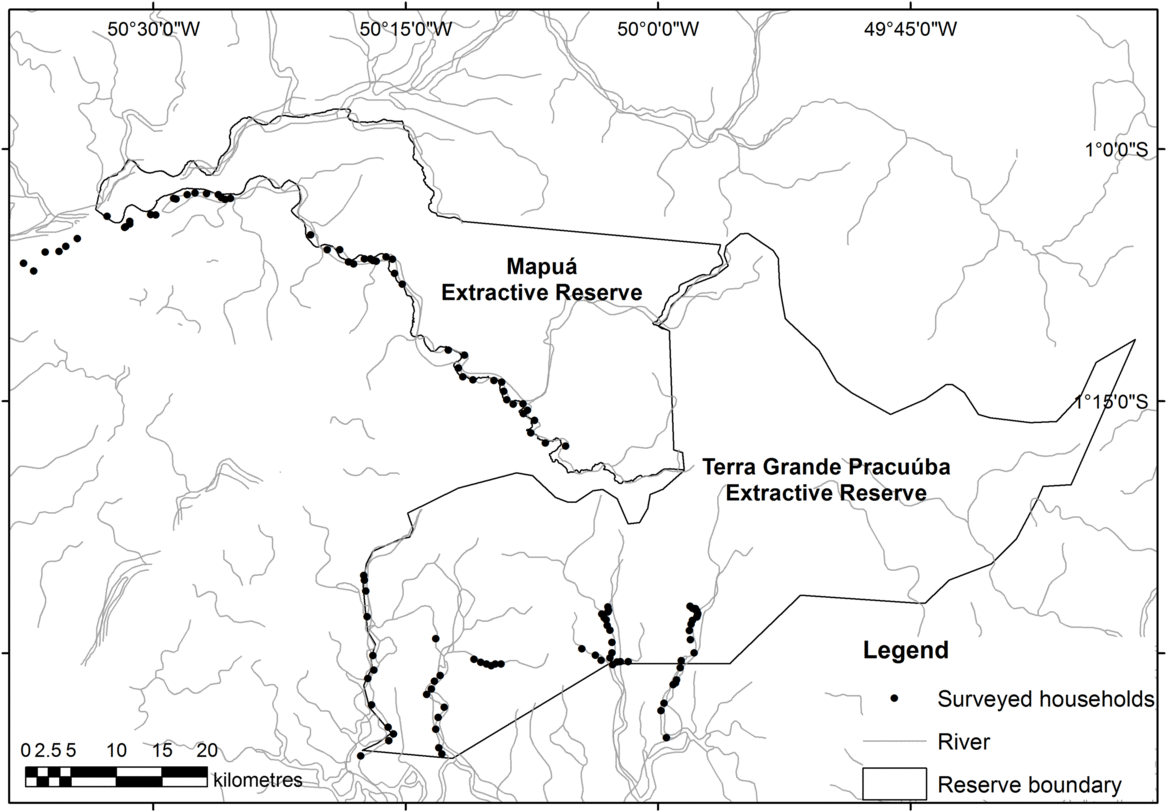
The study was conducted in the Mapuá Extractive Reserve (MER; 94 000 ha) and the Terra Grande Pracuúba Extractive Reserve (TGPER; 195 000 ha), two contiguous sustainable use areas located on the western part of Marajó Island (Fig. 1), the main island at the mouth of the Amazon river (c. 50 000 km2) and one of the largest river islands in the world (Goulding et al. Reference Goulding, Barthem and Ferreira2003). Together, the two reserves host c. 1400 households (Ferreira et al. Reference Ferreira, Sobrinho and Vasconcellos2017, NS Menezes, personal communication 2017). The households are distributed along the main rivers draining to the west of the island. The main activities in the reserves are subsistence agriculture, fishing, hunting, small-scale selective logging and extraction of non-timber forest products (Goulding et al. Reference Goulding, Barthem and Ferreira2003, Smith Reference Smith1999). Apart from poultry and dogs, livestock is rare in the reserves, in contrast to the eastern half of the island, which is a major cattle area (Goulding et al. Reference Goulding, Barthem and Ferreira2003). The study was partly motivated by a recent record of human–jaguar conflict in the study area, where dogs from 24 different households were reportedly killed by jaguars in MER between 2011 and 2012 (EAR Carvalho Jr, unpublished data 2012).
Diagrammatic map of Mapuá and Terra Grande Pracuúba Extractive Reserves in Marajó Island, showing the distribution of surveyed households.

Data collection
Between September and October 2013, I surveyed 134 households along the rivers Mapuá, Cantagalo and Coqueiro at MER and along the rivers Guajará, Mutuacá and Piriá-Miri in TGPER, as well as households bordering both reserves (Fig. 1). I visited every fifth house along the surveyed rivers in an attempt to collect a systematic, unbiased sample, while covering the widest possible stretch of each river. At each household, I interviewed one adult individual (>18 years old). I applied a structured questionnaire including questions on: (1) household and respondent characteristics; (2) perceptions about jaguars as a threat to human safety; (3) acceptance of jaguar hunting; (4) neighbours’ involvement in jaguar hunting (i.e., descriptive norms, or ‘what most others do’; Cialdini et al. Reference Cialdini, Reno and Kallgren1990); (5) perceptions of risk of suffering sanctions for hunting jaguars; and (6) involvement of household in jaguar hunts within the 5 years prior to the study (2008–2013). I conducted interviews in Portuguese under verbally informed consent from the participants. Acceptance and perceptions were recorded using four- to five-point multiple-item rating scales (Newing et al. Reference Newing, Eagle, Puri and Watson2011). The full questionnaire, including the items used for each construct and the scales used, is available in Supplementary Appendix S1 (available online).
The question about household involvement in jaguar hunting is potentially sensitive and may compromise the validity of the data due to underreporting (Nuno & St John Reference Nuno and St John2015). To circumvent this, I used the RRT as a complement to direct questioning. The RRT is a method designed for sensitive research, which has been successfully applied in previous studies on non-compliance in natural resource use (Razafimanahaka et al. Reference Razafimanahaka, Jenkins, Andriafidison, Randrianandrianina, Rakotomboavonjy, Keane and Jones2012, Solomon et al. Reference Solomon, Jacobson, Wald and Gavin2007, St John et al. Reference St John, Keane, Edwards-Jones, Jones, Yarnell and Jones2012, Reference St John, Mai and Pei2015).
When using the RRT, a randomizing device is used to deliberately add noise with a known distribution to the response data. The noise protects respondents from self-incrimination, while the prevalence of the behaviour of interest may be calculated for the sample population by correcting for the noise (St John et al. Reference St John, Keane, Edwards-Jones, Jones, Yarnell and Jones2012). I used the ‘forced response’ RRT design (St John et al. Reference St John, Keane, Edwards-Jones, Jones, Yarnell and Jones2012) using a 12-sided die placed in an opaque plastic mug as a randomizing device. I presented the method to interviewees as a game with a set of rules (Razafimanahaka et al. Reference Razafimanahaka, Jenkins, Andriafidison, Randrianandrianina, Rakotomboavonjy, Keane and Jones2012, Schill & Kline Reference Schill and Kline1995). I instructed the respondents to answer truthfully, or to say ‘yes’ or ‘no’ regardless of the truth, depending on the outcome of the die roll. Outcomes 1–3 required a ‘forced yes’ answer, outcomes 4–10 required a truthful answer and outcomes 11–12 required a ‘forced no’. Dice results were concealed from me, guaranteeing respondent privacy. I presented the RRT section of the questionnaire to all interviewees immediately after presenting the direct question about jaguar hunting.
Data analysis
I assessed the internal reliability of the scales using the Spearman–Brown coefficient, a reliability measure that ranges from 0 to 1 and is the best choice for two-item scales (Eisinga et al. Reference Eisinga, Grotenhuis and Pelzer2013), which was the case for many variables in this study. The coefficient was calculated in the R package multicon (Sherman & Serfass Reference Sherman and Serfass2015). To evaluate potential drivers of acceptance of jaguar hunting, I ran generalized linear models including education level, perception of jaguars as a threat to human safety, descriptive norms on jaguar hunting and perceptions of risk of suffering sanctions as predictors. I did not include household characteristics in the analysis because the response variable was a subjective, individual attribute not directly related to household sociodemography. I used a multi-model inference approach to select the best models among all possible candidate models using the selected predictor variables. I based the model selection on the Akaike information criterion corrected for small samples (AICc) and retained models with ΔAICc <2 in the subset of best models (Burnham & Anderson Reference Burnham and Anderson2001). I assessed the relative importance of each variable by summing the Akaike weights of all models in which they appeared (Burnham & Anderson Reference Burnham and Anderson2001). I ran the analysis in the R package MuMIn (Bartón Reference Bartón2013).
I estimated the RRT prevalence of jaguar hunting by the formula π = (λ – θ)/P1, where π is the estimated prevalence of hunting, λ is the proportion of ‘yes’ answers, θ is the probability of ‘forced yes’ answers and P1 is the probability of having to say the truth (Lensvelt-Mulders et al. Reference Lensvelt-Mulders, Hox, Van der Heijden and Maas2005, St John et al. Reference St John, Keane, Edwards-Jones, Jones, Yarnell and Jones2012). I calculated confidence intervals by bootstrap resampling (n = 1000). I considered prevalence estimates derived from direct questioning and RRT to be significantly different if the bootstrapped 95% confidence interval (CI) of the mean difference did not include 0 (Razafimanahaka et al. Reference Razafimanahaka, Jenkins, Andriafidison, Randrianandrianina, Rakotomboavonjy, Keane and Jones2012, St John et al. Reference St John, Keane, Edwards-Jones, Jones, Yarnell and Jones2012). To evaluate whether RRT respondents and non-respondents differed in age, gender and education, I used χ2 tests.
Results
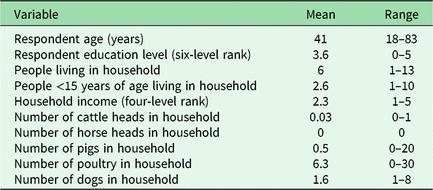
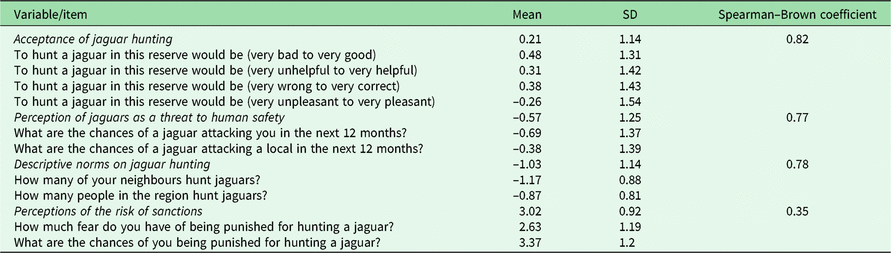
All individuals who were approached (n = 134) agreed to participate in the survey. Respondent and household characteristics are summarized in Table 1 and scores for latent variables are summarized in Table 2. On average, scores for the acceptance of jaguar hunting were close to neutral (Table 2), suggesting that local people do not have strong opinions on this subject. Most interviewees do not see the jaguar as a threat to humans, nor do they perceive jaguar hunting as a prevalent behaviour among their neighbours, as evidenced by the negative scores for these variables (Table 2). On the other hand, people are highly afraid of sanctions, as indicated by the high scores recorded for the perceived risk of sanctions for hunting a jaguar (Table 2).
Summary data on the characteristics of the surveyed respondents/households in Marajó Island, Brazilian Amazonia (n = 134).

Items used to measure latent variables (acceptance, perceptions and norms), means and standard deviations and Spearman–Brown coefficient. All scales range from –2 to 2, except perception of sanctions, which ranges from 1 to 4.

Most multiple-item scales had adequate reliability, except for perception of risk of suffering sanctions (Table 2). The two questions comprising this scale focused on different aspects of perception: one affective (dread of suffering sanctions) and the other cognitive (the rational perception of the likelihood of suffering a sanction). Since the two items were not correlated (Supplementary Appendix S1), I kept them as separate predictors in the global model for attitudes towards jaguar hunting.
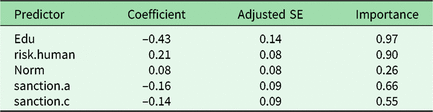
Only three models were retained within the set of models that best explained the variation in the acceptance of jaguar hunting, ΔAICc <2 (Table 3). The two most important predictors were education level and perception of jaguars as a threat to humans, which were retained in all top-ranked models and had high relative importance (sum of Akaike weights >0.9; Table 4). Perceptions of risk of sanctions for hunting jaguars (both the affective and the cognitive aspects) were also retained in the set of best models, but displayed lower relative levels of importance. Acceptance of hunting was negatively related to education level and both to the cognitive and affective aspects of the perception of the risk of sanctions for hunting jaguars; on the other hand, it was positively related to the perception of jaguars as a threat to humans (Table 4).
Top-ranked models (ΔAICc <2) explaining variation in attitudes towards jaguar hunting in Marajó Island.

Predictors: edu = education level (rank); risk.human = perception of jaguars as a threat to humans; sanction.a = affective aspect of the perception of the risk of sanctions (fear of sanction); sanction.c = cognitive aspect of the perception of the risk of sanctions (rational perception of the likelihood of suffering a sanction).
AICc = Akaike information criterion adjusted for small sample bias; ΔAICc = difference between a given model and the best model; ω i = Akaike weights.
Model-averaged coefficients, standard errors and relative importance of potential predictors of attitudes towards jaguar hunting in Marajó Island.

Predictors: edu = education level (rank); risk.human = perception of jaguars as a threat to humans; norm = descriptive norms (perception of neighbours’ involvement in jaguar hunting); sanction.a = affective aspect of the perception of the risk of sanctions (fear of sanctions); sanction.c = cognitive aspect of the perception of sanctions (rational perception of the likelihood of suffering a sanction).
All respondents answered the direct question about jaguar hunting, but 35 did not answer the RRT question. Of these, 16 were unable to understand the game instructions, 15 were unable to recognize or see the die numbers and four simply refused to answer the question. RRT respondents and non-respondents had similar average ages (χ2 = 38.50, p = 0.9), but differed in gender (χ2 = 6.57, p = 0.01) and in educational level (χ2 = 28.37, df = 4, p < 0.001). Women and less educated individuals were less likely to answer the RRT question.
According to the RRT estimate, approximately a fifth of households were involved in jaguar hunting during the 5 years prior to this study (proportion = 0.229, 95% CI: 0.06–0.40). In contrast, the outcomes of direct questioning indicated that a little less than 10% of households were involved in jaguar hunts (proportion = 0.09, 95% CI: 0.04–0.15). Though the difference was large, it was not statistically significant, since the CIs of the two estimates overlapped.
Discussion
The acceptance of jaguar hunting being negatively related to the level of education of interviewees corroborates previous studies on attitudes towards jaguars and carnivores in general (Porfirio et al. Reference Porfirio, Sarmento, Leal and Fonseca2016, Røskaft et al. Reference Røskaft, Händel, Bjerke and Kaltenborn2007). The effect of education was detected despite the fact that it was measured through a rank that targeted general, ‘non-environmental’ education. This suggests that prospects for coexistence between people and jaguars in the study area could be improved simply by increasing general access to education, a measure that may also help in poverty alleviation (Pinho et al. Reference Pinho, Patenaude, Ometto, Meir, Toledo, Coelho and Young2014).
The second most important predictor variable in the study was the perception of jaguars as a threat to humans, which had a positive effect on the acceptance of jaguar hunting. At other Amazonian sites, the perceived impact of jaguars on human safety was also a predictor of people’s intention to kill jaguars (Marchini & Macdonald Reference Marchini and Macdonald2012). Moreover, in the Brazilian Atlantic Forest, fear was associated with negative attitudes towards jaguars and pumas (Puma concolor) (Engel et al. Reference Engel, Vaske, Bath and Marchini2016). People who see wildlife as a threat tend to be more hostile to it (Dickman Reference Dickman2010, Inskip et al. Reference Inskip, Fahad, Tully, Roberts and MacMillan2014). Carnivores are usually associated with ‘dread risks’ that involve a perceived lack of control, dread and fatal consequences, which people naturally want to minimize (Slovic Reference Slovic1987). Furthermore, the perception of carnivores as a threat is usually stronger among vulnerable social groups, which are less resilient to impacts on their livelihoods (Dickman Reference Dickman2010, Inskip et al. Reference Inskip, Ridout, Fahad, Tully, Barlow, Barlow and Islam2013). In Guatemala (Soto-Shoender & Main Reference Soto-Shoender and Main2013) and the Brazilian Pantanal (Porfirio et al. Reference Porfirio, Sarmento, Leal and Fonseca2016), villagers are more prone to see jaguars as a threat than wealthier ranchers.
Perceptions of the risk of suffering sanctions (both the affective and the cognitive aspects) were negatively related to people’s acceptance of jaguar hunting. This probably occurs because fear of sanctions is a discouraging factor (St John et al. Reference St John, Mai and Pei2015, Steg & Vlek Reference Steg and Vlek2009). Law enforcement can reduce environmental non-compliance (Baruch-Mordo et al. Reference Baruch-Mordo, Breck, Wilson and Broderick2011, Harrison et al. Reference Harrison, Baker, Twinamatsiko and Milner‐Gulland2015, Jachmann Reference Jachmann2008, St John et al. Reference St John, Mai and Pei2015). By increasing people’s fear of sanctions, law enforcement could help decrease local support for jaguar hunting in the study area. However, this may be undesirable in the context of sustainable use reserves, since such actions may undermine the trust between managers and local people, which is hard to attain yet essential for effective reserve management. Furthermore, local households would hardly be able to afford the harsh penalties for killing endangered wildlife.
To my knowledge, this was the first study to use the RRT to study illegal hunting in the Amazon. The experience demonstrated the feasibility of using the technique among rural illiterate people, although the fact that a high proportion (26%) of interviewees could not respond to the RRT question indicates that the implementation of the technique needs adjustments (Razafimanahaka et al. Reference Razafimanahaka, Jenkins, Andriafidison, Randrianandrianina, Rakotomboavonjy, Keane and Jones2012, Solomon et al. Reference Solomon, Jacobson, Wald and Gavin2007).
The prevalence of jaguar hunting as estimated by the RRT was more than double that derived from direct questioning. Unexpectedly, the difference was not statistically significant. This may be an artefact of the sample size being insufficient, considering that the RRT produces inflated variances (Lensvelt-Mulders et al. Reference Lensvelt-Mulders, Hox, Van der Heijden and Maas2005). Furthermore, the two methods may perform similarly in ‘non-sensitive’ areas (Razafimanahaka et al. Reference Razafimanahaka, Jenkins, Andriafidison, Randrianandrianina, Rakotomboavonjy, Keane and Jones2012, Solomon et al. Reference Solomon, Jacobson, Wald and Gavin2007), and, perhaps, Amazonian sustainable use reserves may be regarded as such for studies on hunting. Recent studies on jaguar hunting in sustainable use reserves obtained first-hand accounts of jaguar hunts because people spoke openly about it (Carvalho & Pezzuti Reference Carvalho and Pezzuti2010, Ramalho Reference Ramalho2012). In such cases, direct questioning may be the best choice because it is much easier to implement.
The mean proportion of households involved in at least one jaguar hunt in the 5 years prior to the study was estimated at 0.09 for direct questioning and at 0.229 for RRT. Even the more conservative direct question estimate is relatively high, since it implies that roughly one out of every ten houses was involved in at least one jaguar hunt during this period. This was observed despite the low levels of conflict in the area. For example, the average score for the perception of the jaguar as a threat to humans was negative (Table 2), indicating that most people do not see the species as a threat. Furthermore, the mean scores for the acceptance of jaguar hunting were close to neutral (Table 2), suggesting that people in the area probably do not have attitudes or opinions formed about jaguar hunting. The role of other incentives for hunting, in addition to attitudes, deserves further investigation.
To improve livelihoods without compromising biodiversity conservation, sustainable use reserves must improve the prospects of long-term coexistence between people and jaguars. Thus, tolerance towards jaguars must increase and support towards hunting them must decrease. This study suggests that improving basic education and reducing the perception of jaguars as a threat to humans may have roles to play in fostering coexistence in the study area.
Supplementary material
To view supplementary material for this article, please visit https://doi.org/10.1017/S0376892919000274.
Acknowledgements
This study would not have been possible without the generous collaboration of the people of Marajó Island. Simone A Rabelo and Diana A Menezes introduced me to the study area and provided logistical support. Elias F Baia piloted the motorboat. I am especially grateful to Whaldener Endo, Yennie K Bredin and Kelsey A Barnhill for their comments on previous drafts of this manuscript.
Financial support
This work was supported by ICMBio/DIBIO (chamada interna 2013) through the PNUD BRA 008/023 project.
Conflict of interest
None.
Ethical standards
The study was conducted under licence SISBIO 34242-1. Research followed the American Anthropological Association Code of Ethics.