Introduction
The subfamily Heliothinae (Lepidoptera: Noctuidae) encompasses 381 described species, many of which are important agricultural pests. The genera Helicoverpa Hardwick and Chloridea Duncan and Westwood (Pogue, Reference Pogue2013) contain several economically important pest species, which are native to South America including H. gelotopoeon (Dyar), H. zea (Boddie), C. virescens (Fabricius), C. subflexa (Guenée), and C. tergemina (Felder & Rogenhofer) (Mitter et al., Reference Mitter, Poole and Matthews1993; Pastrana, Reference Pastrana2004; Pogue, Reference Pogue2013). The South American invasion of Helicoverpa armigera Hübner added a new species into the Heliothinae complex; this species is now found in Brazil (Czepak et al., Reference Czepak, Albernaz, Vivan, Guimarães and Carvalhais2013; Specht et al., Reference Specht, Sosa-Gómez, Paula-Moraes and Yano2013; Tay et al., Reference Tay, Soria, Walsh, Thomazoni, Silvie and Behere2013), Paraguay (Senave, 2013), Argentina (Murúa et al., Reference Murúa, Scalora, Navarro, Cazado, Casmuz, Villagrán, Lobos and Gastaminza2014), Bolivia, and Uruguay (Kriticos et al., Reference Kriticos, Ota, Hutchison, Beddow, Walsh, Tay, Borchert, Paula-Moreas, Czepak and Zalucki2015). In addition to H. armigera, three other Heliothinae species are present in the North of Argentina: H. gelotopoeon, H. zea, and C. virescens (Murúa et al., Reference Murúa, Cazado, Casmuz, Herrero, Villagrán, Vera, Sosa-Gómez and Gastaminza2016).
Helicoverpa gelotopoeon, the South American bollworm, is a polyphagous pest and has been reported in cotton (Gossypium hirsutum L.; Malvales: Malvaceae), alfalfa (Medicago sativa L.; Fabales: Fabaceae), sunflower (Helianthus annuus L.; Asterales: Asteraceae), soybean (Glycine max L.; Fabales: Fabaceae), chickpea (Cicer arietinum L.; Fabales: Fabaceae), and corn (Zea mays L.; Poales: Poaceae) (Pastrana, Reference Pastrana2004; Navarro et al., Reference Navarro, Saini and Leiva2009). Larvae cause damage in the vegetative and reproductive plant growth stages. Helicoverpa gelotopoeon occurs in Argentina, Chile, southern Brazil, Paraguay, and Uruguay (Pastrana, Reference Pastrana2004; Navarro et al., Reference Navarro, Saini and Leiva2009). In Tucumán and other provinces of Argentina, H. gelotopoeon is a major pest of soybean and can be difficult to control with insecticides (Navarro et al., Reference Navarro, Saini and Leiva2009; Scalora et al., Reference Scalora, Casmuz, Cazado, Socías, Tolosa, Aralde, Aybar Guchea, Fadda, Gómez, Gómez, Montaldi, Gastaminza, Willink, Rodríguez, Devani, Ledesma and Sánchez2012). Consequently, it causes a significant economic impact, since Argentina is the third major soybean producer in the world, covering an area of 20.1 million hectares (Bolsa de Cereales, 2016). Helicoverpa gelotopoeon also affects cotton and chickpea, and damage is most severe when these crops are grown in succession (Pastrana, Reference Pastrana2004; Fichetti et al., Reference Fichetti, Avalos, Mazzuferi and Carreras2009; Navarro et al., Reference Navarro, Saini and Leiva2009; Scalora et al., Reference Scalora, Casmuz, Cazado, Socías, Tolosa, Aralde, Aybar Guchea, Fadda, Gómez, Gómez, Montaldi, Gastaminza, Willink, Rodríguez, Devani, Ledesma and Sánchez2012).
The bioecological characteristics of this Heliothinae complex, in addition to the numerous occurrences of insecticide resistance within this subfamily (Forrester, Reference Forrester1990; Forrester et al., Reference Forrester, Cahill, Bird and Layland1993; Armes et al., Reference Armes, Jadhav and DeSouza1996), necessitate establishing alternatives to insecticide control for the 34 species of Helicoverpa. Since 1996, Bacillus thuringiensis (Bt) crops have been the primary tool for managing major pests, such as H. armigera, H. zea, and C. virescens, in cotton and corn fields worldwide (Tabashnik et al., Reference Tabashnik, Van Rensburg and Carriere2009; Blanco et al., Reference Blanco, Chiaravalle, Dalla-Rizza, Farias, García-Degano, Gastaminza, Mota-Sanchez, Murúa, Omoto, Pieralisi, Rodríguez, Rodríguez-Maciel, Terán-Santofimio, Terán-Vargas, Valencia and Willink2016). Currently, genetically modified soybeans are one method to control primary crop pests, but these also impact on secondary pests, such as H. gelotopoeon and H. zea (MacRae et al., Reference MacRae, Baur, Boethel, Fitzpatrick, Gao, Gamundi, Harrison, Kabuye, McPherson, Miklos, Paradise, Toedebusch and Viegas2005; Wu et al., Reference Wu, Um, Liang and Gou2005; Casmuz et al., Reference Casmuz, Cazado, Scalora, Tuzza, Fernández, Fadda, Fadda, Dami, Colledani Toranzo, Gómez, De Felice, Vera, Gastaminza, Devani, Ledesma and Sánchez2014; Cazado et al., Reference Cazado, Casmuz, Scalora, Fadda, Fernández, Tuzza, Fadda, Dami, Colledani Toranzo, Jadur, Vera, Gastaminza, López, Ruiz, Devani, Ledesma and Sánchez2014; Monsanto, 2014).
Helicoverpa armigera, H. zea, and C. virescens have developed resistance to insecticides and Bt Cry proteins (Forrester et al., Reference Forrester, Cahill, Bird and Layland1993; Gould et al., Reference Gould, Anderson, Reynolds, Bumgarner and Moar1995; Armes et al., Reference Armes, Jadhav and DeSouza1996; Hardee et al., Reference Hardee, Adams, Solomon and Sumerford2001; Li et al., Reference Li, Wu, Gould, Wang, Miao, Gao and Guo2007; Mahon et al., Reference Mahon, Olsen, Garsia and Young2007; Pietrantonio et al., Reference Pietrantonio, Junek, Parker, Mott, Siders, Troxclair, Vargas-Camplis, Westbrook and Vassiliou2007; Gao et al., Reference Gao, Wu, Gould and Shen2009; Liu et al., Reference Liu, Xu, Zhu, Huang, Wang, Li, Gao, Zhou and Shen2010; Bird & Downes, Reference Bird and Downes2014; Brévault et al., Reference Brévault, Tabashnik and Carrière2015; Reisig & Reay-Jones, Reference Reisig and Reay-Jones2015; Tay et al., Reference Tay, Mahon, Heckel, Walsh, Downes, James, Lee, Reineke, Williams and Gordon2015); this has led to increased interest in understanding Heliothinae genetic diversity and gene flow among its populations and the possible exchange of alleles between geographically distant populations. Some insect populations identified as the same species may yet display different biological and genetic traits and show reproductive isolation, preventing complete gene flow among populations. Therefore, identifying cryptic species is important to not only explain phytophagous insect evolution but also help understand implications for insect pest management and the emergence of insecticide and Bt resistance (Pérez Contreras, Reference Pérez Contreras1999; Rull et al., Reference Rull, Abraham, Kovaleski, Segura, Islam, Wornoayporn, Dammalage, Santo Tomas and Vera2012). In general, unstructured genetic populations have been reported for H. armigera, H. zea, and C. virescens species, which were based on several molecular markers, including mtDNA, allozymes, and microsatellites (Korman et al., Reference Korman, Mallet, Goodenough, Graves, Hayes, Hendricks, Luttrell, Pair and Wall1993; Roehrdanz et al., Reference Roehrdanz, Lopez, Loera and Hendricks1994; Nibouche et al., Reference Nibouche, Bues, Toubon and Poitout1998; Zhou et al., Reference Zhou, Faktor, Applebaum and Coll2000; Han & Caprio, Reference Han and Caprio2002, Reference Han and Caprio2004; Behere et al., Reference Behere, Tay, Russel, Heckel, Appleton, Kranthi and Batterham2007; Endersby et al., Reference Endersby, Hoffmann, McKechnie and Weeks2007; Groot et al., Reference Groot, Classen, Inglis, Blanco, López, Vargas, Schal, Heckel and Schöfl2011; Perera & Blanco, Reference Perera and Blanco2011; Asokan et al., Reference Asokan, Rebijith, Krishna Kumar and Manamohan2012; Leite et al., Reference Leite, Alves-Pereira, Corrêa, Zucchi and Omoto2014; Arneodo et al., Reference Arneodo, Balbi, Flores and Sciocco2015). However, other studies (Nibouche et al., Reference Nibouche, Bues, Toubon and Poitout1998; Khiaban et al., Reference Khiaban, Hejazi, Irani-Nejad, Mohammadi and Khaghaninia2010; Domingues et al., Reference Domingues, Silva-Brandão, Abreu, Perera, Blanco, Cônsoli and Omoto2012; Yenagi et al., Reference Yenagi, Patil, Biradar and Khadi2012), have found genetic population structure in different species of this complex.
Genetically distinct populations of insects can vary in their susceptibility to control tactics (Joyce et al., Reference Joyce, White, Nuessly, Solis, Scheffer, Lewis and Medina2014); therefore, understanding the biology and genetic population structure of H. gelotopoeon is essential for the development of sustainable management strategies. The objective of this study was to characterize biological and reproductive parameters of two H. gelotopoeon populations collected in Tucumán and Córdoba provinces of Argentina. Our research provided detailed information about South American bollworm biology, unknown until now, and will be useful to define the management strategies for this species in Argentina.
Materials and methods
Insect collections
Helicoverpa gelotopoeon larvae were collected from September to October 2014 in commercial chickpea fields located in two Argentine provinces. In Tucumán province (Northwestern region), collections were made in San Agustín county (26°50′21″S, 64°51′32″W), and in Córdoba province (Pampas region), collections were made in Marcos Juárez county (32°43′14.25″S, 62°07′00.30″W). Each sampling location was treated as a population. At each sampling site, a minimum of 300 larvae (instars 2–5) were collected and placed individually in glass tubes (12 cm high and 1.5 cm diameter) with pieces of artificial diet. Collected larvae were returned to the laboratory and placed in breeding chambers under controlled conditions (27 ± 2°C, 70–75% relative humidity, 14 : 10 light : dark photoperiod) until adult emergence. Then, all adults that emerged in the laboratory were examined using male genitalia to confirm the species according to Velasco de Stacul et al. (Reference Velasco de Stacul, Barral and Orfila1969). Sampled insects from each of these populations were deposited as voucher specimens in the insect collection of the Sección Zoología Agrícola, Estación Experimental Agroindustrial Obispo Colombres, Tucumán, Argentina.
Insect rearing
Approximately 250 adults (125 females and 125 males) were randomly selected from reared larvae to establish an experimental colony for each population. Adults were arranged in five cylindrical oviposition cages (40 cm high and 20 cm diameter) lined with polyethylene bags with approximately 25 females and 25 males per cage. For aeration, both ends of the cage were covered with a nylon cloth. Each population was maintained in the same chamber under identically controlled conditions at 27 ± 2°C, 70–75% relative humidity and a photoperiod of 14 : 10 light:dark. The food for adults was provided via a cotton plug saturated with a mixture of honey and water (1 : 1 volume : volume) which was replaced every day. Cages were checked daily for oviposition and adult mortality. Rearing of each population was maintained between September 2014 and February 2015.
Eggs deposited in the cages were collected and put into plastic containers of 1000 ml. Once emerged, neonate larvae were placed individually in glass tubes with artificial larval diet that included chickpea flour (Grandiet®, Buenos Aires, Argentina), wheat germ (Grandiet®, Buenos Aires, Argentina), brewer's yeast (Calsa®, Tucumán, Argentina), vitamin C (Anedra®, Buenos Aires, Argentina), sorbic acid (Anedra®, Buenos Aires, Argentina), sodium benzoate (TodoDroga®, Córdoba, Argentina), vitamin supplement amino acids (Ruminal®, Buenos Aires, Argentina), and methylparaben (Todo Droga®, Córdoba, Argentina) (Murúa et al., Reference Murúa, Virla and Defagó2003). Artificial diet was replaced every 2–3 days. As larvae pupated, pupae were sexed and placed in containers with moistened filter paper until adult emergence. Adults were used to initiate a new generation. After establishing a colony for each population, individuals from the second to the fourth generation were used for studies of fitness and reproductive compatibility.
Biology of South American bollworm populations from different provinces
From each experimental colony of H. gelotopoeon, five groups of neonate larvae were randomly selected (total 120 and 90 larvae of Tucumán and Cordoba province, respectively) to analyze the following parameters: duration of larval instars and pupal stage, pupal mass (obtained 24 h after pupation), and adult sex ratio.
From the adults obtained, a set of approximately 35 females and 35 males of Tucumán population, and 22 females and 22 males of Córdoba population were randomly selected to determine incubation period, longevity, and reproductive parameters. One virgin female and one virgin male (24 h old) from the same population were placed in cylindrical oviposition cages similar to those described above (25 cm high and 15 cm diameter) (Tucumán population, N = 35; Córdoba population, N = 22). These single pair matings represented the parental cross that was used for reproductive compatibility studies. Moths were maintained in this cage, with mortality and oviposition recorded daily. Dead females were dissected to establish the number of spermatophores present in their reproductive tract to determine whether or not mating had occurred. Pre-oviposition, oviposition, and post-oviposition period (number of days that a female survives after its last oviposition); total fecundity (number of eggs deposited by a female during her entire life period); incubation period; total fertility (percentage of eggs hatching); and adult longevity were recorded.
Reproductive compatibility between South American bollworm populations from different provinces
A crossing experiment was performed to determine reproductive compatibility between Tucumán and Córdoba populations, according to the methodologies described by Pashley & Martin (Reference Pashley and Martin1987); Pashley et al. (Reference Pashley, Hardy, Hammond and Mihm1990); Lopez-Edwards et al. (Reference Lopez-Edwards, Hernandez Mendoza, Pescador Rubio, Molina Ochoa, Lezama Gutierrez, Hamm and Wiseman1999); Murúa et al. (Reference Murúa, Vera, Abraham, Juaréz, Prieto, Head and Willink2008) and Fogliata et al. (Reference Fogliata, Vera, Gastaminza, Cuenya, Zucchi, Willink, Castagnaro and Murúa2016). To determine compatibility, we used one virgin female and one virgin male of 24 h old. Four different types of crosses were performed: (i) parental crosses using parents from the same population, (ii) hybrid crosses using one parent of each population, (iii) backcrosses with the female progenitor as the recurrent parent and backcrosses with the male progenitor as the recurrent parent, and (iv) inter-hybrid mating crosses between F1 hybrids from different populations.
A subset of larval progeny (F1) from each fertile cross was monitored for survival until pupation and then reared to adulthood. The parameters measured to determine compatibility were: number of spermatophores; pre-oviposition, oviposition, and post-oviposition period duration; total fecundity; and total fertility.
Data analysis
Fitness data between both populations were compared by Wilcoxon rank-sum test (Lehmann, Reference Lehmann1975) (P < 0.05). For the reproductive compatibility data, due to the high number of combinations, the performance of all parental crosses was compared with the results of other types of crosses (hybrid crosses, backcrosses, and inter-hybrid matings) using Kruskal–Wallis (Reference Kruskal and Wallis1952) test (P < 0.05).
For all studies, pre-oviposition, oviposition, and post-oviposition periods were compared for those females that laid eggs. Total fecundity was compared for all females including those that laid no eggs. For total fertility, females that laid eggs but had no spermatophores were not included. All data were analyzed using InfoStat (2006).
Results
Biological and reproductive parameters
All adults from Tucumán and Córdoba sampled were identified as H. gelotopoeon based on the morphology of male genitalia (Velasco de Stacul, Reference Velasco de Stacul, Barral and Orfila1969).
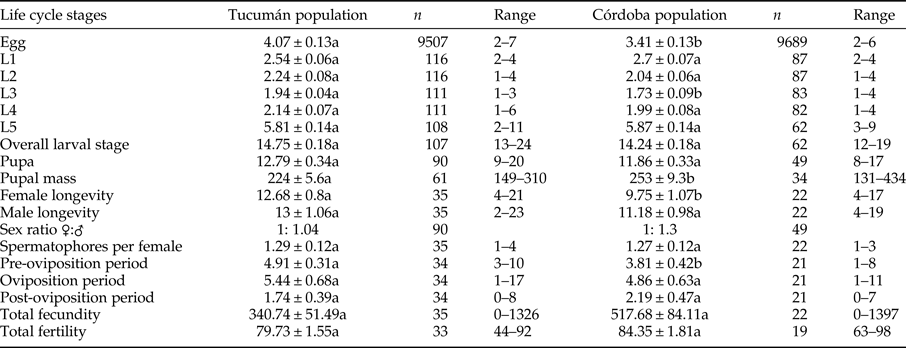
In total, 35 and 22 parental crosses were used to determine biological and reproductive parameters of Tucumán and Córdoba populations, respectively. The duration of each life stage and reproductive parameters are presented in table 1. The biological parameters that showed significant differences between Tucumán and Córdoba populations were: incubation period (W = 3969; P = 0.0005), third instar larval development time (W = 7055; P = 0.0014) and female longevity (W = 294.50; P = 0.0438), which were all longer in duration for the Tucumán population and pupal mass (W = 1982, P = 0.0066) that was larger for the Córdoba population (table 1). Differences in reproductive parameters only occurred in pre-oviposition period (W = 451; P = 0.0155), which was longer for the Tucumán population.
Duration in days (mean ± SE) of egg, larval (L1–L5), and pupal stages; pupal mass (mg); female, male, and total longevity (days); sex ratio (F : M); and life span of Helicoverpa gelotopoeon populations collected in Tucumán and Córdoba provinces in Argentina and reared at 25 ± 2 °C, 70–75% RH, and 14L:10D.

Values followed by same letters within a row are not significantly different according to Wilcoxon test (P > 0.05).
Reproductive compatibility between South American bollworm populations
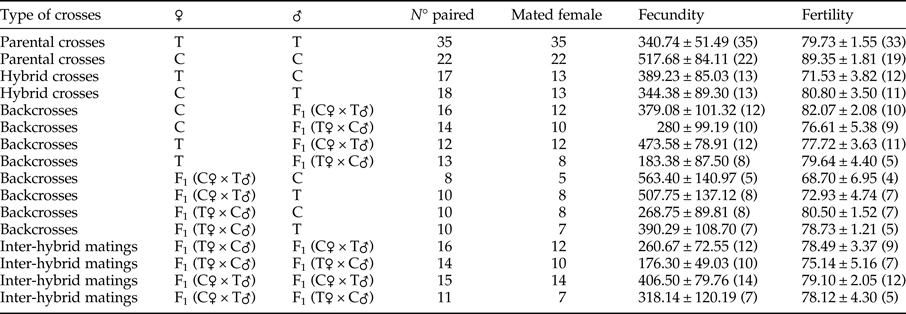
In total, 57 parental crosses, 35 hybrid crosses, 93 backcrosses, and 56 inter-hybrid matings were performed between Tucumán and Córdoba populations (table 2). No significant differences were observed in reproductive parameters between both populations. In general, all hybrid crosses, backcrosses, and inter-hybrid matings showed more similar values than both parental crosses for all parameters (tables 2 and 3).
Number (mean ± SE) of spermatophores per female; duration of pre-oviposition, oviposition, and post-oviposition periods; total fecundity (number of eggs per female); and total fertility (percentage of egg hatch) of Helicoverpa gelotopoeon parental crosses, hybrid crosses, backcrosses, and inter-hybrid matings using populations collected in Tucumán and Córdoba provinces in Argentina and reared at 25 ± 2°C, 70–75% RH, and 14L:10D.

Values followed by same letters within a column are not significantly different according to Kruskal–Wallis test (P > 0.05).
Number (mean ± SE) of mated female, total fecundity (number of eggs per female), and total fertility (percentage egg hatch) of each Helicoverpa gelotopoeon crosses and backcrosses using populations collected in Tucumán (T) and Córdoba (C) provinces in Argentina and reared at 25 ± 2°C, 70–75% RH, and 14L:10D.

Discussion
This study compared biological and reproductive demographic traits and mating compatibility between two H. gelotopoeon populations collected from chickpea in two regions of Argentina. Helicoverpa gelotopoeon populations from Tucumán and Córdoba showed similar biological and reproductive characteristics when reared on artificial diet in the laboratory. However, differences in incubation period, third instar larval development time, female longevity, pupal mass, and pre-oviposition period were found. These parameters were higher for the Tucumán population, but the pupal mass was higher for Cordoba population (table 1).
Results of our study showed that the South American bollworm populations from Tucumán and Córdoba provinces complete a single generation (from egg to adult) in approximately 40 and 38 days under laboratory conditions. A different development time was reported by Navarro et al. (Reference Navarro, Saini and Leiva2009) for this species, but a similar observation was reported by Naseri et al. (Reference Naseri, Fathipour, Moharramipour and Hosseininaveh2009) for H. armigera. The incubation period for both populations was similar to that reported by Navarro et al. (Reference Navarro, Saini and Leiva2009), but it differed compared with the report made by Urretabizkaya et al. (Reference Urretabizkaya, Vasicek and Saini2010). Five larval instars of both populations were found and this result was similar to that reported by Iannone & Leiva (Reference Iannone and Leiva1993) and Sharma et al. (Reference Sharma, Bhardwaj and Sharma2011) for H. gelotopoeon and H. armigera, respectively. Larval development time was similar to that reported by Iannone & Leiva (Reference Iannone and Leiva1993); Urretabizkaya et al. (Reference Urretabizkaya, Vasicek and Saini2010); and Navarro et al. (Reference Navarro, Saini and Leiva2009) for H. gelotopoeon. Pupal stage duration was shorter than reported by other studies (Iannone & Leiva, Reference Iannone and Leiva1993; Urretabizkaya et al., Reference Urretabizkaya, Vasicek and Saini2010), but the values were consistent with those obtained by Naseri et al. (Reference Naseri, Fathipour, Moharramipour and Hosseininaveh2009) and Mironidis (Reference Mironidis2014) for H. armigera. No previous studies have examined H. gelotopoeon pupal mass, but in general it was smaller than those observed for H. armigera (Arghand et al., Reference Arghand, Naseri, Razmjou, Hassanpour and Rahimi Namin2014) and H. zea (Giolo et al., Reference Giolo, Rossato Busato, Silveira Garcia, Manzoni, Bernardi and Zart2006). Adults from the H. gelotopoeon populations had a similar survival time as those reported by Simmons & Lynch (Reference Simmons and Lynch1990); Liu et al. (Reference Liu, Li, Gong and Wu2004); Naseri et al. (Reference Naseri, Fathipour, Moharramipour and Hosseininaveh2009); and Pérez & Suris (Reference Pérez and Suris2012) for Helicoverpa and Chloridea species. The sex ratio found for the H. gelotopoeon population from Tucumán and Córdoba (1 female:1 male) was similar to that reported by Álvarez Hernández et al. (Reference Álvarez Hernández, Pérez, González, Cruz, Gómez and Álvarez2010) for C. virescens reared on leaves and pods of chickpea. In this study, we found that females emerged before males, suggesting that H. gelotopoeon is a protogyneus species, a characteristic also observed by Giolo et al. (Reference Giolo, Rossato Busato, Silveira Garcia, Manzoni, Bernardi and Zart2006) and Colvin et al. (Reference Colvin, Cooter and Patel1994) with H. zea and H. armigera, respectively. According to Rhainds et al. (Reference Rhainds, Gries and Min1999), protogyny may be an evolved mechanism to reduce inbreeding, given that early emerged females are less likely to mate with their brothers.
The number of spermatophores found in dissected females was generally one for both populations. Similar observations were reported by Callahan (Reference Callahan1958) and Navarro (Reference Navarro1987) for H. zea. The periods of pre-oviposition, oviposition, and post-oviposition were similar with those found by other reports for H. armigera (Sharma et al., Reference Sharma, Bhardwaj and Sharma2011). Navarro et al. (Reference Navarro, Saini and Leiva2009) reported higher fecundity of H. gelotopoeon than that recorded in our study. However, our fecundity results were similar to that found by Urretabizkaya et al. (Reference Urretabizkaya, Vasicek and Saini2010) for the same species. No previous studies have examined H. gelotopoeon fertility. Nevertheless, our results showed values lower than those reported for C. virescens and H. zea (Navarro, Reference Navarro1987; Méndez Barceló, Reference Méndez Barceló2003), but higher than those found for H. armigera (Laster & Sheng, Reference Laster and Sheng1995; Ali et al., Reference Ali, Choudhury, Ahmad, Rahman, Khan and Ahmad2009) (table 1).
Intra- and inter-population crosses revealed that H. gelotopoeon populations from the northwestern and Pampas regions in Argentina did not present evidence of pre-zygotic or post-zygotic incompatibility, suggesting that Tucumán and Córdoba populations of H. gelotopoeon belong to a single wide-ranging species (tables 2 and 3).
As previously mentioned, unstructured genetic populations have been reported for different species of the Heliothinae complex. Most of these studies used molecular tools (Korman et al., Reference Korman, Mallet, Goodenough, Graves, Hayes, Hendricks, Luttrell, Pair and Wall1993; Roehrdanz et al., Reference Roehrdanz, Lopez, Loera and Hendricks1994; Nibouche et al., Reference Nibouche, Bues, Toubon and Poitout1998; Zhou et al., Reference Zhou, Faktor, Applebaum and Coll2000; Han & Caprio, Reference Han and Caprio2002, Reference Han and Caprio2004; Behere et al., Reference Behere, Tay, Russel, Heckel, Appleton, Kranthi and Batterham2007; Endersby et al., Reference Endersby, Hoffmann, McKechnie and Weeks2007; Groot et al., Reference Groot, Classen, Inglis, Blanco, López, Vargas, Schal, Heckel and Schöfl2011; Perera & Blanco, Reference Perera and Blanco2011; Asokan et al., Reference Asokan, Rebijith, Krishna Kumar and Manamohan2012; Leite et al., Reference Leite, Alves-Pereira, Corrêa, Zucchi and Omoto2014; Arneodo et al., Reference Arneodo, Balbi, Flores and Sciocco2015). Only Colvin et al. (Reference Colvin, Cooter and Patel1994) compared reproductive compatibility between different African, Indian, Chinese, and Australian populations of H. armigera, suggesting that H. armigera exists as a single species over its geographical range.
This study is the first to report a lack of reproductive isolation between H. gelotopoeon populations from Argentina based on reproductive parameters and mating compatibility. Our results clearly indicate that there are no signs of geographical isolation, since populations mated successfully in both directions. This supports the presumption that substantial gene flow occurs between H. gelotopoeon populations, probably due to the long-range migratory capacity of Heliothinae species, which has been widely documented (Hartstack et al., Reference Hartstack, Lopez, Muller, Sterling, King, Witz and Eversull1982; Farrow & Daly, Reference Farrow and Daly1987; Gregg et al., Reference Gregg, Fitt, Zalucki, Murray, Drake and Gatehouse1995; Westbrook, Reference Westbrook2008; Westbrook & Lopez, Reference Westbrook and Lopez2010).
This study provides useful information about South American bollworm biology to define the management strategies and control of this species in Argentina. However, additional research on the population genetics of this specie in other crops will further increase our understanding of its unstructured genetic populations.
Acknowledgments
The authors thank Ing. Lucas Fadda and Tec. David González at EEAOC for excellent technical support and assistance in the collection of material and Ing. Fernando Flores (INTA-Marcos Juárez) for the Helicoverpa gelotopoeon individuals collected. The authors also thank Dr Andrew Michel (Department of Entomology, The Ohio State University, Ohio) for critical review of the manuscript and valuable comments and Lic. Eduardo Willink (EEAOC) for constructive comments on an earlier draft of the manuscript. This study was supported by the Agencia Nacional de Promoción Científica de Argentina (ANPCyT) through the Fondo Nacional de Ciencia y Tecnología (FONCyT), Ministerio de Ciencia, Tecnología e Innovación Productiva (MINCyT) (grants PICT/2015 No. 3109), EEAOC, CONICET, and Consejo de Investigaciones de la Universidad Nacional de Tucumán (CIUNT no. G535/26). This study is part of the first author's doctoral thesis.