

People's social relationships serve as crucial sources of information and influence, with important implications for politics. The presence, quality, and pattern of these relationships—features of social networks—have been found to affect outcomes like voting behavior (Sinclair Reference Sinclair2012), public opinion (McClurg Reference McClurg2006), policymaking (Scholz et al. Reference Scholz, Berardo and Kile2008), social capital (Jackson et al. Reference Jackson, Rodriguez-Barraquer and Tan2012), protests (González-Bailón and Wang Reference González-Bailón and Wang2016), and political violence (Parkinson Reference Parkinson2013; Larson and Lewis Reference Larson and Lewis2018), as well as public health decisions (Rao et al. Reference Rao, Mobius and Rosenblat2007) and technology adoption (Conley and Udry Reference Conley and Udry2010; Ferrali et al. Reference Ferrali, Grossman, Platas and Rodden2018).
In the wake of promising findings such as these, scholars are increasingly undertaking fieldwork that entails eliciting original data on networks among individuals or small groups via surveys. This is the case because observational data on relevant networks are rarely readily available. While social media can offer promising avenues for collecting network data, they are not informative in rural, developing country settings where their use is often minimal, nor can they answer questions about networks relevant to face-to-face transmission of information or services. Eliciting networks via surveys have been central to advances in knowledge about, broadly speaking, the consequences of network position for individual behavior (Barr et al. Reference Barr, Ensminger, Johnson, Cook, Levi and Hardin2009; Baldassarri and Grossman Reference Baldassarri and Grossman2013; Baldassarri Reference Baldassarri2015; Breza et al. Reference Breza, Chandrasekhar and Larreguy2015); the spread of information through a group (Banerjee et al. Reference Banerjee, Chandrasekhar, Duflo and Jackson2014; Alatas et al. Reference Alatas, Banerjee, Chandrasekhar, Hanna and Olken2015; Larson and Lewis Reference Larson and Lewis2017); the presence and magnitude of peer influence (Conley and Udry Reference Conley and Udry2010; Banerjee et al. Reference Banerjee, Chandrasekhar, Duflo and Jackson2013; Paluck et al. Reference Paluck, Shepherd and Aronow2016); and the way social networks change in response to shocks (Fafchamps and Gubert Reference Fafchamps and Gubert2007; Jackson et al. Reference Jackson, Rodriguez-Barraquer and Tan2012). The contexts for these studies vary widely, for example from villages in the Philippines and India to high schools in the US.
In any context, however, measuring networks in the field is not a straightforward task. Since respondents in a network are interrelated—and thus cannot be taken as independent and identically distributed observations—problems that would be minor under “the usual” independent sampling procedures can compound into large problems that generate misleading results in a network context. To measure any one network, the way nodes and links are sampled, and the way survey questions are worded and ordered have large consequences for the resulting data. Moreover, for a given group of people, numerous different networks could be measured. Because resources, time in the field, and the attention span of respondents are all finite, researchers measuring networks face a large set of high-stakes tradeoffs that can be difficult to evaluate prior to collecting data.
Yet little practical guidance is available for the measurement of networks in the field. While researchers have ready access to guides to formal network theory (Wasserman and Faust Reference Wasserman and Faust1994; Easley and Kleinberg Reference Easley and Kleinberg2010; Jackson Reference Jackson2010; Siegel Reference Siegel2011), statistical methods using network data that already exist (Butts Reference Butts2008; Kolaczyk Reference Kolaczyk2009), and causal inference on networks (Fowler et al. Reference Fowler, Heaney, Nickerson, Padgett and Sinclair2011), such works do not aim to assist researchers with the myriad choices involved when designing a study that collects original network data from people. An exception and useful starting point is Marsden (Reference Marsden2005), which reviews the findings from studies testing the consequences of design decisions in sociology and psychology.
This paper's aim is to help researchers design a network elicitation study. Naturally, there is no one-size-fits-all design; the optimal design will vary study by study. Consequently, we stress that carefully specifying a network-related theory first is crucial to guide complex design decisions. Simply put, one must know which network(s) she/he is trying to capture and why before designing a study to do so. We begin by presenting a simple framework for constructing such a theory.
We then address a battery of dimensions on which network studies can vary, and hence about which a researcher faces choices. We highlight the often subtle tradeoffs entailed in each. The first set of tradeoffs we consider pertains to the method of eliciting the network: how exactly should the study identify the presence of a link between two people? The second set pertains to precision: how precisely must the true network be measured, and what are the consequences of a variety of options for measuring it more coarsely? Our supporting information also considers a third set which pertains to cleaning the data after collection: how should problems like spelling discrepancies across names or ties to people outside the sample be handled? The third set is easy to ignore ex ante, but anticipating these problems allows researchers to build in straightforward safeguards that vastly simplify the cleaning ex post. The supporting information also introduces a new technique for cleaning relational name data.
Finally, we emphasize the need to determine the importance of network structure to the research question, and offer a classification to help with this assessment. The more the research question depends on structure—identifying how central people are, how socially distant any two people are, and so on—the more important it is to measure a network as thoroughly as possible. Since most network studies seek to uncover network structure and samples that are subsets of the population of nodes of interest recover structural properties poorly, a key implication is that most network studies would benefit from prioritizing surveying as many nodes as possible. This consideration is particularly important for researchers planning to collect data in, and contrast network structures between, multiple locations. While measuring networks in many locations with few nodes each can be a tempting option, each location's measured network may fail to preserve the structural properties of interest.
1. Measuring the right network
The first step in any networks study is identifying the network that is of interest. Although at first blush this may seem like a straightforward task, in practice, specifying a theory of which network matters and why can be challenging, warranting careful thought and substantive knowledge of the context under study. All design decisions hinge on having a carefully specified network theory.
1.1. Specifying a network theory
A network among a set of nodes N (here usually taken to be a set of people) is a record of the presence or absence of a link (also called a “tie” or an “edge”) between every pair in N. For any set of nodes N, pairs of nodes could be linked in many ways.
Formulating a network theory requires three steps:
1. Define a set of nodes
2. Specify the type of links
3. Specify the function of the links
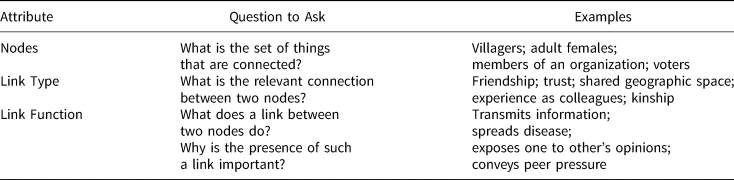
In many studies, the nodes of interest will be people. When this is the case, a network theory minimally requires answering the questions: which people are included in the network, how are they connected, and what do the connections do? The final question is easy to overlook, but is essential to the design of network elicitation. Networks are theorized to matter because the ties do something: transmit information, spread disease, indicate opportunities for learning, generate obligation, and so on. Being precise about their theorized function will simplify many of the design choices. Specifying the link function can also be thought of as specifying the mechanism by which links affect outcomes. Table 1 summarizes these steps.Footnote 1
Constructing a Network Theory

As an example, in a study of how information spreads through a village, a theory may hold that people receive new information from people they trust. This theory would regard the set of village residents as the nodes, trust as the link type of interest, and the transmission of credible information as the link function.
As another example, in a study of how people decide whether to vote, a theory may hold that a person can feel compelled to vote if her/his most intimate friends would judge her/him badly if she/he abstains. For this theory, a voting district's population could be the nodes, the link type is a close friendship, and the ability to convey effective peer pressure is the link function.
For any set of nodes, there are many different links that could connect them in theory. This is particularly true for studies theorizing that the “social network” is the network of interest. There is no single “social network” among a group of people, even in theory. Links connoting blood relatives, friends, business confidants, coworkers, conversation partners, and schoolmates are all sociable. Researchers must first carefully specify why sociable ties may matter, and then define and measure ties that correspond to this function. If ties matter in theory because they let people share trusted information face-to-face, then the ties must capture the ability to share news face-to-face as directly as possible. If ties matter because they let people verify uncertain information, then the ties must capture the ability to verify information. While it may be tempting to remain agnostic and say the social network entails all of these link types, this imprecision in the theory can result in data that mask network effects (Larson and Rodríguez Reference Larson and Rodríguez2018).
For each of the design issues raised in the remainder of the paper, we will discuss how to evaluate the tradeoffs with respect to the network theory underlying the project. The more precisely the nodes, link type, and link function can be specified, the easier it will be to evaluate the tradeoffs inherent in the study design.Footnote 2
1.2. Operationalizing a network theory
Once the network theory is specified by the following steps (1)–(3), network measurement requires two additional steps:
4. Determine which nodes to include
5. Operationalize link type
Step (4) requires a judgment call on the boundary separating the group of interest. Step (5) entails pinning down a set of rules to establish when a link will count as present in the data. The following sections will help make these decisions.
2. Eliciting networks
Researchers have many survey-based options for eliciting network ties. Different techniques are optimal in different contexts. How respondents are prompted to give names, which tie types are measured, the order of the questions, and how missing respondents are handled while in the field all affect the resulting picture of the network in the data; theory-driven choices will ensure that the data are informative for the research question.
2.1. How to collect the ties
The two main techniques for directly eliciting social networks are asking respondents to name names—the “name generator” approach—and asking respondents to select names (or photos, in contexts of low literacy) from a list.
The list approach requires the availability of a census, and that a finite set of options for ties be theoretically appropriate.Footnote 3 Respondents are less likely to forget ties if they are selecting them from a full census (Brewer Reference Brewer2000), which results in the detection of more weak ties compared to name generator methods. Exactly how many more varies: list methods have been found to recover between about 20 percent (Sudman Reference Sudman1988; Brewer Reference Brewer2000) and about 1000 percent (Hammer Reference Hammer1984) more ties than name generators.Footnote 4 Particularly long censuses risk exhausting respondents and so introducing error as their attention wanes. Pretesting can reveal the length of time required to consider a whole census and inform the decision of whether to use this method.
In short, list methods are best suited to situations in which the boundary of network ties is straightforward, a census is readily available, the length of the census is not too long, and erring on over-inclusion is helpful to the study.
Name generators are questions of the form “With whom do you discuss important matters?” or “Name up to five people with whom you have shared an office in the past.” These questions rely on the respondent recalling and reporting the links of interest.
Name generators need not restrict the option set of ties (though they can by prompting respondents to only consider people within some set: “Name up to five …in this village”). This method has been shown to collect relatively strong ties, and the ties offered in response to a network prompt tend to be socially related to one another as well (Brewer Reference Brewer1995; Fiske Reference Fiske1995; Marin Reference Marin2004), which is particularly useful for studies aiming to detect local structure such as clustering.Footnote 5
When the boundary of network ties is not straightforward, a census is not readily available (or assembling one would compromise the study), the population is large, or detecting strong ties is important, name generators can be best.Footnote 6
Most of these determinants are matters of feasibility. The issue of strong tie detection is a matter of theory. Given the link function, will the research question be better answered if the respondent gives every single person who meets a criterion, even if she/he needs to be reminded by seeing that name on a list, or will it be better answered if the respondent only gives the names most salient to the respondent that meet the criterion? If the former, over-including weak ties is best, which favors the list method; if the latter, prioritizing strong ties is best, which favors the name-generator method.Footnote 7
2.2. Operationalizing link types
Given a method for collecting the ties, there are three issues to consider when operationalizing the link type: what to measure, how to prompt respondents to reveal the link, and how many different measurements of a link type to take.
Eliciting networks through surveys requires respondents to recall their ties. Because salient, concrete things are easier to recall, the link function is a useful starting point for crafting elicitation questions. The survey can measure the link type by asking respondents about the link function, or about a concrete instance of the link functioning. For example, in Barr et al. (Reference Barr, Ensminger, Johnson, Cook, Levi and Hardin2009), the theory suggested that the relevant link type was social relationships, which function to make villagers behave in a trusting and trustworthy way with one another. The authors operationalized this link type by asking about a concrete activity that likely connotes trust: “Who do you usually talk to about any kind of problem in this village” (p. 74). Because theory suggests that social ties function as sources of political discussion (Klofstad et al. Reference Klofstad, McClurg and Rolfe2009), the 1985, 1987, and 2004 versions of the General Social Survey operationalize the link type by inquiring about people with whom a respondent discusses important matters: “From time to time, most people discuss important matters with other people. Looking back over the last six months—who are the people with whom you discussed matters important to you?” In Paluck et al. (Reference Paluck, Shepherd and Aronow2016), potential sources of influence in schools were identified with the more concrete activity of spending time together: “whom did you choose to spend time with, face to face or online?”
Knowledge of the local context is crucial for identifying an appropriate activity that captures the concept. To measure transactional relationships, Banerjee et al. (Reference Banerjee, Chandrasekhar, Duflo and Jackson2013) asked about activities specific to the context of the Indian villages under study such as borrowing and lending rice and kerosene.
Asking about concrete activities not only helps with recall, but also avoids a related problem with prompts that are too vague. Respondents in different contexts may understand a vague concept to be different than the meaning intended by the researcher. The concept of “friendship” is particularly susceptible to this problem: a mismatch between researchers' and respondents' understanding of the concept has been documented in US samples (Fischer Reference Fischer1982) and has been anecdotally noted by researchers conducting pretests throughout the developing world. This problem can be avoided by asking about activities that should indicate what the researcher means by friendship.Footnote 8 For instance, if friendship is theorized to matter because friends spend time together and expose one another to their political views, asking about those with whom the respondent spends a lot of time may be preferable to asking about those whom the respondent regards as a friend. The more precisely the link function is specified in theory, the easier it will be to devise these questions.
If the link function can be captured reasonably well by a single question, then money, time, and attention are saved by asking just the one question to elicit ties. Researchers may prefer to use multiple questions when the theoretical tie of interest does not have a single obvious operationalization, the function is abstract and can only be made more concrete by asking about multiple aspects separately, or when the research aims to test competing network theories. Section 3 of the supporting information gives examples of studies that collect multiple types of ties and which ties they collect.
Beyond recall issues, learning reliable information about networks through surveys requires that subjects openly report their ties to the researcher. As in all fieldwork, this requires that the researcher be highly knowledgeable about and sensitive to the local context. In particular, contexts of authoritarianism, clientelism, and gender inequality, among others, require a great deal of awareness of how these contexts may influence responses (Schwedler Reference Schwedler2006; Gonzalez-Ocantos et al. Reference Gonzalez-Ocantos, Kiewiet de Jonge, Meléndez, Osorio and Nickerson2012; Shih Reference Shih2015). Pretesting surveys helps to detect systematic response biases, especially if paired with knowledge about what biases to look for in a given context.
As a final note, some link types are easier to measure than others, which can generate temptation to operationalize the link type with an easier-to-measure proxy. For instance, the availability of GPS devices makes geographic networks easy to measure, so that two individuals are considered to share a link if their homes are geographically close. Shared membership in groups can be easier to learn via surveys than the individuals to whom a person is connected. Common origin can also be relatively easy to learn. While there are some research questions for which these networks will be meaningful, there are many others for which they will not.
The theorized link function helps sort the two by way of two questions. First: given the theorized link function, how likely is it that all links with this function will be captured by the proxy? Second: given the theorized link function, how likely is it that all links detected by the proxy serve this function? The greater the likelihood for both questions, the better the proxy. If the answer to the first question is “very likely” and the answer to the second question is “not very likely,” then the correct links are likely to be a subset, possibly a small subset, of the links contained in the proxy, effectively over-counting links. For more on using proxies in place of direct elicitation survey questions, see Gross and Jansa (Reference Gross, Jansa, Victor, Montgomery and Lubell2016).
3. Level of precision
A precisely-measured network among a set of nodes N is a record of the presence or absence of a link for every pair of nodes in N. Precision is expensive: network portions of surveys take a substantial amount of time. The longer the survey, the fewer can be collected on a fixed budget and the greater the risk of exhausting respondents' attention before the survey's end.
The key determinant of how precisely a network must be measured is the extent to which the network structure is of interest. At one extreme are studies concerned exclusively with independent attributes of nodes. These are uninterested in how the nodes relate to one another and instead seek to estimate, say, the mean age or education status of a population. Small random samples of nodes will recover estimates of population values reasonably well. At the other extreme are the studies interested in the way each person is interconnected with every other person. Studies interested in how central each person is in the network relative to each other person (eigenvector centrality), or on average how socially proximate a person is to every other person (closeness centrality) are closer to the second extreme. Sampling a number of nodes less than the full population, even randomly, can poorly represent these values(Lee et al. Reference Lee, Kim and Jeong2006; Chandrasekhar and Lewis Reference Chandrasekhar and Lewis2011).Footnote 9
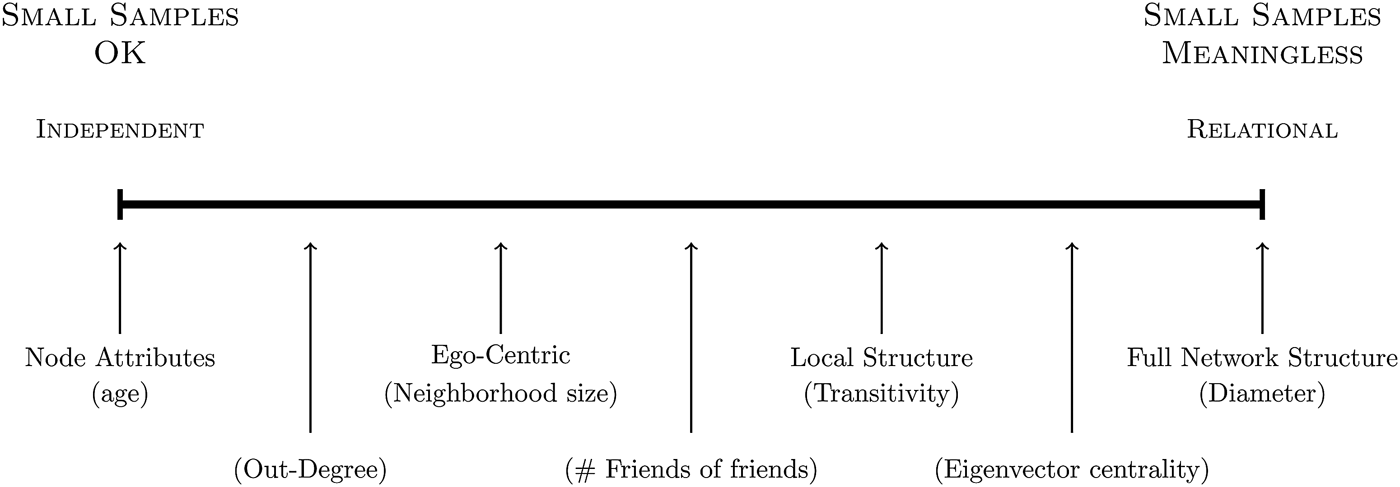
Figure 1 helps classify types of network attributes along the continuum from fully independent to fully relational data. Some attributes of a network, such as a person's total number of connections, are less demanding. Any person's connections (out-degree) can be determined by simply talking to that person. Other attributes are relatively more demanding. To know a respondents' total number of first- and second-degree contacts (friends and friends of friends, for instance), the researcher needs information in addition to that which the respondent will provide about herself. To know how connected a person is in the grand scheme of the network—her/his eigenvector centrality, for instance—then the researcher needs to know about a much larger set of connections (or the absence of them).
The more the network attributes of interest depend on interconnections throughout a network, the more precisely a network needs to be measured. Studies interested in network features like centrality, path lengths, transitivity, reciprocated ties, etc. suffer from small samples.

Network attributes that are farther to the right in Figure 1 require more information about the network structure. One implication is that, in general, the more information required about the network structure, the less informative data collected on only a small subset of nodes will be.
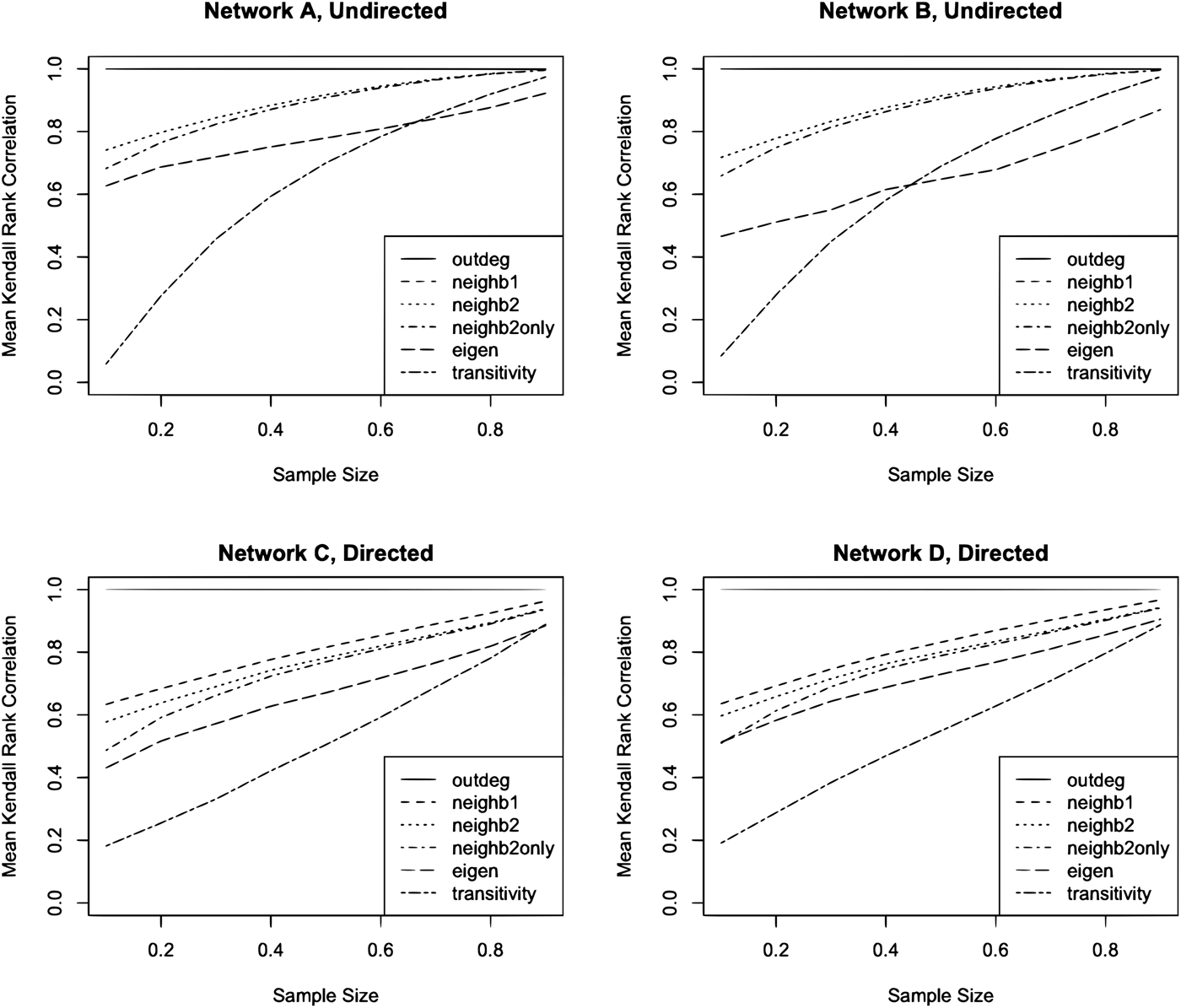
Figure 2 demonstrates this point for four real social networks, two from Indian villages in Banerjee et al. (Reference Banerjee, Chandrasekhar, Duflo and Jackson2013), and two from Ugandan villages in Larson and Lewis (Reference Larson and Lewis2017). On average, smaller samples perform poorly at recovering the network structure; they perform especially poorly at recovering more demanding structural features, even simply preserving the nodes' rank ordering by them.Footnote 10 The only exception is of course out-degree, which can be measured perfectly for respondents in both directed and undirected networks with information provided exclusively by respondents. For the same reason, neighborhood size can also be measured well in small samples in undirected networks. In directed networks, where a link connecting i to j and a link connecting j to i can be different (as when i may lend to j without j lending to i), even the neighborhood size is better measured in larger samples. The more the network attribute of a node depends on the full set of connections throughout the network (such as eigenvector centrality and transitivity), the more nodes must be included in the study. In light of the damage to network structure that sampling introduces, sampling the largest possible number of nodes should be a top priority.
Consequences of random sampling from four real social networks at different sample sizes for six network attributes. Figures display the average Kendall rank correlation between nodes' true network feature and the observed network feature when a sample of a certain size is drawn. Networks A and B are undirected social networks from Banerjee et al. (Reference Banerjee, Chandrasekhar, Duflo and Jackson2013), and Networks C and D are directed social networks from Larson and Lewis (Reference Larson and Lewis2017). On average, small samples perform especially badly for more demanding structural features.

3.1. Reductions in precision and their costs
In a perfect world, researchers interested in network structure would measure the network with full precision—capture every node of interest, and measure the presence or absence of every possible link among them. There are options for reducing precision, all of which shorten the survey at the cost of introducing some error. Here we present the tradeoffs surrounding five of them. Researchers should take these tradeoffs into careful consideration before deciding to reduce the precision with which the network is measured.
Each will refer to the respondent offering her/his network information as an “ego” and the names she/he lists as her/his “alters.”
3.1.1. Reducing precision by capping the number of ninks
Any one respondent in N can have as many as n − 1 links to others in N, and possibly many more to others outside of N. Researchers have the option of letting a respondent list or select from a roster every single alter that meets a criterion.
The downside is that each extra name considered by the respondent adds time to the survey. If the network is dense, lots of respondents will have many names to name or select. Researchers have the option to cap the number of alters that each respondent can offer.
A cap on the number of alters tends to take the form “name up to x people with whom you have …” or “select up to x people from the following list with whom you have …” The larger the value of x, the longer the survey will take.
Two considerations should guide the choice of x. First, is variance in out-degree important to the research question? A cap on the number of alters necessarily right-censors out-degree. Individuals who offer x names all appear the same in the data even though some may truly have more than x out-links in the network. If a key analysis will entail distinguishing respondents based on their degree centrality or popularity, then x must be large enough to generate variance.Footnote 11
Research has shown that eliciting three to five alters produces reliable information on network density (Marsden Reference Marsden1993), and that eliciting one alter for multiple networks is worse than eliciting multiple alters for fewer networks (Marin and Hampton Reference Marin and Hampton2007). Pretesting the networks question will reveal the likelihood that respondents hit the cap when offering ties; if many do and variance is of interest, the cap should be increased.
Note that degree is not the only network statistic that relies on variance in out-degree. Sometimes reciprocated ties—a names b and b names a—are used to proxy for strong ties. This measure works best when any tie is given sufficient opportunity to show up as reciprocated in the data. If everyone is only free to offer one name, few ties that are genuinely reciprocated will show up in the data as reciprocated. The larger is x, the more reciprocated ties will be detected.
A final consideration that should drive the choice of x is whether documenting the absence of a link is important. Projects focused on the way that people are connected can afford to miss links; projects focused on the way that people are not connected need to more carefully document the absence of links. For a project interested in how social ties are arranged, setting x 1 could potentially be informative. On the other hand, setting x 1 would be much less informative for a project interested in whether two tribes are connected by social ties. The latter is interested in the documenting absence of ties between tribes and so should offer a strong test for missing ties. The smaller the x, the weaker this test.
3.1.2. Reducing precision by measuring households instead of individuals
Taking nodes to be households instead of individuals can shorten surveys by effectively reducing the sample size. In this case, links are present when households are connected in some way with other households. The cost is the loss of information within household. Theory and context can help establish whether the network operates at the level of the household or the individual. For instance, to measure the reach fertilizer use training, losing within-household variation may be irrelevant if farming practices are undertaking by households as units. Connections among households then could be meaningful channels along which this information spreads.
Two considerations should guide the choice of aggregating up to the household level versus keeping networks at the level of the individual. First, is the research question at the level of the household or the individual? If at the level of the household, then so long as cross-household links are defined and operationalized carefully, this can be the best network to measure.Footnote 12 Second, does the research question require information about nodes or links for which there is within-household variance? Answering the second question may be difficult ex ante, but can be estimated with pretesting or by contacting local experts in advance. If yes, then aggregating at the household level may be inappropriate.
3.1.3. Reducing precision by using proxies for network position
One way to dramatically save survey time is to measure properties of the network without measuring the network itself. The most popular version of these measures aims to estimate the size of a person's social network. Rather than asking respondents to name individuals, the researcher asks for the number of ties with a series of questions of the form “how many X do you know” where X is a reasonably popular first name. Responses can be used immediately as a relative measure of popularity, or summed or scaled to estimate degree in a social network (Killworth et al. Reference Killworth, McCarty, Bernard, Shelley and Johnsen1998; McCarty et al. Reference McCarty, Killworth, Bernard, Johnsen and Shelley2001; McCormick et al. Reference McCormick, Salganik and Zheng2010; Calvo and Murillo Reference Calvo and Murillo2013).
The number of people with certain first names that a person knows gives a measure of popularity or general social network size. These simplifications can also be used to estimate degree in more specific networks by asking questions of the form “with how many people do you Y ” where Y is an activity or specific relationship. Using a single question that asks respondents to estimate the number of people in their network has been popular in communication studies and American politics (Moy and Gastil Reference Moy and Gastil2006; Eveland and Hively Reference Eveland and Hively2009; de Zúñiga and Valenzuela Reference de Zúñiga and Valenzuela2011).
These simplifications offer substantial time savings; if the only network feature that the researcher needs to collect is degree, these can be worthwhile substitutes for eliciting precise networks and tend to perform reasonably well (Bell et al. Reference Bell, Belli-McQueen and Haider2007). Moreover, these methods better recover true zeros: listing no names in response to a network elicitation question is a weaker signal that that person in fact has no ties of that sort than responding ‘zero’ to the question of how many ties of a sort a person has (Fischer Reference Fischer2009).
The most obvious downside is that no additional details of the network are measured. These methods have two other limitations. First, measures of popularity that depend on counts of the number of names a person knows can be difficult to relate to the precise underlying network. A person who knows more names has a larger social network in some sense, but many research questions require knowing more than this. A person who knows more people does not necessarily have the most access to credit or the most sources of gossip or the largest number of trusted contacts.Footnote 13
Second, the flip side of this method providing a more conservative test for zero ties is that it provides a weaker test for the presence of ties. Studies that hinge on the presence or absence of strong, deep connections may do better eliciting names to recover this variance.
3.2. Maintaining precision through cleaning data
Even the most carefully collected data need to be cleaned. Network data present special challenges for cleaning because responses are interconnected. Even if measurement error is random with respect to links, the error may not equally affect nodes. Making sure ties are reported correctly, and carefully deciding how to assemble the ties into a network for analysis, makes or breaks ultimate inferences. There are forward-looking steps the researcher can take when designing the survey to simplify cleaning the data after collection. We present an overview of these methods in Section 2 of the supporting information.
4. Conclusion
As theories of political phenomena increasingly account for interconnectedness between people, researchers must adjust our methods of data collection to capture these relationships. The above is intended as a guide, in order to help researchers think through design issues before eliciting networks in the field. Doing so is an increasingly common research practice in political science, and a necessary one since data on relevant networks are rarely available via observational data.
Of course, eliciting networks via surveys is not the only option. In-depth, repeated interviews are a useful approach in highly sensitive contexts (e.g. Parkinson (Reference Parkinson2013)). Technology opens up several other avenues for observing networks. In contexts where people regularly use online social media, this offers an observable measure of certain online interactions (see González-Bailón and Wang (Reference González-Bailón and Wang2016)). In fact, researchers have documented a strong correspondence between the determinants of the strength of relationships maintained online and offline (Bisbee and Larson Reference Bisbee and Larson2017), and people's strongest ties on Facebook are often their strongest ties offline (Jones et al. Reference Jones, Settle, Bond, Fariss, Marlow and Fowler2013). Mobile phones also present opportunities to observe networks, including the possibility of tracing movement (Christia et al. Reference Christia, Knox and Al-Rikabi2017) and tracking who calls whom (Eubank Reference Eubank2018). Sociometric badges worn by participants record movements relative to one another and offer another observable measure of some kind of social tie (Olguin et al. Reference Olguin, Paradiso and Pentland2006). Common to all of these approaches is the need for strong theory. While the technology only records certain kinds of ties (following, retweeting and mentions on Twitter), it is up to the researcher to make sure that it is these ties that are most relevant to the question at hand. The same principles of study design—especially the need for careful theory—apply in these domains as well.
We have walked the reader through several important tradeoffs to consider when designing a study that will measure networks in the field. Throughout, we have stressed the hazards of importing sampling techniques from settings where observations are independent, and the importance of considering design tradeoff before arriving in the field. Careful thought ex ante maximizes the chance that scholars make the best use of finite time and resources in the field and return with data that can meaningfully answer research questions. In particular, the stronger the underlying network theory—which nodes matter, exactly which links among them matter and why—the easier the design will be. While research teams heading to the field can consider theory case by case, this guide also highlights the value of strong theory on its own.
Our hope is that this guide makes network data collection in the field easier and less error-prone, and encourages those who would have otherwise been deterred by such an onerous task to reconsider. The more political science is able to pin down the relationship between networks and political outcomes, and can be precise about which links in networks affect which outcomes, the more fruitful the empirical study of networks will be.
Supplementary Material
The supplementary material for this article can be found at https://doi.org/10.1017/psrm.2019.5
Acknowledgments
We gratefully acknowledge Cesi Cruz, Franziska Keller, Lucy Martin, Sarah Parkinson, Matthew Simonson, and Josef Woldense for helpful comments on this paper.