Introduction
Nearshore benthic communities of Antarctica are characterized by a high abundance and diversity of marine invertebrates (Dell Reference Dell1972, Arntz et al. Reference Arntz, Brey and Gallardo1994, Reference Arntz, Gutt and Klages1997). Invertebrate phyla that dominate benthic biomass include soft corals, tunicates, cnidarians, and especially sponges and echinoderms (Dearborn Reference Dearborn1967, Dearborn et al. Reference Dearborn, Allen, Hureau and Arnaud1972, Dayton et al. Reference Dayton, Robilliard, Paine and Dayton1974, White Reference White1984, Cattaneo-Vietti et al. Reference Cattaneo-Vietti, Chiantore, Gamio, Albertelli, Cormaci and Di Geronimo2000, Clarke & Johnston Reference Clarke and Johnston2003). Antarctic echinoderms are important because of their significant contribution to benthic biomass and production, and accordingly, they play a significant role in the global marine carbon cycle (Lebrato et al. Reference Lebrato, Iglesias-Rodriguez, Feely, Greeley, Jones, Suarez-Bosche, Lampitt, Cartes, Green and Alker2010). Echinoderms can also play significant roles as determinants of Antarctic benthic community structure. For example, Antarctic asteroids play keystone roles in regulating the ecology of sponge-dominated benthic communities in the Ross Sea (Dayton et al. Reference Dayton, Robilliard, Paine and Dayton1974).
All five classes of echinoderms are represented along the western Antarctic Peninsula, although asteroids and ophiuroids are the most common classes (Dearborn et al. Reference Dearborn, Allen, Hureau and Arnaud1972, Reference Dearborn, Jordan, Fried, King and Miller1973, Dearborn & Fell Reference Dearborn and Fell1974). Dearborn's studies of the echinoderm fauna along the western Antarctic Peninsula provide an important contribution to our knowledge of echinoderm diversity and biogeography. Nonetheless, these collections are qualitative in the sense that echinoderms were collected by ship-based trawls. Barnes & Brockington (Reference Barnes and Brockington2003) quantified the abundance of echinoderms at the base of the western Antarctic Peninsula at Adelaide Island. However, they reported the benthic community as essentially High Antarctic and similar to that seen in McMurdo Sound in the Ross Sea. Two quantitative studies have examined echinoderm abundances to the west of the northern Antarctic Peninsula in the South Shetland Islands (Retamal et al. Reference Retamal, Quintana and Neira1982, Sáiz-Salinas et al. Reference Sáiz-Salinas, Ramos, Garcia, Troncoso, San Martin, Sanz and Palacin1997). As such, despite the importance of echinoderms in the nearshore hard-bottom algal-dominated benthos along the western Antarctic Peninsula, to date there are no quantitative studies of echinoderm populations, nor assessments of how density patterns may vary with depth or local algal ecotype along the western Antarctic Peninsula. Moreover, qualitative studies of western Antarctic Peninsula echinoderms have been conducted at depths necessarily deep enough for trawling and as such do not reflect the population features of echinoderms that occur in shallow hard-bottom algal-dominated depths accessible by SCUBA.
The overall goal of the present study was to conduct the first quantitative survey of the echinoderm fauna of nearshore rocky-bottom benthos representative of the western Antarctic Peninsula.
Materials and methods
In a study assessing the distribution and abundance of Antarctic hard-bottom macroalgae, Amsler et al. (Reference Amsler, Rowly, Laur, Quetin and Ross1995) defined five discrete study sites off a series of small islands within three kilometres of the south-western coast of Anvers Island (64°S, 64°W) on the central western Antarctic Peninsula. These included two study sites along the north-eastern coast of Dream Island, two study sites along both the northern and southern coasts of Hermit Island, and a study site along the south-eastern coast of DeLaca Island (see Amsler et al. Reference Amsler, Rowly, Laur, Quetin and Ross1995 for map). All five study sites were bounded by a steep rocky shore with the substrate generally extending to a depth of at least 20 m.
The echinoderms reported in the present paper were collected during March 1989. At each study site linear transects were established and semi-permanently marked. Transects were 9 m long and each was placed along a different site-specific depth contour. Two transects were sampled at each of the two Dream Island sites, one at 2 and one at 5 m depth. Transects at the single DeLaca Island site were sampled at 2, 5, 10, and 15 m depth. Transects at site 1 at Hermit Island were sampled at 2, 5, 10, 15 and 20 m depth, while transects at site 2 were sampled at 2, 5 and 10 m depth (Amsler et al. Reference Amsler, Rowly, Laur, Quetin and Ross1995). Because only one study site was sampled at 20 m depth, data for echinoderms from this depth were excluded from the present study. Replicate quadrats, each 0.125 m2, were placed at three randomly selected half-metre increments along each transect line. All macroinvertebrates and macroalgae were hand-collected from each of these quadrats. The macroalgal overstorey within the quadrat was cut and removed, then placed into collecting bags made of fine mesh (Amsler et al. Reference Amsler, Rowly, Laur, Quetin and Ross1995, White Reference White2002). A benthic airlift (Amsler et al. Reference Amsler, Rowly, Laur, Quetin and Ross1995) was then employed to exhaustively collect all the understorey organisms. Vacuumed samples were preserved in a solution of buffered 5% formalin in seawater. After preservation, macroalgae were removed from the understorey samples and the benthic invertebrates were transferred to a solution consisting of 70% EtOH and 10% glycerin for storage (White Reference White2002).
In February 2010 the samples were sorted to remove all the echinoderms from the preserved understorey quadrat invertebrate samples. Sorting of large specimens was done by hand and smaller specimens with the aid of a dissecting microscope. Echinoderms from each quadrat were separated into discrete taxa, enumerated, and re-preserved in 70% EtOH. Voucher specimens were retained at the Smithsonian Museum of Natural History. The number of individuals per square metre was calculated for each class of echinoderms for all 45 quadrats across all sites and depths. The relationship between numbers of individuals of a given echinoderm class and depth was evaluated for all combined study sites (doing so for quadrats only with individuals of a given echinoderm class present and also for all quadrats) using both a linear regression analysis and an ANOVA followed by pair-wise Dunn's tests. At three of the study sites, the relationship between the biomass of algae and the densities of echinoderms in quadrats with or without echinoderms were analysed using linear regression analysis. Algal data included in the regression analyses were raw data used to calculate the summary data presented in Amsler et al. (Reference Amsler, Rowly, Laur, Quetin and Ross1995). Categories of algal abundance used in the analysis included wet biomass per unit area for the two brown algae Himanthothallus grandifolius (A. Gepp & E.S. Gepp) Zinova and Desmerestia spp., as well as for algal morphotypes that included branched red algae, bladed red algae, and crustose coralline and non-coralline algae (the latter expressed as percent cover). Amsler et al. (Reference Amsler, Rowly, Laur, Quetin and Ross1995) detailed determinations of wet biomass and percentage cover per unit area.
Results
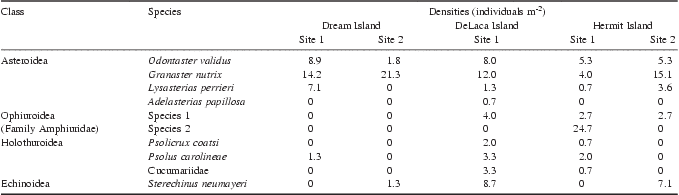
Representatives of the Asteroidea, Ophiuroidea, Holothuroidea and Echinoidea were found at the study sites (Table I). Four species of asteroids were identified. Odontaster validus (Koehler) and Granaster nutrix (Studer) were found at all five study sites. Identification of O. validus was based on Janosik & Halanych (Reference Janosik and Halanych2010), but access to type material of two newly described Odontaster species was limited and understanding of variation owing to size and other factors awaits further study. However, description and depth occurrence in the present study was consistent with O. validus. Lysasterias perrieri Studer was found at four of the five study sites, while Adelasterias papillosa (Koehler) occurred at only one sampling site. Granaster nutrix was the most common asteroid in the study region with a maximum population density of 21.3 individuals m-2 at site 2 at Dream Island. Odontaster validus was the second most abundant, with a maximum density of 8.9 individuals m-2 at site 1 at Dream Island. Lysasterias perrieri had a maximum mean density of 7.1 at site 1 on Hermit Island. Adelasterias papillosa occurred only at DeLaca Island and in very low abundance (0.7 individuals m-2).
Densities (individuals m-2) of echinoderms at the five study sites. Two sites were located off Dream Island, one site off DeLaca Island, and two sites off Hermit Island. All sites were within 3.5 km of Palmer Station, Anvers Island, on the central western Antarctic Peninsula.
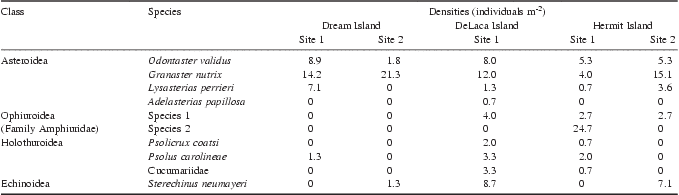
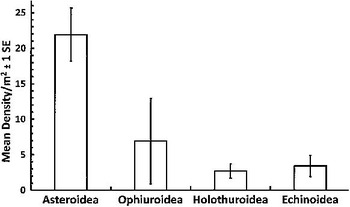
Two unidentified species of ophiuroids in the family Amphiuridae occurred at the study sites. Species 1 was found at DeLaca Island and also at both study sites on Dream Island. The highest density (4 individuals m-2) occurred at DeLaca Island. Species 2 occurred in very high abundance (24.7 individuals m-2), but only at site 1 at Hermit Island. Sea cucumbers included Psolicrux coatsi (Vaney) and Psolus carolineae O'Loughlin & Whitfield, as well as an unidentified member of the Cucumariidae. The cucumariid and P. carolineae were most abundant, both with a maximum density of 3.3 individuals m-2 at DeLaca Island. Psolicrux coatsi occurred in lower abundance at DeLaca Island and at site 1 at Hermit Island. Sterechinus neumayeri (Meissner) was the only sea urchin found at the study sites. Small individuals were found off all three islands and at three of the five study sites. The maximum density (8.7 individuals m-2) occurred at DeLaca Island. Mean ± 1 s.e. densities (number of individuals per square metre) of the four classes of echinoderms for all study sites are presented in Fig. 1.
Densities of each of the four classes of echinoderms collected across depths ranging from 2–15 m at the five sampling sites near Anvers Island on the central western Antarctic Peninsula. Mean ± 1 s.e., n = 45, 0.125 m2 squared quadrats.

Linear regression analyses indicated no significant relationship (all P values > 0.05) between abundance of asteroids, ophiuroids, echinoids, or holothuroids and any other factor considered when all quadrats were included in the analysis. However, when only quadrats with holothuroids were considered, a linear regression revealed a significant positive relationship (P = 0.017) between abundance of holothuroids and depth. When abundance data for all echinoderm classes for all quadrats were analysed using ANOVA, no significant relationships were detected between abundance and depth for asteroids, ophiuroids, holothuroids, or echinoids. However, when only quadrats with ophiuroids were considered, ANOVA detected a significant effect of depth on abundance in the Ophiuroidea (P = 0.014). A pair-wise Dunn's test was unable to discern at which depth ophiuroids were most abundant. This could be due to the pair-wise test being less powerful than the ANOVA, and/or the fact that the majority of the ophiuroids occurred at a single depth (10 m), confounding the pair-wise analyses.
Because of their high abundance and broad distribution across the study sites, the relationship between abundance and depth was further examined for the asteroids O. validus and G. nutrix. Neither species demonstrated a significant relationship between abundance and depth. Linear analysis yielded a P value of 0.07 for O. validus indicative of a trend of increasing abundance with increasing depth, but this was only when quadrats without any O. validus present in them were excluded in the analysis.
A linear regression conducted only for quadrats with urchins present revealed a significant (P = 0.026) positive relationship between the abundance of the echinoid S. neumayeri and the biomass of the brown alga H. grandifolius. Regression analyses failed to detect any further significant relationships between abundances of any of the asteroids, ophiuroids, or holothuroids and the biomass or percent cover of either of the brown algal species or any of the algal ecotypes.
Discussion
Mean population densities of total echinoderms (34.9 individuals m-2) were high and for the four classes of echinoderms ranged from a high of 21.9 m-2 (asteroids) to a low of 2.7 m-2 (holothuroids). Ophiuroids and echinoids displayed intermediate mean densities of 6.9 and 3.4 m-2, respectively. The highest localized population density of any given species occurred in one of the two amphiurid ophiuroids (species 2) where population densities reached 24.7 individuals m-2 at one of the two Hermit Island study sites. Site 1 on Hermit Island and the DeLaca Island site had the highest frequency of total echinoderm species (80 and 90% of the ten species observed, respectively). The remaining three sites had only 40–60% of total species present in the study region. The basis for the higher species diversity at the two sites is unknown but seems likely to be due to the greater number of quadrats sampled at those sites. Those sites with highest species diversity were sampled to deeper depths than the other sites, which could be a factor. Although there were no overall significant correlations between echinoderm densities and depth except with holothuroids when quadrats with none were excluded from the analysis. The diversity of echinoderms detected in nearshore hard-bottom benthos in the present study is at least twice as high (ten vs one–five species) as that found for rocky nearshore macroalgal communities surveyed in Iken et al. (Reference Iken, Konar, Benedetti-Cecchi, Cruz-Motta, Knowlton, Pohle, Mead, Miloslavich, Wong, Trott, Mieszkowska, Riosmena-Rodriguez, Airoldi, Kimani, Shirayama, Fraschetti, Ortiz-Touzet and Silva2010).
One other study has quantitatively examined densities of echinoderms from a hard-bottom community along the western peninsula. However, this study was conducted at Adelaide Island which is located at the base of the western peninsula near the British Antarctic Survey Station on Rothera Point (Barnes & Brockington Reference Barnes and Brockington2003). The authors point out that the patterns of echinoderm and sponge fauna observed at Adelaide Island indicates significant commonality with the benthos of the High Antarctic, for example that described by Dayton et al. (Reference Dayton, Robilliard, Paine and Dayton1974) for McMurdo Sound, rather than the Antarctic Peninsula. As such, direct comparisons with the data in the present study for the central Antarctic Peninsula should to be weighed accordingly. Echinoderm densities measured at 3, 6, 9, 12, 20 and 35 m depths at Adelaide Island showed a strong positive relationship between density and increasing depth and ranged from 3–6 individuals m-2 at 3 and 6 m depth, respectively, and > 150 individuals m-2 at depths ranging from between 10 to 35 m. The high densities of echinoderms at 10 m depth was largely attributable to the echinoid S. neumayeri, and at 20 and 35 m depth, to the holothuroid Cucumaria antarctica Vaney. Other than the asteroid O. validus and the echinoid S. neumayeri, there was no overlap found between the echinoderm taxa identified in the present study and that reported for Adelaide Island (Barnes & Brockington Reference Barnes and Brockington2003). Two quantitative studies have examined echinoderm densities in the South Shetland Islands to the west of the northern Antarctic Peninsula. Retamal et al. (Reference Retamal, Quintana and Neira1982) examined both soft-bottom and hard-bottom communities in Foster Bay, Deception Island and found echinoderms (primarily echinoids and ophiuroids) were among the dominant fauna on hard but not soft bottoms. Sáiz-Salinas et al. (Reference Sáiz-Salinas, Ramos, Garcia, Troncoso, San Martin, Sanz and Palacin1997) examined communities on soft-bottom habitats around Livingston Island, Deception Island, and the Bransfield Strait. Total abundances for asteroids, ophiuroids, echinoids, and holothuroids for all sites sampled were 2.6, 56.9, 3.9, and 4.8 individuals m-2, respectively. Poulin & Feral (1985) reported that densities of the soft-bottom echinoid Abatus cordatus Verrill in shallow bays of the sub-Antarctic Iles Kerguelen peaked (up to 140 individuals m-2) in the shallow sub-tidal (< 2 m depth) and decreased with increasing depth and distance from shore. Nearshore soft-bottom communities between depths of 30 and 115 m were quantitatively sampled in Arthur Harbour adjacent to Palmer Station on Anvers Island on the central western Antarctic Peninsula (Hyland et al. Reference Hyland, Laur, Jones, Shrake, Cadian and Harris1994). The study evaluated the potential impacts of an oil spill, but no oil impacts were detected. The survey revealed very high densities and taxa of macroinvertebrates (particularly polychaetes, oligochaetes, and cumaceans) at four study sites. Interestingly, no echinoderms were detected. Despite this study examining slightly deeper depths, the near proximity of the Hyland et al. (Reference Hyland, Laur, Jones, Shrake, Cadian and Harris1994) study to the present study (within 3.5 km) indicates that the fine glacial silts that characterizes the soft-bottom habitat of Arthur Harbour excludes echinoderms.
Comparative data on echinoderm densities from temperate and tropical latitudes are surprisingly scarce despite their obvious importance (but see recent review by Iken et al. Reference Iken, Konar, Benedetti-Cecchi, Cruz-Motta, Knowlton, Pohle, Mead, Miloslavich, Wong, Trott, Mieszkowska, Riosmena-Rodriguez, Airoldi, Kimani, Shirayama, Fraschetti, Ortiz-Touzet and Silva2010). Lawrence & Sonnenholzner (Reference Lawrence and Sonnenholzner2004) reported the densities of eight species of echinoids, five species of holothuroids, and five species of asteroids from hard- and soft-bottom habitats of the central Galápagos. While the echinoid Eucidaris galapagensis Döderlein had a mean density of 15.4 individuals m-2, the remaining seven echinoids had mean densities below 1 individual m-2. Holothuroids and asteroids displayed very low mean densities (0.01–0.3 individuals m-2). Lawrence & Agatsuma (Reference Lawrence and Agatsuma2007) summarized publications reporting densities for the hard-bottom soft-bottom tropical regular echinoid Tripneustes. Mean density calculated across 29 published studies was c. 2.0 urchins m-2. The echinoids Strongylocentrotus purpuratus (Stimpson) and Strongylocentrotus franciscanus (A. Agazzis) commonly occur in localized high abundance (> 25 m-2) on hard bottoms and periodically exhibit population explosions where urchin fronts may number in the hundreds of individuals per square metre (reviewed by Tegner Reference Tegner2001). Densities of the subtropical/tropical soft-bottom echinoid Lytechinus variegatus (Lamarck) are typically 5–10 individuals m-2 on sand and in seagrass beds (Beddingfield & McClintock Reference Beddingfield and McClintock2000). Densities of temperate soft-bottom suspension feeding ophiuroids are an exception to the norm for echinoderms and can be remarkably abundant (Warner Reference Warner1971).
Overall, population densities of hard-bottom nearshore Antarctic Peninsula asteroids, ophiuroids, echinoids, and holothuroids are robust when compared to those reported in other studies (reviewed above), reflecting their importance in the hard-bottom nearshore faunal communities of the central western Antarctic Peninsula. Of particular note is the high abundance of Antarctic asteroids when compared to patterns of asteroid abundance in temperate and tropical benthos. This supports previous studies emphasizing the importance of asteroids in Antarctic marine ecosystems (Dearborn et al. Reference Dearborn, Jordan, Fried, King and Miller1973, Dayton et al. Reference Dayton, Robilliard, Paine and Dayton1974, Dearborn & Fell Reference Dearborn and Fell1974, McClintock et al. Reference McClintock, Pearse and Bosch1988).
The most abundant asteroid in the present study, G. nutrix, occurred at all five study sites. Population densities were as high as 21.3 individuals m-2 at site 2 at Dream Island. Granaster nutrix is a small (radius = 1–1.5 cm) brooding asteroid that occurs commonly along the Antarctic Peninsula on rocky substrates in cracks and crevices (Fell & Dawsey Reference Fell and Dawsey1969, Dearborn & Fell Reference Dearborn and Fell1974). As an omnivore, G. nutrix feeds on small gastropods and red macroalgae (Dearborn Reference Dearborn1977, Dearborn & Edwards Reference Dearborn and Edwards1984, McClintock Reference McClintock1994), both of which are common in the region of the present study (Amsler et al. Reference Amsler, Rowly, Laur, Quetin and Ross1995, White Reference White2002).
Odontaster validus was also widespread and occurred at all five of the study sites. With the exception of site 2 at Dream Island where density was 1.8 individual m-2, mean densities of O. validus at the study sites (range = 5.3–8.9 individuals m-2) were two- to threefold higher than those reported by Dayton et al. (Reference Dayton, Robilliard, Paine and Dayton1974) for McMurdo Sound (mean density 2.7 individuals m-2). This suggests that O. validus has at least the numerical potential to impact community structure in nearshore shallow peninsular communities. Odontaster validus is a very common species in the sponge dominated communities below 33 m depth in McMurdo Sound, Ross Sea. Dayton et al. (Reference Dayton, Robilliard, Paine and Dayton1974) indicated that in addition to employing extraoral feeding to consume macroinvertebrate prey, O. validus displayed suspension feeding behaviour (arms upturned and extended into the water column) that presumptively regulated larval settlement of the spongivorous asteroids Perknaster fuscus Sladen and Acodontaster conspicuus (Koehler). This, in turn, regulated levels of spongivory that controlled the diversity of the sponge-dominated community. Because the present study focused on much shallower depths on the western Antarctic Peninsula, impacts of O. validus would be limited to algal communities. While O. validus occasionally consumes fleshy red macroalgae (Dearborn Reference Dearborn1977, reviewed in McClintock Reference McClintock1994), insufficient amounts are consumed to play a role structuring the community (C. Amsler, personal observation). Whether O. validus is sufficiently abundant at deeper depths coincident with the sessile invertebrate community to serve a role in community dynamics is not known. Manipulative field studies are needed to investigate this possibility.
Population densities of ophiuroids collected from the study sites varied greatly with location. A density of 24.7 individuals m-2 occurred in one of the two amphiurid species at one of the two Hermit Island study sites. While this level of abundance is impressive, it is less so when considering some ophiuroids at temperate latitudes. The classic example is Ophiothrix fragilis (Abildgaard), a species that forms dense suspension-feeding assemblages on soft sediments off the British Isles. Densities can range from 340–2100 individuals m-2 (Warner Reference Warner1971). One of the most well studied Antarctic ophiuroids, Ophionotus victoriae Bell, is common in soft-bottom habitats (e.g. c. 5–10 individuals m-2 at 30 m depth at New Harbour, Ross Sea, J. McClintock personal observation). That O. victoriae was not detected in the present study reflects the absence of soft-bottom habitats sampled in the study, rather than the absence of the species. Populations of O. victoriae occur on soft sediments near Palmer Station (C. Amsler, personal observation).
The regular echinoid S. neumayeri was the only echinoid observed in the present study. Small individuals occurred off all three of the islands sampled, but only at one of the two study sites at each of Dream and Hermit islands. Sterechinus neumayeri is the most abundant echinoid in nearshore waters of Antarctica (Brey et al. Reference Brey, Pearse, Basch, McClintock and Slattery1995). While densities near Palmer Station were moderate (3.4 individuals m-2), they were somewhat lower than densities in some nearshore regions of McMurdo Sound, Antarctica (McClintock, personal observation, Brey et al. Reference Brey, Pearse, Basch, McClintock and Slattery1995). The largest numbers of individuals in the present study were found at a relatively shallow depth of 5 m at DeLaca Island. Pearse & Giese (Reference Pearse and Giese1966) noted that leafy red algae (Iridaea sp.) may provide some food for S. neumayeri in McMurdo Sound, however, gut content analyses indicated they fed primarily on benthic diatoms. Sterechinus neumayeri has only rarely been observed grazing directly on attached macroalgae near Palmer Station although it commonly covers with brown algae (C. Amsler, personal observation) and algal fragments are present in its gut contents (Brand Reference Brand1976), perhaps representing drift material. Moreover, in the present study no relationship was found between urchin abundance and the abundances of branched red algae, bladed red algae, or encrusting coralline algae. Higher densities of urchins associated with the brown alga Himanthothallus grandifolius (but only when quadrats with urchins are included in the abundance-depth regression analysis) suggest an association with this alga for cover rather than as a food resource. It is curious that unlike most regular echinoids, S. neumayeri does not graze readily on the fresh thalli of macroalgae (Lawrence Reference Lawrence1975). This may be explained by the prevalence of chemical defences among Antarctic macroalgae (Amsler et al. Reference Amsler, McClintock and Baker1998, Reference Amsler, Iken, McClintock, Amlser, Peters, Hubbard, Furrow and Baker2005), and/or a high abundance of benthic diatoms available as an alternate resource (Amsler et al. Reference Amsler, Moeller, McClintock, Iken and Baker2000).
The prevalence of echinoderms in hard-bottom nearshore benthic communities of the western Antarctic Peninsula adds support to a broadening consensus that echinoderms are an overlooked, yet critical, global contributor to the marine carbon cycle (Lebrato et al. Reference Lebrato, Iglesias-Rodriguez, Feely, Greeley, Jones, Suarez-Bosche, Lampitt, Cartes, Green and Alker2010). This growing body of evidence challenges the prevailing view that calcium carbonate is primarily produced and exported by marine plankton in a “biological pump.” The echinoderm fauna documented in the present study fall within the 0–800 m depth range that contributes over 80% of the global calcium carbonate produced by echinoderms worldwide (Lebrato et al. Reference Lebrato, Iglesias-Rodriguez, Feely, Greeley, Jones, Suarez-Bosche, Lampitt, Cartes, Green and Alker2010). The primary contributors to the standing stock of calcium carbonate among Antarctic echinoderms in the Southern Ocean (< 500 g m-2) are the asteroid Odontaster validus, the echinoid S. neumayeri, and ophiuroids Ophionotus victoriae, and Ophiurolepis gelida (Koehler) (Lebrato et al. Reference Lebrato, Iglesias-Rodriguez, Feely, Greeley, Jones, Suarez-Bosche, Lampitt, Cartes, Green and Alker2010). Given an overall mean echinoderm population density of 34.7 individuals m-2, it is probable that the nearshore hard-bottom standing stock of echinoderm-derived calcium carbonate in the vicinity of Anvers Island would exceed the 500 g m-2 average for the Southern Ocean.
The dominance of echinoderms in hard-bottom Antarctic Peninsula communities is also relevant in the context of ocean acidification. Given that the Southern Ocean is the largest sink for atmospheric carbon dioxide, and that there is an inverse relationship between temperature and decalcification, Antarctica is the most vulnerable region of the planet to early impacts of ocean acidification (Fabry et al. Reference Fabry, McClintock, Mathis and Grebmeir2009). Antarctic calcifying organisms are estimated to experience sub-saturated levels of aragonite and calcite by mid-century (Fabry et al. Reference Fabry, McClintock, Mathis and Grebmeir2009, McClintock et al. Reference McClintock, Amsler, Angus, Challener, Schram, Amsler, Mah, Cuce and Baker2011). Moreover, the susceptibility of echinoderms’ inorganic carbon to dissolution is exacerbated because of their high concentrations of magnesium calcite, a skeletal constituent that is even more soluble than aragonite or calcite (Bischoff et al. Reference Bischoff, MacKenzie and Bishop1987). A recent survey of the magnesium calcite levels of Antarctic echinoderms (McClintock et al. Reference McClintock, Amsler, Angus, Challener, Schram, Amsler, Mah, Cuce and Baker2011) indicated that asteroids and ophiuroids, the two classes that occurred in greatest abundance in the present study, have the highest levels of skeletal magnesium calcite. Thus the two classes of echinoderms that may most influence nearshore hard-bottom communities are at near-term risk.
Acknowledgements
We thank David Pawson at the Museum of Natural History at the Smithsonian Institution, Washington DC, and R. Mooi at the California Academy of Sciences, USA, for assistance with the taxonomy of holothuroids and echinoids, respectively. We also thank R. Rowley, D. Laur, J. Baldelli and J. Campbell for assistance with field collections in Antarctica and a number of UCSB undergraduates who assisted with initial sample sorting. This research was facilitated by funds from an Endowed Professorship in Polar and Marine Biology (JBM), a travel grant from All Seasons Travel, Birmingham that supported travel for BAW to the Smithsonian Institution (JBM), and National Science Foundation grants DPP-8518872 (LBQ, RMR), DPP-8918276 (LBQ, RMR, CDA), and ANT-0838773 (CDA, JBM). The constructive comments of the reviewers are gratefully acknowledged.