INTRODUCTION
In Brachyura, the hard integument of crabs, favouring accurate measurements, and the simple identification of ovigerous females by the presence of eggs attached to their pleopods, facilitate investigations on two important reproductive subjects: the relative growth and the breeding season (see Flores & Negreiros-Fransozo, Reference Flores and Negreiros-Fransozo1998; Mantelatto & Fransozo, Reference Mantelatto and Fransozo1999a, Reference Mantelatto and Fransozob; Corgos & Freire, Reference Corgos and Freire2006; Hartnoll et al., Reference Hartnoll, Baine, Grandas, James and Atkin2006; Gerhart & Bert, Reference Gerhart and Bert2008; Cobo & Alves, Reference Cobo and Alves2009; Mclay & Van den Brink, Reference Mclay and Van den Brink2009; Bertini et al., Reference Bertini, Teixeira, Fransozo and Fransozo2010; Rasheed & Mustaquim, Reference Rasheed and Mustaquim2010). Throughout the growth of brachyuran crabs, certain body structures, particularly the chelipeds in males and the abdomen in females, have been used by various researchers in studies on morphological maturity due to their functions in reproduction (see Hartnoll, Reference Hartnoll1978, Reference Hartnoll, Bliss and Abele1982, Reference Hartnoll and Wenner1985; Pinheiro & Fransozo, Reference Pinheiro and Fransozo1993; Fernández-Vergaz et al., Reference Fernández-Vergaz, López Abellán and Balguerías2000; Corgos & Freire, Reference Corgos and Freire2006; Bertini et al., Reference Bertini, Braga, Fransozo, Corrêa and Freire2007; Hirose & Negreiros-Fransozo, Reference Hirose and Negreiros-Fransozo2007; Doi et al., Reference Doi, Yokota, Strüssmann and Watanabe2008; Mclay & Van den Brink, Reference Mclay and Van den Brink2009; Rasheed & Mustaquim, Reference Rasheed and Mustaquim2010; Sal Moyano et al., Reference Sal Moyano, Gavio and Maggi2011). In these studies, significant changes in the allometric growth rates are usually correlated with morphological changes in such body structures between immature and mature phases, which might occur gradually over a series of moults or abruptly at a single moult (Hartnoll, Reference Hartnoll1978, Reference Hartnoll, Bliss and Abele1982, Reference Hartnoll and Wenner1985). In addition, studies on breeding season are another important tool for a better comprehension of the reproductive biology of brachyuran crabs. According to Sastry (Reference Sastry, Vernberg and Vernberg1983), breeding patterns are results of complex interactions between environmental variables and reproductive processes, leading to inter- and intra-specific variations in the duration of the reproductive cycle, which allow characterizing the periodicity and intensity of reproduction of the species.
The Brazilian coast harbours 302 species of brachyuran crabs (Amaral & Jablonski, Reference Amaral and Jablonski2005), including 18 species of the family Leucosiidae (Melo, Reference Melo1996). Twelve of these leucosiid species occur on the south-eastern coast, from the border of Espírito Santo State to the extreme south of São Paulo State (Melo, Reference Melo1996). On the northern coast of São Paulo State, Persephona lichtensteinii Leach, 1817, P. mediterranea (Herbst, 1794), and P. punctata (Linnaeus, 1758) are the most abundant leucosiid crabs (Mantelatto & Fransozo, Reference Mantelatto and Fransozo2000; Bertini et al., Reference Bertini, Fransozo and Melo2004). Lithadia brasiliensis (von Martens, 1872), P. crinita (Rathbun, 1931), and Ebalia rotundata (A. Milne-Edwards, 1880) have also been recorded in this region (Mantelatto & Fransozo, Reference Mantelatto and Fransozo2000; Bertini et al., Reference Bertini, Fransozo and Melo2004). Persephona lichtensteinii, P. mediterranea, and P. punctata are widely distributed in the western Atlantic from intertidal to subtidal zones at depths to 70, 60 and 50 m, respectively, and on substrates composed of mud, sand, shells, calcareous algae and/or corals (Melo, Reference Melo1996). Although these species are not commercially exploited, they might play an essential ecological role within the trophic web of soft bottom environments to which they pertain. But P. lichtensteinii, P. mediterranea, and P. punctata are also an important part of the by-catch of the shrimp fishery on the south-eastern Brazilian coast; as a result, their populations have been strongly impacted by shrimp trawling.
Despite several studies on relative growth and reproductive traits of brachyuran crabs (see Pinheiro & Fransozo, Reference Pinheiro and Fransozo1993; Flores & Negreiros-Fransozo, Reference Flores and Negreiros-Fransozo1998; Mantelatto & Fransozo, Reference Mantelatto and Fransozo1999a, Reference Mantelatto and Fransozob; Fernández-Vergaz et al., Reference Fernández-Vergaz, López Abellán and Balguerías2000; Corgos & Freire, Reference Corgos and Freire2006; Hartnoll et al., Reference Hartnoll, Baine, Grandas, James and Atkin2006; Bertini et al., Reference Bertini, Braga, Fransozo, Corrêa and Freire2007; Hirose & Negreiros-Fransozo, Reference Hirose and Negreiros-Fransozo2007; Doi et al., Reference Doi, Yokota, Strüssmann and Watanabe2008; Cobo & Alves, Reference Cobo and Alves2009; Mclay & Van den Brink, Reference Mclay and Van den Brink2009; Bertini et al., Reference Bertini, Teixeira, Fransozo and Fransozo2010; Sal Moyano et al., Reference Sal Moyano, Gavio and Maggi2011), little is known about the biology of leucosiid species, including P. lichtensteinii, P. mediterranea, and P. punctata throughout their range of distribution. Negreiros-Fransozo et al. (Reference Negreiros-Fransozo, Fransozo and Hebling1989) described the early larval development of P. mediterranea; Bertini et al. (Reference Bertini, Fransozo and Costa2001, Reference Bertini, Teixeira, Fransozo and Fransozo2010) reported on the spatial and temporal distribution of Persephona spp. and the reproductive period and the sexual maturity of P. mediterranea, in the Ubatuba region; and Carvalho et al. (Reference Carvalho, Carvalho and Couto2010) performed a comparative analysis of the distribution and sexual maturity of P. lichtensteinii and P. punctata in Ilhéus, Bahia State. Thus, due to the lack of previous studies dealing with relative growth and reproductive traits of leucosiid species worldwide, information that contributes to understanding the population dynamics of these species, maintenance and preservation of natural stocks is needed, especially at sites such as the south-eastern coast of Brazil, where intense and uncontrolled expansion of tourism is affecting the marine ecosystems (Mantelatto et al., Reference Mantelatto, Fransozo and Negreiros-Fransozo1995).
This paper describes the relative growth of secondary characters, by investigating allometric changes during the growth of juvenile and adult specimens, the size at the onset of morphological sexual maturity, and the breeding seasons of P. lichtensteinii, P. mediterranea, and P. punctata on the south-eastern coast of Brazil.
MATERIALS AND METHODS
Sampling of Persephona spp.
Crabs were collected every two months from January 1991 through to November 1992, in Ubatuba Bay (23°30′S, 45°09′W) on the south-eastern Brazilian coast. The shrimp fishing boat used for trawling was equipped with two otter-trawl nets (mesh size 10 mm). The trawls were carried out at depths from 4 to 18 m. Captured specimens of Persephona lichtensteinii, P. mediterranea, and P. punctata were labelled and stored frozen until analysis. In the laboratory, the crabs were sexed and measured. Sex and maturation stages (immature and mature) were established by the shape and adherence of the abdomen to the thoracic sternites (Haefner, Reference Haefner1985). Males have an elongated abdomen while females have an oval shaped abdomen. Immature males and females were categorized as those specimens with abdominal somites adhered to sternites, whereas mature males and females were categorized as those specimens without abdominal somites adhered to sternites.
Size–frequency distributions for all species and both sexes were constructed using 2.0-mm carapace length (CL) size intervals. Student's t-test (α = 0.05) was used to compare differences in the carapace width of males and females of each species. Homoscedasticity and normality of the data set were evaluated and found satisfactory after logarithmic transformation of the data.
Relative growth, size at the onset of morphological sexual maturity, and breeding season
Body dimensions were measured separately for males and females, using a Vernier caliper with a precision of 0.1 mm. The following dimensions were selected for morphometric analyses: maximum carapace width (CW); abdomen width (AW)—measured from the greatest width of 5th segment; and cheliped propodus length (CPL)—measured from the tip of propodus (fixed finger) to the base where it articulates with carpus. Specimens with an imperfect carapace or with regenerating body parts were not included in the analyses.
Analyses of relative growth were based on the allometric equation y = ax b (y = dependent variables [AW, CPL]; x = independent variable [CW]; a = intercept on y axis; and b = allometric growth coefficient), converted to the linear form by means of natural logarithm transformation (lny = lna + blnx) (Hartnoll, Reference Hartnoll1978). Growth can be characterized as positively allometric when b > 1, negatively allometric when b < 1, or isometric when b = 1 (Huxley, Reference Huxley1950). Student's t-test was utilized to evaluate the allometric coefficient of growth, with significance level α = 0.05 (Zar, Reference Zar1999). A covariance analysis (ANCOVA, α = 0.05) was used to test the similarity of slopes and intercepts of lines for each phase of growth for both sexes.
The overall size at the onset of morphological sexual maturity was estimated for both sexes of each species, and calculated from the size at which 50% of the specimens were able to reproduce (see above). The method used to estimate sexual maturity was based on fitting the sigmoid, logistic curve to the data obtained (see Pinheiro & Fransozo, Reference Pinheiro and Fransozo1998). The equation used was: y = 1/(1 + e (−r(CW-CW50))); where y is the estimated proportion of mature male and female crabs, CW is the carapace width, CW50 is the size at the onset of sexual maturity, and r is the coefficient for the slope of the logistic curve. The logistic curve was fitted by least squares to the aforementioned proportions per size-class of all the individuals and samples, using maximum-likelihood iterations. After adjusting the model regression, the size at which 50% of the males and females reached sexual maturity was estimated (CW50). Finally, the breeding seasons of P. lichtensteinii, P. mediterranea, and P. punctata were determined by the proportion of ovigerous females to the total number of mature females collected during each of the sampled months.
RESULTS
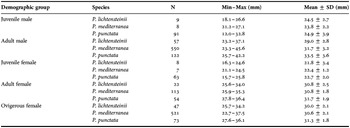
A total of 1745 individuals were analysed in the current study, which corresponded to 143 specimens of Persephona lichtensteinii, 1199 of P. mediterranea, and 403 of P. punctata. The size ranges, means, and standard deviations of the carapace width for each sex of each species are shown in Table 1.
Size (mm) of Persephona individuals based on carapace width.

N, number of individuals; Min, minimum; Max, maximum; SD, standard deviation.
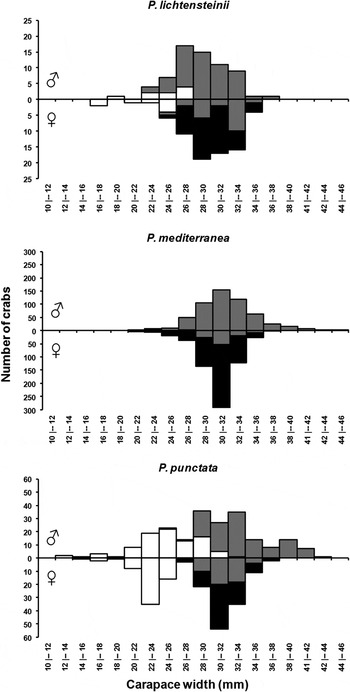
The size–frequency distribution of males and females of each species is shown in Figure 1. In general, males were more numerous than females in the last size-classes; for P. lichtensteinii, P. mediterranea, and P. punctata, males were about 6, 21 and 16% larger than females, respectively. However, significant differences in the sizes of carapace width between males and females were obtained only for P. mediterranea (Student's t-test, P < 0.001) and P. punctata (Student's t-test, P = 0.01). For both species, the males reached larger mean sizes than females (mean ± standard deviation; P. mediterranea: ♂ = 31.5 ± 3.4 mm CW, ♀ = 30.6 ± 2.2 mm CW; P. punctata: ♂ = 29.8 ± 5.7 mm CW, ♀ = 28.6 ± 4.6 mm CW). In P. lichtensteinii, the mean size of carapace width did not differed statistically between the sexes (Student's t-test, P = 0.20) (♂ = 28.4 ± 3.2 mm CW, ♀ = 29.4 ± 3.5 mm CW).
Size–frequency distributions for all species and both sexes (white bar = juvenile males and females; grey bar = adult males and females; black bar = ovigerous females).

Relative growth
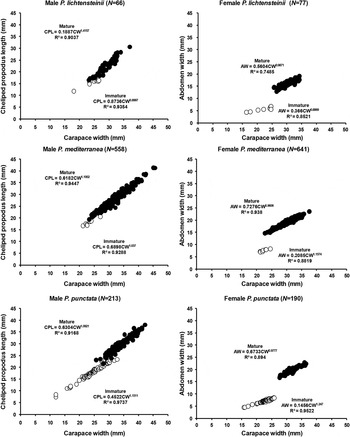
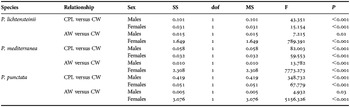
ANCOVA analyses revealed significant differences in the slopes and intercepts of lines for immature and mature phases of the three species and for both sexes with respect to all body dimensions analysed (ANCOVA, P < 0.05; Table 2; Figure 2).
Morphometric relationships between carapace width (CW), cheliped propodus length (CPL), and abdomen width (AW) for males and females of Persephona lichtensteinii, Persephona mediterranea and Persephona punctata.

Summary of analyses of covariance of growth patterns between immature and mature phases for all Persephona species and sexes.

CW, carapace width; CPL, cheliped propodus length; AW, abdomen width; SS, sum of squares; dof, degrees of freedom; MS, mean square.
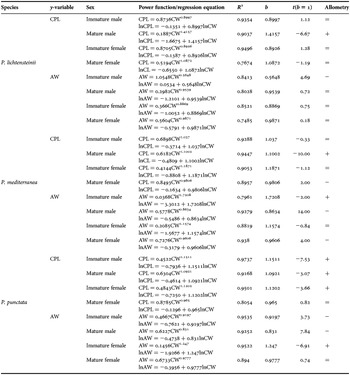
Immature males and females of P. lichtensteinii showed isometric growth between the cheliped propodus length and carapace width, whereas the growth of such body structures in the mature individuals was positive for males and isometric for females (Table 3; Figure 2). Concerning the abdomen and carapace widths, a negative allometry and an isometry were observed for immature males and females, respectively. For mature individuals, an isometric growth was recorded for both sexes (Table 3; Figure 2).
Summary of power function and ln-transformed regression analyses based on the carapace width (CW) as x-variable for Persephona lichtensteinii, Persephona mediterranea and Persephona punctata.

CPL, cheliped propodus length; AW, abdomen width; R 2, determination coefficient; =, isometry; +, positive allometry; −, negative allometry.
For P. mediterranea, immature individuals of each sex showed isometric growth for the relationship CPL versus CW, while a positive and a negative allometry were observed for mature males and females, respectively (Table 3; Figure 2). The relationship AW versus CW was characterized by a positive allometric growth for immature males and an isometric growth for immature females (Table 3; Figure 2). For mature males and females, this same relationship showed a negative allometric growth (Table 3; Figure 2).
Only immature individuals of P. punctata showed positive allometric growth between the cheliped propodus length and carapace width, whereas a positive allometry and an isometry were identified for mature males and females, respectively (Table 3; Figure 2). The growth pattern considering the relationship AW versus CW was negatively allometric for both immature and mature males (Table 3; Figure 2). For females, the same relationship showed a positive allometric growth for immature individuals and an isometric growth for mature individuals (Table 3; Figure 2).
Importantly, there was a slight overlap of dispersion points of immature and mature males for the relationship CPL versus CW, where the puberty moult can occur from 23 to 27 mm CW in P. lichtensteinii and P. mediterranea, and from 25 to 33 mm CW in P. punctata (Figure 2). For the relationship AW versus CW, a marked discontinuity of points for immature and mature females was identified, except for females of P. mediterranea, for which the dispersion points overlapped in the same morphometric analysis, showing that the puberty moult can occur from 22 to 25 mm CW (Figure 2).
Size at the onset of morphological sexual maturity
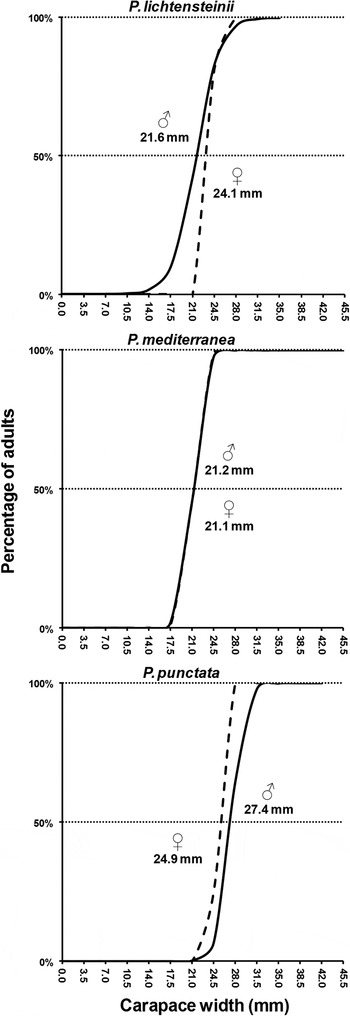
Taking into account the total number of crabs collected during the entire sampling period, the sizes at the onset of morphological sexual maturity (CW50) of males and females were estimated to be 21.6 and 24.1 mm in P. lichtensteinii, 21.2 and 21.1 mm in P. mediterranea, and 27.4 and 24.9 mm in P. punctata (Figure 3).
Size at the onset of morphological sexual maturity for each Persephona species and sex (___ = males; _ _ _ = females).

Breeding season
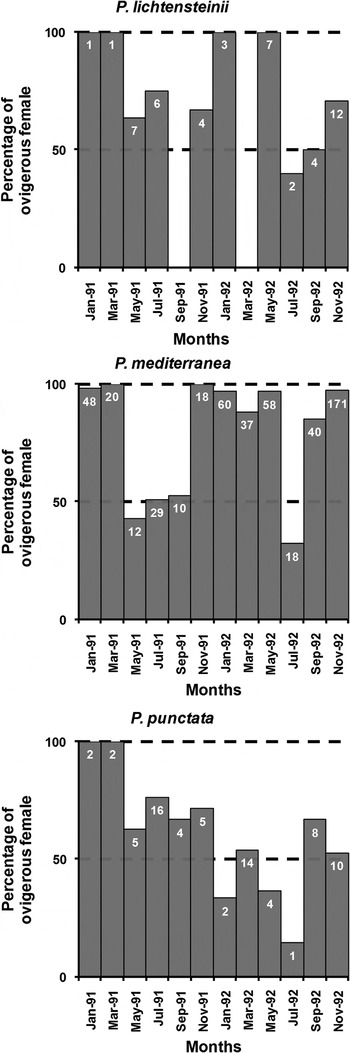
The mature females collected during the present study included 69 specimens of P. lichtensteinii, 634 P. mediterranea and 127 P. punctata, of which 68, 82 and 57% were carrying eggs, respectively. For P. mediterranea and P. punctata, ovigerous females occurred throughout the sampling period (Figure 4). On the other hand, ovigerous females of P. lichtensteinii were not recorded in September 1991 and March 1992 (Figure 4). In general, the percentage of ovigerous females remained relatively constant and above 50% throughout the years for all species (Figure 4). Despite the slight seasonal differences observed in the reproduction pattern among P. lichtensteinii, P. mediterranea and P. punctata, the main reproductive peak of the three species occurred in January and March 1991. A second peak was observed in January and May 1992 for P. lichtensteinii, and from November 1991 to May 1992 for P. mediterranea (Figure 4). For P. punctata, the percentage of ovigerous females decreased practically over the following sampled months, except in July and November 1991, and in March and September 1992 (Figure 4).
Variation in the percentage of ovigerous females in relation to mature females sampled in the population during the study period, for Persephona lichtensteinii, Persephona mediterranea, and Persephona punctata (numbers above each bar correspond to the total individuals collected).

DISCUSSION
Distinct patterns of sexual dimorphism in carapace size were obtained for the three leucosiid species. Males of Persephona mediterranea and P. punctata reached larger mean sizes than females, whereas no significant difference was observed for P. lichtensteinii. The results herein obtained along with those reported by previous studies along the Brazilian coast, show that such sexual dimorphism was observed only in P. mediterranea (Ubatuba coast, São Paulo State—Bertini et al., Reference Bertini, Teixeira, Fransozo and Fransozo2010). For P. lichtensteinii, Carvalho et al. (Reference Carvalho, Carvalho and Couto2010) did not obtain significant differences in carapace width between males and females along the Ilhéus coast, Bahia State, corroborating the results of the present study. In addition, these authors did not record a sexual dimorphism in carapace width of P. punctata, probably due to the low number of specimens obtained during their research (58 individuals). Several studies have shown that males attain greater body sizes than females, supporting the notion that the sexual dimorphism is the rule rather than the exception within the Brachyura (see Hartnoll et al., Reference Hartnoll, Baine, Grandas, James and Atkin2006; Litulo, Reference Litulo2006; Gerhart & Bert, Reference Gerhart and Bert2008; Hirose & Negreiros-Fransozo, Reference Hirose and Negreiros-Fransozo2008; Pereira et al., Reference Pereira, Branco, Christoffersen, Junior, Fracasso and Pinheiro2009; Teixeira et al., Reference Teixeira, Fransozo, Cobo and Hiyodo2009). Usually, larger body size in males represents successful mating and reproduction during agonistic interactions, courtship, and protection of females during and after copulation (Hartnoll, Reference Hartnoll and Wenner1985; Mantelatto & Martinelli, Reference Mantelatto and Martinelli1999; Fernández-Vergaz et al., Reference Fernández-Vergaz, López Abellán and Balguerías2000; Corgos & Freire, Reference Corgos and Freire2006; Mclay & Van den Brink, Reference Mclay and Van den Brink2009; Varisco & Vinuesa, Reference Varisco and Vinuesa2011; Araújo et al., Reference Araújo, Negromonte, Barreto and Castiglioni2012). In the present study, different reproductive strategies may be displayed by the three leucosiid species; the aggressiveness level of males during the courtship probably is high in P. mediterranea and P. punctata, but low in P. lichtensteinii, given the pattern of sexual dimorphism observed. Unfortunately, there is no information about the mating behaviour either of these species or the family Leucosiidae. Future studies on reproductive strategies of P. lichtensteinii, P. mediterranea and P. punctata will elucidate the social interactions of these crabs, contributing to the comprehension of the distinct patterns of sexual dimorphism of the species.
The morphometric relationships CPL versus CW (males) and AW versus CW (females) showed a similar pattern of relative growth for P. lichtensteinii, P. mediterranea, and P. punctata. It is known that changes in allometric growth of the chelipeds and abdomen characterize the transition between immature and mature phases, which is achieved at the puberty moult (Hartnoll, Reference Hartnoll1978, Reference Hartnoll and Wenner1985). The visible overlap and discontinuity of points observed in the scatter plots of the above relationships can be related to the puberty moult of these crabs, marking the transition from the immature to mature phase for each sex. These results agree with previous observations in other crabs of different families (Portunus spinimanus Latreille, 1819 by Santos et al., Reference Santos, Negreiros-Fransozo and Fransozo1995; Menippe nodifrons Stimpson, 1859 by Bertini et al., 2007; Charybdis bimaculata (Miers, 1886) by Doi et al., 2008; Mithrax tortugae Rathbun, 1920 by Cobo & Alves, Reference Cobo and Alves2009; Halicarcinus cookii Filhol, 1885 by Mclay & Van den Brink, Reference Mclay and Van den Brink2009; and others).
For males of P. lichtensteinii, P. mediterranea, and P. punctata, the marked increase in the size of chelipeds observed after the puberty moult, can be considered a good advantage for them. As briefly discussed, greater body sizes in males contribute to the reproductive success during many behavioural displays, from territorial defence to carry and hold the female during copulation (Hartnoll, Reference Hartnoll1969; Rasheed & Mustaquim, Reference Rasheed and Mustaquim2010). Such advantage was reported for the species Arenaeus cribrarius (Lamarck, 1818) studied by Pinheiro & Fransozo (Reference Pinheiro and Fransozo1993), Sesarma rectum Randall, 1840 by Mantelatto & Fransozo (Reference Mantelatto and Fransozo1999a), Uca thayeri Rathbun, 1900 by Negreiros-Fransozo et al. (Reference Negreiros-Fransozo, Colpo and Costa2003), Gecarcinus ruricola (Linnaeus, 1758) by Hartnoll et al. (Reference Hartnoll, Baine, Grandas, James and Atkin2006), M. tortugae by Cobo & Alves, Reference Cobo and Alves2009, and H. cookii by Mclay & Van den Brink (Reference Mclay and Van den Brink2009). Interestingly, females did not show considerable changes in the cheliped growth rate; although a positive allometry was identified in juvenile females of P. punctata. According to Gerhart & Bert (Reference Gerhart and Bert2008), for females it is more important to direct available energy to reproduction than to attain proportionally larger claws.
In female leucosiid crabs, as well as in many brachyuran females (e.g. A. cribrarius—Pinheiro & Fransozo, Reference Pinheiro and Fransozo1993; S. rectum—Mantelatto & Fransozo, Reference Mantelatto and Fransozo1999a; Chaceon affinis (Colosi, 1923)—Fernández-Vergaz et al., Reference Fernández-Vergaz, López Abellán and Balguerías2000; M. nodifrons—Bertini et al., Reference Bertini, Braga, Fransozo, Corrêa and Freire2007; Callinectes danae Smith, 1869—Araújo et al., Reference Araújo, Negromonte, Barreto and Castiglioni2012; M. tortugae—Cobo & Alves, Reference Cobo and Alves2009; H. cookii—Mclay & Van den Brink, Reference Mclay and Van den Brink2009), the main function of the abdomen is related to protection of eggs (Hartnoll, Reference Hartnoll, Bliss and Abele1982). This body structure, in conjunction with the sternum, encloses a chamber that facilitates the fixation of the eggs to the pleopods and protects them during incubation. According to Hartnoll (Reference Hartnoll, Bliss and Abele1982), immature females show positive allometry of the abdomen regarding the carapace width, but the degree of allometry decreases after the puberty moult. In the present study, this growth pattern was recorded only for P. punctata. However, there was a clear distinction between immature and mature females of P. lichtensteinii and P. mediterranea in the abdomen shape, as observed in the scatter plots. In contrast, the abdomen of males changes little throughout the immature and mature phases; the growth is approximately isometric (Hartnoll, Reference Hartnoll, Bliss and Abele1982). For all species in the present study, the growth of the male abdomen varied between isometry and negative allometry during the immature and mature phases; it remained elongated, as in majid crabs, covering only the gonopods and a small part of the sternum.
According to Hartnoll (Reference Hartnoll1969), male crabs are considered morphologically mature when they are able to hold the females during pre- and post-copulatory guarding and to transfer successfully sperm to females, whereas females reach maturity when they are able to mate and spawn. The size at the onset of morphological sexual maturity (CW50) attained by males of P. lichtensteinii was smaller than females. However, Carvalho et al. (Reference Carvalho, Carvalho and Couto2010) observed the opposite; males of P. lichtensteinii attained the sexual maturity at a slightly larger size than females. Smaller body sizes in males can be also considered a good advantage. Based on previous studies (Powell et al., Reference Powell, James and Hurd1974; Jivoff, Reference Jivoff2003), the capacity of males to attain sexual maturity at relatively small sizes may function as an increase of opportunities to mate. Another possible cause for earlier maturation in males of P. lichtensteinii could be explained by the absence of a pronounced sexual dimorphism (see above). In general, mate searching, display, territorial defence and mate guarding, all have energetic costs for males, which can be directed mainly to the increase of the chelipeds (Hartnoll, Reference Hartnoll2006). Thus, the absence of such sexual dimorphism could be an advantage for P. lichtensteinii; males may reduce their energy intake for somatic growth, increasing their investment at reproduction. Concerning the size at the onset of morphological sexual maturity of P. mediterranea and P. punctata, similar results were obtained by Bertini et al. (Reference Bertini, Teixeira, Fransozo and Fransozo2010) and Carvalho et al. (Reference Carvalho, Carvalho and Couto2010), in which males attained the sexual maturity at larger size than females. However, Bertini et al. (Reference Bertini, Teixeira, Fransozo and Fransozo2010) estimated the sexual maturity of P. mediterranea according to ovarian development. Interestingly, both results suggest that these processes occur synchronically. According to Fernández-Vergaz et al. (Reference Fernández-Vergaz, López Abellán and Balguerías2000), morphometric maturity means that the crab is morphometrically functional for reproduction, independent of whether it becomes physiologically mature before or after reaching morphometric maturity. Therefore, a crab should be classified as adult only when it reaches both morphometric and physiological maturity. This phenomenon was also observed in other brachyurans such as C. ornatus Ordway, 1863 (Mantelatto & Fransozo, Reference Mantelatto and Fransozo1996), P. spinimanus (Santos & Negreiros-Fransozo, Reference Santos and Negreiros-Fransozo1996), Maja squinado (Herbst, 1768) (Sampedro et al., Reference Sampedro, González-Gurriarán, Freire and Muiño1999), Hepatus pudibundus (Herbst, 1785) (Reigada & Negreiros-Fransozo, Reference Reigada and Negreiros-Fransozo1999); C. affinis (Fernández-Vergaz et al., Reference Fernández-Vergaz, López Abellán and Balguerías2000), Anamathia rissoana (Roux, 1828) (Mura et al., Reference Mura, Orrù and Cau2005), and Libinia spinosa (Milne-Edwards, 1834) (Sal Moyano et al., Reference Sal Moyano, Gavio and Maggi2011).
The breeding season is defined as the interval of time in which females of a given population become ovigerous (Sastry, Reference Sastry, Vernberg and Vernberg1983). In the present study, ovigerous females of P. mediterranea and P. punctata were found throughout the sampling period. For P. lichtensteinii, they were not recorded only in September 1991 and March 1992, probably due to the lower number of captured crabs of this species. Considering these results, the reproduction pattern of the three species can be classified as continuous in this subtropical region. Such pattern was observed for the same species (Bertini et al., Reference Bertini, Teixeira, Fransozo and Fransozo2010) and for other crabs at the same region of the present study (e.g., C. ornatus—Mantelatto & Fransozo, Reference Mantelatto and Fransozo1999b; H. pudibundus—Reigada & Negreiros-Fransozo, Reference Reigada and Negreiros-Fransozo2000, C. danae—Costa & Negreiros-Fransozo, Reference Costa and Negreiros-Fransozo1998). It is assumed that in subtropical and tropical regions, breeding is a continuous process because environmental conditions are favourable for gonad development, feeding, and larval release; and that in temperate regions, breeding is often restricted to a few months because of resource limitations and also due to temperature variations (Sastry, Reference Sastry, Vernberg and Vernberg1983). The main reproductive peak of P. lichtensteinii, P. mediterranea, and P. punctata, recorded in January and March (summer), occurred concomitantly with the intrusion of the South Atlantic Central Water (SACW) into the bottom layer of the continental shelf (Pires, Reference Pires1992). This water mass transports nutrients to the studied region due to its high nitrogen (N) to phosphorus (P) ratio (N:P = 16:1) that favours primary productivity (Aidar et al., Reference Aidar, Gaeta, Gianesenella-Galvão, Kutner and Teixeira1993; Pires-Vanin & Matsuura, Reference Pires-Vanin and Matsuura1993; Odebrecht & Castello, Reference Odebrecht and Castello2001), providing great conditions for the larval survival of these leucosiid species at the Ubatuba region.
Overall, the present study suggests that there are no major differences in the relative growth and breeding season within P. lichtensteinii, P. mediterranea, and P. punctata, as well as between the previous studies dealing with the same species on the north-eastern and south-eastern coast of Brazil (see Bertini et al., 2010; Carvalho et al., 2010), and among other brachyuran species. However, the absence of a pronounced sexual dimorphism and the size at the onset of morphological sexual maturity (males < females) observed for P. lichtensteinii, might be explained by distinct reproductive strategies of males. Unfortunately, no previous studies have investigated the mating behaviour of leucosiid species. Future studies on the population structure, moult cycle, functional maturity (including physiological, behavioural, and morphological aspects), and mating system should improve the understanding of factors driving the biology and ecology of these species at a subtropical region.
ACKNOWLEDGEMENTS
The authors are grateful to the Conselho Nacional de Desenvolvimento Científico e Tecnológico (CNPq) for providing financial support. We are thankful to our NEBECC co-workers for their help during the fieldwork, and to Dr Janet W. Reid (Virginia Museum of Natural History, Virginia, USA) for her great help with the English language. All sampling in this study has been conducted in compliance with current applicable state and federal laws.