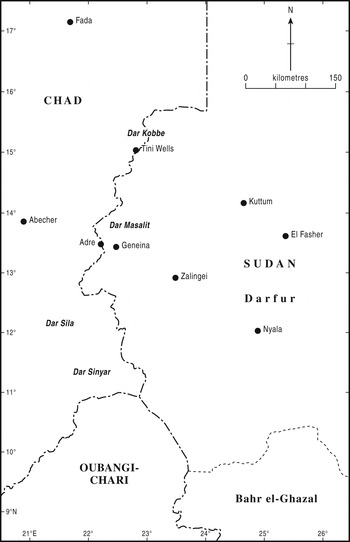
In January 1924, as negotiations between British and French officials over the final definition of the boundary between Sudan and French Equatorial Africa were coming to a conclusion, 200 pastoralists from the Salamat Arab tribe crossed what they believed to be the boundary between Chad and Darfur, driving 4,500 of their cattle with them. They later claimed to Sudan government officials that as they crossed a wadi (seasonal river bed) that marked the boundary, they had held ‘rejoicing as we said “now we are in English territory and no one can harm us”’.Footnote 1 Nonetheless, shortly afterwards, Sultan Bakhit Syam of Dar Senyar, one of the border sultans subordinated to the French colonial state, attacked the Salamat with a substantial armed force. Thirty of the Salamat were killed and 1,500 of their cattle were taken by Bakhit back with him to Dar Senyar. British officials complained that the attack took place in Sudanese territory and supported Salamat claims to restitution, but those claims were never fulfilled by the French.Footnote 2
This massacre and the circumstances surrounding it raises several points of wider relevance for the history of borderlands in colonial Africa: the crucial role chiefs played in policing borders in a context where state resources were extremely limited; the commonly observed tendency for migrants to move to what was perceived as the less unpalatable of two colonial impositions (in this case, the British rather than the French version); and the often ignored potential for borderland peoples to invoke the ideal of territorial sovereignty as a means of claiming protection and rights, even if such claims were not always successful.Footnote 3 This story demonstrates the varied roles of Africans in shaping the political and social meanings of colonial boundaries. Yet it also draws attention to the extreme risks and hazards associated with border crossing, and the violence that was a significant aspect of colonial border policing and governance. This latter point is perhaps an unfashionable one to emphasise in the burgeoning literature on African borderlands.
Whilst African borderlands have received increasing attention from anthropologists and development studies scholars, deeper histories of borders and boundaries, analysed as such, are still relatively limited in number.Footnote 4 Nonetheless, understanding of the impact of colonial boundaries has shifted substantially in recent years. From the 1980s, rather than arguing for the historicity of postcolonial African nation-states, as had an earlier generation of nationalist historians, the nation-state was increasingly seen by scholars as an alien imposition, profoundly ill-suited to African social and political realities.Footnote 5 Colonial boundaries were, of course, central to the territorial definition of postcolonial states, and thus a central part of this damaging legacy. Anthony Asiwaju's edited volume Partitioned Africans can be read as a development of this kind of argument. Asiwaju acknowledged that at a macro-level the partition had caused problems for African political elites, but also made the famous statement that the artificiality of colonial boundaries meant they had very little impact at a local level: ‘the partition of Africa, from the perspective of borderland peoples, might be said to have hardly taken place’.Footnote 6 In a sense, the boundaries of postcolonies were as artificial and irrelevant to African peoples as the nation-states that they supposedly contained, and were best ignored by borderland populations.
Arguments that colonial borders were either damaging or irrelevant, depending on one's level of analysis, were challenged by Paul Nugent's work on the Ghana-Togo border, which subsequently influenced a new wave of scholarship on African borderlands. Through careful empirical research, Nugent showed that the colonial border between Ghana and Togo was not a top-down imposition. Instead, its local impact was shaped by the initiative of local peoples. Not only did the partition have real meaning, but that meaning was shaped principally by the very actors for whom, according to Asiwaju, colonial boundaries were irrelevant. For Nugent this was because the existence of an inter-state boundary made the borderland a ‘zone of opportunity’.Footnote 7 In the course of smuggling or land disputes, the boundary became a resource to local peoples. Smugglers made money because of cross-border price differentials. And borderlanders ‘invoked state power’ in order to make claims to the ownership of land against their neighbours, who lived under the jurisdiction of another state: local disputes over land became to an extent disputes between neighbouring states over territory.Footnote 8 Nugent describes the ensuing configuration of authority and regulation on the border as an ‘accommodation between the state and border society’, a conclusion that contributes to wider recent understandings of colonial rule as being shaped by ‘ongoing negotiations and compromises’ between coloniser and colonised.Footnote 9
Subsequent research has pursued the idea of African borders and boundaries as economic, social, and political resources for local populations, emphasising the agency of borderlanders in shaping the social and political meanings of borders.Footnote 10 Yet a single-minded focus on the border as resource threatens to obscure what Nugent and Asiwaju earlier recognised as the key paradox of African boundaries: that they represent both opportunity and constraint.Footnote 11 Christopher Clapham similarly expresses some scepticism as to whether inter-state boundaries in the Horn of Africa have bestowed a net advantage to borderland populations, and notes that whilst certain opportunities are indeed opened up by a border's existence, others (free trade, the political unification of particular ethnic groups) are closed down.Footnote 12
This article discusses the opportunities and resources generated by the existence of a colonial boundary between Darfur and Chad, particularly with respect to the manipulation of state rivalries by local actors pursuing their own political and economic agendas. However, it also gives full weight to the violence with which states and their auxiliaries pursued the policing of their borders. The violence of state-led border control, made explicit in the story with which this article opened, is missing in much of the recent work on boundaries (as it is in some of the more ‘accommodation’ minded of views of colonial rule more generally).Footnote 13 Where border violence does appear in these accounts, it is often seen to be generated by rival state claims to territory, or conflicts between local groups over resources. Violence, in this view, occurs when borders are disputed by states or local populations, and is something which state policing often fails to prevent.Footnote 14 In the Darfur-Chad case, border violence was not merely something that the state failed to prevent. It was also produced by state-led practices of border policing. Violence was an essential aspect of the everyday meaning of the border and of the state power with which it was associated. Beyond the direct use of the state's limited but potentially deadly coercive force to police its borders, states also oversaw a diffusion of violence towards local auxiliaries (chiefs) who would police the border on the state's behalf. The state's pursuit of control over borderland territory and (more prominently) borderland peoples led it, paradoxically, to compromise its pretensions to a monopoly on the legitimate use of violence. The pursuit of state control entailed a dilution of state sovereignty by devolving the means of violence to local chiefs.
This has a particular longer-term resonance in the Sudanese case, where the tendency of the postcolonial state to control its several peripheries through the arming of local militia groups, causing attendant large-scale violence and disorder, has been so prominent in recent decades.Footnote 15 In particular, the mass inter-ethnic violence in Darfur in 2003–4 was the product of a government counterinsurgency strategy which mobilised and armed local militias and let them loose on rebels and civilians alike, with active government military backing.Footnote 16 This strategy (also used during the civil war in what is now South Sudan) has its roots in the colonial-era strategies of control discussed in this article. Moreover, the violence of this frontier zone during the colonial period challenges the tendency of some scholarship on postcolonial violence in Darfur and Chad to rather glibly refer to a ‘Pax Britannica’ and ‘Pax Gallica’ imposed during the colonial period, which had apparently prevented ‘raiding and petty war’ on the Darfur-Chad frontier.Footnote 17 Rather than providing ‘an over-arching sense of security’, colonial rule might instead be seen as generating new and unpredictable sources of insecurity that have only intensified in more recent years.Footnote 18
However, the fragmentation of sovereignty in this colonial borderland was manifested not just in the diffusion of violence, but also in a more generalised regulatory plurality and hybridity. Important work by Timothy Raeymaekers on the contemporary Congo-Uganda border has demonstrated how, in the midst of widespread violence, relatively stable ‘hybrid systems of regulation’ have nonetheless emerged that ‘mix different and often contradictory legal orders and cultures’.Footnote 19 These points might at first appear to be highly specific to a situation of political and social crisis. In fact, they have a wider application. Raeymaekers himself acknowledges that apparently ‘novel’ forms of regulation are closely related to ‘historical systems of sovereignty’.Footnote 20 In the present case, archival evidence provides glimpses of plural and interacting regulatory orders, evidence which suggests the value of fuller historical analysis of regulatory authority in African borderlands. In the Darfur-Chad case, this complexity went beyond the existence of multiple orders of regulation to encompass multiple visions of state sovereignty. On occasion, state actors projected bureaucratic power beyond state borders in order to achieve more effective control of mobile subjects. In such cases, the state suspended notions of distinct spheres of territorial sovereignty in favour of maintaining a relationship of jurisdictional sovereignty with specific subject groups, regardless of their (shifting) territorial location. The complexities and contradictions of the colonial state are thus thrown into sharp relief by the study of an apparently peripheral, remote borderland.
MAKING A BOUNDARY, 1811–1923
The colonial boundary between Darfur and Chad, while innovative in its attempt to fix a strict line of division along the entire border between the two colonial states, was not completely arbitrary in its construction. Both the British and the French entered a zone which had previously been ruled by African states: the Darfur Sultanate and the Sultanate of Wadai, respectively. In both cases, these sultanates were also the last territories to be conquered by these colonial states. The French finally moved into Wadai in 1909, and the British, into Darfur in 1916.
This area had therefore long been a border zone between two rival states. And along part of this border, a demarcated boundary had existed before the arrival of European colonial states. Travellers, passing through Darfur during the reign of Sultan Ali Dinar (1898–1916), reported the existence of a parallel range of hills fortified with stone and zara'ib (thorn enclosures), known locally as the tirja, which marked out the boundary between the sultanates. This demarcation had been put into place among the Masalit people, settled agriculturalists whose political affiliation was divided between Darfur and Wadai.Footnote 21 The presence of zara'ib along the boundary suggests that this demarcation may have been the work of the Turco-Egyptian regime in Darfur, which briefly ruled the area in the 1870s and early 1880s. Yet the German traveller Gustav Nachtigal, travelling between Wadai and Darfur before the Turco-Egyptian conquest of Darfur, reported the existence of border posts maintained by the rival sultans that carried out similar functions to those of their colonial successors: exacting some form of tribute from traders crossing the border, quarantining the sick, and maintaining border guards at key settlements.Footnote 22 Several decades earlier in 1811, al-Tunisi saw large iron spikes driven into trees to mark the boundary between the two sultanates.Footnote 23 Nonetheless, other reports noted the existence of an area of land that was one day's march wide, a no man's land over which neither state had control, rather than a clear line separating the limits of each state's sovereignty.Footnote 24 It is also worth pointing out that all the reports of a boundary having been marked out on the ground came from travellers observing areas inhabited by settled peoples, areas more amenable to state control. In the northern and southern peripheries of the sultanates – areas inhabited by more mobile pastoralists over whom the state had considerably less control – there is no evidence of any demarcation of boundaries.
Moreover, it is also clear that tributary relationships between minor frontier sultans and the sultans of Darfur and Wadai were often of crucial importance in determining the scope of each state's authority, defined in terms of personal loyalty and obligation, rather than by territorial boundaries. One of the frontier sultanates, that of Dar Sila, simultaneously paid tribute to Darfur and Wadai during the nineteenth century, whilst retaining substantial autonomy from both, exemplifying the uncertainty over the limits of state sovereignty in the region.Footnote 25 This tension between territorial and jurisdictional forms of sovereignty – the latter based on the personal relationship of affiliation between subject and ruler – would remain under colonial rule, though the overall balance would shift towards territoriality.
In 1899, seventeen years before the occupation of Darfur, and ten years before the occupation of Wadai, the British and the French governments had already agreed on the principles for their spheres of influence in the region. These spheres would ‘separate in principle the Kingdom of Wadai from what constituted in 1882 the Province of Darfur’.Footnote 26 This was an approach that acknowledged Britain's imperial predecessors in the region, the Turco-Egyptian state that had briefly seized control of Darfur between 1874 and 1884, and not the boundaries of the nineteenth-century Darfur Sultanate with Wadai. Later attempts to delineate the boundary were, then, not an attempt to discover precolonial boundaries, but rather to define the extent of the authority of an earlier colonial state in Darfur. Moreover, what was agreed in principle remained flexible in application. The French occupation of the western part of Dar Masalit by 1911 had a dramatic transformative impact on the territorial scope of that frontier sultanate. Nonetheless, the 1899 agreement ensured that historical claims were at the heart of the negotiation process as each side marshalled historical evidence to support its claims to authority in the borderland.Footnote 27 And, therefore, when the Boundary Commission of 1922–3 attempted to finalise the settlement negotiated in 1919 on the ground, local elites had the opportunity to mobilise their knowledge of local history to support their own, often conflicting, claims to land and authority. The drawing of a strict boundary between the two colonial states threatened to constrain existing flexible patterns of local rights to the use of land and water. Equally, however, it presented an opportunity for local elites to make maximal claims to resources in the border zone and to obtain the sanction of state support for such claims.
The Darfur-Chad Borderland, 1916–56.

Officials were often well aware of the pragmatic and expedient character of territorial claims made by local elites. One British official described the behaviour of the son of one of the frontier sultans: ‘every evening Hashim used to point out the hills and wadi which marked it … Having heard that a commission was coming in the autumn to mark out the frontier, they were doing their best to get in the first word.’Footnote 28 Indeed, this activity by border elites meant that the boundary commissioners on their arrival – technocrats of the day – rapidly took on political roles as advocates for the claims of people on ‘their’ side of the boundary, as well as claims for the territorial rights of one colonial state against the other. One group, Taaisha pastoralists in the southernmost part of the border region (neighbouring what is now the Central African Republic, Oubangi-Chari under French rule), who it had been agreed would be kept under British control, strongly disputed French claims to what they considered to be part of their territory. The lead British commissioner, Colonel Pearson, was ‘impressed with the warmth of local indignation, when the French commissioner erected a store hut’ on territory claimed by the Taaisha and suggested in reports that ‘it is possible that it may be considered on political grounds that we cannot renounce any of the ancient Taaisha territory’.Footnote 29 Fatefully, from the Taaisha perspective, Pearson died of blackwater fever before the final delimitation was agreed. In the late 1920s, Taaisha elites bemoaned his loss, claiming that if he had lived they would have kept this territory.Footnote 30
Elsewhere along the border, commissioners were drawn into disputes that ranged across both sides of the line. Along the old border between Wadai and Darfur, colonial states sometimes inherited the position of the sultans as supporters of rival local elites struggling to expand their authority. This was most obviously the case in the pastoralist Zaghawa Sultanate of Dar Kobbe at the northern end of the frontier. The leading section of the Kobbe had for two generations been split by rivalry between first cousins over the Sultanate of Dar Kobbe. Immediately before European colonial rule, Ali Dinar and Sultan Dud Murra of Wadai each supported one of the rival parties. The British and the French subsequently continued to support the rival claimants to authority along the precolonial pattern.Footnote 31 Kobbe elites used state support to pursue their own rivalry.
Water resources in this semi-arid pastoralist border zone were a key issue of conflict between the rival Kobbe factions. A particular group of wells at Tini on the border were the focus of contest, suggesting the importance of point-centred conceptions of territory for pastoralist groups.Footnote 32 As part of the delimitation process, Pearson and his French equivalent, Grossard, assembled ‘witnesses’ from both sections of the Kobbe to provide evidence as to which section had the stronger claim to Tini. A local representative of Haggar Toke, the chief under French jurisdiction, ‘stoutly proclaimed that he had not left Tini for a single day since 1912, it was quite impossible, and Sultan Haggar Toke here vehemently supported him’ suggesting it was impossible ‘for any representatives of the Sudan Government to pass in the night without his knowing it’. This was found to be ‘extravagant’ and ‘easily refuted’. The British produced agents of Sultan Dosa, the chief under British jurisdiction, who had been associated with the activity of the colonial state in the area, assessing taxes and ‘chasing malefactors’ since 1917. However, the outcome of this process also suggests the limits of the importance of local testimony. Grossard asserted, after all the evidence was given, that ‘no native witnesses could be relied upon and it was impossible to arrive at the truth’.Footnote 33 The wells were eventually included in French territory.
As many colonial and postcolonial states have discovered, attempts to find a stable ‘historic’ boundary foundered here on the multiple and contradictory claims to historical knowledge made by local actors. Interestingly, though, the final terms of the boundary settlement attempted to preserve rights of access to the Tini wells for both Kobbe sections. Nonetheless, the question of use rights continued to flare up in subsequent years, as elites continued to make exclusionary claims to the wells. The drawing of a boundary seems to have done little to limit local disputes; if anything, it exacerbated them further.
STATE AND NON-STATE RAIDERS
Both states expected that a clear delineation of the boundary between their respective jurisdictions would bring in its wake considerably higher levels of local stability.Footnote 34 In this, they shared the general preference of modern states for legible units of governance with clear lines of division between the territorial sovereignty of each state. And it is certainly true that in the years before delimitation, both states struggled to impose their vision of order in the borderland. Most prominently, Gourane nomads located in the desert north of the border zone, and the Kababish nomads of Kordofan province in Sudan (who made considerable use of seasonal grazing on the desert's edge in Darfur) repeatedly launched sizeable raids and counter-raids on one another. In 1916, the year of the British occupation of Darfur and consequently a time of considerable political instability, these raids were on a very large scale with thousands of animals being captured, as well as many women and children. There was a specific Gourane group (led by one Mohammed Erbeimi) that the French labeled as rebels and bandits. The British described all the Gourane as ‘congenital brigands of a wild and independent nature who have never been brought under effective control’.Footnote 35 Officials later noted that attempts to bring the Gourane under control were handicapped by the fact that they inhabited ‘a wild rugged waterless almost entirely unexplored tract of country, only to be reached by traversing a country almost equally unknown’. The mobility of the Gourane was also central to their ability to evade control, ‘changing their places of abode from time to time emerging from fastnesses known in some cases only to themselves’.Footnote 36
Official French policy in dealing with such persistent resistance was to act ‘without mercy’ in enacting ‘counter-raids’. A patrol would install itself in good local pasture and water-points of areas identified as centres of disorder, and then send patrols to adjoining pasture or water points to ‘capture some woman and children here, some camels there, a flock of sheep elsewhere, and maybe kill some men here and there’. These terms of action were formalised as a joint strategy with the British in a conversation between the governors of each territory, approved by the Foreign Office in 1918.Footnote 37 However, the recognition of the need for joint action by the two governments appears to have remained largely theoretical. A British official in 1917 expressed great exasperation at the difficulties involved in coordinating action with the French who had launched their own raid against the Gourane and ‘captured a great deal of loot’.Footnote 38 Here, colonial power was consciously engaged and enmeshed in local dynamics of raid and counter-raid, rather than standing above those dynamics. Unsurprisingly, attempts to ‘pacify’ the Gourane had only temporary effects. Even by the 1950s, reports of Gourane raids across the northern desert frontier of Sudan continued.Footnote 39 It is worth noting that at the time of writing, the desert north of the Darfur-Chad border remains an important area of rebel operations, a zone beyond the control of either Sudan or Chad.Footnote 40
In their attempts to control the Gourane, both colonial states accepted some dilution of their theoretical monopoly over violence. French reports repeatedly refer to the involvement of ‘partisans’ in state military campaigns.Footnote 41 This tendency is even clearer in more detailed British records. One of the first attempts by the British to attack Erbeimi's band in 1917 had involved the recruitment of the Kababish, the principal local antagonists of the Gourane, to provide men to support the British military effort. According to the plan of Sarsfield-Hall, the leading officer of the patrol, the Kababish were to be stationed at the wells of Jebel Meidob in northern Darfur, an obvious point for Erbeimi's band to fall back upon if they were attacked. Yet the Kababish (much like the French) launched their own raid upon the Gourane, using arms provided to them by the British, and seized 300 camels.Footnote 42 Here the state both used and was used by local actors in a combustible ‘politics of alliance’.Footnote 43 The northern Darfur-Chad border was not simply a zone of resistance against colonial rule: the dynamics of violence were as much the product of local competition as they were the expression of coloniser-colonised antagonism. Nonetheless, the state entered these dynamics as an additional participant and facilitator.
This all might be read as in many ways typical of early colonial ‘pacification’. Yet, whilst elsewhere in Darfur state violence was channelled into (and euphemised within) the judicial force of ‘Native Courts’ from the 1920s, in this borderland, a willing distribution of technologies of violence to what were effectively state-armed militias continued until the 1930s at least, despite the general prohibition on the carrying of firearms.Footnote 44 In 1926, a party of Um Galul Arabs migrating to the northern grazing lands were instructed that they were to ‘arrest all Goraan … found without lawful occasion’ and that they were to shoot first if they found any ‘in possession of stolen animals’ whose arrest should ‘entail danger to themselves’.Footnote 45 When they complained that their existing rifles were old and useless, the governor of Darfur despatched 15 Remington rifles to them, with firm instructions that they ‘should only be given to persons of good repute and guaranteed by the tribal Nazir or Omda’.Footnote 46 Receipts were to be kept for each rifle loaned, and all were to be returned when the Um Galul returned from the desert. However, it is unclear whether such controls were actually implemented. In the early 1930s, a time of considerable drought, Gourane raids into Darfur once more became a prominent issue. After the Zaghawa pastoralists of northern Darfur suffered casualties to Gourane raiders in 1932, Melik Mohammedein Adam Sebi, the leading Zaghawa chief in Northern Darfur, appealed in a letter to the district commissioner (DC): ‘If my people were armed like them (the raiders), they would leave none of them to escape.’Footnote 47 Once again, the state distributed guns to the Zaghawa. By then it was felt to be unfair ‘to ask our people to face modern rifles with antique Remingtons’.Footnote 48 A levy of thirty men was recruited to go on patrol and secure the desert well of Harumba, where the raiders were believed to be based. Despite the presence of the DC on the patrol this was a chance for Mohammedein to temporarily revive the military role of which he and other chiefs had been stripped by the colonial state. At the outset of the patrol Mohammedein
girded on his ‘Seif El Nasr’ (sword of victory) – a magnificent heirloom – this set the hallmark to the tribal significance of the force, and the chanting of encouragement and praises by the Zaghawa girls formed an irresistible background to concerted action … Oaths of ‘death rather than disgrace’ were sworn.Footnote 49
Given all this excitement, the expedition had rather an anti-climactic outcome. The Gourane evaded their pursuers as they had done many times before. But a few years later, arms were again sent to the Zaghawa. Hastily recruited ‘scouts’ sent to one of the desert oases often used by the raiders were equally hastily costumed as policemen wearing ‘khaki jibbas with police bandoliers … their leader is wearing the stripes of a shawish (police lieutenant)’.Footnote 50 Repeatedly then, the colonial state in Darfur oversaw the distribution of the resources of state violence to local groups in this borderland, thus somewhat compromising its own monopoly on the use of force in order to achieve the appearance of territorial control.
POLICING CROSS-BORDER MOVEMENT
Violence was not just directed at cross-border raiders, but also at other groups who crossed the border on a regular basis. Hunting across the border became a risky business. One case attracted particular attention in 1925, as the French had attacked a Baggara hunting party from Darfur that had crossed into Oubangi-Chari, killing ten men.Footnote 51 A British official later heard of this event. Taaisha hunters told him they
had been trapped by the French. I asked them why they had not taken out hunting permits. But they ridiculed the idea. ‘French native soldiers would shoot at us as soon as they caught us hunting without stopping to ask us for our permit, so if we are to be shot at in any case, we see no use in paying.’Footnote 52
Similarly, arbitrary border policing was also reported much later in the colonial period. In 1947, Sudanese merchants complained to Sudan government officials of being tortured into false confessions of smuggling by the French police and customs officials in Abecher, having been whipped until they bled or forced to kneel in the sun all day.Footnote 53
Nonetheless, both seasonal and longer-term migrants who crossed borders without official permission were the most persistent border control issue for the colonial administrations. Generally, the literature on this subject has presented migration from French to British territory as a phenomenon that states were unable to police and that was indeed welcomed by the British, who gained additional sources of taxation and labour.Footnote 54 To a significant extent, those observations hold true in the Darfur-Chad context. However, not all migrants were viewed in the same light. Whilst economic migrants seeking work (usually travelling to the east of Sudan) were often welcomed by the British, those who were explicitly leaving Chad due to French ‘oppression’, and who often remained in Darfur, presented a rather difficult problem for the colonial state, as we will see. Moreover, the inability of the state to fully police its borders did not simply lead to an accommodation with local society, but also to sporadic bursts of violent and unpredictable policing. This was the case even at moments when official arrangements had been made between colonial governments to allow free movement across the border.
As part of the 1924 protocol agreeing the final course of the Darfur-FEA border, the British and French agreed that people living on or close to the boundary should have the ‘option’ to move across the boundary at will within a defined six month period, of which they would be notified by local officials.Footnote 55 Following this notification, French reports feverishly discussed the ‘crisis’ that had emerged. These described an ‘exodus’ of population out of French territory and into British-ruled Sudan, depriving the French colonial state of significant potential tax revenue and labour.Footnote 56 French officials were convinced that the British were actively spreading propaganda through a network of agents to attract French subjects. As a result, local chiefs like Sultan Bakhit, whose authority was of course also threatened by such a substantial loss of people, were stationed to block roads and eject British ‘propaganda agents’ from the zone of the frontier. At one point, Bakhit followed a wealthy subject who had crossed the border and ‘destroyed four grain bins and burnt five houses’ in Dar Masalit.Footnote 57 By 1925, British officials were convinced that Sultan Bakhit had intimidated his people sufficiently to prevent them taking advantage of the migration ‘option’. Theoretical flexibility in colonial arrangements had thus translated into the practical effect of significant violence on the ground. Reports of attacks on groups of migrants by Chadian chiefs continued at least into the later 1930s.Footnote 58
Although the period of the cross-border migration ‘option’ was a period of particularly high levels of movement, there was a longer-term trend of significant net movement eastwards from French Equatorial Africa (FEA) into Sudan. Many migrants went to work on the Gezira cotton scheme in eastern Sudan, in order to earn cash.Footnote 59 Many of those moving across the boundary were classed as pilgrims on the road to Mecca, although they often became difficult to distinguish from economic migrants, as they took work in the areas through which they moved, and sometimes settled there. Some simply moved across the border temporarily (in both directions) to evade tax assessment and collection. However, though many were pulled east by economic and religious incentives, some migrants also told British administrators that they had left Chad in order to evade the predatory demands of the French colonial state and its chiefs for labour, cattle, and women.Footnote 60 These groups became particular targets of French ire. One chief who had left Chad recounted the story of how his uncle (who had been chief before him) and 39 other men who wished to leave to Darfur had been lured by the French to a meeting place, tied up, and then killed with knives. The present chief was one of the few survivors: ‘they let me go so as to tell others what punishment had been meted out’.Footnote 61 Migrants retold similar stories to British officials time after time. One man said memorably to a British official that ‘in the Dar of the English the poor man can live and the weak are protected’.Footnote 62 This sort of language appears to have become a convention of engagement between migrants and British state officials.
British DCs were often sympathetic to requests for protection by migrants – one wrote rather dramatically to his superior that ‘knowing the fate of any returned fugitive I cannot in common humanity return them’.Footnote 63 In the first decade of British rule, senior officials were also inclined to take a relaxed approach – in 1924, the civil secretary's instructions to Darfur officials stated ‘you are under no obligation to return fugitives but your attitude should be inability rather than unwillingness’.Footnote 64 Yet once the border was clearly defined (in theory at least) and the option period had expired, governors of Darfur ordered reluctant DCs to return groups of migrants to Chad. Specific requests from the French for the return of listed, named migrants were not easy to ignore.Footnote 65 As one governor put it to a DC, following another attack by Chadian chiefs on migrants in 1927: ‘You need not concern yourself with the casualties and loss of cattle but endeavour to locate and stop survivors.’Footnote 66 Or as the civil secretary of Sudan put it in more generalised, if similarly unconcerned terms, the ‘sympathies’ of local officials should be contained: ‘natives do sometimes exaggerate and suppress essential facts’.Footnote 67
Moreover, from an administrative perspective, ‘unauthorised’ migrants were seen as potentially uncontrolled, untaxed, and unknown.Footnote 68 This was particularly the case in the early 1930s when economic depression meant there was almost no demand for casual labour in Darfur, and immigrants were seen simply as an ‘embarrassment to Native Administrations’.Footnote 69 In particular, pastoralists from FEA, for whom the boundary was surely an alien imposition on existing patterns of seasonal migration, were seen to present specific challenges for the British administration. The resident of Dar Masalit remarked in 1930 that
they are continually paying off old scores by slipping back over the frontier to steal cattle; the Sultan cannot arrest them because they have no family obligations and are not known, as are the Masalit; and they bring us our sporadic outbreaks of smallpox.Footnote 70
The colonial prejudice against pastoralists as disease-spreading, criminal, uncontrollable peoples is clear. The French shared this view. When a group of Bedayet nomads moved across the boundary from Darfur into Chad, officials blamed them for everything from encouraging migration to Darfur, to helping dissidents to escape French patrols and illicit trade in camels. The French sent troops to evict the Bedayet and destroy their camps.Footnote 71 Mounted infantry companies were also periodically used to round up pastoralist ‘immigrants’ in northern Darfur.Footnote 72 The use of violence was not confined to mobile pastoralists, however. In agriculturalist areas, accounts of the burning of migrant villages were common. In 1929, ten villages in the Masalit zone of the border were burnt by British administrators; in neighbouring Zalingei, returnees were ‘roped or put in shaibas’ (forked tree trunks fixed around the neck as a restraint).Footnote 73
Nonetheless, even when officials were ready to deploy state violence against migrants, they were ultimately defeated by the capacity of migrants to evade control along this huge border. Philip Broadbent, resident of Dar Masalit in the early 1930s, and initially a very vigorous advocate of province-wide efforts to return migrants to Chad, wrote to his French counterpart that in 1933 ‘after three years of chasing refugees I have taken a well earned holiday’. After repeatedly trying to round up migrants, only for them to escape from the police on the way back to Chad, or simply to later move back into Darfur, Broadbent had become convinced of the futility of such efforts, directed against either sedentary or pastoralist migrants. He reminded his French colleague that Adre and Geneina, border towns on either side of the boundary, were ‘economic centres for both grain and labour and sale of cattle’.Footnote 74 Continuous cross-border movement was therefore inevitable, and its complete regulation was impossible. Broadbent also noted the limits of the utility of French lists of names in assisting the return of Arab pastoralist migrants: ‘Their ingenuity in inventing names, tribes and sheikhs is amazing.’Footnote 75 The complex kin relationships that existed across the international boundary provided one means by which migrants might simply melt into Darfur, and defy colonial capture.
Indeed, policy agreed by the governor-general of Sudan in 1928 made it clear that the highest levels of the colonial administration were also well aware of the limits of their power: officials would ‘honour the principle, and in practice as the occasion arose, to return parties of refugees to French territory, and so “keep an end up” in the event of diplomatic representations being made’.Footnote 76 Beyond a selective targeting of groups requested by the French, Sudan government officials saw little advantage in a thorough pursuit of repatriation – this was simply impossible. For much of the border's length, senior officials acknowledged that ‘our frontier offers no obstacle to penetration’ and that there were ‘few and widely scattered frontier posts’.Footnote 77 The key point was that ‘we avoid any suspicions that we encourage and welcome immigrants’.Footnote 78
Acknowledging the limits of their ability to police the border, especially in pastoralist areas, some administrators decided to work with the flow of movement, rather than try to prevent it. In 1944, French and British officials agreed that the Zaghawa and Bedayet pastoralists in the northern frontier should be left to ‘come and go as seasons, economics and family affairs directed’. Instead of futile attempts to confine nomads behind boundaries, ‘accredited wakils’ (deputies) were to manage the cross-border administration of these nomads, cooperating in collecting taxation from the individuals listed under a particular chief, regardless of which side of the boundary they were on at the time.Footnote 79 The model of sovereignty being adopted here was not modern European territorial sovereignty, but a rather different notion of jurisdictional sovereignty. The personal relationship of affiliation between subject and, in this case, their chief also defined the state's jurisdiction over mobile pastoralists. To some extent this reflects an enduring African political logic, as people were the resource over which colonial and precolonial states competed, much more than territory.Footnote 80 Permissive attitudes towards pastoralist migration had periodically been asserted by senior officials on both sides of the boundary since the early years of colonial rule, though the system of the 1940s seems to have been the first attempt to create a formal system of ‘floating administration’, projecting state power beyond state boundaries.Footnote 81
At one level, it appears British administrators were resigned to the limits of their control of the border, and that movement continued regardless of the state. Multiple conceptions of state sovereignty also existed in the colonial imagination which weighed the personal affiliation between state and subject against the policing of territorial boundaries and which sometimes mitigated against the risks of border crossing. Nevertheless, the forceful nature of sporadic colonial and chiefly border policing meant that the boundary remained a zone of unpredictable hazard. People indeed crossed the boundary without authorisation, but with the possible eventuality of arrest, forced return, or even death as the risk they took in doing so. Yet while the state might often have been hostile to unauthorised movement, chiefs who stood to benefit from incoming migrants had quite a different attitude.
CHIEFS AND REGULATORY HYBRIDITY ON THE BORDER
Paramount chiefs and village sheikhs in Darfur were often as welcoming and protecting of new arrivals as the chiefs in Chad were hostile towards those attempting to evade their authority. British administrators observed with distinct approval that Sultan Endoka of Dar Masalit took a ‘warm-hearted’ approach to incoming migrants, reported as a manifestation of the personal generosity which made Endoka (in the British imagination at least) such a well-loved ruler.Footnote 82 This approval was maintained even in the face of bitter French complaints that Endoka offered ‘three years immunity from taxation as an inducement to immigrants’. The governor of Darfur (rather generously) pronounced this ‘to be a distortion of the fact that in Dar Masalit, as in nearly all districts of Darfur, the assessment of taxation is carried out triennially’.Footnote 83 Endoka's protection by his British patrons was also ensured by his ability to return unauthorised migrants when specifically and occasionally prompted by British officials. Even this was a partial performance. One official wrote that ‘the Sultan produced Shottia and Mahamid [Arabs] with consummate ease but has rather a weak memory for cases involving Masalati’.Footnote 84 Another official noted of Endoka's discouragement of immigration that ‘where French Masalit subjects were concerned such discouragement could scarcely be expected to be successful or whole-hearted’, referring implicitly to Endoka's loss of subjects to French conquest in 1911. At the micro-level, sheikhs were also clearly expanding their followings with new migrants. One official wrote in irritation in 1931 that ‘sheikhs of villages should not grant cultivation areas, and sheikhs of town quarters should not grant tax-free residence to French subjects who are evading their fiscal obligations’.Footnote 85
To a significant extent, the state was kept at a distance from the practices of chiefs, allowing apparently informal border regulation to emerge outside the control of the state. For instance, chiefs might set up their own parallel systems of customs dues from those of the state, thus blurring the boundary between formal and informal trade.Footnote 86 Chiefs in Chad also regularly gave letters of recommendation to those labelled ‘smugglers’ by the French colonial state, letters addressed to chiefs in Darfur, which guaranteed the trader access to the Darfur markets.Footnote 87 Attempts by the French to force these traders to obtain laisser-passers directly from French officials were undermined by lack of cooperation from officials in Darfur, who instead complained of the ‘antiquated’ French customs regulations criminalising a thriving cross-border trade.Footnote 88 Where the integrity of their own regulations was not at stake, British officials appear to have given tacit consent to what was defined by the French as an illegal trade, further complicating the regulatory patterns of the borderland.
Yet, the wide scope chiefs had for setting the conventions of border regulation did not create an informal order altogether separate from the state. Chiefs could appropriate the symbols and discursive resources of the state in pursuit of their own interests. For example, in 1931, the colonial states discovered that the sultan of Dar Daju in Chad had written to the emir of Zalingei in Darfur about migration, and used the official French seal in his correspondence, prompting a rebuke from the French.Footnote 89 Chiefs might also profit from ‘policing’ the boundary more vigorously than did the state itself. Border chiefs sometimes seized the goods of passers-by in the name of anti-smuggling restrictions and kept the material themselves.Footnote 90 Moreover, the language of state sovereignty could be employed by Darfuri chiefs to gain support from British officials against the incursions of French state agents. A subchief of Dar Masalit reportedly told a French officer pursuing refugees that he was ‘in Sudan territory without right’ before beating his war drums and intimidating the officer into retreat. Sultan Endoka supported his local representative, saying to officials that the French had ‘entered the boundary without reason’.Footnote 91
This hybrid regulatory order through which chiefs functioned independently of formal state control, yet also often drew on the symbolism, normative language, or tacit consent of state power, was partially undermined in the later years of colonial rule by the increasing bureaucratisation of border control and of the colonial state as a whole. Yet that bureaucratisation simply replaced the periodic violence of raids inflicted on migrants with the violence of temporary imprisonment. By the late 1940s, a separate passport control office had been established in the now sizeable town of Geneina, close to where the British oversaw, in the words of one official report, ‘the annual incarceration of some 10,000 foreigners in a cluster of broken-down shelters at Dissa from periods from 2 to 21 days depending on the ability of staff to cope with documents’.Footnote 92 Measures to stop migrants breaking out of quarantine to visit Geneina had resulted in violent clashes between policemen and pilgrims. Elsewhere, frontier posts, staffed with police and medical quarantine officials, were established along the Dar Masalit-Chad border through the 1950s.Footnote 93 In Northern Darfur, the relaxed approach to pastoralist seasonal migration of the 1940s was reversed. Crossing the border without a permit signed by a senior chief was made a criminal offence, punishable by imprisonment.Footnote 94
Yet these changes were themselves something of a performance intended to mask the continued ineffectiveness of colonial border control. The new passport control office, set away from the town, was simply ignored by most border-crossers. Many of those who were held in the shelters at Dissa subsequently evaded police control and successfully ‘concealed’ themselves in Geneina with friends and family.Footnote 95 And the new frontier posts were not working as hoped: in 1953 ‘yet another case of highway robbery by a policeman on the Adre road was detected’.Footnote 96 The policing of colonial boundaries continued to impose unpredictable risks of violence on local populations even in the final years of colonial rule.
THE STATE IN LOCAL POLITICS
State power was a resource not just for chiefs imposing their own version of regulatory order on the border, but also for chiefs pursuing disputes against neighbours on the other side of the boundary. While the terms of the colonial boundary agreement had explicitly recognised flexible patterns of cross-border use of wells and grazing land by local populations, local elites often asserted that the definition of such resources as belonging to one of the two states by the drawing of the boundary also implied exclusive rights of access to those resources for groups under the jurisdiction of that state. So while the boundary was a political resource to some, it might become an exclusionary obstacle to others. Yet in the course of such local contests, both sides appealed to the state under whose jurisdiction they came to support their rights, usually in the person of the local district commissioner or commandant. And those under threat of exclusion pressed ‘their’ administrator to impose a flexible definition of cross-border arrangements. State actors could, then, act either as enforcers of exclusionary practices or as advocates for flexible rights of access, depending on their own interests and those of their chiefly partners. As Nugent observes in the Gold Coast-Togo case, state power was something to be invoked in the course of local struggles: local elites attempted to play the neighbouring states off against one another.Footnote 97
Officials were well aware of the potential for local elites to manipulate cross-border colonial rivalries. As a result, cross-border meetings involving officials and chiefs from both sides of the border were regularly held, with the explicit intention of producing an effect of a single colonial order, and indeed a single colonial culture, which incorporated both British and French governments. At a meeting in 1942 between rival groups in Northern Darfur, British and French officials stated that ‘both governments were in complete accord – “Aishethum Wahid” (one way of life)’. In the course of this meeting itself, and others like it, colonial officials might do very little to resolve or settle disputes – rather chiefs and elders encouraged settlement, whilst administrators became an ‘interested audience’.Footnote 98 In this way, colonial officials could maintain the impression of being detached from and superior to local politics, representatives of an abstract, neutral colonial order, which could not be dragged into taking sides in local disputes. This might be interpreted as one local manifestation of what Timothy Mitchell has labeled the ‘state effect’ – an effect which marks off the state as an ‘inert structure’ distinct from individuals and society and therefore legitimates its authority – but here taking on a broader cultural connotation across state boundaries: producing a kind of ‘colonial effect’. This effect aimed to show that the divisions of state boundaries could do nothing to undermine the common ‘way of life’ which British and French colonial officials shared, and that colonial officials, by virtue of belonging to this detached, neutral, and superior colonial order, had the legitimacy to act as the ultimate arbiters of local disputes.Footnote 99
But officials noted that the decisions made at cross-border meetings were very difficult to execute because of problems of communication.Footnote 100 Colonial officials in Fada (in northern Chad) and Kuttum (northern Darfur) were 370 miles apart and, even by the 1950s, a telegram from one to the other had to be ‘re-transmitted five times, and being in a foreign language, if it arrives at all, arrives exceedingly corrupt’.Footnote 101 So it was in fact much easier for chiefs and officials to talk within their district or subdivision than it was for British and French officials to communicate or coordinate policy across borders. Away from the formal performances of cross-border colonial unity, chiefs continued to tug on the vertical ties between themselves and administrative officials who were dependent on chiefs just as chiefs were dependent on them. This created an administrative dilemma of balancing the maintenance of strong local partnerships with cross-border colonial harmony, as demonstrated in the following case.
In the northern region of the Darfur-Chad border, the use of the Tini wells, defined as lying in French territory as noted earlier, remained at issue between the rival sections of the Zaghawa Kobbe across the border throughout the period of colonial rule. While rights to water animals at the wells for both groups was assured under the 1924 agreement, and notably appear to have been broadly maintained throughout the colonial period despite periodic disputes, the Kobbe under Sudanese jurisdiction also continued to cultivate around the wells, despite repeated promises by Dosa, the sultan on the Sudanese side, to restrict these practices. By the mid-1940s, Sultan Abdel Rahman, on the Chadian side, was pushing for the complete eviction of Dosa and his people from the area. However, the DC in northern Darfur at the time, Guy Moore, acted to protect Dosa's position. Moore persistently emphasised that the French should not be too legalistic in their interpretation of the boundary and that the frontier must not ‘become a gulf between the normal affinities of the Kobbe rank and file’. The area round Tini had great ‘family association’ for the sultan, as it was ‘the place where the tombs of his fathers and brothers lay’. It was also the only reliable well centre in his tiny Dar [land].Footnote 102 Dosa kept pressure on Moore to protect his rights, suggesting that the French commandant across the border ‘did not want justice but only listened to the talk of his people’.Footnote 103 Of course, Dosa himself aimed to influence Moore in similar fashion. Yet Moore's support was not unconditional. Dosa also demanded that those of his subjects, including some prominent elites, who had decided to affiliate to Abdel Rahman in recent years, should be returned to Darfur and his jurisdiction. Significantly, Moore, a believer in unrestricted cross-border movement by pastoralists, did not lend his support to this demand.Footnote 104
In cases such as this, chiefs tugged on vertical ties of imagined mutual obligation shared with state administrators, while officials attempted to find the balance between supporting their local clients, and preserving the impression of cross-border cultural and political detachment, superiority, and unity. At the border, the uncertainties of colonial authority came clearly into view, yet so did the significance of the role of the state in local politics. State authority was made in the course of this negotiation and bargaining as well as in the spectacular violence of mass arrests and the burning of villages.
CONCLUSION
The history of the Darfur-Chad borderland under colonial rule was characterised by many of the kinds of constraints and opportunities that colonially imposed boundaries have presented to African societies more widely. The border was not simply a European imposition; its shape and meaning was in part negotiated between local and state actors. Opportunities of several kinds were associated with the boundary's existence: it might be a route of escape from oppressive configurations of power, or a line of division between states to manipulate in the course of local disputes over authority and the control of resources. Nevertheless, the policing of this boundary by colonial states and their local auxiliaries inflicted considerable violence on some of those who tried to cross the border without official sanction. The boundary indeed presented opportunities but these opportunities often entailed considerable risks.
Examining the policing of boundaries between Darfur and Chad has also suggested the value of historicising the regulatory hybridity which recent scholarship has shown to be central to the dynamics of contemporary African borderlands. Colonial officials, especially clearly on the British side of the line, did not consistently participate in a rigid top-down discourse and policy of border control, but were often engaged in negotiations which compromised European-style visions of territorial sovereignty. This was expressed not just in the acknowledgement of the limits on the state's capacity to control immigration and smuggling, but also in the willingness to arm local groups in order to police remote border regions, and dilute the state's theoretical (though never actual) monopoly on armed violence. Conversely, the chiefs who were themselves central to the regulation of the border appropriated state symbolism and practices in order to pursue their own interests.
This was, then, a colonial borderland characterised less by the imposition of territorial state sovereignty than by the formation of fragmented and multiple sovereignties, shifting in character over time and space. State actors themselves had no consistent view on the vision of sovereignty being imposed. Violent attempts to impose territorial control in settled areas might coexist with a preference for jurisdictional sovereignty in areas of nomadic habitation. Formal and informal modes of regulation fed off one another, sometimes came into conflict and were often hybridised, though bureaucratic innovations shifted the terms of this hybridity over time. And the particular configuration of regulatory authority at any given time depended on the particular and shifting interests of states and local actors, often as defined by particular individuals on the ground. All this suggests that we might reappraise the idea that colonial sovereignty always marked an absolute rupture with precolonial sovereignty. Although there was an overall move towards state-defined territoriality, territorial and jurisdictional sovereignty and state and non-state forms of authority remained in unresolved tension in this borderland during the colonial period, as they had been under the precolonial sultans.
This study also demonstrates that a particular value of studying colonial (and postcolonial) borders lies in the way the dynamics of such regions reveal central features of the modern African and colonial state with great clarity. In this sense, apparent ‘peripheries’ can indeed be analysed as centres of state formation in their own right.Footnote 105 The mixture of the legal-bureaucratic and the highly personalised, informal, and often violent modes of authority which characterise the history of the state in Africa since the advent of colonial rule is very prominent in the history of the borderland offered here. Colonial boundaries in this region were never fully policed or even physically marked – to this extent state boundaries might appear to fit with Patrick Chabal and Jean-Pascal Daloz's view of the state more broadly as an illusory ‘façade’ – yet they did make a difference to local lives, both as partially, unpredictably, and violently policed constraint, and as political and economic opportunity.Footnote 106 And, just as the boundary presented a shifting constellation of risks as well as opportunities so too, by implication, did state power.