The invitatory antiphons in the morning service of Matins marked the beginning of each new liturgical day for the Birgittine sisters.Footnote 1 Matins was part of the Cantus sororum (the Song of the Sisters) comprising seven Offices which together form a weekly cycle. Each Office illuminates one aspect of the Virgin Mary in her role as the mother of the Redeemer, and it was the particular function of the invitatory antiphon to announce or at least highlight this theme through its text. As such, these invitatories had an especially significant symbolic meaning in the Birgittine liturgy.
The text of Cantus sororum is based on the Officium parvum beate Marie Virginis expanded to a weekly Office comprising numerous text contributions exclusive to the Order.Footnote 2 It is structured around seven different themes, one for each day of the week. The theological essence of these themes will be discussed below in connection with the invitatory antiphons. As for the chants, the Cantus sororum mixes newly composed as well as material borrowed and adapted from the common stock of medieval plainchant. Melodies unique to the Cantus sororum conform to the modal system and are structured in recognisable ways though with a Birgittine twist, as will be demonstrated later.
The Birgittine Order
The Order of the BirgittinesFootnote 3 was founded in the fourteenth century by the mystic St Birgitta of Sweden, whose religious work began in the 1340s when she received revelations instructing her to found a new order open to both men and women. Before setting off for Rome in 1349, however, Christ informed her in a vision that the order should be foremost for women and for the purpose of honouring His mother.Footnote 4 Although no new monastic rules were allowed at this time – the Birgittine rule was an addition to the Augustinian – Birgitta and her collaborator and confessor, Petrus Olavi of Skänninge, outlined the order's principal features and part of its liturgy in the 1350s and 1360s.Footnote 5 This was to be an order of double abbeys where the Birgittine sisters and brothers would share the same church but live in separate quarters within the abbey precincts.Footnote 6 The brothers observed the cathedral liturgy of the diocese where a given abbey was situated; the sisters, on the other hand, regardless of the abbey's location celebrated the Cantus sororum, the only Office created exclusively for women's use.
The first Birgittine abbey opened in 1384 in Vadstena in the Swedish diocese of Linköping. Although a liturgy had been created by this time, its exact shape during this period is unknown for lack of sources – the earliest notated Birgittine liturgical books from Vadstena abbey itself date from the mid-fifteenth century.Footnote 7 The Order grew rapidly during the fifteenth century and spread to other regions, the Low Countries and German-speaking lands in particular. These were all double abbeys (which seventeenth- and eighteenth-century ecclesiastical authorities dissolved, allowing only the Birgittine sisters’ monastic life to continue). Around 1437, the first Birgittine abbey in the Dutch-speaking area opened, namely Mariënwater (relocated and renamed Maria Refugie in 1713), which exists to this day as an abbey for Birgittine sisters.Footnote 8 Its rich collection of around fifty liturgical manuscripts dating c.1500 through the nineteenth century form the basis of this study; this article will address conditions only up to c.1500.Footnote 9
Prior research on invitatories and Birgittine chant
The invitatory is an insufficiently researched genre.Footnote 10 Scholars do not yet know the full scope of the late medieval repertoire: the Corpus Antiphonalium Officii (hereafter CAO) contains 116 texts for invitatory antiphons, but this edition concentrates on sources from the ninth through the eleventh centuries, a repertoire formed earlier than the founding of the Birgittine Order.Footnote 11 Processes of composition also remain largely uninvestigated, although David Hiley reports on connections between invitatories and great responsories in their use of melodies, formulas and texts, which is more pronounced than for other antiphons.Footnote 12
One impediment to research on the invitatory may be the regional nature of the genre and considerable differences even within regions.Footnote 13 Birgittine invitatory antiphons are, however, strikingly uniform in their dissemination across Sweden (including medieval Finland), the Netherlands, Belgium, Germany and England. Once the Birgittine liturgy was codified in the middle of the fifteenth century, its fixed chant repertoire was transmitted from one abbey to another exclusively within the Order – the Birgittine invitatories appear not to have spread outside the Order.
In contrast to invitatory antiphons in general, and those of the Cantus Sororum in particular, there exist several studies of other Birgittine chant genres. Their authors employ different approaches, but the idea that this liturgy comprises three layers or categories has been influential. Tryggve Lundén identifies the unique contributions of Birgitta and Petrus Olavi of Skänninge, borrowings from other traditions and additions to the Birgittine liturgy by later generations.Footnote 14 Viveca Servatius's study of the ninety-two psalm antiphons divides them into three categories in a slightly different way depending on their origins: some were borrowed from the common stock of plainchant, others were adaptations from the common stock and still others are compositions she identifies as unica.Footnote 15 Servatius also studied the Benedicamus Domino tropes which were based on known melodies but troped in a uniquely Birgittine way.Footnote 16 As such, they represent the only known Benedicamus Domino tropes in medieval Sweden. Hilkka-Liisa Vuori's study of the twenty-one great responsories of Matins follows a similar pattern: these chants were borrowed, adapted or unica. Vuori attributes all the unique chants to Petrus Olavi of Skänninge.Footnote 17 Concerning the Birgittine hymns, Ann-Marie Nilsson concludes that the melodies were all borrowed from the common stock, although more than half have new texts.Footnote 18 A recent dissertation by Michelle Ann Urberg concerns the Order's processional chants.Footnote 19 Though not part of the Cantus sororum, the Birgittine processional liturgy was closely related to the performance of the sisters’ Office and shares some of its melodies. Thus prior research indicates that the Cantus sororum is a variegated Office comprising unica as well as contributions of both texts and melodies from the common plainchant stock. This variegation is not in itself unique, but rather typical of monastic environments: it expresses a wish to belong to the Catholic lineage paired with one to create a distinctive tradition to establish an identity that was different from other liturgical contexts.
A new look at Birgittine Chant
The tripartite model developed by Servatius and Vuori to account for the ingredients of the Birgittine liturgy has influenced discussions of the Birgittine musical repertoire, but it remains difficult to establish the distinctions among the three categories. How far can a melody be adapted before it must be considered a new composition? What exactly constitutes a borrowing? Moreover, although these divisions suggest that there are clear boundaries, borrowing of all sorts was central to medieval culture. As regards Birgittine chant in particular, borrowings ranged from entire melodies to minor melodic motives. The borrowed/adapted/newly composed model has furthermore led to considerations of melodic material from an evaluating perspective of bad/better/best, newly composed chants being considered unique and therefore the best. But why should a chant melody used in a limited context or area be more interesting than a widely used and disseminated one? Under what conditions? Might it not be the other way around? Does this assumption not owe more to a nineteenth-century view of the composer and his works as something unique, stemming from a single particularly talented individual or even a genius rather than from actual medieval circumstances? Why should melodies with an international dissemination not be regarded as more successful than regional ones?
The view which I advocate suggests a different understanding of the Cantus sororum, stressing the role of the common stock of plainchant and the presumed unique circumstances of this particular liturgy. It looks beyond complete melodies and pays close attention to the ways in which smaller structures, such as motives typical to plainchant, were incorporated into melodies that do not necessarily have any exact melodic concordances outside the Cantus sororum. Here, motif is understood as a set of pitches in a certain order. I also employ the concept of pitch group in the sense developed by Leo Treitler, that is, as a group of pitches in which ‘there is no fixed way in which the melody moves through their pitches’. This is a method for ‘focusing the melodic features of the melodies for purposes of comparison’.Footnote 20 A pitch group in this sense is thus understood as a set of pitches used as an underlying structure through which a melody can move in different ways, not in a fixed order. This approach will enable a discussion of flexibility in the use of a musical material to show how musical patterns might have been consciously chosen in order to constitute a Birgittine repertoire. By this, I want to show that it does not matter whether or not concordances of a specific chant can be found, but rather that all layers of Birgittine chant are indebted to the common stock of plainchant, understood as a set of compositional features constituting all its subgenres, including invitatories. This way of looking at Birgittine chant will guide the following discussion and analysis.
Sources, methods and resources for comparing the texts and melodies
The principal sources consulted for this study, and in particular the antiphonal Uden HS K:An 1, come from the Dutch Birgittine abbey of Mariënwater. Uden HS K:An 1 has been chosen for transcription because it represents the earliest recoverable state of the Birgittine chant repertoire. It is unrevised; no later hand has added or altered either the texts or the melodies discussed in this article.Footnote 21 The manuscript has been studied in situ; it is neither digitised nor accessible online.
Uden HS K:An 1 is one of a group of seven liturgical manuscripts from Mariënwater which were all copied around 1500 based on their script, decoration and historical circumstances.Footnote 22 Although none of these books yields a precise date or the name of any scribe, it is known that a scriptorium existed at Mariënwater towards the end of the fifteenth century. Although scholars disagree slightly as to the exact time of its heyday,Footnote 23 the peak of the scriptorium's activity coincided with the forty-three years when Helwig Olijvers was abbess (1464–1507).Footnote 24 Given the available evidence, then, the dating of the manuscript to c.1500 must suffice.
The Cantus database has been a most valuable resource in the following comparative study of both texts and melodies.Footnote 25 Though not an exhaustive source of invitatory antiphons, it has enabled me to survey the Birgittine repertory within a large framework, permitting me to investigate a wide array of possible concordances and/or correspondence to known patterns of melody and texts outside the Birgittine tradition. The melody search tool in Cantus has been particularly useful since it makes it possible to trace melodic concordances for units smaller than complete melodies. The Cantus interface does not permit the entry of repeated notes, which explains why the number of notes mentioned in the following analyses refers only to unrepeated notes. The melody search tool also permits the beginnings of chants to be studied in depth since it searches for melodic patterns rather than exact correspondences. The concordances identified cover different centuries and regions, so when choosing notated sources for comparison I have favoured those from the fourteenth and fifteenth centuries, that is, from the time of the Order's founding up to the date of the earliest notated Birgittine sources. The Cantus text search tool has been useful in comparing texts: it is relevant to distinguish text and melody since assumptions can be misleading if it is not completely certain which is involved. Finally, the Breviarium Lincopense has been consulted, not only because the Vadstena brothers observed the liturgy of Linköping cathedral, but also because I wish to examine its possible influence on the Cantus sororum. Here only texts are considered since the Breviarium Lincopensem is unnotated.Footnote 26 This article concentrates mainly on the invitatory antiphons; the accompanying psalm tones will be only briefly addressed.
The text tradition
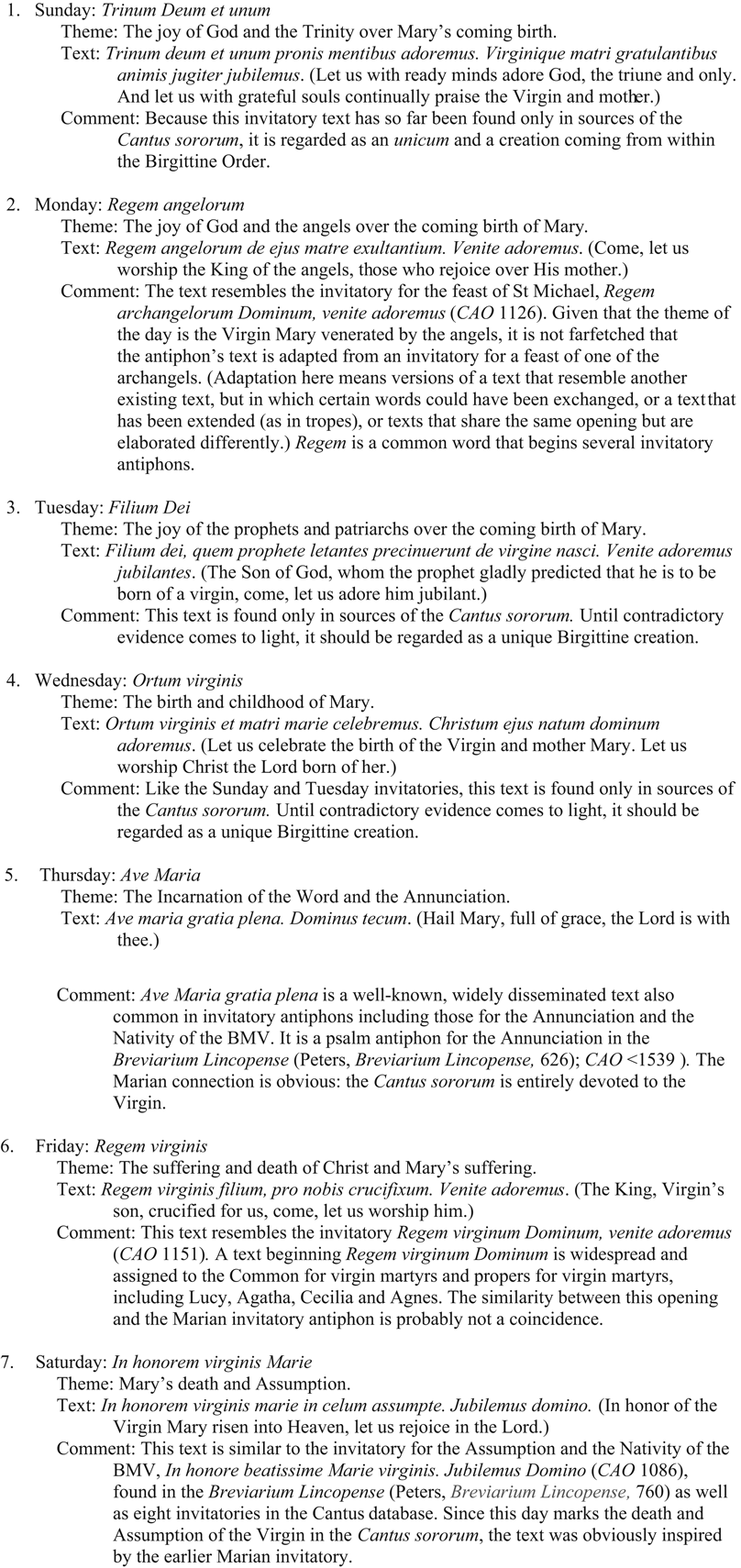
In attempting to discover the possible origin of any Birgittine chant, attention must focus initially on the text: just because a text is found in a source outside the Birgittine tradition does not necessarily mean that the melody has also been borrowed. Starting with the texts of the Birgittine invitatory antiphons, and recalling that each day in the Cantus sororum had its own theme (independent from the brothers’ Office), let us imagine that an invitatory's theme created something of a ‘mind-map’ for the sisters, orienting them to the day.Footnote 27 The seven antiphons are divided into two sentences each; in Uden HS K:An 1, punctuation follows capitalisation and also marks the bipartite (A–B) structure in the melodies (see Ex. 1).
As Example 1 illustrates, the texts conform to an established pattern: a clear two-sentence structure which allows A and B to be separated in performance. The invitatories in the Cantus sororum involve borrowings from the common stock, variants of texts known from other sources or texts with no known concordances. In this respect they roughly follow the pattern of borrowed, adapted and newly written texts previously mentioned. As for individual words, Regem is an opening shared by seventeen invitatories in the CAO; among Cantus sororum invitatories it occurs twice; Venite adoremus is another common expression.
Themes, regularised Latin texts and translations of seven invitatories of the Cantus sororum, with comments; English translations courtesy of Robert Andrews.

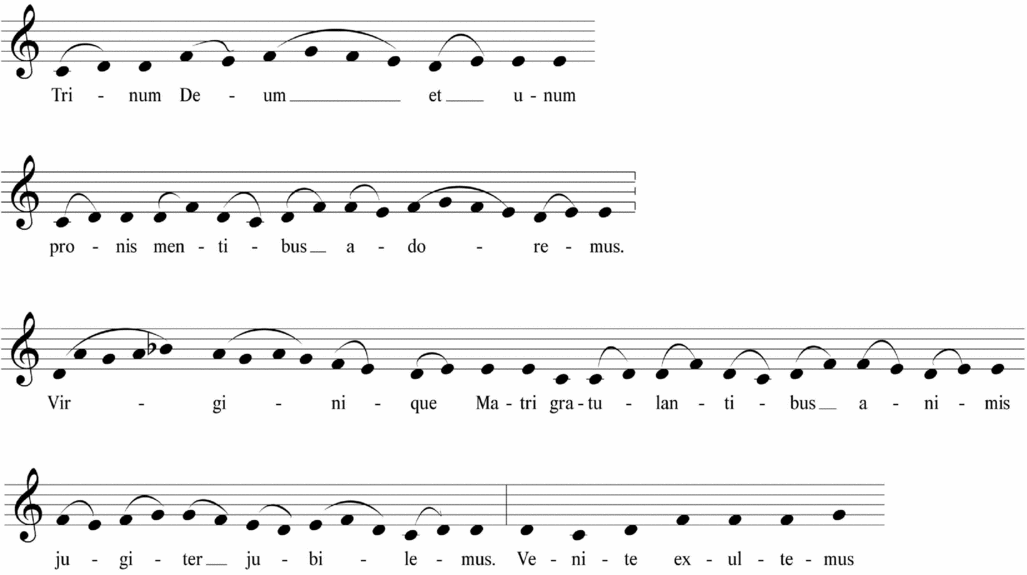
Invitatory, Trinum Deum et unum (Uden HS K:An 1, fol. 1r), mode II, Venite tone II.

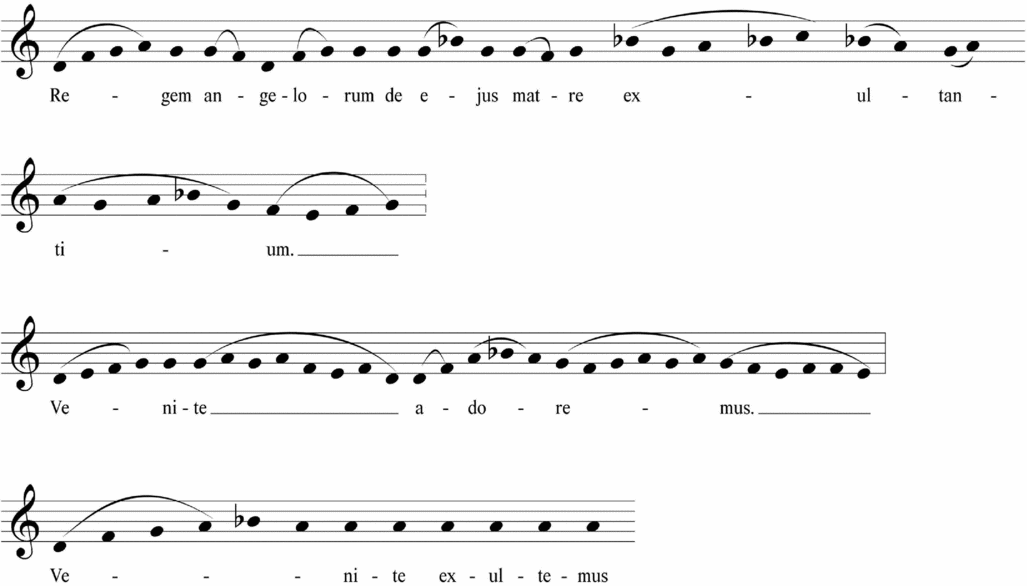
Invitatory, Regem angelorum (Uden K:An 1, fol. 26r), mode III (Venite tone not found in LR).

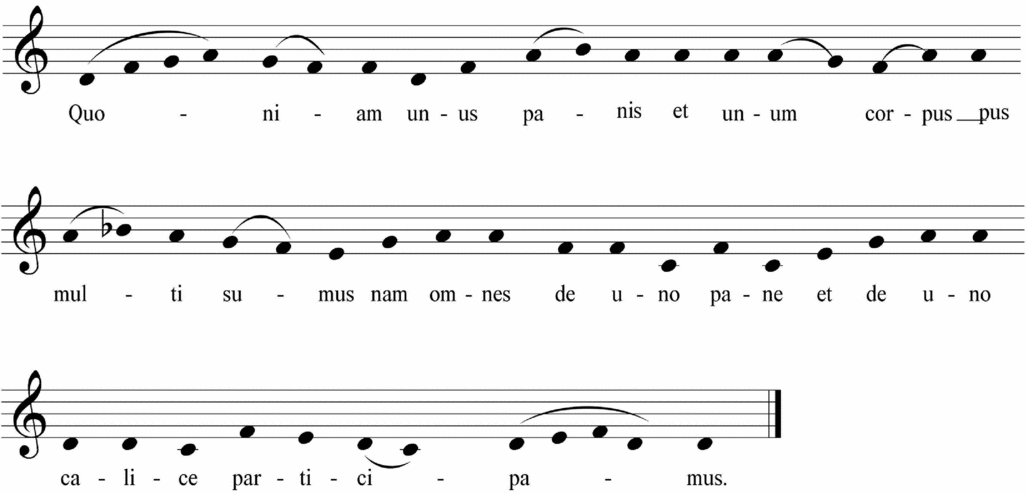
Responsory verse, Quoniam unus panis, Einsiedeln, Stiftsbibiliothek, Codex 611 (89), f. 121v.

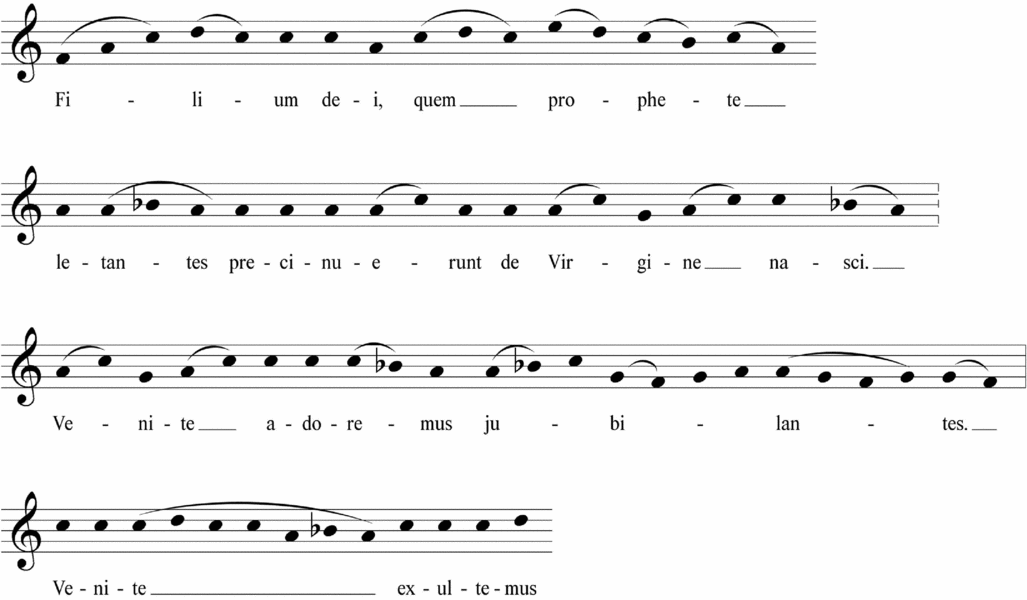
Invitatory, Filium Dei (Uden HS K:An 1, fol. 41v), mode V, Venite tone V.

We shall return to these texts after the analysis of the melodies, but for now let us note the absence of close relations between the invitatory texts in the Cantus sororum and the Linköping diocesan liturgy, that is, apart from those involving very widely known texts. Sunday, Tuesday and Friday have what one assumes are newly composed invitatory texts, but the reason why is difficult to ascertain. Sunday is of course the most important liturgical day of the week and Friday commemorates Christ's crucifixion, but Tuesday does not have a prominent place either in the Birgittine liturgy or more broadly.
Transcription and analysis of the melodies in Uden HS K:An 1
As noted previously, the Birgittine invitatories consistently employ a standard bipartite form (A+B) with a clear cadence separating the two sections. The antiphons are of course paired with psalm 94, Venite exultemus, comprising five verses with a concluding doxology set to ornate, though standardised psalm tones. Performed in the traditional manner, the verses alternate with complete statements of the antiphon and its B section only. In performing the invitatories, the Birgittines clearly conformed to the common practice: surviving manuscripts from Uden preserve the complete form, including fully notated psalm verses for all seven invitatories.
In the following musical examples, the square neumes of Uden HS K:An 1 have been transcribed into modern notation. The bipartite text structure is indicated by sentence divisions (in line with how the manuscript is structured) and a dashed barline at end of the A section. Whenever possible, the invitatory psalm tones have been compared with those in the modern Liber Responsorialis (hereafter LR; Solesmes, 1895). The accompanying analyses take into account the modal features, melodic motifs and pitch groups of the antiphon melodies.Footnote 28 In a few cases, text-music relationships will also be considered. Although no modes are designated in Uden HS K:An 1 or any other Uden antiphoner, modes have been assigned to the invitatories using an analytical framework considering ambitus, tonal centre, finalis, the connection between antiphon and psalmody as well as typical melodic gestures common to special modes.Footnote 29 As discussed above, the organisation of Cantus data inclines one to concentrate on the beginnings of antiphons.
Sunday: Trinum Deum et unum. A search of the Cantus database does not reveal any melodic pattern on which Trinum Deum et unum (Ex. 2) might have been modelled, but its opening motif (C–D–F–E) is typical of certain responds and verses of great responsories in modes I, II and IV. The invitatory's melody centres around the tenor tone F, pointing towards mode II, but the beginning of the B section, which opens with a leap (D–a extending to b flat via a small melisma) characteristic of mode I.
Monday: Regem angelorum. According to the Cantus database, the opening motif of Regem angelorum (see Ex. 3) is typical of many Office chants, but not more to one mode than another. It is common in modes VIII and I and, among great responsories, modes II and III. (Several mode III invitatory antiphons open with the word Regem, but none has a similar opening. Melodic comparison with an antiphon for St Michael having a similar text, mentioned above, is not possible for lack of a notated source.)
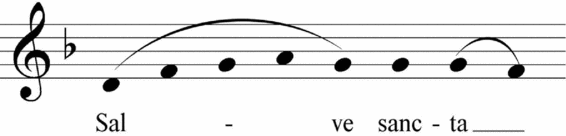
Although no exact matches have been identified, the melody of Regem angelorum resembles several great responsory verses; for example, Quoniam unus panis (resp. Calix benedictionis) for Corpus Christi (cf. Ex. 4, from Einsiedeln, Stiftsbibiliothek, Codex 611 (89), early fourteenth century).Footnote 30 The openings of the Birgittine invitatory antiphon and the responsory verse (D–F–G–a–G) are practically identical; the same opening formula is also used in a number of chants sung in the Birgittine sisters’ daily Mass, Salve sancta parens, which will be discussed later. Note further that the overall contours of both chants are similar in both the A and B sections until the middle of the responsory verse, where Quoniam unus panis proceeds in a different direction (from the second b flat) and closes on a different finalis (D).
The striking resemblance between the Venite tone (Ex. 3), nowhere found in the LR,Footnote 31 and the opening of the preceding A section (D–F–G–a–G, ascending to b flat in the former) tempts one to speculate that the tone was created in conjunction with this particular invitatory antiphon. Notice also that section B opens with an ascending melisma (D–E–F–G) which is similar though not identical to the openings of both the antiphon's A section and the Venite tone. This motive will be discussed again later in connection with thoughts concerning the Birgittine soundscape.
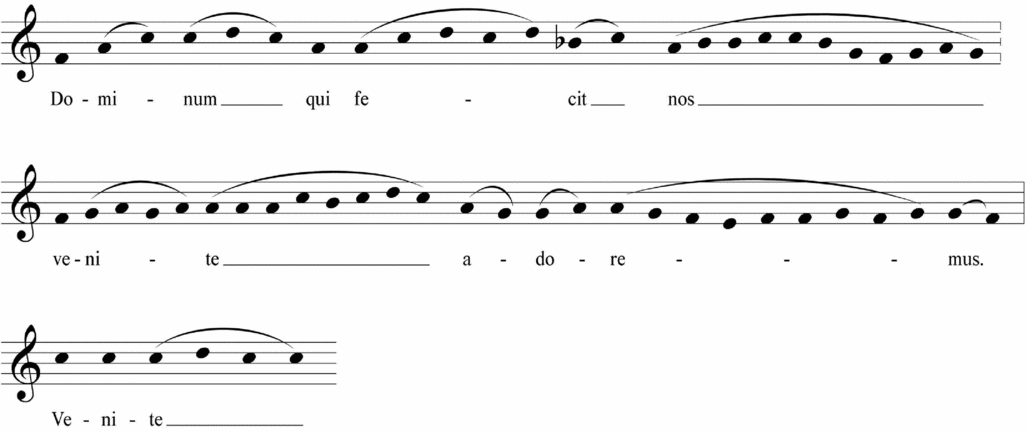
Tuesday: Filium Dei. The ascending tertian figure (F–a–c) which opens Filium Dei (Ex. 5) is standard particularly in mode V chants, but it can also be found in other modes.Footnote 32 Indeed, the first nine notes of the melody find exact matches in six chants in Cantus sources, two of which are in mode IV, one in mode VII, but none in mode V. Five of the six are (again) great responsories; one is an invitatory for the Third Sunday of Lent, Dominum qui fecit nos venite adoremus, transcribed in Example 6 from a twelfth-century source.Footnote 33
Invitatory, Dominum qui fecit nos venite adoremus (Utrecht, Universiteitsbibliotheek, Ms. 406 (shelf mark 3 J 7), fol. 76r).

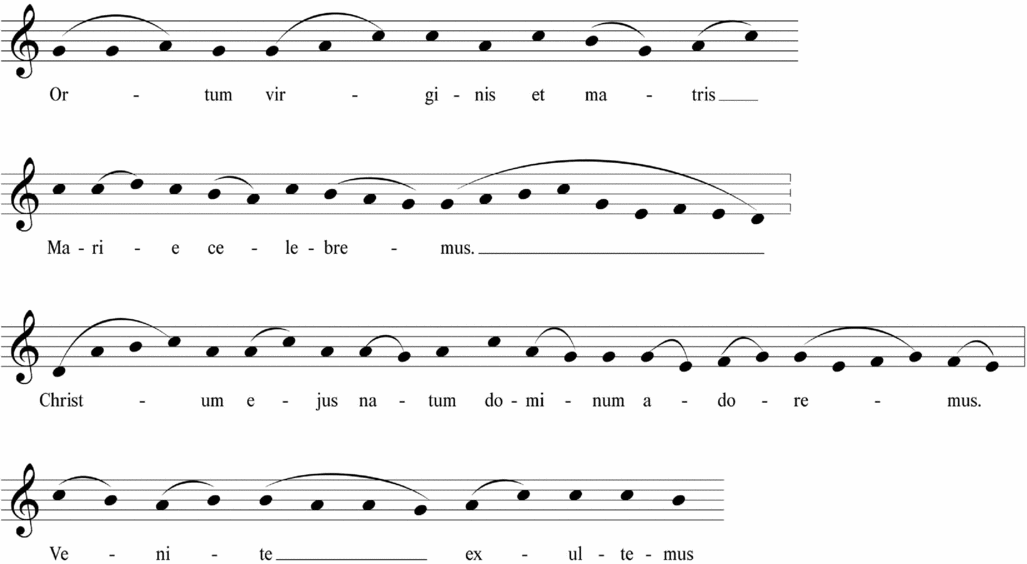
Invitatory, Ortum virginis (Uden HS K:An 1, fol. 58r), mode III, Venite tone III.

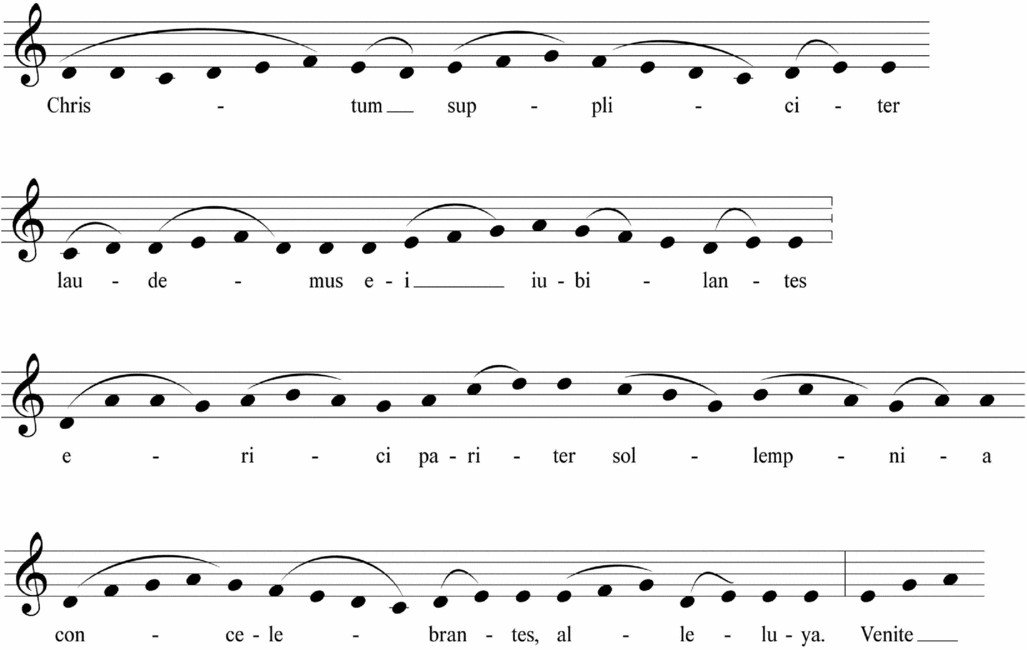
Invitatory, Christum suppliciter (Turkku, Gummerus I:3).

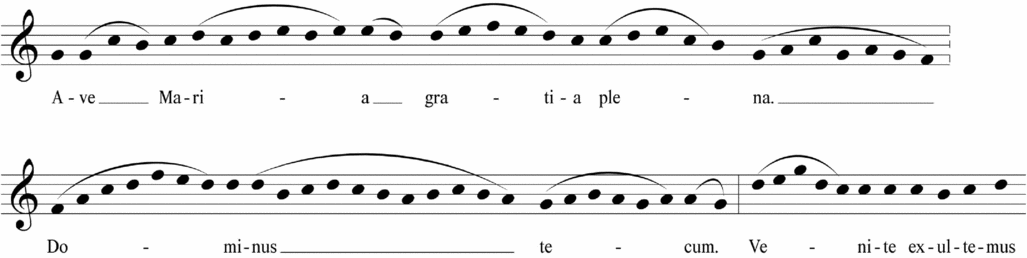
Invitatory, Ave Maria (Uden HS K:An 1, fol. 72r), mode VII, Venite tone VII.

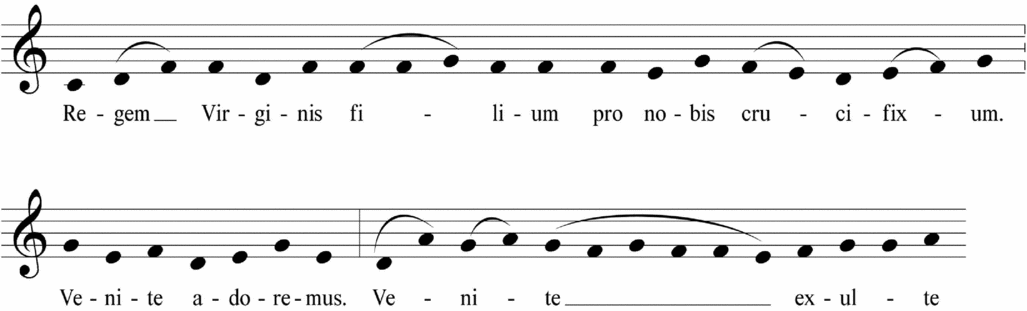
Invitatory, Regem virginis (Uden HS K:An 1, fol. 88r), mode IV, Venite tone IV.

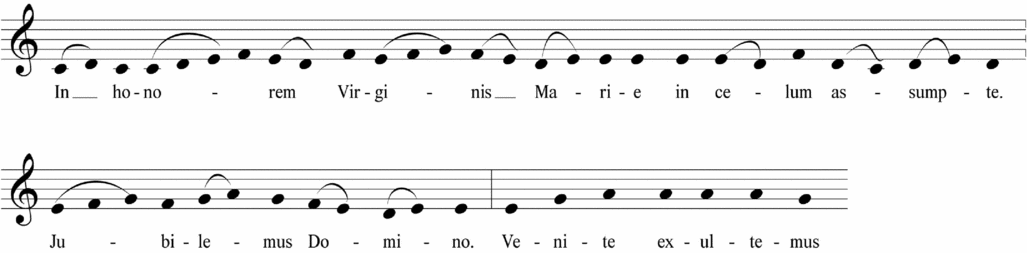
Invitatory, In honorem (Uden HS K:An 1, fol. 107v), mode IV, Venite tone IV.

Great responsory, Intelligens Abraham (Uden HS K:An 1, 46v), opening.

Introit, Salve sancta parens (The Hague, Royal Library, MS. 71 A 21, fol. 279r), opening.

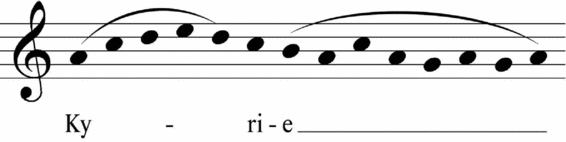
Kyrie eleison (The Hague, Royal Library, MS. 71 A 21, fol. 279v), opening (transposed up a fifth in the source).

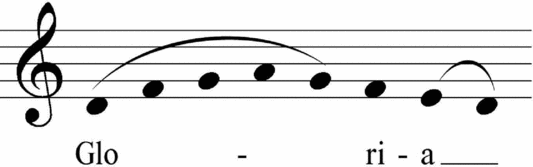
Gloria in excelsis (The Hague, Royal Library, MS. 71 A 21, fol. 280v), opening.

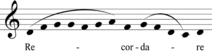
Offertory, Recordare (The Hague, Royal Library, MS. 71 A 21, fol. 285r), opening.

Ite missa est (The Hague, Royal Library, MS. 71 A 21, fol. 286v), opening.

Sequence, Tota pulchra es (The Hague, Royal Library, MS. 71 A 21, fol. 301v), opening.

According to the Cantus data, the opening (F–a–c–d–c) is especially common in great responsories, but this same beginning is also found in numerous other chants. Yet despite the formulaic opening, typical of mode V, there are no concordances or striking similarities between this melody and those in other sources. Compared with the two previous invitatory chants, this one has a wider range and a higher tonal focus (C). The descending leap of a fourth on the last word jubilantes is noteworthy since it is uncommon but found in other Birgittine invitatories, as will be demonstrated below.
Wednesday: Ortum virginis. The opening motif of Ortum virginis (see Ex. 7) is encountered in seven antiphons and great responsories in mode III, although these melodies all develop in directions different from the Birgittine invitatory. The ambitus of Ortum virginis spans an octave (D–d) and though it ends on E and may be assigned to Mode III based on the Venite tone, it is only in the cadence of the A section (G–E–F–E–D) that the pitch E is sounded for the first time. Before this, the melody has a character more typical of mode VII, with a melody spanning G to d. The unusual melodic gesture of a descending fourth leap on celebremus is similar to the A-section cadence of Filium Dei, the Tuesday invitatory, whose descending fourth on jubilantes gives the melody an odd impression (cf. Ex. 5). These are instances in which the melismatic melody moves in a way atypical to the standard plainchant repertoire and points to a possible Birgittine melodic style.
The B section is clearly marked by an ascending fourth (D–a) that can also be noticed in other E-mode invitatory antiphons, another factor obscuring the mode of Ortum virginis. A further example of this from a fifteenth-century (before 1467) Scandinavian source is the fourth-mode invitatory for St Erik of Sweden, Christum suppliciter (Ex. 8).Footnote 34 No proof exists that this chant in any way served as a model for the Birgittine Ortum virginis, but it does point to the constant reuse of melodic formulas in the chant repertoire.
Thursday: Ave Maria. The opening of Ave Maria (see Ex. 9), which ascends a fourth from g to c, resembles Ortum virginis (Ex. 7), but the melodies develop in different directions and different modes. Moreover, unlike Ortum virginis, the melody of Ave Maria is widespread among invitatory antiphons and great responsories, though in different guises. The opening of the Birgittine invitatory (corresponding to the text Ave Maria gratia) exactly matches seventeen chants, all in mode VII and all disseminated across Europe.Footnote 35 Although these melodies continue differently and are all longer than the Birgittine invitatory, some contain the same ascending passage (F–a–c–d) which opens the B section of Ave Maria. (It also begins the A section of Filium dei for Tuesday (Ex. 5), but in a mode VII melody.) No Cantus source has an exactly concordant text, but there exists a Marian connection in the great responsory Gloriose virginis marie ortum dignissimum, for the Conception and the Nativity of the Virgin, with a melody that can have served as a model for Filium Dei. Cantus database has seven matches for this responsory from all over Europe.Footnote 36
Friday: Regem virginis. The opening of Regem virginis (C–D–F–D–F–G–F–E) (see Ex. 10) is similar to those of Cantus sororum invitatory antiphons for Sunday and Saturday in D and E modes, but it is also common in a total of thirteen other chants in different modes outside the Cantus sororum – again great responsories and invitatory antiphons with great variety of texts. These include melodies in modes II, III and IV, and transposed for modes III, VI, VII and VIII.Footnote 37 Among Birgittine invitatories Regem virginis is the shortest, with an unusually brief and syllabic B section. The last word (adoremus) has an unusual melodic gesture in which the cadential gesture (E–G–E) seems to aim at avoiding the semitone. Like the descending fourth leaps in Filium Dei (jubilantes) and Ortum virginis (celebremus), this melodic passage is atypical in the standard plainchant repertoire and possibly a unique Birgittine solution.
Saturday: In honorem virginis. As noted previously, the text of In honorem virginis (Ex. 11) resembles those found in many other sources. The melody was widely disseminated with variants outside invitatory antiphons, great responsories and other genres. A very close concordance is In honore beatissimae marie virginis for the Assumption, whose text and melody match exactly except for the variation honore/honorem.Footnote 38
In summary, the melodies of the invitatory antiphons in the Cantus Sororum follow a standard pattern: they are relatively short – sometimes very short, as with the Friday invitatory, Regem virginis – with a clear A+B-structure. Melismas are in most cases restricted to two or three notes; they are rarely elaborate. Melismas longer than four notes occur most frequently at beginnings of the A and B sections or at cadences. The Thursday invitatory, Ave Maria, is by far the most melismatic. Some melodies are, however, nearly or wholly syllabic, the most striking example being the B section of the Friday invitatory.
The melodies conform to the medieval modal system, but stability is sometimes attained only towards the end, as in Regem virginis, for example, giving an overall impression of changing pitch focus and modal ambiguity. Several motives, though typical of chant, occur in different modes and thus are not representative of specific modes. In line with what Hiley reports concerning the broader invitatory repertoire there is no Cantus sororum invitatory in mode I or VIII. Steiner points out that mode IV is common among invitatory antiphons from some regions, but only two of seven invitatories in the Cantus sororum are in mode IV (In honorem virginis and Regem virginis). The limited number of chants makes it impossible to establish any reliable statistics concerning modal preferences in the sisters’ repertoire. All told, for all the importance of the modes as a means of systematising chants, in reality we are dealing with fuzzy boundaries. Composing and compiling were not done according to a set of rules, but involved more complicated and creative processes.
Stylistically, the invitatory melodies in Cantus sororum are a mix of common formulas paired with unique musical gestures. Gestures like the descending leap of a fourth are rare in the broader chant repertoire, but distinctive to the Birgittine invitatories as we have observed. Whether such are typical of the Cantus sororum in general is a question that cannot be addressed in this study.
The musical connection, discussed earlier, between great responsories and invitatory antiphons in the broader repertoire is also present in the Cantus sororum but only to a very limited extent. The opening of the second great responsory for Tuesday, Intelligens Abraham (D–F–G–a; see Ex. 12) is a well-represented pitch group.
But apart from this motif, no obvious connections are found between invitatory antiphons and great responsories in the Cantus sororum, meaning that, but for this exception, the Birgittine invitatory melodies are only related to great responsories outside the Order's repertoire. As exemplified by the invitatory repertoire, relations between the Cantus sororum and the standard chant repertoire indicate that the Birgittines were dependent on the latter by the fifteenth century if not before – the lack of sources dating earlier than c.1450 makes this impossible to establish.
As for the Venite tones, Monday stands out as having no concordance in the Liber Responsorialis, yet its opening closely resembles the A section of the antiphon with which it is paired. This particular Venite tone might not turn out to be unique to the Birgittines, but the point I wish to make is that it was either chosen or created in such a way as to match an opening motive that recurred often in the Order's repertoire.
The only clear case of a borrowing from the common stock is the Thursday invitatory, Ave Maria, in which a borrowed melody (connected both with invitatories and great responsories) and a borrowed text were combined in a way perhaps unique to the Birgittines. The other Birgittine invitatory antiphon melodies are ‘more or less’ adapted from existing chants or formulas. These borrowed formulas appear at the beginnings or ends of melodies in other sources, a feature that is common in oral repertoires, where the most important cognitive trick is to memorise the opening and the cadence.
An important pitch group?
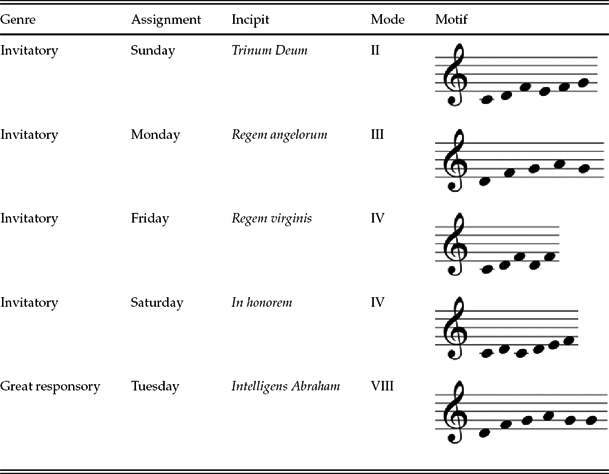
One valuable finding of the foregoing melodic analyses is that four out of the seven antiphons – for Sunday (mode II), Monday (mode II), Friday (mode IV) and Saturday (mode IV) – have similar openings in which the pitch group C–D–E–F–G–a is used in various positions. Some of the pitches in the ascending motif may be omitted, a and E in particular, giving them a weak position, but the pitch group ascending C to a (with varying contours) occurs in a related set of melodies. Further strengthening the idea of a cohesive and recognisable pitch group associated with invitatories is Regem angelorum, in which both the antiphon and the Venite tone have identical openings emphasising this musical theme. There is no modal consistency among these melodies: the pitch group C–D–E–F–G–a could be used in different modes and not just in these invitatory antiphons, as previously mentioned. Before turning to other Birgittine chant melodies employing this motif, let us take stock of how this pitch group is used in the invitatory antiphons.
All days listed in Table 1 except Monday and Tuesday were of liturgical importance, not just for the Birgittines but the Christian church in general. Sunday is the week's first and most solemn day, and the beginning of the weekly Birgittine cycle. Friday marks the death of Christ. Saturday traditionally commemorates the Virgin Mary and in the Cantus sororum her Ascension. (Why Monday and Tuesday were included in this pitch group is difficult to say.) The pitch E is omitted from the openings of the Monday, Friday and Saturday invitatories, which instead emphasise the minor third although E occurs a little later in the chants.
Chants incorporating the pitch group C–D–E–F–G–a.

Perhaps an explanation for this omission is to be found in a possible connection to the Birgittine ferial Mass, Salve sancta parens, which makes similar use of this pitch group in several chants. This motif (pitch group C to a with E and a in weak positions) opens the introit Salve sancta parens, Kyrie, Gloria, offertory Recordare and the Ite missa est (Exx. 13–17). To these, the Sunday sequence Tota pulchra es can be added (Ex. 18).Footnote 39 I have chosen the Birgittine manuscript entitled Officia et Missae de B. Maria Virgine, now in the Royal Library, The Hague, Netherlands (Mariënwater, c.1500) as the basis for transcription since it contains a complete Mass section including the Ordinary.
Bearing in mind that the motif C–D–E–F–G–a was sung regularly several times a week – that is, on all days without feasts specifically assigned to them – the formula can be said to bridge the Mass and the Office of the Birgittine sisters’ repertoires. I would argue that it is a strong musical signal from which a Birgittine soundscape was created. The systematic use of pitch groups and motives in the Birgittine repertoire needs further investigation, but this result points to why it is important to study complete chant repertoires and not just certain genres. Such studies can offer a more complete picture of how nuns and monks experienced the daily liturgy, and how various elements were combined together into one meaningful totality. The work of mapping out the possible Birgittine melodic patterns is only at its beginning.
Text and melody analysed together
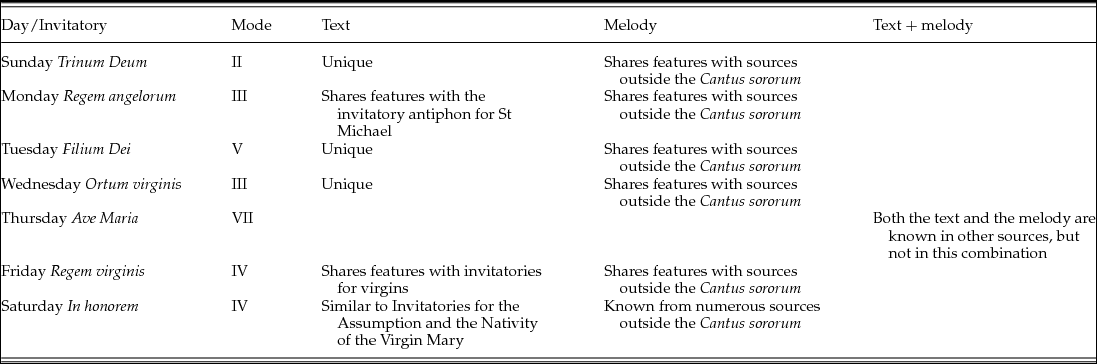
So far texts and melodies have been examined separately, but analysing them together yields the summary given in Table 2.
The Birgittine invitatories: summary of findings concerning texts and music.

As demonstrated in this article, analysing texts and the melodies offers new insights as to how borrowings were combined into new combinations, and how known texts were set to melodies and melodic motives known from other sources. Three patterns have been observed: (1) unique texts were combined with melodies that resemble other known melodies outside the Cantus sororum (Sunday, Tuesday and Wednesday); (2) texts and melodies that resemble other variants outside the Cantus sororum were combined in a new way (Monday, Friday and Saturday); (3) a known text and melody were combined in a new way (Thursday). It remains uncertain whether or not this combination was made at Vadstena for lack of comparable sources.
Similarities involving texts can often be linked to Marian feasts, and to some extent the Marian connection is also evident in melodic relations. As might be expected in the Marian liturgy of the Birgittines, borrowings involving complete melodies, melodic formulas and texts from Marian feasts are many. This preceding investigation shows that the division into borrowed/adapted/newly composed is a blunt tool which overlooks the subtleties of how a new liturgical repertoire could be worked out.
Invitatory antiphons: an example of a new way of looking at Birgittine Chant
Searching for pitch groups can make one blind as the brain tries to make all kinds of systematic arrangements of the pitches in the samples being studied. After a while one finds patterns everywhere and the Birgittine soundscape would seem to consist of nothing other than pitch groups organised with an underlying intention of shaping a Birgittine identity. I have tried to avoid this temptation except for instances of obvious patterns involving the systematic use of a certain musical motif, here treated as a pitch group which transcends individual modes and chant genres.
The seven invitatory antiphons in the Cantus sororum belong to a corpus which, at least as we know is based on the earliest preserved liturgical sources, was fixed by the middle of the fifteenth century at the latest. This was approximately a century after the Order's foundation and some seven decades after the opening of its first abbey at Vadstena. The aim of this study is not, however, to establish how and when the invitatory antiphons in the Cantus sororum became the corpus we know today, or to sort out the contributions by Petrus Olavi of Skänninge. If we regard the Cantus sororum as a corpus of chant originating from a common identity defined by membership in the Birgittine Order, one is instead invited to entertain questions relating to the way in which this group of people used this repertoire and its texts and, if needed, modified them. In this conception questions of authorship and establishing the earliest versions become unimportant.
Building on prior research, this study has shown that the invitatories in the Cantus sororum can be said to consist of borrowings, adaptations and unique material, but it has further emphasised the dependence on the common stock of plainchant melodies and its common formulas. This makes it difficult to talk about firm boundaries between these three categories since even unique compositions are dependent on pre-existing material. Separating texts and melodies and then analysing them together has shown a more complicated web of structures and relationships in borrowings and adaptations. Melodies and texts do not always follow one another, which supports my conviction that text and melody need to be considered separately in order to examine, for instance, questions of borrowings. I would like to suggest that examinations of other, previously studied chant genres using this approach might show that this tripartite division is at least problematical if not invalid. The very idea of plainchant is to be part of a genre, and by using already existing formulas and motives the melodies participate in an ongoing conversation with the past and tradition.
The uniqueness of the Birgittine liturgy and the Cantus sororum has often been stressed. I would like to offer an alternative view of its dependence on the common stock of plainchant. By using existing patterns, the Birgittines created their own repertoire, one which owes its existence to an already existing chant repertoire in use for many centuries. This study has further demonstrated melodic links with particular reference to a certain pitch group among certain Birgittine chants. This functions as a self-referential system which was arguably a factor for creating and strengthening the identity of the Birgittine sisters through their own singing, and through which they achieved and maintained an identity of being Birgittine not only in words but also in music.