In the alpine mountains, the traditional breeding system of dairy cattle involves the direct use of high altitude pastures during summer. In addition to the traditional system the percentage of farms keeping animals in the stable all year with a hay-based diet is increasing.
Many studies have shown that, other factors being equal, the forage component of the diet is able to modify milk and raw milk cheeses characteristics. From a nutritional point of view, pasture-derived dairy products seem particularly interesting when assessed in relation to anti-oxidant substances content such as vitamin E, polyphenols and carotenoids (Lucas et al. Reference Lucas, Agabriel, Martin, Ferlay, Verdier-Metz, Coulon and Rock2006; Noziere et al. Reference Noziere, Graulet, Lucas, Martin, Grolier and Doreau2006). Furthermore, the fatty acid (FA) profile is favourable to human health being characterised by a higher content of polyunsaturated fatty acids (PUFA), able to decrease the risk of cardio-vascular origin, and acid conjugated linoleic acid (CLA), which seem to be involved in anti-tumour, immuno-modulatory and anti-diabetic activity (Dewhurst et al. Reference Dewhurst, Shingfield, Lee and Scollan2006). In effect, the hay-making process, i.e. mechanical damage to plant tissues combined with air access, causes extensive oxidation of PUFA (Kalac & Samkova, Reference Kalac and Samkova2010). Even the sensory properties – colour, smell, aroma, flavour and texture – of cheeses made with pasture-derived milk rather than dry forages may be different (Coulon et al. Reference Coulon, Delacroix-Buchet, Martin and Pirisi2004). These characteristics are also modified during ripening because of the different enzymatic processes, including proteolysis and lipolysis, which play a key role in texture and aroma development, typical of the product (McSweeney & Sousa, Reference McSweeney and Sousa2000).
In order to increase the market value of mountain dairy products, in particular quality-labelled products, it is important to test the ability of consumers to recognise and appreciate these differences. Montasio cheese is one of the most important Protected Designation of Origin (PDO) products in North-East Italy. However, although it takes its name from a mountain plateau, it is produced and manufactured largely in lowlands. Several papers about Montasio cheese have been published highlighting its chemical, nutritional and organoleptic characteristics (Innocente et al. Reference Innocente, Pittia, Stefanuto and Corradini2002, Reference Innocente, Munari and Biasutti2013; Marino et al. Reference Marino, Maifreni and Rondinini2003), while there are no studies on the effect of the forage component of the diet. Recently, in order to valorise the mountain cheese and to link it to the breed more present in this area, the production of Montasio PDO was combined with two additional labels: ‘Mountain Product’ and ‘Only Simmental breed’.
The aim of the study was to compare the quality properties of this cheese produced from milk of Italian Simmental cows grazing on mountain pasture or fed indoor with a hay-based diet.
Materials and methods
Animals and rearing systems
The trial was carried out using 120 lactating Italian Simmental cows, registered on the herd-book (milk production: 19·2±0·72 kg/d, number of lactations: 2·7±0·17; stage of lactation: 183±13·1 d in milk).
Sixty dairy cows (Group MP) were maintained on mountain pasture (Malga Montasio, Udine, Italy; lat. 46°24′45″N, long. 13°25′53″E; altitude 1500–1800 m) characterised by a Poion alpinae alliance (main species: Phleum alpinum, Festuca pratensis, Poa alpina, Trifolium repens, Trifolium pratense, Leontodon hispidus). Cows were allowed to pasture day and night and milked twice a day. At milking, cows were supplemented with 2 kg head/d of concentrate (based on maize, barley, beet pulp, soybean and wheat).
The other 60 cows (Group I) were reared indoors at lowland altitude and fed with alfalfa hay, permanent meadow hay characterised by a Arrhenatheretum elatioris association (main species: Arrhenatherum elatius, Dactylis glomerata, Phleum pratense, Poa pratensis, Festuca rubra, Festuca pratensis, Trifolium repens, Trifolium pratense) and concentrate (based on maize, barley, soybean and bran). The average forage to concentrate ratio was approximately 60 : 40.
Cheese making and ripening
In two periods, early July (J) and late August (A), milk from the evening milking (cooled to 10 °C) pooled with milk from the morning was processed for three consecutive days in accordance with the product specification of PDO Montasio cheese.
In the vat, milk was heated to 32 °C and then 7·5 g natural starter/kg of milk was added (natural starter: microflora naturally present in raw milk and cultured in appropriate conditions for a day). After 25 min of incubation the rennet (Clerici Sacco, 96% chymosin) was added. Firming time (between the addition of rennet and the beginning of cut of the curd) was 20 min. The curd was cut to obtain pellets of size comparable to grain of rice, then it was cooked at 45 °C for 30 min. The curd was blended out fire for 20 min and left to stand. After draining the whey, it was placed in moulds and pressed. The curd at the time of extraction had an average pH 6·30 (43 °C), while at 8 h to extraction from the vat, it had pH 5·50 at 25 °C.
Fresh cheeses were then placed in brine for 24 h (18% salt concentration). Subsequently the salt was put once on one side of the cheeses that then were stacked. Cheese shape was cylindrical, about 6 kg weight and 70 mm height. Two cheeses for each cheese making were ripened for 60 (RT60) and 180 (RT180) days in a ripening cellar with controlled temperature (12 °C) and humidity (85%) until analysed.
Chemical and rheological analysis
On samples of milk were made the following determinations: fat, protein and lactose (IDF, 2000), urea (AOAC, 2000) and somatic cell count (SCC; Foss-o-Matic, Foss Electric). SCC data was analysed as somatic cell score (SCS)=log2 (SCC/100 000)+3 (Schutz, Reference Schutz1994).
The experimental cheeses were analysed for: dry matter (DM) using a gravimetric method, fat according to the Schmidt-Bondzynzki-Ratzlaff method, total nitrogen (TN) and soluble nitrogen at pH 4·6 (SN) by the Kjeldhal method (AOAC, 2000). The ripening index (RI) was calculated as ratio (x100) between SN and TN. Protein content was obtained multiplying TN×6·38.
A spectrophotometer (Minolta CM2600d) was used for measuring colorimetric parameters: L*, a* and b*.
The rheological properties of cheeses were evaluated with a Texture Analyser (TA Plus, Lloyd Instruments, UK) using the procedure described by Bourne (Reference Bourne1978) and modified by Gunasekaran & Ak (2003). Texture Profile Analysis (TPA) was applied to the cylinders of cheese (20 mm in diameter and 20 mm height) compressed axially in two consecutive cycles, with a deformation of 50% of the original height and applying a force of 100 mm/min. The rheological parameters analysed were: hardness, cohesiveness, adhesiveness, springiness, gumminess and chewiness.
For fatty acids (FA) analysis milk was centrifuged at 17 800 g for 30 min at 8 °C, milk cream was stored at −20 °C until analysed. Lipid extraction of milk cream and cheese fat was performed according to Hara & Radin (Reference Hara and Radin1978). FA were transesterified with sodium methoxide according to method of Christie (Reference Christie1982) and modify by Chouinard et al. (Reference Chouinard, Corneau, Saebo and Bauman1999).
FA methyl ester in hexane were then injected into a GC system (model HRGC 5300 Carlo Erba, IT) with 1 : 50 split mode. Separation was performed with a SP-2380 fused silica capillary column (60 m×0·25 mm×0·25 μm, Supelco, Bellefonte, US). Helium was used as carrier gas. Oven temperature was programmed from 50 to 230 °C and held for 70 min; injector and detector were set at 250 °C. Each peak was identified by pure methyl ester standards (Supelco 37 Components FAME Mix; Fluka CLA 10E, 12Z and 9Z, 11E; Sigma Methyl Trans-Vaccenate) and quantified with Fluka Nonadecanoic acid as internal standard. The milk and cheese FA composition was expressed as g/100 g of identified FA.
Consumer test
The consumer test was performed in four subsequent sessions, according to UNI ISO 8589:1990, using 280 consumers of cheese (151 men and 129 women; mean age of 40 years; 85% eat cheese more than once a week). The consumers not previously informed about cheeses origin were asked to record their overall liking (Labelled Affective Magnitude scale; LAM from −100 to +100; Cardello & Schutz, Reference Cardello and Schutz2004), and intensity scores (Just About Right scale; JAR from 1 to 5, with 3 point for the ideal of typicality for each descriptor; Chambers & Baker Wolf, Reference Chambers and Baker Wolf1996) for colour, holes, smell, taste and structure. JAR data were expressed as frequency.
Statistical analysis
The statistical analysis was performed using the free software R version 2.14.1. Normality of data distribution was tested by the Shapiro-Wilk test. Milk data were subjected to two-way ANOVA with rearing systems (RS; MP and I) and period (P; J and A) as fixed factors. Cheese chemical composition, texture and overall liking were analysed using the general linear model (GLM) repeated measures procedure considering the ripening times (RT; RT60 and RT180) as within-subject factors and RS and P as the between-subject factors. Also the triple interaction was considered, but not reported in Tables because it never reached the level of significance. When an ordinal interaction from the perspective of a factor was significant, the main effect of the same factor was discussed (Keppel, Reference Keppel1973). Student's t-tests were performed for overall liking data. The frequency distributions for JAR scales were compared using Stuart-Maxwell and McNemar tests as proposed by Stone & Sidel (Reference Stone and Sidel2004). Data were also processed by Principal Component Analysis (PCA) carried out using The Unscrambler X version 10.2 (Camo Software AS, Oslo, Norway). Data were weighted with 1/SD and the full cross-validation method was used.
Results and discussion
Milk composition
MP milk had a higher fat and lower protein content than I milk (Table 1). As well known the high levels of energy in the diet of animals kept indoor reduce fat content in milk, reducing the synthesis of acetic acid in the rumen while maintaining a high protein content (Bargo et al. Reference Bargo, Muller, Kolver and Delahoy2003; Delaby et al. Reference Delaby, Peyraud and Delagarde2003). In addition, the lower protein level in MP milk could be due to low energy supply and hypoxia, which are characteristic on high mountain pastures (Leiber et al. Reference Leiber, Kreuzer, Leuenberger and Wettstein2006).
Characteristics of milk, n=24

† MP: mountain pasture, I: indoor
‡ J: July, A: August
§ RS: Rearing system, P: Period, *: P<0·05, **: P<0·01, ns: not significant
¶ SCS: Somatic cell score
Urea content was slightly higher in I. The results obtained in both rearing systems fall in the range of values reported by Jonker et al. (Reference Jonker, Kohn and Erdman1998) and are indicators of the correct balance of the ration. SCS of MP milk, result comparable with that of I milk, with an average value of 230 700 units/ml. This value is lower than those reported by Bovolenta et al. (Reference Bovolenta, Saccà, Corazzin, Gasperi, Biasioli and Ventura2008, Reference Bovolenta, Corazzin, Saccà, Gasperi, Biasioli and Ventura2009) but similar to that recorded by Comin et al. (Reference Comin, Prandi, Peric, Corazzin, Dovier and Bovolenta2011) in similar conditions in alpine pastures. Surprisingly MP milk showed higher total bacteria count, both values are well below the limit of 100 000 cfu/ml.
As expected, from J to A, there was an increase of milk fat, protein and urea contents. These changes in milk composition are due to the effect of lactation stage as explained also by Coulon et al. (Reference Coulon, Verdier, Pradel and Almena1998).
Milk fatty acid profile
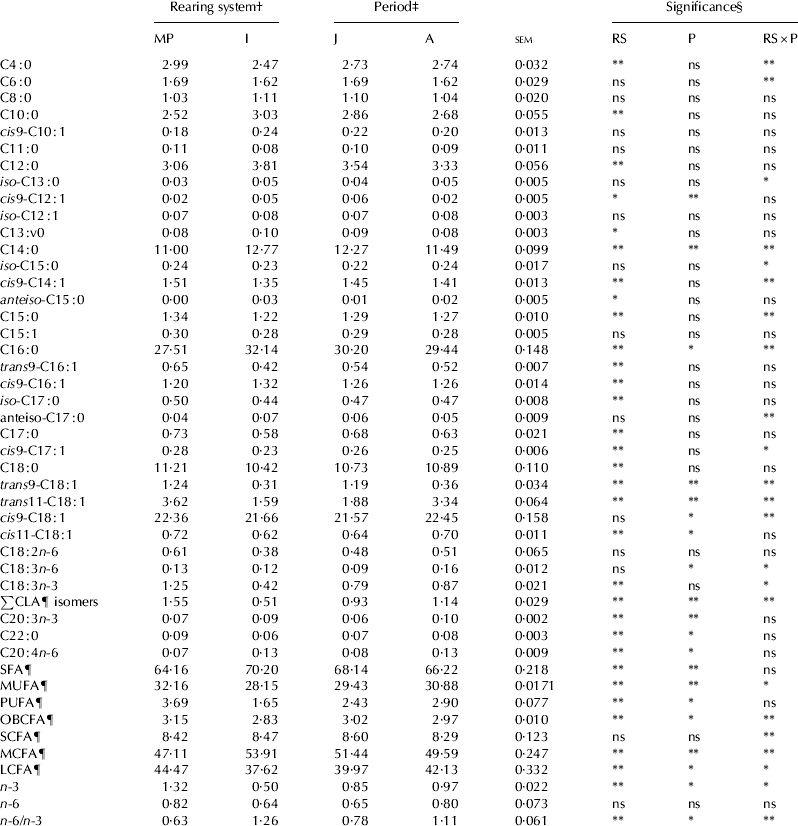
In general, MP cheese had lower levels of short and medium chain saturated fatty acids (SFA), with the exception of C4 : 0 (Table 2). MP milk was richer in C18 : 3 n-3 and its biohydrogenation products (trans11-C18 : 1 and C18 : 0) than I milk. Also CLA isomers, which derived both from desaturation of trans11-C18 : 1 in mammary gland and from biohydrogenation of PUFA in rumen (Rutkowska et al. Reference Rutkowska, Adamska and Bialek2012), was higher in MP than I milk. MP milk showed higher values of PUFA and lower values of SFA than I milk, in agreement with the results of several studies (Dewhurst et al. Reference Dewhurst, Shingfield, Lee and Scollan2006; Coppa et al. Reference Coppa, Verdier-Metz, Ferlay, Pradel, Didienne, Farruggia, Montel and Martin2011). Despite over the 80% of dietary PUFA could be hydrogenated in rumen (Scollan et al. Reference Scollan, Choi, Kurt, Fisher, Enser and Wood2001), these results could be due to the high content of PUFA n-3 of the fresh forage (50–75% of total FA; Elgersma et al. Reference Elgersma, Tamminga, Dijkstra, Elgersma, Dijkstra and Tamminga2006), and by the high losses of these FA during hay making (Kalac & Samkova, Reference Kalac and Samkova2010). However Collomb et al. (Reference Collomb, Bisig, Butikofer, Sieber, Bregy and Etter2008) and Khiaosa-ard et al. (Reference Khiaosa-ard, Soliva, Kreuzer and Leiber2011) explained the high level of C18 : 3 n-3 of milk of grazing cows as a possible consequence of the interaction among many factors such as: pasture feeding, alpine hypoxia condition of animals, and a reduced ruminal biohydrogenation due to possible presence of polyphenols or terpenoids in fresh forage. Moreover, these differences may have been increased by the different levels of concentrate offered to the two groups of animals (Bovolenta et al. Reference Bovolenta, Corazzin, Saccà, Gasperi, Biasioli and Ventura2009; Khiaosa-ard et al. Reference Khiaosa-ard, Klevenhusen, Soliva, Kreuzer and Leiber2010).
Milk fatty acids profiles (g/100 g of total fatty acids), n=24

† MP: mountain pasture, I: indoor
‡ J: July, A: August
§ RS: Rearing System, P: Period, *: P<0·05, **: P<0·01, ns: not significant
¶ CLA: conjugated linoleic acids, SFA: saturated fatty acids, MUFA: monounsaturated fatty acids, PUFA: polyunsaturated fatty acids, OBCFA: odd and branched chain fatty acids, SCFA: short chain fatty acids, MCFA: medium chain fatty acids, LCFA: long chain fatty acids
Odd and branched chain fatty acids (OBCFA) were higher in MP than I milk, in agreement with the findings of Loor et al. (Reference Loor, Ueda, Ferlay, Chilliard and Doreau2005). OBCFA derived mainly from rumen bacterial, and they could be related to change in the substrate for microbial populations of rumen. Short chain fatty acids (SCFA; C4 : 0–C10 : 0) were similar in both RS, while Medium chain fatty acids (MCFA; C11 : 0–C16 : 0) were lower in MP than I milk. Despite part of C16 : 0 and, to lesser extend to C14 : 0, can derived from circulating lipids, short and medium fatty acid can be used to evaluated the mammary de novo FA synthesis (Glasser et al. Reference Glasser, Ferlay, Doreau, Schmidely, Sauvant and Chillard2005). In our trial, higher level of dietary C18 : 3 n-3 and subsequent higher mammary uptake of this FA could have induced an inhibition effect on FA synthesis in agreement with the findings of Yang et al. (Reference Yang, Bu, Wang, Khas-Erbene, Zhou and Loor2012).
The differences between cheese making periods were less evident than those between rearing systems. J milk showed higher levels of C14 : 0, C16 : 0 and lower level of CLA isomers with respect to A milk. However a disordinal interaction between experimental factors was found, which was largely a response to greater difference between periods of C14 : 0 (J: 13·65 vs. A: 11·88) and C16 : 0 (J: 33·02 vs. A: 31·26) in I milk than in MP milk, and to greater period difference of CLA isomers in MP milk than in I milk (J: 1·35 vs. A: 1·76). These results are in agreement with Coppa et al. (Reference Coppa, Lonati, Gorlier, Falchero, Cugno, Lombardi and Cavallero2010) who found a limited effect of season on the level of these FA of milk from cows grazing on mountain pasture, with the exception of CLA that increased from July to September. In general, J milk presented slightly higher SFA and lower PUFA content.
Cheese composition and texture analysis
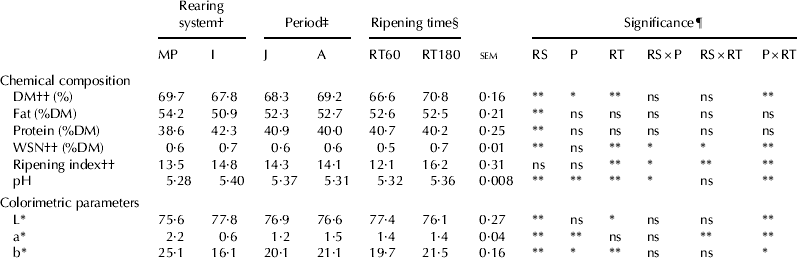
As expected in relation to the composition of milk, MP cheeses showed higher fat and lower protein content than I cheeses (Table 3). The values of ripening index did not vary between rearing systems and were similar to those reported for Montasio PDO cheese (Innocente et al. Reference Innocente, Pittia, Stefanuto and Corradini2002). The increase of 4·1 points in the ripening index from RT60 to RT180 is in agreement with data reported by Coppa et al. (Reference Coppa, Verdier-Metz, Ferlay, Pradel, Didienne, Farruggia, Montel and Martin2011) on Cantal cheese.
Chemical composition, ripening index and colorimetric parameters of cheeses, n=48
† MP: mountain pasture, I: indoor
‡ J: July, A: August
§ RT60: 60d of ripening, RT180: 180d of ripening
¶ RS: Rearing System, P: Period, RT: Ripening Time, *: P<0·05, **: P<0·01, ns: not significant
†† DM: dry matter, WSN: water soluble nitrogen, Ripening index: WSN/TN (×100), TN: total nitrogen
Lightness is higher in I cheeses and decreases slightly with the ripening in agreement with Coppa et al. (Reference Coppa, Verdier-Metz, Ferlay, Pradel, Didienne, Farruggia, Montel and Martin2011). MP cheese have higher a* index and b* index compared with I cheese. The colour of cheeses depends on high content of carotenoids in grass, which varies according to the phenological stage of the plants that compose the pasture and consequently the diet of animals (Noziere et al. Reference Noziere, Graulet, Lucas, Martin, Grolier and Doreau2006; Cozzi et al. Reference Cozzi, Ferlito, Pasini, Contiero and Gottardo2009). The effects of period and ripening are less pronounced, although there was a statistically significant increase in a* and b* with period and only of b* with ripening.
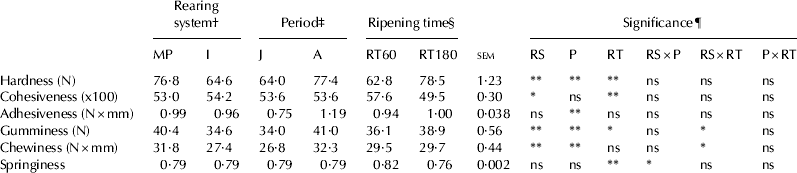
Hardness, gumminess and chewiness were significantly higher in MP cheese compared with I cheese (Table 4). Texture of cheeses is related to a complex interaction between chemical composition and ripening parameters. The differences in water content and holes may have caused these differences, with particular regard to hardness (Innocente et al. Reference Innocente, Pittia, Stefanuto and Corradini2002; Gunasekaran & Ak, Reference Gunasekaran and Ak2003). A cheeses were harder, more adhesives, more gummy and more chewable than J cheeses. Ripening causes in cheeses, as expected, an increase in hardness and a loss of cohesiveness and springiness in agreement with data obtained by Bertolino et al. (Reference Bertolino, Dolci, Giordano, Rolle and Zeppa2011) on Castelmagno PDO cheese.
Textural profile analysis of cheeses, n=48
† MP: mountain pasture, I: indoor
‡ J: July, A: August
§ RT60: 60d of ripening, RT180: 180d of ripening
¶ RS: Rearing system, P: Period, RT: Ripening time, *: P<0·05, **: P<0·01, ns: not significant
Cheese fatty acid profiles
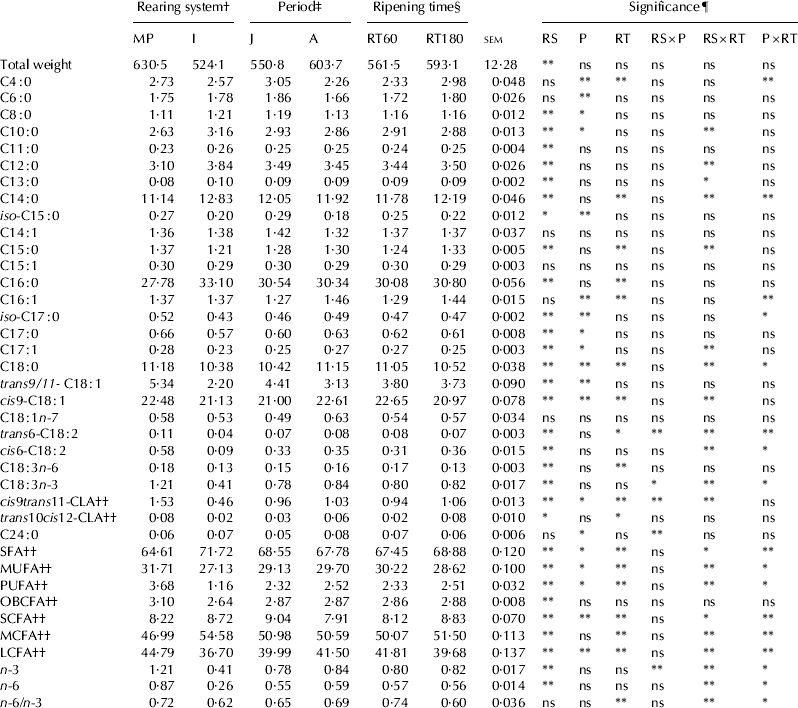
Cheese processing involves negligible variations on FA profile compared with the original milk (Revello Chion et al. Reference Revello Chion, Tabacco, Giaccone, Peiretti, Battelli and Borreani2010; Table 5). MP cheeses presented lower level of total SFA, and higher level of MUFA and PUFA than I cheeses.
Cheese fatty acid content (g/100 g of total fatty acids) and total weight (mg/100 g of cheese), n=48
† MP: mountain pasture, I: indoor
‡ J: July, A: August
§ RT60: 60d of ripening, RT180: 180d of ripening
¶ RS: Rearing System, P: Period, RT: Ripening Time, *: P<0·05, **: P<0·01, ns: not significant
†† CLA: conjugated linoleic acids, SFA: saturated fatty acids, MUFA: monounsaturated fatty acids, PUFA: polyunsaturated fatty acids, OBCFA: odd and branched chain fatty acids, SCFA: short chain fatty acids, MCFA: medium chain fatty acids, LCFA: long chain fatty acids
The RT mainly increases level of C4 : 0 and C16 : 0, and decrease the level of C18 : 0 and cis9-C18 : 1, with an increase of total SFA and a decrease of total MUFA. Despite the negative oxidation-reduction potential of cheese, these results could be due to oxidation of cheese lipids favoured by the action of lipase and esterase present in raw milk (McSweeney & Sousa, Reference McSweeney and Sousa2000). Surprisingly cis9trans11-CLA and trans10cis12-CLA increased from RT60 to RT180. Considering cis9trans11-CLA, the interaction RS×P was ordinal, while interaction RS×RT was disordinal. In effect, the increasing level of cis9trans11-CLA from RT60 to RT180 in MP cheese (1·45 vs. 1·60) was not found in I cheese (0·47 vs. 0·46). Other studies suggest that ripening has negligible (Werner et al. Reference Werner, Luedecke and Shultz1992; Luna et al. Reference Luna, Juarez and De La Fuente2007) or at least controversial effect on CLA content. In particular, Lobos Ortega et al. (Reference Lobos Ortega, Revilla, Gonzalez Martin, Hernandez Hierro, Vivar Quintana and Gonzalez Perez2012) observed an increase of CLA limited to the first part of the ripening in cow cheese while Lin et al. (Reference Lin, Boylston, Luedecke and Shultz1999) reported that, with the progress of ripening (from 3 to 6 months), there is a reduction of CLA due to enzymatic hydrogenation to MUFA and SFA.
Principal component analysis
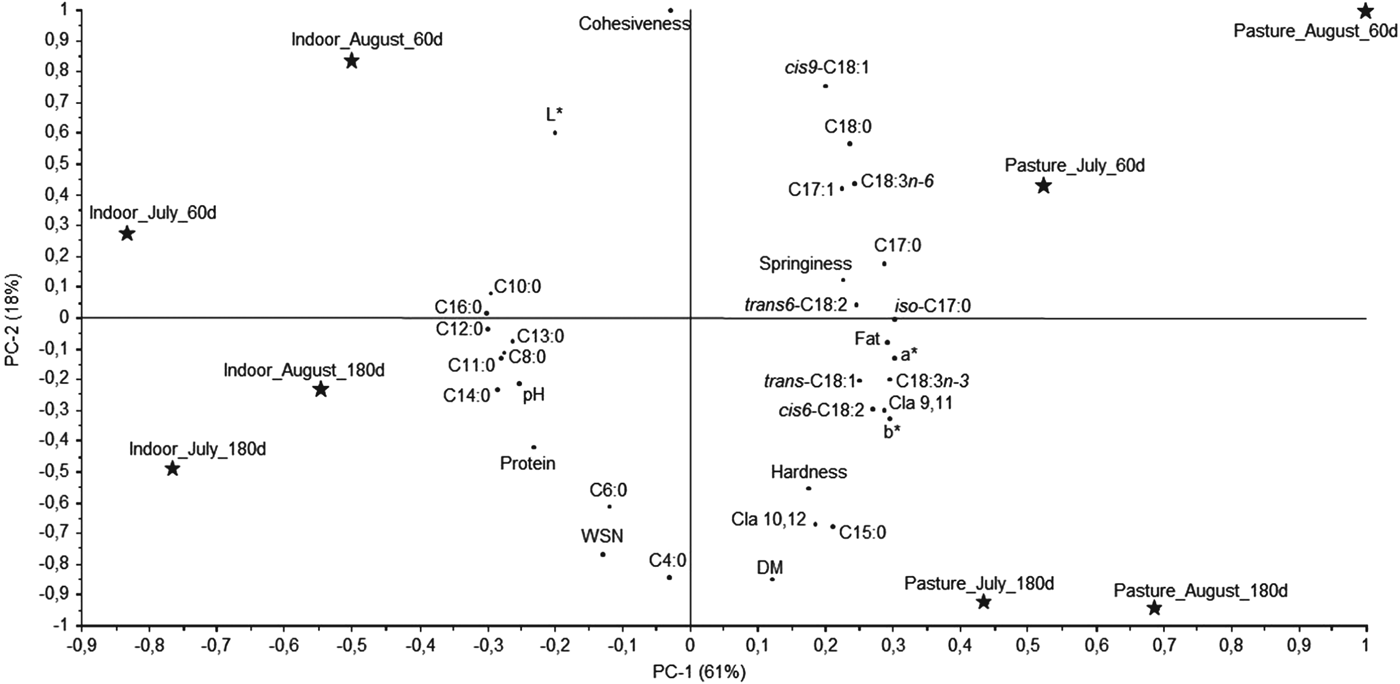
Figure 1 provides an overall description of the chemical composition, colorimetric parameters and textural profile of the cheeses. The first Principal Component separated MP from I cheese, and it is mainly correlated with PUFA and colorimetric parameters. Instead the second Principal Component separates the cheeses according to ripening period, and it is mainly correlated with textural parameters, WSN and short chain fatty acid. The effect of period is not evident.
Principal Component Analysis of chemical composition, ripening index, colorimetric parameters, textural and sensory properties of cheeses.
Consumer acceptance
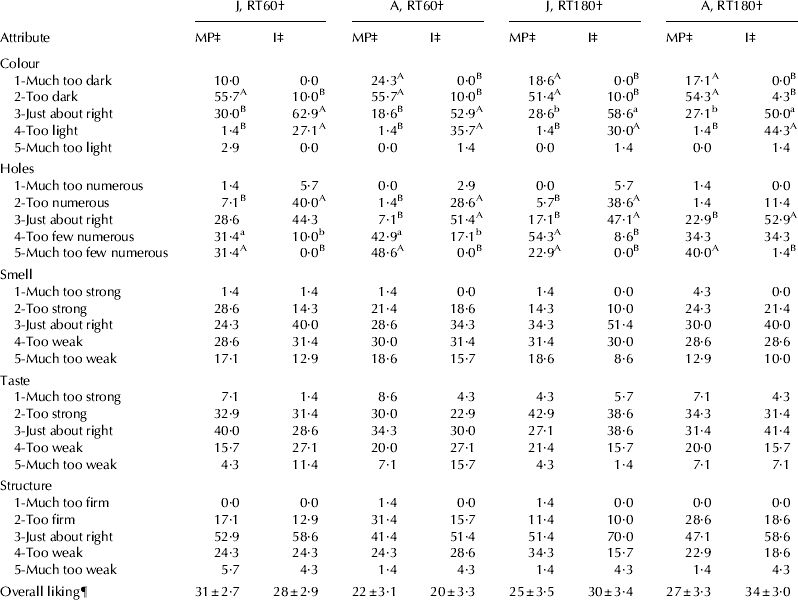
Consumers are usually able to discriminate between cheeses made from raw milk produced in mountain pasture and indoor (Coulon et al. Reference Coulon, Delacroix-Buchet, Martin and Pirisi2004; Dovier et al. Reference Dovier, Valusso, Morgante, Sepulcri and Bovolenta2005). In this trial, assessors not previously informed about cheese origin have highlighted some peculiarities in the experimental products in relation to colour and holes (Table 6). In particular, MP cheeses showed a more intense colour (average: 3·9 vs. 2·7) than I, this difference decreases slightly with the ripening. These results are consistent with those obtained with the colorimetric analysis. Another distinctive characteristic between cheeses was holes, which was much less marked (average: 1·9 vs. 3·2) in P cheese than I. With regards to other parameters evaluated consumers did not find any significant difference. Despite these differences consumers have expressed a similar overall liking for MP and I assessed within periods and ripening times. The average result was 27±1·1 (mean±se), which corresponds to a judgment of ‘moderately like’ (Cardello & Schutz, Reference Cardello and Schutz2004).
Consumer acceptance (frequency%) and overall liking (mean±se) of cheeses
† J: July, A: August, RT60: 60d of ripening, RT180: 180d of ripening
‡ MP: mountain pasture, I: indoor
A,B Within row and within P and RT, values with different superscript letters differ at P<0·01, a,b Within row and within P and RT, values with different superscript letters differ at P<0·05
¶ Expressed on a LAM scale
The present study can provide useful data to develop future marketing strategies based on objective information. Consumers not informed about product origin have not properly appreciated pasture derived cheese. Thus, it will be necessary to support the market value of this product in order to help preserve the social and environmental role of traditional mountain farms.