

Introduction
From the misdeeds of Wells Fargo employees to Volkswagen's emissions fiasco and Uber's privacy intrusions, recent highly publicized scandals instigated by employees and executives have revealed that unethical behaviors take a significant toll on organizations. Indeed, workplace unethical behaviors can harm employee morale, damage an organization's reputation, and threaten organization survival – not to mention the wider damage to society as a whole (Chen & Soltes, Reference Chen and Soltes2018; Schminke, Caldwell, Ambrose, & McMahon, Reference Schminke, Caldwell, Ambrose and McMahon2014; Treviño, den Nieuwenboer, & Kish-Gephart, Reference Treviño, den Nieuwenboer and Kish-Gephart2014). Thus, organizations are putting greater effort into promoting employees’ moral acts and inhibiting their immoral acts by implementing ethics training, financial incentives, and employee moral recognition programs for rewarding moral behaviors (Collins, Reference Collins2012; Epley & Kumar, Reference Epley and Kumar2019). For example, Alibaba, one of the world's biggest online commerce companies, presents the ‘Touching the Heart of Alibaba Award’ to employees for their significant moral behaviors (Aliyun, 2021). Similarly, Zappos awards employees with distinguished morality who go above and beyond to help out other team members (Zappos Insight, 2012). An important assumption underlying these morality-related awards is that moral stars are inherently good and can help organizations build an ethical culture and succeed in long-term development. This assumption, however, has not been empirically tested.
Indeed, compared with the extensive research on performance stars in organizations (Aguinis & O'Boyle Jr, Reference Aguinis and O'Boyle2014; Call, Nyberg, & Thatcher, Reference Call, Nyberg and Thatcher2015; Long, Baer, Colquitt, Outlaw, & Dhensa-Kahlon, Reference Long, Baer, Colquitt, Outlaw and Dhensa-Kahlon2015; Volmer & Sonnentag, Reference Volmer and Sonnentag2011), our understanding of moral stars and their impacts are still very limited. Most current star employee research focuses on in-role performance stars, such as those showing superior performance on specific tasks for a domain (Ericsson & Lehmann, Reference Ericsson and Lehmann1996). However, as Call et al. (Reference Call, Nyberg and Thatcher2015) suggested in their review of the star employee literature, research on star employees should consider the full range of performance (Beck, Beatty, & Sackett, Reference Beck, Beatty and Sackett2014). Unfortunately, moral stars are largely neglected in the star employee literature, although a growing number of companies are paying more attention to employee ethics and adopting recognition programs to show appreciation for employees with outstanding morality. Given that morality plays an irreplaceable role in organization success (Treviño, Weaver, & Reynolds, Reference Treviño, Weaver and Reynolds2006; Treviño et al., Reference Treviño, den Nieuwenboer and Kish-Gephart2014) and that performance orientation may induce certain negative consequences (Matzler & Mueller, Reference Matzler and Mueller2011; Yeo & Neal, Reference Yeo and Neal2004), it is an unfortunate oversight to neglect morality when defining the star employee. The present study aims to advance understanding of moral stars and their influence by integrating literatures of star employees and morality.
Following the literature on star employees (Aguinis, Ji, & Joo, Reference Aguinis, Ji and Joo2018; Call et al., Reference Call, Nyberg and Thatcher2015; Li, Li, Li, & Li, Reference Li, Li, Li and Li2020; Oldroyd & Morris, Reference Oldroyd and Morris2012), we define a moral star as the employee (not the team leader) who exhibits disproportionately high and prolonged morality relative to others and has a reputation of being moral in his or her team. The concept of the moral star reflects a collection of extraordinary moral performance indicators, rather than considers a single moral construct such as moral identity (Bergman, Reference Bergman2002), or moral awareness (Reynolds, Reference Reynolds2006). By introducing this new concept, we also aim to extend star employee literature by shifting the focus from performance to morality. More importantly, drawing upon self-categorization theory (Ashforth & Mael, Reference Ashforth and Mael1989; Tajfel & Turner, Reference Tajfel, Turner, Worchel and Austin1986), we aim to explore the influence of the presence of a moral star on nonstars’ behaviors, because findings in the performance star literature cannot be simply applied to understanding the impact of moral star.
Specifically, self-categorization theory suggests that individuals tend to categorize themselves and their peers into different social groups based on different group prototypes (Ashforth & Mael, Reference Ashforth and Mael1989; Tajfel & Turner, Reference Tajfel, Turner, Worchel and Austin1986). Moreover, in-group members share responsibility for group affairs (Tajfel & Turner, Reference Tajfel, Turner, Austin and Worchel1979; Turner & Oakes, Reference Turner and Oakes1986) and purposely differentiate themselves from out-group members (Park & Rothbart, Reference Park and Rothbart1982). According to self-categorization theory, we suggest that the effect of the presence of a moral star on nonstars’ moral cognition and behavior is dependent on whether nonstars categorize themselves with the moral star. Nonstars who categorize themselves with a moral star are likely to view such star as an in-group member and thus feel that they share the same moral responsibility as the star. In contrast, nonstars who do not categorize themselves with a moral star are likely to view such star as an out-group member and thus are likely to delegate the moral responsibility in their team to the moral star. Thus, we propose that nonstars with high moral identity are likely to identify with moral stars as in-group members who share the same in-group prototypes and thus experience an increased felt moral responsibility. Based on previous research (e.g., Fuller, Marler, & Hester, Reference Fuller, Marler and Hester2006; Pearce & Gregersen, Reference Pearce and Gregersen1991), we define felt moral responsibility as an individual's belief that he or she is personally obligated to care for the moral issues in the team and the welfare of the team. In contrast, nonstars with low moral identity are likely to view moral stars as out-group members and thus experience a decrease in felt moral responsibility. Furthermore, nonstars’ felt moral responsibility is positively related to their prosocial behavior, which is a typical moral behavior (De Groot & Steg, Reference De Groot and Steg2009). Taken together, we suggest that the presence of a moral star has a double-edged sword effect on nonstars’ prosocial behavior (via felt moral responsibility) and it is contingent upon nonstars’ moral identity. We tested this theoretical model (see Figure 1) via an experiment and a multi-time and multi-source field study, which can provide a good combination of internal and external validity evidence for our theoretical model.
Theoretical model of the current research

This research attempts to make several primary theoretical contributions to current literatures. First, our research is among the first to propose the concept of moral star and empirically explore how the presence of a moral star influences other team members. We therefore contribute to the star employee literature research by incorporating morality as another essential part of star employees. Furthermore, while previous star research has largely assumed that the impact of a star is identical for different coworkers (e.g., Kehoe & Tzabbar, Reference Kehoe and Tzabbar2014; Li et al., Reference Li, Li, Li and Li2020), we suggest that the effect of the presence of a moral star on nonstars’ prosocial behavior is not identical but rather depending on nonstars’ moral identity. By doing so, we extend our understanding on the differentiated impact of the presence of the moral star employee on nonstars.
Second, we extend self-categorization theory by showing that moral stars can induce a salient social category defined by morality within a team. Researchers applying self-categorization theory in organizational contexts (Ashforth & Mael, Reference Ashforth and Mael1989) have paid limited attention to moral values and differences between groups despite the fact that these differences are a fundamental part of this theory (Tajfel & Turner, Reference Tajfel, Turner, Austin and Worchel1979; Turner & Oakes, Reference Turner and Oakes1986). We explicitly consider how the presence of a moral star can evoke a salient distinction between team members with different moral values. Such a distinction can explain why stars can have differentiated – or even contradictory – effects on different coworkers.
Third, we also contribute to the employee prosocial behavior literature by advancing a new antecedent of prosocial behavior from a peer perspective. Past research has primarily adopted social learning theory and emphasized the role of moral leaders (e.g., Brown, Treviño, & Harrison, Reference Brown, Treviño and Harrison2005; Mayer, Kuenzi, Greenbaum, Bardes, & Salvador, Reference Mayer, Kuenzi, Greenbaum, Bardes and Salvador2009) in promoting employee prosocial social behavior (Fehr, Yam, & Dang, Reference Fehr, Yam and Dang2015; Mo & Shi, Reference Mo and Shi2017). Different from this line of research, our research proposes a new perspective that, besides formal leaders, the presence of special coworkers (i.e., moral stars) can also influence employee prosocial behavior. By doing this, we also respond to the appeal to investigate the disproportionate effect of special individuals on other team members (Humphrey, Morgeson, & Mannor, Reference Humphrey, Morgeson and Mannor2009; Li, Zhao, Walter, Zhang, & Yu, Reference Li, Zhao, Walter, Zhang and Yu2015).
Theoretical Background and Hypotheses Development
The Concept of Moral Star
Star employees who are visible and productive have received considerable attention from previous scholars (Lacetera, Cockburn, & Henderson, Reference Lacetera, Cockburn and Henderson2004; Oldroyd & Morris, Reference Oldroyd and Morris2012; Zheng, Zhao, Liu, & Li, Reference Zheng, Zhao, Liu and Li2019). A general definition of star employees identifies them as ‘those with disproportionately high and prolonged (a) performance, (b) visibility, and (c) relevant social capital’ (Call et al., Reference Call, Nyberg and Thatcher2015). Such stars are likely to influence other team members in a positive way through providing abundant social capital (e.g., Burke, Fournier, & Prasad, Reference Burke, Fournier and Prasad2007; Groysberg, Lee, & Nanda, Reference Groysberg, Lee and Nanda2008; Kehoe & Tzabbar, Reference Kehoe and Tzabbar2014) and motivating colleagues to imitate the stars’ performance (e.g., Li et al., Reference Li, Zhao, Walter, Zhang and Yu2015; Li, Zheng, Harris, Liu, & Kirkman, Reference Li, Zheng, Harris, Liu and Kirkman2016; Lockwood & Kunda, Reference Lockwood and Kunda1997). Because most of the current research on star employees has focused on the employee's in-role performance, recent studies have called for identifying star employees based on other types of employee performance, such as creative star, referring to the team member who exhibits superior creativity relative to other team members (Li et al., Reference Li, Li, Li and Li2020).
The concept of moral star is different from that of performance star and creative star because they focus on different aspects of employee behavior. Current star literature has mainly focused on employees’ in-role performance (Aguinis et al., Reference Aguinis, Ji and Joo2018; Call et al., Reference Call, Nyberg and Thatcher2015; Oldroyd & Morris, Reference Oldroyd and Morris2012), however, it is necessary to include employee moral behaviors into star selection, as these behaviors are also vital to the survival of organizations (Treviño et al., Reference Treviño, den Nieuwenboer and Kish-Gephart2014, Reference Treviño, Weaver and Reynolds2006). Further, the altruistic nature of moral behaviors reminds that evidence found in the extant performance star literature cannot be simply applied to understanding the influences of moral stars. Specifically, high performance is important for all employees as it is required by organizations and usually determines the rewards they can get, performance stars have been found to stimulate nonstars’ emulating behavior via social learning processes (Kehoe & Tzabbar, Reference Kehoe and Tzabbar2014; Li et al., Reference Li, Zheng, Harris, Liu and Kirkman2016; O'Boyle & Aguinis, Reference O'Boyle and Aguinis2012).
However, unlike in-role performance, moral behavior is altruistic and may not be rewarded by monetary incentives or promotion. Whether nonstars’ will imitate moral star and take moral responsibilities depends on how important such behaviors are for self-construction (i.e., moral identity) (Blader & Tyler, Reference Blader and Tyler2009). As such, although previous research suggests that performance stars could have a spillover effect on nonstars (e.g., Call et al., Reference Call, Nyberg and Thatcher2015; Li et al., Reference Li, Zheng, Harris, Liu and Kirkman2016), whether and how the presence of a moral star could evoke other employees’ moral acts, such as prosocial behavior, deserves to be explored. Exploring these questions is important because doing so can not only enriches our conceptual understanding of moral stars and their influences, but also provides opportunities for practical guidance for organizations such as the means by which employee recognition programs with respect to ethics might best be executed.
Furthermore, although moral star emphasized star employees from the perspective of morality, this concept is related to yet distinct from other existing moral concepts. On the one hand, a moral star is expected to display a range of characteristics that moral individuals typically possess, such as strong moral identity, acute moral awareness, and appropriate moral behavior. Thus, moral star is related to varied aspects of moral reasoning in that it involves an aggregation of the factors that drive and constitute moral behavior and action. On the other hand, moral star is distinct from other moral concepts in that it is not a construct to be evaluated in isolation on a person-by-person level. Rather, it involves a comparison among team members (not including the team leaders) regarding outstanding moral performance. As such, displaying high levels of morality (characteristics and behavior) is not a sufficient cause to be labeled as a moral star if other team members also display high levels of morality. Only when an employee has disproportionately high morality relative to other team members can he or she be regarded as a moral star. Next, we adopt self-categorization theory to illustrate when and how the presence of a moral star will have a positive or negative effect on nonstar's moral behavior.
Self-Categorization Theory and the Effect of the Presence of a Moral Star
Self-categorization theory, which grew out of social identity theory (Tajfel & Forgas, Reference Tajfel, Forgas and Forgas1981), outlines the process by which individuals define, describe, and evaluate themselves in terms of social category and in turn apply the in-group's norms of conduct to themselves (Turner, Hogg, Oakes, Reicher, & Wetherell, Reference Turner, Hogg, Oakes, Reicher and Wetherell1987). It suggests that social identification involves two fundamental subprocesses: categorization and depersonalization. Categorization is the process by which an individual is classified into a group based on value connotations, such as the group representative attributes, or typical behaviors, that differentiate the in-group from the out-group (Mackie, Reference Mackie1986). Categorization allows individuals to cognitively order the proximate social contexts, enabling them to systematically define themselves and others (Ashforth & Mael, Reference Ashforth and Mael1989; Turner & Tajfel, Reference Turner and Tajfel1986). Following the categorization process, depersonalization involves individuals beginning to act and think in accordance with the group's perceived prototypical characteristics. Prototypes are a set of attributes that capture the context-dependent features of group membership, often in the form of representations of exemplary members’ most fully or ideal types (Fiske & Taylor, Reference Fiske and Taylor1991; Hogg, Terry, & White, Reference Hogg, Terry and White1995). As these attributes become internalized, the prototype serves as a guideline for how a group member should behave (Tajfel & Turner, Reference Tajfel, Turner, Austin and Worchel1979; Turner & Oakes, Reference Turner and Oakes1986). Thus, according to self-categorization theory, individuals tend to categorize themselves and their peers into different social groups (Ashforth & Mael, Reference Ashforth and Mael1989; Turner & Tajfel, Reference Turner and Tajfel1986). In turn, they share the same responsibility approved by in-group members on many group affairs (Tajfel & Turner, Reference Tajfel, Turner, Austin and Worchel1979; Turner & Oakes, Reference Turner and Oakes1986), and they purposely differentiate themselves from out-group members.
The premise of the categorization and depersonalization processes is that people can identify a salient social category containing characteristics that are capable of distinguishing between different groups (even within one team) and find that they belong to a group with which they share similarities. The presence of a moral star on a team enhances the salience of between-group difference on how people act in a specific context concerning moral issues or affairs. In other words, individuals are likely to distinguish between different groups of individuals based on level of morality. According to self-categorization theory, a moral star would act as a salient stimulus in the context that can activate other team members’ perceptions of moral categorizations, based on their similarities and differences in morality levels. Moreover, through the categorization and depersonalization processes, team members who categorize themselves as consistent with the moral star will carry the same moral responsibility for the welfare of the team as the star. Conversely, other team members who belong to a category different than the moral star will experience greater intergroup differences (Bruner, Reference Bruner1957; Oakes, Reference Oakes and Turner1987), thereby becoming less responsible for the welfare of the team.
The Interaction Effect of the Presence of a Moral Star and Nonstars’ Moral Identity
Drawing upon self-categorization theory, we argue that the presence of a moral star may have different effects on different team members’ felt moral responsibility and resulting prosocial behavior, depending on whether these other members view themselves as belonging to the same social category as the moral star or not. Individuals possess multiple social identities that become more or less salient in different contexts (e.g., Abrams, Reference Abrams1994; Brown, Reference Brown2000). Moral stars’ moral behavior and reputation may serve as situational cues that evoke team members to perceive social identities that involve different levels of morality. Specifically, nonstars whose self-concept is organized around moral traits or characteristics are likely to categorize themselves with the moral star in the group, which defines their social identities as moral persons (Blasi, Reference Blasi1980, Reference Blasi, Noam and Wren1993, Reference Blasi, Lapsley and Narvaez2004). In contrast, nonstars who do not view morality as important to their self-concept are likely to perceive themselves as distinct from the group that the moral star prototypically represents.
The construct that captures the extent to which an individual organizes his or her self-concept around morality is moral identity (Aquino & Reed, Reference Aquino and Reed2002). The definition of moral identity is grounded in both the self-concept and social identity theories (Tajfel & Turner, Reference Tajfel, Turner, Austin and Worchel1979; Turner & Oakes, Reference Turner and Oakes1986). It can be a basis for the social identification that individuals use to construct their self-definitions. Aquino and Reed (Reference Aquino and Reed2002) suggested that moral identity reflects a part of individuals’ self-concepts organized around moral characteristics, and it is a kind of social identity that may be a part of a person's social self-schema. The categorization process allows team members to identify with salient social categories to derive social identities that can help them understand the similarities and differences among others (Stets & Burke, Reference Stets and Burke2000; Tajfel & Turner, Reference Tajfel, Turner, Austin and Worchel1979). Similarity or dissimilarity can be based on demographic characteristics and workgroup membership, as well as on a number of other cues, including values and behavior patterns (Hogg & Terry, Reference Hogg and Terry2000; Van der Vegt & Van de Vliert, Reference Van der Vegt and Van de Vliert2005). Team members who possess a strong moral identity tend to feel that morality is important to their self-concept, and evaluate the moral conduct as socially responsible (Aquino & Reed, Reference Aquino and Reed2002; Reed, Aquino, & Levy, Reference Reed, Aquino and Levy2007). Thus, they are likely to view themselves as similar with the moral star and classify themselves into the same category as the star (Turner & Oakes, Reference Turner and Oakes1986). In contrast, nonstars with weak moral identities are likely to feel that they belong to a different social group than the moral star in that they do not emphasize moral beliefs as the most important part of their life.
Self-categorization theory further suggests that the depersonalization process can accentuate individuals’ attitudinal, emotional, and behavioral similarity to the group prototype, and thus lead to a perceived similarity of needs, goals, and motives (Tajfel & Turner, Reference Tajfel, Turner, Austin and Worchel1979). In-group individuals experience a sense of ‘we-ness’, defined as ‘a sense of connectedness or a categorization of another person as a member of one's own group’ (Dovidio, Gaertner, Validizic, Matoka, Johnson, & Frazier, Reference Dovidio, Gaertner, Validizic, Matoka, Johnson and Frazier1997: 102). In this way, in-group members are viewed as more homogeneous (Allen & Wilder, Reference Allen and Wilder1979) and as more like prototypical members (Rothbart, Evans, & Fulero, Reference Rothbart, Evans and Fulero1979; Trope, Reference Trope1978; Tversky & Kahneman, Reference Tversky and Kahneman1973). Thus, nonstars with high levels of moral identity are likely to perceive that they share similar motives and goals with the moral star, and will act according to a similar behavioral pattern to achieve the common goal (Turner et al., Reference Turner, Hogg, Oakes, Reicher and Wetherell1987). Moral stars demonstrate prolonged and superior high morality through personal actions and interpersonal relationships in the workplace, such as striving to live in accordance with moral standards and demonstrating social responsiveness to – and responsibility for – the needs and interests of others. Thus, for nonstars with a strong moral identity, the presence of a moral star will increase their felt moral responsibility as well.
In contrast, the presence of a moral star can send explicit information to nonstars with low levels of moral identity that they belong to different groups. Once these nonstars categorized the moral star as an out-group member, they will engage in a depersonalization process in which they tend to conduct more in-group prototype behaviors and avoid conducting similar behaviors with the moral star (Rothbart, Fulero, Jensen, Howard, & Birrell, Reference Rothbart, Fulero, Jensen, Howard and Birrell1978; Stets & Burke, Reference Stets and Burke2000). As a result, for these nonstars, the moral star's moral behaviors are no longer an inspiration for taking moral responsibility to enhance group welfare. Rather, they become a salient cue that those behaviors reflect the features of an outgroup prototype that need to be avoided (Bruner, Reference Bruner1957; Oakes, Reference Oakes and Turner1987). Thus, nonstars with low levels of moral identity will be motivated to magnify the differences between them and the star by carrying less moral responsibility. That is, for nonstars with low levels of moral identity, the presence of a moral star has negative impact on their felt moral responsibility. In sum, we hypothesize the following:
Hypothesis 1 (H1): The presence of a moral star, and strength of nonstars’ moral identity, have an interactive effect on nonstars’ felt moral responsibility, such that (1a) the relationship between the presence of a moral star, and nonstars’ felt moral responsibility will be positive when nonstars’ moral identity is high, and (1b) the relationship will be negative when nonstars’ moral identity is low.
Nonstars’ Felt Moral Responsibility and Prosocial Behavior
We further argue that nonstars’ felt moral responsibility is positively related to prosocial behavior, which is indicative of being a good citizen and is directed at helping coworkers (Brief & Motowidlo, Reference Brief and Motowidlo1986; Penner, Dovidio, Piliavin, & Schroeder, Reference Penner, Dovidio, Piliavin and Schroeder2005). Prosocial behavior means that members devote time and energy to help others, such as engaging in cooperation and providing support for colleagues, actions that are important for most groups and organizations (De Cremer, Mayer, Van Dijke, Schouten, & Bardes, Reference De Cremer, Mayer, Van Dijke, Schouten and Bardes2009; Tyler & Blader, Reference Tyler and Blader2000). Previous research suggests that prosocial behavior is associated with morality and it can increase the level of enjoyment and efficiency in organizations, and has also been linked to many favorable work outcomes, including positive job attitudes (Brief & Motowidlo, Reference Brief and Motowidlo1986), improved performance (Podsakoff, MacKenzie, Paine, & Bachrach, Reference Podsakoff, MacKenzie, Paine and Bachrach2000), and decreased deviant behaviors (Dalal, Reference Dalal2006).
Individuals engaged in prosocial behavior go beyond in-role requirements (Brief & Motowidlo, Reference Brief and Motowidlo1986). Importantly, recent research demonstrates that prosocial behavior is rarely automatic and effortless (DeWall, Baumeister, Gailliot, & Maner, Reference DeWall, Baumeister, Gailliot and Maner2008; Fehr, Yam, He, Chiang, & Wei, Reference Fehr, Yam, He, Chiang and Wei2017; Owens, Yam, Bednar, Mao, & Hart, Reference Owens, Yam, Bednar, Mao and Hart2019). Indeed, specific motivation and deliberate actions are required for employees to engage in prosocial behavior (Owens et al., Reference Owens, Yam, Bednar, Mao and Hart2019). Felt moral responsibility has a positive effect on prosocial behavior because individuals with high moral responsibility are deeply concerned with others and strongly believe that it is their duty to help other team members with their work (Starrett, Reference Starrett1996). In contrast, when felt moral responsibility is low, employees lack the motivation to engage in effortful prosocial behavior. This logic is consistent with previous research, according to which responsibility has been shown to be positively related to prosocial behavior (e.g., Penner et al., Reference Penner, Dovidio, Piliavin and Schroeder2005). Therefore, we propose the following:
Hypothesis 2 (H2): Nonstars’ felt moral responsibility will be positively related to their prosocial behavior.
We have proposed a moderating effect of the moral identity of a nonstar on the relationship between the presence of a moral star and a nonstar's felt moral responsibility. Combining this with the proposed positive relationship between felt moral responsibility and prosocial behavior, our overall model suggests that the presence of a moral star, and a nonstar's strength of moral identity, have an indirect interactive effect (via felt moral responsibility) on the nonstar's prosocial behavior. Specifically, nonstars with high moral identity are likely to view themselves as belonging to the same group as moral stars, which facilitates felt moral responsibility and further leads to an increase in prosocial behavior. In contrast, nonstars with a low moral identity tend to regard themselves and moral stars as belonging to different groups, which degrades felt moral responsibility, leading to a decrease in prosocial behavior. In all, we posit moral identity as an important boundary condition of the relationship between the presence of a moral star, felt moral responsibility, and prosocial behavior.
Hypothesis 3 (H3): The presence of a moral star, and the strength of nonstars’ moral identity, have an indirect interactive effect on nonstars’ prosocial behavior via nonstars’ felt moral responsibility, such that (3a) the indirect effect will be positive when nonstars’ moral identity is high, and (3b) the indirect effect will be negative when nonstars’ moral identity is low.
Overview of the Current Research
To test our theoretical model, we conducted an experiment (Study 1) and a field study (Study 2). The experiment was designed to establish the causal relationship between the interaction of the presence of a moral star and nonstar's moral identity and nonstar's felt moral responsibility. While the experimental study provides robust evidence for the internal validity of moderating effect of moral identity on the relationship between the presence of a moral star and felt moral responsibility, we employed a multi-source and multi-wave design in Study 2 to establish the external validity of our full model in a field setting. Considered together, these two studies comprise a mix of different designs and samples that can enhance the internal and external validity of our research findings. All the material, data, and code of these two studies were uploaded on the OSF (https://osf.io/3dvxh/?view_only=c9697f0cbdc94e38be108de5ee07c4a5).
Study 1 Method
Participants and Procedure
We recruited 172 participants in United States using Amazon's Mechanical Turk (MTurk), an online crowdsourcing marketplace that has been used extensively in previous studies (Buhrmester, Kwang, & Gosling, Reference Buhrmester, Kwang and Gosling2011; Ju, Huang, Liu, Qin, Hu, & Chen, Reference Ju, Huang, Liu, Qin, Hu and Chen2019; Qin, Huang, Johnson, Hu, & Ju, Reference Qin, Huang, Johnson, Hu and Ju2018a; Qin, Chen, Yam, Huang, & Ju, Reference Qin, Chen, Yam, Huang and Ju2020). All participants were required to be currently working in a team. Following previous recommendations (Meade & Craig, Reference Meade and Craig2012), we included an attention check item (i.e., ‘Please choose “Strongly disagree”’) in the survey and excluded eight participants who failed this item. We also excluded data from six participants who regarded themselves or their team leaders as moral stars in their responses. Thus, the final sample included 158 participants. Among them, 64.6% were female and 70.3% were Caucasian, with an average age of 36.4 (SD = 11.4) years, an average of 13.1 years of education (SD = 5.9), and an average organizational tenure of 7.1 years (SD = 6.7).
In the experiment, participants were first asked to complete the moral identity measure and report their demographic information. They were then randomly assigned to one of two conditions: the moral star condition (n = 78) or the control condition (n = 80). In the moral star condition, participants first read the definition of moral star: a team member who exhibits superior high and prolonged morality relative to others, and has a reputation of being moral. They were then instructed to recall a time when they were working in a team that had a moral star (excluding themselves or the team leaders) in the team. After this recall task, participants were instructed immediately to write a paragraph about how the moral star behaved and interacted with other members in their teams. For example, a participant in the moral star condition wrote the following:
‘As best as I can recall, “Abby” demonstrated superior high moral qualities than others. She is very kind. She always covers for someone who can't make it into work. Everyone thinks of her in the highest regard. One time, she covered someone's morning shift, and then stayed all the way until close. In this sense, everyone really admired her for her selflessness’.
In the control condition, participants were instructed to write about a time when they were working in a team that had a team member they remembered. After this recalling task, participants were instructed immediately to write a paragraph about how this person behaved and interacted with other members in their teams. A participant in the control condition wrote the following:
‘At work, we were working on a project, revamping Table 1 entries. My teammate would scan the information and save it to a public work folder then let me know when he was finished. My job would be to enter the information he scanned into the PDQS system. We were able to complete the work and meet the required deadlines’.
Descriptive statistics and correlations of study variables in Study 1

Notes: n = 158. For moral star, control condition = 0; moral star condition = 1. *p < 0.05. **p < 0.01.
After the writing task, participants completed a questionnaire that included measures of felt moral responsibility and manipulation check. We also conducted a post-experiment debriefing (Bargh & Chartrand, Reference Bargh, Chartrand, Reis and Judd2000) to ask participants if they were aware of the purpose of the study or the manipulation. No one guessed the purpose.
Measures
Unless otherwise specified, all measures for the two studies were rated using a 5-point Likert scale (from 1 = ‘Strongly disagree’ to 5 = ‘Strongly agree’).
Moral identity
Moral identity was measured using Aquino and Reed's (Reference Aquino and Reed2002) 10-item scale. Participants were first asked to imagine a person with nine moral traits (i.e., caring, compassionate, fair, friendly, generous, helpful, hardworking, honest, and kind). After having a clear image of what this person would be like, participants were asked to rate themselves on each item of the measure. A sample item is ‘Being someone who has these characteristics is an important part of who I am’ (α = 0.91).
Felt moral responsibility
As the construct of felt moral responsibility has not been operationalized previously, we developed and validated a new measure following the procedures recommended by Hinkin (Reference Hinkin1998), which has been widely adopted by previous research (Mitchell & Ambrose, Reference Mitchell and Ambrose2007; Qin, Ren, Zhang, & Johnson, Reference Qin, Ren, Zhang and Johnson2018b; Tepper, Reference Tepper2000).
Phase 1: Item generation and content validity assessment. Based on previous research about responsibility (e.g., felt responsibility for constructive change, Fuller et al., Reference Fuller, Marler and Hester2006; felt responsibility, Pearce & Gregersen, Reference Pearce and Gregersen1991; Schoorman & Holahan, Reference Schoorman and Holahan1996), we generated six items that reflect the definition of felt moral responsibility as it relates to group welfare. The six items were ‘I would feel that it was personally my responsibility to help other team members’, ‘I would feel that someone else (not me) in my team has responsibility for encouraging other team members to get involved in issues that affect the business ethics of the team (reversed)’, ‘I would feel that someone else (not me) in my team has responsibility for making innovative suggestions to improve the team (reversed)’, ‘I would feel that someone else (not me) in my team would engage in behaviors that can improve the team ethics (reversed)’, ‘I would feel that it was up to me to engage in behaviors that can help other team members’, and ‘I would feel that I should orient new people even if it is not required’. The reversed items reflect that individuals are not willing to take responsibilities. Next, we recruited 15 subject matter experts who were professors and PhD candidates in the field of organizational behavior to evaluate the extent to which these items matched the definition of felt moral responsibility. The items used a 5-point Likert scale ranging from 1 meaning ‘The item is an extremely bad match’ to 5 meaning ‘The item is an extremely good match’. The average score was 4.5, which is comparable to subject matter experts’ scores in other studies (e.g., Colquitt, Baer, Long, & Halvorsen-Ganepola, Reference Colquitt, Baer, Long and Halvorsen-Ganepola2014; Gardner, Reference Gardner2005; Qin et al., Reference Qin, Ren, Zhang and Johnson2018b; Rodell, Reference Rodell2013).
Phase 2: EFA. We conducted an exploratory factor analysis to validate the felt moral responsibility scale. We surveyed 176 participants who had working experiences using MTurk. Among these participants, 40.3% were female and 59.1% were Caucasian. Their average age was 37.9 years (SD = 11.9), the average education length was 13.3 years (SD = 6.0), and the average organizational tenure was 7.3 years (SD = 7.6). The results of principal component analysis showed that all items loaded on one factor (eigenvalue for first factor = 3.90) and all items’ factor loadings were above 0.74. These results suggest that all six items (α = 0.92) were tapped into the same construct.
Phase 3: Discriminant validity and criterion-related validity. We first tested the discriminant validity by measuring related variables including moral identity, felt duty orientation, social CSR and felt obligation. A separate data set with 242 participants was collected through MTurk. Among these participants, 52.5% were female, their average age was 35.7 years (SD = 12.7), average education length was 13.2 years (SD = 6.1), and average tenure was 6.0 years (SD = 7.8). Moral identity was measured with the scale developed by Aquino and Reed (Reference Aquino and Reed2002) (α = 0.77). Felt duty orientation was measured using a 12-item scale developed by Hannah, Jennings, Bluhm, Peng, and Schaubroeck (Reference Hannah, Jennings, Bluhm, Peng and Schaubroeck2014). A sample item is ‘My actions demonstrate that I get the job done under the toughest conditions’ (α = 0.90). Felt obligation was measured using a seven-item scale developed by Eisenberger, Armeli, Rexwinkel, Lynch, and Rhoades (Reference Eisenberger, Armeli, Rexwinkel, Lynch and Rhoades2001). A sample item is ‘I would feel guilty if I did not meet the organization's performance standards’ (α = 0.79). Social CSR was measured using the nine-item scale developed by Bianchi, Bruno, and Sarabia-Sanchez (Reference Bianchi, Bruno and Sarabia-Sanchez2019) and a sample item is ‘my company treats employees very well’ (α = 0.93). The results of CFA showed that hypothesized four-factor model had a better model fit (χ2(142) = 333.78; CFI = 0.93, TLI = 0.91, SRMR = 0.07) than other alternative models, supporting that felt moral responsibility is different from these three related variables.
Next, we evaluated the factor structure and criterion-related validity of the items using a separate sample (Bagozzi, Yi, & Phillips, Reference Bagozzi, Yi and Phillips1991; Hinkin, Reference Hinkin1998). Specifically, we recruited 218 participants from MTurk who had work experience. Among this sample, 56.9% were female and 72.5% were Caucasian, with an average age of 34.9 years (SD = 11.1). They also averaged 13.2 years of education (SD = 2.4) and 6.7 years of organizational tenure (SD = 9.2). Participants responded to our survey with our measure for felt moral responsibility (α = 0.90), as well as scales of moral self-efficacy, helping behavior, and counterproductive work behavior (CWB). We posit that moral self-efficacy enables employees to be confident in their capacity to attain moral performance, facilitating (and thus being positively related to) the perception of moral responsibility in the organization. In addition, employees with high levels of felt moral responsibility are likely to proactively take self-responsibility and engage in extra-role behavior. Thus, we propose that felt moral responsibility is positively related to moral self-efficacy and helping behavior. Moral self-efficacy was measured using a 3-item scale developed by Rich (Reference Rich1997). A sample item is ‘I have mastered the ethical rules, regulations, and skills necessary for my job’ (α = 0.83). Helping behavior was measured using a 7-item scale developed by Van Dyne and LePine (Reference Van Dyne and LePine1998). A sample item is ‘I volunteer to do things for this work group’ (α = 0.77). In addition, individuals with high levels of felt moral responsibility tend to pay attention to their obligations and take responsibility themselves. Thus, we expect felt moral responsibility to negatively co-vary with CWB. We used Dalal, Lam, Weiss, Welch, and Hulin's (Reference Dalal, Lam, Weiss, Welch and Hulin2009) 8-item scale to measure CWB. A sample item is ‘I spend time on tasks unrelated to work’ (α = 0.93).
We conducted a confirmatory factor analysis (CFA) among felt moral responsibility, moral self-efficacy, helping behavior, and CWB. The results showed that a 4-factor model fit the data well (χ2(246) = 539.34, p < 0.001; SRMR = 0.06, RMSEA = 0.07, CFI = 0.91, TLI = 0.90) and significantly outperformed all other alternative models (a full report of these results is available from the authors upon request). The results indicated that our new measure of felt moral responsibility has a high convergent and discriminant validity. Moreover, correlation analyses further suggested that felt moral responsibility was positively related to moral self-efficacy (r = 0.32, p < 0.001) and helping behavior (r = 0.21, p < 0.01), but negatively related to CWB (r = −0.58, p < 0.01). The pattern of results was consistent with our expectations and thus provided encouraging evidence to support the reliability and validity of our measure of felt moral responsibility.
In Study 1, participants rated the extent to which they agreed with the felt moral responsibility scale in the team they just recalled (α = 0.85).
Manipulation check
Participants rated the extent to which they agreed with the statement, ‘The team I just recalled has a member who exhibits disproportionately higher and more prolonged morality than others, and has a great reputation of being moral’.
Analytical Strategy
We used t-test and Ordinary Least Squares (OLS) regression in Stata 15.0 to test our hypotheses. Moral identity was centered before computing the interaction term.
Study 1 Results
Manipulation Check
As expected, results from a t-test revealed that participants in the moral star condition (M = 4.04, SD = 0.84) rated higher in the manipulation check item than those in the control condition (M = 3.19, SD = 1.10, t(156) = 5.43, p < 0.001, Cohen's d = 0.87). These findings support the success of our manipulation.
Tests of the Hypotheses
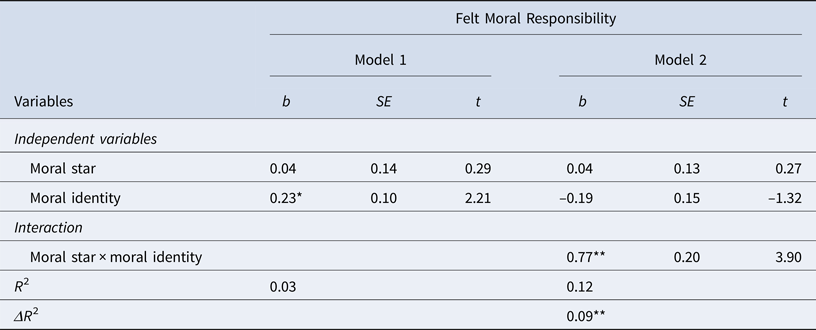
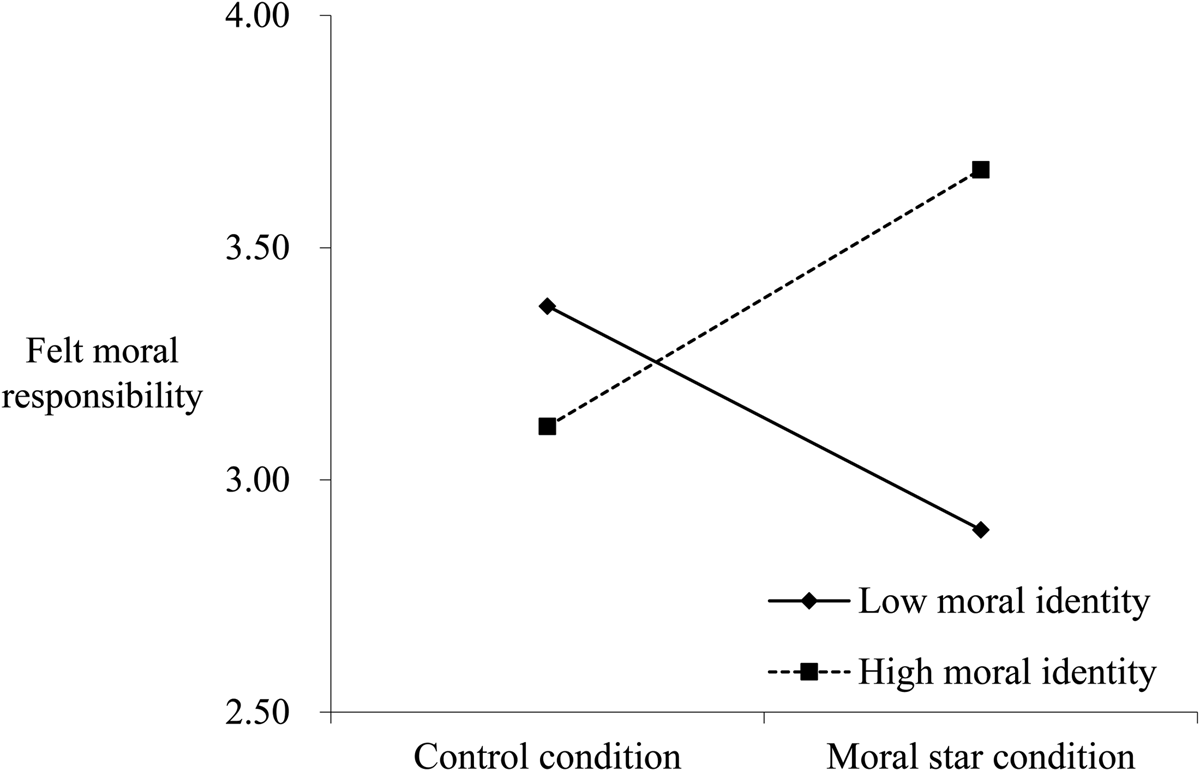
Table 1 presents the mean, standard deviations, and correlations of the Study 1 variables. The OLS results were presented in Table 2. Hypothesis 1 suggests that the presence of a moral star and nonstars' moral identity have an interactive effect on nonstars' felt moral responsibility. As shown in Table 2, the interaction of the presence of a moral star and moral identity was a significant predictor of felt moral responsibility (b = 0.77, SE = 0.20, p < 0.001). As depicted in Figure 2, for participants with a high moral identity (+1 SD), the presence of a moral star had a significant and positive effect on felt moral responsibility (b = 0.55, t = 3.01, p < 0.01), while for participants with a low moral identity (−1 SD), the presence of a moral star had a significant and negative effect on felt moral responsibility (b = −0.48, t = −2.60, p < 0.01). Thus, Hypotheses 1a and 1b were supported in Study 1.
Regression results for the predictors of felt moral responsibility in Study 1

Notes: n = 158. b = unstandardized coefficient; SE = standard error. Moral identity is mean-centered. For moral star, control condition = 0; moral star condition = 1. *p < 0.05. **p < 0.01.
The moderating effect of nonstars' moral identity on the relationship between the presence of a moral star and nonstars’ felt moral responsibility in Study 1

The results of Study 1 provided evidence for our arguments that participants with a high moral identity in the moral star condition had a significantly higher felt moral responsibility than in the control condition, while participants with a low moral identity in the moral star condition had a significantly lower felt moral responsivity than in the control condition. Although the experiment provides causal support for our theoretical model, the overarching model should also be tested. In addition, the external validity of whether this model could be applied in a real organizational context still requires confirmation. Thus, we extend these findings to the next study by conducting a multi-wave and multi-source field study.
Study 2 Method
Participants and Procedure
In Study 2, we collected multi-wave and multi-source data through the alumni networks of several large universities in China. Initially, 322 employees participated in our study at Time 1 (T1). At T1, we sent links to online surveys to employees and asked them to report demographic information, moral identity, whether there was a moral star on their teams, and supervisors' ethical leadership. A total of 303 employees completed the T1 survey (response rate, 94.1%). The second-wave survey was sent to employees 2 weeks later (Time 2, T2). At T2, surveys were sent to employees who completed the T1 survey and their 172 supervisors. The employees rated their felt moral responsibility, while the supervisors rated subordinates' prosocial behavior. Among them, 276 employees and 153 supervisors completed the survey (response rates of 85.7% and 89.0% for employees and supervisors, respectively). To encourage participation, each follower and supervisor was compensated with 10 RMB (approximately 1.4 USD) and 15 RMB (approximately 2.1 USD) per survey. We also provided feedback about the study results following data collection. To improve data quality, participants were assured of confidentiality throughout the data collection process, and we emphasized that their truthful responses were crucial for our research.
After excluding those who did not complete both waves of the surveys or did not have matched evaluations from supervisors, and those who regarded themselves or their leaders as moral stars in their teams, we obtained a total of 238 employees (a final response rate of 73.9%) and their 139 supervisors (a final response rate of 80.8%). Among the final employee sample, 65.1% were female, with an average age of 30.6 years (SD = 7.0), an average education length of 16.0 years (SD = 2.3), and an average dyadic tenure of 3.1 years (SD = 3.9). The average team size in which employees operated was 12.4 (SD = 10.4). These employees covered functional areas including technology (28.6%), administration (19.3%), service (16.0%), marketing (11.8%), and financing (9.2%). We also conducted response analyses, and the results suggested that there were no significant differences in terms of gender, age, education, and dyadic tenure between the final sample and those who only completed the initial survey.
Measures
For scales that were originally developed in English, we translated them into Mandarin Chinese following the back-translation process (Brislin, Reference Brislin, Triandis and Lambert1980).
The presence of a moral star
Consistent with previous conceptualization of star employees in teams (Aguinis & O'Boyle, Reference Aguinis and O'Boyle2014; Li et al., Reference Li, Li, Li and Li2020; Tzabbar & Kehoe, Reference Tzabbar and Kehoe2014), we first provided a definition of moral star: ‘Moral stars are employees who exhibit disproportionately high and prolonged morality relative to others, and have a reputation of being moral’. We then asked employees to report whether they had a moral star in their teams (excluding their team leader and themselves). The presence of a moral star was coded as a dummy variable (0 = there is no moral star in my team; 1 = there is at least one moral star in my team). If employees reported that they had at least one moral star on their team, we further asked them to write down the first letters of the first and last name of moral star. Then, an attention check question was followed which asked them to state whether the moral star was a coworker, themselves, or the leader of the team. This information was used to exclude samples in which participants regarded themselves or their leaders as moral stars in our analyses.
Moral identity
Moral identity was measured using the same scale as in Study 1 (α = 0.89).
Felt moral responsibility
Felt moral responsibility was measured using the same scale as in Study 1 (α = 0.72).
Prosocial behavior
In line with previous research (e.g., Owens et al., Reference Owens, Yam, Bednar, Mao and Hart2019), prosocial behavior was measured using the 6-item scale from Smith, Organ, and Near (Reference Smith, Organ and Near1983). A sample item is ‘This employee helps others who have been absent’ (α = 0.90).
Control variable
We controlled for several variables that are theoretically related to the core variables and may provide alternative explanations for the proposed relationships in our model (Bernerth & Aguinis, Reference Bernerth and Aguinis2016). Specifically, we controlled for team size, as previous research suggested that team size may be related to the diffusion of responsibility (Fischer et al., Reference Fischer, Krueger, Greitemeyer, Vogrincic, Kastenmüller, Frey and Kainbacher2011). We also controlled for employee demographics including gender (0 = female, 1 = male), age (years), education level (years), and dyadic tenure (years), as previous research has demonstrated that these characteristics may influence prosocial behavior (Farmer, Van Dyne, & Kamdar, Reference Farmer, Van Dyne and Kamdar2015; Van Dyne & LePine, Reference Van Dyne and LePine1998; Zhu & Akhtar, Reference Zhu and Akhtar2014). Moreover, leadership is also regarded as a significant factor that influences followers' moral cognition and behavior (e.g., Brown & Treviño, Reference Brown and Treviño2006; Owens, Johnson, & Mitchell, Reference Owens, Johnson and Mitchell2013; Schminke, Ambrose, & Neubaum, Reference Schminke, Ambrose and Neubaum2005; Van Gils, Van Quaquebeke, Van Knippenberg, Van Dijke, & De Cremer, Reference Van Gils, Van Quaquebeke, Van Knippenberg, Van Dijke and De Cremer2015). Thus, to separate the effects of the moral star, we controlled for ethical leadership as the main type of leadership that has been demonstrated to affect followers' moral standards because it may influence employees' felt moral responsibility and prosocial behavior (Babalola, Stouten, Camps, & Euwema, Reference Babalola, Stouten, Camps and Euwema2017; Mayer et al., Reference Mayer, Kuenzi, Greenbaum, Bardes and Salvador2009). Ethical leadership was measured using a 10-item scale developed by Brown et al. (Reference Brown, Treviño and Harrison2005). A sample item is ‘My supervisor sets an example of how to do things the right way in terms of ethics’ (α = 0.95).
Analytical Strategy
Given that our study utilized a nested design (i.e., employees nested in teams), we conducted multilevel analyses in Mplus 7 (Muthén & Muthén, Reference Muthén and Muthén2012). Specifically, we used path analysis to test the moderated mediation model. All continuous predictors and the mediator in our research models were grand-mean centered to decrease multicollinearity and facilitate results interpretation (Cohen, Cohen, West, & Aiken, Reference Cohen, Cohen, West and Aiken2003). In addition, following the processes of Edwards and Lambert (Reference Edwards and Lambert2007) and previous research (Preacher & Selig, Reference Preacher and Selig2012), we conducted moderation analysis and used the Monte Carlo method to test the moderated mediation hypotheses.
Study 2 Results
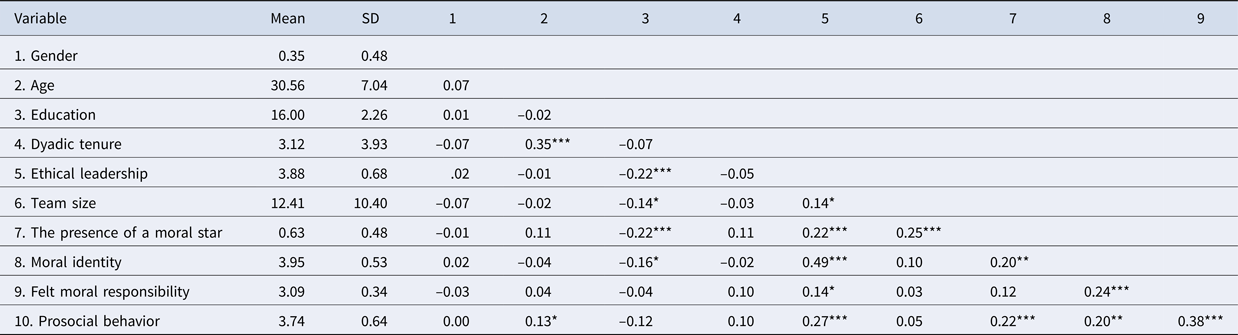
Table 3 presents the mean, standard deviations, and correlations of the study variables in Study 2. Before proceeding to test our hypotheses, we conducted CFAs to test the discriminant validity of moral identity, ethical leadership, felt moral responsibility, and prosocial behavior. The results revealed that the four-factor model had an acceptable fit (χ2(458) = 926.74, p < 0.001; SRMR = 0.06, RMSEA = 0.07, CFI = 0.90, TLI = 0.89; Hu & Bentler, Reference Hu and Bentler1999) and fit better than all alternative models (e.g., a three-factor model that combined felt moral responsibility and prosocial behavior (χ2(461) = 1082.62, p < 0.001; SRMR = 0.07, RMSEA = 0.08, CFI = 0.87, TLI = 0.86; Δχ2 = 155.88, Δdf = 3, p < 0.001; a full report of these results is available from the authors upon request). Thus, these results provide evidence for the discriminant validity of the focal variables in our research.
Descriptive statistics and correlations of study variables in Study 2

Notes: n = 238. For gender, female = 0; male = 1; For the presence of a moral star, there is no star in the team = 0; there is at least one moral star in the team = 1. *p < 0.05. **p < 0.01. ***p < 0.001.
Tests of the Hypotheses
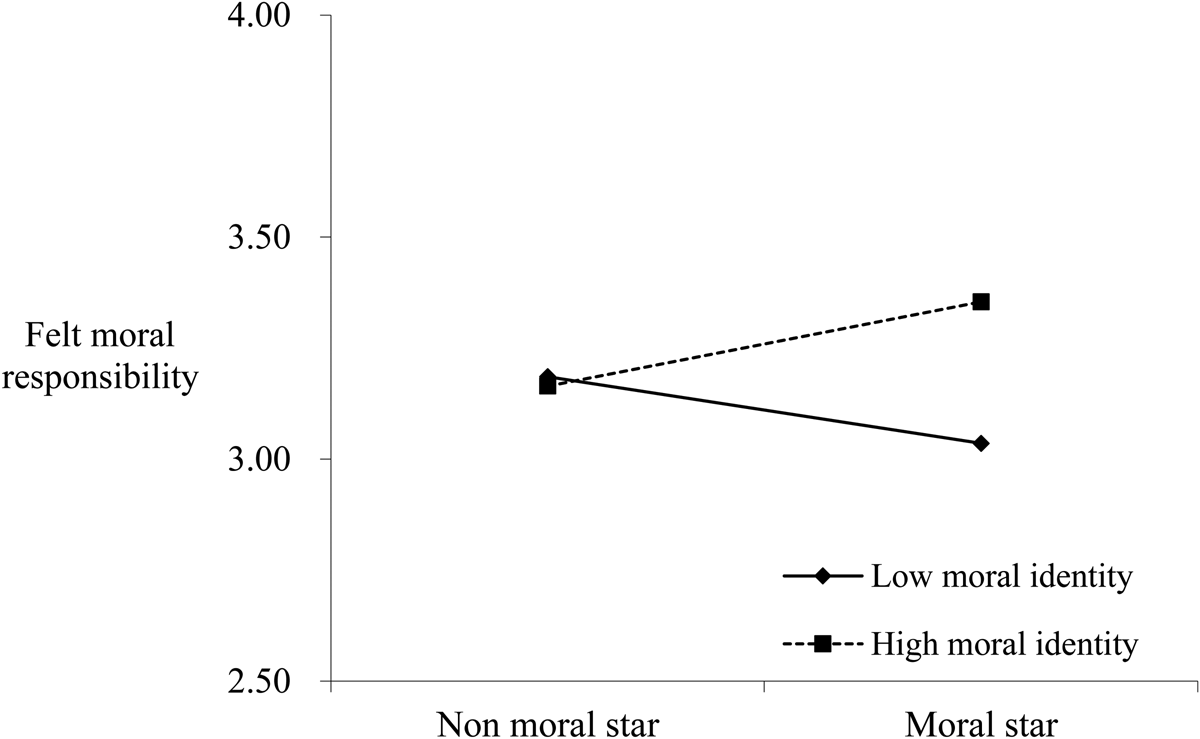
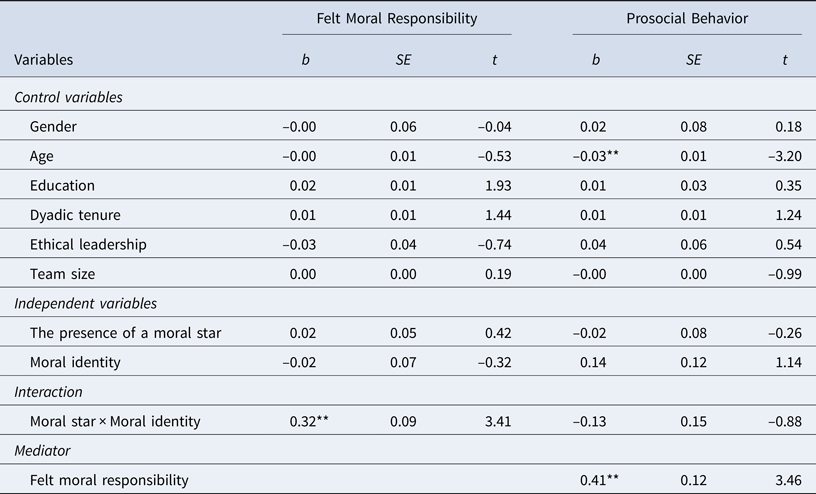
The results of the path analyses are reported in Table 4. Hypothesis 1 predicts the interactive effect of the presence of a moral star and moral identity on felt moral responsibility. As shown in Table 4, there was a significant interaction predicting felt moral responsibility (b = 0.32, SE = 0.09, p < 0.01). As depicted in Figure 3, the relationship between the presence of a moral star and felt moral responsibility was positive and significant when moral identity was high (+1 SD; b = 0.19, t = 2.29, p < 0.05), but negative and significant when moral identity was low (−1 SD; b = −0.15, t = −2.74, p < 0.01). Thus, Hypotheses 1a and 1b were supported in Study 2.
The moderating effect of nonstars' moral identity on the relationship between the presence of a moral star and nonstars' felt moral responsibility in Study 2

Summary of path-analytic results in Study 2

Notes: n = 238. For gender, female = 0; male = 1; For the presence of a moral star, there is no star in the team = 0; there is at least one moral star in the team = 1. *p < 0.05. **p < 0.01.
Hypothesis 2 posits a positive relationship between felt moral responsibility and prosocial behavior. Table 4 shows that felt moral responsibility is significantly and positively related to prosocial behavior (b = 0.41, SE = 0.12, p < 0.01). Thus, Hypothesis 2 was supported in Study 2.
Hypothesis 3 proposes that the presence of a moral star and nonstars' moral identity have an indirect and interactive effect on prosocial behavior through felt moral responsibility. To test this moderated mediation hypothesis, we used the Monte Carlo method (20,000 repetitions) to compare conditional indirect effects (Preacher, Rucker, & Hayes, Reference Preacher, Rucker and Hayes2007). The results showed that the indirect effect was positive and significant when moral identity was high (+1 SD; estimate = 0.08, 95% CI = [0.01, 0.17], not containing 0), but negative and significant when moral identity was low (−1 SD; estimate = −0.06, 95% CI = [−0.12, −0.02], not containing 0). The difference between these indirect effects was also significant (Δestimate = 0.14, 95% CI = [0.05, 0.27], not containing 0). Thus, Hypotheses 3a and 3b were supported in Study 2.
Additional Analyses
In order to further establish the causal relationship between felt moral responsibility on prosocial behavior, we also collected a two-wave data sample through Mturk, with the samples separated by two weeks. Participants included 82 employees from the United States. The average age of participants was 35.9 years (SD = 10.3), 40.2% were female, 73.2% were Caucasian, and the average work tenure was 5.8 years (SD = 4.8). At Time 1, in addition to felt moral responsibility (α = 0.87), we also controlled organizational identification, empathic concern, and moral attentiveness since they are suggested to be important antecedents of prosocial behavior (e.g., Eisenberg, Reference Eisenberg1991; Organ & Ryan, Reference Organ and Ryan1995; Podsakoff et al., Reference Podsakoff, MacKenzie, Paine and Bachrach2000). At Time 2, participants reported prosocial behavior. Organizational identification was measured by the six-item scale used by Mael and Ashforth (Reference Mael and Ashforth1992). A sample item is ‘This organization's successes are my successes’ (α = 0.89). Emphatic concern was assessed by the seven-item scale developed by Kamdar, McAllister, and Turban (Reference Kamdar, McAllister and Turban2006). A sample item is ‘I would describe myself as a pretty soft-hearted person’ (α = 0.83). Moral attentiveness was measured by a five-item scale adapted by Reynolds (Reference Reynolds2008). A sample item is ‘I think about the morality of my actions almost every day’ (α = 0.85). The results of regression analyses showed that felt moral responsibility was positively related to prosocial behavior (b = 0.47, p < 0.001) after controlling for the influences of organizational identification (b = 0.13, n.s.), empathic concern (b = 0.25, p < 0.05), and moral attention (b = 0.34, p < 0.001). The additional analyses using two-wave data also showed that felt moral responsibility is a significant antecedent of prosocial behavior, thus providing further support for Hypothesis 2.
Discussion
Drawing upon self-categorization theory (Turner et al., Reference Turner, Hogg, Oakes, Reicher and Wetherell1987), we developed and tested a model that explains when and how the presence of a moral star affects nonstars' prosocial behavior. Findings from an experiment and a multi-time and multi-source field study revealed that the relationship between the presence of a moral star and felt moral responsibility is positive when nonstars' moral identity is high and negative when nonstars' moral identity is low. Moreover, nonstars' felt moral responsibility is positively related to their prosocial behavior. Finally, the influence of the presence of a moral star on prosocial behavior via nonstars' felt moral responsibility is positive when nonstars' moral identity is high and negative when nonstars' moral identity is low.
Implications for Theory
This research offers several contributions to the literature. First, the current research enriches the literature on morality and star employees by connecting these two independent lines of research for the first time. Specifically, the existing literature on star employees has typically focused on in-role performance stars (Call et al., Reference Call, Nyberg and Thatcher2015; Call, Campbell, Dunford, Boswell, & Boss, Reference Call, Campbell, Dunford, Boswell and Boss2020; Long et al., Reference Long, Baer, Colquitt, Outlaw and Dhensa-Kahlon2015; Oldroyd & Morris, Reference Oldroyd and Morris2012) with recent research beginning to explore issues related to other types of performance-related star employees such as creative stars (Li et al., Reference Li, Li, Li and Li2020). However, while the presence of a moral star is common in teams, the existing star literature has yet to look into this important phenomenon and explored how the presence of a moral star affects other team members' moral behaviors. This research thus represents an important first step in exploring the concept and impact of a moral star. By doing so, we shift the focus of star literature from employees' performance-related characteristics to ethics-related characteristics and thus extend the scope of research on star employees.
Second, our research also extends self-categorization theory by highlighting morality as an important individual characteristic that can be used in the self-categorization process. While self-categorization theory has been shown to be a powerful perspective in exploring how individuals in organizations interact in accordance with many kinds of demographic categories such as sex or race (e.g., Chattopadhyay, Tluchowska, & George, Reference Chattopadhyay, Tluchowska and George2004; Lam, Liu, & Loi, Reference Lam, Liu and Loi2016; Schaubroeck, Demirtas, Peng, & Pei, Reference Schaubroeck, Demirtas, Peng and Pei2022; Turner et al., Reference Turner, Hogg, Oakes, Reicher and Wetherell1987), the existing literature has rarely adopted this theory to explore the influence of ethics-related social categories on individuals. In this research, we make an initial attempt by drawing upon self-categorization theory to reveal that the presence of a moral star can induce a process of categorization in accordance with morality among other team members and further affect other members' moral acts. Thus, we extend the scope of self-categorization theory by incorporating a new social classification defined by morality and revealing the power of this theory in exploring ethics-related issues.
Third, our research advances a peer perspective to social learning theory by exploring how and when employees learn from peers in the aspect of morality. Most prior research that drew up social learning theory (Bandura & Walters, Reference Bandura and Walters1977) to understand employee moral behavior has assumed that leaders with formal power are likely to serve as an important moral role model for followers. In this case, they focused on how leader moral characteristics, such as ethical leadership (Brown et al., Reference Brown, Treviño and Harrison2005; Mayer et al., Reference Mayer, Kuenzi, Greenbaum, Bardes and Salvador2009), leader moral identity (Yam, Barnes, Leavitt, Wei, Lau, & Uhlmann, Reference Yam, Barnes, Leavitt, Wei, Lau and Uhlmann2019), and leader moral humility (Owens et al., Reference Owens, Yam, Bednar, Mao and Hart2019), influence followers' moral conducts. However, recent studies pointed out that, besides team leaders, some employees can also have disproportionate influences on other team members, such that certain employees play a more crucial role in affecting other team members (e.g., Humphrey et al., Reference Humphrey, Morgeson and Mannor2009; Li et al., Reference Li, Zhao, Walter, Zhang and Yu2015). Unfortunately, our understanding of how peers who have superior morality (i.e., moral star) influence employee moral behavior is still very limited. Specifically, whether the learning process from peer is similar with that from leader remains worth exploring. Our findings showed that, after controlling for the influence of ethical leadership, the presence of a moral star had a horizontal effect on nonstars' prosocial behavior only when their moral identity was high. Hence, it indicates that employees don't necessarily learn from specific peers unless they categorize them with the same group, suggesting the peer learning process may be different from the leader learning process. This is probably because peers lack formal power compared with the team leader, while the social categorization process might compensate for the lack of power in the learning process from distinguished peers.
Finally, we advance the literature on ethics by highlighting that organizational members with high morality may have both positive and negative effects on other organizational members' moral conduct. Specifically, the current literature on individuals with high morality in organizational context has mainly focused on ethical leaders and suggested that they are likely to be viewed as ethical role models by employees and have positive impacts on employees (Brown et al., Reference Brown, Treviño and Harrison2005; Ng & Feldman, Reference Ng and Feldman2015). However, recent research suggests that ethical leaders may not be always viewed as ethical role models and positively affects employees (Wang, Xing, Xu, & Hannah, Reference Wang, Xing, Xu and Hannah2021). Specifically, Wang et al. (Reference Wang, Xing, Xu and Hannah2021) found that (a) ethical leaders are viewed as ethical role models only by employees with high moral identity and high leader identification and that (b) for employees with low moral identity and low leader identification, ethical leadership leads to increased employee unethical behavior. While we shift the focus from ethical leaders to moral star employees, our research echoes with Wang et al. (Reference Wang, Xing, Xu and Hannah2021) by showing that individuals with high morality (i.e., moral stars) may not always be viewed as ethical role models by other employees and may even have negative effects on other employees' moral acts. Overall, together with Wang et al. (Reference Wang, Xing, Xu and Hannah2021), we extend the literature on employee ethics by highlighting that, besides positive impacts, high-morality organizational members may also have negative effects on other members' moral conduct and thus it is critical to take boundary conditions into consideration.
Implications for Practice
Our research findings have several important managerial implications. First, our research suggests that organizations should be careful about adopting moral-related employee recognition programs. Performance-related recognition programs are widely adopted by organizations (Garr, Reference Garr2012; Li et al., Reference Li, Zheng, Harris, Liu and Kirkman2016) and have been shown to have positive effects on employee performance in general (e.g., Kosfeld & Neckermann, Reference Kosfeld and Neckermann2011; Luthans & Stajkovic, Reference Luthans, Stajkovic and Locke2009; Markham, Scott, & McKee, Reference Markham, Scott and McKee2002). Thus, organizational practitioners may assume that moral-related employee recognition programs would help promote employee moral conducts. However, our findings reveal that although the presence of a moral star motivates some employees (i.e., those with a high moral identity) to engage in more prosocial behavior, it also leads to less prosocial behavior for other employees (i.e., those with a low moral identity). Therefore, if an organization adopts an employee recognition program that identifies employees with high morality (e.g., moral stars), such a program may be a double-edged sword that can lead to undesirable results.
Second, our research highlights the importance of moral identity in employees' moral conduct. The common assumption underlying the adoption of employee recognition programs is that setting up role models would motivate other employees to learn from these models and thus behave in more desirable ways (e.g., Li et al., Reference Li, Zheng, Harris, Liu and Kirkman2016). However, our findings reveal that employee moral identity is a critical factor that determines whether the presence of a moral star encourages or discourages coworkers' prosocial behavior. Thus, we suggest that a basic way for organizations to promote employee moral conduct is to improve their employees' overall level of moral identity. Organizations can do so by activating employees' moral identity and recruiting new employees with high levels of moral identity. To activate employee moral identity, organization can use slogans and posters that provide social cues about morality (Aquino, Freeman, Reed II, Lim, & Felps Reference Aquino, Freeman, Reed II, Lim and Felps2009; Aquino & Freeman, Reference Aquino, Freeman, Narvaez and Lapsley2009). In addition, as Reynolds and Ceranic (Reference Reynolds and Ceranic2007) suggested, organizations can encourage employees to develop moral identity by rewarding behaviors that are closely related to the traits of a high moral identity (e.g., fair, honest, caring, and compassionate). To recruit new employees with high moral identity, organizations should include moral identity into their candidate portrait, and design tests and interview questions that can help evaluate candidates' levels of moral identity when selecting new employees.
Third, our findings also suggest the importance of employee felt moral responsibility in motivating prosocial behavior. Accordingly, organizations or managers who aim to promote employee prosocial conduct should try to improve employees' felt moral responsibility. While there is little research on how to promote employee felt moral responsibility, we can gain insights on how to achieve this from related research on employee felt responsibility (e.g., Lorinkova & Perry, Reference Lorinkova and Perry2019; Pearce & Gregersen, Reference Pearce and Gregersen1991). Specifically, Pearce and Gregersen (Reference Pearce and Gregersen1991) found that task interdependence is positive related to employee felt obligation, which in turn positively affects employee extra-role behavior. Lorinkova and Perry (2019) found that group – focused transformational leadership fosters employee felt obligation which in turn leads to more helping behavior and higher group performance. Based on these studies, we suggest that managers can promote employee felt moral by engaging in group-focused ethical leadership behavior, highlighting that it is the responsibility of all employees to behave ethically and that all employees are interdependent in building a team with high moral standards.
Future Directions
First, based on self-categorization theory, we argued that nonstars viewed the star as an in-group member or an out-group member according to their perceived similarity with the star in terms of morality. Empirical research on self-categorization also revealed that employees compare their own demographic characteristics (e.g., sex, race, and tenure) with those of other members and that perceived similarity and dissimilarity determine which group they feel they belong to (e.g., Chatman & Spataro, Reference Chatman and Spataro2005; Chattopadhyay, George, & Shulman, Reference Chattopadhyay, George and Shulman2008). Thus, we encourage future research to explore the influence of perceived similarity enforced by other kinds of social categories. For example, if the moral star is a female, other female nonstars may view the moral star in in-group terms and, in turn, share with her the same responsibility for moral conduct aimed at enhancing group welfare.
Second, given the potential importance of the moral star phenomenon, we recommend that future research investigate additional consequences of moral star, which would further elucidate the phenomenon. Self-categorization theory suggests that in-group individuals and out-group individuals are likely to be perceived as being stereotypically extreme (Mackie, Reference Mackie1986). While we found that out-group individuals engage in less prosocial behavior, we encourage future research to explore whether they might even engage in unethical behavior, such as deviant behaviors. Moreover, many companies, such as Alibaba and Fotile, take social responsibilities and encourage their employees to engage in more prosocial behaviors outside organizations, including donation and planting. Thus, future studies could further explore whether moral star would promote employees to take more social responsibilities outside organizations.
Third, according to the definition of moral star, the moral star needs to be the one who has the most salient morality within the team. However, it is also possible that one team has more than one moral star (Li et al., Reference Li, Zheng, Harris, Liu and Kirkman2016). As we focus on the nonstars' perception of the presence of a moral star, one or more moral stars will also stimulate self-categorization process of nonstars and, as such, it will not influence our hypotheses development. Furthermore, we also encourage future research to further examine whether the number of moral stars in a team could have different influences on team ethical climate and team members' ethical behavior. Moreover, different employees may choose different moral stars in their perceptions in a team. In this case, as we focus on the interpersonal effect of the presence of moral star, we did not control factors that may influence moral star choice, such as the interpersonal relationship that might influence the choose of a moral star. Thus, future studies would benefit from exploring moral star emergence, that is, what kind of factors might influence team members to choose a moral star.
Fourth, moral stars are significant moral characters in an organization. Previous research found that people with a strong moral identity were perceived as less humorous and less likeable (Yam et al., Reference Yam, Barnes, Leavitt, Wei, Lau and Uhlmann2019). Meanwhile, the literature on performance stars revealed that the star can suffer harmful behaviors from coworkers (Lam, Van der Vegt, Walter, & Huang, Reference Lam, Van der Vegt, Walter and Huang2011). As such, it is worth exploring the impact of becoming the moral star on themselves. That is, although this study investigated the effect of moral stars on other members, future research should examine potential social consequences for the moral star himself or herself, and it would depict a more comprehensive picture of the impact of the moral star.
Finally, although our findings suggest that the presence of a moral star is related to less prosocial behavior for nonstar employees with low moral identity, future studies can empirically explore whether adopting formal employee recognition programs that identify moral stars would strengthen or weaken such undesirable reactions. A formal moral recognition program may reduce such reactions because it encourages these employees to learn from moral stars (e.g., Epley & Kumar, Reference Epley and Kumar2019). It may also enhance such reactions because it may make nonstars more likely to feel less moral obligation in the team. Thus, we believe it is both interesting and important for future research to explore how formal moral recognition programs may affect nonstar employees' reactions to the presence of a moral star.
Strengths and Limitations
Several strengths of our two studies are worth mentioning. Morality is always emphasized and valued in traditional Chinese culture. For instance, Confucian philosophy suggests individuals with superior morality could serve as a role model for others and attract others without rewards (德不孤,必有邻) (Yang, Reference Yang, Cheng, Cheng and Chen1993; Zhang, Bai, Caza, & Wang, Reference Zhang, Bai, Caza and Wang2014). However, most previous research focuses on moral leaders while neglecting the role played by special moral employees. Our research extends our understanding of the moral individuals by exploring the concept and influence of moral stars. Moreover, we conducted an experiment (Study 1) to test the causal effect of the interaction of presence of a moral star and nonstars' moral identity on the felt moral responsibility, and we collected multi-wave and multi-source field study (Study 2) to test the entire theoretical model, while controlling for rival independent variables (e.g., ethical leadership). In addition, we replicated our findings on the relationship between the independent variable and mediator across two different cultures (United States and Chinese). These strengths should enhance confidence in the generalizability and robustness of our findings.
There are also several limitations of our research. First, we used a dummy variable to measure the presence of the moral star. This measure is consistent with our theoretical arguments that focus on the individual team members' perception of whether there is a moral star in their team. This measure is also in line with prior research to capture star employees (e.g., Kehoe & Tzabbar, Reference Kehoe and Tzabbar2014). However, we did not measure the different moral foundations of a moral star (e.g., care, fairness, authority, loyalty, and sanctity). Thus, future scholars could use different measures of moral star to test our model. Scholars could also investigate the moral star at the team level by using network analysis to recognize the moral star in terms of the moral foundations. Second, with regard to the presence of a moral star in a team, team size should be considered. According to our definition, a moral star should exhibit high prolonged morality and gain a reputation of being moral. Both the exhibition of morality and gaining such reputation can only occur in a team whose members have frequent interactions. Team size can influence the frequency of interaction among team members. Thus, we controlled for team size in our Study 2. The results showed a significant positive relationship between the presence of a moral star and team size (r = 0.25, p < 0.001). We suggest future research consider why a large team size contributes to the emergence of a moral star. Third, although we controlled ethical leadership in the analyses, future studies could control other factors that might influence felt moral responsibility, such as ethical climate. This would provide more rigorous evidence for our research model.
Conclusion
The present research represents an initial attempt to explore the concept of moral star and the effects of the presence of a moral star on the prosocial behavior of nonstars. In particular, we highlighted the potential negative impact of the presence of a moral star on nonstars' felt moral responsibility and subsequent prosocial behavior. This knowledge should be taken into consideration for organizations planning to carry out ethic-related employee recognition programs. We hope that our research will fuel scholars' interest in further exploring the various impacts of moral stars in the organizational context.
Notes
This research was supported by grants funded by National Natural Science Foundation of China (Grant No. 72372012 and 71702175, awarded to Dr. Dong Ju; Grant No. 72372033 and 72002038 awarded to Dr. Shengming Liu; Grant No. 72072032 awarded to Dr. Mingpeng Huang; and Grant No. 72325012, 72272155, and 71872190 awarded to Dr. Xin Qin).
Dong Ju (dongju@bnu.edu.cn) is an associate professor in the Business School of Beijing Normal University. She received her PhD in organizational management from the Guanghua School of Management, Peking University. Her current research interests include leadership, ethics, and employee well-being. She has published her research in Academy of Management Journal, Journal of Applied Psychology, Organizational Behavior and Human Decision Processes, and Journal of Business Ethics.
Shengming Liu (shengmingliu@fudan.edu.cn) is an associate professor at the School of Management, Fudan University. He received his PhD in organizational management from the Guanghua School of Management, Peking University. His research interests include leadership, social media, and high-tech ventures management. He has published his research in Journal of Applied Psychology, Journal of Management, Journal of Organizational Behavior, and Journal of Business Ethics.
Marshall Schminke (mschminke@bus.ucf.edu) is Pegasus Professor of Business Ethics at the University of Central Florida, where he specializes in business ethics and strategy. He received his doctorate from Carnegie Mellon University and has served as a Visiting Scholar at Oxford University and the London School of Economics. He has held the position of Associate Editor at the Academy of Management Journal, Journal of Management, and Business Ethics Quarterly.
Mingpeng Huang (hmp@uibe.edu.cn) is an associate professor in the Business School of the University of International Business and Economics. He received his PhD in organizational management from Guanghua School of Management, Peking University. His research focuses on leadership and ethics and has been published at journals including Academy of Management Journal, Organizational Behavior and Human Decision Processes, Journal of Organizational Behavior, Journal of Business Ethics, and Journal of Organizational and Occupational Psychology.
Xin Qin (qinxin@sysu.edu.cn) is a professor in the Sun Yat-sen Business School, Sun Yat-sen University. He received his PhD in organizational management from Guanghua School of Management, Peking University. His research focuses on leadership, ethics, and artificial intelligence. He has published papers in PNAS, PNAS Nexus, Academy of Management Journal, Strategic Management Journal, Journal of Applied Psychology, Personality and Social Psychology Bulletin, and so on.