


Science and technology are generally appreciated by humanity as they seek to regularly provide humankind with more convenient and easier approaches to living. This explains the general acceptance that greeted the advent of the internet. The internet is a global interconnection of information and communication technology (ICT) resources that allows for sharing of these resources irrespective of time and location in space. It is a critical facility in the present digital era and has redefined the context of human living as it influences activities in virtually every aspect of life. This includes its usefulness in education, medicine, space science, interpersonal relationship and counselling, among others. Indeed, the ubiquity of the internet as a critical resource in today’s world cannot be overemphasised.
Just as with many such inventions, the advent of the internet has witnessed continuous improvement to its functioning and functions. Web 2.0 is one of such improvement. The name ‘Web 2.0’ was said to have been coined in 1999 by Darcy DiNucci, but it was not until late 2004 that Tim O’Reilly and Dale Dougherty made the name popular at the O’Reilly Media Web 2.0 Conference of 2004 (Mohammadyari, Reference Mohammadyari2012; Wikipedia, n.d.). ‘Web 2.0’ has been defined variously. Wikipedia defines it as those websites that place emphasis on user-generated contents, ease of use and ability to function on multiple devices; while Rockinson-Szapkiw and Walker (Reference Rockinson-Szapkiw and Walker2009) see it as those technologies that provide opportunities to users to interact both synchronously and asynchronously. While acknowledging the lack of unanimity on what Web 2.0 is, O’Reilly (Reference O’Reilly2005) submitted that the term ‘Web 2.0’ is here to stay, and identified some tools of the Web 2.0 and the differences between Web 1.0 and Web 2.0.
Despite the different definitions given to Web 2.0, the critical thing about it is that it has revolutionised and simplified the way content is uploaded to the internet and has given more power to users of the internet in terms of editing posted content and creating and uploading new content. The present research defines Web 2.0 as second-generation internet that allows for collaboration, networking, creating, editing and sharing of content among users and with no emphasis on technical expertise. Web 2.0 empowers the users to be in charge and take control of creating, posting, uploading and publishing content. D’Souza (Reference D’Souza2006) emphasised the user-friendly nature of Web 2.0 by describing it as not only readable but writable web that requires no knowledge of programming languages or software applications. The user-friendly and interactive nature of Web 2.0 applications has made them a veritable resource in the teaching-learning process.
There are different types of Web 2.0 applications. These include social networking sites, blogs, wikis, podcast, folksonomies, social bookmarking, social citations, web conferences (which may be tele or video conferences), vodcast/video sharing sites (e.g., YouTube), Rich Site Summary (RSS), multiplayer online games, and Flickr, among others. These applications indisputably add value to the teaching-learning process (John, Reference John2012; Mosha, Reference Mosha2017; Nashipudi, Reference Nashipudi2012; Selwyn, Reference Selwynn.d.; Warr, Reference Warr2008, as cited in Vijayakumar, Reference Vijayakumar2010; Wikipedia, n.d.).
Apart from the user-friendliness of Web 2.0 applications and their positive effects on the teaching-learning process, available information has it that the internet in general and Web 2.0 applications in particular are widely embraced by the world population. Kemp (Reference Kemp2020) reported that social media has become an indispensable part of a normal life for the world’s population, with 4.8 billion people using the internet and over 3.8 billion people using social media; the figure for social media usage is a huge increment from about 2.08 billion people who were active on social media as at January 2015 (Kemp, Reference Kemp2015). Kemp (Reference Kemp2020) added that, on average, internet users spend about 7 hours online daily, which implies they are online for 100 days out of 365 days in a year. In a further analysis of this data, Kemp showed that if 8 hours is taken from this figure for sleep, it means that the average internet user spends 40% of their waking time online. In Nigeria, Internet World Stats (2020) reports that internet users grew from a paltry 200,000 as at December 31, 2000 to 126,078,999 as at December 31, 2019; with the same astronomical pattern of growth for Facebook subscribers, which stood at 27,120,000 as at December 31, 2019. These are indications of the acceptability of the internet and Web 2.0 applications in Nigeria and globally.
With respect to podcasts, available statistics in the United States indicate growing awareness and utilisation of this Web 2.0 application. According to Baeyer (Reference Baeyer2020) and Winn (Reference Winn2020), both citing Edison Research and Triton Digital whose reports were released in March 2020, 75% of Americans (i.e., 212 million people) are now familiar with podcasting. There has also been a consistent increase in the number of people who listen to podcasts, from 40% in 2017 to 51% in 2019 and 55% in 2020. Furthermore, while 24% of Americans listened to podcasts monthly in 2017, 37% — representing more than 100 million Americans — listened to a podcast monthly in 2020. The scenario is not different for blogging. According to firstsiteguide (n.d.), as at 2020, there were more that 600 million blogs on the internet and blogs are read regularly by 77% of internet users.
The implication of these high figures is that very soon many global activities will be based more in cyberspace than in the real world. Another implication of this high acceptability is that in the near future, counsellors will be required to be conversant with the use of Web 2.0 applications to be able to have and attend to clients. It is therefore a reality in the foreseeable future that the new world of the client will be the cyberworld, and counsellors will have to belong to this new world to be able to have clients. This gives a further justification for this study, which is to establish the extent of utilisation of Web 2.0 applications in counsellor education. The study seeks to bring to the fore the need for counsellor educators to include Web 2.0 content in training programmes so as to make future counsellors compliant with the requirements of the new world, thus making them comfortable members of the new world of their future clients — the cyberworld.
The present study focused on six Web 2.0 applications with a view to establishing the extent of their utilisation in counsellor education. These are social networking sites (SNSs), blogs, wikis, podcast, video sharing (vodcasts) and folksonomies. SNSs refer to websites that allow users to create their own profile and form relationships or interact with other users who also have their profiles within the same website. The ability to establish and maintain relationships has made SNSs virtual communities where users can create individual public profiles, interact with real-life friends, and meet other people based on inclinations (Kuss & Griffiths, Reference Kuss and Griffiths2011; Deepika, 2014; Eyo, Reference Eyo2016). Examples include myspace, Facebook, Google plus, twitter, LinkedIn, and Instagram.
Blogs are customised web sites that allow an author to regularly share and update their thoughts, with entries logged in reversed chronological order, while the users of the site have the option to comment on articles of interest. Blogs facilitate collaboration and aid reflection. Examples include www.wordpress.com, www.ebn.weblogger.com, www.edublogs.org, www.weblogg-ed.com.
Wikis, on the other hand, are similar to blogs as they allow an author to share their thoughts on an area of interest. An additional feature of wikis is that they allow any user to edit or update the content without restriction and without waiting for the consent of the author or the administrator. Some examples include www.wikipedia.org, http://en.wikibooks.org, http://pbwiki.com, www.wikispaces (Rockinson-Szapkiw & Walker, Reference Rockinson-Szapkiw and Walker2009).
Podcasts refer to audio files that are recorded and posted on a website. Such files are usually recorded in MP3 format and can be downloaded and played in a variety of devices with audio software. With this Web 2.0 application, speeches, lectures, discussions, interviews and any audio-based presentations can be recorded and disseminated online; for example, www.gabcast.com, http://audacity. Vodcasts are similar to podcasts, except they incorporate video with the audio. An example of this is www.youtube.com.
Folksonomies is commonly referred to as ‘tagging’. It is a service that allows users to label the contents they are viewing with words or phrases known as tags or bookmarks, which can subsequently help to easily locate such information. It is evident in many web-based services, including but not limited to SNSs, photo-sharing sites, bookmark storage and blogs, among others (D’Souza, Reference D’Souza2006).
Researchers have investigated the utilisation of Web 2.0 applications in the teaching-learning process. In a study on the use of Web 2.0 tools at the University of Michigan, it was reported that students spent a great deal of their time using Web 2.0 applications (Chapman & Varnum, Reference Chapman and Varnum2007). Similarly, Eyo (Reference Eyo2016) investigated the digital competencies of teachers in the use of SNSs in the teaching-learning process. He reported that the level of application of SNSs in the teaching-learning process was low. These reviewed studies indicate that Web 2.0 is already an acknowledged important variable in the teaching-learning process. The present study therefore sought to establish the extent of its utilisation in the teaching-learning process with respect to counsellor training.
Researchers have also conducted studies on the influence of independent variables on the use of Web 2.0 tools in education. In a study on the use of Web 2.0 tools by Faculty of Education students of the Istanbul University, Agir (Reference Agir2014) reported that there are differences in the use of Web 2.0 by the students based on departments, gender and high school, among other variables. Still on the influence of independent variables, in a study on teachers’ digital competencies in the use of SNSs, Eyo (Reference Eyo2016) reported that the age of the teachers had a significant influence on the level of application of SNSs in the teaching-learning process. In relation to these previous studies, the present study considered gender and age as potential predictors of the utilisation of Web 2.0 tools in counsellor education.
Other researchers have also conducted studies aimed at establishing the influence of independent variables on their dependent variables of interest. In a study on students’ background variables and their utilisation of library resources, Maliki and Uche (Reference Maliki and Uche2007) reported that students’ background variables can significantly predict their utilisation of library resources. In a related study on demographic variables as predictors of the use of the library by first-year undergraduates, Bassey and Eyo (Reference Bassey and Eyo2015) reported that age and area of specialisation are predictors of first-year undergraduates’ use of the library, while gender is not. Quadri (Reference Quadri2013) investigated the influence of demographic factors on the utilisation of online library resources by undergraduates and reported that there was a significant relationship between level of study and age of the students and their utilisation of online library resources; but that gender had no significant relationship with the students’ use of online library resources. These findings are relevant to the present study, which sought to establish the influence of similar independent variables, including age, gender, years of experience, qualifications and designation of the counsellor educators, on the utilisation of Web 2.0 applications in counsellor education. The present study sought to establish whether these independent variables have a composite and individual influence on the extent of utilisation of Web 2.0 applications in the counsellor education process.
Research questions
-
1. What is the extent of utilisation of Web 2.0 applications in counsellor education?
-
2. What is the composite contribution of the background variables to the extent of utilisation of Web 2.0 applications in counsellor education?
-
3. What are the relative contributions of each of the background variables to the extent of utilisation of Web 2.0 applications in counsellor education?
Hypothesis 1 (Ho1) There is no significant joint influence of the background variables on the extent of utilisation of Web 2.0 applications in counsellor education.
Hypothesis 2 (Ho2) There is no significant influence of the individual background variables on the extent of utilisation of Web 2.0 applications in counsellor education.
Methodology
The study adopted an ex post facto research design at a university in Cross River State, Nigeria. The population of the study included all of the 28 counsellor educators who are lecturers in the Department of Guidance and Counselling at the university. The entire population was used for the study as it was manageable; thus no sample was composed. However, out of 28 copies of the instrument administered on the 28 respondents, 26 copies of the instrument were successfully retrieved and used for analysis.
The researcher developed an instrument called Background Variables and Web 2.0 Utilisation Questionnaire (BVW2.0UQ). The BVW2.0UQ had Sections A and B. Section A sought to gather background information about the respondents; this included gender, age, years of experience, highest qualification and designation, which are the independent variables of the study. Section B had 17 items that sought to establish the extent of utilisation of Web 2.0 tools in the teaching-learning process by the counsellor educators. This section measured the frequency with which the educators used Web 2.0 applications in teaching the Guidance and Counselling students of the university, covering the six types of Web 2.0 applications that this study concerned itself with. Specifically, items 1–3 of section B measured use of SNSs, items 4–7 use of blogs, items 8 and 9 use of wikis, items 10–12 use of podcasts, items 13–16 use of vodcasts, and item 17 measured use of folksonomies. Response options for section B were scored 4, 3, 2 and 1 for 1–2 times a week, 1–2 times a month, 1–2 times a semester and Never respectively.
The instrument was validated by a counsellor educator and two measurement and evaluation experts, all from a university in Cross River State, Nigeria. The reliability of the instrument was established by administering the questionnaire to 15 masters and doctoral degree students from the Department of Guidance and Counselling at the university; the generated data was tested for reliability using Cronbach statistics. The reliability of the questionnaire was established as .79.
The research adopted a direct delivery, self-administered technique for data collection, which involves the researcher administering the questionnaire to the counsellor educators directly; this facilitated a high return rate. The data gathered and collated were analysed using means, standard deviations and multiple regression analysis. Mean score and standard deviation were used in answering research question 1, while multiple regression analysis was used in answering research questions 2 and 3, and also in testing the two hypotheses. In answering research question 1, the mean scores of the individual items and that of the entire cluster of section B of the BVW2.0UQ were compared with the real limit of numbers. If the mean score fell between 0.50 and 1.49, it indicated very low, 1.50–2.49 implied low, 2.50–3.49 meant moderate, while 3.50–4.49 indicated high extent of utilisation.
Presentation and discussion of results
Research question 1: What is the extent of utilisation of Web 2.0 applications in counsellor education?
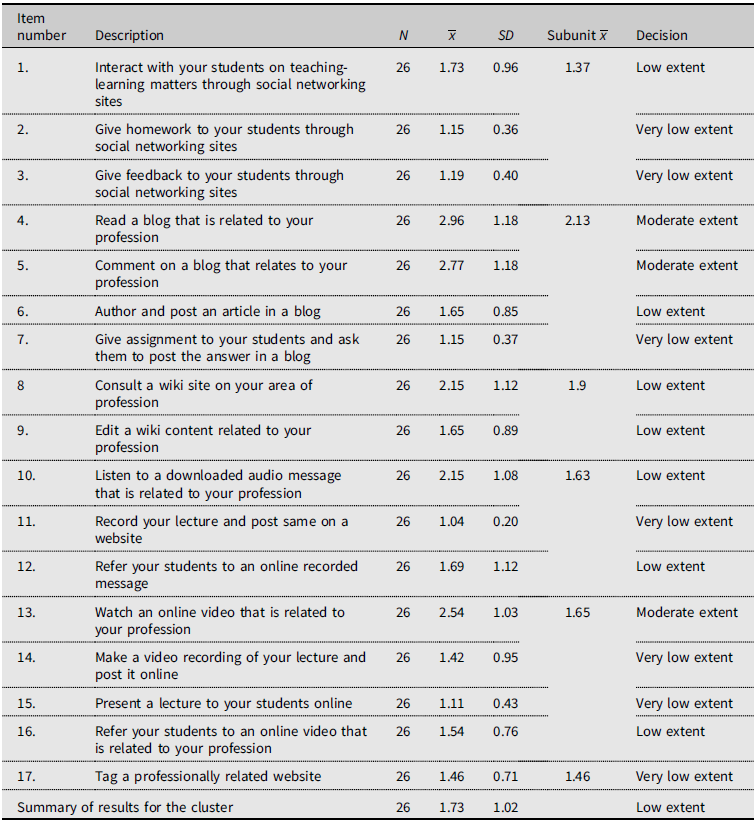
This research question sought to establish the extent of utilisation of Web 2.0 applications in counsellor education. Table 1 replicates 17 items from the questionnaire that sought to measure the extent of utilisation of Web 2.0 applications in counsellor education. The items indicate the extent of utilisation by the counsellor educators in the teaching-learning process for each of the six Web 2.0 applications that this study focused on. Section B of the instrument had a 4-point response options of 1–2 times a week, 1–2 times a month, 1–2 times a semester and Never, which were scored as 4, 3, 2 and 1 respectively. In making a decision based on the mean of a particular item, it was guided by the proposition that if the mean score fell between 0.50 and 1.49, it indicated very low, 1.50–2.49 was low, 2.50–3.49 was moderate, while 3.50–4.49 implied high extent of utilisation. It can be seen in Table 1 that out of the 17 items that measured the extent of utilisation of the six Web 2.0 applications, 7 items indicated very low extent of utilisation, another 7 items indicated low extent of utilisation, only 3 items had moderate extent of utilisation, while there was no high extent of utilisation at all.
The means and standard deviations on the extent of utilisation of Web 2.0 applications in counsellor education

It can be seen in Table 1 that of the three items in the questionnaire (items 1 to 3) that measured SNSs, their mean scores indicated that one was used to a low extent while the other two indicated very low extent of utilisation. The average mean score for the three items is 1.36, indicating that the extent of utilisation of this aspect of Web 2.0 application was very low. With respect to blogs, four items (items 4 to 7) sought to establish their extent of utilisation. Of these four items, two had moderate level of utilisation, one item was low, while the other item had very low extent of utilisation. The mean score of this subunit was 2.13, indicating low extent of utilisation of blogs in counsellor education.
Another type of Web 2.0 application that this study focused on was wikis, and two items (items 8 and 9) measured the extent of its utilisation in counsellor education. Both items had mean scores indicating low extent of utilisation of this application. The mean score for the two items was 1.9, which confirmed the low extent of utilisation of this application in counsellor education. Items 10–12 of the instrument were concerned with podcasts. As shown in Table 1, two of the items had a low extent according to their mean scores, while the third item on podcasts had very low extent of utilisation. The mean score for this subunit was 1.63, which indicates low extent of utilisation of podcasts in the teaching-learning process in counsellor education.
Vodcasts was another type of Web 2.0 application that this study investigated, and items 13–16 were targeted at this. The results shown in Table 1 indicate that out of the four items of this Web 2.0 application, one item had moderate utilisation, one had low utilisation, while two had very low extent of utilisation. Additionally, the mean score for this subunit was 1.65, which indicated low extent of utilisation of vodcasts in counsellor education. Utilisation of folksonomies in counsellor education was measured with item 17 of the instrument. The mean score of 1.46 for this item indicated that this Web 2.0 application was utilised to a very low extent in counsellor education.
Furthermore, the summary of results for all 17 items indicates that counsellor educators utilise Web 2.0 applications in counsellor education to a low extent, as indicated by the mean of the entire cluster, which is 1.73.
Research question 2: What is the composite contribution of background variables to the extent of utilisation of Web 2.0 applications in counsellor education?
This research question sought to establish the joint contribution of the background variables to the extent of utilisation of Web 2.0 applications in counsellor education. Table 2 presents the summary of the analysis in respect of this research question.
Regression model summary of the composite contribution of background variables to the extent of utilisation of Web 2.0 applications in counsellor education

Table 2 indicates .50 as the regression coefficient of the background variables and the extent of utilisation of Web 2.0 applications in counsellor education. This indicates a moderate level of relationship. However, the square of r shown in Table 2 is a better indication of the extent of the relationship. The r-squared of .25 indicates that only 25% of the extent of utilisation of Web 2.0 applications in counsellor education is attributable to the independent variables, including gender, age, years of experience, qualifications and designation. This 25% influence cannot be said to be a potent influence. In order to establish the statistical significance of this influence, Ho1 was tested and the result is presented.
Ho1: There is no significant joint influence of background variables on the extent of utilisation of Web 2.0 applications in counsellor education.
This hypothesis was concerned with establishing the significance of the joint influence of the independent variables on the dependent variable.
The summary of the test of significance presented in Table 3 indicates that the exact probability of .28 is greater than the alpha of .05, just as the calculated F ratio is less than the critical F. These premises lead to the retention of the null hypothesis that there is no significant joint influence of the background variables on the extent of utilisation of Web 2.0 applications in counsellor education. This finding has corroborated the result of research question 2, which indicated that only 25% of the extent of utilisation of Web 2.0 applications in counsellor education is attributable to the independent variables. The result of testing this hypothesis has also indicated that apart from the 25% being low, it is also statistically insignificant, and thus cannot predict the extent of utilisation of Web 2.0 applications in counsellor education. This finding does not confirm the finding of Maliki and Uche (Reference Maliki and Uche2007), who reported that students’ background variables can significantly predict their utilisation of library resources.
Analysis of variance of significance of influence of background variables on the extent of utilisation of Web 2.0 applications in counsellor education

Research question 3: What are the relative contributions of each of the background variables to the extent of utilisation of Web 2.0 applications in counsellor education?
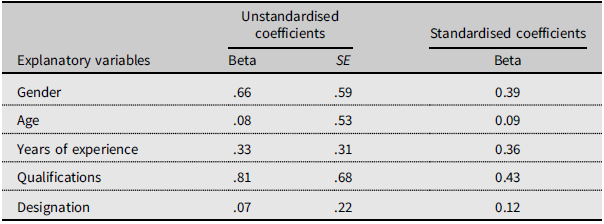
This question sought to establish the relative contributions of the different background variables to the extent of utilisation of Web 2.0 applications in counsellor education. The summary of analysis for this research question is presented in Table 4.
Regression coefficients indicating the relative contributions of each of the background variables to the extent of utilisation of Web 2.0 applications in counsellor education

In Table 4, the beta values under unstandardised coefficients represent the regression coefficients of the different background variables in relation to the extent of utilisation of Web 2.0 applications in counsellor education. It can be seen in Table 4 that qualifications have the highest regression coefficient of .81, followed by gender with .66. Other background variables and their regression coefficients in the order of their strength are years of experience, .33; age, .08; and designation, .07. This indicates differences in the level of influence of the different independent variables on the dependent variable. This finding confirms an earlier finding by Agir (Reference Agir2014) that there are differences on the usage of Web 2.0 by the students of the Faculty of Education of Istanbul University, Turkey, based on departments, gender and the high school they graduated from, among other variables. The present study established different regression coefficients for the different independent variables, which indicates different levels of influence of these independent variables on the extent of utilisation of Web 2.0 applications in counsellor education. In order to establish the statistical significance of these regression coefficients, Ho2 was tested and the results are presented in Table 5.
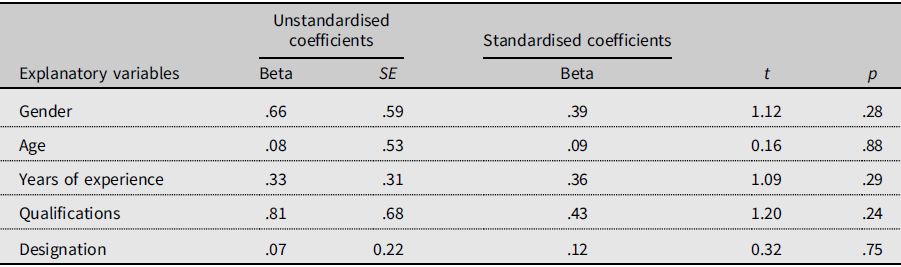
Regression coefficients indicating the significance of the influence of each of the background variables on the extent of utilisation of Web 2.0 applications in counsellor education

Ho2: There is no significant influence of the individual background variables on the extent of utilisation of Web 2.0 applications in counsellor education.
This hypothesis sought to establish whether the influence of the individual background variables on the extent of utilisation of Web 2.0 applications in counsellor education is statistically significant or not. The results of the analysis are presented in Table 5.
Table 5 shows, among other parameters, the t values and p values for the different independent variables that determine the significance or otherwise of the influence of each of these variables. It can be seen that gender has a t value of 1.12 and a p value of .28. This p value is greater than alpha, thus a retention of the null hypothesis with respect to gender. It implies that gender has no significant influence on the extent of utilisation of Web 2.0 applications in counsellor education. Other independent variables, including age, years of experience, qualifications and designation have p values of .88, .29, .24 and .75 respectively. These p values are all greater than the alpha value of .05, implying retention of null hypotheses for these variables. In other words, neither gender, age, years of experience, qualifications or designation have a significant influence on the extent of utilisation of Web 2.0 applications in counsellor education. The findings here do not confirm the results of a study by Eyo (Reference Eyo2016) in which it was reported that the age of the teachers had a significant influence on the level of application of SNSs in the teaching-learning process. The present study revealed that age does not significantly influence the extent of utilisation of Web 2.0 applications in the teaching-learning process. Furthermore, the findings of this study confirm an aspect of findings by Quadri (Reference Quadri2013), who studied the influence of demographic factors on the utilisation of online library resources by undergraduates and reported that gender had no significant relationship with students’ use of online library resources; however, the results did not confirm Quadri’s (Reference Quadri2013) finding that there was a significant relationship between level of study and age of students and their utilisation of online library resources. The study also confirms the finding of Bassey and Eyo (Reference Bassey and Eyo2015), who reported gender as not being a predictor of the first-year undergraduates’ use of the library. However, it did not confirm Bassey and Eyo’s finding that age and area of specialisation are predictors of first-year undergraduates’ use of the library.
Summary of major findings
The extent of utilisation of Web 2.0 applications in counsellor education is low. The joint influence of the background variables on the extent of utilisation of Web 2.0 applications in counsellor education is not statistically significant. Therefore, these variables do not predict the extent of utilisation of Web 2.0 applications in counsellor education.
None of these independent variables have an individual significant influence on the extent of utilisation of Web 2.0 applications in counsellor education. They therefore do not predict, jointly or individually, the extent of utilisation of Web 2.0 applications in counsellor education.
Implications of the findings for counselling youth and students
The findings of this study have implications for counselling youth and students. Web 2.0 applications are known to be embraced by youth and students. Such embrace, as has been widely reported, implies that functional and effective counselling for them should incorporate the use of the Web 2.0 applications. This is because the Web 2.0 environment is where the clients (youth and students) are most likely to be found. Reaching out to this population in an environment where they are comfortable, and using media they are comfortable with, will help to sustain their interest in the counselling situation. The low extent of utilisation of these tools in counsellor education should therefore be a matter of serious concern as this implies that counsellor educators are not exposing trainee counsellors to these tools.
Furthermore, such lack of exposure may affect the outcome of the teaching-learning process, as it is indisputable that the utilisation of a medium that students are comfortable with will help to sustain their interest in the teaching-learning process, thus improving the outcome of the process. Additionally, the low extent of utilisation portrays a gap in the training process as future counsellors are being trained without exposing them to the future tools and setting that their future clients are likely to be found. This may lead to producing counsellors who cannot ‘speak the language’ of their clients, which will undoubtedly affect the outcome of counselling. In other words, if the youth are Web 2.0 compliant, it would be easier for a counsellor who is also Web 2.0 compliant to meet them in the virtual world and attend to their needs. A counsellor who is not Web 2.0 compliant will find it difficult to relate, establish rapport and be able to assist this target population.
Conclusion and recommendations
This study sought to establish whether background variables are predictors of utilisation of Web 2.0 applications in counsellor education. The study restricted itself to six Web 2.0 tools: SNSs, blogs, wikis, podcasts, video sharing (vodcasts) and folksonomies. The findings of this study have indicated that the extent of utilisation of Web 2.0 applications in counsellor education is low and that background variables, including gender, age, years of experience, qualifications and designation do not have joint statistically significant influence on the extent of utilisation of Web 2.0 applications in counsellor education. Furthermore, the study has also established that these independent variables do not, individually, have statistically significant influence on the extent of utilisation of Web 2.0 applications in counsellor education. It can therefore be concluded that gender, age, years of experience, qualifications and designation do not, jointly or individually, predict the extent of utilisation of Web 2.0 applications in counsellor education.
Against the backdrop of these findings, it is recommended that counsellor educators and other stakeholders in the counsellor education process should adopt deliberate measures to incorporate Web 2.0 tools in the teaching-learning process with respect to counsellor education. Furthermore, strategies to encourage the utilisation of Web 2.0 applications in counsellor education should be applied generally to the counsellor educators irrespective of their gender, age, years of experience, qualifications and designation, as these independent variables do not predict the utilisation of Web 2.0 applications in counsellor education.
Financial support
This research received no specific grant from any funding agency, commercial, or not-for-profit sectors.
Conflicts of interest
None.
Statements on ethical standards
No ethics review was required to be undertaken in this study. The study did not involve human research participants.