Implications
Adding either activated carbon (AC) or Tween-60 (Tween; polyoxyethylene sorbitan monostearate) to diets of entire male pigs reduced levels of boar taint compounds and may reduce the dependence on castration to eliminate boar taint. As an addition to a finisher feed, any potential negative effects of AC or Tween on binding essential nutrients would be limited to a short period of time before slaughter. Although there have been several dietary manipulations reported that can reduce levels of skatole, this is the first report describing a dietary intervention that can reduce levels of androstenone. Further study to test the efficacy of this process under the conditions of commercial pork production is warranted.
Introduction
Boar taint, an unsavoury odour produced when pork fat is heated, is due to high levels of the indolic compound, skatole and the 16-androstene steroid, 5α-androstenone (AND). Owing to the potential of boar taint, pigs are castrated shortly after birth. However, with the animal welfare concerns about castration and the negative effects on production efficiency, it has become increasingly important to investigate alternatives to castration for controlling boar taint. Several methods for controlling boar taint have been investigated, including dietary treatments, immunocastration and possibilities for genetic control (reviewed by Zamaratskaia and Squires, Reference Zamaratskaia and Squires2008).
Skatole is produced by the microbial degradation of tryptophan in the intestinal tract, and a major source of tryptophan for skatole production is from the turnover of cells from the gut mucosa (Claus et al., Reference Claus, Weiler and Herzog1994). The production of skatole is regulated by the amount of available tryptophan and the composition of the intestinal bacteria. Including fermentable carbohydrates, such as inulin or raw potato starch, in pig diets has been shown to decrease production of skatole by the gut microflora and decrease levels of skatole in plasma and fat (Claus et al., Reference Claus, Lösel, Lacorn, Mentschel and Schenkel2003; Hansen et al., Reference Hansen, Mejer, Thamsborg, Byrne, Roepstorff, Karlsson, Hansen-Mølle, Jensen and Tuomola2006). AND is a steroid produced by the Leydig cells of the testis, along with the sex steroids. Levels of AND are regulated by sexual maturity, as well as the genetic predisposition of the pig for its synthesis and metabolism. In contrast to skatole, there have been no dietary manipulations reported that limit the concentration of AND in fat.
Steroid hormones are metabolized in the liver by a two-phase process involving first hydroxylation reactions and then the formation of conjugates by sulphation or glucuronidation. These conjugates can enter the bile and be delivered to the small intestine, where they can be deconjugated by the intestinal bacteria to produce the free steroids, which are absorbed into the portal venous blood from the enterocytes; this is known as the enterohepatic circulation (Roberts et al., Reference Roberts, Magnusson, Burczynski and Weiss2002). Ruoff and Dziuk (Reference Ruoff and Dziuk1994) showed that oestradiol placed in the stomach of pigs undergoes enterohepatic circulation. Treatment with oral antibiotics to decrease the activity of the gut microbes interrupted the enterohepatic circulation by decreasing the amount of deconjugation and reducing the reabsorption of estrogens (Ruoff and Dziuk, Reference Ruoff and Dziuk1994). Although it is not known whether AND undergoes enterohepatic circulation, Sinclair et al. (Reference Sinclair, Hancock, Gilmore and Squires2005) showed that hepatocytes produce sulphoconjugates and glucuronyl conjugates of AND; Sinclair and Squires (Reference Sinclair and Squires2005) also found that increased levels of sulphoconjugation decreased the accumulation of AND in adipose tissue. Chen et al. (Reference Chen, Ren, Yang, Qiu, Kamal-Eldin and Lundström2010) also reported that the majority of plasma AND was in the form of conjugates. If AND follows a similar route of metabolism and recycling as oestrogens, it may be possible to decrease AND levels by interrupting the enterohepatic circulation.
Adsorbent materials have been used to detoxify mycotoxin-contaminated feedstuffs by binding mycotoxins in the gastrointestinal tract and interrupting their enterohepatic circulation (Solfrizzo et al., Reference Solfrizzo, Visconti, Avantaggiato, Torres and Chulze2000; Huwig et al., Reference Huwig, Freimund, Kappeli and Dutler2001; Döll et al., Reference Döll, Dänicke, Valenta and Flachowsky2004). Activated carbon (AC) is a form of processed carbon that is extremely porous and possesses a large amount of available surface area for adsorption. Typically, AC is used as a universal antidote against acute toxicosis due to its ability to efficiently adsorb solutes in aqueous solutions (Dabrowski et al., Reference Dabrowski, Podkoscielny, Hubicki and Barczak2005). This ability has been utilized in the detoxification of mycotoxins and several in vitro studies have found that approximately 80% to 100% of mycotoxins in aqueous solutions were adsorbed by ACs (Döll et al., Reference Döll, Dänicke, Valenta and Flachowsky2004). Tween-60 (Tween; polyoxyethylene sorbitan monostearate) belongs to the polysorbate family of surfactants used extensively in the food, cosmetic and pharmaceutical industries to solubilize essential oils into water-based products (Oser and Oser, Reference Oser and Oser1956). They are also similar in structure and function to sucrose polyesters, known to interrupt the enterohepatic circulation of persistent organic pollutants by competing with intestinal micelles for lipophilic nutrients (Cooper et al., Reference Cooper, Berry, Spendel, King, Kiorpes and Peters1997; Meijer et al., Reference Meijer, Hafkamp, Bosman, Havinga, Bergman, Sauer and Verkade2006).
Our in vitro studies have shown that AC and Tween can efficiently bind AND and skatole (Jen and Squires, Reference Jen and Squires2011). It is not known whether similar efficacy of binding of AND and skatole would occur in vivo and result in a decrease in AND and skatole in the plasma and fat of pigs. If so, this would be an interesting and new strategy to solve the boar taint problem. However, several studies have shown that results obtained in vitro do not always correlate with the efficacy of binding in vivo. In vitro studies by Galvano et al. (Reference Galvano, Pietri, Bertuzzi, Bognanno, Chies, Angelis and Galvano1997) show that AC has high affinity towards fumonisin B1; however, an inclusion rate of 20 mg/g diet of AC to fumonisin-contaminated diets showed no protection to rats against fumonisin B1 (Solfrizzo et al., Reference Solfrizzo, Carratu’, Avantaggiato, Galvano, Pietri and Visconti2001). Therefore, as a follow up from our promising in vitro binding studies, we wanted to next determine whether adding binding agents in the diet before slaughter would decrease levels of AND and skatole in boars. We, therefore, evaluated the effect of adding AC and Tween to finishing diets on concentrations of AND and skatole in plasma and fat of boars.
Material and methods
Chemicals
Tween was obtained from Sigma-Aldrich (Oakville, ON, Canada) and AC (NORIT® SA 2; decolourizing) was obtained from Fisher Scientific (Ottawa, ON, Canada). 16,(5α)-androsten-3-one and 1,3,5(10)-estratrien-3-ol-17-one sulphate were purchased from Steraloids Inc. (Wilton, NH, USA) and stock solutions of the steroid hormones were prepared in 100% ethanol. Radio-labelled oestrone sulphate (E1S), ammonium salt [6,7-3H(N)], was obtained from Perkin Elmer (Boston, MA, USA). Stock solutions of 7-ethylindole (Sigma-Aldrich) were prepared from crystalline standards in 100% acetonitrile (Sigma-Aldrich).
Animals and sample collection
Yorkshire boars (119.8 ± 2.2 kg) were housed individually at the Arkell Swine Research Station, University of Guelph, in a temperature-controlled environment (18°C ± 2°C) with free access to water. Boars were fed 3 kg of control diet of a typical corn–barley-based finisher feed (14.66% crude protein, 3.14% crude fibre and 3354 kcal/kg digestible energy) per day for 4 days before the start of experiment. All procedures were approved by the Animal Care Committee at the University of Guelph and used in accordance with the rules laid down by the Canadian Council on Animal Care.
A pre-trial was conducted to estimate the dose and treatment time required to reduce plasma levels of AND and E1S. Boars were fed diets supplemented with AC or Tween at 1%, 2.5% and 5% inclusion rates for consecutive 4-day periods, followed by a recovery period of 14 days when they were fed the control (CTRL) diet without AC or Tween. Blood sample was taken from the orbital sinus into heparinized tubes, centrifuged and the plasma levels of AND and E1S were determined as described below. Both Tween- and AC-treated boars had decreased plasma levels of AND and E1S, with the largest decrease occurring following feeding diets with 5% inclusion of AC or Tween; thus, the inclusion level of 5% was chosen for further investigation (data not shown).
For the main trial, boars were randomly assigned to one of three treatment groups: CTRL (n = 11) boars fed the control diet; Tween (n = 13) boars fed the control diet supplemented with 5% Tween; and AC (n = 13) boars fed the control diet supplemented with 5% activated charcoal. Boars were fed the treatment diets for 28 days, after which all groups returned to CTRL diets for a recovery period from days 42 to 56. Blood samples were collected at 0800 h from the orbital sinus into heparinized tubes at days 0, 7, 14, 21, 28, 42 and 56, and BW was measured on all collection days. Samples were centrifuged at 4°C and plasma stored at −20°C until analysed. Backfat biopsies, approximately 1 to 2 g, were taken at days 0, 28, 42 and 56. Boars were given local anaesthesia with 2% lidocaine-HCl at 15 min before biopsy in the neck region. After biopsy, the incision was disinfected locally with 70% ethanol and the skin was sutured.
Sample preparation and biochemical assay procedures
Plasma and fat samples were assayed for AND with an ELISA method, modified after Claus et al. (Reference Claus, Mahler and Münster1988) as described by Squires and Lundström (Reference Squires and Lundström1997). Radioimmunoassay was used for measurements of E1S in plasma samples (Schwarzenberger et al., Reference Schwarzenberger, Toole, Christie and Raeside1993). Plasma skatole levels were measured by HPLC using the method described by Claus et al. (Reference Claus, Dehnhard, Herzog, Bernal-Barragan and Gimenez1993) and Dehnhard et al. (Reference Dehnhard, Bernal-Barragan and Claus1991).
Statistical analysis
Analyses of experimental data were performed using the GLM procedure of Statistical Analysis System program (SAS Institute, Cary, NC, USA). The repeated measures ANOVA was performed using PROC MIXED. Analysis of trends of days 0 to 28 were tested using contrasts to compare the responses among treatment diets over collection days. Data points from each treatment on collection days were compared with data points at day 0 by a paired Dunnett's t-test. P-values of <0.05 were considered statistically significant.
Results
Comparison of age and BW between groups
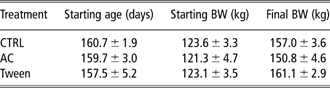
The starting age and BW and the final BW of the boars in the different treatment groups are shown in Table 1. There was no difference (P > 0.05) between treatment groups in the age at the beginning of the trial (159 ± 2.1 days), starting BW (119.8 ± 2.2 kg) or final BW (156.2 ± 2.2 kg). There was no difference in growth rate among the three groups (0.71 ± 0.01 kg/day; P > 0.05).
Age and BW of boars in the different treatment groups
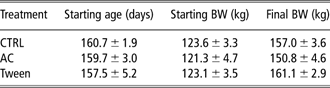
CTRL = control; AC = activated carbon; Tween = Tween-60 – polyoxyethylene sorbitan monostearate.
There was no significant difference in the age at the beginning of the trial, starting BW or final BW among the three groups.
E1S levels in plasma
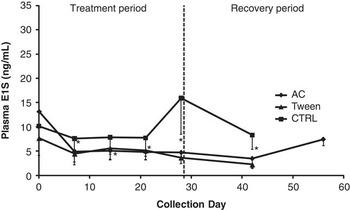
Concentrations of E1S in plasma for all treatment groups are shown in Figure 1. Levels of E1S for CTRL boars remained constant throughout the course of treatment and were not significantly different (P > 0.05) from day 0 with overall levels being 9.4 ± 1.6 ng/ml. Levels of E1S in AC boars decreased at day 7 (4.9 ± 1.4 ng/ml) compared to day 0 (13.1 ± 2.6 ng/ml) and then remained constant until day 42. At day 56, levels increased (7.4 ± 2.8 ng/ml) and were not significantly different (P > 0.05) from day 0. Regression analysis indicated that there was a significant linear trend in the Tween treatment for decreased levels of E1S over days 0 to 28. Following 14 days of recovery, plasma E1S levels in Tween boars were not significantly different from day 28.
Profile of E1S concentrations in plasma of AC (⧫; n = 13), Tween (▴; n = 13) and CTRL (▪; n = 11) treatment boars from days 0 to 56 of the trial. Values are plotted as means ± s.e.; *indicates values significantly different (P < 0.05) from values at day 0 (E1S = oestrone sulphate; AC = activated carbon; Tween = Tween-60 – polyoxyethylene sorbitan monostearate).

AND levels in plasma and backfat
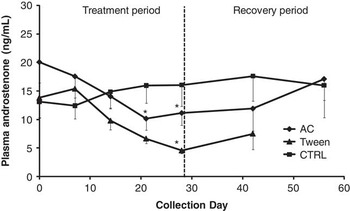
The profiles of plasma AND concentrations in all treatment groups are given in Figure 2. Plasma AND levels for CTRL boars remained constant over the course of treatment and were not significantly different (P > 0.05) from day 0, having an overall mean of 15.1 ± 1.3 ng/ml. Plasma AND levels in Tween boars decreased significantly (P < 0.05) at day 28 (4.5 ± 0.5 ng/ml) from levels at day 0 (13.8 ± 3.5 ng/ml). Levels of plasma AND in AC boars decreased (P < 0.05) at days 21 and 28 (11.1 ± 2.2 and 11.9 ± 3.9 ng/ml, respectively) compared to day 0 (20.1 ± 3.7 ng/ml). Following a 14-day recovery period, Tween boars showed an increase in plasma AND (7.5 ± 2.7 ng/ml; P < 0.05) from day 28, which was not significantly (P > 0.05) different from day 0. Similarly, following a 28-day recovery period, plasma AND of AC boars increased to 17.1 ± 3.7 ng/ml, which was not significantly (P > 0.05) different from day 0.
Profile of androstenone concentrations in plasma of AC (⧫; n = 13), Tween (▴; n = 13) and CTRL (▪; n = 11) treatment boars from days 0 to 56 of the trial. Values are plotted as means ± s.e.; *indicates values significantly different (P < 0.05) from values at day 0 of that group (AC = activated carbon; Tween = Tween-60 – polyoxyethylene sorbitan monostearate; CTRL = control).

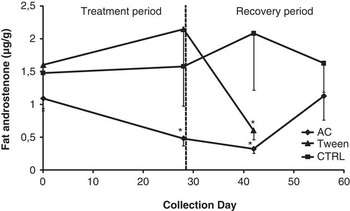
The profiles of fat AND concentrations in all treatment groups are shown in Figure 3. Levels of fat AND in CTRL boars were unchanged over the course of the experiment and not significantly different (P > 0.05) from levels at day 0 with overall levels of 1.7 ± 0.3 μg/g. Regression analysis confirmed that no trend was apparent in the CTRL group. Levels of fat AND in Tween boars did not change over the treatment period; however, Tween boars showed a significant (P < 0.05) decrease in fat AND levels between days 28 (2.1 ± 0.6 μg/g) and 42 (0.6 ± 0.1 μg/g) during the recovery period. In AC-treated boars, levels of fat AND decreased significantly (P < 0.05) at days 28 and 42 to 0.5 ± 0.1 and 0.3 ± 0.06 μg/g, respectively, compared to day 0 (1.1 ± 0.2 μg/g). Following the recovery period at day 56, fat AND levels of AC-treated boars increased to 1.1 ± 0.4 μg/g, which was not significantly (P > 0.05) different from day 0.
Profile of androstenone concentrations in fat of AC (⧫; n = 13), Tween (▴; n = 13) and CTRL (▪; n = 11) treatment boars from days 0 to 56 of the trial. Values are plotted as means ± s.e.; *indicates values significantly different (P < 0.05) from values at day 0 (AC = activated carbon; Tween = Tween-60 – polyoxyethylene sorbitan monostearate; CTRL = control).

Skatole levels in plasma and fat
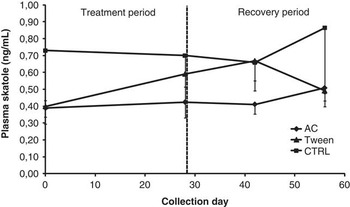
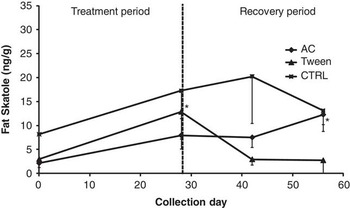
Levels of plasma skatole were very low and the profile of plasma skatole concentrations did not vary from day 0 for any of the treatments (Figure 4). Levels of skatole in fat (Figure 5) were also well below the acceptable cut-off level of 200 to 250 ng/g fat. Fat skatole levels in CTRL boars did not change over the course of the trial. Fat skatole levels in Tween boars increased during the treatment period, but there was a significant decrease in fat skatole at day 42 during the recovery period. Levels of skatole remained low in the AC treatment up to day 42, followed by a significant increase in fat skatole by day 56.
Profile of skatole concentrations in plasma of AC (⧫; n = 13), Tween (▴; n = 13) and CTRL (▪; n = 11) treatment boars from days 0 to 56 of the trial. Values are plotted as means ± s.e., *indicates values significantly different (P < 0.05) from values at day 0 (AC = activated carbon; Tween = Tween-60 – polyoxyethylene sorbitan monostearate; CTRL = control).

Profile of skatole concentrations in fat of AC (⧫; n = 13), Tween (▴; n = 13) and CTRL (▪; n = 11) treatment boars from days 0 to 56 of the trial. Values are plotted as means ± s.e., *indicates values significantly different (P < 0.05) from values at day 0 (AC = activated carbon; Tween = Tween-60 – polyoxyethylene sorbitan monostearate; CTRL = control).

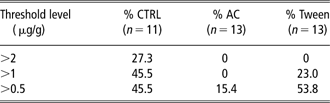
We next determined the effect of AC and Tween treatments on the percentage of animals with levels of AND and skatole in fat above the established sensory threshold levels (0.5 to 1.0 μg/g for AND and 200 to 250 ng/g for skatole) at day 42 (Table 2). There were 45.5% of the CTRL and 23.0% of the Tween boars with AND levels of >1 μg/g and 27.3% of CTRL boars had levels of AND >2 μg/g. In contrast, none of the AC boars had AND levels above the 1 μg/g threshold. When considering a lower threshold of 0.5 μg/g, 15.4% of AC boars and 53.8% of Tween boars were above this cut-off level. No boars in any treatment group had fat skatole levels of >200 ng/g at day 42. The measurements of skatole and AND in fat on day 42 were also ranked, divided into five equal-sized groups on the basis of their rank, and the proportions of pigs in the highest group (upper 20%) were compared with in four lower groups (lower 80%) in each treatment group using the Fisher's exact test. There was a significant effect of treatment on the proportions of animals in the different groups for AND (P = 0.017), but not for skatole (P = 0.16).
A comparison of the percentage of animals at day 42 above threshold levels for androstenone in fat in the different treatment groups
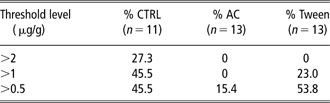
CTRL = control; AC = activated carbon; Tween = Tween-60 – polyoxyethylene sorbitan monostearate.
Discussion
Leydig cells produce not only androgens, but also large amounts of oestrogen, mostly as E1S, which is thought to play a role in the regulation of accessory sex glands in the boar (Raeside et al., Reference Raeside, Christie and Renaud1999; Zamaratskaia et al., Reference Zamaratskaia, Madej, Babol, Squires and Lundström2005b). Zamaratskaia et al. (Reference Zamaratskaia, Babol, Andersson, Andersson and Lundström2005a) have suggested that due to concomitant increases in skatole and oestrone (E1), it is possible that E1 is involved in the regulation of skatole in fat rather than testosterone. Furthermore, E1 is known to undergo enterohepatic circulation and plasma E1S is correlated with the accumulation of AND in fat (Babol et al., Reference Babol, Squires and Lundström1999; Zamaratskaia et al., Reference Zamaratskaia, Madej, Babol, Squires and Lundström2005b; Chen et al., Reference Chen, Bourneuf, Marklund, Zamaratskaia, Madej and Lundström2007). In this study, we measured the effects of AC and Tween treatments on plasma levels of E1S as an initial estimate for their potential effects on enterohepatic circulation.
Our results show that the addition of 5% AC to finishing feed reduced the levels of AND in plasma and backfat and levels of E1S in plasma of entire male pigs. Several in vitro studies have shown that AC can adsorb mycotoxins with high efficacy from aqueous solutions due to its high surface to mass ratio, with an adsorption capacity of up to 120 mg/g (Huwig et al., Reference Huwig, Freimund, Kappeli and Dutler2001; Avantaggiato et al., Reference Avantaggiato, Havenaar and Visconti2003; Döll et al., Reference Döll, Dänicke, Valenta and Flachowsky2004). Furthermore, our in vitro results (Jen and Squires, Reference Jen and Squires2011) indicated that AC had the greatest potential of the adsorbents tested to bind AND, skatole and E1S. A potential concern is that, as a relatively unspecific adsorbent, AC could bind essential nutrients as well as boar taint compounds in an in vivo system. However, we found that AC treatment did not affect growth rate in this study, and therefore, short-term use of AC does not appear to have negative effects on performance. It is also likely that inclusion levels of AC at <5% would be effective in reducing levels of AND, since in our in vitro studies (Jen and Squires, Reference Jen and Squires2011), the K-value that represents the concentration of AC that gives 50% of the maximum binding of AND was 0.6 mg/ml or 0.06% of AC. Further studies should also determine the effects of AC treatment on meat quality, since other potential malodorous compounds, such as indole, may also be eliminated when AC is used.
Tween treatment also significantly decreased the levels of plasma AND with an overall decrease in the levels of fat AND and E1S. Tween also bound both AND and oestrogen in our in vitro studies (Jen and Squires, Reference Jen and Squires2011). Polysorbates such as Tween partition lipophilic molecules into micelles, such that they are no longer incorporated into mixed micelles to be transported to the intestinal surfaces (Akoh and Min, Reference Akoh and Min1998), but are eliminated through the stimulation of faecal fat excretion (Meijer et al., Reference Meijer, Hafkamp, Bosman, Havinga, Bergman, Sauer and Verkade2006). AND is reversibly stored in the adipose tissue and metabolized in the liver, and can be eliminated with the use of Tween; however, further studies are needed to investigate this mechanism.
Previous studies have found that fat AND concentrations were correlated with concentrations of plasma steroids in market weight pigs (Sinclair et al., Reference Sinclair, Squires, Raeside, Britt and Hedgpeth2001b). Both AC and Tween treatments reduced plasma concentrations of AND below the levels in CTRL animals and below the cut-off level of 15 ng/ml, which are associated with low concentrations of fat AND (Sinclair et al., Reference Sinclair, Squires and Raeside2001a). However, levels of AND in plasma and fat are not always correlated (Rhodes, Reference Rhodes1971; Claus et al., Reference Claus, Weiler and Herzog1994; Sinclair et al., Reference Sinclair, Squires, Raeside, Britt and Hedgpeth2001b). This is likely due to the slow turnover rate of AND in fat (Claus, Reference Claus1979) compared to that in plasma. The elimination of AND from fat after castration can require 3 to 6 weeks (Claus, Reference Claus1979), which may account for the lag in both the recovery and clearance of AND levels in fat compared to that in plasma. In this study, plasma AND levels decreased during Tween treatment from day 0 to a lowest level at day 28, whereas AND levels in fat were not different at day 28 from day 0, only decreasing subsequently at day 42. With AC treatment, plasma and fat AND levels decreased at day 28 and increased at day 56. This may be related to the increased adsorption efficiency of AND by AC compared with Tween.
We also found a wide variation between individuals in the accumulation of AND, with boars starting with either high and low levels of AND and E1S. CTRL boars with high starting levels tended to stay at high concentrations, while the greatest decreases in levels of AND and E1S following AC and Tween treatments were found in the high AND phenotype boars (data not shown). However, levels of skatole were very low in all boars in this study and well below the cut-off level for fat skatole of 0.20 to 0.25 μg/g (Andresen, Reference Andresen2006), which corresponds to levels of 7.5 to 12.6 ng/ml in plasma (Agergaard and Laue, Reference Agergaard and Laue1998; Babol et al., Reference Babol, Zamaratskaia, Juneja and Lundström2004). Levels of skatole can be affected by a number of factors, including breed, diet and environmental factors, and generating high levels of skatole in boars can be somewhat problematic. With such low levels of skatole present, it is perhaps not surprising that AC and Tween treatment did not decrease levels of skatole as dramatically as was seen with AND.
The results of this study indicate that AC and Tween treatments can be used to decrease the levels of plasma and fat AND pigs, but further study is needed to confirm the effects of these treatments on reducing fat skatole levels. Plasma levels of E1S were also decreased, suggesting that the enterohepatic circulation of oestrogen was interrupted. In order to fully understand the mechanism of the effects of adsorbent agents on boar taint, further mechanistic studies are needed to determine whether AND undergoes enterohepatic circulation. These would include the direct determination of enterohepatic circulation of AND by administering a dose of labelled compound and measuring its removal in bile, plasma, urine and faeces. In addition, the determination of the exact conjugated moiety of AND present in the intestinal tract and any complexes it would form with adsorbent agents could be determined. Our present results provide a justification for undertaking these extensive studies and provide a basis for the design of diets that reduce levels of boar taint compounds in the carcass. The long-term effects of these adsorbent agents on both development and meat quality need further investigation. Furthermore, more extensive trials with a larger sample size under commercial conditions should be conducted to determine effects due to breed and age, and to determine the effective dose and treatment time to reduce boar taint to acceptable levels.
Acknowledgements
This study was supported by grants from the Natural Sciences and Engineering Research Council of Canada and the Ontario Ministry of Agriculture, Food and Rural Affairs and was part of the MSc work of K Jen. We thank Dr PJ Dziuk for helpful suggestions on the enterohepatic circulation of steroids.