In the late 1940s, after the end of the Second World War and the advent of Indian Independence in 1947, a new era began in Indian anthropology. The last few British colonial, official anthropologists left India shortly after independence, but more importantly, a new international group of professional, academic anthropologists from India, Britain, the United States, and elsewhere started to collect ethnographic data through intensive fieldwork in small communities, which their predecessors in the colonial era had rarely done. Almost all the post-war anthropologists specialised in social and cultural anthropology, and were broadly functionalist in their theoretical outlook, so that they did little or no research in physical anthropology, archaeology, or material culture, and rejected older evolutionist and diffusionist theories. Moreover, especially from around 1914 to 1945, the anthropology of India had been dominated by the study of ‘primitive’ Adivasi hill and forest tribes. Tribal studies continued after the war, but the majority of post-war anthropologists carried out ethnographic fieldwork in villages situated on the plains, which were and are broadly describable as peasant communities. These villagers, who made up the vast majority of the Indian population, were mostly Hindus, Muslims, or followers of other world religions. They were organised in local caste systems and most of them earned their livelihood from agriculture as landowners, tenants, or wage labourers, or from pastoralism, but some were village artisans or servants.
There were several reasons for selecting villages as fieldwork sites after the war. In the first place, villages were where most Indians lived. Secondly, most villages then had relatively small populations of no more than 1,500, so researchers could normally undertake a reasonably comprehensive functionalist study in approximately 12 to 18 months. Moreover, many anthropologists, like other students of Indian society and culture, were particularly attracted to villages because they seemed to be places where authentic ‘traditional’ India could still be found and should be studied before modernity overwhelmed it. Others, however, were mainly interested in how villages were changing in the newly independent nation. Since these settlements were often blighted by poverty, illiteracy, and other privations, they were crucial sites for the government’s development policies following independence, as well as for its novel initiatives in village-level democracy introduced through panchayati raj. Hence government planners, development economists, agricultural experts, political scientists, public health practitioners and others seeking to improve ordinary people’s lives were also seeking information on villages that anthropologists could collect, either collaboratively or independently.
Village studies anthropology in India
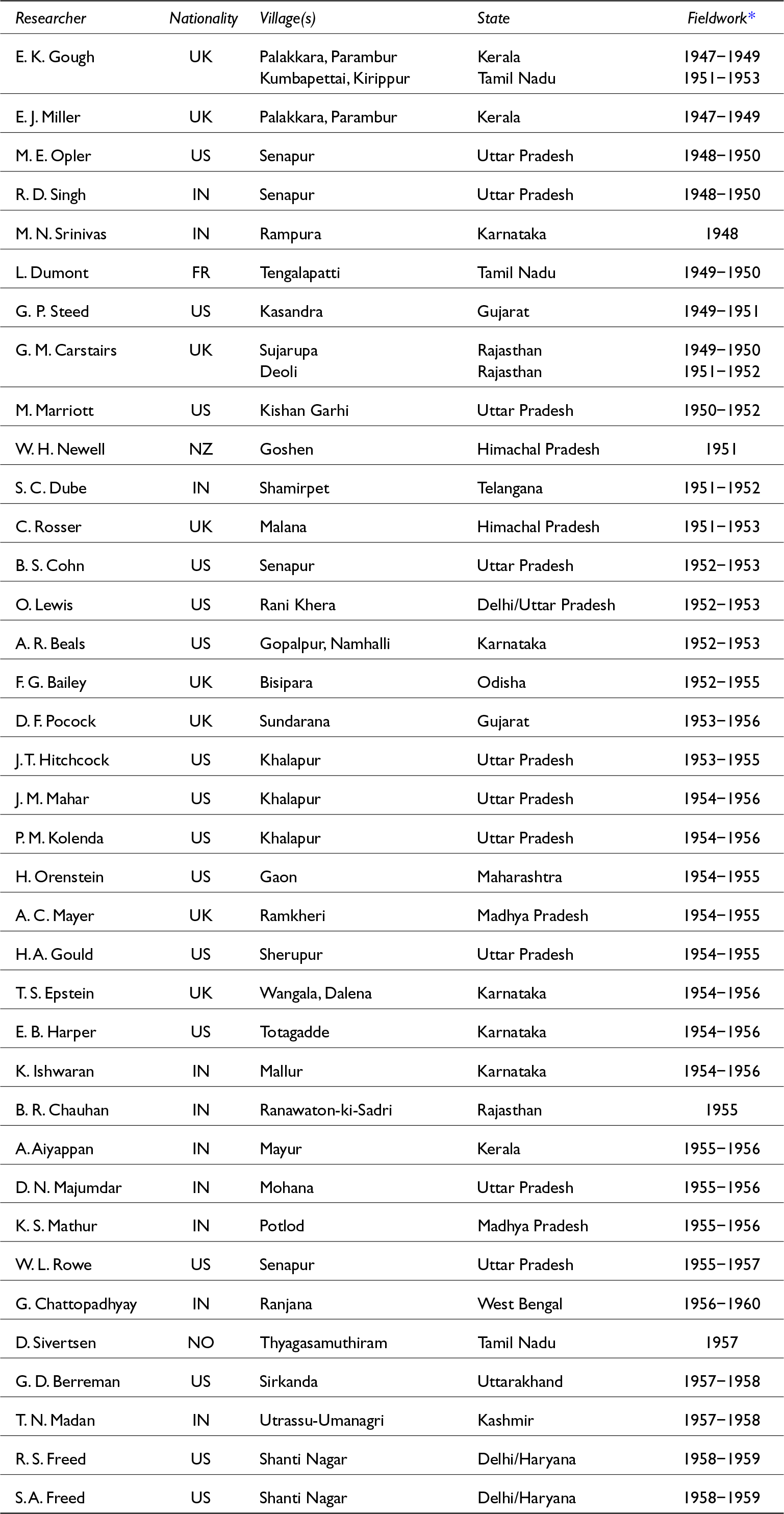
From the early 1950s until the late 1970s or thereabouts, ‘village studies’ laid the foundations of modern, postcolonial Indian social and cultural anthropology (the usual disciplinary labels in the West, which I use here) or sociology (the usual one in South Asia). Table 1 lists the 37 men and women who, to the best of my knowledge, carried out ethnographic fieldwork in peasant villages between 1947 and 1959 and later published monographs or full-length articles or edited book chapters about them. Of these 37, 16 were American, 10 were Indian, eight were British, one was French, one was Norwegian, and one came from New Zealand. Other people who did fieldwork but published little or nothing are not listed.
Village studies anthropologists, 1947–1959

Table 1 Long description
The table lists village-study anthropologists, giving each researcher’s nationality, the village or villages studied, the Indian state, and the years of their first fieldwork period. Fieldwork begins in 1947 and runs through 1959, with one entry extending to 1960 in West Bengal. Uttar Pradesh appears most often, including repeated studies in Senapur by multiple researchers across the late 1940s to mid 1950s and in Khalapur by several US researchers in the mid 1950s. Karnataka is another major focus, with several different villages studied there during the mid 1950s. The researchers come from several countries, most commonly the United States, the United Kingdom, and India, with additional entries from France, New Zealand, and Norway. Some researchers conducted fieldwork in more than one village and, in a few cases, across more than one state. Dates reflect only the first fieldwork period for each researcher, which may omit later visits or shorter follow-up work.
* Note: Only the dates of first fieldwork, which usually lasted longest, are listed.
Several Indian anthropologists and sociologists who studied villages after independence, including M. N. Srinivas and S. C. Dube, had started their academic careers during the colonial period. For most of them, there was no sharp break at independence but rather an expansion of earlier activities as a result, for example, of new positions in an expanding university sector, access to new sources of funding, or collaboration with overseas academics.Footnote 1 I should also note that many Indian scholars who identified themselves as ‘anthropologists’ continued to study tribes primarily, while ‘sociologists’ were generally more interested in castes and villages, even though they often called themselves ‘anthropologists’ when they were abroad. Although anthropologists from Britain made up the third largest contingent, twice as many came from the United States and the growing American academic presence in the subcontinent after 1947 was a significant development that I discuss shortly.
The start of the village studies era has often been identified as the publication in 1955 of three books with similar titles, all of which were widely read: Village India: Studies in the Little Community, edited by McKim Marriott; India’s Villages, edited by M. N. Srinivas; and Indian Village, an ethnographic monograph by S. C. Dube. Village India was the most academically ambitious of the three, although, like many edited volumes, it was uneven in quality and lacking in intellectual unity, as Marriott himself told me in 2009—despite previously defending its eclecticism as illustrative of different models of the Indian village.Footnote 2 The single most important reason for this lack of unity was disagreement about the Village India project’s objectives between its progenitors, Robert Redfield and Milton Singer, as well as Marriott, on the one hand, and some of its contributing participants, on the other. This difference of opinion, as we shall see, had a significant impact on how village studies came to be conceptualised and, more broadly, on the paths that the anthropology of India has taken, as well as not taken, since the 1950s. By the same token, in the history of modern, postcolonial Indian anthropology, Village India is a crucial text that warrants retrospective analysis.
Village India was published in a series, Comparative Studies of Cultures and Civilizations, which Redfield and Singer edited. Their foreword to Village India began by declaring that it belonged to ‘a series which explores various ways to the scientific and scholarly understanding of civilizations’, and ‘the anthropological study of small communities’ in the book provided a ‘close view’ of ‘a civilization in vivo’ within its local, social contexts. Moreover, the Village India project’s ‘primary interest’ was ‘not the effort to understand India and her changes’, but ‘the effort to understand how to seek understanding of any great civilization and its enormously complex changes through anthropological studies of villages’. Methodological questions were therefore important, in particular, how anthropologists’ ways of working in ‘isolated tribal communities’ must be changed when investigating ‘a village that is part of a larger society … and a local culture that is part and cause and product of an ancient civilization’.Footnote 3 This was a problem Redfield had considered in The Little Community and would take up again in Peasant Society and Culture, where he described ‘the peasant society [as] a half-society … and the peasant culture [as] a half-culture’, because ‘the peasant community … is an aspect or dimension of the civilization of which it is a part’. ‘Civilization’, as Redfield characterised it, is made up of ‘a great tradition of the reflective few … and a little tradition of the largely unreflective many’.Footnote 4
Village India’s contents are summarised later and the key point to make here is that several contributors, especially Srinivas, obviously regarded the book’s principal subject matter as village society, the little community of the village itself, not Indian civilisation. Moreover, that is what the book’s title appears to indicate—notwithstanding the series’ title—and is what I always assumed it actually was about until I re-read it carefully and started the research for this article. Even Bernard S. Cohn, a contributor to Village India, who produced a bibliography for students on the ‘social institutions of Indian civilization’ for a conference organised by Singer in 1957, recommended the book for its good descriptive accounts of villages without mentioning its concern with Indian civilisation. Knowledgeable reviewers of the book also appear to have assumed that it was about villages themselves, rather than civilisation, and I am sure most ordinary readers and countless students who first came across it on reading lists for courses on South Asian society thought the same.Footnote 5
I will look at the reasons for this misunderstanding below, but the key point to stress here is that within Village India there was both an unresolved question about its subject matter and a latent ambition, which was primarily owed to Redfield, to make the understanding of pan-Indian culture and civilisation, not just the ‘half-society’ of the village, a principal goal of village studies ethnography and anthropology. These partly hidden aspects of Village India have been made clearer to me by looking at archival material that particularly sheds light on the original aims and objectives of Redfield, Singer, and Marriott, as well as some of the other contributors. First and foremost, therefore, this article is a contribution to the history of the modern, postcolonial anthropology of India through a retrospective examination of a formative text that has nonetheless been partly misperceived, so that hardly any anthropologists or other scholars of South Asia have ever seen Village India as required reading on Indian civilisation, as Redfield would have hoped.
American anthropology in India before and after the Second World War
Village India was one of the fruits of the new American academic presence in the Indian subcontinent after the Second World War and independence, but before the war, American anthropological expertise in India (and most other Asian countries) was minimal. A few American missionaries had worked there, however, notably William H. and Charlotte V. Wiser, who lived in Karimpur village in North India (in modern Uttar Pradesh). In 1930, the Wisers wrote Behind Mud Walls, which is generally regarded as the sole village ethnography published before independence; William also wrote his MA and PhD theses on Karimpur’s economy and society at Cornell University in 1932–1933.Footnote 6 But the only American professional anthropologist doing research in India before the war was David G. Mandelbaum. He studied the Plains Cree in Saskatchewan for his PhD degree at Yale University and went to Travancore (southern Kerala) in 1937 to carry out fieldwork among its hill tribes. A little later, however, Mandelbaum started again in the Nilgiri Hills (western Tamil Nadu), where he collected ethnographic data in 1937–1938 on the Kotas, a hill tribe who were neighbours of the Todas, whom W. H. R. Rivers had studied in 1901–1902. Mandelbaum took up a post in the University of Minnesota in 1938, but in 1942, after the United States had entered the war, he joined the Office of Strategic Services (OSS)—the precursor of the Central Intelligence Agency—which was set up to meet the government’s need for strategic knowledge. At the OSS headquarters in Washington, DC, Mandelbaum’s superiors included W. Norman Brown, the head of the India desk, who was professor of Sanskrit at the University of Pennsylvania. Mandelbaum then worked as an OSS intelligence officer in New Delhi; he was later an agent attached to an army unit that infiltrated Burma behind enemy lines and, after reaching Rangoon in early 1945, he became the head intelligence officer there until the end of the war.Footnote 7 Mandelbaum’s superior in India and Burma was the anthropologist Cora Du Bois, who was based in Kandy, Ceylon; she did fieldwork on Alor island in Indonesia in 1938–1939 and led a research project in Bhubaneswar, Orissa, in 1961–1973 when she was a professor at Harvard University.Footnote 8
After returning home, Mandelbaum worked for the US government before his appointment as professor of anthropology at the University of California, Berkeley, where he remained from 1946 to 1978. By 1946, Mandelbaum had more first-hand knowledge and experience of India and Burma than any other American anthropologist. During the post-war years, he and Brown, with whom he retained strong links, both became key figures in developing the fledgling field of South Asian studies in American universities. They also strove to promote Indo-American cooperation, especially under the auspices of the Association for Asian Studies, the Social Science Research Council, and the Institute for Pacific Relations. But crucially, too, these developments were the product of new initiatives in American universities, where government agencies and the Carnegie, Ford, and Rockefeller foundations were funding a big expansion of teaching and research on the non-Western world. This was seen as a strategic priority, mainly because the United States was believed to need more expert knowledge to fight the Cold War by combating communism’s international appeal and influence. Compared with economists, who were generously funded and had close links with politicians and government officials, anthropologists had a small presence in South Asia and most of their research was unconnected with policy imperatives.Footnote 9 Nonetheless, American anthropologists, like economists and other academics, greatly benefited from post-war developments and, even though the total number of anthropologists studying India and its villages was still very small (as Table 1 shows), a notable feature was the Americans’ emergence as the single largest national group in the postcolonial period, as well as the best resourced.
Anthropological projects on India at Columbia, Cornell, and Berkeley
Three major ethnographic research projects in Indian villages were started by American university teams between 1949 and 1953. The first was the Columbia University Research in Contemporary India Field Project, 1949–1951, which was funded by the US Department of the Navy. The project’s director was Gitel Steed, a student of Ruth Benedict’s, who previously did fieldwork among native Americans in Montana, Inuit communities in Greenland, and Chinese immigrants in New York City.Footnote 10 In India, Steed collected data in Kasandra village in Gujarat, and her project was guided in its theory and method by culture and personality studies, as developed by Benedict, Margaret Mead, and Abram Kardiner, the project’s director. Her research team included James Silverberg, a research student who worked in Nawabpur in Uttar Pradesh, and G. Morris Carstairs, a British psychiatrist with anthropological training, who worked in Sujarupa in Rajasthan and was financially supported by the Rockefeller Foundation. Steed and Silverberg completed PhD theses with their data, and Steed wrote a chapter in Village India; Carstairs wrote Death of a Witch about Sujarupa much later but also worked independently in other Rajasthani villages and published his better-known book, The Twice-born, in 1957.Footnote 11
The other two projects were both based at Cornell University and directed by Morris E. Opler, whose earlier anthropological research was mainly among the Apache people in New Mexico, though he also worked with Japanese American internees in California during the war. In the late 1940s, Opler taught at Harvard, where one of his students was Rudra Datt Singh, who came from Senapur, a village in eastern Uttar Pradesh. Opler became interested in India, visited Senapur with Singh, and co-authored three papers on the village with him. Opler moved to Cornell in 1948, where he took charge of the Indian section of a larger project on villages in South and South-East Asia, funded by the Carnegie Corporation, which formally became the Cornell University India Research Project. After starting research with Singh in another village, Opler decided to continue studying Senapur, where several research students did fieldwork in the early 1950s, including Bernard Cohn, Jack Planalp, and William L. Rowe, who all completed PhD theses.Footnote 12 Cohn’s chapter in Village India, as well as several other papers, discussed Senapur (which he sometimes called ‘Madhopur’), and Rowe published a small amount on it.
Opler’s second and bigger Indian project was the Cornell Rankhandi (Khalapur) Project, 1953–1956, which was based in a village in north-western Uttar Pradesh; ‘Khalapur’ is the researchers’ pseudonym. Cornell University and Opler, as its director, were in charge of the project, which was financially supported by the Ford Foundation, but the University of Lucknow and D. N. Majumdar, a professor of anthropology there who was a visiting scholar at Cornell in 1952–1953, also had an interest in it. This led the Ford Foundation and the Indian government to decide that Cornell and Lucknow should jointly run the project, an arrangement that did not work smoothly and was not helped by Opler’s absence from India for family reasons, although the ethnographic research in Khalapur was largely unaffected.Footnote 13 Majumdar also secured a grant to carry out a separate study of Mohana, a village near Lucknow, on which he published a monograph.Footnote 14 The primary researchers on the multidisciplinary Khalapur project included John T. and Pat Hitchcock, Pauline Kolenda, and J. Michael Mahar (all anthropologists), John Gumperz (a sociolinguist), Leigh Minturn (a child and social psychologist), and Ralph Retzlaff (a political scientist), but several other American and Indian researchers, plus interpreters, research assistants, and administrators, participated as well. John Hitchcock was the project’s acting director for most of the time when Opler was away.
Kolenda told me in 2009 that the researchers were primarily organised by a division of labour. Thus, for example, she and Mahar carried out research among the Untouchables, the Chuhras or Bhangis (Kolenda), and Chamars (Mahar); John Hitchcock and Minturn studied the Rajputs, Khalapur’s dominant caste, though Minturn specially focused on the women and children; Gumperz mainly collected material on local dialects of Hindi, and Retzlaff studied village panchayats. All the researchers had access to each other’s typed fieldnotes, but in practice they rarely discussed their findings together, which Kolenda at least much regretted.Footnote 15
The overriding purpose of the Khalapur project, like its Senapur forerunner, was to gather empirical data, so that neither project—as opposed to individual researchers—appears to have had any explicit comparative or theoretical objectives. Minturn and Hitchcock wrote a long essay about the Rajputs, especially child-rearing practices, and Minturn completed a book on the changing position of Rajput women; because both works included broader material about Khalapur, they amounted to brief ethnographies of the whole village community.Footnote 16 But nothing resembling a full village ethnography was ever produced, although members of the project published a range of articles and book chapters about Khalapur.Footnote 17 The exceptional project member was Gumperz, who published very extensively on dialect variations of Hindi and social stratification in Khalapur, as well as many other important questions in sociolinguistics, on which he became an internationally renowned expert.
S. C. Dube was also involved in the second Cornell project. Dube did fieldwork among the Kamar tribe in Chhattisgarh for his PhD thesis in 1944–1946, which he later revised for publication. He was then invited to Hyderabad (in modern Telangana) by Christoph von Fürer-Haimendorf, an Austrian anthropologist who studied the Nagas in Assam in the 1930s and several tribes in Hyderabad princely state during the war. Haimendorf, the only academic anthropologist besides Mandelbaum to work in India in the inter-war period, became a tribal welfare adviser for the Hyderabad government and later a professor at Osmania University as well. When Dube went to Hyderabad, he carried out a study of Shamirpet, a village near the city, in 1951–1952. In the following year, as a visiting fellow at the School of Oriental and African Studies in London, where Haimendorf had just been appointed as a professor, Dube wrote Indian Village, an ethnography of Shamirpet, for which Opler wrote the foreword. Opler then asked Dube and his wife Leela to join the Cornell Khalapur project in 1954–1955, although they and their team separately studied a rural development scheme, as well as two other villages. Dube wrote up the results of this study in India’s Changing Villages, which was not as well received as Indian Village.Footnote 18 Nonetheless, during the 1950s, Dube established himself in India and overseas as one of his country’s leading anthropologists alongside Srinivas.
The Berkeley India Village Studies Project, 1953–1955, which was extended until 1958 and expanded to cover both India and Pakistan, may also be mentioned here. Mandelbaum directed the project, which was based in the Institute of East Asiatic Studies at the University of California, Berkeley. According to a report Marriott wrote when he was a junior researcher in the institute for two years, the project’s aims and objectives were very broadly defined as research, teaching, and related activities pertaining to culture, social organisation, and socio-cultural change in village India. In Berkeley, Marriott also worked on his own PhD thesis and helped to organise the Village India seminar, as described below.Footnote 19 Singer, an academic visitor at the Institute in Berkeley in 1956, later described it as a ‘booming center for South Asianists’ under Mandelbaum’s direction.Footnote 20 Alan R. Beals, who wrote a chapter in Village India, was one of several PhD students associated with the institute and advised by Mandelbaum who carried out fieldwork in Indian villages.
The Comparative Studies of Cultures and Civilizations series
Village India, as I mentioned above, was published in Redfield and Singer’s series, Comparative Studies of Cultures and Civilizations. The series was a product of Redfield’s project on civilisations at the University of Chicago, which was funded by the Ford Foundation. As a scholar and teacher, Redfield welcomed the post-war development of area studies, but only if they contributed to the ‘ends of universities’, which were ‘education and research’ and therefore very different from those of ‘wartime programs [of] training and more training’. He strongly believed, too, that knowledge of another culture was indispensable in a liberal general education that could overcome American parochialism and open up a universalist, global perspective. But post-war area studies could only fulfil this role if a suitable body of literature on non-Western cultures, which did not exist in the 1940s, was built up. His civilisations project and its publication series in the 1950s were designed to meet this need by bridging the scholarly division between ‘humanists’ and social scientists, especially anthropologists, who were respectively engaged in ‘textual’ studies and ‘contextual’ ethnographic ones, and to provide interdisciplinary resources for teaching and researching other cultures.Footnote 21
Some of the edited volumes appeared to meet these purposes better than others. Thus, for example, in the first in the series, Studies in Chinese Thought, edited by Arthur F. Wright, historical comparison was a prominent theme, but there was virtually no social science in it, whereas several chapters in Chinese Thought and Institutions, edited by John K. Fairbank, had a sociological framework or theme, although no chapter (even C. K. Yang’s, which discussed popular religion) contained any substantial ethnography.Footnote 22 Islam was a collection of articles on Muslim culture and civilisation by Gustave E. von Grunebaum, whose approach brought him ‘close … to the cultural anthropologist’ according to Redfield and Singer, although all the material in the volume was textual and historical rather than ethnographic.Footnote 23 Grunebaum also edited Unity and Variety in Muslim Civilization and, in his chapter on ‘unity in diversity’, he examined both the relation between the ‘universal’ or ‘supernational’ civilisation and its ‘provincial’ counterpart, which corresponded to Redfield’s concepts of the ‘great’ and ‘little traditions’ within a culture, and the ways in which Islam adjusted to local cultures. Several other authors—especially J. N. D. Anderson on sub-Saharan Africa and G. W. J. Drewes on Indonesia—also included ethnographic material in their chapters.Footnote 24 Village India, unlike the series’ other volumes, contained only ethnographic chapters and nothing by ‘humanists’ on Indian civilisation, so that it was not interdisciplinary and differed considerably from the books on China and the Muslim world.
The participants in the Village India project
The Village India project was Redfield and Singer’s idea and they directed it jointly, although neither of them had ever been to India before 1954 and they knew relatively little about the subcontinent when they started. Redfield, who was a graduate student and then a professor in the University of Chicago’s department of sociology and anthropology, was strongly influenced by Robert E. Park, a leading figure in the Chicago School of urban sociology who also became his father-in-law. After Park encouraged Redfield to pursue his doctoral research outside Chicago, he carried out fieldwork in Tepoztlan, a peasant village in Mexico, in 1926–1927 and published his thesis on it as a monograph in 1930.Footnote 25 During the 1930s, Redfield did further research on peasant communities in Mexico. In 1948, he went to China where he planned to do fieldwork but had to leave after the 1949 Revolution, and in the early 1950s he and Singer decided that India would be the best alternative place for their ‘cultures and civilizations’ research.Footnote 26 During the 1950s, Redfield was also writing on anthropological theory and method, especially about the peasantry as a ‘part-society’; the ‘little community’ and its extensions; culture, civilisation and ‘worldviews’; and the concept of ‘great’ and ‘little traditions’ within cultures, which he particularly developed in an article on folk society and another on the ‘cultural role of cities’, co-authored with Singer, as well as in Peasant Society and Culture.Footnote 27
Singer, who was teaching social science in the University of Chicago when he began to work with Redfield in 1951, became a professor of anthropology in 1955. He began to develop a serious interest in Indian society and culture in 1953, spent several months attending Brown’s classes in the University of Pennsylvania and Mandelbaum’s in Berkeley to improve his knowledge, and started his own research in the city of Madras (Chennai) in 1954–1955.Footnote 28 Like Brown and Mandelbaum, Singer actively participated in the development of post-war South Asian studies in the United States.Footnote 29
In organising the Village India seminar series, Redfield and Singer were assisted by Marriott, who was then in Berkeley (as mentioned above) and eventually did most of the work, although the two senior professors made the key decisions. Marriott came to Indian studies by an indirect route. He was studying Japanese at Harvard until he joined the US army in 1944 and volunteered to go to Kunming, Chiang Kai-shek’s capital in southern China, to assist the Chinese defence against Japanese aggression. After arriving in India on the way to Kunming, he was instead sent to New Delhi, where at night he translated Japanese pilots’ radio messages, which could be overheard at a listening station in the Himalayas. During his daytime leisure periods, he cycled through the countryside around the capital and became fascinated by the villages he saw, so that he decided he wanted to study them as an anthropologist. When he was demobilised, Marriott went to Chicago where his Harvard credits allowed him to finish his degree quickly. He was particularly inspired by Redfield, though he also took courses with W. Lloyd Warner, a professor of both anthropology and sociology, who had co-directed several ethnographic research projects on ‘modern communities’ in American small towns—notably Newburyport, Massachusetts (‘Yankee City’) and Natchez, Mississippi (‘Old City’)—as well as African American neighbourhoods in Chicago (‘Black Metropolis’). Fred Eggan, also an anthropology professor, who headed the university’s Japanese training programme, was keen to have someone working on India, which hardly anybody in Chicago was doing, so he advised Marriott to read everything on the country in the library and then go there. After getting as much advice as possible, Marriott travelled to India in late 1950 with funding from the Social Science Research Council and went to an area of western Uttar Pradesh recommended by the Wisers. He surveyed several possible fieldwork sites and selected Kishan Garhi village, where he stayed for about one year in 1951–1952. When he returned to Chicago to write his PhD thesis, Warner was his main adviser, but Redfield, for whom Marriott worked as a teaching assistant, influenced him more by showing that anthropologists could successfully study peasant village communities as well as ‘primitive’ tribal ones.Footnote 30
In August 1953, Redfield invited Marriott to contribute to the Village India seminars. He accepted and during the next few months he suggested possible contributors, discussed Singer’s list of proposed topics with him, and agreed to edit the seminar papers for a book.Footnote 31 By February 1954, most speakers were confirmed and a tentative programme was issued, which listed 17 twice-weekly sessions in March, April, and May. Redfield and Singer probably chaired all of them and spoke at the first and last sessions; the audience mainly consisted of interested graduate students and faculty members in Chicago.Footnote 32 Marriott had hoped that all contributors could assemble for a collective conference, but that was impractical. A. T. Mosher, an agronomist and economist in Chicago with first-hand knowledge of India, gave the first seminar. Thereafter the sequence of contributors was Oscar Lewis, Cohn, Mandelbaum, Steed, Kathleen Gough, Beals, and Marriott. Each person gave two seminars in one week, either on one extended topic and or on two different ones.
Lewis, who was a consulting anthropologist for the Ford Foundation in 1952–1953, had done research in Rani Khera, a village near Delhi, and Redfield knew of him because he had previously undertaken a critical restudy of Tepoztlan. Opler, who declined an invitation to participate in the project, instead suggested Cohn, who had completed his PhD thesis at Cornell using his data on Senapur. Marriott recommended Steed, whom he had met in India, but he and Singer may have known her earlier. Marriott also recommended Gough, the only British participant, with whom he had corresponded in India in 1952, though they did not meet there; Mandelbaum may have recommended her as well.Footnote 33 Gough, who carried out fieldwork among the Nayars and other matrilineal communities in Malabar and Cochin (Kerala), completed her PhD thesis at the University of Cambridge in 1950. Supported by a British Treasury studentship, she then studied Kumbapettai and Kirippur, two villages in Tanjore (Thanjavur) district in Madras state (Tamil Nadu), in 1951–1953. In 1953–1954, she was visiting Harvard for a year to study culture-and-personality and psychoanalytic theory in anthropology. Despite her junior status, Gough had completed more fieldwork in India than any of the other seminar speakers. Beals, Mandelbaum’s PhD student in Berkeley whom Marriott presumably knew as well, conducted fieldwork in several villages near Bangalore in Mysore state (Karnataka). Marriott also suggested several other possible contributors to Singer, but from them only M. N. Srinivas was invited.
Srinivas studied sociology under G. S. Ghurye at Bombay University and completed his PhD thesis on the Coorgs (whose tiny province adjoined Mysore) in 1944. In Bombay, he read Benedict’s Patterns of Culture, which impressed him, and he also applied for places to pursue further studies at both Columbia and the University of Oxford, which replied and accepted him first. In 1945, he enrolled at Oxford, where A. R. Radcliffe-Brown, who was his supervisor, first told him to write an essay on ‘culture patterns’. Radcliffe-Brown approved of it, despite his own antipathy to Benedict’s approach, and then suggested that Srinivas should reanalyse his Coorg material on religion for his Oxford DPhil thesis, which he and later E. E. Evans-Pritchard supervised. The thesis was finished in 1947 and revised for publication in 1952 as Religion and Society Among the Coorgs of South India. Srinivas was appointed to a lectureship in Indian sociology at Oxford starting in 1948 but was allowed to spend the first year doing fieldwork in Rampura village in Karnataka. He left Oxford in 1951 to take up a chair in sociology at the M. S. University of Baroda. Marriott and Gough both visited Srinivas in Baroda in 1952, though Gough had already met him in Oxford in 1946 before she and Eric Miller, her husband at the time, went to Kerala for their PhD research.Footnote 34
When Marriott suggested Srinivas’s name to Singer in early 1954, he described him as a ‘first-rate protégé’ of Radcliffe-Brown and Evans-Pritchard, and, though he knew Srinivas would need financial assistance to travel to Chicago, he wrote to him anyway and received a paper from him in April.Footnote 35 Singer, who finished reading Srinivas’s Coorg monograph while studying with Mandelbaum in Berkeley in early 1954, quickly realised the congruence between Srinivas’s ideas about Sanskritic, pan-Indian Hinduism and its non-Sanskritic, local converse, and Redfield’s about the great and little traditions.Footnote 36 Srinivas had briefly corresponded with Mandelbaum in 1945.Footnote 37 The two men first met in June 1953, however, when Mandelbaum was an academic visitor at Cambridge and went to a meeting of Indianists arranged by Louis Dumont, who was Srinivas’s successor in Oxford from 1951 until 1955. Srinivas, who was in England at the time, attended the meeting—together with Gough and Carstairs, among others—and gave a paper on a washermen’s dispute in Rampura, which Mandelbaum thought was excellent but lacking much theory.Footnote 38 A few weeks earlier, Marriott had told Srinivas he was sorry they would probably miss each other in England, where he planned to go in 1954, but he hoped Srinivas could visit America soon and informed him that Mandelbaum was ‘very anxious to invite you to Berkeley’.Footnote 39 In the early 1950s, Srinivas was also actively persuading Mandelbaum, Marriott, Gough, Beals, Carstairs, and others to write articles on Indian villages for the Economic Weekly that were republished in 1955 in his edited volume, India’s Villages.
In the end, Srinivas could not attend the Village India seminars in Chicago owing to lack of funds. Nonetheless, it is clear, even though the exact chain of events is not, that Singer, Marriott, Mandelbaum, and probably Redfield as well, all agreed in 1954 that Srinivas, who was becoming well known in both Britain and America, was one of the most outstanding anthropologists of his generation and would be an invaluable participant in the Village India project, as well as its only Indian.
The publication of Village India
In May 1954, near the end of the seminar series, Singer told Marriott that he and Redfield thought all the papers but one were of good quality and fairly uniform in approach, although they still needed to see Srinivas’s. The exception was Mandelbaum’s paper, which overgeneralised about India too hastily after discussing the Kota ‘world view’.Footnote 40 During the next nine months, Marriott, supported by Redfield and Singer, discharged the duty of editing the volume by cajoling or threatening the contributors with publication deadlines, striving to correct inconsistent transliterations and other errors, insisting on a sensible book title, and rewriting Cohn’s draft text for him after he was inducted by the army; he also had to finish his own paper. One problem was the introduction, which Singer reminded Marriott he had promised to write ‘on village studies in India, past, present and future’, before hoping he would ‘not find it too burdensome to add that task to your other duties’. But Marriott plainly did, saying that Singer’s proposed introduction was ‘vastly greater in scope’ than anything he had heard about earlier. He also pointed out that ‘the ideas … are all Redfield and Singer products’ and insisted that because they had been ‘cogitating this material from far fresher perspectives’ than him, they should write it and he expected a strong piece.Footnote 41 As this exchange of letters suggests, Marriott was probably finding some of his senior professors’ editorial demands irksome by this time.
In Marriott’s opinion, Lewis’s and Steed’s papers were problematic, as well as Mandelbaum’s. Marriott initially had a respectful exchange of views with Lewis about his paper but criticised it more sharply when writing to Redfield. Redfield agreed, saying Lewis’s paper ‘disappoints’ and ‘[we should] get him to write a short and better conclusion’, which he eventually did, so that his paper was accepted.Footnote 42
Steed missed several deadlines and when her badly written paper eventually arrived, Marriott needed much longer than expected to edit it. But Steed also needed to make further revisions, which she failed to do before yet another final deadline in January 1955, so that Redfield decided to accept her paper despite its remaining defects. It was the last one and the full manuscript of Village India was then dispatched to the American Anthropological Association, which issued as it a Memoir before its publication by the University of Chicago Press.Footnote 43
Mandelbaum’s paper turned into a particular source of exasperation. It was ‘expected soon’ for weeks on end, and when it finally came Marriott thought it still needed radical revision, partly because its comparative remarks overlapped the proposed introduction in which he still hoped Redfield would ‘review the substance of the papers’. But he could not persuade Mandelbaum to change very much, so that by late December 1954 he and Redfield decided they had to accept his text and Redfield even thought Mandelbaum had saved him ‘some trouble in writing a foreword’.Footnote 44 One of Mandelbaum’s difficulties, it seems, was that he ‘could do little with the concept of “world view”’, which Redfield and Singer had asked him to ‘tackle’ for their book. As he later wrote to his friend Meyer Fortes in Cambridge, he had agreed to write about the concept because it was easier to agree and also because he was curious to try: ‘After a good deal of thrashing around, I found that I could use it’, but not really as Redfield had meant.Footnote 45 Yet it is important, too, that Mandelbaum’s problems with some of Redfield’s ideas were not confined to him. Thus Srinivas later told his younger colleague André Béteille that he was sceptical about Redfield’s approach to village studies and regarded Radcliffe-Brown’s concept of ‘social structure’ as superior in clarity and rigour to the former’s concept of ‘culture’.Footnote 46 Srinivas’s opinion was a common one in the 1950s among British-trained social anthropologists, who criticised American notions of culture and world-view as too woolly.Footnote 47 Gough probably agreed with Srinivas, for she later thanked Fortes ‘above all’ for her ‘training in “structural–functional” analysis, the dominant influence on my Thanjavur fieldwork’.Footnote 48 That Srinivas and Gough were of one mind is implicitly confirmed, too, by their chapters on Rampura’s ‘social system’ and Kumbapettai’s ‘social structure’, both written in the standard social anthropological style of the time. Mandelbaum’s doubts, as well as Srinivas’s (and probably Gough’s) scepticism, undoubtedly contributed to Village India’s intellectual unevenness and indirectly affected how readers understood it.
Three months after Village India’s manuscript was finished, Gough, who was then in England, wrote to Redfield and Marriott. Unlike other contributors, she had two papers in the volume: the published one on Kumbapettai’s social structure and another with the title ‘Some aspects of modal personality structure among Brahmans of a Tamil village’.Footnote 49 Redfield, who knew Singer and Srinivas were worried about Indian reactions to her second paper, expressed his own reservations about Gough’s arguments, which confirmed her growing conviction that she had used psychoanalytic theory unsoundly, even though her interpretation of Brahmin personalities, like Freed’s of Rajput ones in her chapter, was a fairly conventional addition to the culture-and-personality literature of the 1950s. But Gough also feared her text ‘might be widely read in India and received as cheap anti-Brahman propaganda’, which certainly was possible in South India, given the political climate then. She therefore wanted to withdraw her paper and, while apologising profusely, offered another on Brahmin kinship. Redfield regretfully agreed to remove the paper, though it was too late to accept a replacement, and reassured her that he had no hard feelings about the matter.Footnote 50 Marriott told me in 2009 that Fortes persuaded Gough to withdraw her paper, though he was never mentioned in the relevant correspondence at the time and his part in the affair is unclear.
Marriott also said Mandelbaum had intended to play a more active role in the Village India project but took offence at what he saw as Redfield’s domineering attitude.Footnote 51 That may partly explain why he was so dilatory in completing the unsatisfactory discussion of world-views that became the book’s last chapter and its conclusion by default. But that in turn, as I discuss shortly, was one important reason for the book’s flaws, because Redfield and Singer’s foreword was an inadequate substitute for a well-argued introduction or conclusion to persuade readers of its intellectual coherence.
In its final published form, Village India contained Redfield and Singer’s foreword, Marriott’s short preface, and eight chapters that I briefly summarise here. Srinivas’s first chapter on the social system of Rampura was mainly about the village’s caste system, which gave rise to ‘horizontal’ solidary relations within castes and ‘vertical’ ones cutting across them. Gough’s chapter on the social structure of Kumbapettai similarly discussed its caste system but also its agrarian class system and contemporary political conflict and change. Cohn examined the Untouchable Chamars’ attempt to raise their social status in Senapur (‘Madhopur’) in the context of extensive social, economic, and political change. Beals’s chapter on change in Namhalli, near Bangalore, surveyed the long-term impact of economic and political changes, including those brought about by the village’s proximity to the city, between 1800 and 1953. Steed described the social structure of Kasandra, before discussing personality formation through a case study of an individual from the village’s dominant Rajput caste. Lewis compared peasant culture in Tepoztlan and Rani Khera from several perspectives and found more differences than he expected. Tepoztlan, for example, retained more of the ‘folk quality’ of isolation than Rani Khera, which was linked to numerous other villages by kinship ties. Marriott’s chapter on ‘little communities in an indigenous civilization’, which was based on fieldwork in Kishan Garhi, first considered how the Indian village should be conceptualised theoretically. It then examined Kishan Garhi’s embeddedness in the wider Indian world, especially by exploring how its festivals and deities could be interpreted in relation to the structure of Hinduism. Finally, Mandelbaum discussed the world-view of the Kota tribal people before comparing it with that of the other villagers represented in the volume.
Isolable villages and complex civilisation in Village India
Redfield and Singer drew on a preliminary outline circulated prior to the seminar series for their foreword, which began by summarising the conclusion to Mandelbaum’s chapter. As I noted earlier, they then set out their methodological questions about studying little communities in India and said that investigating the wider Indian culture and civilisation through village studies was one of their primary objectives. They implicitly drew a distinction between a village that could be treated as an ‘observational isolate’ and hence ‘isolable’—even though it was not actually isolated—and another type of village that was isolated (or very nearly so) like a small tribal band unconnected to other bands. They pointed out, too, that Srinivas portrayed Rampura ‘almost as if it were an isolate’ in his chapter, whereas Gough, Cohn, Beals, Steed, and Lewis described villages in which external change, or the relationship with the state, was impinging upon them so radically that they could not be plausibly treated as isolable at all, at least at the time of fieldwork. Marriott, however, was the only author to argue unequivocally that a ‘little community’ such as Kishan Garhi was invariably part of a larger society and civilisation and could itself be understood solely in relation to that greater whole.Footnote 52
According to Marriott’s preface, the contributors to Village India addressed ‘a dual problem raised by the extension of anthropological methods of holistic analysis to villages in India’s complex civilization’: namely, how relevant were these methods for village studies, and how relevant were such studies for understanding pan-Indian problems?Footnote 53 These two questions were clear. But parts of the foreword covering the same ground were not, and that—together with the lack of an editorial introduction explaining the book’s aims and objectives with respect to each chapter—left its principal subject matter in considerable doubt. Was it the village itself, or culture and civilisation, or the relationship between the little community and the greater whole, or the best method for studying them, or all of these? This uncertainty contributed to the book’s lack of intellectual unity but was not itself the main impediment to grasping how the macrocosm of India could be understood through studies of village microcosms.
In the first place, as we have seen, Village India—unlike its companion volumes on China and the Muslim world—was entirely ethnographic. It therefore included nothing to show either how Redfield and Singer conceptualised Indian culture and civilisation per se, or what they thought their most vital features were when considering the little community of the village. Secondly, according to Redfield and Singer themselves, the local, implicit, little traditions of a ‘folk society’ are transformed, within old civilisations, into a wider, explicit, and systematic great tradition in ‘orthogenetic’ cities, such as Benares, Mecca, or Rome.Footnote 54 It is there that the literati—theologians, clerics, priests, astronomers, and others—live and work, so that orthogenetic urban centres look like better sites for systematic inquiry into great-tradition cultures and civilisations than villages. That is what Singer, indirectly encouraged by members of the Village India project, seems to have decided when choosing to do field research on the Hindu great tradition in Madras, where ancient orthogenetic quarters—especially Mylapore and Triplicane, his main research sites—still survived within a modern, ‘heterogenetic’ city.Footnote 55 Redfield’s intended study of pilgrimage centres in Orissa in 1955, which illness prevented him from carrying out, would presumably have been mainly done in urban areas as well. Only Marriott showed that the great tradition could be identified in a ‘parochialised’ form in the village, and only he seriously tried to answer Redfield and Singer’s methodological question about studying Indian civilisation through the village. But because his chapter was the second to last, as well as the longest and most complicated in the book, it probably got less attention from most readers than it deserved, even though Redfield himself highlighted it soon afterwards in Peasant Society and Culture.Footnote 56
There are various other reasons, too, why readers of Village India have not generally thought its subject matter embraced Indian culture and civilisation. In this respect, Srinivas’s role was crucial. His ‘Sanskritic Hinduism’ concept greatly influenced how Redfield and Singer thought about great-tradition civilisation in India, but in his own chapter, Srinivas mentioned Sanskritisation only as a mechanism for upward caste mobility in Rampura, not as a process relevant to analysis of the village’s relation to the Indian whole.Footnote 57 More importantly, Srinivas did more than any other contributor to portray Indian village ethnography as first and foremost about villages themselves. In 2009, Marriott told me he always disagreed with Srinivas’s point of view. Nevertheless, his perspective has tended to prevail and three factors in particular probably explain this. First, he wrote Village India’s opening chapter, which most readers surely found easy to understand, because it was a well-written ethnographic description and structural–functionalist analysis of a familiar kind; Gough’s second chapter, despite her greater emphasis on class relations and change, was in a similar style. Secondly, Srinivas edited India’s Villages. Unlike Village India, all its chapters were fairly short and intended for a lay readership, though some of them actually were substantial essays. Five of the authors—Srinivas himself, plus Beals, Gough, Mandelbaum, and Marriott—were represented in both collections. In addition to his own chapter, which was a preliminary version of the one in Village India, Srinivas wrote an introduction to India’s Villages in which he focused on the question of village unity (as did several of the book’s contributors); he particularly insisted, too, that this unity was not nullified by caste solidarities, because ‘vertical’ intercaste relationships were as important as ‘horizontal’ ones within castes.Footnote 58 Hence in Village India and India’s Villages taken together, it was Srinivas who most emphatically stressed the social reality and unity of the village, which could best be understood as a functionally integrated social system.
The third factor is the impact of Louis Dumont and David Pocock’s article reviewing the two books, which appeared in 1957 in the first volume of Contributions to Indian Sociology. Dumont and Pocock hailed Village India and India’s Villages as major contributions to Indian anthropology but also argued that the village is not a crucial ‘social fact’ and ‘India, sociologically speaking, is not made up of villages’. Hence the dual problem posed in Marriott’s preface was misconceived, inasmuch as the village is not actually ‘a microcosm reflecting the macrocosm of Indian civilisation’. On the other hand, they remarked, Srinivas’s term ‘Sanskritisation’ did help to make the ‘microcosm–macrocosm opposition’ intelligible. Marriott, they further suggested, had clearly seen the need for a new approach in his chapter and had excellently analysed the ‘general problem’ of this opposition, though they queried his idea of a ‘dual process of universalisation and parochialisation’, because it was ‘more descriptive than analytic’ and called for ‘further structural analysis’.Footnote 59 The short passage commending Marriott probably attracted little attention compared to the article’s critique, but it was telling and I return to it shortly.
Dumont and Pocock particularly criticised Srinivas for exaggerating the village’s significance, which they saw as an outcome of both the power of the ‘idea of the village’ in Indian thought and civilisation, and the tendency among ethnographers to overstate the importance of their fieldwork sites. In reality, they contended, when people talk about their own villages they are normally referring to their caste fellows in those settlements, and their ‘loyalty’ to a village is normally given to its dominant caste, a group they discussed at some length. In brief, therefore, Dumont and Pocock insisted that the caste system, not the village community, was the building block of Indian society.Footnote 60 Eventually, in 1975, Srinivas decisively responded to their criticisms by amassing evidence to show that a village truly was ‘a social entity in that all villagers have some loyalty to it’, in spite of frequently conflicting allegiances and the power of dominant castes in village society.Footnote 61 Dumont and Pocock’s article ‘has acquired retrospective fame as an early critique of village studies’, as Satish Deshpande remarks, and both the article and Srinivas’s response have tended to reinforce the illusion that the village’s ‘sociological reality’ was the real point of contention in Village India.Footnote 62
Dumont and Pocock’s laudatory comment on Marriott raises the question of how their idea of the civilisational macrocosm compares with his, and Redfield and Singer’s. The very first article in Contributions was the editors’ ‘For a sociology of India’, in which they emphasised the unity of India, as initially demonstrated by the ‘existence, and influence, of the traditional higher, Sanskritic, civilisation’. But India’s unity was social, as well as cultural; it was revealed by the existence of the pan-Indian caste system and expressed in the ‘ideas and values’ pervading Indian society as a whole, which were primarily those of religious hierarchy, although ‘hierarchy’ was treated only summarily in this first article. Dumont and Pocock cited a text on ‘civilisation’ by Marcel Mauss but did not explain what he meant by the term. And for them, it seemed to denote merely a loose mixture of social and cultural phenomena, though they did distinguish between higher and lower or popular levels of civilisation, which implicitly corresponded to great and little traditions.Footnote 63 In his introductory book, La civilisation indienne et nous, Dumont declared that it was imperative to study ‘society’ in order to understand ‘civilisation’; he also avoided a sharp distinction between them because ‘everything is social’ from his sociological point of view and a society consists in a ‘symbolic system’ more than a collection of people.Footnote 64 Dumont and Pocock undoubtedly understood ‘civilisation’ in a more ‘social’ and less ‘cultural’ way than Redfield, Singer, and Marriott. Nonetheless, they all appeared to have looked at it—especially ‘Sanskritic civilisation’—in broadly similar ways, even though Dumont and Pocock’s brief praise for Marriott was a rare allusion to convergence between ‘Dumontian’ and ‘Redfieldian’ approaches in Indian anthropology in the 1950s and 1960s.
Sequel and conclusion
Redfield, who was diagnosed with leukaemia in 1955 after returning from India, died in 1958. His death brought the comparative cultures and civilisations project to an end, but more immediately, of course, it meant that he never carried out research in Orissa, and the major work on ‘culture and civilization’ he and Singer intended to write never appeared, leaving complete just his short discussion in Peasant Society and Culture and three essays on ‘civilization’ published posthumously.Footnote 65
Traditional India, a ‘symposium’ edited by Singer, was published in 1959 and dedicated to Redfield’s memory. It contained eleven papers by anthropologists—including Singer himself on the great tradition in Madras city, Cohn on the Senapur Chamars’ changing traditions, and Gough on Sanskritic and non-Sanskritic Nayar cults of the dead—and eight by Sanskritists and other Indological scholars.Footnote 66 Traditional India was a sequel of sorts to Village India, but it actually fitted the interdisciplinary model of Redfield and Singer’s ‘cultures and civilizations’ series (which subsidised its publication) better than the earlier volume, although its chapters were very miscellaneous in content and uneven in quality. Yet Singer did try to show in the preface that his symposium possessed a thematic unity given by its ‘leading idea’ that ‘a civilization may be conceived and studied as a “structure of tradition”’, a concept developed by Redfield in one of the posthumous essays from which Singer quoted. Some of the quoted text is convoluted, but compared with Village India’s foreword, Traditional India’s preface contained a clearer exposition of Redfield and Singer’s methodological idea that Indian civilisation can be investigated in villages, for example, by collecting data on local cultural or ritual performances that display the interaction between the great and little traditions.Footnote 67 This was aptly illustrated in the volume’s essays by Singer, Cohn (very briefly), and Gough. Several village ethnographies focusing on popular religion adopted similar methods in the 1970s and thereafter.Footnote 68 Nevertheless, the idea of studying Indian civilisation in ordinary, peasant villages never aroused much enthusiasm among anthropologists of India. Moreover, especially after Singer finished his study of Madras by publishing When a Great Tradition Modernizes in 1972, Redfield’s general ideas about culture and civilisation faded away in Indian anthropology, even though his ‘great’ and ‘little traditions’ have become standard concepts in it.
Some of the decline in Redfield’s posthumous influence in the Indian field was connected with its more general decline within peasant studies as a whole. When reviewing peasant studies in 1961, Clifford Geertz identified Redfield and Julian Steward as the two key anthropological figures, and contrasted the former’s stress on cultural dimensions with the latter’s on occupational and economic ones, which came to prevail.Footnote 69 Thus, for example, Sidney Mintz and Eric Wolf, Steward’s leading successors, concentrated on the political economy of the peasantry, especially questions of class, inequality, and exploitation. Anthropologists of India conversant with Redfield’s work, such as André Béteille, discussed similar questions in relation to peasants stratified by caste as well as class.Footnote 70 Overall though, as Clifford Wilcox argued, an important reason why Redfield’s writings became less persuasive after his death was his inattention to class and related topics, and ‘his failure to confront the issue of power’.Footnote 71
To return to India specifically: the flow of village ethnographies lasted until the late 1970s, but 1970 itself was a turning point, because that is when both Dumont’s Homo Hierarchicus in English translation and Mandelbaum’s Society in India were published. A lot of Dumont’s empirical evidence came from village ethnographies, but Homo Hierarchicus was, of course, a theoretical treatise on the caste system that treated the village as a secondary social unit.Footnote 72 Mandelbaum’s encyclopaedic work was a synthesis of village ethnography and related material designed to make Indian society intelligible in relation to three ‘principal institutions’: the family, caste (jati), and the village.Footnote 73 In Dumont’s book, which was the most influential anthropological work on India in the late twentieth century, Redfield is not mentioned at all, and in Mandelbaum’s he is referred to only in passing and not with reference to ‘civilisation’.Footnote 74 This evidence is not conclusive but tends to confirm that Redfield’s ideas about culture, civilisation, and little communities were attracting hardly any attention from leading anthropologists of India by 1970.
In the 1970s, Marriott was starting to develop his ‘ethnosociological’ project on India after severely criticising Homo Hierarchicus and dismissing Dumont’s ‘expressed preference for taking the non-Western view … more as precept than example’.Footnote 75 A few years later, however, Marriott insisted that he shared Dumont’s ‘aim of constructing cultural models of the whole of South Asian society’, though Dumont himself responded rather sceptically.Footnote 76 In 1989, Marriott explained his ethnosociological objective as the construction of a ‘general theoretical system for the social sciences of a non-Western civilisation, using [its] own categories’, which his readers have usually interpreted as criticism of Dumont’s ‘western’ theorising, although Roland Lardinois has persuasively argued that Marriott, like Dumont, ‘install[ed] Brahmanical knowledge at the centre of his project’.Footnote 77 Evaluating ethnosociology is beyond the scope of this article, but Marriott’s claim that he and his Chicagoan ethnosociological collaborators all shared the intellectual goals of Redfield and Singer in their multidisciplinary ‘civilisational studies’ was surely rhetorical.Footnote 78 In reality, Redfieldian ideas of Indian ‘civilisation’ and its relationship with the little community were no more important for ethnosociologists than for Dumont and other Indian anthropologists by the 1980s.
T. N. Madan, however, has been a partial exception. In 1984, he reviewed several different American anthropological ‘images’ of India, including those influenced by Redfield and Singer. The particular strength of their approach to the material, he said, was that it gave due weight to the ‘high civilizational backdrop’, as well as the ‘grass-roots reality’, which enabled the construction of a ‘composite view [that] locates everyday life at the conjunction’ of the great and little traditions, as illustrated by Marriott’s essay in Village India.Footnote 79 Madan did not endorse Redfield and Singer’s ‘image’ as superior to all the alternatives he discussed, but he did emphasise the potential value of their ‘civilizational’ approach, which had been largely forgotten or discarded by the 1980s, as had the idea that Indian culture and civilisation could be researched through village studies.
It is tempting, but probably futile, to speculate about how the modern anthropology of India might have differed if other scholars had agreed with Madan and pursued Redfield and Singer’s idea that Indian culture and civilisation could be fruitfully researched through village studies. From the perspective of anthropological history, however, it is remarkable that Village India—the book that exercised the greatest formative influence on village studies in modern, post-colonial Indian anthropology—was the brainchild of two American scholars with no first-hand experience of India, although Redfield had, of course, carried out research in peasant villages in Central America that were comparable in some respects with ones in India. One question that particularly interested him was how anthropological concepts and methods developed for ‘primitive’ tribal societies should be modified for village communities in peasant societies, but he and Singer also who wanted to know about village India because it would be interesting and important for their project on the comparative study of cultures and civilisations. Yet it is also noteworthy that Village India’s formative influence partly came about because Redfield and Singer’s methodological aims and objectives in respect of Indian civilisation outside and beyond the little village community were never fully shared by all the book’s contributors and have been persistently misconstrued by its readers.
Acknowledgements
I am especially grateful to the late McKim Marriott, as well as Pauline Kolenda and M. N. Srinivas, who gave me invaluable information on village studies in interviews and correspondence. For helpful critical comments on earlier drafts of this article, I thank Nick Dirks, Tony Good, John Harriss, Costas Nakassis, Johnny Parry, and Sylvia Vatuk. I also thank Laura Ring for helping me to consult McKim Marriott’s papers, which were accessioned, but not catalogued, in 2023 (as is still the case in September 2025).
Conflicts of interest
None.