Many species of termite (Isoptera) build their nests inside mounds because a mound has direct and positive feedback effects on the termite colonies through the maintenance of humidity and protection of the population from enemies, e.g. ants (Jouquet et al. Reference JOUQUET, DAUBER, LAGERLÖF, LAVELLE and LEPAGE2006, Korb Reference KORB2003, Noirot & Darlington Reference NOIROT, DARLINGTON, Abe, Bignell and Higashi2000). Soil manipulation by termites (Isoptera) for mound construction is of particular interest for many researchers in terms of pedogenesis of the tropics (Lavelle et al. Reference LAVELLE, BLANCHART, MARTIN, SPAIN, MARTION, Lal and Sanchez1992, Lobry de Bruyn & Conacher Reference LOBRY DE BRUYN and CONACHER1990). The termites select soil particles according to ecological requirements such as water availability (Jouquet et al. Reference JOUQUET, LEPAGE and VELDE2002, Reference JOUQUET, BOTTINELLI, LATA, MORA and CAQUINEAU2007) and improve soil structural stability by means of application of clay particles and saliva/excreta (Fall et al. Reference FALL, BRAUMAN and CHOTTE2001, Jouquet et al. Reference JOUQUET, TESSIER and LEPAGE2004). The nest-building activity of the termites inevitably causes regional translocation of soils (Bagine Reference BAGINE1984, Holt & Lepage Reference HOLT, LEPAGE, Abe, Bignell and Higashi2000) and distinctive patches in local ecosystems, which contributes to ecological diversity (Lavelle et al. Reference LAVELLE, BLANCHART, MARTIN, SPAIN, MARTION, Lal and Sanchez1992). This is the reason why termites are regarded as an ecological engineer (Jouquet et al. Reference JOUQUET, DAUBER, LAGERLÖF, LAVELLE and LEPAGE2006). Soil-particle selection by the termites, however, has not been fully explored in relation to diverse ecologies and landscapes in Africa.
Inland valleys are an important geological component in West Africa supporting biological or ecological diversity. In the inland valleys, soil characteristics are often affected by toposequence position (Windmeijer & Andriesse Reference WINDMEIJER and ANDRIESSE1993). We hypothesize that toposequence influences termite nest-building activity. In fact, number and volume of termite mounds are often found to be lower in the lowlands than the uplands (Abe et al. Reference ABE, YAMAMOTO and WAKATSUKI2009, Kang Reference KANG1978). The objective of this paper, therefore, was to examine effects of toposequence on soil-particle selection by Macrotermes bellicosus, a dominant species in Nigerian tropical savanna. To achieve this aim, we assessed principal mound structures as compared with natural horizons of surrounding pedons (smallest volume of a representative soil for description and sampling) on a sandy loam catena by measuring particle size distribution with five sand and two silt fractions. Most previous studies considered the mound as a whole and compared it with adjacent topsoil only (Lobry de Bruyn & Conacher Reference LOBRY DE BRUYN and CONACHER1990). However, other studies have shown that termites use subsoil to build a mound and that soil properties may vary according to the different structures built within the mound, such as walls, hives and pillars (Jouquet et al. Reference JOUQUET, TESSIER and LEPAGE2004, Lavelle et al. Reference LAVELLE, BLANCHART, MARTIN, SPAIN, MARTION, Lal and Sanchez1992).
A field survey was conducted in an inland valley in Bida, about 165 km west of the capital Abuja, Nigeria, during the dry season (February 2005). This location is part of the Guinea savanna agro-ecological zone with mean annual rainfall of about 1100 mm and mean annual daily temperature of approximately 23° C. The soil in this region is underlain by Nupe sandstone, a Cretaceous mixture of coarse grits, conglomerates, fine-grained sandstones, siltstones and shales, and thus is sandy, kaolinitic and/or siliceous (Abe et al. Reference ABE, MASUNAGA, YAMAMOTO, HONNA and WAKATSUKI2006, Reference ABE, OYEDIRAN, MASUNAGA, YAMAMOTO, HONNA and WAKATSUKI2007). In the inland valley, we investigated three different toposequence positions, i.e. valley bottom, hydromorphic fringe and upland plateau, and selected a representative mound constructed by M. bellicosus Smethman (Isoptera: Macrotermitinae) at each position. Soil samples were collected from identifiable biogenic structures i.e. external wall, internal wall, hives, royal cell, base-plate and pillars, in mounds and soils below the nest. The bottom and fringe mounds were less developed and thus provided fewer samples than the upland mound (Abe et al. Reference ABE, YAMAMOTO and WAKATSUKI2009). Soils were also sampled from natural horizons of pedons 2 m away from the mounds. Soil morphological alterations by the termites were not visible in the pedons.
The gravel (>2 mm) content was obtained by dry-sieving. The particle-size distribution was measured after decomposition of the organic matter and removal of free sesquioxides (when necessary), as described by Gee & Or (Reference GEE, OR, Dane and Topp2002). The sand fractions, i.e. very coarse (VC) sand (1–2 mm), coarse (C) sand (0.5–1 mm), medium (M) sand (0.25–0.5 mm), fine (F) sand (0.10–0.25 mm) and very fine (VF) sand (0.05–0.10 mm) were separated by wet-sieving. The silt, i.e. C silt (20–53μm) and F silt (2–20μm), and clay (<2μm) fractions were separated by means of the pipette method ensuring optimal dispersion in 0.5% sodium hexametaphosphate solution. The particle-size distribution was expressed on an oven-dry basis at 105 °C.
Data were statistically examined by analysis of variance using the StatView software (Version 5.0.1., SAS Inst., Cary, NC, USA) and means were separated between mound structures and natural horizons at each toposequence position by Fisher's protected probability test.
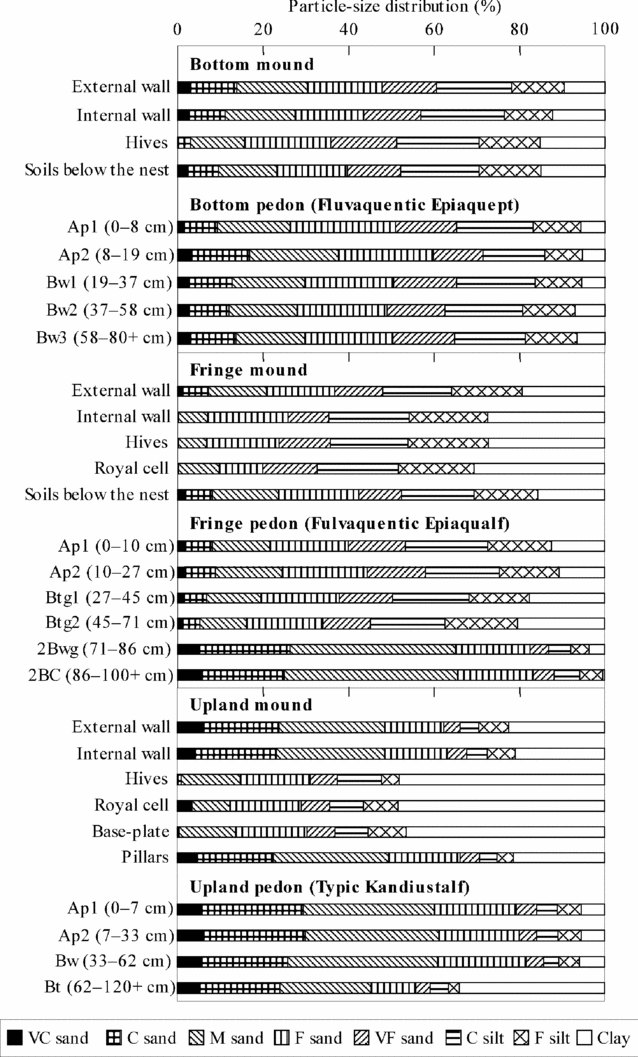
Particle size distribution varied widely among structural units of the mounds (Figure 1), which indicated the methodological weakness of many previous reports (Ekundayo & Aghatise Reference EKUNDAYO and AGHATISE1997, Sheikh & Kayani Reference SHEIKH and KAYANI1982) that assessed the mound as a whole and adjacent topsoil only. In particular, structural units in the nest body (i.e. hives, royal cells and base plates) contained finer particles than the other mound constituents (i.e. walls and pillars) and soils below the mound, except for the fringe mound, where nest body and other mound constituents had similar particle size distribution. Combination of silt and sand distribution differentiates nest bodies from the other mound structures at any location on the toposequence. This suggests that M. bellicosus will use different soil particles depending on the function of each mound structure or ecological requirement for their livelihood. Jouquet et al. (Reference JOUQUET, LEPAGE and VELDE2002, Reference JOUQUET, BOTTINELLI, LATA, MORA and CAQUINEAU2007) also pointed out that the termites (Odontotermes nr. pauperans and Pseudacanthotermes spiniger) used soils having contrasting particle size distribution by selection to various extents in response to ecological requirements such as structural stability and water-holding capacity.
Particle-size distribution of Macrotermes bellicosus mounds and surrounding pedons on a toposequence at the study site. A = mineral surface horizon with organic matter accumulation; B = subsurface soil structure; C = little or no pedogenic alteration. g = greyish colour with redoximorphic features; p = plough layer or other artificial disturbance; t = illuvial accumulation of silicate clay; w = weak colour or structure development.

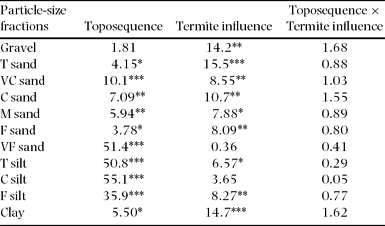
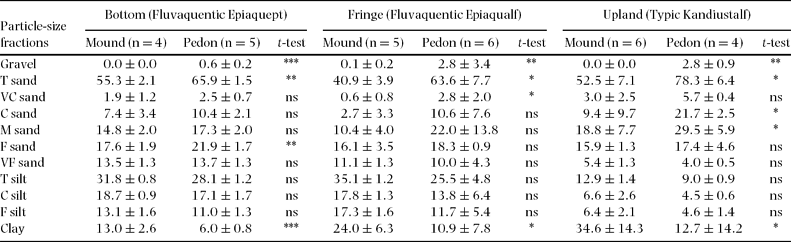
In spite of considerable variability in the mounds, the mound structures, particularly the upland mounds, apparently had finer particles than the upper horizons of the adjacent pedons (Figure 1). Setting the subsurface horizon (Ap2) fraction to 100%, fractions that were depleted in the mound as compared with the subsurface horizon were: VC sand (average bottom mound (MB), 58%; fringe mound (MF), 33%; upland mound (MU), 49%), C sand (average MB, 54%; MF, 38%; MU, 39%), M sand (average MB, 71%; MF, 66%; MU, 60%) and F sand (average MB, 79%; MF, 81%; MU, 84%). Fractions that were enriched in the mound as compared with the subsurface horizon were: C silt (average MB, 130%; MF, 103%; MU, 130%), F silt (average MB, 145%; MF, 124%; MU, 116%) and clay (average MB, 254%; MF, 224%; MU, 636%). The limit for particle size selection by M. bellicosus was VF sand because there were no clear differences observed in VF sand content between the mound and the pedon at each toposequence position. In addition, the mound structures were gravel-free in contrast to the surrounding pedons which contained gravel in the range 0.39–7.61 g kg−1. These results were supported by analysis of variance which showed influence of M. bellicosus on various sizes of particles except for VF sand and C silt (Table 1). Furthermore, the Fisher's protected probability test indicated significant differences in the contents of gravel, total (T) sand and clay between the mound and pedon at each toposequence position (Table 2). This indicates that M. bellicosus preferentially uses finer soil particles and intentionally excludes gravel in building mounds. This is in agreement with many previous studies (Jouquet et al. Reference JOUQUET, LEPAGE and VELDE2002, Reference JOUQUET, TESSIER and LEPAGE2004, Reference JOUQUET, BOTTINELLI, LATA, MORA and CAQUINEAU2007; Lobry de Bruyn & Conacher Reference LOBRY DE BRUYN and CONACHER1990). Macrotermes bellicosus manipulated clay most among the different particle size fractions because clay accumulated in the mounds plays a significant role in stabilization of the mound structure or in enhancement of water-holding capacity (Jouquet et al. Reference JOUQUET, LEPAGE and VELDE2002, Reference JOUQUET, TESSIER and LEPAGE2004).
Analysis of variance of the influence of toposequence and Macrotermes bellicosus on particle-size distribution.*, ** and *** represent P < 0.05, P < 0.01 and P < 0.001, respectively. T = total; VC = very coarse; C = coarse; M = medium; F = fine; VF = very fine.

Comparison of particle-size distribution between the Macrotermes bellicosus mound and surrounding pedon at each toposequence position at the study site. The value represents mean ± SD. The t-test represents not significant (ns), significant P < 0.05 (*), P < 0.01 (**) or P < 0.001 (***) between the mound structures and adjacent natural horizons at each toposequence position. Gravel in the fringe pedon exceptionally has n = 5. T = total; VC = very coarse; C = coarse; M = medium; F = fine; VF = very fine.

It is noticeable from Figure 1, that the upland mound contained more clay but less C and F silts and VF sand than the fringe and bottom. The particle size distribution of the mounds apparently reflects that of the surrounding pedons. It is widely agreed that termites preferentially use subsoil material to build their mounds (Lee & Wood Reference LEE and WOOD1971, Lobry de Bruyn & Conacher Reference LOBRY DE BRUYN and CONACHER1990). The findings of this study suggest that M. bellicosus mainly used argillic horizons (a subsurface horizon with clay illuviation), i.e. Btg1 and Btg2 at the fringe, and Bt2 at the upland, for building their mounds. This assumption is also supported by soil organic carbon distribution and forms and contents of iron oxides (Abe & Wakatsuki unpubl. data, Abe et al. Reference ABE, YAMAMOTO and WAKATSUKI2009). The limited number and relatively small volume of M. bellicosus mounds in the lowlands (Abe et al. Reference ABE, YAMAMOTO and WAKATSUKI2009, Kang Reference KANG1978) is probably due to interference with a shallow water table in poorly drained soils. However, limited access to a clay-rich subsoil may be another constraint for mound construction. This might be endorsed by field observation that well-developed mound nests with a cathedral shape and base plate were found only in well-drained upland sites (Abe et al. Reference ABE, YAMAMOTO and WAKATSUKI2009).
Our findings showed (1) M. bellicosus generally selected the same particle size whatever the local soil along the toposequence, but (2) clay content in the subsoil and accessibility to clay-rich soil horizons may define nest-building capacity.
ACKNOWLEDGEMENTS
The financial support for the field survey was provided by the Japan Society for Promotion of Science (Grant-in-aid No. 15101002). The authors are grateful to O. O. Fashola, J. Aliyu, A. N. Agboola and H. Y. Fu for the generous support in the field sampling, to Y. Terano for technical assistance with the laboratory analysis and to M. C. S. Wopereis, S. O. Oikeh, K. Saito and two anonymous referees for useful comments on an earlier version of the manuscript.