1. Introduction
When people today use the phrase “spontaneous symmetry breaking” or the initialism “SSB,” they usually refer to the technical concept in condensed matter physics (cf. Anderson Reference Anderson1997) and high-energy physics (cf. Coleman Reference Coleman and Zichini1975,Weinberg Reference Weinberg1996). The theories of SSB in those fields are complex and recondite, and so it could be difficult to see clearly what SSB really means. By reading articles on the subject in the major journals of physics and mathematical physics, one does not usually come away with a clear understanding of such simple questions as why the symmetry breakings are spontaneous or even what the word “spontaneous” really means in those contexts. What is the difference between SSB and the usual types of symmetry breaking? We sometimes hear in the literature the claim that “SSB” is a misnomer (cf. Coleman Reference Coleman and Zichini1975, 142), and the correct phrase should be “hidden symmetry.” What does the latter mean and is the claim true? We also hear talks about the breakings of symmetry in SSB being “arbitrary” or “a matter of a free choice” or “a matter of pure chance”(cf. Moriyasu Reference Moriyasu1983, 99;Brout and Englert Reference Brout and Englert1998, for Salam's metaphor). Whether given as literal or metaphorical, how should such talks be interpreted? Moreover, we often hear the philosophically inclined announce that in SSB all doubts about the existence of emergent properties can finally be put to rest (cf. Anderson Reference Anderson1997, 263–266). Is this justified?
Fortunately we can answer most of the above questions concerning the nature of SSB by examining some simple mechanical models (see inter alias, Greenberger Reference Greenberger1978,Sivardière Reference Sivardière1983,Drugowich de Felício and Hipólito Reference Drugowich de Felicio and Hipolíto1985). The SSB in such models can be shown to have the main features of SSB.Footnote 1
2. The Model
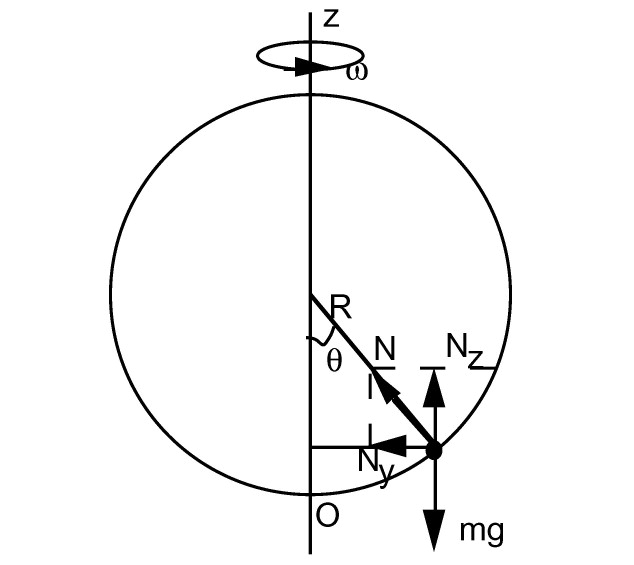
Imagine a circular metal hoop vertically suspended as shown in Figure 1. It rotates freely, and on it is frictionlessly threaded a bead. The only forces acting on the bead are gravity, mg, and the normal force, N, the bead receives from the hoop.
A bead with mass, m ≠ 0, is free to move frictionless on a circular hoop of radius, R, which rotates around the z-axis with a variable w.

Question: when is the bead stationary on the hoop? In other words, what is (are) the equilibrium state(s) of this rotating system? The bead may be stationary whenever the forces are balanced out, which means,
In z-direction:

In y-direction:

where, a is the linear acceleration of the bead, which is

When (1) is true,
 $N=mg/ \mathrm{cos}\,\theta $
. Substitute this into (2) to eliminate N, we have

or

where
 $\beta =\omega ^{2}R/ g$
.
There are obviously two solutions to this equation:
i.
 $\theta =\theta _{0}=0$
such that
$\mathrm{sin}\,\theta _{0}=0$
, which therefore satisfies (3).
ii.
$\theta =\pm \theta _{1}\neq 0$
such that
$\mathrm{cos}\,\theta _{1}=1/ \beta $
.


Solution (ii), θ1, has a further property:
 $\mathrm{cos}\,\theta _{1}$
increases when ω decreases (with R and g held constant), and yet
 $\mathrm{cos}\,\theta _{1}$
has an upper bound of 1. Hence, there is a critical value,
 $\omega =\omega _{1}$
, where
 $\mathrm{cos}\,\theta _{1}=1=g/ \omega ^{2}_{1}R$
, such that below this value solution (ii) makes no sense in physics. The standard way of dealing with such a situation in physics is to say that then solution (i) takes over, so that for all ω such that
 $0\leq \omega \leq \omega _{1}$
,
 $\theta =\theta _{0}=0$
is the solution at which the system is in equilibrium; and for those ω such that
 $\omega > \omega _{1}$
, solution (ii) —
 $\mathrm{cos}\,\theta _{1}=1/ \beta $
—takes over so that all angles θ1, where
 $0< \theta _{1}< \pi / 2$
, are possible stationary positions for the bead on the hoop.
Or alternatively, though perhaps less transparently, the same results can be reached from the Lagrangian (or Hamiltonian) formulation of this problem. Besides obtaining the two solutions, it also gives us the potential energy (or a dimensionless function of it) as a function of the angle, θ. Without going into the actual derivation (see Greenberger Reference Greenberger1978 for details), let me summarize the main steps of the argument. The Lagrangian of the bead is of the usual form: L = (kinetic energy) − (potential energy). Since we are only concerned with the stationary situations, we only need to look at the potential energy term, which has two components: one due to the bead's weight and the other its centrifugal tendency. Writing everything out explicitly, we have the potential energy in the following form:

where U(θ) is the dimensionless potential and it has the following form.

Now, for the bead to be in equilibrium on the hoop at a give ω its potential must be an extremum, which means that

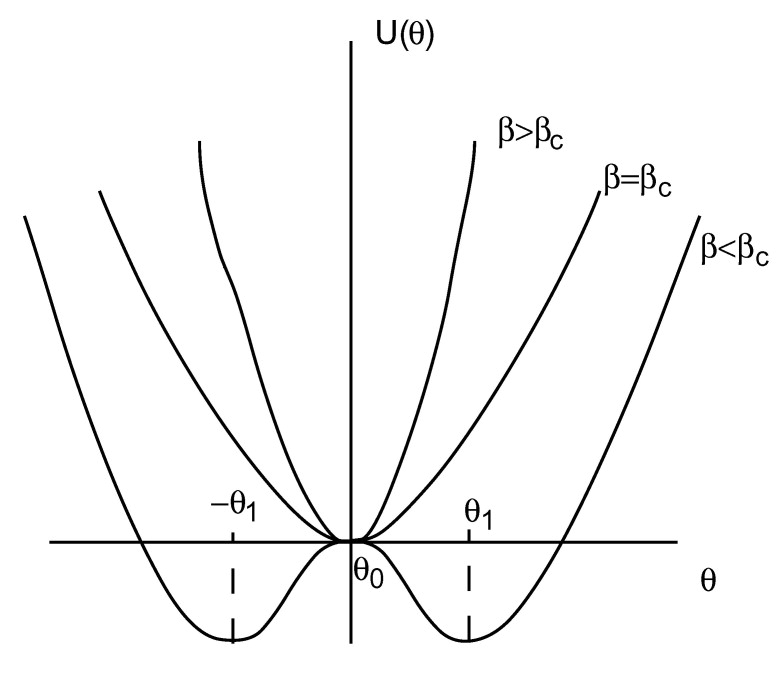
This equation, one should realize, is essentially the same as (3); and so we can derive the same two solutions as given earlier. There are two further benefits from this approach: an exact knowledge of the solutions' stability and a diagram—in which U(θ) is plotted against θ —that vividly shows the SSB in this model.
First, the solutions from (5) are stable if
 $\partial ^{2}U/ \partial ^{2}\theta > 0$
; and now
 $\partial ^{2}U/ \partial ^{2}\theta =\mathrm{cos}\,\theta -\beta \mathrm{\cos}^{2}\theta $
. So,
iii. for
$\theta =\theta _{0}=0$
, we have
$\partial ^{2}U/ \partial ^{2}\theta =1-\beta $
, which means that the bead is stable at this position for
$\beta < 1$
; andiv. for
$\theta =\pm \theta _{1}$
or
$\mathrm{cos}\,\theta _{1}=1/ \beta =g/ \omega ^{2}R$
, we have
$\partial ^{2}U/ \partial ^{2}\theta =\beta -1/ \beta $
, which means that the bead is stable at these positions for
$\beta > 1$
.







In other words,
 $\beta _{c}=1$
or
 $\omega _{1}=\sqrt{g/ R}$
is a critical value where the stable equilibrium solution switches from
 $\theta =\theta _{0}=0\,\mathrm{to}\,\,\theta =\theta _{1}> 0$
, as shown in Figure 2; and the latter no longer preserves the reflectional symmetryFootnote 2 across the z-axis.
The dimensionless potential, U(θ), against θ. Note,
 $\beta =\omega ^{2}R/ g$
and
 $\beta _{c}=\omega ^{2}_{1}R/ g=1$
.

The structural properties of SSB in this model, as highlighted above, are present in all the better known models in previously mentioned fields. In condensed matter physics, models of ferromagnetism (e.g., the Heisenberg model), for instance, have temperature (analogous to β) as the controllable parameter, the crossing of whose critical value (the Curie temperature) brings about a breaking of the rotational symmetry that the systems' Lagrangians preserve, which results in ground states—the lowest energy states—of spontaneous magnetization (analogous to the departure of the bead from O). And in high-energy physics, the models of gauge fields (e.g., the SU(2) gauge field) have an effective mass term, μ2, as their parameter, which has a critical value that separates the symmetrical from the symmetry-breaking region. The symmetries broken in these cases are the respective gauge groups (e.g., SU(2)) that their Lagrangians preserve. In fact, Figure 2 can be used to illustrate the SSB of a scalar gauge field with a simple replacement: θ → φ and β → μ2, where φ represents the field and μ
 $^{2}_{c}=0$
. There are even analogs of equation (5) (or (3)) in gauge fields whose solutions produce the bifurcations (cf. Anderson Reference Anderson1997, Strocchi Reference Strocchi1985, and Quigg Reference Quigg1983).
3. The Meaning of SSB
I shall begin the dissuasion with the simplest question:
1. Why is the symmetry breaking in the model not a symmetry breaking of the usual type?
A common answer in the literature goes as follows: An SSB occurs in a system when its Lagrangian or dynamical law has certain symmetries which the ground state solutions do not preserve (cf. e.g., Anderson Reference Anderson1997, 266; Coleman Reference Coleman and Zichini1975, 141–142). Let's see what this claim means in our model. The independent variables in the model which determine the bead's states are, in polar coordinates, θ,
 $\dot{\theta };\varphi,\dot{\varphi }=\omega $
, which are, respectively, the vertical angle from the z-axis, the velocity; the horizontal angle of rotation, the angular velocity. Now ϕ does not explicitly appear in the Lagrangian, which means that the Lagrangian has the rotational symmetry (i.e., the transformations
 $\varphi \rightarrow \varphi \prime =\varphi +\alpha $
, where α is an arbitrary angle, do not affect the Lagrangian). The Lagrangian is such a function of θ and
 $\dot{\theta }$
that it is also reflectionally symmetrical (i.e., invariant under θ→-θ,
 $\dot{\theta }\rightarrow \dot{\theta }$
).Footnote 3But from Figure 2 we see that U(θ1)—a clear example of a ground state—has no reflectional symmetry.
This is clearly different from the breaking of a symmetry when the Lagrangian in question contains a term that does not preserve the symmetry.
2. Do all cases of nonspontaneous symmetry breakings have some asymmetrical terms in their Lagrangians?
What the Lagrangian represents may be regarded as the lawlike properties of a system, which include both its intrinsic properties and nonaccidental interactions with its environment. And a particular state of a system should be the result (or evolution) of its lawlike properties with a given set of initial and/or boundary (i/b) conditions (cf. Wigner Reference Wigner1979). It is certainly possible that a symmetry is broken not because of any asymmetrical lawlike properties—that would show up in the Lagrangian, but because of some special i/b conditions—that would not (Wigner Reference Wigner1979). Then it is a natural question to ask:
3. Can a symmetry breaking caused by i/b conditions be an SSB?
It seems that the answer would have to be “no,” for the SSB in our model does not appear to be a case of symmetry breaking by any special i/b conditions. To see this point, just imagine that we begin with
 $\omega =0$
and let ω very slowly (e.g., adiabatically) increase. The argument in the previous section is taken to imply that once ω passes the critical value, the bead will depart from O and ascend the hoop, thus breaking the symmetries; nowhere in this argument are any asymmetrical i/b conditions introduced.
Note that it is not a legitimate objection to simply say that because the model is idealized it does not tell us what happens in a real hoop-bead system where any number of asymmetrical causal factors may exist to actually break the symmetries. The bifurcation of the ground state beyond the critical point is a result for the model as it is given, idealized and totally symmetrical; therefore no asymmetrical factors of a real system are relevant.
We now ask the question:
4. Is a symmetry broken in SSB without any cause?
Since neither a lawlike property nor any i/b conditions of a system may be regarded as responsible for a true SSB, the answer may obviously appear to be affirmative. But the matter is not so simple, so let us approach it more carefully. First, van Fraassen (Reference van Fraassen1989, chs. 10 and 11) discussed two general forms of what he calls “the symmetry arguments”:
There are two forms of argument which reach their conclusion “on the basis of considerations of symmetry.” One, the symmetry argument proper, relies on the metaprinciple: that structurally similar problems must receive corresponding similar solutions. A solution must “respect the symmetries” of the problem. The second form, rather less important, assumes a symmetry in its subject, or assumes that an asymmetry can only come from a preceding asymmetry. (Reference van Fraassen1989, 233)
Since the second form is rather a strategy in theory constructions than a principle (and one may argue that it follows, or is strongly suggested by, the contrapositive of the metaprinciple), I shall only consider the first form in connection with our question above. Let us then look at the following question:
4.1. Is the metaprinciple—structurally similar problems must receive corresponding similar solutions—true among deterministic systems?
Here is another way of putting the metaprinciple: problems that can be transformed into one another by a symmetry must receive solutions that are related by the same symmetry. A symmetry here means a group of transformations that leaves what is transformed “essentially the same” or “the same in all essential properties” (van Fraassen Reference van Fraassen1989, 235–236). And we only consider deterministic systems because (i) our model is a deterministic system, and (ii) there is a sense in which the principle is already violated by any indeterministic systems.Footnote 4
Prima Facie, the answer is “no” and the SSB in our simple model is sufficient for such an answer. The “problems” in our model would be the different equations or Lagrangians connected by the reflectional and/or rotational transformations mentioned earlier (i.e., the symmetries for the problem). If the principle holds, the ground-state solutions should also preserve the symmetries; but they do not preserve the reflectional symmetry in the region of
 $\omega > \omega _{1}$
. Hence, the metaprinciple fails.
Second, as mentioned in the introduction, some people argue that SSB is a misnomer; the phenomena it refers to should properly be called “hidden symmetries.” The laws which govern the behavior of a system has one set of symmetries and the behavior another, usually lesser, set. Since what we observe is behavior, the symmetries of the laws are therefore hidden from us. Now the question:
4.2. Is there a breaking of symmetry in the case of hidden symmetries?
Some people (e.g., Coleman Reference Coleman and Zichini1975, 141) argued that there is nothing unusual about a symmetry being hidden in the aforesaid manner, and therefore no symmetry needs be regarded as “broken” in SSB; and all the worry about an uncaused “breaking” of something is a misguided exercise caused by an inappropriate name! If so, the answer to our previous question—whether the metaprinciple holds—is still a “no” since the symmetries are still not preserved; however, it seem to suggest that “there is no reason why” such a principle should hold or why anybody should regard it a kind of violation to have symmetries in a problem (e.g., a Lagrangian) which are absent in its ground-state solutions.
In a limited sense this is just right for our model as I explained earlier. However, if you look at the model and consider the movement of the bead as ω increases, something extraordinary does happen and hence a symmetry breaking really seems to be present. To repeat what I said earlier in response to the third question, as the hoop begins to rotate and very slowly increases its angular velocity, at first the bead sits at the bottom of the hoop, motionless; but as ω passes its critical value ω1 the bead starts climbing the hoop and thus breaks the reflectional symmetry. However one regards the symmetries of the Lagrangian or the laws in this model (e.g., as “hidden” or otherwise), there is presumably a physical process during which the system goes from preserving them (
 $0\leq \omega \leq \omega _{1}$
) to not preserving one of them (
 $\omega > \omega _{1}$
). Therefore, calling the symmetries “hidden” rather than “broken” does not make the legitimate quest for an explanation of why the bead suddenly departs from O goes away.
Third, if there is a breaking of a symmetry, it might not be too far-fetched to ask: what then is its dynamics? So here we have,
4.3. Is there a dynamic process for SSB and, if there is, do we, or are we likely to, have a theory for it?
What we said above seems to indicate that there is a dynamic process through which the bifurcation occurs (or the symmetry is broken); and as we saw earlier that this is true for all models of SSB (a bifurcation which breaks the symmetry occurs when the values of some (controllable) parameter crosses its critical value). But such parameterized dynamic processes are not the ones that are responsible for the actual breakings of any symmetries, and if there are such dynamic processes, they may never be accurately accounted for by any physical theory.
First, one should not think that if there is ever a real system exactly like our model, then the bead, initially sitting motionlessly at the bottom of the hoop, would ever depart from that point however fast the hoop rotates. This is because it is one thing for that position (i.e., O in Figure 1) to no longer be the stable equilibrium state for the bead when
 $\omega > \omega _{1}$
but quite another for the bead to actually move out of it (and to be transferred into one of the new stable equilibrium states). One can easily see by looking closely at Figure 2 that O is still an equilibrium state when
 $\omega > \omega _{1}$
; only it is no longer a stable one. The difference between these two kinds of states is essentially that a system in the latter will return to it when subject to perturbations,Footnote 5 while a system in the former will not. In other words, if there are perturbations present in our model, the bead will not stay at O when
 $\omega > \omega _{1}$
but will stay at θ1 or −θ1. Since, strictly speaking, there are no perturbations of any kind in our idealized model, there should not be any movement of the bead which causes the actual breaking of any symmetries of its Lagrangian or its laws.Footnote 6
Therefore, second, our model should best be seen as telling us the possibility of SSB, not what it actually is. In other words, it does not tell us what the dynamic process is by which the bead actually breaks the reflectional symmetry, namely, it's making the transition from a symmetrical state to an asymmetrical one. The actual breaking can happen only if some asymmetrical causal factors are assumed to exist in or around the system. Because of the instability of position O (or
 $\theta _{0}=0$
), neither a sustained force nor a disturbance of measurable magnitude is necessary; small, and usually random, perturbations (or fluctuations) are sufficient to do the job. Because of the ubiquitous presence of such perturbations, people often neglect to mention them and talk as if an SSB may occur even in an idealized model as ours.Footnote 7
Therefore, the dynamic process in our model which is parameterized by the angular velocity of the hoop and which tells us a complete story of how the ground state solution of the system bifurcates from a single symmetrical state to two asymmetrical states is not the process by which an SSB occurs, if it actually occurs at all. The “real” (or efficient) cause is something for which the model has no account.
Now, there must be dynamic processes that link the perturbations and asymmetrical ground states if SSB are regarded as deterministic phenomena. However, in no case of SSB in any fields of physics can one hope to know, or to write down explicit accounts for, the actual processes in terms of specific i/b conditions. Hence, it is better to characterize perturbations as random elements and to study the actual transitions in SSB in terms of probabilistic distributions.Footnote 8
Hence, there are two ways—one may think of it as SSB1 and SSB2—of giving the notion of SSB a precise meaning: (i) it means that there are stable ground states that do not preserve some of the symmetries of the Lagrangian (or the laws); or (ii) it means that any actual breaking of a system's symmetry can be achieved by random perturbations. Of course, were the symmetrical ground state not unstable, perturbations would not be capable of breaking the symmetry. Whether SSB proper only means (i) is a question that requires careful considerations (discussed elsewhere, also see Kosso Reference Kosso2000 for a rather different view). Whatever the answer to it, the following is true of SSB: The difference between SSB and other types of symmetry-breakings is that in the latter both the possibilities and the actual breakings are produced (or caused) by the same agent, while in the former they are not. That which produces the possibility of SSB is usually completely different from that which causes the actual breakings.
Finally, with this much said, the answer to our main question (i.e., question 4)—whether SSB is uncaused—must be negative. Someone may object to this answer as follows. Is it not true according to my own account of SSB that even without perturbations, the new stable ground state is already asymmetrical, and therefore the metaprinciple is violated in that the symmetry in the problem is no longer a symmetry in the solution?
The point would be justified if an interesting feature of the ground states which are suppose to comprise the “symmetry breaking” solution is absent. From Figure 2 one can clearly see that the ground states when
 $\omega > \omega _{1}$
always come in pairs: (θ1, −θ1), which taken together is reflectionally symmetrical, and if one imagine a 3-d extension of the figure, i.e., with
 $0\leq \varphi < 2\pi $
, one can see that the solution is also rotationally symmetrical. This is what physicists call a (continuously) degenerate solution, meaning that from a formal point of view any of these infinite number of ground states—〈θ1, ϕ〉—is a possible stable ground state. Of course, each of these states is not reflectionally symmetrical, but taken together the solution, which is what our model offers, still has a symmetrical “shape.” Hence the formal results in this sense preserve the symmetries of the Lagrangian.
This is a remarkable feature of SSB: it shows that even with the possibility of symmetry breaking, SSB respects at some level the symmetries in the problems. And it is shared by all the better known cases of SSB in condensed matter physics and high-energy physics. In fact, this ought to be so, for if the ground states do not form a degenerate set whose members are transformable from one to another by the same symmetry that each is supposed to break, it would be a genuine puzzle as to how random perturbations could produce a set of nonrandomly distributed possibilities. For instance, if in our model, state U(θ1) is possible but U(−θ1) is not, then it would be a puzzle as to why the perturbations in the direction of θ1 can cause the bead to ascend the hoop while the perturbations in the direction of −θ1 can not; or it would be equally puzzling why there are perturbations in the direction of θ1 but none in the direction of −θ1, given the symmetries assumed in the model. On the other hand, if it ever turns out that there are such SSB, then the metaphysical landscape of physics would be radically changed. So far, we do not see a need for such a change.
In connection with van Fraassen's metaprinciple or to visit question 4.1 again, we may say the following. “No asymmetry in, no asymmetry out” holds in spite of the existence of SSB. If we banish the random perturbations (which we do for all idealized models), the “broken symmetrical” solution comprise a set of degenerate ground states, each of which breaks the symmetry but all of which together preserve it. If we count the random perturbations, then “no asymmetry in” is no longer true.
And in connection with our question (3) of whether SSB may be a case of symmetry breaking by i/b conditions, we now see that the answer will depend on our conception of random perturbations or fluctuations. According to Poincaré (Reference Poincaré1952, 64ff), being the results of perturbations is what it means to be the results of chance. Along this line, we should not count in i/b conditions such things as perturbations or fluctuations, for otherwise, we are clearly not following the schematic division of dynamical laws and i/b conditions that Wigner (Reference Wigner1979) has emphasized. And hence, SSB is not a case of symmetry breaking by i/b conditions. However, this short remark does not do justice to this rich subject about chance and perturbations, which is discussed elsewhere.
Finally, we come to the question: Why should the increase of the angular velocity in our model, nowhere during which is any asymmetry introduced, “cause” a transition from a symmetry preserving ground state, 〈θ0, 0〉, to a set of symmetrical breaking ground states, 〈θ1, ϕ〉,
 $0< \varphi < 2\pi $
? The answer for this case turns out to be very simple. The centrifugal tendency of the bead is proportional to ω2, and where the ground state of the bead lies depends on the balance between the weight and this tendency of the bead. When
 $\omega < \omega _{1}$
, the balance is in favor of the weight, and hence the ground state is at O; but when
 $\omega > \omega _{1}$
, the balance tips the other way, and hence the ground state “climbs” up the hoop. But the centrifugal tendency is only a potential. So without an actual initial deviation, the symmetry will not be broken. An analogous but more interesting answer exists for a similar question in condensed matter physics. Certain directions of phase transitions in a thermo-system are examples of SSB: for instance, a transition from liquid to a solid or from a paramagnet to a ferromagnet. What happens in these transitions is the formation of “long-range” (or large-scale) orders in systems that are not the result of any external influcences and that break the (characteristic) symmetry in the previous phase. Now, why should the decrease of temperature of such systems across a critical value spantenously breaks the symmetry of the system? The balance in this case is the local tendency to form an order and the global thermo-agitation that prevents such a tendency to achieve a global “alignment.” When the temperature is high, the balance is in favor of the thermo-agitation, and the phase has the symmetry of being “without order” as in the case of a liquid in equilibrium; but when the temperature is lowered across the critical value, the balance tips over to the other side, where the tendency of forming long-range order becomes dominant. This is when a local fluctuation towards an order may easily grow into a long-range order and thus spontaneously breaks the symmetry.
4. Conclusion
From a simple classical model we are able to see that what people usually refer to as SSB has in fact two different meanings: SSB1 means having stable and degenerate ground states each of which taken singly breaks the symmetries of the Lagrangian (or the laws); and SSB2 means that the breakings of symmetries can be done by random perturbations or fluctuations; and also how in such phenomena, a symmetry in question is and is not broken, depending on which level one is considering it. Thus, we can give simple answers to most of the questions I sampled in Section 1. When people argue that SSB is a misnomer and that it should be called “hidden symmetry,” they are thinking of SSB1 but not SSB2, for it is not proper to call a symmetry hidden if SSB2 is part of its meaning. The metaphorical image of objects “choosing” to break a symmetry without apparently having a sufficient reason can now be understood as alluding to the fact that, according to SSB2, the symmetry may not be broken by anything that can be counted in physics as a given cause. Of course no object really makes a free choice in an SSB; but analogous to Buridan's ass which goes for one of the stacks of hay, the arbitrariness with which an object moves into one of the symmetry-breaking ground states reflects the fact that all such states are of equal chance. Other questions, such as whether SSB has demonstrated the existence of emergent properties, will have to be discussed elsewhere.