Expanding market consumption is widely ascribed a key role in European economic growth before industrialization. A “Consumer Revolution” between 1650 and 1800 is thought to have seen the middle classes spending lavishly on luxuries and the masses buying cheap fashions and comestibles.Footnote 1 In a parallel “Industrious Revolution,” it is argued, a growing demand for market goods motivated households—especially women and children—to reallocate time from leisure and household production to income-earning work.Footnote 2 New norms of market consumption and market labor are supposed to have become self-reinforcing, drawing hitherto unused supplies of human time and ingenuity into productive activities and increasing the demand for new goods. These Consumer and Industrious Revolutions, it is believed, fuelled the agricultural revolution, proto-industrialization, and factory industrialization—setting the stage for modern economic growth.Footnote 3 Theories of the Consumer and Industrious Revolutions thus have far-reaching implications not only for economic history, but for economic development more widely. However, they also pose significant open questions.
For one thing, nearly every early modern economy—in northern, central, and southern Europe, as well as parts of Asia—is now supposed to have had its Consumer and Industrious Revolution.Footnote 4 But supportive evidence—inventories showing a proliferation of market goods, sources hinting at longer working hours—comes almost exclusively from the North Atlantic economies. Indeed, most of it applies specifically to the Netherlands and England which, as the early modern “miracle economies,” may have been exceptional in other ways. Until we explore the Consumer and Industrious Revolutions more thoroughly for later-developing economies, we will not fully understand the significance of market consumption and industriousness for economic development.
This raises a second question. Consumption and work are social activities, yet theories of the Consumer and Industrious Revolutions invoke only two social institutions: the family and the market.Footnote 5 This may be justified for the Netherlands and England, with their nuclear family households and precocious market economies. But most early modern European economies had active nonfamilial, nonmarket institutions: craft guilds, merchant associations, village communities, urban corporations, manorial systems, religious bodies, privileged corporate “orders,” political authorities, and many more.Footnote 6 Political scientists regard many premodern institutions (particularly guilds and communities) as exemplars of the closely knit and multistranded social networks that generate “social capital”—the stock of norms, information, sanctions, and collective action that are believed to play a key role in economic development.Footnote 7 Social institutions and their associated social capital varied greatly across early modern Europe. How, then, did they affect the Consumer and Industrious Revolutions?
This leads to a third open question. These early modern “revolutions” are supposed to have been spearheaded by females, who increasingly purchased clothes and comestibles in the market, using cash they earned from reallocating time from unpaid household work to market jobs.Footnote 8 This might seem perfectly consistent with what we know about the Netherlands and England, where early modern travelers remarked on the astonishing degree of freedom manifested by Dutch females,Footnote 9 and the Duke of Württemberg wrote on his 1598 visit to England that “the women have much more liberty than perhaps in any other place; they also know well how to make use of it, for they go out dressed in exceedingly fine clothes … [England is] a paradise for women, a prison for servants, and a hell or purgatory for horses … for the females have great liberty and are almost like masters, whilst the poor horses are worked very hard.”Footnote 10 But in most early modern European economies, women faced a huge array of institutional constraints on their work and consumption choices. Did these widely varying restrictions on women have no impact on the Consumer and Industrious Revolutions?
This study addresses these questions by focusing on an economy in late-developing central Europe which, although market-oriented in many ways, had strong nonmarket social institutions and significant constraints on women. The southwest German territory of Württemberg differed from the Netherlands and England, but resembled many other parts of continental Europe, in the enduring powers of its guilds, communities, and local religious institutions. Württemberg retained occupational guilds until 1862, not just in traditional handicrafts, but also in export-oriented proto-industries, shopkeeping, and merchant trading.Footnote 11 Württemberg also had powerful local communities, whose courts, councils, officials, and citizens' assemblies monitored and regulated work, leisure, consumption, education, marriage, sexuality, and economic transactions.Footnote 12 Württemberg established local church courts in the 1640s which remained active until c. 1890, imposed fines and incarceration as well as religious penances, and closely regulated work, consumption, sociability, sexuality, poor relief, and cultural practices.Footnote 13 Detailed micro-studies have shown how these guilds, communities, and religious institutions generated a rich “social capital” of shared norms, information, sanctions, and collective action, which significantly influenced the economic options of an otherwise highly market-oriented population.Footnote 14 Württemberg is thus a good test case for exploring the Consumer and Industrious Revolutions in a late-developing economy permeated by the “social capital” of nonmarket institutions.
What would we expect to observe if “social capital” affected the Consumer and Industrious Revolutions? For one thing, traditional institutions often enforce social norms about labor, particularly for women, youths, and the laboring poor. So the first section of this article examines whether social institutions, by regulating work and wages, observably changed people's incentives and capacity to reallocate time from household to market production. Traditional institutions also often enforce social norms about commerce—who can trade, in what goods, in what ways. The second section of the article therefore explores whether social institutions, by regulating commerce, affected how retailers made new market wares available to wider social strata. Traditional institutions also typically impose social norms about the quantity, quality, and style of consumption deemed appropriate for particular social groups—particularly women and the lower orders. The third section therefore investigates whether sumptuary controls observably affected people's consumption practices. Finally, traditional institutions often enforce norms about gender roles and household authority. The fourth section of the article therefore examines whether nonfamilial institutions, by intervening in family conflicts, observably altered women's ability to increase market work and market consumption.
SOCIAL CAPITAL AND “INDUSTRIOUSNESS”
For the Industrious Revolution to succeed, economic agents mainly active in household production and leisure—particularly women—had to be free to shift to market employments. They also had to be offered remuneration that motivated them to make this move. Historians of the Netherlands and England have pointed out two of the institutional preconditions for this to happen: a family system permitting women to work outside the household, and labor markets for both sexes. These two conditions were satisfied under the European Marriage Pattern.Footnote 15 But other institutions also affected the extent to which women could shift from household to market, as we see by broadening the analysis to other parts of Europe.
Württemberg had all the hallmarks of the European Marriage Pattern—late female marriage, high female celibacy, low fertility, small and simple nuclear family households.Footnote 16 Had the family system been all that mattered, low sex ratios and high female celibacy should have created generous labor market opportunities for women.
Women in Württemberg did often work in the market, as I have shown in detail elsewhere. But the jobs they did and the wages they earned were affected by institutions other than family and market.Footnote 17 For one thing, community officials and courts often ordered women to work inside households for husbands, parents, or masters rather than taking market employment. Married women shifting from household to market work were important to any Industrious Revolution, but in Württemberg they encountered obstacles from community institutions. Thus, for instance, in 1742 the Ebhausen village court ordered a knitter's wife who was working independently to return to her prodigal husband.Footnote 18 Likewise, in 1793 a Wildberg citizen complained that the wife of an itinerant basketmaker was collecting rags for a village paper miller without an official license, whereupon the communal assembly ordered the village to eject the couple.Footnote 19
The Industrious Revolution also depended on unmarried women shifting from household production for fathers or masters (who also provided their clothes and comestibles) to market production in which they earned their own money (and controlled their own consumption choices).Footnote 20 In societies such as Württemberg, however, independent unmarried women were given an especially pejorative name—Eigenbrötlerinnen (literally “own-breaders”)—and were routinely harassed. Communities tolerated them only as long as they did not encroach on guild privileges, demand wages above the legally fixed rate, deprive male relatives of household labor, take risks that might burden the welfare system, annoy respectable citizens, or violate other social norms. In 1646, for example, when a Wildberg citizen complained that “several unmarried girls are lodging with several citizens here, and should, in his view, be instructed to engage themselves to masters,” the community assembly immediately ordered all Eigenbrötlerinnen to take service within three weeks on pain of a fine of 3 Gulden (almost one year's earnings for a maidservant).Footnote 21 It was not uncommon for an Eigenbrötlerin to be ordered, like Barbara Waltz in 1687, “either to enter into service or, if she has an honorable offer, to get married.”Footnote 22Eigenbrötlerinnen who refused to shift back from market to household production could be ordered to leave the community, as in 1687 when the Ebhausen church court “summoned Barbara Hilber on account of her Eigenbrötlen [own-breading]” and “ordered her out of the hamlet,”Footnote 23 in 1717 when three Ebhausen Eigenbrötlerinnen were instructed to “move away within eight days,”Footnote 24 or in 1752 when Barbara Kleiner was reported to the Wildberg court by her landlord for working independently as a lodger “although she could work as a servant,” and was promptly ordered “to refrain from Eigenbrötlen, and instead enter into a proper job as a servant; otherwise she shall be driven out of the town by order of the authorities.”Footnote 25 Communities restricted the market production even of quite mature spinsters, such as the 45-year-old Friderika Mohlin who in 1796 moved into lodgings to earn her living as a seamstress, but was ordered by the communal court “to betake herself back into her father's house.”Footnote 26 Many Württemberg women did work in the market, but many others were prevented from doing so by the officials, courts, and assemblies of the communities they lived in. Such institutional obstacles inevitably limited women's ability to contribute to any revolution in industriousness.
Even when women were allowed to work, institutional controls limited what they could earn. Württemberg, like many other premodern European societies, set legal wage ceilings for servants and laborers.Footnote 27 The legislation was issued by the state, but the specific wage-rates were set by each community—that is, by male employers, since it was they who manned community institutions.Footnote 28 Community courts also enforced the wage ceilings. To give just one example, in 1619 Hans Drescher demanded in the Wildberg community court that Burckhard Schlaiffer's wife “be punished according to the national ordinance” because she “enticed away a [maid]servant whom Drescher had at his place for several years during the inflation period.”Footnote 29 Unsurprisingly, with such communal enforcement, comparisons between ordinances and actual wages paid reveal few violations.Footnote 30
Württemberg resembled certain other European economies in fixing wage ceilings for both sexes, but setting them disproportionately lower for women.Footnote 31 As I have shown in detail in earlier publications, wage ordinances in Württemberg and other parts of southern Germany prescribed a ratio of about 0.3 between female and male wages. Surviving wage records indicate this was approximately the ratio paid. This was much lower than the 0.6–0.7 female-male productivity ratio in manual labor, the 0.64 calorie-consumption ratio observed in developing economies, or the 0.6–0.7 ratio of wages actually paid in early modern England.Footnote 32
Wage ceilings were also imposed in spinning, another major market employment for women. Male employers—the weavers and the dyers—used their guilds to fix legal ceilings on spinners' piece-rates. Spinners who charged above the ceiling had their yarn confiscated, and weavers who paid above the ceiling—e.g., to secure scarce spinning labor or obtain finer yarn—were subjected to whispering campaigns in the community and fined by the guild.Footnote 33
Community and guild institutions thus enabled employers to fix wages, reducing potential earnings. This in turn reduced the incentives for wageworkers—particularly women—to reallocate time to market work, and thus their ability to consume market goods.
A third way social capital affected “industriousness” in Württemberg was through controlling permission to do particular jobs. Women's physical capacities and domestic responsibilities made them more productive, on average, in industrial and service activities than in farming and laboring. But all guilds in Württemberg banned female apprentices, denying women formal vocational training.Footnote 34 Guilds forbade a married or widowed woman to practice any trade unless her husband held the appropriate guild license, and communal courts enforced guild complaints if she tried to practice one illegally.Footnote 35 Even within a master's own household, guilds excluded daughters and maidservants from core tasks, as in 1669 when the Wildberg weaver Hannß Schrotter was fined three weeks' earnings because he “set his servant girl behind the loom and had her weave.”Footnote 36
In principle, textile proto-industries created opportunities for women to increase their “industriousness,” in relatively low-skilled and physically undemanding work such as wool combing, yarn spinning, or warp making. But proto-industrial guilds reserved all but the most poorly paid auxiliary tasks for male masters, journeymen and apprentices. Weaving itself was forbidden to women other than masters' wives, and the guild fined illegal female weavers and anyone who employed them.Footnote 37 Dyeing, too, was the preserve of the dyers' guilds, which excluded all women except for masters' wives and widows. Even an auxiliary task such as warp-making was prohibited on pain of a fine of 3–6 Gulden (1–2 years' wages for a local maidservant), so as to protect the livelihoods of guild masters, and “in order that such daughters might be kept to other and necessary domestic tasks and business, or be caused to enter into honorable service.”Footnote 38 Guilds in nearly all other trades imposed similar restrictions. This left spinning, farming, and laboring as the only major employments in which women could work freely.
The economic impact of such institutional constraints can be seen in a database of 2,828 observations of women and men working, extracted from c. 7,000 pages of court records for two Württemberg communities between 1646 and 1800, which I have analyzed in a series of previous publications.Footnote 39 The institutional constraints we have discussed did not prevent women from working in the market, as shown by the fact that in this database less than one-third of all observed work by females was in household production (housework, care, and healing). But the most important market activities for women, this database shows, were not the industrial and commercial occupations most suited to female physical capacities and domestic responsibilities. Rather, they were those that were unguilded, particularly farmwork and day laboring, which together made up nearly one-third of all observed work by females. All industrial sectors combined (craft, proto-industry, spinning, and milling) made up only one-fifth of women's observed work in this substantial database, compared to nearly one-third for men. Within industry, men carried out 90 percent of guilded activities, women 90 percent of unguilded ones. It was easier for women to get jobs doing heavy farm work and manual labor than to break into the male preserve of guilded industry.Footnote 40 Institutional barriers thus prevented some women from market work altogether, and forced many others into heavy labor at which they were unproductive and earned low wages. This inevitably stifled market “industriousness” by females, and the market consumption it might have fuelled.
Religious institutions also affected how industrious people could be. Spinners, for instance, sought to minimize their costs by organizing nocturnal spinning bees (Spinnstuben) to share light and reduce tedium. But male citizens used community councils and church courts to outlaw such gatherings, which they saw as fostering gossip and sexual license.Footnote 41 Barring spinning bees increased spinners' costs, however, as Michel Kuch's wife pointed out in 1734 to the Ebhausen church court, explaining that “[working] alone she does not earn her lighting costs.”Footnote 42
Sabbath regulations operated analogously, prohibiting “all business (Geschäft) in house and field, inside and outside the village,” not just on Sundays, but also on Saturday nights, Days of Prayer and Repentance, and other holy days.Footnote 43 Constables, watchmen, and gate wards were adjured to keep a diligent eye out for Sabbath work,Footnote 44 and special officers called Kirchenrüger were appointed by the communal church courts to patrol the streets, carry out internal inspections of suspect households, and “eavesdrop among the houses.”Footnote 45 Ordinary citizens who failed to report neighbors' Sabbath work were punished.Footnote 46
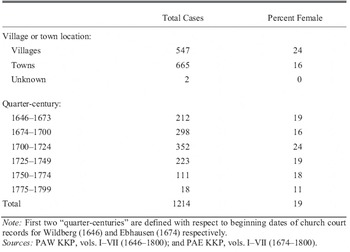
Complaints in local records show that Sabbath prohibitions were binding constraints on rural people who wanted to allocate more time to market production.Footnote 47 As Table 1 shows, between 1646 and 1800 two small Württemberg communities penalized more than 1,200 cases of people working at prohibited times.Footnote 48 This was one way social institutions restricted male industriousness more than female, since 81 percent of those prosecuted were men.Footnote 49 Sabbath regulation actually increased up to c. 1750, and even in the 1750–1775 period was still quite intense. Not until October 1799 did the government proclaim that “on what have hitherto been holy days, church services shall now be held only in the mornings, and outside those hours it shall be permitted to pursue occupations, businesses, and trades, both before and after the church service.”Footnote 50 Throughout the period postulated for the Industrious Revolution, therefore, Württemberg's religious institutions limited people's capacity to intensify their industriousness and, by implication, to consume more market goods.
PROSECUTIONS FOR SABBATH WORK IN COMMUNITY CHURCH COURTS, WILDBERG 1646–1800 AND EBHAUSEN 1674–1800

Note:
First two “quarter-centuries” are defined with respect to beginning dates of church court records for Wildberg (1646) and Ebhausen (1674) respectively.
Sources:
PAW KKP, vols. I–VII (1646–1800); and PAE KKP, vols. I–VII (1674–1800).
This is not to say that all early modern European societies were like Württemberg. Many parts of central, eastern-central, southern, and Nordic Europe did resemble Württemberg, in seeing church, state, and community institutions intensifying “social disciplining”—including economic regulation—between 1600 and 1800. But other European societies—particularly, but not exclusively, on the North Atlantic seaboard—implemented social disciplining sporadically if at all.Footnote 51 Many European economies also had strong guilds into the later eighteenth century. But in England and the Low Countries, guilds regulated fewer occupations, were absent from many towns and villages, and progressively liberalized between 1650 and 1800.Footnote 52 Local communities, as well, varied across Europe in their control over women's residence, work, wages, and sociability.Footnote 53 The scholarship on “social disciplining,” guilds, communities, and women's history all converge in observing an earlier and more thorough relaxation of institutional controls in the Low Countries, England, northern France, and a few other enclaves, than in central, eastern, Nordic, or southern parts of the continent.Footnote 54 The Industrious Revolution could proceed more easily where “social capital” relaxed, creating institutional interstices in which deviations from norms could be experimented with—particularly by women—and new work practices could be formed.
SOCIAL CAPITAL AND COMMERCE
The Consumer Revolution not only needed people to shift into market work and earn more spending money; it also needed the commercial sector to bring new market wares within the reach of wider social strata. This certainly corresponds with what we know of early modern England and the Netherlands, where shops, stalls, hawkers, and peddlers proliferated alongside established merchants, lowering the transaction costs of indulging in new market wares.Footnote 55 But what happened where commerce was not so open? For centuries, European merchants had maintained entrenched interest groups adept at blocking new participants and competitive practices. Did these institutional privileges simply melt away in the heat of the Consumer Revolution?
Commercial change did not prove straightforward everywhere in Europe. In Württemberg, for instance, trade in most agricultural and industrial goods was legally reserved for their immediate producers until well past 1800. Middlemen (and -women) were prohibited as Fürkäufer (regraters).Footnote 56 Trade in craft inputs was reserved for the relevant guild masters, and “encroaching” middlemen were penalized. The export of certain wares (e.g., proto-industrial textiles) was reserved for members of privileged merchant associations with state monopolies. Specialized commerce was restricted to a specified list of “merchants' wares” and was reserved for members of the guilds of merchants and shopkeepers. A few outsiders managed to secure guild permits or princely dispensations (Konzessionen), but these were granted only if one paid a fee and proved it would “correspond to the needs of the community.”Footnote 57
These were not just formal regulations but were enforced in practice. Into the later eighteenth century, those who bought up foodstuffs for resale were not regarded as reducing transaction costs but instead were prosecuted as black market “regraters” encroaching on the privileges of local farmers and guildsmen. In 1764, for instance, the Wildberg community assembly was mobilized by a local baker who complained that “the so-called Schmalzin (lit. “Lard-Woman”) is buying up grain here and there, and selling it again at a higher price on offer to the citizens here, and through this commercium is causing damage to the bakers here.”Footnote 58 In 1793, likewise, five Wildberg citizens separately made use of the community assembly to complain that “in Liebelsberg and Schönbronn, lard is being bought up by a Fürkaufferin (female regrater) from Teinach.” Local officials immediately sent out written reminders to all surrounding communities about the illegality of regrating, urged citizens to report every illegal middleman or -woman instantly, and instructed officials in the woman's locality to “warn her against further regrating and the penalties it involves.”Footnote 59
Guilds and merchant associations also restricted competition and innovation in commerce. Between 1650 and 1797 the 20–45 merchants of the exclusive Calw Worsted Trading Association prevented all outsiders from introducing new worsted varieties that would circumvent their state privileges. Conversely, when this merchant association itself tried to introduce innovations, the weavers' guilds blocked them, as in 1698 when the Wildberg guild lobbied against several merchants “who have begun to make new sorts of Schlickh Cadiß (lit. warp-worsted), and put them out to be woven, which they are not allowed to do.”Footnote 60 Together, the weavers' guilds and the merchants' association hindered the introduction of innovative worsted varieties into the Württemberg market long after they had become widespread in guildless industries in France, England, and the Low Countries.Footnote 61
In many other crafts, too, guilds erected barriers to simple commercial innovations such as peddling, which reduced transaction costs. A Wildberg nailsmith, for instance, complained in 1742 that a village woman was encroaching on his guild privileges by peddling nails, and got her jailed by his communal assembly.Footnote 62 In 1784 a guilded tawer complained that “the peddling of Jews with hides is getting so out of hand that no tawer can sell anything anymore”; the communal assembly and the district authorities responded with prohibitions and penalties.Footnote 63 In 1787 a guilded weaver complained that “through the peddling of the Jews he and other craftsmen are suffering much interference and weakening of their livelihoods.” His complaint led the community assembly to threaten a 20 Reichstaler fine to anyone buying from Jews.Footnote 64
Even for legitimate “merchants' wares” that were not the exclusive privilege of local farmers or craftsmen, shopkeepers' guilds often blocked new commercial practices.Footnote 65 Peddling and hawking were banned altogether, and shopkeepers mobilized guild officials, communal courts, and state institutions to prevent encroachment on their monopolies.Footnote 66 In 1652, for instance, a poor laborer's widow in Wildberg was only granted a princely dispensation to open a corner shop when she petitioned that her sole son was a cripple, she was supporting four younger daughters from alms and ribbon weaving, and the local princely bureaucrat himself guaranteed that she and her son would “sell nothing other than the ribbons they themselves make, kindling wood, and such poor things, so the shopkeepers will suffer no injury or encroachment.”Footnote 67 It was far more typical for officials to support the objections of the shopkeepers' guilds against new retailers and competitive practices, as in 1711, when Maria Christothora Weysin, a converted Jew's widow with a shop in Pfaffenhofen, could not show any princely dispensation or guild permit, “for which reason, upon the complaint of the aforementioned two [guilded] shopkeepers, she was forbidden and ordered to refrain from this encroachment until she presents a legitimate princely order.”Footnote 68 Shopkeepers also used community institutions to defend themselves against new entrants and commercial practices, as in 1784 when two members of the merchants' and shopkeepers' guild complained in the Wildberg community assembly that “the Jews and itinerant rural traders are committing great interference against the merchants, through their prohibited peddling.” The assembly immediately ordered all citizens “to report rural traders, Jews, and other persons trading counter to [the national law-code] to the district authorities” and instructed the district excise officer and the village authorities to watch out for violators.Footnote 69
As such complaints illustrate, a black market “informal sector” existed, in which low-cost traders illegally congregated. Thus, for instance, in 1711 the guilded shopkeepers of Bottwar sought to outlaw “the hedge or barn retailers … who have not been apprenticed to the trade anywhere, whose wives and children beg, and who hold community citizenship in no locality, but with their retailing are very burdensome and cause great curtailment to the public and to the entire trade.”Footnote 70 The guilded shopkeepers of Backnang blocked Italian peddlers who “sell spices which they have not got inspected by anyone, and almost more cheaply than the shopkeepers here can purchase them in Frankfurt.” The Backnang guild also objected to married women selling soap and other washing products at weekly markets “without being able to show any permits to do so.”Footnote 71 Court records and petitions for eighteenth-century Württemberg are replete with examples of women, Jews, immigrants, and poor laborers forced to trade in the black market by the corporate privileges of formal-sector retailers.Footnote 72 Had such low-cost traders been able to establish themselves as a competitive fringe in the core commercial sector, they would have diminished the guilded retailers' monopoly profits, as indeed occurred in the Dutch and English retail sectors after c. 1650.Footnote 73 But in Württemberg, the retailers' guilds increased the costs and risks of illegal traders by imposing fines and confiscations, restricting them to the peripheral goods (uninspected spices, soap, illegal trinkets, nuts) and locations (hedges, barns, taverns, lodgings) typical of the “informal sector,” where they were less likely to be prosecuted but also less accessible to customers. These characteristics are themselves clear indications of how successfully the Württemberg retailers' guilds excluded low-cost, informal traders from core commercial activities.
It is sometimes claimed that throughout early modern Europe guild regulations were easy to circumvent and had no real economic effect. If this were true, one should observe no quantitative difference in economic outcomes between economies where retailing guilds were ubiquitous and strong and those where they were scattered and weak. In most German territories, retailing guilds survived at least until c. 1800—in territories such as Württemberg until 1862—and erected high barriers to entry which they policed quite strictly. In the Netherlands and England, by contrast, retailing guilds were not universal; those that survived progressively liberalized from the seventeenth century on, reducing their barriers to entry and increasingly admitting women, migrants, and even Jews.Footnote 74
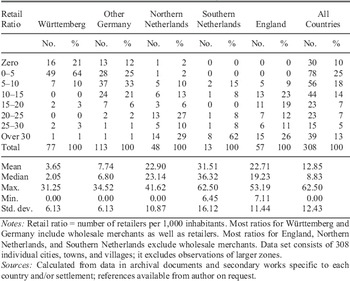
The commonest quantitative benchmark of the Commercial Revolution is the “retail ratio,” the number of retailers per 1,000 inhabitants. Table 2 shows retail ratios calculated for 308 European settlements between 1542 and 1911—77 for Württemberg, 113 for other German territories, 48 for the Northern Netherlands, 13 for the Southern Netherlands, and 57 for England. The ratios for Germany, despite often combining retail and wholesale merchants, are lower than those for the Netherlands and England, which generally include only retailers. Low retail ratios of less than 5 per 1,000 were observed in 85 percent of the Württemberg sample and over one-third of the sample from other German territories, but hardly ever in the Netherlands and England. Conversely, high retail ratios of over 15 per 1,000 were observed in over two-thirds of the samples for England and the Netherlands, but less than one-tenth of those in Württemberg and other German territories. In England and the Netherlands, settlements without retailers were almost nonexistent, whereas they comprised one-fifth of the Württemberg sample and over one-tenth of the sample from elsewhere in Germany.
RETAIL RATIOS BY COUNTRY, 1542–1911
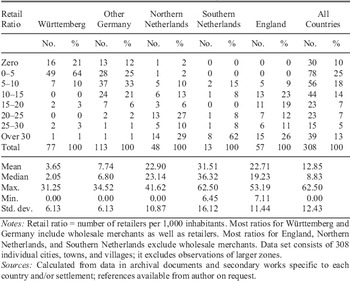
Notes:
Retail ratio = number of retailers per 1,000 inhabitants. Most ratios for Württemberg and Germany include wholesale merchants as well as retailers. Most ratios for England, Northern Netherlands, and Southern Netherlands exclude wholesale merchants. Data set consists of 308 individual cities, towns, and villages; it excludes observations of larger zones.
Sources:
Calculated from data in archival documents and secondary works specific to each country and/or settlement; references available from author on request.
Of course, differences in retail ratios among countries might result from differences in other factors. For instance, the settlements in the sample varied greatly not just in their retail ratios but in their dates of observation and their population sizes.Footnote 75 Perhaps the German settlements had lower retail ratios because they were observed at earlier dates or included fewer large cities? What happens when we control for these variables?
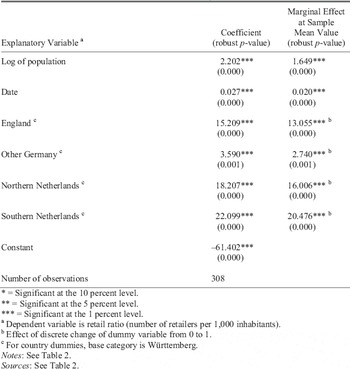
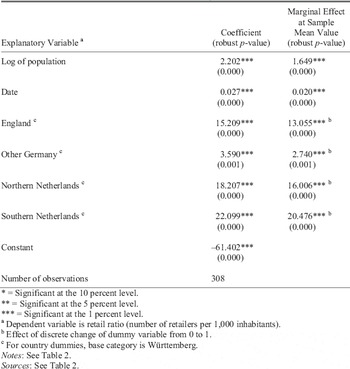
Table 3 reports the results of a Tobit regression with the retail ratio as the dependent variable and population, date and country as explanatory variables. Settlements with larger populations had higher retail ratios, confirming that commercialization was associated with urbanization.Footnote 76 As one might expect, commercialization also increased across the early modern period. But even controlling for urbanization and the passage of time, the country differences remain large and significant. There was no significant difference in retail ratios among England, the Northern Netherlands, and the Southern Netherlands. But Württemberg and other German territories had significantly lower retail ratios than England and the Netherlands. Economic outcomes thus differed significantly between societies where retailing guilds were strong and those where they were more liberal.
DETERMINANTS OF EUROPEAN RETAIL RATIOS, 1542–1911: TOBIT REGRESSION
* = Significant at the 10 percent level.
** = Significant at the 5 percent level.
*** = Significant at the 1 percent level.
a Dependent variable is retail ratio (number of retailers per 1,000 inhabitants).
b Effect of discrete change of dummy variable from 0 to 1.
c For country dummies, base category is Württemberg.
Notes:
See Table 2.
Sources:
See Table 2.
The period after 1650 did see a vast expansion of retailing in the Low Countries and England, lowering transaction costs and bringing market wares within the budgets of poorer consumers.Footnote 77 But this did not take place everywhere in Europe, as shown by this large sample of retail ratios. In some European economies, permission to engage in commerce (as well as what one could do once one had it) was inhibited by the social capital of entrenched interest-groups.Footnote 78 Their institutional privileges hindered the commercial innovations required to open up market consumption to broader, poorer social strata.
SOCIAL CAPITAL AND SUMPTUARY REGULATION
The Consumer Revolution not only needed more market workers with more disposable income, and retailers offering lower transaction costs. It also needed market consumption to become socially acceptable. During the Consumer and Industrious Revolutions in the Netherlands and England, contemporaries described social norms as decisively shifting toward consuming in the market—buying clothes and household furnishings rather than making them oneself, purchasing comestibles at shops and taverns rather than preparing them at home.Footnote 79 In this story, new consumption norms arose spontaneously through the aggregated choices of individuals in households and markets, with other social institutions playing no role. Accurate though this picture may be for England and the Netherlands, can we apply it unquestioningly to other early modern societies?
Studies of early modern “social disciplining” suggest not. In many European societies, the seventeenth and eighteenth centuries saw an intensification of efforts to regulate people's private lives, including their consumption choices.Footnote 80 Accounts of the Consumer Revolution in the Netherlands and England portray such “sumptuary” regulation as emanating solely from the central state, losing force by 1650 at the latest, and lacking real economic impact even before that time.Footnote 81 The early modern Netherlands were certainly remarkably free of sumptuary laws, and England enacted none after 1604.Footnote 82 But evidence from other European societies—including Germany, Austria, Switzerland, Scandinavia, Spain, Italy, and perhaps even France—indicates that sumptuary regulations survived long past 1650, were supported by many non-state institutions, and were enforced in practice, albeit selectively according to the interests of the social groups that endorsed them.Footnote 83 In German-speaking central Europe, for instance, at least 1,350 ordinances were issued between 1244 and 1816 regulating clothing alone, which in turn comprised only one aspect of consumption. Local elites shaped and enforced these sumptuary controls, and often resisted their ultimate abolition.Footnote 84
Like many early modern European societies, Württemberg issued numerous sumptuary regulations throughout the seventeenth and eighteenth centuries, responding to pressure from different social elites. Higher social strata demanded sumptuary rules to demarcate their status vis-à-vis lower strata: courtiers over non-courtiers, townsmen over villagers, the communal Ehrbarkeit (the “notability” eligible for local office) over families of the lower village strata. Men demanded regulation of women's dress to define gender-specific conduct, prevent sexual disorder, and help resist wives' and daughters' demand for new fashions. Employers demanded regulation of servants' dress to reduce pressure for higher wages. Guild masters demanded regulations to reserve exotic wares to small groups of rich consumers, require ordinary people to wear domestically produced textiles and furs, and protect their own markets against foreign competition. Churchmen and local elders demanded regulations to restrain worldly adornment, lavish sociability, drunkenness, and sexual display. Princely councilors, tax collectors, bureaucrats, and military men demanded sumptuary regulations to make ordinary people spend less on themselves so they could pay more in taxes. This conglomeration of social pressures gave rise in Württemberg, as in many other European societies, to a continual flow of sumptuary regulations between the mid-sixteenth and the later eighteenth century.Footnote 85 The main targets were “finery in clothing and excess in eating and drinking”—precisely the new forms of market consumption implied by the Industrious Revolution.Footnote 86 As in many other European societies, sumptuary regulation became ever more elaborate into the eighteenth century, alongside the local administrative machinery for its implementation, and was only abolished at the end of the ancien régime.Footnote 87
Local archival sources show these sumptuary norms being enforced—not perfectly, but enough to affect people's economic choices. Sartorial regulation was seriously pursued by local religious and communal institutions in Württemberg from the later seventeenth century on. In 1660 the communal church court in Wildberg appointed “censors” to monitor “the excessive sartorial display that has got out of hand.”Footnote 88 From that time on, it was not unusual for local church courts to impose admonishments and penalties for sumptuary violations. To give just a few examples, in 1662 the Wildberg court reprimanded the son of a local weaver, “on account of very wide trousers, which fashion it is unfitting for him to wear,” fined him 15 Kreuzer (about 2 weeks' earnings for a male servant), and warned him that “if he should again put on such trousers of this fashion, they shall, by virtue of the Princely Command, be confiscated.”Footnote 89 In 1684 the Wildberg court ordered Hans Caspar Cuenz's wife “to take off the neckerchief she had been wearing, because she is not permitted to wear it, and to set a good example to others.”Footnote 90 In 1708 the Ebhausen church court admonished and penalized a proto-industrial worsted weaver's wife for wearing ostentatiously large neckerchiefs.Footnote 91
It might be argued that such prohibitions were merely futile gestures in the face of an ineluctable Consumer Revolution, were it not for the fact that people at the time took them quite seriously. Sumptuary penalties were regarded as forms of public shaming, important enough to motivate social resentments and enduring conflicts. In 1682, for example, the local church court forbade the Wildberg barber-surgeon's wife “to wear the prohibited clothing which violates the most recently published regulatory ordinance,” and threatened to report her to the princely authorities.Footnote 92 The barber-surgeon himself was “summoned to the Town Hall, where several women had also been summoned on account of the clothing ordinance, and Mr. Pastor, in front of the women who were present, inspected him behind and before, and said that the small ribbon which he had on the collar of his coat also had to come off, and declared that they (the women) will themselves soon go down, and slapped his hand on the clothing ordinance.”
The barber-surgeon declared in court that he “took all of this as a contumely, because it was discussed again and again among the people in the town.”Footnote 93 This conflict over ribbon on the barber-surgeon's collar, trivial though it might seem, gave rise to a feud in the community between the associates of the pastor and the surgeon, which lasted for nine years, occupied three communal court sittings, and issued in several reports to the princely authorities.Footnote 94 A similar prosecution over an Ebhausen woman's neckerchief in 1708 generated bitter village conflict, a series of court sittings, and a fine of more than a day's average male earnings.Footnote 95
When exhortations, sermons, public reprimands, court hearings, gossip, fines, and confiscation did not succeed, communities resorted to heavier penalties. People who violated the clothing regulations could find themselves or their families denied communal welfare. In 1687, for instance, when Jacob Zeyher's widow petitioned for poor relief, the Wildberg church court refused, on the grounds that “this Zeyherin's son and daughter have let themselves be seen in clothing above what is fitting and this implies that they can probably come by other means and can support their old mother, for which reason her children are reminded to care for their mother in accordance with filial obligation.”Footnote 96 In 1703 the Ebhausen community church court summoned the “house-poor people” in the village so that a list could be drawn up for the district authorities, but took advantage of having the village poor assembled, by “additionally giving severe warnings to various widows, that they shall refrain from the loose gossip and other disgraceful troublemaking that has hitherto occurred among them, especially at spinning bees, and also from excessiveness in clothing.”Footnote 97 For this group of women, poor relief was tacitly made dependent on refraining from two manifestations of the Industrious Revolution—working at spinning bees and buying new clothes.
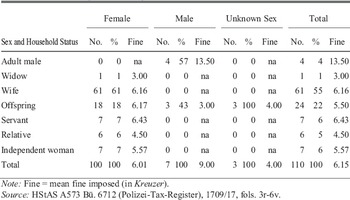
Sumptuary regulations were thus enforced at least sufficiently to provide an instrument for “social disciplining.” A unique documentary survival from the eighteenth century, moreover, suggests even more systematic enforcement. For the community of Wildberg, there survives a single booklet of “Polizei-Tax-Rechnungen” (regulatory fine accounts), which lists all the clothing fines levied over a 12-month period between February 1713 and February 1714.Footnote 98 Similar registers of clothing fines survive for other parts of Europe in the seventeenth and eighteenth centuries, suggesting that such systematic, local enforcement was not unique to Württemberg.Footnote 99 The register from Wildberg makes it possible to identify the targets of sumptuary regulation. As Table 4 shows, over this 12-month period, 110 individuals in a community of only about 1,300 inhabitants were fined for wearing 218 forbidden garments, most of them small items of silk or calico. Although some fines were levied for men's or children's clothing, 91 percent of those penalized were female. This finding is consistent with sumptuary regulation throughout early modern Europe, which was directed disproportionately at women.Footnote 100 Married women took pride of place, at 61 percent of all females fined, a finding also consistent with European studies indicating that sumptuary laws emanated partly from men's desire for institutional support to rein in wives' spending. As one legislator declared in 1621, “laws may rule them though their husbands cannot”Footnote 101—a motive discussed further in the next section. But even a few unmarried daughters, maidservants, female relatives, and independent women living in lodgings were willing to allocate some of their meager earnings to small fashionable garments—and to incur social opprobrium and monetary costs for doing so.
VIOLATIONS OF CONSUMPTION REGULATIONS, BY SEX AND HOUSEHOLD STATUS, WILDBERG, FEBRUARY 1713 TO FEBRUARY 1714

Note:
Fine = mean fine imposed (in Kreuzer).
Source:
HStAS A573 Bü. 6712 (Polizei-Tax-Register), 1709/17, fols. 3r-6v.
It might be argued that all these fines simply show that clothing regulations had no effect, as is sometimes claimed of sumptuary laws more generally. But fines, although they did not wholly prevent people from buying prohibited garments, increased their costs, as did public shaming, threats of confiscation, and denial of poor relief. This register, after all, records the consumption only of those who could afford to pay the fines on top of the cost of the garments. The typical fine inflicted in 1713 was nontrivial. Even for an adult male, the average clothing fine was 13.5 Kreuzer, 1.7 days' average earnings for a proto-industrial worsted weaver, the most important single occupation locally.Footnote 102 For a woman, the average clothing fine of 6 Kreuzer weighed more heavily—2–5 days' earnings for an independent spinner, more than 6 days' wages for a maidservant.Footnote 103 A fine of this size did not make it impossible to indulge in new forms of consumption, but cannot fail to have deterred the marginal consumer, especially among women and the less well-off. The resentment and conflict that sumptuary controls evoked provides additional evidence that even those who could afford to violate them perceived them as a real constraint.
A second major target of sumptuary controls was the public consumption of food and drink, at taverns, markets, fairs, weddings, baptisms, funerals, and other nondomestic venues. “Alimentary regulations” were common in many parts of Europe well into the eighteenth century.Footnote 104 In Württemberg, alimentary regulations were enforced against upwardly mobile members of the lower orders who staged lavish weddings, baptismal suppers, and funerals aping the consumption patterns and challenging the social superiority of higher strata. Community courts prosecuted excessive consumption at such festivities, measured by the quantity of food or the number of guests.Footnote 105 From 1713 to 1743 registers survive recording the graduated fines paid by townsmen and villagers in the district of Wildberg who violated the sumptuary ordinances by inviting “too many” guests to their wedding parties.Footnote 106
A second major motivation for alimentary regulation was to control women's behavior. Württemberg taverns traditionally functioned as social spaces for both sexes, but from the later seventeenth century on, men consuming bread and wine in taverns were tolerated but women (even wives and widows) who engaged in conspicuous public consumption of comestibles began to be fined and incarcerated.Footnote 107 This is vividly illustrated by the accusation leveled in 1684 by the Ebhausen church court against Barbara Müller who, “on Michel Lodholtz's accounting day, remained in the tavern past closing time and spoke very impudently, saying that she could earn 3 Batzen in a quarter of an hour, so what did it matter if she consumed something? … unlike this tankard, she didn't have a lid.”Footnote 108 Barbara Müller evidently felt that a woman who earned her own money was entitled to make her own consumption choices, including engaging in the individuated consumption of comestibles outside the household evoked in accounts of the English or Dutch Industrious Revolutions.Footnote 109 But in Württemberg, it was precisely this combination of independent market work and independent market consumption by women that male elites found unacceptable. The village court sentenced Barbara Müller to three days and three nights in the house of discipline. Would such palpable penalties not have reduced incentives to work or consume in markets, even for such impudent women as Barbara Müller?Footnote 110
Sumptuary regulation intensified in Württemberg between c. 1650 and c. 1750, alongside the administrative apparatus necessary for its implementation. Local courts monitored compliance, offenders were punished, and enforcement evoked resentment and conflict. This suggests that contemporaries regarded sumptuary controls as binding constraints. But how might we assess the broader, quantitative impact of such sumptuary regulation on the Consumer Revolution?
One promising avenue is to analyze the things people owned. Württemberg law mandated detailed marriage and postmortem inventories, which survive for a majority of ordinary citizens who reached adulthood and married.Footnote 111 Anja R. Benscheidt's analysis of 150 Nürtingen inventories between 1660 and 1840 detected a significant decline in clothing ownership between 1660 and 1780, followed by a huge increase up to 1840, which she ascribes partly to “the abolition of all clothing ordinances after the French Revolution.”Footnote 112 Hans Medick's study of 444 inventories for the Württemberg village of Laichingen between 1747 and 1820 describes the gradual spread of small items of sartorial luxury, but also widespread compliance with the clothing regulations until the last quarter of the eighteenth century. It was only after c. 1800, when the sumptuary regulations had been abolished, that the value of wives' clothing surpassed that of husbands, female dress began commonly to include bright colors, exotic fabrics, ornamental accessories and forbidden trinkets, and sartorial display spread beyond the village elite to day laborers and proto-industrial weavers.Footnote 113
These studies analyze only quite small samples of inventories and do not use multivariate statistical techniques, so they cannot establish whether changes in consumption followed changes in regulation, if different strata violated rules to differing degrees or followed differing chronologies, what other personal or community characteristics influenced consumption, and whether the pattern was replicated more widely across Württemberg. A new research project on “Human Well-Being and the ‘Industrious Revolution’: Consumption, Gender and Social Capital in a German Developing Economy, 1600–1900” is seeking answers to these questions using a larger sample (several thousand inventories), two communities (a town and a village), and a period of several centuries (1602–1899). By linking inventories to tax registers, censuses, and family reconstitutions, it will be able to analyze variations in consumption according to individual characteristics such as sex, age, fertility, household structure, occupation, wealth, community citizenship, and communal officeholding, as well as exogenous variables such as sumptuary and guild regulations.Footnote 114
But even the scattered findings available so far show clearly that although people in early modern Württemberg may have been poorer and less highly informed than those in the Netherlands and England, they, too, sought to increase their market consumption after c. 1650.Footnote 115 In doing so, however, they faced very different constraints. In Württemberg—as in many other early modern European economies—entrenched elites used their institutional powers and “social capital” to impose sumptuary norms, limiting the extent to which women and the lower social strata could transform their production decisions into new consumption choices. These institutional constraints survived well into the eighteenth century, and may therefore have influenced the timing and intensity of any revolution in consumption—and any corresponding incentive to increase industriousness—before c. 1800.
SOCIAL CAPITAL AND INTRA-HOUSEHOLD RESOURCE ALLOCATION
The Industrious and Consumer Revolutions emphasize married women's reallocation of time and consumption from household to market.Footnote 116 But the exact processes behind this shift are not wholly clear. Household time allocation and consumption are affected by bargaining between family members. Existing analyses of the Industrious Revolution describe wives' bargaining position as being primarily affected by their earning power—i.e., by interactions between family and market.Footnote 117 But what if other institutions intervened in this bargain? We have already seen how institutions widespread in many early modern societies—guilds, communities, religious bodies, political authorities—affected women's position in the market. Such institutions could also affect women's position in the family, altering the bargains between spouses over time-allocation, income-sharing, and consumption choices.
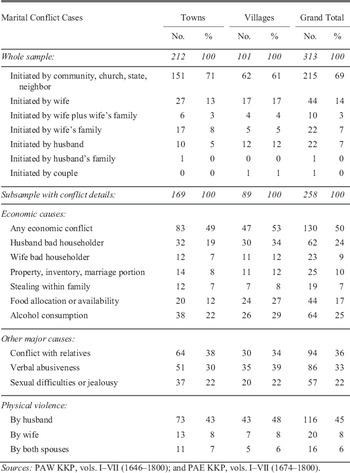
Württemberg provides an instructive example of an economy in which nonfamilial, nonmarket institutions influenced household decision making. The willingness of communal, religious, and political institutions to intervene inside households is illustrated by a database of 313 marital conflicts collected from the church court minutes of two small Württemberg communities between 1650 and 1800.Footnote 118 Lacking figures for the community, district, and consistorial jurisdictions that also heard marriage conflicts in Württemberg, and lacking comparative figures for other European societies, we cannot say whether marital conflict in these communities was especially high or low, but we can analyze its characteristics. As Table 5 shows, one notable characteristic was that more than two-thirds of marital conflicts were brought before the court not by spouses or their families, but by third parties: neighbors, community officers, clergymen, or state officials. In Württemberg, spousal bargaining was a matter not just for the family but for the wider institutional framework.
CHARACTERISTICS OF MARITAL CONFLICT CASES, CHURCH COURT RECORDS, WILDBERG 1646–1800 AND EBHAUSEN 1674–1800

Sources:
PAW KKP, vols. I–VII (1646–1800); and PAE KKP, vols. I–VII (1674–1800).
A second notable characteristic is the importance of economic issues. Conflict details survive in over four-fifths of cases. As Table 5 shows, the four main causes of spousal disputes were economic conflict, conflict with relatives, verbal abuse, and sexual difficulties. Of these, economic conflict was the most important, playing a role in half of all cases for which details are known, compared to about one-third for conflict with relatives and verbal abuse respectively, and about one-fifth for sexual difficulties. Economic conflicts were highly various—one-quarter of cases involved bad householding by the husband, one-quarter alcohol consumption, one-sixth food allocation, one-tenth land or property, and one-tenth bad householding by the wife. But, as we shall see, marital disputes—and communal, church, or state intervention—were evoked by a wide range of other economic issues.
One frequent flashpoint was a wife's time allocation. As I have shown in a series of earlier publications, married women in Württemberg were both able and willing to work outside the household. An extensive database of their observed work shows that only 41 percent was in household production, compared to 48 percent in non-household work—20 percent in agriculture, 18 percent in industry (crafts, proto-industry, spinning, milling), and 10 percent in tertiary activities (commerce, tavern keeping, laboring).Footnote 119 But the marital conflict database shows equally clearly that husbands thought that they should decide whether their wives worked.Footnote 120 To give just two examples, in 1685 a major issue in the conflict between the Wildberg tanner Hans Bernhardt Memminger and his wife Margaretha was that she had disobeyed him when he “forbade her to go out working any longer.”Footnote 121 Similarly, in 1769, the main complaint of the Wöllhausen weaver Johann Martin Dengler against his wife Agnes Margaretha was that she “did spinning for strangers even though she had her own [wool] to spin … and always wants to work more than he does.”Footnote 122
When wives disobeyed, husbands regarded coercion as legitimate. As Table 5 shows, nearly half of all marital conflict cases involved physical violence by husbands. One issue that evoked such violence was a wife's market work, especially when it interfered with a husband's definition of appropriate attention to household production. In 1666, for instance, Young Hanß Peürlin in Effringen justified beating his wife on the grounds that “she goes out of the house far too much and does not attend to the housekeeping, through which he is sometimes caused to become impatient.”Footnote 123 In 1685 when Margaretha Memminger disobeyed her husband's prohibition on her going out working any longer, “he beat her so that the blood ran down her front and back.”Footnote 124 In 1769 Johann Martin Dengler of Ebhausen threatened to beat his wife Agnes Margaretha for spinning for other weavers rather than himself.Footnote 125 In 1778 the Wöllhausen weaver Daniel Dengler justified death threats against his wife on the grounds that she “is herself to blame for this, since she does not remain at home, but runs around among the houses.” He also explicitly requested reinforcement by the communal church court, demanding that it “compel his wife, so that she remains at home.”Footnote 126 Some cases are unclear about whether the issue is the wife's work or her leisure activities outside the household, but most state explicitly that the husband opposes her working for outsiders instead of for him. In such cases, the court typically threw its weight behind the husband, sometimes feebly admonishing him for violence but always ordering the wife to obey him and “attend loyally to the householding, as befits an honorable wife.”Footnote 127
Husbands consequently found that they could enforce their bargaining position within the household even more effectively by getting support from outside institutions manned by other married males, to whose fellow feeling they could explicitly appeal. In 1681, for instance, a Wildberg butcher who threatened his wife with a knife when she resisted his decisions about spousal time allocation put it to the communal church court that, after all, “one can easily imagine that sometimes trouble arises between married people.”Footnote 128 In 1771 the Ebhausen court had been receiving reports of the forest warden's wife beating for years, but had no rejoinder to the man's assertion that “he was the husband—after all, he had the right … his wife was his own—he could treat her however he pleased.”Footnote 129 The outcome was unsurprising. External institutions supported the husband's control over a wife's time, as in 1657 when the Wildberg court ordered that Friedrich Hosch's 58-year-old wife should “in future not go out of the house without her husband's permission, in exchange for which her husband shall allow her to work.”Footnote 130 In a society in which external institutions intervened inside marital disputes to support husbands, married women were less free to reallocate time from household to market, and thus to fuel any Industrious Revolution.
Husbands also claimed control over wives' and offspring's market earnings. In 1661, for instance, the Wildberg weaver Young Johannes Rempffer was “taking away from his wife and children the food that they earn bitterly with spinning.”Footnote 131 Likewise, in 1793, the Ebhausen smith Hans Martin Hausen was demanding that his wife Barbara “give him half of her earnings, even though he earns little or nothing that he can give her.”Footnote 132 If the husband could be demonstrated to be prodigal, the communal court might expostulate feebly, but would also typically admonish the wife to yield. Thus in 1674, when the Wildberg butcher Hannß Geörg Steimblen threatened to kill his wife for not giving him 30 Kreuzer she had earned independently by selling ragout, the court fostered out their child for its own safety but ordered the wife to stay home with her husband, ineffectually warning both spouses “to treat each other better in future.”Footnote 133 Where a husband's bargaining position was reinforced by institutional support, a wife lost disposition over any money she might earn, which inevitably altered her incentives to allocate time to market work.
Husbands' control over household resource allocation also extended to consumption. In 1689 a Gültlingen husband “locked the bread away, and when [his wife] asked for money to buy bread from the shoemaker, he said she didn't need bread because he himself had already eaten.”Footnote 134 In 1715 a weaver's wife in Wildberg complained that “in her last childbed [her husband] had not let anything good be cooked for her, [and] she had had to eat oat gruel.”Footnote 135 In 1770 a weaver's wife from Wöllhausen ran away “because [her husband] gives her no money for bread, but rather makes use of it for other, less necessary things … she had not really wanted to run away, but rather had only sought thereby to compel him to get some bread.”Footnote 136 Husbands also decided how much the dwelling would be warmed, as in 1772 when a Wöllhausen weaver's wife “could not stay in their main room in the daytime because [her husband] heats it little or not at all.”Footnote 137 The court might admonish a husband who demonstrably deprived his wife of basic sustenance, but would also typically instruct the wife “to show and conduct herself toward her husband peacefully and modestly … and not give him cause to give her trouble.”Footnote 138
A husband's control over money earnings translated directly into control over even the most basic forms of household consumption such as meals and warmth. When it came to market consumption, his control over money earnings was even more decisive, especially when, as so often happened, it was reinforced by external institutional intervention. In 1715, for instance, Young Hans Georg Hezel's wife in Wildberg lamented that “he does not let her have any shirts and clothes made, for which reason lice and vermin inevitably grow on her [and] her mother has to provide her clothes”; the community court merely ordered both spouses to behave better, and the wife to be cleaner.Footnote 139 In 1767 the alcoholic and prodigal Wöllhausen weaver Johann Martin Dingler “refused to provide [his wife] with a necessary skirt,” but when she sold two tablecloths to get the money to buy clothes, accused her of “being untrue to him in the domestic economy, with table and storechest, and being a gadabout who never stayed home”—charges on which she was then closely interrogated by the community court.Footnote 140 In a society in which communal and religious institutions supported husbands' control over consumption decisions, wives—whether or not they were allowed to work outside the household—were less likely contribute to a Consumer Revolution by purchasing market fashions.
Occasionally, a woman secured some protection by bringing her husband to court, especially if she could portray his behavior as burdening the wider community. The authorities sometimes penalized a blatantly prodigal husband even while they ordered the wife to submit in order to keep the marriage intact. But this should not lead us to conclude that communal, religious, or state institutions treated spouses impartially, let alone that they favored wives, as has been argued by some scholars.Footnote 141 Communal and state authorities had their own priorities, high among them the desire to sustain marriages at almost any cost in order to ensure tax payments and prevent welfare burdens. Guild, community, and state regulations that reduced women's earning capacity (discussed above in the first section) created powerful incentives for the authorities to keep married couples together and to support the husband as the major earner. Furthermore, communal and religious courts were manned by male householders who shared the perspective of accused husbands whom, as fellow citizens and guild members, they were reluctant to disoblige. This led courts to inflict an abusive husband with often risibly feeble penalties while ordering his wife “to give way to her husband in future,”Footnote 142 “to conduct herself toward her husband peacefully and modestly … and not give him cause to give her trouble,”Footnote 143 “to greet him virtuously at all times, thereby protecting herself from misfortune”Footnote 144—in short, to defer to his resource allocation decisions.
Institutional support for husbands in household bargaining, as studies of modern developing economies suggest, affects basic aspects of production and consumption that were key variables in any Industrious Revolution. For one thing, depriving women of consumption reduces their productivity, reinforcing incentives to allocate them less consumption, thereby creating a self-sustaining cycle of reduced production and consumption by females.Footnote 145 Second, men's consumption choices may focus more on their own individual gratification (particularly with alcohol and tobacco), while women may more often seek the well-being of the entire household, particularly the nutritional and health status of children.Footnote 146 Third, women may be more likely than men to allocate income to staples of the Consumer Revolution such as clothing, furnishings, or market comestibles.Footnote 147 Institutional support for husbands in household bargaining thus not only redistributed resources from women to men (thereby reducing women's welfare), but created incentives reducing women's market production and consumption (thereby reducing efficiency and growth in the wider economy).
Without analogous studies for different European societies, we cannot compare how women's bargaining position within households was affected by different institutional frameworks. The near invisibility of such institutional interventions inside households in studies of the Industrious Revolution in England or the Netherlands might be taken as prima facie evidence that they did not play the active role there that they did in Württemberg. Comparative studies of “social disciplining” certainly conclude that control of private life by community, church, or state was less effective in the early modern North Atlantic societies than in central, southern or Nordic Europe.Footnote 148 Comparative studies also tend to confirm that early modern Dutch and English women enjoyed an unusually strong position in household and market.Footnote 149 This is not to say that couples in the Netherlands or England did not conflict over time-allocation and consumption, but that husbands there had fewer outside institutions available to intervene on their behalf. If future scholarship bears out these comparisons for the sphere of household bargaining, then the relative weakness of institutionalized social capital in England and the Netherlands, compared to societies such as Württemberg, may turn out to have been a crucial variable in enabling an early and vigorous Industrious Revolution.
CONCLUSION
This article began with three open questions about the Consumer and Industrious Revolutions. Did they happen outside the early developing North Atlantic economies? Were they shaped by the “social capital” of institutions other than family and market? And how were they affected by social constraints on women? Evidence from Württemberg, a late-developing economy where nonfamilial, nonmarket institutions observably influenced both sexes' economic options, sheds light on these questions.
Economic agents—especially women—did seek to reallocate time from household to market in early modern Württemberg. But their ability and incentive to become more “industrious” was affected by a wide array of institutional constraints. Communal institutions restricted women's market work where it threatened or annoyed entrenched interests. Guilds, communities, and state authorities capped the wages and piece-rates that could be charged by spinners, servants, and other workers, and enforced unusually low female-male wage ratios. Guilds excluded women—as well as youths and adult male outsiders—from many of the industrial and commercial occupations in which they were most productive and hence best able to earn. Church courts forbade work at religiously prohibited times and prevented women from minimizing costs via spinning bees. Institutionalized “social capital” thus restricted the incentive and capacity—particularly of women and lower-status males—to allocate more time to market work, and thus to power an Industrious Revolution on the Dutch or English model.
Social capital also influenced the Consumer Revolution through commerce. Craft guilds in economies such as Württemberg restricted trade in industrial inputs and outputs to their own privileged, mainly male members. Community and state regulations reserved trade in many primary products to their producers, penalizing middlemen as “regraters.” Retailers' guilds reserved trade in most other wares to their own members and a few outside applicants who begged or purchased guild permits or state dispensations. The privileged few who monopolized the legal licenses mobilized corporate, communal, and state institutions to prosecute “encroachers.” This was reflected in economic outcomes, with retail ratios in strongly guilded German territories much lower than those in the Netherlands and England where guilds were weaker and more flexible. Corporative social capital thus hindered the new traders and commercial practices that brought new market wares within the knowledge and budgets of poorer people during the Dutch and English Consumer Revolutions.
A third effect of social capital was to facilitate sumptuary regulation. In many European economies between c. 1650 and c. 1750, elites supported sumptuary regulations to demarcate their own social status. Male householders supported sumptuary controls to prevent female licentiousness and resist wives' and daughters' demand for new fashions. Guild masters lobbied for sumptuary regulations to protect their markets from exotic imports. Church elders favored sumptuary “discipline” to limit worldly adornment and lavish sociability. And the state supported sumptuary laws to make citizens spend less so they could pay more in taxes. Together, these social pressures created powerful local constituencies favoring sumptuary controls well into the eighteenth century. Perfect enforcement was not necessary. Local records show that the controls were enforced sufficiently to limit purchases of clothes and comestibles by marginal consumers, particularly women (the main targets) and the poor (who could not afford the penalties)—key groups of new consumers in the English and Dutch Consumer Revolutions.
Finally, the social capital of nonfamilial institutions affected bargaining inside households. Where communal and religious institutions were strong, husbands mobilized them to shore up their control over wives' time allocation, earnings, and consumption choices. This inevitably reduced women's ability to do market work, their incentive to do so, the income they earned, and their autonomy in spending it. The relative absence in the Netherlands and England of such institutional interventions in spousal bargaining may have facilitated an earlier and more vigorous reallocation of time and consumption by women, powering the Industrious Revolution.
These findings for Württemberg help answer our opening questions. Populations outside the North Atlantic economies did desire to work and consume in the market between 1650 and 1800, generating some symptoms of the Industrious Revolution. But the extent to which they could implement these desires was constrained by guilds, communities, religious bodies, political authorities, and many other institutions. Entrenched elites who perceived new work and consumption practices as threats used these institutions to generate a “social capital” of norms, information, sanctions and collective action to oppose them. Although they seldom succeeded in blocking new practices wholly, they often delayed them, limited them socially, or increased their costs. They deployed such social capital particularly strongly against less powerful groups such as women, migrants, and the poor—central agents in any Consumer or Industrious Revolution.
Cross-country comparisons suggest that such institutionalized social capital varied across early modern societies. It was widespread in many parts of central, Nordic, eastern and southern Europe but relatively weak in the societies of the north Atlantic seaboard, which were the cradle of the Industrious Revolution. Even in England and the Netherlands, the institutional powers of privileged elites were not altogether moribund after 1650, which may explain why the Industrious Revolution was less visible in some regions and social contexts there.Footnote 150
This analysis suggests that we may reap large dividends by focusing on economies where growth and development came late. Perhaps these economies had their Industrious Revolution, but it led to nothing in terms of economic development. This would cast doubt on the broader logic of the Industrious and Consumer Revolutions—the idea that reallocating time and consumption from household to market prepares the way for modern economic growth. Alternatively, late-developing economies may not even have had an Industrious Revolution because it was stifled by institutional constraints. If so, then claims that social institutions are efficient or irrelevant to long-term economic growth must be wrong. Studying why some economies developed late may thus be central to understanding why other economies developed at all.