INTRODUCTION
Haemonchus contortus is a blood-sucking parasitic nematode responsible for sudden outbreaks of disease that may be associated with mortalities, particularly in young animals in the subtropics and tropics. In a recent report, it was concluded that H. contortus is one of the major constraints to resource poor farmers in Africa (Perry et al. 2002). However, haemonchosis in sheep is also one of the major threats to animal productivity and welfare in Sweden (Lindqvist et al. 2001).
H. contortus is ingested and then travels to the predilection site in the abomasum. It has a direct life-cycle and the infection is transmitted horizontally on pasture by infective third-stage larvae (L3s). The optimal condition for development from egg to L3 is 28 °C with humidity greater than 70% (Rossanigo and Gruner, 1995). Gordon (1948) considered that a total monthly rainfall of [ges ]5 cm with a mean monthly maximum temperature above 18 °C provided optimum conditions for the transmission of H. contortus. The minimum temperature for development from egg to infective L3 is 9 °C (Silverman and Campbell, 1959). On this basis, the environmental conditions in which external larval stages of the parasite can develop and complete its life-cycle are limited in Sweden.
A comparative study of the genetic relationship between 2 isolates of H. contortus, from sheep and goats in Sweden and Kenya, confirmed that these belonged to distinct populations, but represented the same species, H. contortus (Troell et al. 2003). In a recent study on the external development and survival of infective L3s, no differences were found between these isolates when larvae were subjected to cold-stress over an extended period of 24 weeks (Troell, Waller and Höglund, 2005). Furthermore, it was shown recently that H. contortus has only 1 generation per year, which effectively undergoes arrested development early in the grazing season under Swedish field conditions (Waller et al. 2004).
In the present study, we compared various phenotypic traits of 2 H. contortus isolates; one from Sweden, characterized by a temperate climate, and another from Kenya in the tropics. We hypothesized that H. contortus has adapted in response to exposure of different climates. The aim of this study was (i) to investigate whether each isolate of H. contortus behaves differently when L3s are cold-treated compared with fresh larvae used for experimental infection, and (ii) to investigate the differences between 2 isolates representing H. contortus from a temperate climate (Sweden) and a tropical climate (Kenya). Two almost identical experiments were conducted involving 2 groups of experimentally infected penned lambs. In the first experiment, lambs were inoculated with cold-treated L3s, and in the second experiment newly hatched larvae were used.
MATERIALS AND METHODS
Parasite material
The Kenyan isolate was originally isolated from sheep on a farm on the Kapiti plains (latitude 1 °S) Kenya and, since 1998, had been continuously maintained in experimentally infected sheep at the International Livestock Research Institute (ILRI) in Nairobi. Infective larvae from this source were sent to Sweden in September 2000 and have since been experimentally maintained by annual passages through Swedish cross-breed sheep.
The Swedish isolate of H. contortus was initially isolated in 2000, from a sheep farm in Västernorrland (latitude 63 °N) in northern Sweden. It was established by the recovery of adult H. contortus from the abomasum of a naturally infected sheep, which were surgically transferred into 2 worm-free recipient lambs. Eggs were recovered from the faeces of these recipients and the isolate was maintained in a similar manner as the Kenyan isolate.
Infective L3s were obtained from faecal cultures from experimentally infected sheep. The sheep, infected with either a Swedish or Kenyan isolate of H. contortus, were housed in separate indoor pens at the Department of Ruminant Medicine, Swedish University of Agricultural Sciences. Larvae obtained from fresh faecal cultures were stored in small volumes of water in aerated, flat-bottomed tissue culture flasks at 5 °C for 9 months prior to the first experiment. In the second experiment, fresh faeces were collected and cultured to provide infective larvae that were <2 weeks of age before dosing sheep.
Doses of L3s were established by counting the number of motile larvae in 4×25 μl aliquots. Cultures were acclimatized for 7 h to room temperature before motility was assessed.
Experimental animals
Twenty-four Dorset cross-bred lambs were used in this study. Two experiments were conducted with 12 animals each, and in each experiment lambs were divided in 2 equal groups of 6 animals, each composed of 3 males and 3 females. The mean age of lambs at the time of L3 inoculation was 102±40 days. Animals were born and raised indoors and were verified as worm-free by faecal examination prior to the start of the experiment. Animals were randomly divided into equal experimental groups based on initial body weight and sex. During the experiment, animals were fed hay and water ad libitum, in addition to 0·2 kg of supplementary feed per animal and day.
At the beginning of both experiments, all animals were experimentally inoculated orally, each with a total of 2000 motile infective L3s of either isolate, given over 2 consecutive days (1000 L3 per day). In the first experiment, all animals were given cold-treated L3s. In the second experiment, all animals where given freshly harvested larvae. Each experiment lasted for 35 days and nematodes were recovered at post-mortem examination.
Parasitological analyses
Faecal samples were analysed by a modified McMaster technique with a sensitivity of 50 eggs per gram (EPG) (Gordon and Whitlock, 1939) 1 day before inoculation, and 7 and 14 days post-inoculation (p.i.). From day 17 p.i. until the termination of the experiment, the faecal examination was intensified and the number of EPG was calculated, in duplicate, twice per day, to overcome daily variation in egg output and sensitivity of the method. From day 17 p.i., each lamb was fitted with a faecal collection bag, held firmly against the hind-quarters by a cloth harness. The bag was emptied twice daily into a bucket exclusively reserved for a particular sheep, and the daily production of faeces was weighed.
At post-mortem, the abomasum and abomasal mucosa of each animal were processed according to the procedures described by Donald et al. (1978). Worms recovered were identified and enumerated. Inhibited larvae were recovered from acid-pepsin digestion of the abomasal mucosa according to standard practice (Dobson, Waller and Donald, 1990). Worms were differentiated with respect to developmental stage, and counted in 20 ml aliquots of the wash/digest with a minimum detection limit of 100 worms. Establishment was calculated as the number of worms recovered from the abomasum divided by the total infection dose. Inhibition was calculated as the number of worms found in the early fourth larval stage (EL4) divided by the total number of established worms found in the abomasum.
Weight and haematological analysis
Animals were weighed and blood samples taken from the jugular vein in 5 ml EDTA vacutainer tubes (Becton and Dickinsson®). Sampling started before inoculation and was conducted at weekly intervals until slaughter. Erythrocytes as well as total and differential leucocyte counts were performed with Cell-Dyn 3500 using software for veterinary specimens (Abbott Diagnostic Division, Abbott Park, IL, USA).
Measurement of worm length
In total 100 worms, 50 worms from each isolate, were measured. They were randomly selected females from each of the 4 experimental groups. A digital image was taken of each worm through a stereomicroscope (Olympus SZX9), and their total lengths were measured with the software analySIS (Soft Imaging System, Germany).
Statistical evaluation
Statistical analyses were performed using Excel X (Microsoft®) and Stat View™ ver. 5.0 (SAS Institute) for Macintosh (Apple Computers). Non-normally distributed data were log (x+1) transformed prior to analyses. Repeated measures analysis was used to compare the dynamics of faecal egg counts, haematological response and weight gains in each of the experiments during the entire study period. The EPG were also compared by performing linear regression analysis between the values at different points in time from day 21 p.i. until the termination of the experiment and the factor k was calculated for each animal. Multi-way analysis of variance (3 way-ANOVA) was used to relate the effects of isolate, pre-treatment of L3s and host gender on the factor k, as well as on the phenotypic variables listed in Table 1. In addition, a Mann Whitney U-test was used to perform pair-wise comparisons of the phenotypic and the haematological data variables using one factor at the time. The significance level for all statistical tests was set to P≤0·05.

RESULTS
Faecal egg counts
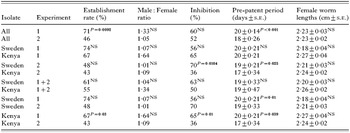
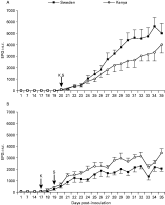
The pre-patent period differed significantly (P=0·025) between the isolates when fresh L3s were used but not when inoculation was done with cold-treated larvae (Table 1). In addition, a significant difference (P<0·0001) in pre-patent period was observed between the two experiments. The difference between the two experiments was also significant when data were compared for each isolate separately (P=0·01 for Sweden and P=0·039 for Kenya). In the experiment with cold-treated larvae, eggs were first detected on day 20 and all lambs excreted eggs on day 21. In the experiment with fresh larvae, eggs were first shed 17 days p.i., and all animals had a positive egg count by day 19.
Mean faecal egg counts (FEC) from both experiments are shown in Fig. 1. The FEC differed significantly between the two experiments (P<0·0001). In the group infected with cold-treated larvae from Sweden, the EPG increased more rapidly than the other groups, and reached a higher mean FEC at the end-point of the experiment.

Fig. 1. Faecal egg counts (FEC) following inoculation of lambs with 2 different isolates of Haemonchus contortus. (A) Experimental inoculation with cold-treated infective larvae. (B) Experimental inoculation with fresh infective larvae. Arrows indicate the pre-patent period for each isolate. K=Kenya; S=Sweden.
Worm burden and measurements
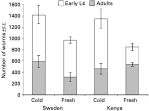
There was a significant difference (P=0·0092) in intensity of infection between the two experiments, with a higher establishment (71%) for cold-treated larvae (Fig. 2). However, no significant difference in worm burden was detected between the isolates, in either of the experiments. When worm burden was compared between host genders, no difference was observed. Larval treatment had no significant effect on the sex ratio of adult worms (Table 1).

Fig. 2. Total worm counts from subsamples of abomasum and abomasal mucosa expressed as adults and early fourth-stage larvae (EL4). One experiment was performed with cold-treated infective larvae, and the other with fresh infective larvae.
We found between 25 and 85% of worms that were arrested in the early fourth larval stage. Since animals were housed under identical conditions where the likelihood of autoinfection could be eliminated, these larvae were considered as inhibited in their development. In the experimental infection performed with fresh L3s, a significant difference (P=0·0104) was observed between the two isolates (Table 1). Inhibition was also greater (P=0·01) in lambs infected with cold-treated Kenyan L3s, than when fresh larvae of the same isolate were used for inoculation. In contrast, when fresh larvae of the Swedish isolate were used there were more inhibited larvae than with cold-treated larvae of the same isolate, although the results were not significant. The majority of nematodes were recovered from the lumen of the abomasum. Only 4% of the inhibited larvae were found in the mucosal digest. Mean lengths of worms are given in Table 1. No significant differences in worm length were observed between experimental groups or isolates.
The multi-way analyses confirmed these results and both the establishment rate (P=0·0082) and the pre-patent period (P<0·0001) were shown to be significantly influenced by the pre-treatment conditions of the L3s. Furthermore, the pre-patent period was significantly different (P=0·042) between isolates, and a significant interaction between experiment and isolate (P=0·042) was observed. The inhibition rate was not significantly different (P=0·059) between Experiments 1 and 2, whereas the interaction between experiment and isolate was highly significant (P=0·0033). No other significant differences were established.
Haematological analysis
The following haematological variables were measured, expressed as means±S.E. Packed red cell volume 32±0·4%; leucocytes 9·6±0·2×109 cells/l; neutrophils 2·0±0·1×109 cells/l; eosinophils 4·4±0·9×1011 cells/l; lymphocytes 7·2±0·2×109 cells/l; monocytes 0·3±0·01×109 cells/l. No significant differences were observed either between experiments or the isolate used. All lambs in both experiments exhibited values that were within the range of normal variation for lambs of this breed and age.
DISCUSSION
Although the isolates studied herein originated from 2 contrasting climatic regions, few differences were found. The larval inhibition pattern, sex ratio, worm length and establishment was similar irrespective of whether isolates came from Sweden or Kenya. In particular, there was little or no difference between the two isolates in the experiment in which cold-treated L3s were used. However, in the second experiment, with inoculation of fresh larvae, significant differences were observed between these isolates, both with respect to pre-patent period and larval inhibition. Significant differences were also found depending on the storage conditions of L3s, especially with respect to pre-patent period and establishment. Thus, when the lambs were inoculated with larvae that had been stored at 5 °C for 9 months, the patent period was somewhat delayed irrespective of the origin of the larvae.
The total number of worms was counted in both washings and in the pepsin digest of the mucosa. In this study, 96% of worms were found in the washings and only 4% in the digests. The present findings indicate that inhibited larvae of H. contortus are found loosely embedded in the abomasal mucosa as also suggested previously (Blitz and Gibbs, 1971; Gatongi et al. 1998).
The total number of inhibited larvae was estimated. In the experiment when cold-treated L3s were used, 56% and 65% of the worms were EL4s of the Swedish and Kenyan isolate, respectively. Thus, in the present study, no major differences in larval arrestment were observed between the isolates when larvae were cold-stored before infection. In a similar study by McKenna (1973), an increasing proportion of the established worm burdens were inhibited in development when L3s were stored at 5 °C for up to 80 days. However, the rate of inhibition declined at 120 and 160 days respectively (McKenna, 1973).
It was clear that the ability of H. contortus to undergo larval arrestment was maintained in the Kenyan isolate studied herein. However, for this isolate, inhibition was influenced by the storage conditions of the larvae. The high level of inhibition in this isolate was surprising as it has been suggested that seasonal change could be the causative factor of inhibition (Muller, 1968; Connan, 1971). In temperate regions, hypobiosis is believed to be an adaptation to survive the winters when the opportunities for larval transmission are restricted (Blitz and Gibbs, 1972; Waller and Thomas, 1975), whereas in tropical and subtropical areas the phenomenon is less commonly reported (Allonby and Urquhart, 1975). In contrast, the Swedish isolate showed no difference in inhibition in relation to storage conditions. This was in accordance with the findings of Mansfield et al. (1977) who reported that temperature for storage of larvae had no effect on the occurrence of inhibition.
Hypobiosis of H. contortus has been associated with a variety of larval culture and storage conditions in several experimental infection studies. Both in England and in Nigeria, it was reported that over 90% were inhibited in lambs killed 2 weeks after infection with freshly hatched larvae, cultured at 25–30 °C (Connan, 1975; Ogunsusi and Eysker, 1979). This is in agreement with the present findings as 70% and 36% of the worms were found inhibited in the experiment with fresh larvae of the Swedish and Kenyan isolates respectively. In contrast, an absence of hypobiosis was reported in lambs dosed with freshly-cultured infective larvae as well as L3 cultured at 15–25 °C for 28 days (Capitini, McClure and Herd, 1990).
Waller et al. (2004) showed that under Swedish field conditions, H. contortus had a high propensity to become arrested in development and that the onset of arrestment occurred early in the grazing season. The ability of H. contortus to become inhibited in the present study was not influenced by the long-term cold storage of L3s for the Swedish isolate. It has been suggested that inhibition in H. contortus is rather an obligatory genetic strategy for survival than dependent of external stimuli (Waller and Thomas, 1975; Waller et al. 2004). This was supported by the present results, and could explain the lack of correlation between storage and inhibition rate. The high levels of inhibition in lambs given fresh larvae of the Swedish isolate indicate that the mechanisms behind inhibition are not dependent upon environmental stimuli such as cold temperatures.
The establishment rates in our experiments were very high compared with earlier studies (Mansfield, Todd and Levine, 1977; Capitini et al. 1990). Mansfield et al. (1977) found that the establishment varied with the inoculating dose. When 10000 infective larvae were given, a smaller percentage of parasites was retained (14·2%) than if a low dose (1000 larvae, 25·8% establishment) was given. However, in both cases the percentage of retained worms was much smaller than in the present study. In experiments by Capitini et al. (1990), the effect of storage time and conditions were reflected in the observed establishment rates. They found that storage at 4 °C for 8 weeks was detrimental to infective larvae, as no worms were recovered from the infected lambs. They also found that in the experimental infections with 10000 larvae cultured at 20 °C, establishment ranged from 7·9% to 19·4% and those infected with freshly harvested L3s, only 5·3% of the inoculating dose was retained. In contrast, in the present study, worm establishment was in the range of 43 to 74%, depending upon pre-treatment of the infective larvae. With cold-treated L3s the mean establishment was 71%, whereas it was 46% when fresh larvae were used. In some of the sheep infected with cold-treated L3s, more than 2000 worms were counted, which was more than the calculated initial dose. The overdosing and the observed larval pre-treatment effect could be explained by the difficulty in estimating the infection doses, since the larvae used for experimental inoculations were considered as infective based on larval motility. In the fresh samples, the larval doses were entirely accurate as 100% of the larvae were motile at the time of inoculation. In contrast, in the experiment with cold-treated L3s, up to 35% of the larvae were coiled or non-motile and therefore regarded as non-infective. Although the larvae in this study were acclimatized to room temperature for several hours before they were counted, many were apparently infectious even though they were coiled. The total number of larvae, including those classified as non-infective, was slightly higher than the estimated dose of 2000 L3, e.g. approximately 2600 for the Swedish isolate and 2700 for the Kenyan. Consequently, each lamb in the first experiment received a slightly higher dose of larvae than calculated. Still, no significant difference in establishment between the two isolates was observed. Furthermore, the long-time cold storage had no effect on the sex ratio in this experiment. This is in agreement with earlier findings by Mansfield et al. (1977).
In conclusion, the results presented here show that the storage of H. contortus at 5 °C, for up to 9 months, had no apparent effect on the infectivity of L3s, as we observed high establishment irrespective of isolate used. There were no major differences between the two isolates studied, when data from both experiments were combined. However, there were several significant differences between the two experiments. One surprising finding was the high level of inhibition observed in the Kenyan isolate, even when fresh larvae were used for inoculation.
The authors are very grateful for technical help by Daniel Brelin. Dr John Githiori is thanked for originally providing us with the Kenyan Haemonchus contortus isolate, Kerstin Göransson for input on statistical analysis and Peter Waller and Jackie Hrabok for useful comments and help with linguistic revision. This project was funded by the Swedish Council for Agricultural Research (SLF0354001) and approved by the Swedish Animal Ethics Committee (permission C243/2).