INTRODUCTION
Lactating ruminants, such as cows, ewes and goats, produce c. 15% more milk when exposed to an artificial long-day photoperiod than those kept under a natural short-day photoperiod (Dahl et al. Reference Dahl, Buchanan and Tucker2000, Reference Dahl, Tao and Thompson2012; Morrissey et al. Reference Morrissey, Cameron and Tilbrook2008; Flores et al. Reference Flores, Flores, Elizundia, Mejia, Delgadillo and Hernandez2011: these results were obtained from indoor, well-nourished animals that were milked twice daily). Furthermore, in addition to increased milk production, light-treated animals also showed elevated plasma insulin-like growth factor 1 (IGF-I) concentrations (Dahl et al. Reference Dahl, Elsasser, Capuco, Erdman and Peters1997; Spicer et al. Reference Spicer, Buchanan, Chapin and Tucker2007). Therefore, it is thought that this growth factor mediates the effects of artificial long days on milk production (Dahl et al. Reference Dahl, Elsasser, Capuco, Erdman and Peters1997). At present, the effectiveness of long-day treatment at increasing milk production or IGF-I blood concentration has not been investigated in goats maintained under extensive natural grazing conditions.
As in other subtropical latitudes, such as south-western Australia (29°S; Martin et al. Reference Martin, Rodger and Blache2004), most goats in northern Mexico (26°N) graze on the available vegetation in semi-desert areas, which depends mainly on the amount of rainfall. The non-rainy or dry season in northern Mexico lasts from December to May, which coincides with a dramatic reduction in food availability in grazing areas (Delgadillo Reference Delgadillo2011). About 0·80 of parturitions in the goat occur during this season. Such conditions result in low kid survival rates and milk yields. Considering the above points, the objective of the present study was to investigate whether artificial long-day treatment can increase milk production in goats maintained under extensive grazing conditions with or without the presence of a nutritional supplement.
MATERIALS AND METHODS
The experimental procedures reported in the current paper complied with the Official Mexican Rule for the technical specifications for the production, care and use of laboratory animals (NOM-062-ZOO-1999; SAGARPA 2001).
Location
The study was conducted on a commercial farm in the Laguna region in the state of Coahuila, Mexico from October 2009 to February 2010. The natural photoperiod in this region ranges from 10 h 19 min of light at the winter solstice to 13 h 41 min at the summer solstice. During the experiment, the mean time at sunrise was 07·24 h and the mean time at sunset was 18·45 h, resulting in an average day duration of 11 h 21 min.
Experimental design
Forty-four local multiparous goats maintained under natural extensive grazing conditions were used. The local population of goats originated from the Spanish Granadina, Murciana and Malagueña breeds imported into Mexico in the 16th century. During the last 50 years, this population has been crossed with Alpine, Saanen and Anglo-Nubian breeds to improve milk and meat production (Duarte et al. Reference Duarte, Nava-Hernández, Malpaux and Delgadillo2010). Goats were mated in May by means of the male effect, in which sexually active males were introduced to seasonally anoestrous females after a period of separation (Flores et al. Reference Flores, Veliz, Perez-Villanueva, Martinez De La Escalera, Chemineau, Poindron, Malpaux and Delgadillo2000). The mean date of parturition (±s.e.m.) for all the goats was October 9±2·0 days. The first parturition occurred on 6 October and the last on 13 October 2009. Goats and their kids remained together in open pens from 19·00 to 05·00 h until day 30 of lactation. At the beginning of the study period, the mean milk yield and body condition score (BCS) for all goats were 0·65±0·03 kg and 1·8±0·05, respectively.
At 15 days of lactation, females were allocated to two groups balanced for initial milk yield (estimated at day 10 of lactation) and BCS. One group of goats was maintained under natural photoperiod conditions (n=22; 13 mothers with single kids and 9 mothers with twins), whereas the second group (n=22: 12 mothers with single kids and 10 mothers with twins) was exposed continuously to an artificial long-day photoperiod of 16 h light : 8 h darkness. All the goats were maintained under grazing conditions from 09·00 to 18·00 h daily and fed only on the available natural vegetation. Animals were sheltered in open pens overnight. The available flora in the grazing areas consisted mainly of shrubs (Parthenium incanun, Agave lechuguilla, Buddleja scordioides and Atriplex canescens), which constituted over 0·80 of the goats’ diet throughout the year; herbaceous plants accounted for 0·12 and grasses <0·10 of the diet for most of the year except during the dry period in October (Mellado et al. Reference Mellado, Foote, Rodríguez and Zarate1991; Ramírez et al. Reference Ramírez, Loyo, Mora, Sanchez and Chaire1991). Previous studies have shown that this kind of pasture provides 149 g crude protein (CP)/kg dry matter (DM) and 9·88 MJ metabolizable energy (ME)/kg DM (Juárez-Reyes et al. Reference Juárez-Reyes, Cerrillo-Soto, Meza-Herrera and Nevárez-Carrasco2004). The daily consumption of this diet did not provide the nutritional requirements for maintenance and production (Cerrillo et al. Reference Cerrillo, López, Nevárez, Ramírez and Juárez2006).
Kids were weaned at 30 days lactation and, thereafter, dams were milked manually once a day at 06·00 h. After weaning of the kids, half of the females maintained under natural photoperiod (n=11) received a daily nutritional supplement indoors, in addition to grazing, composed of a mixture of 300 g rolled maize and 200 g soya bean (121 g CP and 7·20 MJ/day ME) per animal (NDS; natural day supplemented group), whereas the other 11 goats did not receive a feed supplement (NDN; natural day non-supplemented group). Goats treated with artificial long days were separated in the same manner as those maintained under natural photoperiod. Thus, half of the females (n=11) received a nutritional supplement (LDS; long-day supplemented group), whereas the other 11 goats did not receive a nutritional supplement (LDN; long-day non-supplemented group). The nutritional supplement substituted part of the grazing diet and provided 268·0 g CP/kg DM and 14·64 MJ/kg DM overall. At the beginning of supplementation, the mean milk yield for treated and control non-supplemented groups was 1·08±0·08 and 0·94±0·09 kg, respectively, whereas for treated and control supplemented groups, it was 0·94±0·08 and 0·81±0·07 kg, respectively.
When females returned from daily grazing (at 18·00 h), they were separated into their respective pens (four pens in total, each 10×5 m). Each doe was offered the nutritional supplement in a small bucket and feeding was supervised such that all supplemental feed was consumed. Additionally, females had free access to water as well as mineral salts in 25-kg blocks (Cebú, Salinas del Rey, Torreón, México) which contained at least 170, 30, 50 and 750 g/kg of phosphorus (P), magnesium (Mg), calcium (Ca) and sodium chloride (NaCl), respectively, as recommended by the NRC (2007).
Photoperiod treatment
For exposure to the long-day photoperiod, pens were equipped with daylight-type lamps that emitted a minimum luminous intensity of 400 lx at the eye level of the goats. Lights were on from 06·00 to 09·00 h and from 17·00 to 22·00 h to extend the natural daylength up to 16 h light/day. The light-treated and natural photoperiod groups were separated by a distance of 50 m. Additionally, an opaque curtain was placed around the light-treated pens to avoid light exposure to animals in the natural photoperiod groups during the night.
Measurements
Milk yield
During the suckling period (0–30 days of lactation), goats were not milked and milk yield was assessed at 10 and 20 days of lactation by means of the weigh–suckle–weigh method over a 24-h period (Ricordeau et al. Reference Ricordeau, Boccard and Denamur1960). At 19·00 h the day before the measurements were performed, the udder of each animal was emptied by nursing followed by intravenous administration of oxytocin and removal of the residual milk in the udder by hand-milking (OT; 2 IU; Oxilac Proquivet, Guadalajara, Mexico; Salama et al. Reference Salama, Caja, Such, Peris, Sorensen and Knight2004). The next day, two controlled 4-min nursing events were performed at 07·00 and 19·00 h. After each nursing, exogenous oxytocin was injected into the jugular vein of each goat, and residual milk was extracted by hand milking. The residual milk weight was added to the corresponding change in body weight (BW) measurements of the kid.
During the milking period (31–110 days), milk yield was measured by the same person every 10 days from day 40 of lactation. At 06·00 h the day before each measurement, the udder of each animal was emptied by hand-milking followed by administration of intravenous oxytocin to extract residual milk. The next day, goats were hand milked at 06·00 h and the collected milk was weighed. Subsequently, oxytocin (2 IU) was injected into the jugular vein of each female and the residual milk was extracted by hand milking. Residual milk was weighed and added to the quantity obtained by hand milking.
Plasma insulin-like growth factor 1 concentrations
The plasma IGF-I concentrations of eight females from each group were determined on days 20, 40, 60, 80 and 100 of lactation. At these times, blood samples (5 ml) were collected between 07·00 and 09·00 h by jugular venipuncture into tubes containing sodium heparin (130 μl) and were stored at 4 °C for a maximum of 1 h during collection. Plasma was harvested by centrifugation at 2000 g for 30 min and stored at −15 °C until analysis. The IGF-I concentrations were measured in single samples using an enzyme-linked immunosorbent assay (ELISA) kit (American Laboratory Products Company, New Hampshire, Ohio, USA; Porstmann & Kiessig Reference Porstmann and Kiessig1992) according to the manufacturer's protocol. Intra- and interassay coefficients of variation were 0·058 and 0·050, respectively.
Body weight and body condition score
Body weight and BCS of all females were determined every 15 days, from days 15 to 105 of lactation. Females were weighed between 07·00 and 09·00 h using a mobile scale with a 200-kg capacity and a precision of 0·05 kg. Body condition score was determined by the same person by palpating the spinous and lateral processes, as well as the musculature, of the lumbar spine according to the method previously described by Walkden-Brown et al. (Reference Walkden-Brown, Restall, Scaramuzzi, Martin and Blackberry1997) using a scale ranging from 1 (very lean) to 4 (fat) with a precision of 0·5.
Statistical analysis
Data were analysed using the MIXED MODELS procedure in SYSTAT 13 (Chicago, IL). The procedure included the fixed effects of photoperiod treatment (two levels: natural and artificial, with goat within treatment as the error term), nutritional treatment (two levels: non-supplemented and supplemented), days of lactation and their interactions, as well as the random effects of goat and residual. The same statistical procedure was used for analysing variations in BW, BCS and IGF-I concentrations. The individual goat was the experimental unit. Comparisons between groups for all of these variables were made time point by time point using Tukey pairwise comparisons. Data were presented as mean±s.e.m., and the results were considered significant at P≤0·05.
RESULTS
Milk yield
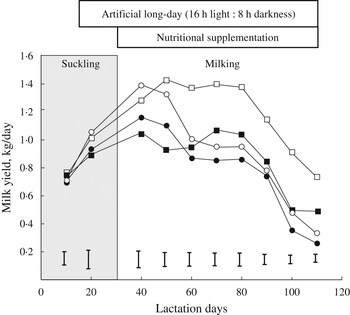
Mean milk yield was greater in the LDN group than in the NDN group (photoperiod effect, P=0·001) and this difference was more pronounced between groups that received a nutritional supplement (photoperiod×nutritional supplement interaction, P=0·005). Further, mean milk production was greater in goats that were supplemented than in goats that were not supplemented (nutritional supplement effect, P=0·001; Table 1), and milk yield of goats in each group was affected by time (P=0·001; Fig. 1). Mean milk yield variations over time differed between non-supplemented and supplemented groups (supplement×time interaction, P=0·001). No interaction was found between photoperiod and time on milk yield (P=0·562). The total milk yield per goat in the LDN group during the study (31–110 days of lactation) was 10·8±0·93 kg greater than in the NDN group, and the LDS group produced 23·9±1·56 kg more milk than the NDS group (photoperiod effect; P=0·003). Furthermore, total milk production in the NDS group was 3·5±0·30 kg greater than in the NDN group, and the LDS group produced 14·9±0·85 kg more milk than the LDN group (P=0·05).
Effects of exposure to a long-day photoperiod starting on 15 days lactation on mean daily milk yield of grazing goats with (□, n=11) or without nutritional supplementation (○, n=11). The other two groups of goats were maintained under natural photoperiod with (■, n=11) or without a nutritional supplement (●, n=11). The grey area represents the time when kids remained with their mothers. Vertical bars indicate s.e. of differences between means.

Mean (±s.e.m.) milk yield, BW, BCS, and plasma IGF-I concentration of grazing goats maintained under an artificial long-day photoperiod or a natural photoperiod, with or without a nutritional supplement*

* Data are least-squares means and standard errors of the mean.
† 4% FCM=0·4 (l of milk) +15 (kg of fat).
PP, photoperiod effect; S, nutritional supplementation effect; PP×S, photoperiod×nutritional supplementation interaction.
BCS scale ranged from 1 (very lean) to 4 (fat).
Plasma insulin-like growth factor 1 concentrations
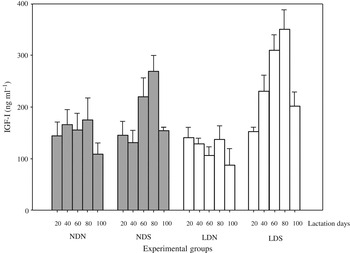
The mean plasma IGF-I concentration was greater in the NDN group than in the LDN group (photoperiod effect, P=0·001; Table 1). Moreover, the plasma IGF-I concentrations were greater in supplemented groups than in non-supplemented groups, independent of photoperiod (supplementation effect, P=0·001). Plasma IGF-I concentrations of goats in the four groups fluctuated throughout the study (P=0·001) and these fluctuations differed between non-supplemented and supplemented groups (supplementation×time interaction, P=0·001). No interaction was detected between photoperiod and time for IGF-I concentration. However, when goats received a nutritional supplement, plasma IGF-I concentration was greater in the LDS group than in the NDS group (photoperiod×nutritional supplementation interaction, P=0·001; Fig. 2).
Effects of exposure to a long-day photoperiod starting on 15 days lactation on mean (±s.e.m.) plasma IGF-I concentrations in goats (n=8 per group) in the four study groups.

Body weight and body condition score
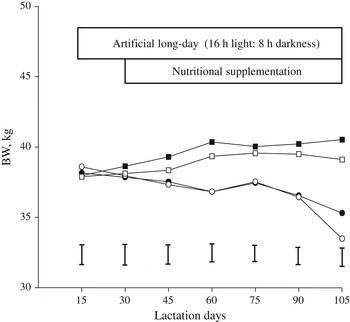
Body weight was not affected by photoperiod treatment (Table 1). Nutritional supplementation increased mean BW by 2·3 and 1·9 kg in goats maintained under natural and artificial long days, respectively (nutritional supplementation effect; P=0·001; Fig. 3). There was no effect of time on BW throughout the study. Moreover, no interaction between photoperiod and nutritional supplementation on time was detected. Similarly, no interaction between photoperiod and nutritional supplementation was found.
Mean BW of grazing goats exposed to an artificial long-day photoperiod with (□, n=11) or without a nutritional supplement (○, n=11). The other two groups of goats were maintained under natural photoperiod with (■, n=11) or without a nutritional supplement (●, n=11). Vertical bars indicate s.e. of differences between means.

Body condition scores were greater for groups exposed to long days than for groups maintained under natural photoperiod (photoperiod effect; P=0·001; Table 1). Additionally, BCS was greater in supplemented than in non-supplemented groups (nutritional supplementation effect; P=0·001). The BCS of the four groups changed during the experimental period (time effect; P=0·001), and these changes differed between supplemented and non-supplemented groups (supplementation and time interaction, P=0·001). No interaction between photoperiod and time was detected for BCS. However, an interaction between photoperiod and nutritional supplementation was found for BCS (P=0·002).
DISCUSSION
The results of the present study show that exposure to artificial long days increases milk production in subtropical goats that are maintained under extensive grazing conditions and start lactation in autumn. Furthermore, when these animals received a nutritional supplement in addition to the long-day treatment, the increased milk production was more pronounced. These results also confirm that, depending on nutritional status, exposure to artificial long days increases the plasma IGF-I concentration in lactating goats.
Although artificial long-day treatment increased milk production in goats that had access only to natural vegetation without nutritional supplementation, these animals tended to diminish their milk production level at 60 days lactation compared with the LDS group. When long-day-treated goats received a nutritional supplement, milk production was further increased and, interestingly, this increase was sustained beyond 90 days lactation. This finding provides evidence for the first time that the intensity of the stimulatory effect of long-day photoperiod on milk yield in goats fed under extensive grazing conditions varies with nutritional supplementation. This result agrees in part with those reported in cows, ewes and goats maintained under constant nutritional levels, in which artificial long days increased milk production compared with females under natural photoperiod (Dahl et al. Reference Dahl, Buchanan and Tucker2000; Morrissey et al. Reference Morrissey, Cameron and Tilbrook2008; Flores et al. Reference Flores, Flores, Elizundia, Mejia, Delgadillo and Hernandez2011). As in other subtropical latitudes, most goat herds in sub-tropical Mexico are managed extensively and fed on native grasslands and occasional crop waste. A dry period runs from the end of autumn to the end of spring, reducing the amount and quality of the feed available in the grazing areas (Delgadillo Reference Delgadillo2011). Therefore, it is probable that the amount of protein and metabolic energy intake during this dry period is insufficient to meet the minimum nutritional requirements for lactation (Juárez-Reyes et al. Reference Juárez-Reyes, Cerrillo-Soto, Meza-Herrera and Nevárez-Carrasco2004). Despite such feeding conditions, it was possible to observe a galactopoietic effect of artificial long days in the present study (18% increase in milk yield), although at a smaller intensity compared with recent reports in well-nourished lactating subtropical goats (24% increase in milk yield; Flores et al. Reference Flores, Flores, Elizundia, Mejia, Delgadillo and Hernandez2011). Nevertheless, nutritional supplementation alone in females kept under natural daylength was not as effective as in those also exposed to artificial long days. The present results show that the average increase in milk production with nutritional supplementation in goats maintained under natural photoperiod was 40 g milk/day, whereas four times this increase was obtained in goats submitted to long days. These results indicate that the response of lactating females to nutritional supplementation is dependent on photoperiod. Thus, long-day photoperiods favour nutrient partitioning towards the mammary gland whereas short days favour the body reserves (Bocquier et al. Reference Bocquier, Theriéz, Kann and Delouis1986).
In supplemented groups, but not in non-supplemented groups, circulating concentrations of plasma IGF-I were greater in goats submitted to long days than in those maintained under natural photoperiod. Data regarding plasma IGF-I in the current study confirm two previously reported findings in ruminants. First, the current results agree with those previously reported in dairy cows, in which plasma IGF-I concentrations were greater in cows submitted to long days than in cows maintained under natural photoperiod (Dahl et al. Reference Dahl, Elsasser, Capuco, Erdman and Peters1997). Second, the low circulating concentrations of plasma IGF-I observed in non-supplemented (natural or artificial) goats confirm that low nutritional status decreases circulating concentrations of IGF-I, as has been observed in previous studies on other animals (ewes: Hodgkinson et al. Reference Hodgkinson, Davis, Burleigh, Henderson and Gluckman1987; heifers: Lacasse et al. Reference Lacasse, Block and Petitclerc1994). An unexpected finding in the current study was that the plasma IGF-I concentrations in non-supplemented goats were lower in those submitted to long days than in those maintained under natural photoperiod. The precise mechanism by which photoperiod decreases IGF concentrations in non-supplemented lactating goats is unknown. However, it is well known that female goats and cows enter a state of negative energy balance at the onset of lactation due to the rising energy demand of high milk production (Dunshea et al. Reference Dunshea, Bell and Trigg1990). In the current study, the LDN group lost more BW than the NDN group. Although there was no significant difference in initial BW, it is possible that the considerable weight loss in non-supplemented goats provoked a negative energy balance, which is characterized by reduced blood glucose and insulin concentrations and elevated blood growth hormone (GH) concentrations (Butler Reference Butler2003). In cows, it has been demonstrated that the liver becomes refractory to GH during negative energy balance and that this uncoupling of the GH–IGF-I axis results in diminished plasma concentrations of IGF-I (Vicini et al. Reference Vicini, Buonomo, Veenhuizen, Miller, Clemmons and Collier1991).
Although the main objective of the current study was to generate knowledge about the environmental factors that influence lactation, the present results show that exposure to long-day photoperiod increases milk production in grazing goats. However, in the present study this increase was marginal and this was probably caused by the low BCS of the females throughout lactation. In fact, in ruminants this corporal measure, that reflects the metabolic status, is a determinant factor for milk production (Roche et al. Reference Roche, Friggens, Kay, Fisher, Stanfford and Berry2009). Similarly, studies on the application of other technologies such as the use of bovine somatotropin have revealed that animals require an optimal BCS to respond and increase their milk production (Fernández et al. Reference Fernández, Rodríguez, Peris, Molina and Torres1997). Considering that in the present work goats presented a large variability in the BCS, it would be interesting to evaluate this photoperiod treatment using groups of goats with lower and optimum BCS. Also, more studies are still needed to evaluate if using cheaper feed supplements or using goats with better dairy genetic value could enable more profitable results to use this treatment under grazing conditions.
To conclude, the present results show that exposure to an artificial long-day photoperiod increases milk yield in subtropical lactating goats maintained under extensive grazing conditions. Moreover, when these animals received a nutritional supplement in addition to the long-day treatment, the increased milk production was more pronounced. These results also confirm that, depending on nutritional status, exposure to artificial long days increases the plasma IGF-I concentrations in lactating goats.
The authors are grateful to Elpidio González (Matamoros, Coahuila, Mexico) for providing the female goats used for the study and to Dolores López for her excellent and kind secretarial assistance. Manuel de Jesús Flores thanks INIFAP-Campo Experimental Zacatecas and CONACyT for supporting his doctoral studies.