1. BACKGROUND
To me, as a performer/commissioner as well as a composer of new works for instruments and electronics, the nature and role of notation within contemporary electroacoustic music practice is a recurring concern. Recent developments in dynamic scores and my own explorations of them within collaborative creation have led to some observations that might be useful to inventors and interpreters on either side of the notation/performance equation. What follows here, then, is a brief and personal account of how different score types can assist in defining the place of a live performer within an art form that is often largely media- and digitally based, by incorporating both the prescriptive symbolism and oral transmission inherent in traditional Western instrumental practice as well as the plug-and-play virtuosity of much electronic and digital music.
2. A SCORE FOR EVERY PURPOSE
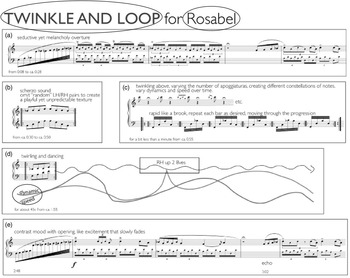
The idea that a single work can have a number of different scores emerged rather naturally from my practice as a performer. One could argue that the cutting and pasting of badly organised, unwieldy instrumental scores into a customised format is not so different from adjusting an electronics patch for a personal rehearsal setup. Over time, however, I realised that a multiplicity of formats could create a kind of augmented score, one that facilitated transmission/appropriation both technically/technologically as well as aesthetically/semantically. Thus, I created a rehearsal version of the score, which was in video/audio format in the case of my latest piano and electronics work (Hron Reference Hron2013), and the performance score, which for the same work included the rehearsal video, but with the audio replaced by the performance patch and instructions. This worked well since the piece relied on a somewhat fixed timeline, and the live electronics could be adequately simulated in a fixed rehearsal version. I also wanted to create a hypertext version using visual stills of the score so as to include information about the work’s creation (in this case a highly collaborative process involving three different pianists), aesthetic and, to some extent, meaning. Figure 1 is an image of the first movement, twinkle and loop, for which the documentation includes a number of hyperlinks, including a short video about the collaborative creation process.
Terri Hron, Maly velky Svet – i. twinkle and loop. © Terri Hron Reference Hron2013 – Circled elements are hyperlinks. The title links to a documentary video, ‘Rosabel’ links to the commissioner/collaborator Rosabel Choi’s website, and the ‘dynamic/speed’ circle links to text information about how to interpret this element.

3. ENHANCING THE PERFORMANCE PRACTICE ANGLE: HYPER-SCORES
The organisation of the score in this way clearly comes from my being a recorder player who faces the emerging notational practices in early music and regularly deciphers contemporary scores. I have ever-present reservations and frustrations with traditional five-line staff and the way this notation influences and delimits much music, but it is an incredibly powerful communicative tool for those expert in reading it. In a recent interview, contemporary bass clarinet player Laura Carmichael told me:
I’ve been learning to read music since I was 5 years old. It’s just so integrated into my process of being a musician… I come back to the fact that I am a reader, that’s what’s in my whole physiology. The notation comes in and my body just reacts: I’m programmed now. Notation can provide a lot of energy about the way sound can be expressed on page. How does someone get their ideas across and how do I understand it, the process of transference of energy is always fascinating to me. (Carmichael Reference Carmichael2012)
Clearly abandoning this symbolic language that so many of us ‘play’ seems counterproductive. However, immediately following the above, Carmichael continues:
I feel like so much of our performance practice is about interpretation and that is an oral tradition that gets handed down … There is an immense amount of information, both written by musicologists but also handed down from generation to generation, and I think contemporary music is like that too. You still have to make it into a whole. You can’t just be stuck in the page completely. The page cannot give you everything that you need for it to come to life. (Carmichael Reference Carmichael2012)
Carmichael expresses instinctively what Trevor Wishart points to in his discussion of notation and its relationship to the divide between composers and performers, which in instrumental music has led to a hierarchy within the creative process:
[M]usic is viewed as an essentially abstract phenomenon and the sound experience of essentially secondary importance. More commonly the score is seen as normative on the musical experience. The split in conception between what are seen as primary and secondary aspects of musical organisation leads to a split between composer and performer, between composition and interpretation and the gradual devaluation of non-notable formations. (Wishart Reference Wishart1996: 35)
While musicologists do study performance practice and even the performer’s creativity, it is still for the most part historical. Furthermore, contemporary performance has seen a resurgence of increasingly individual and divergent practices in the development and augmentation of instruments and their techniques. Innovators always abound, but I would argue that in Western art music, since the establishment of the nineteenth-century orchestra, there was a comparative lull in the development of instruments until the large-scale accessibility of digital technologies. Luckily, at present, our tools for documenting and offering information about innovations that formerly could only be transmitted orally have multiplied. Leaving traces of the process leading to the creation of a work and information about its performance practice – which clearly influences the reading/interpretation/performance of its score – is motivated not only by a desire to be clear about my own intentions, but also a commitment to acknowledging the role of artistic collaborators – most often expert performers – who had an integral role in its definition. One only has to look at recent studies about collaborative practice (Roche Reference Roche2011) to realise to what extent performers play a large role in creation:
In a musical culture that has understood the performer’s role primarily as mediator between composer/piece and audience, very little attention has been paid to the performer’s potentially significant mediation between composer and piece. When the latter interpretation of the role is brought into play early in the conception, the performer may take a vital, inventive stance in which ‘problems’ (musical ideas) are formulated and reformulated in tandem with their ‘solutions’. The composer–performer collaboration may thus become a site for the playing out of the dialogic aspects of artistic creation. (Fitch and Heyde Reference Fitch and Heyde2007: 72)
Hypertext scores, perhaps hyper-scores, are a wonderful solution to adding important performative/aesthetic information without encumbering the largely mnemonic function of a textual score.
4. UTILISING THE PERFORMERS’ EXPERTISE: COMMON-TECH REHEARSAL SCORES
My pet peeve as a commissioner and performer of new works for recorder and electronics is a lack of adequate rehearsal options, formats and instructions. There are (at least) two issues here: the first is the absence of definition of the relationship between the performer and the electronics, and the second is an absence of awareness of a performer’s rehearsal needs.
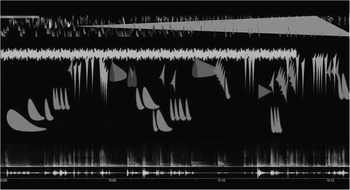
Taking the simplest form of music for instruments and electronics, that which uses a fixed medium, I find it surprising how many scores do not provide the performer with information about the fixed part, other than providing it in audio file format. My feeling is that this may have to do with the difference in notation practice for instrumental versus sound-based music. Instrumental notation is for the most part prescriptive, as it offers information about pitch and duration, and, to various degrees of precision, timbre. The actual sound produced is not described as such, as the organology of the instrument playing is, again for the most part, taken as a given within the formula of symbols. Notation for music from the concrète tradition, when it is used, is by nature descriptive, as the sound pre-dates the symbol, as in the diffusion scores created Bernard Parmegiani for his De Natura Sonorum. A more recent example of software tools that flow from this tradition is EAnalysis by Pierre Couprie, and Figure 2 shows one of his analysis scores (originally conceived in another analysis tool, GRM’s Acousmographe) of a movement of Parmegiani’s De Natura Sonorum.
Pierre Couprie, analysis of Bernard Parmegiani’s De Natura Sonorum: Ondes Croisées. Still from analysis made with the EAnalysis software.

I include these examples as proof that there are innovative ways and tools for describing fixed media content, and the ‘sound following’ of both EAnalysis and the Acousmographe is a feature I find very useful. For instrumental performers, such descriptions stimulate the chamber music instinct that prepares them to share the space with the other sounds present. Of course, on some level, a fixed audio track is in itself a score, and may perhaps not need a graphical description, since it can be sounded in space. My own feeling is that while this is often true, any information about the relationship between sounds in the space is always useful, whether in the form of important timings, sonic equivalencies or blend information.
How to practise this kind of chamber music is key as well, and leads to my second issue: rehearsal requirements. Very few performers have access to full studio setups, or even the hardware/software necessary to run the patches for the works they play. Regardless of the complexity of the setup and their level of interactivity, it is imperative to provide performers with the ability to rehearse using as much of the expertise they already have as possible. To make a traditionalist analogy, it is much like offering a piano reduction of an orchestral score so that a soloist can practise a concerto. Perhaps there is no need for a different ‘looking’ score, but if one considers the whole media package itself as the score, then a rehearsal version could look quite different from the performance version. It might include simulated versions to watch or listen to, standalone versions of interactive patches or video scores with integrated audio to facilitate practice on headphones. In short, common/low-tech versions as close to the performance situation as practically possible. To continue with the same work as the hyperscore example, Maly velky Svet – i. twinkle and loop has a video practice score that can be played back on a computer or tablet placed on the piano music stand, with the synchronised audio playback being the fixed parts and a simulation of the live processing. Performers have responded particularly enthusiastically to this kind of tool, since it allows them to learn all parts of the piece and conveniently avoids page turns. A tablet can even be used without the music stand, allowing for easier access to the instrument if there are preparations (as there are in later movements of this work).
4.1. Parenthesis: interactivity
In 1999, Joel Chadabe (Chadabe Reference Chadabe1999: 29) defined three types of computer-assisted performance: (a) the performer plays a part of another composer’s work; (b) the performer is the composer and controls an algorithm in real time; and (c) the performer controls an algorithm in real time through improvisation, wherein there is often a feedback between the material generated by the computer and the performer. These distinctions also point to the information a score should define and transmit: what does the performer play and what must they control? And taking a step further, what kind of a rehearsal setup enables the performer to best adapt and adopt that control while playing? I would add that there are also different categories of interactivity that influence how a performer will conceive of and rehearse their part. The interaction can be on the level of sound itself, in the case of an augmentation/processing of the sound of an instrument, where the performer has varying degrees of control of the augmentation through direct and indirect means. Obviously, the more augmented the instrument, the more time the performer will need in learning to manipulate what is essentially a different instrument or sounding object. However, pieces for augmented instruments are very often written for specific performers with bespoke instruments, and thus documenting the original performer and the performance practice they develop for the work is essential. For performers unused to augmentations, the hazards of using an external controller should not be underestimated: a switch played by a foot can be tricky for a violinist accustomed to focusing on their hands. Interaction can also exist on the level of the sound material to be played, in the case of dynamically generated scores or forms. In these kinds of pieces, it is not the instrumental technique that requires further definition, it is the rules of play, which are often different from those involving other human performers, since the computations and transformations are of a different order and speed. Often, the performer is required to exercise another kind of control or perhaps become accustomed to the lack of it. An interesting example of this is the recent works of Sandeep Baghwati (Baghwati Reference Bhagwati2008b and Reference Bhagwati2011), in which he explores different kinds of score generation and feedback systems, where aspects of the form and the content of the piece are created in real time. He writes:
Analog interactions require constant creative and regulatory feedback between participants. This means that no single agent can have a detailed overview of the temporal evolution of the work, that this evolution must emerge from the interactions – thus, any conventional fully written out score will be too confining. Likewise there can be no conventional conductor – the conductor must take part in the creative process. In fact, to some degree all musicians must be co-creators of the work. (Bhagwati Reference Bhagwati2008a: 4)
Regardless of the nature of interactivity, the performer will need to have access to a minimum of equipment in order to become adept at their part. A lo-fi version of the piece already proves very useful for rehearsal purposes – just like that piano reduction. Finally, even when a certain level of expertise and equipment is assumed, there should still be clear instructions on the calibration of the performer’s hardware (microphones, controllers).
4.2. Fidelity in concert: improving performance scores
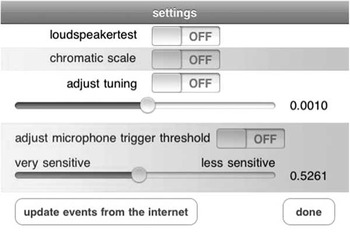
I consider most existing scores of music for instruments and electronics as performance scores, in the prescriptive tradition, and therefore this type needs little definition here. However, I would suggest that the often-overlooked step of calibrating the hardware (for a good discussion see Kimura Reference Kimura2003), the software and the space can also be integrated in a performance score, as in Hans Tutschku’s Irrgärten (Tutschku Reference Tutschku2010). This work, though limited in its use of live processing, does have some very practical features – both for rehearsal and performance – all housed within a downloadable app to use on the iPhone/iPod (Figure 3). Along with the actual playback, the app has a loudspeaker test to ensure the correct channels are connected to the corresponding speakers, a soundfile to test loudspeaker quality, a feature to adjust the tuning of the playback, should the piano not be tuned to A440Hz, and a function to adjust the iPhone’s microphone threshold.
Hans Tutschku, iPhone interface for Irrgärten.

Although as Tutschku admits, the piece is intentionally limited to the use of ‘easy electronics’, I find that the app’s features would be worth integrating in performance scores for many works. In the same vein, alongside the schematics and tech sheets that are often (though surprisingly not consistently) provided with performance scores, there are very seldom instructions for anyone assisting or diffusing the electronics in the space. Considering that such assistance/performance is often part of the rehearsal process once in the performance space, it would make sense that the diffusion part would find its way into the performance score. While diffusion scores exist for acousmatic works, there are few scores with detailed instructions for the electronics, unless these are assigned to a performer (Blake Reference Blake2011). Certainly not all works would need diffusion scores, but the paucity of examples is surprising.
5. CONCLUSION
Instructions for instrumentalists within interactive and media art with hybrid scoring techniques can benefit from hybrid and augmented formats. These can add content that was traditionally only transmitted orally about a work’s background, genesis and performance practice. They can also provide different presentations that facilitate analysis, rehearsal and performance in different situations and contexts.