INTRODUCTION
Among other factors, plant–plant interactions regulate the structure and composition of plant communities (Callaway & Walker Reference CALLAWAY and WALKER1997). Allelopathy is a chemical interaction in which plants or micro-organisms inhibit or stimulate the biological functions of other biological systems through the release of secondary metabolites to the environment (Rice Reference RICE1984). The study of chemical interactions in plants is often obscured by the complexity of soil ecosystems, as well as by substances released by soil micro-organisms (Rosenblueth et al. Reference ROSENBLUETH, MARTÍNEZ, MARTÍNEZ, Anaya, Espinosa-García and Cruz-Ortega2001). However, other plant models (e.g. parasite–tree or epiphyte–tree), in which plant–plant interactions are mediated by few or no other organisms, may be used to study allelopathy. In these particular systems, seeds germinate on trees and are therefore subject directly to the properties of the bark, especially when bark colonization is not dependent on the actions of other organisms such as termites, ants or fungi (Arditti & Ghani Reference ARDITTI and GHANI2000, Flores-Palacios & Ortíz-Pulido Reference FLORES-PALACIOS and ORTÍZ-PULIDO2005).
Potentially, any tree species can provide micro-environments suitable for epiphyte survival (Callaway et al. Reference CALLAWAY, REINHART, TUCKER and PENNINGS2001). It would therefore be expected that epiphytes could inhabit any suitably located tree, given adequate seed availability. However, it has been observed that epiphytes display a distribution which is biased towards some host species (Callaway et al. Reference CALLAWAY, REINHART, TUCKER and PENNINGS2001, Mehltreter et al. Reference MEHLTRETER, FLORES-PALACIOS and GARCÍA-FRANCO2005). There have been various local-scale studies highlighting factors which could explain patterns of epiphyte presence on certain tree species: for example; water retention of bark (Mehltreter et al. Reference MEHLTRETER, FLORES-PALACIOS and GARCÍA-FRANCO2005), plant–insect interactions (Flores-Palacios & Ortíz-Pulido Reference FLORES-PALACIOS and ORTÍZ-PULIDO2005) and some physical characteristics of bark such as thickness and peeling rate (López-Villalobos et al. Reference LÓPEZ-VILLALOBOS, FLORES-PALACIOS and ORTÍZ-PULIDO2008). It has been suggested that trees with rugose and non-peeling bark should be the best hosts for epiphytes (Benzing Reference BENZING1990) because the texture and durability of such bark offers more anchorage capacity and stability to the epiphytic seeds. In the tropical dry forest of San Andres de la Cal, Central Mexico, such bark characteristics are typical of Bursera copallifera, which harbours a high abundance of epiphytes (Vergara-Torres et al. Reference VERGARA-TORRES, PACHECO-ÁLVAREZ, and FLORES-PALACIOS2010). However, in this forest there are other tree species, with at least one ‘suitable’ bark characteristic, that display low abundance of epiphytes, and are considered to be limiting host species (Vergara-Torres et al. Reference VERGARA-TORRES, PACHECO-ÁLVAREZ, and FLORES-PALACIOS2010). We hypothesized that, independent of physical characteristics, bark chemical composition of trees with low epiphyte abundance, could have an allelopathic effect on the germination of a representative bromeliad (Tillandsia recurvata), which is the most abundant epiphyte at the study site. We hypothesized that: (1) hosts with low epiphyte abundance (Ipomoea murucoides, I. pauciflora and Lysiloma acapulcense) would inhibit seed germination of T. recurvata through aqueous and organic bark extracts, (2) hosts with low epiphyte abundance would exert higher inhibition on seed germination of T. recurvata than a host with high epiphyte abundance (Bursera copallifera) and (3), inhibition of seed germination in T. recurvata would be related with the chemical composition of the extracts from the hosts with low epiphyte abundance.
MATERIALS AND METHODS
Collection site and study species
The site of bark and seed collection was San Andrés de la Cal, Tepoztlán, Morelos (18°57′22.2″W, 99°06′50.2″N, 1495 m asl), Central Mexico. Mean annual precipitation is 1098 mm and mean annual temperature is 20.9 °C (Comisión Nacional del Agua, unpubl. data). The vegetation is tropical dry forest and is characterized by an open canopy, with trees of low stature (Rzedowski Reference RZEDOWSKI1978). At the study area, some of the dominant tree species are Sapium macrocarpum Müll. Arg. (Euphorbiaceae), Bursera copallifera (DC.) Bullock, B. fagaroides (Kunth) Engl., B. glabrifolia (Kunth) Engl. (Burseraceae), Ipomoea murucoides Roem. & Schult., I. pauciflora M. Martens & Galeotti (Convolvulaceae), Conzattia multiflora (B.L. Rob.) Standl. and Lysiloma acapulcense (Kunth) Benth (Fabaceae) (Vergara-Torres et al. Reference VERGARA-TORRES, PACHECO-ÁLVAREZ, and FLORES-PALACIOS2010).
Ipomoea murucoides, I. pauciflora and L. acapulcense, were chosen as study systems because despite their high abundance, their epiphyte abundances are lower than those which would be expected by chance. At the studied forest, 17.9% are Ipomoea and L. acapulcense trees, but they harbour 0.7% of the epiphyte plants. Conversely, 2.6% are trees of Bursera copallifera but they harbour 11.5% of the epiphyte plants (Vergara-Torres et al. Reference VERGARA-TORRES, PACHECO-ÁLVAREZ, and FLORES-PALACIOS2010).
The bromeliad utilized in this study was Tillandsia recurvata (L.) L. because it is the most abundant epiphyte species at the study site (72% of the total community of epiphytic plants, Vergara-Torres et al. Reference VERGARA-TORRES, PACHECO-ÁLVAREZ, and FLORES-PALACIOS2010). This species has the broadest distribution in the American continent, even successfully colonizing power lines (Claver et al. Reference CLAVER, ALANIZ and CALDÍZ1983). Therefore, T. recurvata could potentially colonize all possible hosts. Plant species were identified in the herbarium HUMO (CIByC-UAEM), where voucher specimens were deposited.
Bark collection and extraction
In August 2007, we collected branches from six trees of I. murucoides, from eight of I. pauciflora and from five trees of B. copallifera and L. acapulcense. We cleaned the branches in order to eliminate external agents such as invertebrates, detritus, dust and lichens. Bark was peeled from the branches and oven-dried (FD 115-UL, Binder) at 30 °C until a constant dry weight was reached. Dry bark was ground to <3 mm in an electric mill (PULVEX S. A. de C.V. model Mini-100). The resulting dry bark powder samples (approximately 1 kg per species) were stored in darkness at −15 °C until use.
Due to the lack of knowledge about the putative allelopathic effect of the hosts, we obtained aqueous extracts by percolating three times, with distilled water (200 ml each time), 150 g of dry and ground bark of each host species. The leachates were strained through two layers of filter paper (Whatman No. 2), and lyophilized (VirTis Advantage) under vaccum and −20 °C, until complete dryness.
As conducted in previous studies, we carried out a general screening, where 700 g of dry bark material per host species were subjected to extraction by maceration at room temperature with organic dissolvents (Anaya et al. Reference ANAYA, CALERA, MATA and PEREDA-MIRANDA1990, Macias-Rubalcava et al. Reference MACIAS-RUBALCAVA, HERNÁNDEZ-BAUTISTA and ANAYA2008, Pereda-Miranda & Mata Reference PEREDA-MIRANDA and MATA1993). Hexane, dichloromethane and methanol were chosen because they have different polarity and, as a consequence, they can carry a broad spectrum of compounds with different chemical characteristics and with allelopathic potential (Bhat et al. Reference BHAT, NAGASAMPAGI and SIVAKUMAR2005). Hexane and dichloromethane carry water-insoluble compounds or those with low water solubility (i.e. terpenoids, Pavia et al. Reference PAVIA, LAMPMAN and KRIZ2005). The lipophilic properties of terpenoids allow them to get into the cell membrane and reach the target site (Macías & Galindo Reference MACÍAS, GALINDO, Anaya, Espinosa-García and Cruz-Ortega2001). On the other hand, higher-polarity compounds like phenolics are obtained by methanol (Pavia et al. Reference PAVIA, LAMPMAN and KRIZ2005). After filtration, extracts were concentrated under vacuum (Rota-evaporator Buchi R-200) at 39 °C for hexane and dichloromethane, and 46 °C for methanol. Dry extracts were stored at −15 °C until use. Per cent yield of each extract per host was calculated.
Seed collection
Germination trials with aqueous extracts were undertaken with seeds collected in May 2010. Experiments carried out with organic extracts, were undertaken with seeds collected in April and May 2008. We collected seed capsules of T. recurvata from 15 individual plants. Seeds were removed from capsules once dehiscence occurred. We cut the coma hairs from the seeds to facilitate manipulation and to reduce the risk of contamination during the experiments. Seeds were randomized. Prior to sowing, seeds were sterilized using 0.25% sodium hypochlorite solution. This was followed by rinsing three to four times in sterile distilled water to completely remove remnants of sodium hypochlorite.
Germination tests
We hypothesized that the bark of host species with low epiphyte abundance inhibits the seed germination of T. recurvata. To test this hypothesis, we used seven concentrations (0, 0.01, 0.1, 1, 10, 100, 1000 μg ml−1) of aqueous and organic (hexanic, dichloromethanic and methanolic) extracts from all host species. As we could not predict the germination behaviour in response to each extract, the concentrations used were chosen to cover a logarithmic range. Twenty seeds of T. recurvata were placed in a Petri dish using filter paper as substrate. Four Petri dishes were used for each concentration.
Per host species, the effect of aqueous extract concentration on seed germination of T. recurvata was analysed with a linear regression model. Statistical differences among regression slopes were tested following Zar (Reference ZAR2010), this in order to detect differences among the effects of aqueous extracts across all hosts.
Per host species, the concentration effect of each organic extract on germination was analysed with a quadratic regression model (Zar Reference ZAR2010). For both experiments with aqueous and organic extracts, the independent variable was the natural logarithm of concentration (+0.001) of the bark extract. The response variable was the percentage inhibition of seed germination of T. recurvata. For comparing the pooled effect of organic extracts of each host, we performed a one-way ANOVA. Treatment differences were detected with a Tukey test of multiple comparisons (Zar Reference ZAR2010). The main factor was the host species and the response variable was the percentage of inhibition of seed germination. Data for all analysis were tested for normality and homoscedasticity.
In order to exclude the effects of factors other than allelopathy (e.g. non-viable seeds or dormancy) from the calculation, the percentage inhibition of seed germination was calculated with respect to the control (zero concentration, which consisted of distilled water without extract). Percentage inhibition of seed germination was therefore calculated according to the following equation:
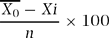
where,  is the mean number of germinated seeds in the control, Xi is the number of germinated seeds under a specific concentration (i), and n is the number of seeds in an experimental unit (always equal to 20). In this equation a positive value indicates inhibition, a negative value means promotion of the germination and zero indicates complete absence of bark host effect.
For extracts which were non-water soluble, we employed dimethyl sulphoxide (DMSO: (CH3)2SO, Fermont) at a maximum concentration of 1% (v/v). The results of a previous experiment showed that DMSO has no significant effect on seed germination of T. recurvata when compared with distilled water treatment (t22 = −1.6, P = 0.1, mean ± 1 SE, 87.9% ± 2.2% germination in water vs. 83.7% ± 1.2% germination in DMSO).
In all germination tests, Petri dishes were placed within an environmental growth chamber (Scorpion Scientific A 50624, Mexico) for 8 d, under a photoperiod regime of 12 h light/ 12 h dark and at a constant temperature of 30 °C. Since bromeliad seeds do not produce a radicle during the early germination process, seeds were considered to have germinated upon rupture of the testa (García-Suárez et al. Reference GARCÍA-SUÁREZ, RICO-GRAY, MOLINA-ACEVES and SERRANO2006). Hereafter, all values are mean ±1 SE, unless otherwise stated.
Phytochemical surveys
Constituents of the hexanic and dichloromethanic extracts of each host were determined by gas chromatography–mass spectrometry (GC–MS). We hypothesized that bark extracts may form associations according to their chemical constituents and to the effect (degree of inhibition) they exert on seed germination of T. recurvata. In order to test this hypothesis we performed a principal components analysis (Johnson & Wichern Reference JOHNSON and WICHERN2002) using the compound abundances of each hexanic and dichloromethanic extract and the percentage of inhibition of germination of T. recurvata as variables.
It has been documented that phenolics and flavonoids may have high allelopathic activities (Anaya & Cruz-Ortega Reference ANAYA, CRUZ-ORTEGA, Anaya, Espinosa-García and Cruz-Ortega2001, Izhaki Reference IZHAKI2002, Wardle et al. Reference WARDLE, NILSSON, GALLET and ZACKRISSON1998); therefore methanolic extracts were analysed for total polyphenol concentration. This was achieved using the Folin–Ciocalteu colorimetric method, adapted to micro-scale (Alothman et al. Reference ALOTHMAN, BHAT and KARIM2009, Dewanto et al. Reference DEWANTO, WU, ADOM and LUI2002). Results were expressed as the mean of four samples from each host methanolic extract (μg of gallic acid equivalents per g of sample).
The amount of total flavonoids in the methanolic extracts was determined using a modified colorimetric method (Yang et al. Reference YANG, MARTINSON and LIU2009). The flavonoid concentration was determined by a catechin standard curve and expressed as the mean (μg of catechin equivalents per g of sample) of the four samples of each methanolic extract.
In order to detect associations, we correlated (Spearman rank correlation, Zar Reference ZAR2010) the ln of total concentration of phenolics and flavonoids of methanolic extracts of the hosts with the inhibition of germination of T. recurvata. All statistical analyses were carried out with STATISTICA (Stat Soft, Tulsa, OK, USA).
RESULTS
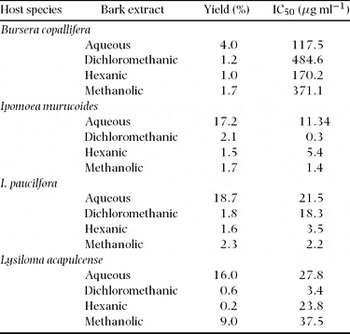
Per cent yield per host species had similar values (B. copallifera 1.9% ± 0.6%, I. murucoides 5.6% ± 3.8%, I. pauciflora 6.1% ± 4.2% and L. acapulcense 6.4% ± 3.7%, Appendix 1). Per extract, per cent yield was better in aqueous extracts (aqueous 13.9% ± 3.5%, dichloromethanic 1.4% ± 0.3%, hexanic 1.1% ± 0.3% and methanolic 3.7% ± 1.8%, Appendix 1).
In general, aqueous bark extracts and the pooled effect of organic bark extracts of each host (F3, 284 = 60.6, P < 0.05) showed statistical differences between the inhibitory effects of the hosts on T. recurvata seed germination. Through their organic bark extracts I. pauciflora, I. murucoides and L. acapulcense displayed the highest inhibitive effect on germination of T. recurvata (P < 0.05), with 27.3% ± 1.8%, 26.5% ± 2.2% and 23.0% ± 1.5% respectively. While B. copallifera displayed the lowest inhibitive effect (1.4% ± 4.3%).
Effect of bark extracts from the host with high epiphyte abundance
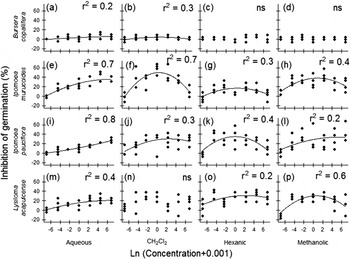
Aqueous extract from B. copallifera showed a negative influence on the germination of T. recurvata seeds; with increasing concentration, germination of T. recurvata diminished slightly (Figure 1a). Through its dichloromethanic extract, B. copallifera exerted a similar degree of inhibition (2.9% ± 0.7%, Figure 1b), but seed germination of T. recurvata was independent of hexanic and methanolic extract concentrations (Figure 1c, d).
Inhibitory effect of aqueous and organic bark extracts (dichloromethanic, hexanic and methanolic) from Bursera copallifera, Ipomoea murucoides, I. pauciflora and Lysiloma acapulcense on the seed germination of Tillandsia recurvata. Coefficient of determination (r2) is showed when the relationship was significant (P < 0.05). CH2Cl2 = dichloromethanic extract. Lines are the quadratic fit.

Effect of bark extracts from hosts with low epiphyte abundance
The inhibition of seed germination of T. recurvata increased constantly with increased concentration of aqueous extracts. Aqueous extracts from the hosts with low epiphyte abundance showed a negative influence on the germination of T. recurvata (Figure 1e, i, m). The maximum mean values of inhibition were 26.5% ± 2.4% (at 1000 μg ml−1), 40% ± 5.2% (at 100 μg ml−1) and 24% ± 4.3% (at 100 μg ml−1) for I. pauciflora, I. murucoides and L. acapulcense, respectively.
For aqueous extracts, there were differences (F3, 104 = 1, P < 0.05) among the regression slopes of the four hosts. Differences occured between B. copallifera and the hosts with low epiphyte abundance (multiple comparisons among slopes, q > 3.7, P < 0.05).
Seed germination of T. recurvata showed a quadratic response with organic extracts, especially with those of I. murucoides (Figure 1f–h). When organic extracts of this species were used, germination of T. recurvata seeds was inhibited with increasing extract concentration until reaching a peak, after which inhibition of germination decreased gradually (Figure 1f–h). Among hosts with low epiphyte abundance, the greatest inhibition of seed germination was reached by I. murucoides (>55%, Figure 1f) through its dichloromethanic extract at a concentration of 1 μg ml−1.
Dichloromethanic and hexanic extracts from I. pauciflora also followed a quadratic pattern (Figure 1j–k) reaching a maximum inhibition value of 35% ± 2.5% (at 0.1 μg ml−1) and 41.2% ± 4.8% (at 0.1 μg ml−1) respectively, but its methanolic extract did not have a significant quadratic term (Figure 1l). Here, inhibition of germination and concentration had a positive relationship (25.4%.± 3.5%).
The concentration of dichloromethanic extract from L. acapulcense did not exert any effect on T. recurvata seed germination (Figure 1n). But, seed germination of this bromeliad declined (26.8% ± 3.1%) when concentration of hexanic extract from L. acapulcense increased (Figure 1o). Methanolic extract inhibited seed germination of T. recurvata, but the germination behaviour showed a quadratic dependence on the concentration of methanolic extract, reaching a maximum inhibition value of 29.1% ± 3.1% at a concentration of 10 μg ml−1 (Figure 1p).
Phytochemical composition
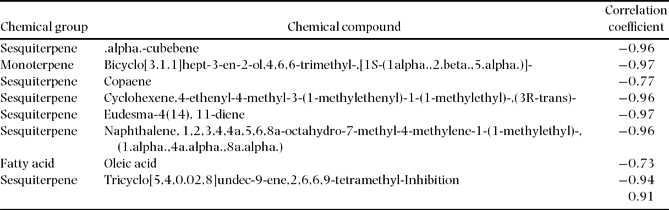
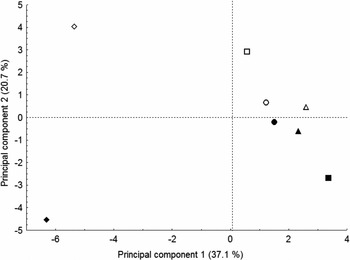
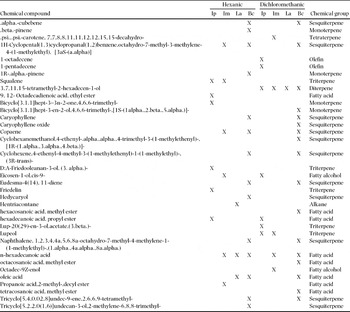
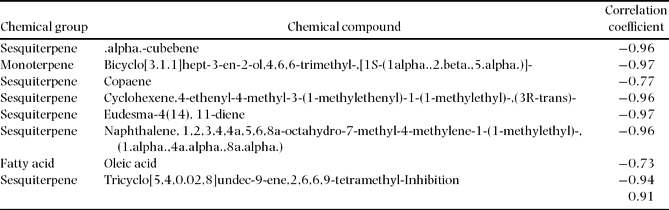
GC-MS of hexanic and dichloromethanic extracts identified 36 different chemical compounds (Appendix 2). The first two principal components (PC) explained more than 55% of the variance. PC1 explained 37.1% of the variance, within this component eight chemical compounds were negatively correlated while inhibition of germination was positively correlated (Table 1). PC2 explained 20.7% of the variance, and in this component only the diterpenoid phytol (3,7,11,15-tetramethyl-2-hexadecen-1-ol) was negatively correlated (r = −0.81). PC2 separated dichloromethanic extracts from hexanic extracts (Figure 2).
Correlation coefficient values between principal component 1 (PC1), eight chemical compounds and the inhibition of germination of Tillandsia recurvata. PC1 resulted from principal component analysis, where the analysed variables were the inhibition of seed germination of T. recurvata and 36 chemical compounds identified in the bark of four host species.
Principal components based on the compounds found in hexanic and dichloromethanic bark extracts of Bursera copallifera (◇ = hexanic, ◆ = dichloromethanic), Ipomoea murucoides (□= hexanic, ■ = dichloromethanic), I. pauciflora (△ = hexanic, ▲ = dichloromethanic) and Lysiloma acapulcense (○ = hexanic, ● = dichloromethanic).

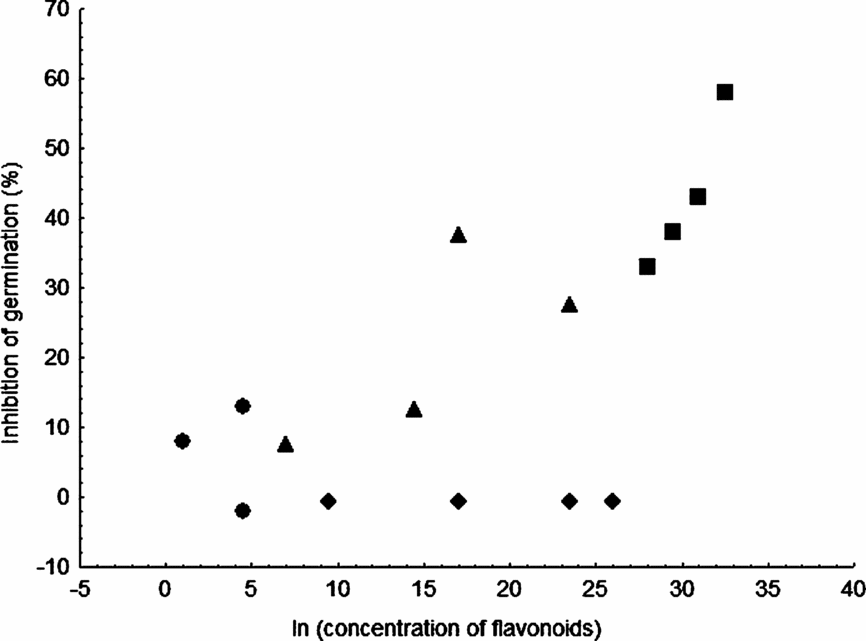
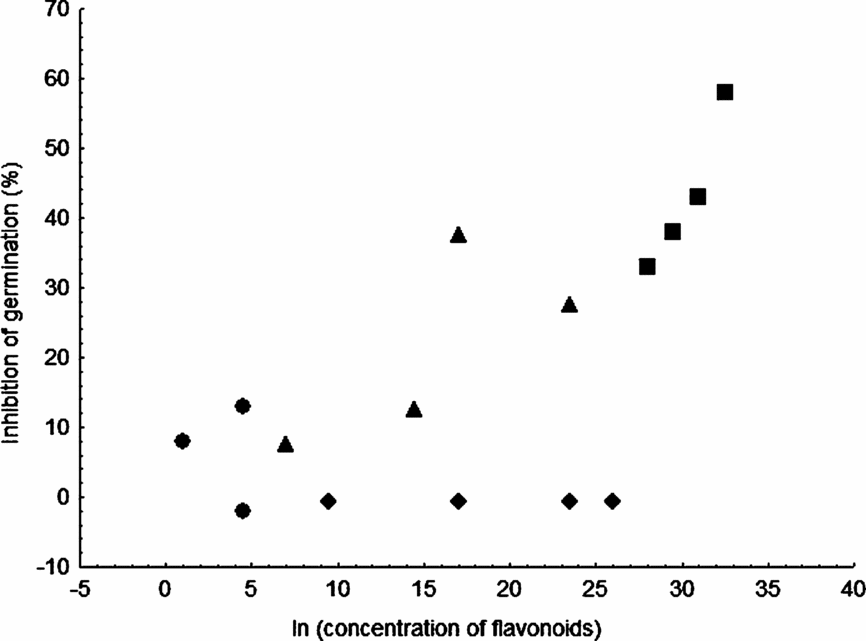
With respect to methanolic extracts, there was no significant relationship between the concentration of total phenolics and the inhibition of germination in T. recurvata (r = 0.37, P > 0.05). However, inhibition of seed germination of T. recurvata did increase with higher flavonoid concentration (r = 0.75, P < 0.05, Figure 3). Reduced inhibition of seed germination of T. recurvata occurred when the methanolic extract of B. copallifera was used, while the highest inhibition occurred on exposure to the methanolic extract of I. murucoides (Figure 3).
Correlations of the total concentration of flavonoids with respect to the inhibition of germination of Tillandsia recurvata seeds. Each point represents one of the four values of each methanolic extract taken from each of the four hosts. ◆ = Bursera copallifera, ■ = Ipomoea murucoides, ▲ = I. pauciflora and ● = Lysiloma acapulcense.
DISCUSSION
Despite the relatively high volume of research, only one study has approached allelopathy as a mechanism to explain host–epiphyte relationships, and examines the effects of compounds of Mexican Quercus spp. bark on germination of Encyclia tampensis, an orchid from Florida (Frei & Dodson Reference FREI and DODSON1972). However, the authors did not take into account the fact that orchid germination depends on the action of mycorrhizas (Arditti & Ernst Reference ARDITTI and ERNST1993). Any allelopathic effect could therefore have been confounded with the lack of mycorrhizae during the germination process. In fact, orchid germination and establishment can also be influenced by interaction with insects and other organisms that affect its symbiotic fungus (Flores-Palacios & Ortíz-Pulido Reference FLORES-PALACIOS and ORTÍZ-PULIDO2005). Unlike orchids, bromeliads such as T. recurvata, do not need mycorrhizas for germination, making them a suitable system for study because their seeds are bigger, and germination can be measured more easily. Moreover, bromeliads are the most abundant epiphytes in several forests, as montane cloud forest (Flores-Palacios & García-Franco Reference FLORES-PALACIOS and GARCÍA-FRANCO2004) and the tropical dry forest studied here. In this study, we investigated experimentally whether hosts with a low abundance of epiphytes could inhibit the germination of T. recurvata but also if the germination of T. recurvata responds differently when bark extracts from hosts with many epiphytes are used. Moreover, differences between bark physical characteristics of the host species chosen for this study were kept to a minimum by utilizing only those that have similar bark physical characteristics (e.g. low or total absence of peeling).
Did bark extracts from hosts with high epiphyte abundance affect the germination of Tillandsia recurvata seeds?
Unlike the hosts with low epiphyte abundance, Bursera copallifera inhibited slightly seed germination of T. recurvata. This could be the consequence of a possible antagonistic action among the chemical compounds within the bark extract, in which single effects could be eliminated or diminished (Williamson et al. Reference WILLIAMSON, OKPAKO and EVANS1996). Another reason why B. copallifera has high epiphyte abundance may be mechanical rather than chemical, and could be attributed to the release of sticky resin by this species (Becerra et al. Reference BECERRA, VENEABLE, EVANS and BOWERS2001) which may function as a trap for the bromeliad seeds, increasing the probability of remaining on the host. But specific experiments are needed to probe this hypothesis.
Did bark extracts from hosts with low epiphyte abundance exert a negative effect on the germination of Tillandsia recurvata seeds?
All the hosts with low epiphyte abundance inhibited the germination of T. recurvata. At the study site, T. recurvata density is 57.6 ind. per tree, 0.2 ind. per tree, 0.17 ind. per tree and 0.6 ind. per tree in B. copallifera, L. acapulcense, I. murucoides and I. pauciflora, respectively (Vergara-Torres et al. Reference VERGARA-TORRES, PACHECO-ÁLVAREZ, and FLORES-PALACIOS2010); these values of density are negatively correlated with the inhibition of germination caused by aqueous bark extracts (rs = −1) and by organic bark extracts (rs = −0.4); in other words, hosts with few epiphytes had higher negative effect on seed germination of T. recurvata. However, these hosts exerted this negative effect through different organic extracts. This may seem obvious considering that the extracts came from different species, but within each species there was no single extract that exerted the inhibitory effect, suggesting the likelihood that a combination of compounds acted together to produce inhibition of germination, rather than any single chemical compound. This behaviour has previously been observed in some allelopathic studies, when mixtures of compounds acted additively rather than alone (Hernández-Terrones et al. Reference HERNÁNDEZ-TERRONES, MORAIS, FERRERIRA, SANTOS, NASCIMENTO and CHANG2007, Reigosa et al. Reference REIGOSA, SOUTO and GONZÁLEZ1999).
Both Ipomoea species exerted a negative effect through their aqueous bark extracts; the germination of T. recurvata diminished with increasing concentration. But, although Ipomoea species had inhibitory properties through their bark, I. murucoides got the major inhibition on seed germination of T. recurvata. This was most obvious under exposure to dichloromethanic bark extract, where the resulting pattern was similar to that seen in some phytohormonal activities (Kefeli Reference KEFELI1978), which are characterized by a quadratic behaviour in their biological activity. Dichloromethanic extract of I. murucoides also produced the greatest inhibition of T. recurvata seed germination. This extract produced the lowest inhibitory concentration at 50% (Appendix 1, IC50 = 0.3 μg ml−1), compared to the hexanic (IC50 = 5.4 μg ml−1) and methanolic (IC50 = 1.4 μg ml−1) extracts. This means that dichloromethanic bark extract from I. murucoides achieved 50% inhibition of T. recurvata seeds with a lower quantity of extract than the other two.
Ipomoea murucoides through its dichloromethanic extract was therefore the host with the greatest negative effect on seed germination of T. recurvata. Also, I. murucoides along with I. pauciflora, were the most inhibitory through their aqueous extracts. This is not the first report that suggests the allelopathic nature of Ipomoea species. Ipomoea tricolor has also been recognized as a species with allelopathic activity, where the responsible compound was identified as tricolorin A, a glycoside resin obtained by chloroformic extract (Anaya et al. Reference ANAYA, CALERA, MATA and PEREDA-MIRANDA1990, Reference ANAYA, SABOURIN, HERNÁNDEZ-BAUTISTA and MÉNDEZ1995). Allelopathy in Lysiloma species has not been well documented, but one study has suggested a negative effect of L. latisifolia on weeds and on tomato radicle growth (Caamal-Maldonado et al. Reference CAAMAL-MALDONADO, JIMÉNEZ-OSORNIO, TORRES-BARRAGÁN and ANAYA2001). Therefore the results of the present study not only further the knowledge regarding the allelopathic potential of Lysiloma species, but also specifically demonstrate an inhibitory effect of L. acapulcense bark on the epiphyte T. recurvata.
Phytochemical surveys
Based on the chemical constituents of the hexanic and dichloromethanic extracts from the four hosts, it was possible to detect that B. copallifera extracts differed from the others because they exclusively contained chemical compounds that, according to our results, probably had the lowest negative (or zero) effect on seed germination of T. recurvata. It is possible that certain combinations within the bark extracts, from host species with low epiphyte abundance, might exert an additive inhibitory activity on T. recurvata germination. Bibliographic references indicate phytol (3,7,11,15-tetramethyl-2-hexadecen-1-ol) and palmitic acid (hexadecanoic acid) as compounds with a recognized allelopathic activity (Macías & Galindo Reference MACÍAS, GALINDO, Anaya, Espinosa-García and Cruz-Ortega2001, Qasem Reference QASEM, Reigosa, Pedrol and González2006). For example, palmitic acid prevents germination of seeds of the parasite Orobanche aegyptiaca (Qasem Reference QASEM, Reigosa, Pedrol and González2006). These two compounds were the most frequent in all the bark extracts, including those of B. copallifera, and it is possible that these compounds are responsible for inhibitory activity in hosts with low epiphyte abundance. In B. copallifera bark extracts, these compounds may have been rendered inactive by the compounds that are unique to this species, but this would require further testing. Following a similar protocol as the principal experiment, we performed an additional experiment sowing T. recurvata seeds in Petri dishes and adding dilutions (0, 0.01, 0.1, 1, 10, 100, 1000 μg ml−1) of a commercial compound of phytol (Aldrich, Phytol 97%, mixture of isomers) and palmitic acid (Reasol, hexadecanoic acid). Results showed that both phytol (r2 = 0.5, P < 0.05) and palmitic acid (r2 = 0.6, P < 0.05) inhibited the germination of T. recurvata at a maximum of 57% and 65% respectively.
Terpenoids, alkaloids and phenolics are the principal chemical groups that have been related with allelopathic activity. Of these, the compounds most frequently related with such bioactivity are the phenolics, most of which are obtained from methanolic extracts (Anaya & Cruz-Ortega Reference ANAYA, CRUZ-ORTEGA, Anaya, Espinosa-García and Cruz-Ortega2001, Chaves & Escudero Reference CHAVES and ESCUDERO1997, Djurdjevic et al. Reference DJURDJEVIC, DINIC and PAVLOVIC2004, Izhaki Reference IZHAKI2002, Wardle et al. Reference WARDLE, NILSSON, GALLET and ZACKRISSON1998). In the present study, methanolic bark extracts from hosts with low epiphyte abundance invariably caused a reduction in T. recurvata seed germination. Phytochemical assays of the methanolic extracts showed that the host species had different concentrations of phenolics and flavonoids, and that phenolics were not related to the inhibition of T. recurvata seed germination. However, flavonoids maintained a positive relationship with inhibition of germination, where the methanolic extract of B. copallifera had the lowest inhibitory effect and I. murucoides extract had the greatest inhibitory effect. Flavonoids are an important chemical group contained in the bark of some tree species (Andersen & Markham Reference ANDERSEN and MARKHAM2006), and previous studies have provided evidence that certain flavonoids, like catechin (Perry et al. Reference PERRY, THELEN, RIDENOUR, WEIR, CALLAWAY, PASCHKE and VIVANCO2005), have allelopathic activity (Callaway et al. Reference CALLAWAY, RIDENOUR, LABOSKI, WEIR and VIVANCO2005, Rivero-Cruz Reference RIVERO-CRUZ1996).
Different life stages of plants influence the growth and maintenance of a population. For the bromeliad Werauhia sanguinolenta it has been found that survival of large individuals is more important for population growth (Zotz et al. Reference ZOTZ, LAUBE and SCHMIDT2005). Meanwhile, clonal growth and adult survival of Tillandsia mainly influence the population growth rate (λ) (Mondragon et al. Reference MONDRAGON, DURAN, RAMIREZ and VALVERDE2004, Winkler et al. Reference WINKLER, HÜLBERT and HIETZ2007). But in studies with Tillandsia, λ was below unity, indicating that Tillandsia populations were not growing. Although adults assure the continuity of the population through their permanence and clonal growth, seed production and seedling establishment contribute to the increase of population size and to the colonization of new phorophytes. However, seeds must arrive to a safe place to germinate. Then germination and seedling establishment might be important in determining population growth too (Silvertown & Lovett-Doust Reference SILVERTOWN and LOVETT-DOUST1993). This work demonstrated experimentally that, through the chemical properties of bark, hosts could reduce T. recurvata germination and potentially influence levels of epiphyte colonization, especially if forests are dominated by hosts like Ipomoea and L. acapulcense.
ACKNOWLEDGEMENTS
We acknowledge the assistance of S. Bazaldúa, J. P. Ruíz, O. A. Orozco, A. Vergara, M. Pacheco, P. Flores, T. Cruz, S. Retiguín and E. Pérez in laboratory and field work. We thank Departamento de Ecología Evolutiva (CIByC-UAEM), Laboratorio de Productos Naturales and Y. Ríos (CIQ-UAEM) and A. Ortíz (CEIB-UAEM), for their support. We are grateful for comments and criticism of the manuscript by J. Solorza, R. Montes, K. MacMillan, G. Zotz and one anonymous reviewer. This research was funded by PROMEP grant 103.5/05/1901 to A. Flores-Palacios and scholarship CONACYT No. 87232 to S. Valencia-Díaz, who conducted this study in partial fulfillment of the PhD requirements at the Centro de Desarrollo de Productos Bioticos – Instituto Politecnico Nacional.
Percentage yield and the half maximum inhibitory concentration (IC50) per host and per extract. Percentage yield was calculated as:  where WE = weight extract and WDM = weight dry material.

Chemical compounds identified by GC-MS of hexanic and dichloromethanic bark extracts of Bursera copallifera (Bc), Ipomoea murucoides (Im), I. pauciflora (Ip) and Lysiloma acapulcense (La).