


As late as the 1820s and 1830s, most nonelite Americans lived in an intimate cosmos. Events in the heavens mattered on earth. Celestial forces governed life's foremost contingencies: health, weather, and eternal salvation. Heavenly signals foretold personal fates. The stars were as close as they appeared to the eye. Beyond their “dome” lived a watchful God and his angelic retinue. The righteous hoped to be raised into the skies at death. The downtrodden looked up to a pure and just otherworld. The heavens were a receptacle for ordinary people's hopes and troubles—for things that on earth were hard to understand, like death and misfortune, or to attain, like equality and security. They were potent, lively, and near at hand. Life had a fundamental upward spatial dimension.
By the middle of the nineteenth century, the relevant world had become flatter. From the 1790s on, a tide of “new” cosmological ideas, many of which had been gestating among educated elites for centuries, gained new prominence among people with no great learning or astronomical expertise. In classrooms, cheap books, and common conversation, the old “heavens” were transformed. They expanded enormously in scale and became, for most Americans, more like the modern “space”: sterile, centerless, vast beyond comprehension. A nearby, watchful God became harder to credence. The agencies of fate moved toward the surface of the earth. The relationship of higher places to higher meaning entered a state of unsettling flux.
This article surveys that shift. Rather than focusing only on the intellectual career of the new cosmology, as many historians have done, it follows key ideas to their social effects. When, and to what extent, did nonintellectuals experience a “cosmological revolution”? Why did this change come about? How does the story of modern cosmology look when one focuses not just on theoretical “roots” but social “fruits”?
My simplest argument is that the critical period in modern cosmology does not end with the celebrated discoveries of the early modern period. Between 1500 and 1700, in what is perhaps the best-known story in the history of science, Nicolaus Copernicus decentered the earth, Galileo Galilei penetrated the heavens with his telescope, and Isaac Newton described uniform laws governing cosmic motion. Few intellectual revolutions have been more decisive. From the standpoint of a social history of ideas, however, the cosmological revolution had barely begun in 1700. Even in 1800, in the prototypically modern and liberal United States, the medieval cosmic dome thrived.
My larger arguments concern the process by which the intimate heavens lost their status as the default cosmology in America's dominant culture—among white Protestants who were neither exceptionally privileged nor exceptionally poor and marginalized. This process began in the eighteenth century as educated writers and ministers reckoned with astronomers’ theories about the size and nature of the cosmos (Part I). It matured in the early nineteenth century as the “new” heavens gained the attention of laypeople, including those who rejected the cosmic reformation on religious grounds (Part II).
The new cosmology entered a crowded field of ideas. Because the heavens dispensed fate in both practical and metaphysical ways, because they gave shape to otherwise abstract ideas about human transcendence and divine majesty, and because their heights belonged equally to the humble and the mighty, assumptions about them were not easily amended. In popular books, personal narratives, periodicals, and other ephemera, disputes were common. Debate occurred between people but also within them. Looked at one way, the outcome was decisive. Few American Protestants emerged from the nineteenth century simply assuming the old intimate cosmos; after about 1820, upholding the ancestral heavens required a more conscious effort. Looked at another way, results were more muted. Few Americans enthusiastically embraced every part of the austere new cosmos. Most sought to preserve at least part of the smaller and warmer heavens of their ancestors, and some defied the new cosmology entirely, building a countercultural conservatism that predated and prefigured better-remembered disputes over Darwinian evolution and earth's age.
In charting this process I make two central points about the interactions of science, religion, and social class. There is no reason to suspect that either of these points apply exclusively to Protestants in the early United States.
First, laypeople and intellectuals may experience fundamental truth claims quite differently: Although there is no necessary and universal conflict between religion and science, in cosmology the reconciliation of scientific and religious claims was more easily accomplished in the realm of pure ideas—among theologians, philosophers, and their readers—than in the applied or “background” ideas of nonintellectuals. The way ordinary Americans tended to understand it, the new science presented difficult questions for the handed-down cosmology of one's grandparents and ancestors. It left little room for a familiar God, heaven, and system of fate. This apparent conflict bothered many laypeople not least because the old heavens had offered an unusually egalitarian sort of religious experience. The world on high was common property, owned by all earnest seekers. It was equally accessible spiritually, and inaccessible physically, to all men and women regardless of rank, learning, wealth, or religious office.
Elites—defined here in terms of formal education and mastery of the intellectual vernacular, more than wealth—presented no simple and united front on cosmology but, on balance, they were more willing and able to adapt their conceptions of God and heaven to the new cosmic science. Trained to deal in abstraction, more fortunate in this world, and generally less intent on material comforts in the next one, elites found it easier to accept a cosmos where the deity was everywhere and nowhere, as placeless and faceless as deep space. Nonelites, by contrast, were more likely to prefer a recognizable God and heaven that promised real remedies to earthly iniquities.
This meant that the cosmic reckoning of the nineteenth century was, among other things, a proxy engagement between credentialed elites and religious populists. For “plain folk,” the new scientific cosmos, humbling and magnificent as it remained, often appeared to present only bad religious options. One could abandon the old heavens entirely, abstract them into something sublime but cold, or defiantly uphold them in the face of a boisterously progressive elites who condescended to old believers. This range of options left people confused, disheartened, and embarrassed. Many preferred to ignore the topic entirely.
My second point is that the visible world structures the invisible one and, in particular, the heavens structure divinity. For countless American Protestants, the heavens lent form and meaning to God, as much or more than God lent meaning to the heavens. The looming skies allowed a strong pagan undercurrent to animate Protestantism. As Protestants scorned mere worldly things, they accentuated the potential value of transcendent and otherworldly things—apparent objects that bridged the divide between holy transcendence and plain presence. The sky was unmatched in this respect. It became a sort of anti-idol. Believers could look into its inscrutable depths and know for themselves the real-yet-other thingness of God and his kingdom. They could harness the power of what was high and beyond. In this sense, cosmology made theology.Footnote 1
This view of the sky was obvious to most laypeople. The heavens were impossibly grand and yet, at the same time, enveloping, intimate, and directly determinative of day-to-day well-being. They dispensed heat, light, water, wind, lightning, and “signs” that allowed one to know when to perform a surgery or expect a drought. Just beyond the vertical horizon, they housed perfected homes, gardens, people, and rulers. They effortlessly fused the natural and supernatural. On high was a thing that allowed believers, paradoxically, to locate platonic idealism in a plain and powerful object.
The heavens circa 1800, in other words, were a uniquely powerful manifestation of what is sometimes called “material Christianity.” Like a grotto or a grove, they made real the invisible. More than a grotto or grove, their semimaterial loftiness served as a fitting home and analogy for a semimaterial God, his semimaterial paradise in the skies, and the semimaterial bodies of departed souls. The heavens were present but transcendent, knowable but mysterious, ethereal but practically consequential, potent but beyond human control—a credible vision of divinity in the seat of its power.Footnote 2
In this context, where elitism met populism and objective observation met subjective feeling, religious and scientific authorities struggled to redefine God and the heavens for laypeople. However adroitly scientists and churchmen reconciled the new cosmology and old, and however reasonable their arguments seemed to contemporary intellectuals and later historians, millions of nineteenth-century Americans sensed flux or loss. The resulting conflicts over heaven and heaven's God produced fewer fireworks than later public debates over Darwinism and earth's creation date. If those were hot wars, this was a cold one—a quiet, slow-burning reckoning with an uncomfortable topic. For many theologians and scientists, the result felt like a victory, a purge of vulgar materialism and superstition. For many ordinary believers, it felt like a defeat, a loss of the real knowledge of transcendence. It forfeited the middle ground between the sacred and the profane. It clarified the need for stubborn defense of the Bible's plain sense, because the gathered church might not survive another great concession.
I.
The “New” Cosmic Science
Some of the developments that remade popular cosmology in early nineteenth century America were new to the period, like the explosion of cheap print and spread of public schooling. Others had been circulating among elites for decades or centuries. Understanding these earlier ideas is essential to understanding the popular cosmology that followed.
The story of the new heavens begins (but only begins) with Copernicus. Medieval Europe had inherited Ptolemy's astronomy. All celestial bodies orbited the earth. Some moved in complex epicycles, most along regular paths. All were located in a succession of moving spheres, the outermost of which enveloped the globe at a distance of perhaps twenty thousand earth radii. Beyond this sphere was the empyrean, the Aristotelian domain of pure fire that Christians had converted into the kingdom of God.Footnote 3
Copernicus was bothered by the intricacies and imperfections of Ptolemy's system. Around 1510, he sketched out a simpler heliocentric scheme and sent it to a few astronomers and philosophers. With their halting encouragement, he spent the next three decades writing a dense mathematical treatise on this subject. De revolutionibus was published in 1543 and is usually credited with launching the Scientific Revolution.
Copernicus then died and faced no repercussions for his work. Not so Giordano Bruno, who took Copernicus's theory; combined it with the ancient speculations of Lucretius; and proclaimed that the sun was a star, the stars were suns, and humans likely lived in a vast and centerless universe of innumerable worlds. For this and other heresies, Bruno was arrested in 1592 and burnt at the stake in 1600. His burning did not prevent Galileo from making further inquiries. In 1610, the Florentine noted that his new instrument, the telescope, appeared to confirm Copernicus's hypothesis. He, too, was called before a church court. He was forced to recant and died under house arrest.Footnote 4
The Roman Inquisition's efforts to suppress heliocentrism were unsuccessful, of course, and eventually worse than unsuccessful, as generations of skeptics used Bruno's and Galileo's stories to embarrass the church and undermine its authority. For casual students of the cosmological revolution, this is where the story ends. The church sensed a threat from heliocentrism and lashed out, but too late, and observational science never looked back. Future astronomers—and eventually geologists, biologists, and so on—worked out the details.
When we ask how cosmological ideas have shaped everyday experience, however, the Copernican system moves to the background. Heliocentrism was slow to catch on, even among elites, and, in any case, Copernicus left the intimate cosmic dome intact, rearranging the inner spheres but leaving the outer ones in place. As such, his system per se did little to undermine the plausibility of traditional cosmic knowledge about, say, God's locality and distance or his ability to direct the weather, send astrological signals, and welcome departed souls to his kingdom—areas that tended to matter to nonintellectuals.Footnote 5
The greater threat to the old cosmology came from corollary discoveries concerning cosmic scale. For ordinary people, if not educated elites, the heavens of 1800 remained finite and fathomable. As late as 1823, one popular writer estimated that the common man assumed the universe's diameter to be perhaps twenty-five thousand miles, or roughly “the sphere of his visible operations.” At revivals and in cheap pamphlets, lay visionaries regularly told of astronomical voyages “beyond the moon and starry regions” to a heavenly city with “glittering walls and burning gates and lofty towers of gold.” Popular hymns suggested that climbing a mountain brought one appreciably closer to God. Scripture amply supported the idea of a local God and heaven, and common discourse was saturated with invocations of God's heaven and heaven's God.Footnote 6
The demise of the cosmic dome began (but, again, only began) with extrapolations from Galileo, who had famously observed stars invisible to the naked eye and, even more intriguingly, noted that stars appeared unmagnified in his telescope, suggesting they were extremely distant. In his wake, galactic space began to open. Telescopes resolved the Milky Way into myriads of dim stars. Thinkers were forced to consider the radically larger cosmos suggested by stellar clouds: If stars could be so numerous and distant as to blur into one another like water vapor, then the cosmos could not be as it appeared to the senses. The familiar dome was untenable.
Still, observing dim points of light was not the same as knowing they were ultradistant stars. Beginning around 1700, astronomers began making credible attempts to empirically measure stellar distance. In 1728 and 1730, James Bradley and Isaac Newton used different methods to arrive at estimates that approximated the actual distance of the closest stars. Exact figures, however, awaited measurement of a star's parallax—its apparent change in position as seen from opposite sides of earth's orbital path. Not until 1838 did astronomers possess instruments precise enough to accomplish this. In that year Friedrich Bessel announced that Cygni 61, a neighboring star, was about 66 trillion miles away.Footnote 7
This put Cygni 61 about a million Ptolemaic universe–widths from earth. Large as that figure may seem, the cosmos's exponential growth was even greater for unlearned people who judged stellar distance with naked-eye reckoning. For them, there was no obvious reason to assume that the stars were more than, as one memoirist later recalled, “about three rifle shots away.”Footnote 8
Nor did the significance of Bessel's discovery end with his establishment of exact distance. Confirmation of Cygni 61's position showed that distant stars emitted approximately as much light as the sun. This strongly suggested that neither sun nor earth had any special place in the cosmos, as skeptical theorists had long suspected. The centerless universe, long a subject of elite speculation, became harder to deny.
Popular Intellectualism
By the mid-nineteenth century, few Americans had avoided an introduction to the immense, dark, centerless heavens. Constraints on the new cosmology's spread had loosened over the past two generations. There was more consensus among cosmologists, more prestige for science in general, more scientific exposition targeted at nonspecialized audiences, and a wider pool of potential readers, hearers, and interlocutors. Most important, as we shall see, there was an explosion of information sharing via books, newspapers, schools, traveling speakers, and so on.
The new content did not come straight from Galileo or Newton, of course. It emerged from an interpretative process, initially by and for educated elites, which began in earnest around the start of the eighteenth century. In the 1710s, the English natural philosophers William Derham and William Whiston published accessible treatises, aimed at moderately learned readers, that defended Copernicus's system while also expanding its scope. “Whereas the Copernican hypothesis supposeth the firmament of the fixt stars to be the bounds of the universe, and to be placed at equal distance from its center the Sun,” wrote Derham, “the New Systeme supposeth there are many other systems of Suns and Planets, besides that in which we have our residence.” Whiston noted that two astronomers had estimated that a bullet would not reach a fixed star for at least five thousand years. By midcentury, most tutors had abandoned geocentrism and the old empyrean heaven.Footnote 9
Rather than directly address the toughest conflicts between the “new” cosmos and the smaller, more human-centered one of popular religious custom, eighteenth-century intellectuals typically looked past them. They ignored the God who descended in clouds on Sinai and the local heaven that contained cities of the risen dead. Formally at least, most popularizers remained optimistic about the new cosmology's role in glorifying God. The universe's depth, order, and equilibrium could only affirm the Creator's power and wisdom. New knowledge of the heavens was necessarily new knowledge of God, the universe's “Designer.” If a placeless architect-God was not the deity of the common people, this would change with time. Once we understand the true scale and the grandeur of the heavens, wrote Scottish popularizer James Ferguson (1756), “our faculties are enlarged . . . our minds exalted above the low contracted prejudices of the vulgar.”Footnote 10
Low-contracted prejudices ran deep, though. If the churches truly embraced a nonlocal heavens and nonlocal God, some thinkers wondered, would they also sacrifice the sort of real religious infrastructure that held the attention of the laity? Could a placeless God still lend practical meaning to life? Could a centerless heavens still be conscripted for moral purposes?
In the eighteenth century, these questions perplexed educated Anglo-Americans who kept abreast of European astronomy. Benjamin Franklin, as a bookish teenager in the 1720s, decided that his ancestral God and heaven were too small. A few years later he composed a “little Liturgy” (1728) for his “private use.” It begins with his reckoning with a limitless cosmos. “When I stretch my Imagination thro’ and beyond our System of Planets, beyond the visible fix'd Stars themselves, into that Space that is every Way infinite, and conceive it fill'd with Suns like ours,” Franklin wrote, “then this little Ball on which we move, seems, even in my narrow Imagination, to be almost Nothing, and my self less than nothing, and of no sort of Consequence.” Franklin, raised a Puritan, could not conceive of a God who presided over infinite worlds and peered down, judge-like, on this one. Unwilling to abandon the old faith entirely, however, he arrived at a pragmatic solution. The super-cosmos was overseen by a “Father of the Gods” who was incomprehensible to humans and “INFINITELY ABOVE” their feeble worship. This God dispatched a class of intermediary “created Gods” to build and oversee individual solar systems. The created gods were lowly and local enough to appreciate human praise and virtue—they were perhaps even subject to periodic replacement—but august enough to relay “more rational and glorious Praise” to the Infinite Father.Footnote 11
Franklin's system was unique and unmentionable. But the dilemmas it addressed were common to many educated people of his time. The young printer's cosmic vertigo was shared, for example, by the youthful John Adams, who mused in his journal in 1756 that the notion of “many Suns” leaves us “lost and swallowed up.” Like Franklin and other savants, however, Adams found a way to reconcile an incomprehensible cosmos and creator with a modicum of personal religious feeling. “Our Imaginations after a few feignt Efforts,” he wrote, “sink down into a profound Admiration of what they cannot comprehend.” This sort of resigned acceptance of an unknown God and heaven, satisfactory as it was to the ambitious Adams, would often prove less appealing to people with less control over worldly circumstance.Footnote 12
Ponderers like Franklin and Adams responded not just to the expanding scale of the cosmos but to speculations, common to their time, that the universe was dotted with inhabited worlds. Egoism aside, philosophers argued, there was no reason to assume that other spheres were barren. Indeed the Bible seemed to suggest otherwise. God had not created the world “in vain” (Isaiah 45:18) but for his people. It stood to reason that he would not have created any world in vain. By the mid-eighteenth century, a chorus of celebrated astronomers had endorsed this idea, despite the lack of observational evidence. “The plurality of worlds” was “inseparable from the principles of astronomy,” proclaimed America's best-respected astronomer, David Rittenhouse, in 1775. By 1800, “belief in extraterrestrial intelligences was higher than it ever had been before or ever would be again.”Footnote 13
Eventually the combination of these two ideas, a boundless cosmos and an inhabited one, would underpin some of the first forthright religious skepticism to jump from elite to mass audiences. Ethan Allen and Tom Paine, both heroes of the American Revolution, published overlapping deist tracts in 1784 and 1794, respectively. Both openly challenged biblical authority, drawing heavily on the new cosmology. “Are we to suppose,” Paine memorably asked, “that every world in the boundless creation had an Eve, an apple, a serpent, and a redeemer?”Footnote 14
Like earlier deists, Paine and Allen affirmed the majesty of the creator. But the deity was present only to those “lost in the immensity” of “the vast regions of the starry heavens,” as Allen put it. The heavens in themselves—in their breadth, purity, and inscrutable power—explained far more about God than did the lowly, corrupt, human Bible. This idea was not new to Paine and Allen; instead, what drew attention to the new deists’ heresies was their refusal to politely look past traditional popular cosmology. Allen mocked the “corporeal deity” of ordinary believers. If God was thus, he declared simply, “I am no Christian.” God was an abstract presence in space. The jealous Jehovah who smote with hail and parlayed with Moses on Sinai? He was the invention of ancient demagogues. No modern man would be fooled by Moses's “pretended intimacy with God,” Allen scoffed, much less by the ridiculous notion that “he was once admitted to a sight of his BACK-PARTS!”Footnote 15
Timothy Dwight, president of Yale, called Allen's book “the first formal publication, in the United States, openly directed against the Christian religion.” Allen's and Paine's names became slurs. Paine alone provoked at least thirty published rebuttals. By the time the new deists wrote, however, most of the intellectual work of abstracting God and heaven had already been done by moderate theological progressives like Derham, Whiston, Ferguson, and even Cotton Mather. Their deity was nearly as incorporeal, placeless, and absentee as that of Paine and Allen, but packaged in a way genteel nonradicals could accept. “Paine's religious opinions were those of three-fourths of the men of letters,” observed Joel Barlow. He and Allen shouted in public what other gentlemen thought in private or wrote in more delicate terms.Footnote 16
Reconciling New and Old
The new deists built up the market for reconciliations of revelation and natural science. But as demand grew, so did the difficulty of the questions reconcilers faced. How far should one go in remaking the old God in the image of the new heavens? Should one ask believers to boldly reimagine God in the blank grandeur of space? Or should one decorously ignore the old believers’ intimate God and heaven, defending revelation on other terms? For William Paley, the most celebrated natural theologian of the nineteenth century, the answer was to ignore. “My opinion of astronomy has always been that it is not the best medium through which to prove the agency of an intelligent Creator,” Paley wrote in his popular Natural Theology (1802). The heavens were glorious, but the intricacies of biology provided a better argument for God. “He closed his eyes to the things he could not deal with,” historian Keith Stewart Thomson writes of Paley's cosmology.Footnote 17
Reconcilers soon learned that in addressing a truly broad audience, there was a lot to deal with. When, for example, a Connecticut minister set out a telescope in a field, in 1806, and proceeded to explain to a farmworker how he knew to expect an eclipse, the worker scoffed at the idea of a heliocentric system. “Didn't you preach last Sunday out of the tenth chapter of Joshua?” he asked the minister.
“Yes.”
“And didn't you tell us that Joshua commanded the sun and moon to stand still?”
“Yes.”
“Well: what was the use of telling the sun to stand still if it never moved?”
For an audience of other workers, this was a “dead shot,” recalled the minister's son. The fieldhand, Mat Olmstead, pressed his advantage: If water spills from an upturned cup, why would earth's revolutions not spill the water from the minister's well?
The beleaguered minister looked to his telescope, waiting for vindication with the arrival of the eclipse. When darkness descended at the appointed time, Olmstead “said not a word” and the other workers were overawed. “I guess the parson was right about the sun and the moon,” said one.
“Well, perhaps he was,” said Olmstead, “but then Joshua was wrong.”Footnote 18
Reconcilers bolder than Paley, or better attuned to this sort of objection, attempted to meet the new cosmology head on. For Thomas Dick, a Presbyterian minister turned science writer whose work found an enormous audience on both sides of the Atlantic, a living and credible God had to maintain a connection to the physical heavens. An immanent God with “no sensible qualities” only “confounds and bewilders” ordinary believers, he warned in 1823. “Abstract ideas and reasonings respecting infinity, eternity, and absolute perfection, however sublime we may conceive them to be, completely fail in arresting the understanding, and affecting the heart.”Footnote 19
Dick's solution was not to revive the old Mosaic God, however, but to embrace the radical restructuring of his being and kingdom. The new astronomical space, visible yet transcendent, could fill traditional religious functions. At a minimum the modern heavens instilled “profound humility,” wrote Dick in a passage typical of many reconcilers: “What an insignificant being does man appear, when he compares himself with the magnificence of creation. . . . What are all the honors and splendors of this earthly ball . . . when judged in competition with the resplendent glories of the skies?”Footnote 20
This impersonal but sublime view appealed to reconcilers because Christians had long learned that God's power was infinite, that the heavens declared his glory, and that individual humans were insignificant in his light. Still, the idea that a patriarch-God ultimately did watch and did care was essential to popular ethical religiosity, and the new astronomy made it harder to picture that God. Dick recognized this; he simply saw no honest and practical alternative. The old cosmology, pleasing as it was, offered more and more fodder to “infidel scoffers” like Paine. For the sake of Christianity's credibility, it was time to retire the heaven that lay “above the visible concave of the sky,” where the saved wandered “adorned with ‘starry crowns,’ drinking at ‘crystal fountains,’ and making ‘the vault of heaven ring’ with their loud acclamations.” It was time to exalt “him whose presence pervades all space.”Footnote 21 If God was no longer nearby or personal, at least he still had a physics.
Other reconcilers asked less of their readers, using modern cosmology to make the old “argument from design.” God had allowed “no confusion, no jarring of contending worlds, no collisions of flying orbs to disturb the harmony of Heaven,” wrote the Cincinnati-based astronomer and popular lecturer O. M. Mitchel. Yet even this well-versed argument, in the hands of an avowed Christian, could take modern forms that flummoxed traditionalists. “Telescopic revelation” demonstrated God's power, Mitchel declared; regrettably, it also forced the wise to overlook the “primitive record” of the Mosaic creation and the “absurdity” of the ancient firmament as mentioned in Genesis.Footnote 22
Mitchel and Dick had the luxury of not relying on a congregation for their employment. Cosmological reconciliation was trickier for Sunday-to-Sunday preachers because it complicated a promise—eternal life in a heavenly paradise—that was, for many believers, the church's singular great promise. It was also a subject on which parishioners’ views were strong and unsettled, meaning that any view of heaven was likely to offend one faction or another. Placing God in “infinite space” was, as the Presbyterian minister William Leitch put it, wading into a “mare magnum of controversy.” Dick lamented the “many prejudices” assailing those who took “expansive views of the Divine operations.” Many ministers understandably avoided or elided the subject.Footnote 23
Some nevertheless confronted “the felt necessity,” as Leitch wrote, “of a better adjustment between the arguments of the theologian and the discoveries of the astronomer.” A key question was where to locate God's kingdom. “The dominant ideas of heaven,” as the New York scholar-preacher George Bush observed in 1849, were “still pervaded by the ideas of space.” Common believers persisted in the “sensuous and childlike” view that heaven was “a place in some distant region . . . reached by . . . migration.” This crude materialism would not last long, Bush predicted: “[T]he astronomer has lifted his optic tube to the starry world, and, as if it were the lever of Omnipotence, it has pushed the twinkling luminaries back into the regions of space.” But questions lingered, embarrassing as they were for many educated clergy. “Is heaven a place, or is it a state of existence merely?” asked one Pennsylvania preacher's flock. “Has it locality, and is it material? Will that world be visible to the eye and tangible to the senses? In short, will it be a local, material, visible, and tangible heaven?”Footnote 24
Some learned ministers were uncompromising in their portrait of an abstract heaven. Heaven was not a “a distant country, to which we are to be conveyed,” chided William Ellery Channing, the noted Boston liberal, in 1828. God was not a sky king. The true God pervaded all space and, more importantly, all minds. Rather than awaiting travel to the skies, Christians should find “heaven now”—on earth, in their souls and spirits. “How slowly do men learn that heaven is the perfection of the mind,” Channing told the faithful.Footnote 25
Channing's conception of heaven was considerably bolder than that of most antebellum churchmen. But the new cosmic map was forcing a more abstract heaven into many pulpits. “Many have doubted whether heaven is a place at all, or merely a state,” noted a Presbyterian minister from Elizabethtown, New Jersey, in an 1840 funeral sermon. It was true, he conceded, that the Bible clearly described heaven as “a place”—a “local abode,” “on high,” with walls of jasper, gates of pearl, and streets of gold. And yet, he warned, “as regards the locality of the world of glory, it becomes us not to speak with much confidence.” The only sure thing about heaven “viewed as a place” was that Christ would be its light and center. “The universe is immense but what one portion of it is assigned as the everlasting abode the blessed, it is impossible to determine.”Footnote 26
Ambivalence regarding heaven's locality and characteristics was common among trained clergy in the period. Many preachers were caught in the middle, alongside their parishioners, unable to fully abandon or fully embrace the old heavens. Typical in this respect was Henry Harbaugh, pastor of the Second German Reformed Church in Lancaster, Pennsylvania, and the author of the popular Heaven (1848). Harbaugh conceded much to modern cosmology. God might not have a body, despite the “first impression” given by scripture. And one could not by “gazing into the dim distant blue . . . see by sight what can only be seen by faith—a distant heaven.”Footnote 27
Still, Harbaugh could not abide a shapeless heaven and placeless God. “Heaven is strictly and properly a place,” he declared, “a local and material heaven.” The Bible was too clear on this point, and the idea of a “tangible” heaven too important to the faith of ordinary believers. The “pleasantly cherished” traditional heaven could “only be removed by that reckless speculative curiosity by which the holiest of divine truths are invaded and dislodged by such as are cruel and bold enough to take away the contents of our faith without feeling themselves responsible to furnish us with a better.”Footnote 28
Harbaugh struggled to furnish something better. Unwilling to ask his readers to accept the biblical heaven on faith alone, he sought to merge the astronomical and sacred heavens. Perhaps the dead inhabited undiscovered worlds “still floating like islands in the blue sea of space”—planets where “fancy may still erect its castles.” Perhaps heaven lay at the universe's gravitational center, as Thomas Dick had argued, in a universe within a universe that “blended the glories of every other system.” Harbaugh was uncertain. “Let us try to persuade ourselves,” he wanly suggested, “that the future and unseen world . . . is as simply natural and true as is this world of land and water, trees and houses.”Footnote 29
Harbaugh's struggles reflected trained preachers’ dual roles as learned men and religious guides. Well into the nineteenth century, seminarians typically had more liberal education than all but the best-read laypeople. As believers became more knowledgeable about modern cosmology—and, later, geology and biology—it became increasingly difficult for preachers to perform both these offices with ease and confidence. Cosmic credibility seemed to require, at a minimum, an increasingly remote God and heaven. “God is a SPIRIT,” warned the Congregationalist sage Jacob Abbott. “He has no form, no place, no throne.”Footnote 30
II.
The New Cosmic Canon
By 1800, elites had reached a near-consensus on this abstracted God and heavens. They condescended to dissenters within their own ranks and more obviously to the unlearned. “Philosophy viewed the frantic ravings of religious enthusiasm with a mixed sentiment, composed of compassion and disgust,” remembered the New York deist Elihu Palmer. A gap grew between the cosmologies of the educated and the merely literate. Even as “a whole family of ologies” became fashionable “among the learned,” the New England educator Samuel Goodrich wrote, “in the benighted parts of the country, as in the precincts of Monadnock, this mania still appeared to be madness.”Footnote 31
In the decades around 1800 the cosmological gap was at its widest. It never closed completely, and obstinate rejections of the new cosmos led to new polarization in the ways Americans created higher meaning. On balance, however, cosmological divides narrowed in the nineteenth century. With each decade after 1800, a busy layperson's path of least resistance tilted a bit more towards an abstract God and heaven. Traditional cosmology was increasingly confined not just to nonelites but to marginal groups within that majority. By the 1850s and 1860s, the burden of cosmic proof lay squarely with those who preferred an intimate God and heaven.
The most important agency of this transformation was an explosion of cheap information. Astronomical lecturers spoke in small towns, public schooling expanded, and, above all, affordable print media penetrated even the remotest villages. Not everyone had access to these resources—the very poor and the enslaved were notable exclusions—but, overall, the spread of communication made it much harder to avoid a reckoning with the new cosmology.
Some Americans received a preview of the new cosmology in their almanacs. Before the general expansion of cheap print around 1800, almanacs were often the only volumes Americans owned apart from a Bible. For as little as six cents, they offered, through detailed astrological calendars that occupied most of their pages, a sense of control over two essential contingencies: health and the weather. Their celestial charts told yeomen when to treat illness, harvest crops, or breed livestock. Almanacs’ central concern with astrology limited their reach as vehicles for the new cosmology, since zodiacal prediction relied on the idea of an earth-facing cosmos where the movements of various celestial bodies (as directed by God) influenced and foretold human destinies. By the mid-eighteenth century, however, nearly all almanac compilers had accepted the Copernican system, and a few had gone so far as to print short essays on the new cosmology. Not all readers accepted these reforms: In one 1774 almanac, a reader scrawled “Dam'd Lye” next to the claim that a bullet would take five thousand years to reach the stars. Nevertheless, it became harder to escape the notion that the cosmos was not as it appeared to the eye, or to one's ancestors, or in the Bible.Footnote 32
By 1800, newspapers were beginning to supplant almanacs. Between the 1780s and 1820s, the percentage of U.S. households with a newspaper subscription rose from about 18 percent to over 50 percent. The papers—including “penny” dailies from the 1830s on—played an important role in disseminating cosmological knowledge. “Astronomy was clearly the most accessible and appreciated” of the scientific fields covered in newspapers, notes one historian of science. Over thousands of columns, educated editors observed, often quite casually, the dimensions of space, discoveries of astronomers, or transit of meteors. Storms and comets, once interpreted with excitement as God's work, received dry and professorial coverage. Such was the attitude of people who knew.Footnote 33
Most important in reforming the cosmos were books. Book prices fell, and sales rose, in tandem with the growth of newspapers. Bookshops opened in small towns and bestsellers became available in general stores. Brigades of peddlers sold cheap volumes door to door: hymnals, schoolbooks, and riskier material like Paine's Age of Reason. In the vicinity of Windsor, Vermont, family libraries grew from an average of 5.3 volumes in the 1790s to 23 in the 1820s. Townspeople and farmers exchanged books informally and set up thousands of formal lending libraries, especially in the North. Religious works like John Bunyan's Pilgrim's Progress remained steady sellers, but most new growth was in nonreligious books, notably on scientific and philosophical topics, including astronomy. “By any standard,” historian William J. Gilmore writes of the Windsor district, “family reading was increasingly dominated by secular thought and modern intelligence, especially after about 1805.”Footnote 34
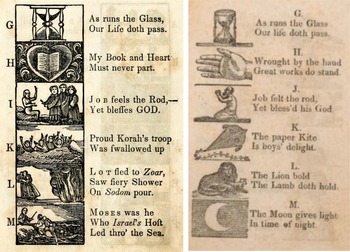
The most prominent class of books to challenge the old cosmology were schoolbooks. By the 1820s, after decades of expansion in public schooling, about one-third of all book spending in the United States went to teaching texts. As the century progressed, these books drifted farther from the old God and heaven, either presenting the new cosmology without preamble or broadly affirming God's sovereignty but not his local and personal presence. Circa 1800, the resolutely God-fearing New England Primer, replete with celestial imagery (fig. 1) and a mainstay of public schools, began to cede its near-monopoly to other books “more literary and less religious in character.”Footnote 35
Illustrations from 1777 (left) and 1818 (right) editions of The New England Primer. The editor of the 1818 edition, Samuel Woods, made “alterations” designed to prevent the Primer from becoming completely “obsolete.”

Some of its market was filled by the McGuffey Readers, which faintly echoed the Primer's focus on a patriarchal God and heavenly kingdom. But even the pious William McGuffey, writing in the mid-1830s, was noncommittal about the nature of God in heaven. On the one hand, the dead could expect to rise “beyond the cloudless skies” to a heaven where they would “see God . . . seated upon [a] majestic throne.” On the other, God was “everywhere,” as invisible and ambient as the wind. After McGuffey lost control of his readers later in the 1830s, even his mild nod to cosmic conservatism disappeared. In its place was a worldly emphasis on the “morality of industry, self-denial, sobriety, conformity, and submission to authority.” By the 1860s it was rare to find references to God or his kingdom in schoolbooks of any kind.Footnote 36
A flood of new specialized textbooks on astronomy, meanwhile, generally followed suit, either ignoring the religious heavens, or affirming them in the vaguest terms. This was true even among religious authors. “It is not the design of the Bible to explain the laws of nature,” began one minister's 1826 introduction to astronomy for schoolchildren. Another Christian educator, answering student questions about whether the new cosmos would “militate against the acknowledged truths of the Bible,” warned that “the Bible was not intended to teach us the science of astronomy, so neither was astronomy designed to instruct us in revelation.” Both writers wished to update Christian teachings; both found it difficult to do so without compromising the church's ancestral claim on the heavens.Footnote 37
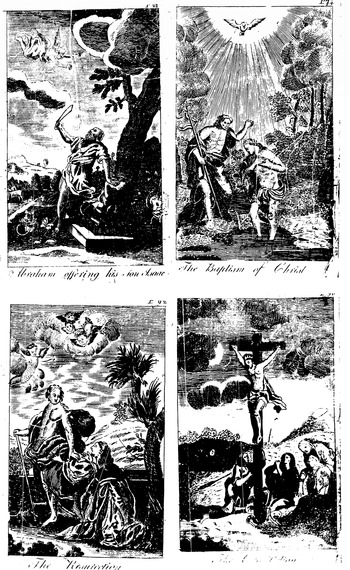
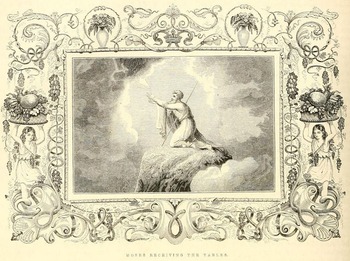
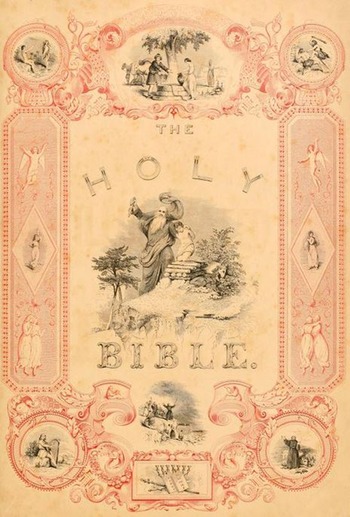
Meanwhile, Bibles themselves began to reflect a retreat from the old cosmology. As printing costs fell, illustrated Bibles became more common. Early printers often saw this as a chance to emphasize graphic celestial imagery (fig. 2). Later volumes, like Harper Brothers’ popular Illuminated Bible (1846), still offered readers sublime heavenly vistas (fig. 3) but printed relatively few of them, amid vast galleries of terrestrial imagery (fig. 4). As the century progressed, so did this trend. Printers increasingly backed up scripture not with otherworldly scenes but earthly ones: maps of sacred geography, Near Eastern landscapes, sketches of artifacts.Footnote 38
Four of the seven illustrations from William Norman, ed., The Holy Bible abridged (Boston, 1802).

“Moses Receiving the Tablets,” Harpers Brothers’ Illuminated Bible (New York, 1846).

Frontispiece to Harper Brothers’ Illuminated Bible.

This is not to say that popular print served the new cosmology alone. Ubiquitous books like Peter Parley's Universal History (1837) narrated famous Bible stories—flaming sky-chariots, Elijah's flight on a “whirlwind up to heaven”—as part of otherwise secular histories of monarchs, battles, and so on. By the 1840s, however, the Universal History (edited by Goodrich) included an apologetic preface aimed at the smirking “college professor.” Others editors deployed similar hedges. Although open hostility to the old cosmology remained rare, middlebrow intellectuals were decidedly uncommitted. The New and Complete American Encyclopedia, for example, struggled to place God in space: “Heaven” was “considered as a place in some remote part of infinite space, in which the omnipresent Deity affords a nearer and more immediate view of himself . . . than in the other parts of the universe.” In the “popular notion of heaven,” another encyclopedist observed, “heaven is conceived as a place,” but “authors are much divided as to the reality of such a local heaven.”Footnote 39
Of all the new mass-market books reframing cosmology for a modern audience, Paine's Age of Reason was most important. It was extremely popular in the United States, at one point selling perhaps one hundred thousand copies in a single year (1797) at a time when a typical book printing was around two thousand copies. Because single books tended to be read by several people, it is plausible that something like a quarter of all American adults had read the book by the 1810s, and probable that a majority knew of it at least through counterarguments. “This is a popular argument against Christianity,” complained the theologian Thomas Chalmers of Painite dismissal of an earth-facing God, “a good deal insinuated in conversation.”Footnote 40
Paine's popularity was partly a result of his prior celebrity and partly his narrative style, which was as confrontational as Allen's but pithier and better organized. More essential, though, was his credible assault on the traditional sky-God and clergymen who, as he saw it, had conscripted heaven's sublimity into the service of their vain authority. For Paine and untold thousands of his readers, this corruption called for a new reformation. Just as early Protestants had revered the Bible and fearlessly rejected any corrupt superstructure built upon it, modern rationalists ought to revere the heavens and reject any ecclesiastical superstructure built upon it—including the Bible. “Churches . . . set up to terrify and enslave mankind” had taken the pure celestial wonder of the earliest Christian mystics, Paine wrote, and harnessed it to a petty bureaucracy designed to “monopolise power and profit.” Paine called for a return to roots. “Natural philosophy . . . of which astronomy occupies the chief place . . . is the true theology,” he wrote. “The Creation . . . is an ever-existing original, which every man can read. It cannot be forged; it cannot be counterfeited.” The cosmos was scripture.Footnote 41
Cosmological Progressives
These ideas interested people. Could it be true, as Paine said, that the new cosmology “renders the Christian system of faith at once little and ridiculous” and “scatters it in the mind like feathers in the air”? Was the cosmos God's only text? For many Americans the answer was yes, or mostly yes, however quiet they remained in public. “Boys that dressed flax in the barn,” wrote the New England revivalist Lyman Beecher of the period around 1800, “read Tom Paine and believed him.” Wicked “philosophical books” ricocheted through society, recalled the Baptist preacher Asahel Moore, leading to maddening “doubts and temptations.” “Many young men like myself,” he wrote, “with a mere smattering of philosophical knowledge, [were] ready to judge and determine that, which men of experience and knowledge are at a loss about.” One almanac reported that Paine's deathbed nurse had called Age of Reason “the most dangerous and insinuating book she had ever seen” and yet admitted that “the more she read the more she wished to read.”Footnote 42
But the new cosmology could undercut Christianity's relevance for people who never read or accepted Paine. Also decisive, again, was conscientious moderation: the quiet half-retreats of earnest laypeople from a local, material God and heaven. An anonymous Baptist writer lamented, in 1833, that so many of his fellow Christians were shying away from “material images” of God's kingdom. Why adopt such “dim and shadowy conceptions, void of distinctness, and almost of the power to produce impression”? Why did believers “deprive themselves of that happiness, which the scriptures authorize them to seek”? These were hard questions in the 1830s and, tellingly, the author left them unanswered. Rather than quote from scriptural passages directly suggesting a material heaven and God, he declared one man's heaven as good as the next. Each would be “swayed more or less by his own peculiar ways of thinking.”Footnote 43
This sort of ambivalent resignation could be just as destructive to the old cosmology as overt infidelity. Certainly it was more common. Rather than systematically rearranging inherited views of the cosmos, as philosophers and theologians did, ordinary people picked up cosmological knowledge largely by chance and assembled it into shorthands that departed somewhat from those of their ancestors. They often did this with regret. “Men lose the objects of their fondest hopes as if through forgetfulness,” as Alexis de Tocqueville observed in 1835. “They are carried away by an imperceptible current, which they have not the courage to stem, but which they follow with regret, since it bears them away from a faith they love, to a skepticism that plunges them into despair.” Old beliefs “are not rejected, but they fall away.”Footnote 44
As the cosmological middle ground shifted, the intimate God and heaven remained most vital in contexts where earthly comforts were few and education was either impractical, as among the poor, or actively suppressed, as among the enslaved. Slave songs celebrated a nearby God and heaven that dispensed justice from above (as through lightning), embodied moral purity (like the air), and promised a better future (in a restful afterlife). Many elderly ex-slaves, interviewed in the 1930s, dated events from their family histories in relation to the Leonid meteor shower of 1833, widely seen as both a threat and promise from God. Poor whites looked up to a similarly pure and promising otherworld. Their songs (often shared with African-Americans) were “preoccupied with concrete manifestations of the supernatural” and the “pastoral landscape” of heaven in particular. “No other evangelical hymn subject approached [heaven's] level of popularity,” notes Stephen Marini in a study of the best-known hymns in antebellum America. Meanwhile, many families missed the tide of cheap print: For every book owned by the poorest families in Windsor, the wealthiest owned about twenty. Well into the nineteenth century, then, earthly have-nots continued reporting local encounters with a manlike, descending God, like Joseph Smith's “first vision,” or voyages to a nearby, astronomical heaven, as in the narratives of Zilpha Elaw, Nathan Culver, or Jane Cish. As late as 1838, a young Mormon reported that “a number of persons” stopped work outside Kirtland, Ohio, to watch a steamboat cross the sky, its decks packed with departed elders waving their hats and singing hymns.Footnote 45
Such concrete heavenly vision could act as a sedative, as later critics were quick to point out. “The Negro, losing the joy of this world, eagerly seized upon the offered conceptions of the next,” wrote W. E. B. Du Bois in 1903. For Du Bois and many of his peers, otherworldliness bred complacency and atavism—a superstitious refusal to insist on dignity and comfort in this world. “Church spires pointed silently to Thee,” he wrote in a rebuke of the traditional sky-god, as “death and fury filled the air and trembled underneath the stars.” Even so, Du Bois refused to patronize his less learned compatriots. He acknowledged the solace and courage one might gain from an intimate otherworld, owned by all, where justice was blind and God stood ready to strike down vain tyrants. Quoting a spiritual, he captured the heavens’ ability to insulate the oppressed not only from present humiliations, but the fear of death:
If earthly underclasses took solace and courage from a concrete God and heaven well into the later nineteenth century, they were not alone. The elaborate heavenly landscape of Emmanuel Swedenborg, for example, appealed to primarily genteel audiences, and Elizabeth Phelps's starkly literalist Gates Ajar was a bestseller after the Civil War. Still, by midcentury, the serene condescension of detractors had become inescapable. “Some persons may smile,” conceded a Mormon after describing, in 1830, a self-contorting “chain of light” in the heavens—the sort of “sign” long observed by pious laypeople. A steamboat pilot who saw the letters G - O - D written in the night sky, in 1843, assured his local newspaper that he was not “crazy or frightened” and invited doubters to call on him personally so that he might vindicate himself. By all accounts, skeptics were on the march. “It is an opinion somewhat prevalent in the world,” complained a Methodist women's magazine, “that eminent piety is incompatible with high intellectual attainments.” Doubters questioned the basic sincerity of the faithful. “Do any of you really believe,” demanded the frontier gadfly John Kelso, “that there actually are . . . bodies of water above the sun, the moon, and the stars, and that this water can be made to pour down upon the earth through windows or doors in any . . . solid sky or heaven?”Footnote 47
Even as cosmological traditionalism thrived in pockets, then, its growing confinement to the social margins hastened its demise within the dominant culture. White Protestant progressives casually denounced the old cosmology as “primitive” and “pagan”—a medieval “survival” suited to savages, fanatics, and superstitious women, not civilized white men. Catholics, Mormons, and emotional revivalists—implicitly, the ruder classes of whites—reveled in celestial superstitions. So did nonwhites and unformed minds. The old cosmology was “proper and sufficient for children,” one observer wrote, but unbecoming of any man who had “begun to learn astronomy.”Footnote 48
By the mid-nineteenth century, however, it was no longer possible to take for granted that even poor people would assume a close connection between heavenly events and earthly life. Henry David Thoreau, traveling with lumbermen in backwoods Maine, reported that talk in camp “naturally turned upon astronomy” and that his companions were able to recount “by turns the most interesting discoveries in that science.” A naval officer eulogized “the old type of sailor” who had read signals into every change in the skies, half-regretting his replacement by “the mechanical seaman” for whom the moon was “a lifeless ball of stones and clods.” Of all the developments of the first half of the nineteenth century, Samuel Goodrich remarked, the most remarkable had been “the progress of knowledge, not merely in the minds of scholars, but among the masses.” This had been a mixed blessing: “Heads grow giddy,” he added. “Materialism pervades the air.” There was a real risk that Americans would “dethrone God from the sky.”Footnote 49
Cosmological Conservatives
Even as this climate pushed most Americans reluctantly toward a more abstract God and heavens, it pushed others to defiance. “The serious contemplation of the heavens,” Thomas Dick complained, inspired hostility in some, deliberate ignorance in others. Conservative parents shielded their children from astronomy; churchmen sought to ban it from religious instruction. “Many pious persons, whose views have been confined to a narrow range of objects, have been disposed to declaim against such studies,” Dick wrote of modern astronomy, “as if they had a tendency to engender pride and self-conceit, and as if they were even dangerous to the interests of religion and piety.”Footnote 50
Some of the old heavens’ staunchest defenders were millenarians who awaited the “signs in the heavens”—a dark sun, falling stars, shaking planets, Jesus “coming in the clouds”—that, according to scripture, would announce the end of time. Henry Jones, a New York itinerant preacher, produced compendious lists of recent astronomical portents while cursing the waning fear and humility they inspired. “The mass of the community have recently been made to believe, from the published theories of meteorologists and astronomers concerning these phenomena,” spat Jones in 1843, “that they are but natural and common events, of all ages, rather than prophetic modern ‘wonders,’ ‘sights,’ and ‘great signs’ of the judgment at hand.” Jones wondered aloud if unbelieving “scientific astronomical men” might share the fate meted out to deviant astrologers in the book of Isaiah: “They shall be as stubble, the fire shall burn them; they shall not deliver themselves from the power of the flame.”Footnote 51
Rejecters of the new cosmos rested their case partly on republican anti-intellectualism. Consciously unsophisticated plain-folk found virtue in their lack of higher learning. No special respect was due to distant astronomers who undermined the intimate cosmos, the knowable God, and the promise of heaven, much less to “flowery elevated” preachers who followed meekly behind them, “convert[ing] some of the most plain and simple doctrines of revelation into allegory, metaphor and mystery.” Suspicion of sophistication was central to both republican and Protestant ideology, and to the extent that high astronomy and high theology appeared allied against a recognizable God and heaven, many plain-folk found themselves indignant.Footnote 52
Cosmological conservatism both reflected and intensified the religious populism of the early nineteenth century. Evangelical sects disputed many trivialities but shared a common animus toward the pale and academic religion of the orthodox. Believers proudly foreswore elite theology, trained clergy, and even churches themselves, meeting outside “under the canopy of heaven.” Preachers’ learning was held against them. “It was the serious belief of many—I think I might say of most,” recalled William Alcott in 1859, “that those boys who ‘took to learning’ were by nature rather ‘weak in the attic,’ especially those who inclined to the ministry.” In frontier Indiana, the first college-educated Methodist circuit rider quit after being ridiculed for his education. Conservatives flocked to lay preachers who professed “the religion of the heart” and enthusiastically exhibited a material, recognizable, human-scale God and heaven. “There! there! they go! they ascend—they enter the world of glory!” wrote a caustic Russell Streeter after witnessing a four-day revival in 1832. “They are transported in a balloon to heaven, while saints in fluttering robes of cherub-whiteness, divide in stately columns to let them pass.”Footnote 53
Like other critics, Streeter, a Universalist, reveled in mocking revivalists and questioning their sincerity. “Do you complain, Sir, that I make light of your aerial exhibition? That may be:—but . . . I could not but suspect you were laughing in your sleeve, when you stretched your giant arms to the clouds, threw open the doors of paradise, [and] escorted your drunken libertine hosts to heaven.” What Streeter perhaps missed was that defying one's betters could be part of the appeal. Counterculturalism had its own rewards. Even dyed-in-the-wool revivalists, indeed, struggled to satisfy the heavenly materialism of their liveliest audiences. The frontier itinerant Peter Cartwright, himself no stranger to voices and visions from heaven, struggled with “fanatics” who “professed to fall into trances” and fly away to “heaven and hell . . . God, angels, the devil and the damned.” So appealing were these visions to the “ignorance, superstition, and credulity of the people,” Cartwright wrote, that preachers who spoke out against them risked mutiny. “If you try to reason them out of their visionary flights . . . they construe it all into the want of religion, and cry out persecution.” Some gravely warned that God would “send fire down from heaven” to destroy their doubters.Footnote 54
Conservative indignation rested not just on generalized populism, but on the specific idea that the Bible was understandable to the laity in its “plain sense.” No doctrine was more central to Protestantism than this: Scripture provided a direct conduit between laypeople and divinity. Believers required no special instruction or genius to know God through the word. When the Lord descended in a cloud and “spake unto Moses face to face, as a man speaketh unto his friend,” that was precisely what happened. When Isaiah says that God “sits enthroned above the circle of the earth, and its people are like grasshoppers,” he means that God lives a comprehensible distance above us. When Joshua stops the sun, he stops the sun.Footnote 55
Looking backward from the twenty-first century, it is easy to overlook the extent to which the Bible rests the invisible and supernatural power of God on the visible and natural power of the heavens. Learned readers, including most historians, usually take for granted that scripture's basic significance lies in its ideals. Christianity is a set of teachings about, for example, sin and redemption, or joy and suffering. References to “heaven” or worlds “above” are properly understood as rhetorical and poetic gestures, not invocations of a real, visible, upward site of religious experience. Heavenly literalism is a vulgar misunderstanding of core Christian ideas.Footnote 56
But for many of the flock, particularly those for whom material concerns were paramount, a “vulgar” reading was crucial to the maintenance of relevant, credible, and hopeful religion—the religion that “offered common people, especially the poor, compelling visions of individual self-respect and collective self-confidence,” as Nathan Hatch put it, and “empowered ordinary people by taking their deepest spiritual impulses at face value.” Divinity was more real and hopeful when rendered in the image of a pure, fateful, looming sky.Footnote 57
Fortunately for the traditionalists, the Bible strongly underscored the idea of a near-at-hand, earth-facing, man-like sky-deity. In Genesis, for instance, God sets “lights in the firmament” as “signs” to aid humans in telling time and other matters. In Exodus, he destroys Egypt with hail (but preserves the Israelites); rains down “bread from heaven”; and descends in fire to Mount Sinai, where he gives Moses the Ten Commandments in stone and repents, like a man, “of the evil which he thought to do unto his people.” In a Psalm well known to nineteenth century Americans, God rides down from heaven on a cherub's back, shooting hail, wind, thunder, lightning, and coals, to rescue a loyal servant.Footnote 58
Passages such as these led many liberal Christians, by 1800, to dismiss the Old Testament as “literary fragments of a rude and barbarous age,” as Harriet Beecher Stowe complained in 1855. The books of the New Testament, however, rarely flinch in affirming the Israelite cosmology. “I ascend unto my Father,” Jesus tells Mary Magdalene. The skies darken at Christ's death, and soon thereafter his disciples gaze skyward as he is “taken up” into heaven and “received” by a cloud. Upon Jesus's return the faithful would be similarly “caught up . . . in the clouds to meet the Lord in the air.” Revelation closes the New Testament with a phantasmagoria of heavenly visions—rubies, thrones, crowns, harps, lightning, falling stars, “a woman clothed with the sun,” a golden city with jasper walls 144 cubits thick—which provided a template for the thousands of lay visionaries who journeyed to a recognizable heaven in the skies.Footnote 59
Plain, physical readings of these passages had enormous appeal for traditionalists. “I claim for myself and my brethren of the ‘blessed hope,’ the right to understand them all literally, and to mean precisely all that is most naturally implied or understood by them,” wrote Jones of the Bible's cosmological passages. Many ordinary believers made the same claim. Even when preachers insisted on allegorical readings, observed the Massachusetts home missionary Bernard Whitman in 1831, parishioners often remained steadfast in their materialism, “their belief . . . acquired by receiving literally, the figurative expressions of their preachers.”Footnote 60
The new cosmology put many clergy and ordinary believers in a difficult position. They could follow liberals to a God and heaven that were less immediate, intimate, and relevant, or conservatives to a literalism out of step with science, progress, and social prestige. Faced with this choice, many Christians simply wished not to be challenged. The “peculiar sacredness” of heaven was too central to their religious “emotion” and “hope,” and the “rude intrusion of a spirit of inquiry and doubt” too disturbing, explained Bush, for the bulk of ordinary believers to embark on a serious point-by-point examination of the evidence for the old or new cosmos. “Left to our own impulses, we should prefer simply to be reminded of Heaven and pointed to it as something about which there could be no dispute—no jarring dissonance of opinion—no grounds for argumentative debate.” Everyone preferred the “definite place—having in it the throne of God resting on the cerulean firmament”; at death everyone wished to make a “local sojourn to some particular, favoured, and central region of the universe.” Bush regretted the need to disturb the “feelings” of good Christians with his thoughts on the heavens. But he was only the messenger. The new astronomy had killed the old cosmos. “The heaven conceived of by the ancients as a place has passed away and disappeared, nor can we ever bring it back again.”Footnote 61
A Cosmological Reformation
The later nineteenth century showed Bush to be correct in general, if not in every particular. Most Americans were content with the path of least resistance, cosmologically; that path tended to take them away, by degrees, and with some regret, from the old God and heavens. But among traditionalists, a righteous remnant always endured. After 1850, there would be many attempts to bring the old heaven back, some of which drew a wide audience. Phelps's Gates Ajar ridiculed Dr. Bland, a “scholarly” minister who insipidly proclaims heaven “a state of holiness”—chilling a young widow with his “cold commonplace, vagueness, unreality”—and glorified Aunt Winifred, an earthy matron whose populist heaven offered rivers, fountains, trees, “solitary walks, and summer holidays, and the greenness of fields, and the delicious juices of meats and fish, and society, and candle-light and fireside conversations.” The late nineteenth century's most popular hymn, Nearer My God to Thee (1841), retold the story of Jacob's Ladder and its “steps unto heav'n.” Several nationally known preachers of the Gilded Age happily spurned the abstract heaven. “This idea that heaven is everywhere and nowhere is not according to Scripture,” declared Dwight Moody. “We believe [it] is just as much a place and just as much a city as is New York, London or Paris.” In 2015, 89 percent of Americans said they believed in God and 72 percent in a heaven “where people who have led good lives are eternally rewarded.”Footnote 62
But neither “heaven,” heavens, or God persisted in the same form after 1850 as before 1800. If nothing else, Americans lived in a society where fewer of their peers simply assumed an intimate God and heaven. Ordinary believers moved from what theologian Marcus Borg called “natural literalism”—the literalism of those with no reason to read the Bible any other way—to the “conscious literalism” of conservatives who deliberately rejected or ignored modernist readings. The latter position was less comfortable and secure than the former.Footnote 63
The abstraction of the heavens both echoed and drove secularizing trends. It echoed them in the sense that, after about 1800, a growing share of important-seeming knowledge ignored traditional biblical views, even when the authors were professed theists. It drove secularization in the sense that the old popular cosmology had been an essential conduit to credible religious feeling for millions of ordinary believers. To whatever extent people valued the abstract principles of religious authorities, it helped to be able to attach them to the visibly transcendent space that began immediately above one's head and stretched to God. With the skies’ decline as an obvious site for blending the material and the ideal, people vested “higher” meaning in other things—landscapes, homes, leaders, nations, cities, loved ones, rare objects—or vested it in nothing and drifted toward a more thoroughgoing materialism or idealism.
“Science” need not displace “religion.” But this episode in American history shows how scientific cosmologies can make it easier or harder to maintain certain kinds of religious beliefs or feelings. In the case of nineteenth-century American Protestants, the new cosmology made it harder to believe in the easiest God: the traditional sky-deity, vividly described in the Bible and passed down from generation to generation, who resided in a kingdom just beyond view, looked down in judgment upon the earth, and shared the overawing, semimaterial qualities of the visible heavens. In no sense did the dominant educational and intellectual currents of the nineteenth century make this manlike, nearby, human-facing God easier to credence.
The popular cosmological reformation of the early nineteenth century had few self-declared leaders or fully committed followers. It produced no heroes or antiheroes of lasting fame; key debates happened within rather than between people; resolutions were ambivalent and based on imperfect information. It was an uncomfortable, incomplete, and largely unwelcome revolution in the ways people understood their place in the cosmos and the relationship of higher places to higher meaning. As a result, it has been overshadowed both by the elite cosmological revolution that preceded it and the Darwinian debates that followed it.Footnote 64
For all it lacks in black-and-white conflict, however, the cosmological reformation left a mark. By making it harder to believe in the easiest God, it opened emotional divisions between cosmological liberals, for whom the church typically lost a measure of everyday relevance, and conservatives, for whom maintaining the faith demanded a stubborn countercultural effort. For the majority who drifted toward the reformed universe, the new God, heaven, and cosmos could still offer humbling and otherworldly experience, but on new terms. More than a local skyworld that embodied justice, fate, purity, and possibility, the new cosmologists trembled before yawning space itself. They bowed before something more like an “it” than a “he,” more like a concept than a place, and perhaps more like death than life.
Whatever else could be said of religion in the mid-nineteenth century, observed the mathematician and philosopher William Clifford in 1879, two points could not be doubted. First, the loss of old religious comforts was “very painful.” Second, it was very common: “We have seen the spring sun shine out of an empty heaven, to light up a soulless earth; we have felt with utter loneliness that the Great Companion is dead.” An Ohio theologian rose to defy him. “In fact, the sun still shines,” wrote Randolph Foster. “The heavens still resound with the shouts of rejoicing myriads, and the great Father still sits upon the throne of the universe. . . . No, the great Companion is not dead—the heaven is not empty.” It was a point he had to make.Footnote 65