Introduction
Despite advances in non-surgical and organ-sparing treatment for laryngeal cancer, laryngectomy remains a lifesaving operation for many patients. Laryngectomy is a morbid procedure that results in dramatic changes to a patient's body and lifestyle. Whilst oncological control is rightly the priority, through careful scrutiny and research it should be possible to reduce the associated morbidity and improve outcomes incrementally.
Hypocalcaemia is thought to be a common complication following laryngectomy. This may be a transient, early phenomenon that resolves spontaneously. However, in a proportion of individuals, it continues for several months or is permanent. For all these patients, this results in extra strain in a group already overburdened with morbidities, and adds extra costs to resource-poor health services. Severe hypocalcaemia may result in a critical care admission and the placement of central lines, both of which carry significant risks of their own. Identifying and treating hypocalcaemia may also have specific challenges following laryngectomy, because of communication difficulties, and the administration of supplements may block feeding tubes.Reference Basheeth, O'Cathain, O'Leary and Sheahan1 Despite these concerns, the prevalence of hypocalcaemia following laryngectomy is not known.
Post-laryngectomy hypocalcaemia is presumed to be secondary to hypofunction of the parathyroid glands due to direct damage, reduced perfusion or following excision. It is traditional practice to perform a hemi- or total thyroidectomy as part of a laryngectomy for malignancy, although the evidence for this decision is scarce, and some recently published articles question if this is necessary in all patients.Reference Mourad, Saman, Sawhney and Ducic2–Reference Harris, Passant and Ingrams4 Outside the laryngectomy setting, hypocalcaemia has been shown to occur even in young, healthy patients undergoing an isolated hemi-thyroidectomy.Reference Harris, Prades, Tkachuk and Zeitoun5
For isolated thyroidectomy, it has been shown that patient and operation factors can be used to predict the risk of post-operative hypocalcaemia, but little is known about hypocalcaemia following laryngectomy.Reference Harris, Prades, Tkachuk and Zeitoun5 During laryngectomy, the parathyroid glands may be expected to undergo a much larger insult, due to more extensive dissection, with increased disruption to the glands themselves, their blood supply and lymphatic drainage. Furthermore, laryngectomy patients as a group are generally older, and have extensive co-morbidities and vascular disease, and thus a higher rate of hypoparathyroidism may be expected. The published evidence describing hypocalcaemia after thyroidectomy cannot therefore be directly applied to laryngectomy patients without specific research in this group.
This study aimed to establish the prevalence of early, protracted and permanent hypocalcaemia following laryngectomy. A secondary aim was to demonstrate if total thyroidectomy is the main factor related to post-laryngectomy hypocalcaemia.
Materials and methods
This was a retrospective study; data were collected prospectively as part of each patient's standard care, but collated retrospectively. Included in the study were all cases of total laryngectomy undertaken at The Royal Gwent Hospital (Newport, Wales, UK) from 1st January 2006 to 1st August 2017. The latter date was chosen as this would allow at least a six-week follow up for the most recent procedures, accepting that those with less than a year of follow up could not be included in the analysis for permanent hypocalcaemia (defined at one year, as described below).
Patients were identified using clinical coding and surgeons’ operative logbooks. Patients were excluded if they had previous calcium derangement, known parathyroid disease, previous thyroid or parathyroid surgery, or if the total laryngectomy was undertaken as part of a larger resection (such as concurrent glossectomy, pharyngectomy or oesophagectomy). Data including laboratory results, clinic letters, discharge summaries and operative notes were extracted from patients’ electronic records.
Patient-specific variables were taken at the time of laryngectomy. The patient-specific variables recorded were: age, gender, histological diagnosis and tumour–node–metastasis staging. The treatment-specific variables recorded were: whether or not hemi- or total thyroidectomy was included as part of the procedure; unilateral or bilateral neck dissection; radiotherapy prior to or following laryngectomy; and length of survival or follow up following laryngectomy.
Adjusted calcium levels are used throughout the study (adjusted for albumin level). Hypocalcaemia was defined as early, protracted or permanent based on definitions described in other large studies of post-operative hypoparathyroidism, but taking into account local laboratory ranges.Reference Ritter, Elfenbein, Schneider, Chen and Sippel6, Reference Lorente-Poch, Sancho, Muñoz-Nova, Sánchez-Velázquez and Sitges-Serra7 Early hypocalcaemia was defined as an adjusted calcium level of 2.149 mmol/l or less, measured between 12 and 24 hours following laryngectomy. Protracted hypocalcaemia was defined as an adjusted calcium level of 2.149 mmol/l or less, or the continued need for calcium or vitamin D replacement, at four to six weeks. Permanent hypocalcaemia was defined as subnormal parathyroid hormone, with the continued need for calcium or vitamin D supplementation, after 12 months.
Data were collected in Microsoft Excel® spread sheet software and analysed in Stata release 12.0 statistical software (Stata, College Station, Texas, USA). The Fisher's exact test with the Bonferroni correction, and exact logistic regression were used, with 95 per cent confidence intervals, and a p-value of less than 5 per cent taken as statistically significant.
In order to assess the effect of thyroidectomy on hypocalcaemia, several potentially confounding factors, such as age, gender, previous radiotherapy and neck dissection, were assessed. For hypocalcaemia at 12 months, post-operative radiotherapy was also assessed as a possible confounding factor.
Ethical approval
In concordance with the institution's research ethics policy and the NHS Health Research Authority guidelines, research ethics committee approval was not sought or required for this project.8 This was because of the retrospective methodology, with no changes to any patient's care, and non-anonymised data were only seen by members of the team who cared for these patients. All data were recorded as part of the care of these patients and were collated by the authors in an anonymous form.
Results
Patient demographics
Ninety patients underwent total laryngectomy at The Royal Gwent Hospital from 1st January 2006 to 1st August 2017. There were no exclusions; data were available for all patients. All procedures were carried out by, or under the supervision of, one of two consultant head and neck surgeons. Eighty-seven patients were alive to undergo serum calcium testing at four to six weeks. Sixty patients who had undergone their procedure prior to 30th September 2016 (and therefore had at least one year of follow up at the time of data collection), were still alive and therefore able to be included in the analysis for permanent hypocalcaemia at one year post procedure.
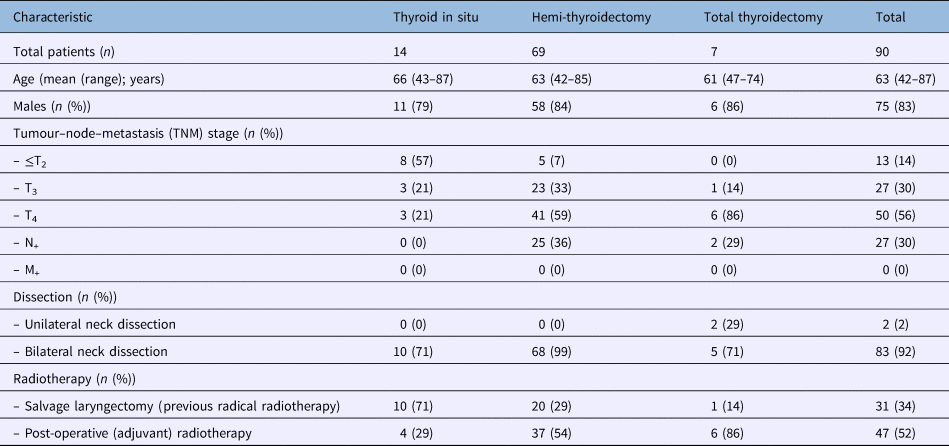
Table 1 provides a detailed breakdown of demographics, described for all patients and divided into groups based on the type of thyroidectomy. Seventy-five patients (83 per cent) were male and the average age was 63 years on the day of their procedure (range, 42–87 years). The majority of patients (n = 50; 56 per cent) had T4 disease. Sixty-three (70 per cent) were node-negative, and none had evidence of distant metastases at the time of surgery. Thirty-one patients (34 per cent) had previously undergone radical radiotherapy and were undergoing salvage laryngectomy for recurrent disease. Forty-seven patients (52 per cent) received adjuvant radiotherapy following their laryngectomy. Eighty-three patients (92 per cent) underwent bilateral neck dissection in conjunction with their laryngectomy.
Patient demographics

Seven patients (8 per cent) underwent a total thyroidectomy as part of their laryngectomy; 69 patients (77 per cent) underwent a hemi-thyroidectomy. The thyroid was left in situ in 14 patients (16 per cent).
Hypocalcaemia prevalence
Early hypocalcaemia (12–24 hours post laryngectomy) occurred in 16 patients (18 per cent). Protracted hypocalcaemia (four to six weeks post laryngectomy) occurred in seven patients (8 per cent). Permanent hypocalcaemia (one year post laryngectomy) occurred in six patients (10 per cent of those living at one year post laryngectomy).
Table 2 describes the prevalence of hypocalcaemia by thyroidectomy group for early, protracted and permanent hypocalcaemia, respectively. The prevalence of hypocalcaemia in patients with the thyroid in situ was 0 per cent across all time frames. Following hemi-thyroidectomy, the prevalence values were: 16 per cent for early hypocalcaemia, 6 per cent for protracted hypocalcaemia and 7 per cent for permanent hypocalcaemia. Following total thyroidectomy, the prevalence values were: 71 per cent for early hypocalcaemia, 43 per cent for protracted hypocalcaemia and 60 per cent for permanent hypocalcaemia.
Hypocalcaemia prevalence by thyroidectomy group

Data represent percentages
The Fisher's exact test was used to assess significance. For all time periods, the difference in hypocalcaemia prevalence was not statistically significant between the thyroid in situ and hemi-thyroidectomy groups (early, p = 0.197; protracted, p = 1; permanent, p = 1). However, the difference in prevalence between the total thyroidectomy group and the hemi-thyroidectomy group was statistically significant (early, p = 0.004; protracted, p = 0.016; permanent, p = 0.01).
Regression analysis
Exact logistic regression was used to measure the odds ratio of performing a total thyroidectomy compared to all other options (including hemi-thyroidectomy and thyroid in situ), for the risk of early, protracted and late hypocalcaemia. It was not possible to measure the odds ratio comparing thyroid in situ versus hemi-thyroidectomy as the prevalence of hypocalcaemia in the thyroid in situ group was 0 per cent.
An odds ratio analysis was performed at different established time periods. As mentioned in the methods, different risk factors including age, gender, previous radiotherapy and concurrent neck dissection were assessed in each model. None of these factors exhibited enough effect to be included in the final model. Post-laryngectomy radiotherapy was assessed for the permanent hypocalcaemia model only and did not reach the level required to be included in the model. The effect (odds ratio) of thyroidectomy was significant at all time periods. The final models are described in Table 3.
Exact logistic regression for different hypocalcaemia time frames

CI = confidence interval
Discussion
This analysis of over 10 years’ consecutive total laryngectomies describes the prevalence of early, protracted and permanent hypocalcaemia, overall and divided by the type of concurrent thyroid gland procedure. Fisher's exact test has shown that the proportion of hypocalcaemia cases was higher in the total thyroidectomy than the hemi-thyroidectomy groups, for all the time periods. Furthermore, exact logistic regression analysis showed that performing a total thyroidectomy is associated with a statistically significant increase in the risk of early, protracted and permanent hypocalcaemia.
Prevalence
Very few studies could be identified in the English-language literature that describe the prevalence or risk factors for hypocalcaemia or hypoparathyroidism following laryngectomy. Prior to this study, no published series have included patients with follow up of longer than three months. The prevalence of early, protracted or permanent hypocalcaemia following laryngectomy was therefore unknown prior to this project. The literature review considered prevalence and incidence, as there is some confusion between these concepts. Prevalence is the proportion of the population at a given time (e.g. X per cent of the described population in the study is affected) and incidence is the number of new cases for a particular period of time (e.g. X new cases per 100 population described in the study per year). This study therefore describes prevalence, but the term ‘incidence’ is used in many studies.
Basheeth et al. investigated hypocalcaemia within the first week post-operatively in a sample of 60 laryngectomy cases.Reference Basheeth, O'Cathain, O'Leary and Sheahan1 Theirs was the largest study in the published literature focusing on this topic. The authors found early hypocalcaemia in 30 per cent of patients (defined in their study as hypocalcaemia within the first 3 days) and they did not follow up for longer than one week. No factors were found to be significant for early hypocalcaemia. However, through assessing the lowest serum calcium level during the first 7 days, they showed that bilateral neck dissection and previous radiotherapy reached significance. They did not show that the extent of thyroidectomy was significant in their sample. There were some marked differences between their cohort and the present one. In the present study, the majority of patients underwent bilateral neck dissection (92 per cent), compared to 50 per cent in the Basheeth et al. study; the latter also included pharyngo-laryngectomies, and no patient had the entire thyroid gland preserved.Reference Basheeth, O'Cathain, O'Leary and Sheahan1
Several smaller studies describe the prevalence of hypocalcaemia or hypoparathyroidism following laryngectomy. These include: Negm et al.,Reference Negm, Mosleh, Fathy and Awad9 with a hypoparathyroidism prevalence of 42 per cent (n = 17); Mortimore et al.,Reference Mortimore, Thorp, Nilssen and Isaacs10 with a hypoparathyroidism prevalence of 30 per cent (n = 30); and Thorp et al.,Reference Thorp, Levitt, Mortimore and Isaacs11 with a hypoparathyroidism prevalence of 75 per cent (n = 20), but with lower levels of hypocalcaemia.
Krespi et al. investigated hypocalcaemia within the first three months post-operatively in 54 patients.Reference Krespi, Wurster, Wang and Stone12 These were split into three different operation groups of increasing complexity: laryngectomy with or without hemi-thyroidectomy (n = 17); laryngectomy with total thyroidectomy and mediastinal resection (n = 7); and laryngo-pharyngo-oesophagectomy with gastric pull-up (n = 30). They reported hypocalcaemia prevalence values of 12 per cent, 50 per cent and 73 per cent, respectively. Given the inclusion of more complex operations and abdominal surgery, and the lack of radiotherapy, it is difficult to compare these results to a modern cohort. It is suggested that abdominal surgery particularly may have a significant effect, because of the possible reduction in calcium absorption.
The numbers of patients included in the present study were therefore larger than any other, the cohort is more homogeneous and, furthermore, this is the first study to follow patients up for over a year. This study also follows similar definitions to studies of hypocalcaemia following thyroidectomy;Reference Harris, Prades, Tkachuk and Zeitoun5–Reference Lorente-Poch, Sancho, Muñoz-Nova, Sánchez-Velázquez and Sitges-Serra7 the heterogeneity of the studies investigating hypocalcaemia following laryngectomy makes comparison difficult. The overall prevalence of hypocalcaemia in this study is lower than many of the smaller studies described above. It may be surmised that the inclusion of preserved thyroid glands in the present study has resulted in the lower incidence overall, as focusing on the hemi-thyroidectomy and total thyroidectomy groups in isolation gives more comparable figures.
Despite the prevalence of post-laryngectomy hypocalcaemia being lower than in many published studies, it is still highly significant. Permanent hypocalcaemia was seen in 10 per cent of patients overall, 7 per cent of those were following hemi-thyroidectomy and 60 per cent were following total thyroidectomy. This is strikingly higher than the levels seen in isolated thyroidectomy patients (without laryngectomy), where the prevalence of permanent hypocalcaemia in hemi-thyroidectomy has been shown to be below 1 per cent.Reference Harris, Prades, Tkachuk and Zeitoun5 This difference makes sense given the more extensive dissection in a much less healthy cohort. What is surprising is the lack of evidence and research into this area. Two-thirds of this cohort survived their disease and its treatment to one year, but 10 per cent of these patients have permanent hypocalcaemia. Surely this represents an opportunity for the head and neck fraternity to reduce the morbidity in one of its most morbid groups?
Preventing post-laryngectomy hypocalcaemia
This study has demonstrated that the main factor increasing the risk of hypocalcaemia following laryngectomy is thyroid gland removal. Hypocalcaemia prevalence was markedly lower when half of the thyroid remained in situ, and was further reduced when the entire gland was preserved. It is disappointing that a statistical difference could not be demonstrated between the thyroid in situ and hemi-thyroidectomy groups; a larger sample may be able to prove this hypothesis.
If it is accepted that saving thyroid tissue is important in reducing hypocalcaemia, then it is necessary to identify in which patients this may be done safely. The justification for removing the thyroid gland is that it is a possible site of spread of squamous cell carcinoma. A meta-analysis revealed that this was the case in 10.7 per cent of total laryngectomies (95 per cent confidence interval = 7.6–14.2).Reference Kumar, Drinnan, Robinson, Meikle, Stafford and Welch13 However, there is little evidence in the literature to support the decision to remove or preserve thyroid tissue. Squamous cell carcinoma has been shown to invade the thyroid predominantly by direct spread from the larynx, through the laryngeal cartilage or cricothyroid membrane, rather than through haematogenous or lymphatic means.Reference Mourad, Saman, Sawhney and Ducic2, Reference Mendelson, Al-Khatib, Julien, Payne, Black and Hier3, Reference Gorphe, Ben Lakhdar, Tao, Breuskin, Janot and Temam14, Reference Wiegand15 The risk of thyroid invasion appears to be raised in subglottic disease, and pre-operative computed tomography has been shown to be useful in ruling out thyroid invasion.Reference Mendelson, Al-Khatib, Julien, Payne, Black and Hier3, Reference Harris, Passant and Ingrams4, Reference Kumar, Drinnan, Robinson, Meikle, Stafford and Welch13, Reference Gorphe, Ben Lakhdar, Tao, Breuskin, Janot and Temam14, Reference Mangussi-Gomes, Danelon-Leonhardt, Moussalem, Ahumada, Oliveira and Hojaij16
Another theoretical factor that may affect post-operative hypocalcaemia is the method of thyroid pedicle dissection. Many surgeons divide the vascular supply to the upper pole of the thyroid, even if the thyroid is left in situ, as this improves access to the larynx. Whilst the thyroid gland itself may have an adequate blood supply from its lower poles alone, the superior parathyroid gland is supplied by an end arteriole from the superior thyroid artery. It is therefore possible, and already some surgeons' standard practice, to preserve the superior thyroid artery, or divide the thyroid from its vascular supply close to the gland, as is common practice when performing a thyroidectomy. These data were not available for this study as it was only occasionally described in the operative documentation.
Limitations
This was a retrospective study and therefore is reliant on the data collected at the time. Thankfully, the electronic record system at the study authors’ institution meant that all blood results, imaging findings, operation notes and clinic letters were available to the research team. However, parathyroid hormone testing was not carried out consistently. Parathyroid hormone analysis would have been useful in showing the parathyroid function more directly, rather than relying on adjusted calcium levels, which can be affected by the patient's fluid status and by supplementation.
• Hypocalcaemia is a recognised complication following laryngectomy
• The prevalence and risk factors of post-laryngectomy hypocalcaemia were previously unknown
• This is the largest study to investigate this and the first to include follow up of over three months
• Hypocalcaemia was found in 18 per cent of patients on day 1 and in 10 per cent at 1 year
• Concurrent total thyroidectomy significantly increases the risk of hypocalcaemia at all time frames
Although this is the largest study exploring this question in the English-language literature, the numbers are still relatively modest. A larger study would strengthen the conclusions, provide narrower confidence intervals and give more options for statistical analysis. As over three-quarters of the sample underwent a hemi-thyroidectomy, this has limited the effect of the other groups. Also, for many patients with laryngeal cancer, laryngectomy is a final attempt at disease control, and it is often carried out in patients with multiple co-morbidities and low performance scores; inevitably there is a high mortality in this group. This was reflected in the reduction of included patients at one year, meaning that the analysis of permanent hypocalcaemia was limited. Although the significance of total thyroidectomy is clear, the reduced numbers could mask the true effect of other risk factors, particularly ones that were less balanced between categories.
Conclusion
This study showed the prevalence values of early, protracted and permanent hypocalcaemia following total laryngectomy to be 18 per cent, 8 per cent and 10 per cent, respectively, in this cohort. This is the largest study to investigate this, and the first to follow up patients for longer than three months. No patients in whom the entire thyroid gland was preserved were found to have hypocalcaemia. The highest prevalence of hypocalcaemia was seen following total thyroidectomy; however, a significant prevalence was shown even if one thyroid lobe was preserved. Regression analysis revealed that total thyroidectomy has an effect on hypocalcaemia at all time frames, independent of other variables such as age or radiotherapy. This study cannot change practice, but establishes the level of the problem. It is now important to add to these findings, and to demonstrate which patients can undergo laryngectomy without thyroidectomy, without impairing oncological control.
Acknowledgements
The authors would like to acknowledge the help and support of the Aneurin Bevan University Health Board Head and Neck Multidisciplinary Team for their role in the care of the included patients and for assisting with the data collection.
Competing interests
None declared