Over the past four decades, historians of working-class women in the United States have shared, to a large extent, a common assumption about women's paid work experiences in the decades around the turn of the twentieth century. This conventional wisdom tells us that, from the 1870s through the 1920s, if a family needed the income of a female family member in order to survive, daughters entered the workforce much more frequently than did mothers. As Alice Kessler-Harris put it as recently as 2001, “A typical early twentieth-century urban white working-class daughter might know that she would have to earn wages for several years before marriage and then sporadically thereafter. But she could expect, or at least hope, that some part of her working life would involve caring for her own home and family” (Kessler-Harris Reference Kessler-Harris2001: 24).
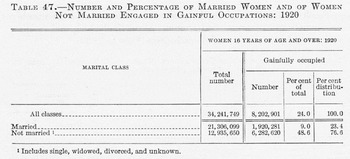
Accordingly, women's labor historians have focused almost exclusively on the paid work experiences of young and single working women (see, e.g., Enstad Reference Enstad1999; Tentler Reference Tentler1979). The work histories of mothers, widows, and older women have received attention only as the exceptions to this widely accepted rule that “working woman” equals “single woman” in this time period (see, e.g., Blewett Reference Blewett1988; Turbin Reference Turbin1992). Only very recently, possibly under the influence of today's attention to “work-family” issues, historians have begun to question the alleged absence of married women from the workforce (DeVault Reference DeVault2013). More than a dozen years ago, a colleague of mine expressed surprise at the number of married women in the strike stories I ultimately told in my book United Apart (DeVault Reference DeVault2004). In order to explain the presence of those women, I began a search for information on just how many wage-earning women were or once had been married around the turn of the century. Like many other historians, I turned first to Joseph Adna Hill's Women in Gainful Occupations, 1870–1920. Hill, tasked with refiguring the numbers reported in the six censuses around the turn of the century, told us that in 1920 married women over the age of 16 made up only 23.4 percent of all women workers; the remaining 76.6 percent of women workers were “not married” (Hill Reference Hill1929: 76; see figure 1). This is the key statistic that has told us for years that “most” women workers at the turn of the century were unmarried and, we go on to assume, were therefore the “daughters” of families, leaving divorced and widowed women out of our analyses.
Table from Women in Gainful OccupationsSource: Hill Reference Hill1929: 76.

The US Census Bureau published Hill's volume in 1929. In this work Hill provided a great service to future historians of women's paid employment, as he meticulously analyzed women's representation in the workforce across distinctions of race, nativity, age, and marital status. Between the 8th census of 1870 and the 14th census of 1920, enumeration of all these categories had undergone many changes (Anderson Reference Anderson1988). First appointed to the staff of the 12th census in 1899, Hill became the only employee from that census to remain permanently with the bureau. He was named assistant director for the next three censuses and also served as the chief of the Division of Revision and Results and the Division of Statistical Research. In 1919, Hill served a term as president of the American Statistical Association. Hill remained employed by the Census Bureau until his death in 1938 at the age of 78 (National Archives and Research Administration). Because of his unusually long-term employment by the bureau, Hill could perform the Herculean task of figuring and refiguring six decades’ worth of statistics on women's participation in the workforce. The resulting volume has served as a crucial resource for historians of women's work ever since its publication. My interest here is with a particular part of Hill's refiguring that has influenced and, I argue, misdirected historians in important ways.
The Problem
Women in Gainful Occupations is a 416-page work with some 253 pages of “detailed tables.” In both its presentation of raw numbers and its textual “analysis” of those numbers, it very much falls into the tradition of Progressive Era statistical study. Included in the volume is a chapter on married women's labor force participation from 1890 to 1920. The tables published there provide historians with the invaluable, but flawed, materials from which we have begun our discussions of the interactions of women's work and their marital status. Hill's data here are invaluable exactly because of the changes in what published census reports at the time included. The 1880 Census recorded the civil condition (or, as we now would call it, the marital status) of the US population, enumerating those married, single, divorced, and widowed but, unfortunately, it did not tabulate and report this information in any of its many publications. The 1890 and 1900 published reports present great detail on the marital status of both female and male workers. For the 13th census of 1910 no figures on workers’ marital status were published, despite the fact that the then director of the Census Bureau promised that figures on women's marital status would appear at some future time. The published reports of the 1920 Census only distinguished between those who were married versus those who were single, including widowed or divorced. Hill's volume transformed all the prior numbers into this bipartite structure. In Hill, women workers appeared as either married or single. Using Hill's presentation, historians have not even needed to prove that single women made up almost all working women in the decades surrounding the turn of the last century; we have simply stated that as fact and cited Hill. Following Hill, we have described women workers at the turn of the century as being overwhelmingly single (“daughters” rather than “mothers”) and therefore only temporarily in the workforce until marriage would remove them from formal wage earning. Only within the past decades has the existence of the Integrated Public Use Microdata Set (IPUMS; Ruggles et al. Reference Ruggles2008) allowed us to redivide and regroup women workers.
Hill's basic table on married and not-married women in 1920 informs us that married women made up only 23.4 percent of all women workers and that only 9 percent of married women were gainfully employed. More than three-quarters (76.6 percent) of all women workers were “not-married,” including all women single, widowed, or divorced. Almost half (48.6 percent) of this group of women found employment (Hill Reference Hill1929: 76). These numbers have led historians to conclude that most working women in the early twentieth century were the daughters of families rather than the mothers of those families. We have, in general, spent a great deal of time and ink discussing the implications of the resulting family economies. Leslie Woodcock Tentler, for example, argued in 1979 that “young women . . . found at work a preponderantly adolescent world . . . importantly influenced by the relative absence of older women workers” (Tentler Reference Tentler1979: 60). Other historians like Carole Turbin, writing in 1992, could only complicate the “conventional wisdom” of temporary work by “dependent” young daughters through an in-depth examination of manuscript census records for a single industry in a single small city (Turbin Reference Turbin1992). When married women show up in the historical record, we have treated them as historical exceptions, performing “only” sporadic work in home industries rather than holding down full-time “gainful occupations” (see Boris Reference Boris1994; Bose Reference Bose2001; DeVault Reference DeVault2013).
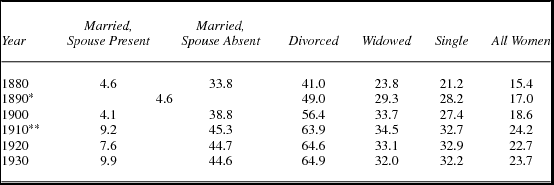
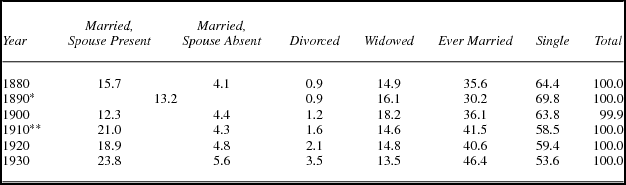
Now, however, the IPUMS, based on the manuscript census records of the United States, allows us to redivide and regroup the marital status of working women from 1880 to 1930 (see tables 1 and 2). Table 1 shows us that while married women whose spouses were present in the household participated in the labor force less than did single women, widowed and divorced women as well as those whose husbands were “absent” from the household all had higher labor force participation rates than that of single women. Furthermore, as table 2 demonstrates, while the majority of women workers remained unmarried during these five decades, married, or ever-married, women began to present a more substantial proportion of the total. By 1920, single and ever-married women present a 60/40 split; ten years later, they were creeping closer to even representation in the workforce (53.6 percent to 46.4 percent). While single women outnumbered those who had ever been married in the workforce, ever-married women made up a substantial portion of the female labor force. A clearer presentation of these figures in the 1920s would have altered historians’ beginning concepts about who the women were who made up the female labor force of this country.
Women's labor force participation rate by marital status, 1880–1930
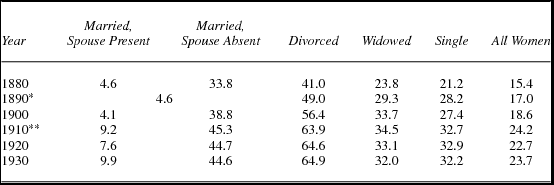
* Includes all married women.
** In 1910, instructions to enumerators changed so that more women were recorded as “gainfully employed.”
Sources: Ruggles et al. Reference Ruggles2008. For 1890 numbers: U.S. Bureau of the Census 1896.
Composition of female workforce by marital status, 1880–1930
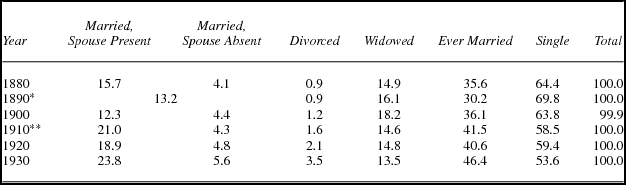
* Includes all married women.
** In 1910, instructions to enumerators changed so that more women were recorded as “gainfully employed.”
Sources: Ruggles et al. Reference Ruggles2008. For 1890 numbers: U.S. Bureau of the Census 1896.
The numbers presented in tables 1 and 2 help us understand that marriage did not end women's wage-earning responsibilities. Though single women might have dreamed of a day when they could escape the workforce through marriage, the realities of working-class life at the time meant that gaining a husband did not necessarily mean a permanent exit from the world of waged work. This then brings us to the main point of this paper: Why have these facts remained hidden from sight for so long? Why did the Census Bureau, and Joseph Hill along with it, change the way they reported workers’ marital status? In both 1890 and 1900, the bureau not only had published detailed tables presenting the occupations of both males and females by “conjugal condition” (single, married, widowed, and divorced) but they had also devoted some time and publication space to discussion of these statistics (four pages of text and tables in 1890 and more than 12 such pages in 1900). By the time of the 1910 Census the regular publications of the bureau promised future presentation of such materials; the only such materials to appear for the 1920 Census are those sections of Hill's work on the marital status of women workers only. Why did this change occur for the 1910 and 1920 censuses, compared to the robust data analyzed in 1890 and 1900? My search for an answer to this seemingly simple question took me on a circuitous route through the records of both the Census Bureau and a number of Progressive Era reform organizations.
Census Bureau Issues
Historian Margo Anderson has described the many difficulties faced by the 13th census of 1910 (Anderson Reference Anderson1988: 116–30). Issues thought resolved after the 12th census reappeared when the newly permanent Census Bureau was moved from the Department of the Interior to the new Department of Commerce. As the 1910 Census date approached, the bureau faced both fiscal and technical difficulties. For the 12th census in 1900, the bureau had rented tabulating machines invented by Herman Hollerith for the purpose. After that census was largely published, the bureau set up its own shop in order to produce its own machines for the next census. As it turned out, their own machines created their own problems. Official reports on the progress of census tabulation after 1910 are rife with comments such as the following entry from April 1913 (National Archives Building [NAB], Record Group [RG] 29, Monthly Report Series [Ser.] 193, Box 43, 4/1/1913):
With regard to the work on occupation statistics, the necessary sorting of cards to connect the proper cards with the schedules is making satisfactory progress. The first sort (separating those gainfully employed from others) being completed. The second sort (connecting with the enumeration districts and number on schedules) is over 96 per cent completed. The third sort (by industries and occupations in detail) is over 38 per cent completed. The punching on the necessary cards of the proper occupation symbols, following the second sort, is about 82 per cent completed. The count for each specific occupation under each Industry, according to sex, color, and certain age groups, is progressing.
When the bureau finally published volume 4 of the 1910 Census, “Occupations,” in 1914, the director's “letter of transmittal” included the following statement:
the present report is somewhat limited in scope and does not contain, as originally contemplated, statistics for the gainful workers with respect to unemployment, marital condition, country of birth, and class of worker; but these subjects will be covered by a special report on occupations to be published later. (US Bureau of the Census 1914: 11, emphasis added)
Such a report would never appear. When the “Occupations” volume of the 1920 Census appeared, it included a chapter on “Marital Condition of Occupied Women,” which compared 1910 and 1920 using the bipartite definitions of “married” and “single, widowed, divorced, and unknown” (US Bureau of the Census 1923: 692). No comment on this change appears in the records of the census. So why did the census make the change?
Labor Reform Legislation
At the same time the Census Bureau allegedly was working on its “special report,” reformers in the United States were attempting to move forward the idea of passing “sickness insurance” legislation on a state-by-state basis. Under the leadership of John B. Andrews, the American Association for Labor Legislation (AALL) began drafting such legislation for New York state in 1912. Industrial accidents had long been seen as devastating to working-class family economies. As Florence Kelley put it in a lecture series in 1913,
If the breadwinner is not killed but disabled by an injury incident to his work, or by an industrial disease, transforming him from the breadwinner to a dragging burden upon his wife and children, they need not less but greater indemnification for their loss, not from taxes, or charity, but from the industry which deprives them of their breadwinner. We are, as a nation, far slower than the nations of Europe to enforce the payment of this debt to families bereft by industry of their breadwinners. (Kelley Reference Kelley1914: 14)
The AALL proposed to take this one step further. The legislation Andrews's group proposed called for payments to gainfully employed but ill individuals for up to 26 weeks at two-thirds of the worker's regular pay. Funded two-fifths by employers, two-fifths by workers, and one-fifth by state governments, the AALL hoped that this type of insurance would help ameliorate the devastating impact sickness had on families dependent on weekly wage payments (AALL, Reel 17). The organization focused mostly on the effect a husband and father's illness could have on his family's well-being. While parts of the AALL's first sickness insurance bills echoed New York state's Workers’ Compensation law, which was yet to be declared constitutional, the organization was ultimately unsuccessful in passing any such sort of health insurance bill (New York Times 1917b). Arguments on both sides still echo a hundred years later in continuing efforts to expand health insurance coverage in the United States.
The AALL's first drafts of the New York sickness insurance bill in 1915 also included a proposal to grant all working women “maternity insurance.” The AALL hired Olga Halsey to study other countries’ maternity benefits and construct an appropriate plan for the United States. In Halsey's notes, she compares a woman who has just given birth with maternity insurance and without the insurance. The woman with maternity insurance would not lose out on her regular source of income during the “difficult” weeks surrounding her pregnancy. More importantly to Halsey, both women insured through their own employment and the wives of insured men would “receive obstetrical aid at confinement” (AALL, Reel 62). As Halsey put it, “Proper care at childbirth is perhaps even more important to the health of the mother and child than the provision of the cash benefit which will enable the mother and child to have extra nourishing food at that time” (ibid.). Maternity insurance as proposed by the AALL in 1916 constituted a special case of general workers’ sickness insurance, providing payments to employed women for two weeks prior to and six weeks following childbirth (ibid.).Footnote 1 Eager to enlist as wide support for its proposal as possible, in late 1915 the AALL began to circulate drafts of its legislation.
One of the early opponents to the maternity insurance provisions of its plan was well-known reformer and National Consumers League activist Florence Kelley. On December 17, 1915, Kelley wrote a letter to Dr. George Hooker stating “we are actively opposed to the provisions of the draft bill of the Association of Labor Legislation so far as regards women.” Kelley compared the proposed legislation “to saying to the wage-earning husband: ‘Send your wife into a mill, factory or sweatshop, and the public will send you a present for your next baby’” (Sklar and Palmer Reference Sklar and Palmer2009: 209–10). Further outlining her reasons for opposition, Kelley went on to write a “Memorandum on the Maternity Features of the Proposed Health Insurance Act.” Declaring maternity insurance to be a form of “Discrimination Against Self-Respecting Unmarried Women,” Kelley stated that unmarried women should not have to pay for “this proposed care of the wives of insured married men.” This was problematic, Kelley explained, “at a time when unmarried, wage-earning women are so ill paid that a nationwide campaign for minimum wage boards for their especial protection is carried on. Advocates of that legislation,” (such as herself) she continued, “cannot logically advocate taking from the single women contributions (in two forms!) for cash premiums to lighten the burdens of husbands who send their wives out as wage-earners” (AALL, Reel 62). Kelley went on to call maternity insurance “a leap in the dark . . . preceded by no enquiry as to the numbers and distribution of married women wage-earners.” This meant that “No rational estimate can, therefore, be offered in its support as to the cost which it will impose upon the taxpayers and particularly upon the single women.” Kelley noted that “[t]he last federal census appears not to have segregated married women in any way available for answering this question, through [sic] the schedules are believed to contain uncompiled material dealing with it” (ibid.).
Kelley repeated her main points of opposition to the AALL's bill at a December 1916 Conference on Social Insurance in Washington, D.C., during which she and several other women reformers complained about the dearth of accurate statistics on women's wage-earning activities. Mary Van Kleeck of the Sage Foundation, for example, acknowledged that women aged 16 to 21 tended to join the workforce in higher proportions, but argued that the number of married women wage-earners was increasing as well. She then commented that, “Unfortunately the census has not yet provided us with the very important comparable information about married women at work in 1910” (US Department of Labor 1917: 592). As historian Kathryn Kish Sklar has argued, “The AALL's plan to provide childbirth health benefits to married wage-earning women clashed with Kelley's campaign and she attacked it relentlessly” (Sklar and Palmer Reference Sklar and Palmer2009: 168). Kelley's opposition to maternity insurance at the 1916 conference told the AALL that the organization would need to provide equally strong arguments in order to include it in their bill.
The Request
The AALL accordingly turned to the Census Bureau to request information on the number of wage-earning married women at the beginning of 1917. In the monthly report of the Census Bureau director to the secretary of commerce for February 1917, Director Samuel Rogers noted that:
Preparation of the data relating to the marital condition of women at work was advanced in order to show the number of married women at work in 1910 in comparison with similar figures for the two preceding censuses. These data are especially needed at this time for use in connection with possible action by state legislatures as a part of the general campaign for health insurance, with particular application to maternity insurance. (NAB, RG 29, Ser. 193, Box 43)
Neither the records of the Census Bureau nor those of the AALL include a copy of the organization's request for the data.Footnote 2 However, in order to attempt to convince Kelley (and the influential Consumers League she worked for) to support the campaign for “sickness insurance,” the AALL would have wanted numbers to show that single women far outnumbered married women in the workforce. This would have suggested a lower cost for maternity insurance and therefore a lower “tax” on single women workers to support it.
When the New York state legislature held hearings on a “compulsory health insurance” bill on March 7, 1917, “[t]he widest possible divergence of opinion . . . was expressed.” The state Chamber of Commerce, the National Civic Federation, the National Association of Manufacturers, and various medical organizations all opposed the plan, while Pauline Newman of the International Ladies’ Garment Workers’ Union, various child welfare organizations, and a number of individual doctors supported the bill. At the end of the hearings, however, a “compromise” sent the bill into oblivion, as James M. Lynch of the State Industrial Commission called for “the creation of a legislative committee to investigate the entire subject” (New York Times 1917b).
The Result
Almost a full month after the defeat of the New York health insurance bill, the Census Bureau sent the AALL the statistics on gainfully employed women (NAB, RG 29, Ser. 193, Box 43). Soon after, the bureau published a press summary outlining its findings (ibid.). Unfortunately, no copies of this release appear to have survived. However, the timing of the release limited public and press attention to it. On the same day the Census Bureau sent the figures to the AALL, April 2, 1917, President Wilson asked Congress to authorize US entry into World War I. The only published reference to the bureau's release that I have found was in the Washington Post, in a three-paragraph article entitled “Spinsters No Longer Monopolize Jobs Open to Women in Industry,” published on page 6 of the May 6, 1917 edition. The article sought to amuse its readers by comparing the census report to the popular song, “Everybody Works but Father.”Footnote 3 Many probably would have agreed, humming along to Jean Havez's (Reference Havez1905) chorus:
Page one of the Washington Post that day carried headlines such as “French Seize Part of Hindenburg Line,” “British Seek Troops,” “Draw U-Boats’ Sting,” and “Rush Troops to Trenches.” US involvement in the war would sidetrack attention to women workers’ marital status for not only the media but also the Census Bureau. As Margo Anderson has put it, US entry into World War I meant that “the bureau suddenly found itself in the limelight as other agencies and policymakers turned to them for data on everything from explosives and manpower sources to leather stocks” (Anderson Reference Anderson1988: 127). The bureau thus turned, along with the rest of the nation, to issues of the European war. At the same time that the bureau's director reported its publication on women workers, for example, he also noted the bureau's “Emergency Work” for the War Department, estimating population in accord with plans for military enrollment (NAB, RG 29, Ser. 193, Box 43). Such attention would continue throughout the war years, eventually including “data being prepared for use at the peace council at the conclusion of the war” (NAB, RG 29, Ser. 193, Box 43, 10/10/18). Questions regarding women workers’ marital status took an understandable back seat. There would be no additional 1910 Census publications on women workers’ marital status and no mention at all of men workers’, despite the textual interest expressed in such in the 1900 Census publications.
Women in Gainful Occupations
By the time the 14th census of 1920 was taken and published, little interest remained in examining the details of workers’ marital status evinced in the 1890 and 1900 censuses. The 1920 volume on occupations included the following statement:
Since statistics showing marital condition in relation to occupation are of so much greater importance in the case of female than in the case of male workers, the special tabulation of the Fourteenth Census occupation returns by marital condition was limited . . . to the returns for females. And, since the employment of married women possesses special economic and sociological significance . . . the returns for this class of women were tabulated as a separate group . . . while the returns for all other marital classes were tabulated together. (US Bureau of the Census 1923: 691)
Any further publications on workers’ marital status would come through the appearance of “census monographs,” a new form of census publication. These monographs were overseen by the new Census Advisory Committee, a committee seen by Anderson as “the most successful” of the bureau's attempts to achieve greater permanence through its war efforts (Anderson Reference Anderson1988: 128). The Advisory Committee was composed of three members each of the American Statistical Association and the American Economic Association. As Anderson notes, “The committee effectively served as a policymaker in the absence of strong bureau leadership . . . and set priorities for special census studies . . . forg[ing] a tangible link between the government and the academic community” (ibid., 129) While not an official member of the Advisory Committee, Joseph Adna Hill played a crucial role in shaping the agenda of the committee (NAB, RG 29, Ser. 148).
In early 1920, the Advisory Committee began to discuss the eventual “special studies” it wanted to see produced out of the 1920 figures. In its January 1921 meeting, the committee discussed the details of the desired report on occupations, agreeing that “figures should be shown by literacy, marital condition, age . . ., country of birth or mother tongue, [and] class of worker.” They also apparently agreed that “tabulation [was] preferred to marital condition detail, in case one of two must be abridged” (NAB, RG 29, Ser. 148, Box 71). By 1923, the Advisory Committee had agreed that one of the “special studies” should be a monograph on “women at work,” comparable to one published in 1900. This work proceeded along a tortuous path until it finally became Hill's Women in Gainful Occupations.
The Advisory Committee first recommended that the bureau undertake a special study on “women at work” in December 1921. The committee's Chairman W. S. Rossiter suggested “that the 14th Census report on occupation statistics include comparable 13th Census statistics . . . on the marital condition of female workers, to the extent that it is found practicable to compile such statistics without delaying the completion of the report beyond the close of the census period” (ibid.). Early in 1922, Hill corresponded with Edith Abbott, requesting her assistance with this volume. By this time Abbott was already a prolific scholar and she had just accomplished moving the Chicago School of Civics and Philanthropy to the University of Chicago as the School of Social Service Administration. In the early 1900s, Abbott had worked with Carroll D. Wright as well as pushing for the initiation of the project that would turn into the 19-volume Report on Condition of Woman and Child Wage-Earners in the United States. With a doctorate in economics and a strong belief that census data had been inadequate in its discussion of female labor, Abbott appeared to be the perfect candidate for the job (Costin Reference Costin1983: 101).Footnote 4 Unfortunately, she responded saying that while she was willing to “collaborate with Dr. Edwards, reading and criticizing text and perhaps writing portions of it. She prefer[ed] to be connected with this volume in an advisory capacity” rather than taking on full responsibility for it (NAB, RG 29, Ser. 148, Box 71, 4/26–27/22).
Scrambling for an author for the work, the project was finally assigned to Olive M. Riddleberger, a 53-year-old employee of the bureau. In early March 1923, Hill informed the Advisory Committee that “Miss Riddleberger, having been absent from the office for two months or more on account of illness, has made little progress on the project assigned to her, namely, ‘Women in Gainful Occupations’” (NAB, RG 29, Ser. 148, Box 71). The committee responded by recommending “that the Director [Hill], at his discretion, attempt to complete this study as speedily as practicable by utilizing data relating to the 11 selected cities for which the cards have been edited” (ibid.). By January 1924, Riddleberger had only written about half of the volume's text and in December of that year, Hill reported that “Miss R has completed her work on this monograph but we find it will have to be largely rewritten.” Hill assured the committee that he was rewriting the volume “with the assistance of Dr. Edwards, but progress [was] somewhat slow because [he could] give so little time to it” (ibid.). The director of the census reported to the secretary of commerce that the manuscript of “Women at Work” “was completed during the month of August” 1924. By the following year, “women in gainful occupations” was listed as one of the census monographs in “various stages of completion” and a year later the volume was reported as “manuscript being revised.” Finally, in July 1928, the manuscript was reported as “prepared for printing.” The manuscript was sent to the printer in August 1928, and was listed as being “in process of printing” by November of that year (ibid.). In November 1929, Monograph IX of the 1920 Census, Women in Gainful Occupations: 1870 to 1920, finally appeared in print.
Given Joseph Hill's careful shepherding of census costs and his dislike for unnecessary “detail except that which is really significant and valuable” (NAB, RG 29, Ser. 148, Box 71, 11/10/24), it is not surprising that he followed the division of women workers’ marital status into the two categories requested in 1917: married and single, with the latter including divorced and widowed women. Whether Hill still remembered that this scheme had come following the AALL's request we cannot tell from the census records. However, the sections of Women in Gainful Occupations dealing with women workers’ “marital condition” remain heavily marked by the preoccupations of both the AALL and Florence Kelley. Committed to different types of reform, both wanted to make the presence of married women (and mothers) in the workforce appear smaller than, in fact, it was. That they succeeded in doing this had unforeseen consequences for future historians.
Discussion
As I searched for the answer to my question about why the census changed the way it reported workers’ marital status, my “guesses” on the answer kept changing. I began by suspecting Hill, imagining him as a fusty old bureaucrat much more concerned with cost-cutting than with uncovering the “truth” about women workers’ experiences. Then, as I worked through the papers relating to Hill's work in the National Archives, I began to see Hill as someone trying to inject intellectual concerns of his time into the census bureaucracy. (He did, after all, first approach Edith Abbot to write the book; what a different tome that might have been!) My second set of suspects was the group of all-male academics on the Census Advisory Committee, but they, too, appear in the records to be committed to uncovering and disseminating information on women workers’ marital status. On my last day in the archives, I found the Census Bureau director's response to the AALL's request for information. That then led me into the weeds of Progressive Era Reform and one of the early futile attempts to gain state-sponsored health insurance in the United States. I never would have guessed when I began my search that arguments within the reform community over maternity insurance versus minimum wages for women workers would provide the tipping point in the story I tell here.
That Kelley's opposition to the AALL's proposed reforms came at the exact historical time that it did ended up compounding two other important Census Bureau developments, one organizational and technical and the other geopolitical. Before the 1910 Census, the Census Bureau did not exist as a permanent governmental agency. Instead, every decade Congress had to appoint a US Census director and appropriate moneys for taking the census and publishing its reports. By the time the last report was published, virtually all of the employees would find themselves moved to other jobs. A few years later the process would begin again. For decades the census had battled for the permanent status it was finally granted in 1902. Only then could the new bureau take the chance of investing in its own technology for tabulating the census numbers, let alone set up something like the Census Advisory Committee. Both of these “successes” for the bureau also entailed new problems and expenses. Throughout both the lead up to the AALL's request for the numbers of single versus married women workers and the ensuing years of efforts leading to the publication of Women in Gainful Occupations, the newly permanent Census Bureau still struggled to contain costs and justify its existence.
US entry into World War I in 1917 provided the perfect opportunity for the census to prove its worth as Congress turned immediately to the bureau for a wide range of information. As noted earlier, mustering an army for overseas warfare required knowledge of the ages and health of the nation's men. Providing that army (and the armies of US allies) with the munitions and other supplies that they needed required further information on the nation's workforce and industries. The census director eagerly volunteered the skills of his employees and the scope of their information for these types of war efforts. These wartime efforts led to the creation in late 1918 of the Census Advisory Committee, made up of members from the American Statistical Association and the American Economic Association (Anderson Reference Anderson1988).
Perhaps the Advisory Committee would have called for an inquiry into women workers after the war anyway, but without the calls of Kelley and the AALL for the distinct categorization of presently married versus presently not-married (“single”) women workers, I believe Hill's figures in Women in Gainful Occupations would have looked quite different. While Kelley's efforts did lead to the first legal minimum wage legislation in the United States, historians of early-twentieth-century feminism and reform have discussed the pros and cons of the use of Kelley's type of “opening wedge” strategy for gaining various forms of protective legislation (Baer Reference Baer1978; Cott Reference Cott1987; Skocpol Reference Skocpol1992; Woloch Reference Woloch1996, Reference Woloch2015). Those historians have not paid attention to the collateral damage of that strategy such as that we see with the census. In this case, that damage reminds us that statistics are never neutral. The way in which statistics are gathered, expressed, and deployed has always affected both contemporary policy issues and the history later written.
Women's labor historians in the late twentieth century found Hill's reinterpretation of census statistics for the decades around the turn of century to be the most easily available source of information about women workers’ marital status. The result was our mistaken assumption that the “girls” mentioned in virtually every public notice of women workers were, in fact, young and single women: the daughters of families rather than the wives and mothers, whether married, divorced, or widowed. Even sophisticated and relatively recent studies of working women such as Nan Enstad's Ladies of Labor, Girls of Adventure focus on the “working girl” and leave the more mature-sounding “ladies” for representation of middle-class supporters. Rethinking this type of assumption through the use of IPUMS figures has opened new opportunities for the history of US workers and their workplaces and experiences. Though even the IPUMS figures still do not allow us to compute home work, participation in family businesses, or other forms of “selling subsistence” (Boris Reference Boris1994; Bose Reference Bose2001; DeVault Reference DeVault2013), they do enable us to enlarge our sense of women's roles in the waged workforce. Furthermore, the IPUMS-enabled separation of ever-married women into those still married, those widowed or divorced, and even those living separately from their husbands gives us a much more nuanced view of the family circumstances of women in the labor force. The many different ways in which the wives and mothers of families, as well as those families’ daughters, contributed to the economic sustenance of those families begins to be more clarified. Perhaps the presence of wives and mothers in the workforce was never as limited as Joseph Adna Hill (and Florence Kelley!) have led us to think (DeVault Reference DeVault2013). With our current focus on work-family issues along with new historical statistics, perhaps we can rewrite the words to Jean Havez's song and change the title to “Everybody works with father.”
Acknowledgments
Thanks go to Ayala Falk for her efforts to track down the basic story of maternity insurance and Kelley's opposition to it; Seth Popick for performing the initial library census research; Margo J. Anderson; Census Bureau Historians David M. Pemberton and the late William M. Maury; Constance Potter at the National Archives Building in Washington, D.C.; Diane Feldman and Sara DeVault-Feldman for putting up with my research trip to D.C.; the women's writing group at the ILR School; and all my friends who encouraged me to figure out the answer to the Census Change Question. Reviewers for Social Science History helped me clarify and sharpen my argument. I take full responsibility for the information and inferences drawn here.