“The lions of the Islamic State are blowing up the temple (#TempleofBaalshamin) in the city of Palmyra, and eventually by God’s will they will blow up the pyramids and the Sphinx”
(Tweet, 23 August 2015, original Arabic text in online supplementary material (OSM) 1).
Deliberate heritage destruction by the so-called ‘Islamic State’ (ISIS) has made headlines across the world. Although widely condemned, these actions have also generated support for and potentially increased recruitment to ISIS. While they are not the first to publicise heritage destruction in support of wider goals (e.g. the filmed destruction of the Bamiyan Buddhas), they are the first to engage in what Smith et al. (Reference Smith, Burke, de Leiuen and Jackson2016) refer to as ‘socially mediated terrorism’, where events are mediatised and shared via social media to enhance impact. The rationale underlying such destruction, its mediatisation and its effects, however, remain poorly understood.
The destruction must be understood in a two-fold context: why the attacks occur, and how they are used within ISIS’s media strategy. Numerous reasons have been proposed. Isakhan and Gonzalez Zarandona (Reference Isakhan and Gonzalez Zarandona2017) identify symbolic sectarianism (heritage attacks on Islamic sects that do not conform to ISIS’s doctrine), and pre-monotheistic iconoclasm (attacks on sites and artefacts emphasising polytheistic cults and practices). ISIS themselves cite a religious motivation (e.g. their discussion of the destruction of the Mosul Museum statues in Dābiq 8). This was also noted in a study of Western jihadist social media networks that indicated that amongst ISIS supporters, doctrinal discussions accounted for four-fifths of their tweets and forum discussions: “Proselytizing and instruction in the proper understanding of the jihadist belief system are the priority themes” (Klausen Reference Klausen2015: 10). Other possible (complementary) motivations for destruction, however, include hiding looting (Fisk Reference Fisk2016), strategic political or military gain (Jasparro Reference Jasparro2015: 103; Clapperton et al. Reference Clapperton, Martin Jones and Smith2017), deliberately increasing political-sectarian tensions to incite conflict (Danti Reference Danti2015: 138; Isakhan & Gonzalez Zarandona Reference Isakhan and Gonzalez Zarandona2017), and well-documented, deliberate cultural cleansing (e.g. Bevan Reference Bevan2016; Clapperton et al. Reference Clapperton, Martin Jones and Smith2017; Turku Reference Turku2018). ISIS also, however, repurpose religious sites, and demolition may be for construction—these events may be reported, filmed and shared by others.
Any event can then be utilised by ISIS for propaganda, and that may sometimes be its sole purpose (Felch & Varoutsikos Reference Felch and Varoutsikos2016). Yet, only select heritage events are mediatised performances with timed releases that coincide with (for example) Islamic religious festivals or major military setbacks. While some assume mediatised destruction primarily targets a Western audience, the video narration and photograph captions are in Arabic. Twitter data indicate three-fifths of ISIS’s online supporters are Arabic-speakers; only one-fifth selected English as their primary Twitter language (Berger & Morgan Reference Berger and Morgan2015), and the ‘State’ itself is located within Arabic-speaking countries. Together, these indicate that heritage incidents became part of a media strategy focused on an Arab audience, which is more than just propaganda-driven. Generally, ISIS’s media strategy aims to enlarge their support network, build antipathy to the West to drive out invaders, and establish and legitimise a new Islamic caliphate (Ingram 2016). Harmanşah (Reference Harmanşah2015) suggests three reasons behind ISIS’s specific inclusion of heritage destruction:
∙ Humiliating targeted communities.
∙ Broadcasting ISIS’s ideology as part of their recruitment campaign.
∙ Defying common values of global cultural heritage.
ISIS’s mediatised campaign expresses several inter-related motivations that support and add to Harmanşah’s categories. Establishing whether these strategies actually mobilise extremist sentiment is a key aim of our study.
Currently, the heritage community is divided over how to respond to heritage destruction and its mediatisation. Analyses of the motivations underlying the destruction, and the relationship between heritage loss, mediatisation and their effects, are only just beginning (Harmanşah Reference Harmanşah2015; Jones Reference Jones2015; Smith et al. Reference Smith, Burke, de Leiuen and Jackson2016; Isakhan & Gonzalez Zarandona Reference Isakhan and Gonzalez Zarandona2017; Turku Reference Turku2018), limiting our ability to respond effectively.
Reactions frequently condemn the barbarity of the iconoclastic destruction of ancient sites (see Clapperton et al. Reference Clapperton, Martin Jones and Smith2017; Isakhan & Gonzalez Zarandona Reference Isakhan and Gonzalez Zarandona2017), or analyse the extent of damage (e.g. Jones Reference Jones2015; ASOR Cultural Heritage Initiatives reports). Such studies often include all damage, regardless of the cause or motivation.
Some scholars advocate a policy of no response, concerned that giving attention—or proving only limited damage occurred—could encourage additional destructive acts; and that responding to heritage events when lives are being lost is callous. Furthermore, counter-strategies that may protect heritage are associated with military force, counter-terrorism initiatives and the Global War on Terror (White & Livoti Reference White and Livoti2013; Jasparro Reference Jasparro2015), which are controversial within the heritage community (Shearer et al. Reference Shearer, Curtis, Price, Rowlands, Rush and Tiejgeler2011) and beyond the remit of most heritage professionals.
Without deeper understanding of events and reactions, we cannot develop counter-strategies. Therefore, we used a database of events to conduct a sentiment analysis of reactions amongst Arabic speakers on Twitter over 11 months, assessing positive or negative sentiments in Tweets about ISIS and heritage destruction. The results offer new insights into the relationship between ISIS’s heritage destruction and the reaction expressed on social media. Do such acts produce positive or negative sentiment towards ISIS, furthering their cause; are some destructive acts more effective than others; and what are the reasons behind positive evaluations of ISIS’s actions?
Methodology
Although several analyses examine extremist social media strategies and their effects (Weimann Reference Weimann2005; Bockstette Reference Bockstette2008; Soriano Reference Soriano2012; Farwell Reference Farwell2014; Berger & Morgan Reference Berger and Morgan2015; Ceron et al. Reference Ceron, Curini, Iacus and Ruggeri2015; Ingram 2016), only Smith et al. (Reference Smith, Burke, de Leiuen and Jackson2016) and Harmanşah (Reference Harmanşah2015) have focused on heritage destruction. Our research correlates a list of reported heritage events against an analysis of Arabic responses on Twitter.
We selected Twitter data for three reasons. First, Twitter is popular within the Arabic community. Nearly 40 per cent of the Arab public is now online, and of this population, 30 per cent are on Twitter (Amaney Jamal et al. Reference Amaney Jamal, Keohane, Romney and Tingley2015). Hence, although Twitter users are not a random sample of any identifiable population, they do constitute a significant portion of the Arabic-speaking population. Second, Twitter has been used repeatedly by ISIS as a propaganda tool (Berger & Morgan Reference Berger and Morgan2015), and third, unlike other mostly closed social networks (e.g. Facebook, Instagram), Twitter is more easily accessible to researchers (Kontopoulos et al. Reference Kontopoulos, Berberidis, Dergiades and Bassiliades2013). Social media analysis allows for observation of social and political attitudes/preferences that are often difficult to detect: Stephens-Davidowitz (Reference Stephens-Davidowitz2014) notes how out-group hostility (e.g. racism) was hard to investigate directly, via surveys for example, while indirect approaches based on social media can be fruitful—online comments were less likely to be affected by social desirability bias (i.e. less biased towards the desire to please) than other data. The same is expected of the terrorism debate.
This present research is based on two new datasets covering 1 August 2015 and 30 June 2016, a period witnessing some of the worst destruction of heritage by ISIS. One lists heritage events (OSM 2: Table 1), and one contains summarised daily sentiments of tweeted responses (OSM 2: Table 2). For simplicity, events were analysed according to site-type (site-category definitions are in OSM 3).
Heritage event database
The event database includes the name and location of the site (where known), the event date, when the event became public knowledge and which events were claimed by ISIS, compiled from news articles, websites, Facebook updates, Twitter posts and ASOR Cultural Heritage Initiative Reports. Information was collected on 121 events: 85 (including three rumours) were attributed to ISIS, leaving 82 confirmed. Sixty had widespread media coverage (including the rumoured events, which affected sentiment): these formed the study sample. The dataset includes intentional attacks, acts of destruction, repurposing of religious sites and demolition for construction purposes, as these all inform sentiment. Data collection was biased by information availability in different countries, and cannot be considered comprehensive. The extent of media coverage of events was not monitored, but will affect sentiment. The dataset should, however, include the most widely reported events affecting sentiment from this period. (Rationale for event inclusion is in OSM 4.)
Twitter database
On average, 4600 daily tweets (1.5 million in total) were obtained from Brandwatch, a company with official access to the feed of every tweet, covering all Arabic-language tweets that explicitly discussed ISIS and heritage destruction (OSM 5 contains query keywords). Given the search terms employed, tweets discussing heritage events not directly linked to ISIS were discarded. Therefore, our analysis provides a conservative dataset. Almost 43 million posts discussed ISIS in this period—3.6 per cent appear to discuss heritage events. Our analysis extracted: a) the site discussed; b) the sentiment expressed towards ISIS (negative, positive or neutral); and c) the reasons behind the sentiment.
The application of sentiment analysis to Arabic posts has attracted growing interest (e.g. Al-Moslmi et al. Reference Al-Moslmi, Albaredm Adel Al-Shabim, Omar and Abdullah2017). We rely on iSA (integrated sentiment analysis: Ceron et al. Reference Ceron, Curini and Iacus2016), a human-supervised statistical approach, where part of the text (the training set) is read by trained Arabic-speaking coders who ascribe:
a) The discussed topic/site subjected to an ISIS attack.
b) The sentiment towards the event (i.e. positive, negative or neutral—when the tweet reports news without any added comment).
c) The reasons expressed to support such sentiment. (The categories suggested by Harmanşah (Reference Harmanşah2015) were given to the coders with additional possible categories.)
For example, the tweet opening this paper was codified as:
a) Discussing archaeological sites.
b) Expressing positive sentiment towards ISIS actions.
c) Relating broadly to humiliation of the target community (elaborated below).
Conversely, the following tweet: “In the long history of Islam, no troupe has ever been badly misguided to target mosques, Qur’an or Muslims while praying, except for Daesh” (Tweet, 15 August 2015) is codified as:
a) Discussing mosque sites.
b) Expressing a negative sentiment towards ISIS actions.
c) Recognising ISIS as attacking a form of Islamic culture.
The test set is classified by a machine algorithm that learns the association between the sets of words used and the opinions from the training set stage, extending the same rule to other texts. The initial supervision circumvents reliance on semantic rules that sometimes fail to catch nuances of language (e.g. jargon, neologisms or irony). The final distribution of the set is estimated directly to reduce the final statistical error (Hopkins & King Reference Hopkins and King2010).
Results
Type of site attacked and discussed
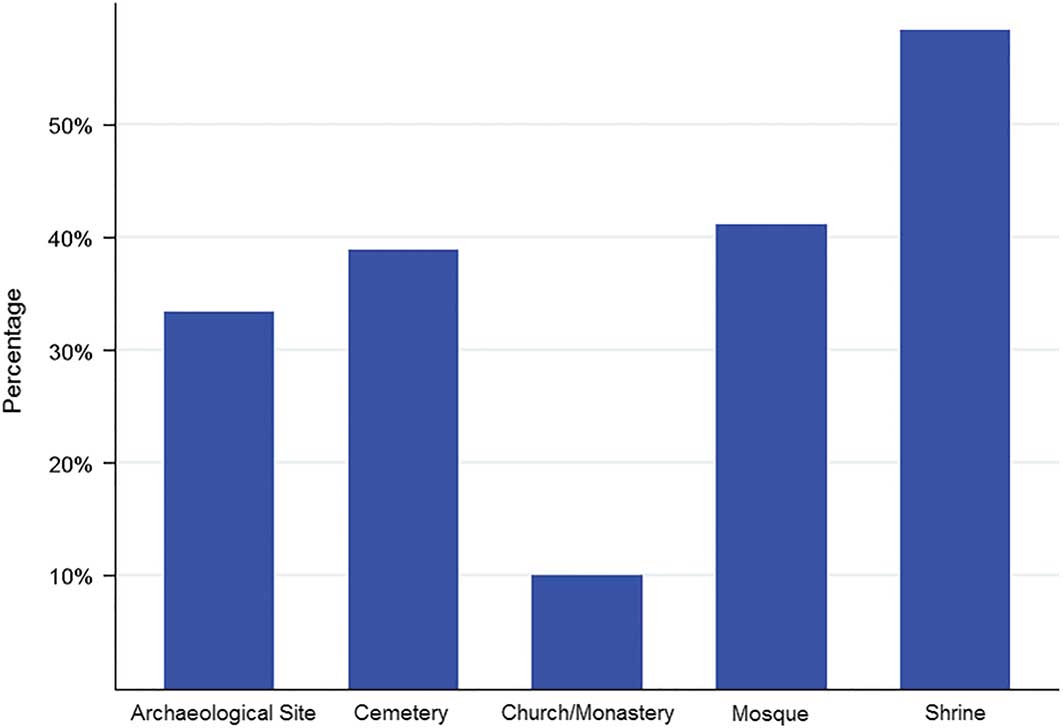
The events discussed in the media are split into six types: archaeological/historic sites, mosques, cemeteries, shrines, churches/monasteries and other (defined in OSM 3). Of the 82 events attributed to ISIS, the group claimed only 31; the rest were picked up in other media sources. Regardless of site-type, there are more unclaimed events than claimed. Figure 1 shows the percentage of events claimed by ISIS out of the total reported events for each site-type. ISIS claimed few events (only for shrine destructions do they claim more than half), and rarely claim events connected to churches/monasteries (10 per cent). The category ‘Others’ is omitted in both Figures 1 and 2 due to small sample size; the three rumoured events are also omitted as those sites were not actually attacked.
Percentage of reported heritage events claimed by ISIS during the study period for analysed site-types, excluding the category of ‘other’.

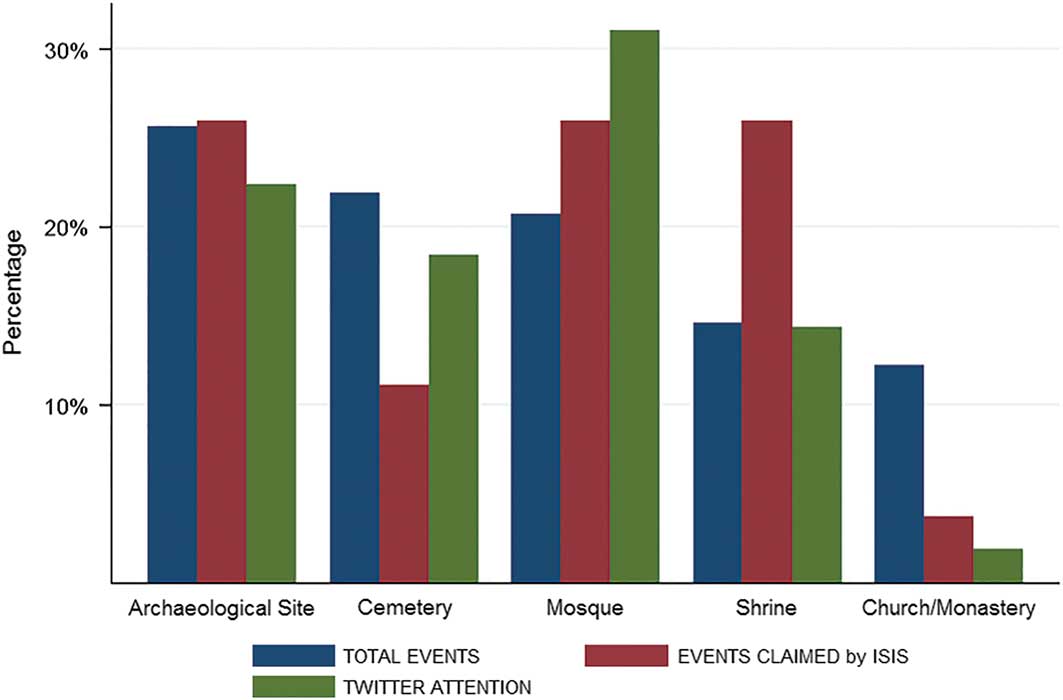
Graph showing types of site targeted, comparing the number of reported events, displayed as a percentage of total sites targeted; discussion on Twitter, displayed as a percentage of the total discussion about heritage destruction; and events claimed by ISIS.

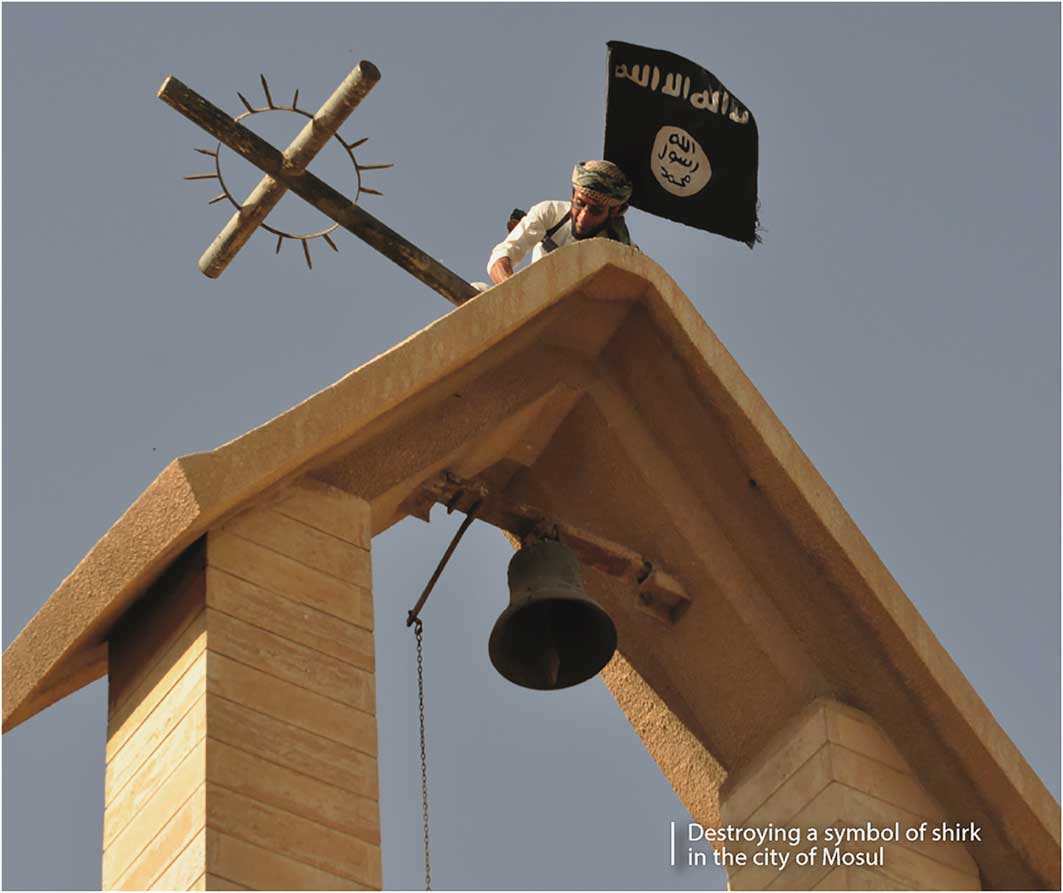
Figure 2 examines the type of site targeted, comparing: the number of reported events, displayed as a percentage of total sites targeted (labelled ‘TOTAL EVENTS’); discussion on Twitter, displayed as a percentage of the total discussion about heritage destruction (labelled ‘TWITTER ATTENTION’); and events claimed by ISIS. TWITTER ATTENTION appears to have a robust correlation with both TOTAL EVENTS (R-Pearson > .75), i.e. the distribution of the general discussion on Twitter about sites connected to heritage events appears to reflect, at the aggregate level, the actual percentage of events occurring. The only difference is between mosques and churches: the former appear to garner more discussion than the latter. This may be because church attacks are rarely claimed (or mediatised): additionally, they are often classed as ‘shirk’ (the sin of practising idolatry or polytheism) and are harder to identify (e.g. Figure 3), thus limiting discussion.
ISIS member removing a cross on an unnamed church tower and replacing it with the ISIS flag. The caption reads: “Destroying a symbol of shirk in the city of Mosul” (Dābiq 2015b: 59).

Heritage destruction, attention and sentiment
The second analysis aims to understand whether ISIS’s heritage use—differentiated by site-type—has any effect on the attention devoted to it on social media or the sentiment towards such actions. We have focused on ISIS events that had at least one media release, regardless of who reported it (journalists, locals or ISIS), as this increases the probability of social media attention affecting sentiment. While we could have included all events (the TOTAL EVENTS variable reported in Figure 2), many are unreported and only known via satellite imagery and specialist reports, so sentiment impact is probably minimal. Conversely, it does include the rumoured events, as rumours still affect sentiment.
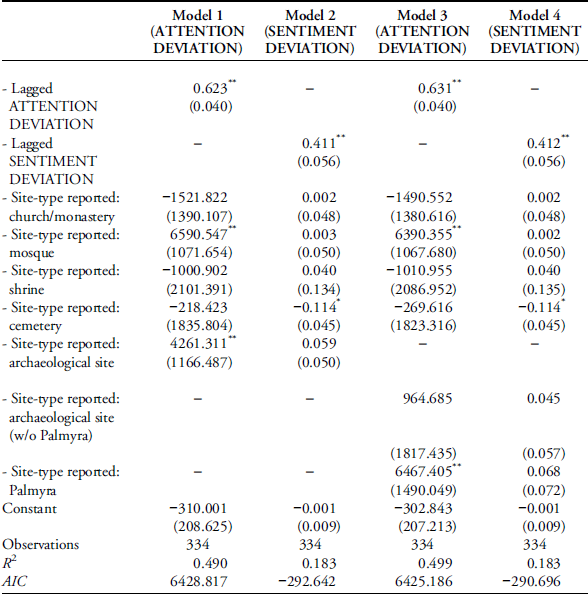
Table 1 reports statistical analysis results from four models examining two dependent variables—discussion volume and sentiment. Models 1 and 2 are discussed here, models 3 and 4 are in the following section. We have repeated observations over time for both dependent variables: assuming that the value of one observation at time ‘t’ could be affected by some temporal trend related to its past, we always included a lagged dependent variable (i.e. the value of each dependent variable at time ‘t-1’) in all models. Model 1 examines daily variation around the average number of relevant tweets. This dependent variable is labelled ATTENTION DEVIATION. A positive number means that on that day the volume of discussion about ISIS and heritage within the Arabic Twittersphere was larger than the mean, approximately 4600 tweets; a negative number indicates the opposite. Media releases for events claimed by ISIS translated to an average increase of around 3000 tweets.
Impact of targeted site-types on attention and sentiment towards ISIS’s heritage events. Models 1 and 2 examine daily variation around the average number of tweets (ATTENTION DEVIATION) and daily variation around the positive sentiment mean towards ISIS’s actions (SENTIMENT DEVIATION). Models 3 and 4 replicate models 1 and 2, but split ‘Site-type reported: archaeological site’ into two variables, one excluding attacks on Palmyra, and one including only events related to Palmyra.

Standard errors in parentheses + p < 0.10, * p < 0.05, ** p < 0.01.
Model 2 focuses on the daily variation around the mean positive sentiment towards ISIS’s actions, labelled SENTIMENT DEVIATION. (The focus on positive rather than negative sentiment is for convenience; results are not affected by the chosen polarity.) The average positive sentiment value (the ratio between positive tweets over positive and negative tweets) is 21.7 per cent. This percentage is a recurrent finding in literature analysing Arabic tweets when dealing with both sentiment towards ISIS (Malik Reference Malik2014), and reactions to terrorist attacks against Western countries (Jamal et al. Reference Jamal, Keohane, Romney and Tingley2015). Our data suggest that media coverage of an ISIS event does not change the overall average sentiment towards ISIS’s actions in a significant way, but comparison of different site-types reveals significant patterns.
ATTENTION DEVIATION demonstrates discussion increases in a statistically significant way when attacks were conducted on mosques (+6590 tweets compared to the average volume of attention) or archaeological sites (+4261 tweets). This accords with the earlier results (Figure 2).
SENTIMENT DEVIATION suggests the only events systematically affecting sentiment towards ISIS relate to cemeteries. Although the events have an ideological foundation, ISIS “was supervising prisoners convicted of smaller crimes to commit the damage […] The number of graves the prisoner was required to destroy was based on the crime committed” (Danti et al. Reference Danti, al-Azm, Cuneo, Penacho, Rohani, Gabriel, Kaercher and O’Connell2016: 46). In these cases, the impact is significant and negative, depressing sentiment towards ISIS by 11 per cent on average.
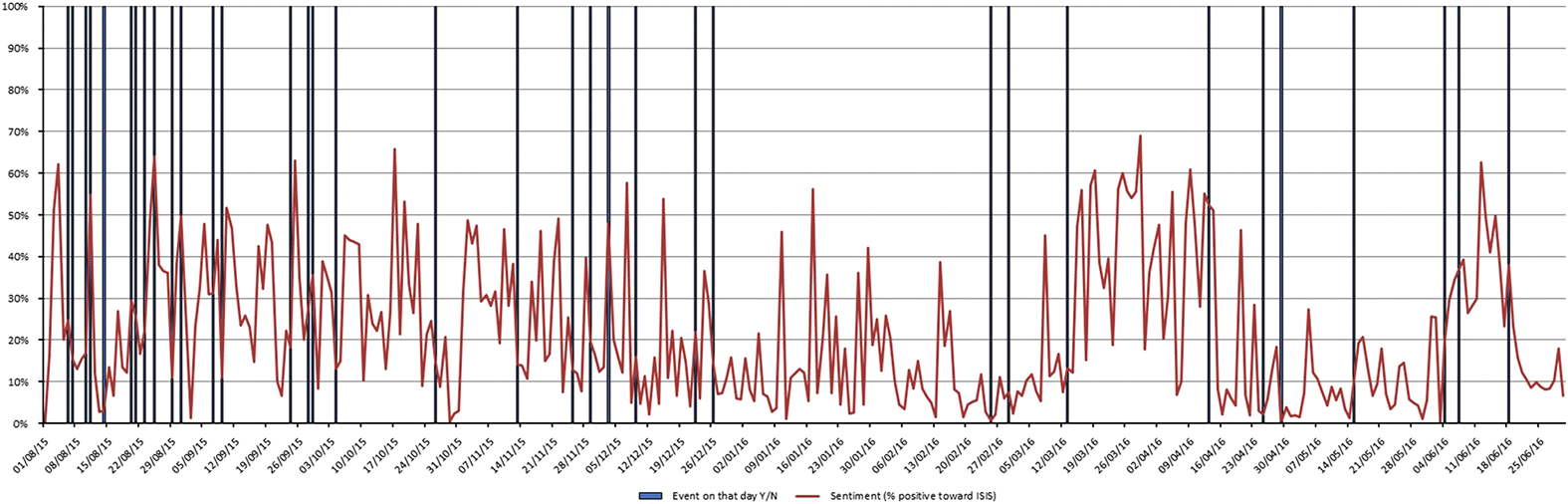
Compared to model 1, model 2 (SENTIMENT DEVIATION) presents a lower R2 value, meaning it is less suitable for explaining the total variance around the dependent variable. This is also evident in Figure 4, which shows the dates of events in the study period as black lines, compared to daily sentiment changes. There is only a weak relationship between the date event information is released and changes in sentiment, and not all changes correspond to reported events. This might indicate events missed from data collection, but more probably reflects background discussion from ongoing media reporting of earlier events. Moreover, some sentiment changes should not be linked solely to the historic importance of the sites involved. For example, events at Qaalat al-Rahbeh Castle generated negative sentiment, but this was probably related to the events that occurred there, such as the use of children to kill prisoners (Danti et al. Reference Danti, Cuneo, al-Azm, Gabriel, Penacho, Kaercher, Barnes Gordon, Ham and O’Neill2015a: SHI-0153).
Daily sentiment change against events. The red line indicates daily percentage of positive sentiment towards ISIS. Black lines indicate days on which heritage events were first reported (by anyone). Neither very high nor very low sentiment regularly corresponds to media releases about events.

Palmyra
In May 2015, ISIS took control of the town of Tadmur and the adjacent World Heritage site and conducted a series of heritage attacks. Before the study period, the group used the ancient theatre for executions, destroyed the Al-Lat statue and placed mines throughout the site. During the period studied, ISIS destroyed: the Temple of Bel, the Temple of Baalshamin, the Triumphal Arch, three columns during executions, multiple Tower Tombs and the remaining museum collections. Additionally, ISIS beheaded Khalad al-Assad, the former Head of Palmyra Antiquities. Of these, the temple destructions featured in Dābiq 9 (ISIS’s English magazine), a video of damage to the Museum was released much later (in Arabic), and a photograph of al-Assad’s body was circulated on social media. No other events were officially ‘claimed’, including those conducted during ISIS’s second occupation of the site. Furthermore, ISIS reputedly held religious services in the Temple of Baalshamin (Lamb Reference Lamb2015), but later destroyed it. ISIS commander Abu Laith al-Saoudi stated in a video released 26 May 2015 that only statues would be destroyed. Yet structures, some with only floral decorations (e.g. the Triumphal Arch), were targeted, implying a lack of consistency (or control) in their approach.
Given the attention that these particular acts garnered in Western media, models 3 and 4 (Table 1) replicate models 1 and 2 but split ‘Site-type reported as destroyed: archaeological site’ into two variables: all archaeological events, and events excluding Palmyra.
Although discussion volume increased dramatically when ISIS attacked Palmyra (+6500 tweets compared to the average attention), there was no statistically significant change in positive sentiment. Accordingly, the destruction at Palmyra did not appear to diminish ISIS support significantly within the Arabic (online) world that we monitor, but it did drastically increase coverage of those actions in the Arabic online world and in the West. Thus, the destruction at Palmyra could be considered a successful propaganda coup. Yet, despite the strategy’s apparent success, there was only one further media release: a video of damage to Palmyra’s Museum, released shortly after ISIS’s eviction from the site, perhaps evidencing a failure to capitalise on their media strategy.
ISIS may have deliberately limited their media releases, aware that the West (in their preoccupation with Palmyra) would learn of the damage and generate media interest that would increase recruitment while minimising ISIS’s effort. Yet, media interest is not guaranteed, so this is presumably not the only reason. The destruction could have been aimed at the small remaining population of Tadmur, but low local engagement with Palmyra (Alkateb Reference Alkateb2013) suggests that they were not the main targets. The destruction also defies common values of global and national cultural heritage (Harmanşah Reference Harmanşah2015; Turku Reference Turku2018), seen, for example, in the video ‘The promotion of virtue and destruction of vice’ released 6 March 2015 and featured in Dābiq 8. Palmyra is repeatedly lauded in the Syrian and international press as an icon of global cultural heritage, embodying values shared by all humanity. Publicising damage in the Iraqi Mosul Museum, ISIS wrote:
The kuffār [non-Muslims] had unearthed these statues and ruins in recent generations and attempted to portray them as part of a cultural heritage and identity that the Muslims of Iraq should embrace and be proud of. Yet this opposes the guidance of Allah and his messenger and only serves a nationalist agenda that severely dilutes the walā’ [loyalty/kinship] that is required of the Muslims towards their Lord (Dā biq 2015a: 22–23).
The destruction at Palmyra may be best viewed in this context. While publicity is of significant benefit to ISIS, its true audience is not necessarily international, or even national, but perhaps internal.
Reasons for sentiment towards heritage destruction
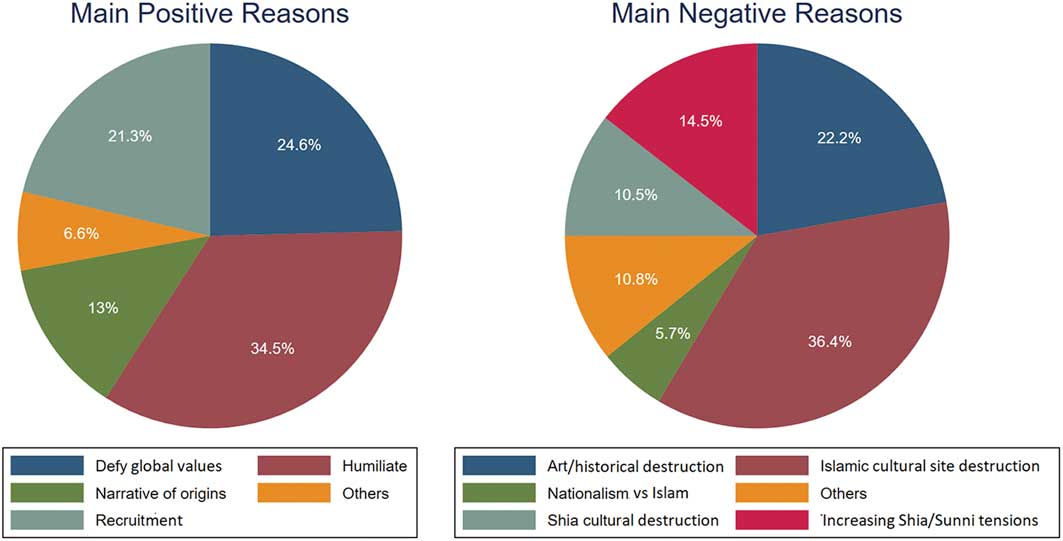
Figure 5 visualises the main reasons for positive and negative sentiment towards ISIS when discussing heritage destruction. The classifications are broad and cover many interlinked aspects; some general trends can, however, be seen.
Categories of positive and negative sentiment in the Twitter sample.

The main reasons heritage destruction increases positive sentiment towards ISIS (Figure 5: left) relate to the intention to:
1. Humiliate targeted communities (this category includes both aspects of humiliation, as well as a positive judgement about the desire to attack pre-Islamic culture, as the two are closely interlinked).
2. Defy values of global cultural heritage.
3. Recruit through the broadcasting of their ideology.
4. Developing a narrative of origins, returning to the purity of the Early Islamic past.
5. Other reasons, including:
∙ Destruction of idols of other religions and cultures, as ordered by the Prophet (peace be upon him).
∙ Financing through the illegal trade of art/antiquities.
The identified reasons connecting heritage destruction with an increase in positive sentiment towards ISIS do not distinguish between attacks on more modern religious sites and archaeological sites (cf. Isakhan & Gonzales Zarandona Reference Isakhan and Gonzalez Zarandona2017). The top three categories are those suggested by Harmanşah (Reference Harmanşah2015): humiliation (34.5 per cent), defying common values (24.5 per cent) and increasing recruitment (20 per cent). The destruction of ancient sites relates to the main reasons that positive sentiment increases: the religious destruction of idols; a desire for a purer form of Islam; and defying a nationalist agenda (cited in Dābiq 8 as a religious requirement). Although its particular expressions vary, religious motivations are key in generating support for ISIS.
The main reasons heritage destruction increases negative sentiment towards ISIS (Figure 5: right) relate to:
1. Destruction of Islamic cultural sites.
2. Destruction of artistic/historical sites (pre-Islamic archaeological sites are often considered a form of art-history in Islam).
3. Aggravating tensions between Shia and Sunni: fuelling clashes between Islamic sects.
4. Destruction of Shia cultural sites.
5. Weakening nationalism/patriotism to promote Islamic culture: targeting states via sites to weaken nationalist sentiments, and to promote a united Islamic community.
6. Other reasons include:
∙ Destruction of Christian/Alawite/pagan cultural sites.
∙ Financing through the illegal trade of art/antiquities.
∙ Raising awareness of the ‘real’ ISIS, damaging recruitment: the destruction provides a valuable lesson to the youth as it shows the ‘real’ ISIS, limiting their recruitment.
The destruction of Islamic culture is the main cause of negative sentiment for Arabic tweeters (36.4 per cent of negative tweets), although 22.2 per cent felt it was wrong to destroy art, which may encompass archaeological sites (UNESCO 2001). Fourteen and a half per cent of tweets recognised heritage destruction as an intentional strategy to increase sectarian tension between Shias and Sunnis (as seen in Iraq—the bombing of the Al-Askari Mosque in Samarra in 2006 is widely considered to be a key contributor in the change to an internal sectarian conflict in Iraq (Isakhan Reference Isakhan2013)). Crucial psychological drivers of radicalisation depend on:
perceptions of crisis—characterised by the Other (out-group) identity, breakdown of tradition, and uncertainty […] to confront a threatening Other deemed responsible for the perceived breakdown of tradition, individuals and groups may turn to solutions that promise to confront the Other and strengthen the in-group (Ingram 2016: 462–63).
The categorised motivations suggest that in mediatised attacks on heritage, ISIS have identified a vehicle to represent the ‘Other’, and so strengthen their own position and legitimise the Caliphate. Most of the identified reasons for positive sentiment relate to an identified ‘Other’ (i.e. ‘targeted communities’, ‘global’ heritage or other religions and cultures), together with a corresponding recruitment factor; conversely, negative responses include fears over increasing sectarianism and the loss of national identity. The following tweet (6 August 2015) expresses these fears clearly: “Daesh organization have targeted Shia’s mosques and have also targeted Sunni’s mosques in Abha. So their goal and target is not Sunni or Shia, but rather to destabilize and dismantle the unity of this country”.
Conclusions
The large social media dataset analysed here raises several issues about how and why ISIS mediatises its destruction of heritage and the effects this has on the Arab-speaking world. Only a small proportion of heritage-related incidents are promoted in the media, and even fewer are claimed. Not all are destructive: analyses should distinguish intentional destruction from repurposing or construction demolition (e.g. Nineveh), and differentiate between publicised and unpublicised events, as the former are not representative of the wider strategy. The high numbers of unpublicised events suggest that the main intended audience is local or internal, and the primary positive reason for support relates to ISIS’s humiliation of targeted communities. Emphasising only the role propaganda plays could result in wider motivations being overlooked.
ISIS appear to be highly strategic in their social media actions (supporting Clapperton et al. Reference Clapperton, Martin Jones and Smith2017). Events are emphasised that generate the greatest responses in the Arabic-speaking world (in terms of location, site-type, volume of discussion and sentiment), and the greatest interest in the West, such as the attacks on Palmyra. Concurrently, they downplay events, at least online, that could be costly in terms of their support, such as attacks on cemeteries. While there is a degree of coordination, the strategy is neither coherent nor consistently followed.
Ongoing fluctuations in sentiment indicate that discussions of heritage events are a constant feature of the conflict with long-lived ramifications for sentiment towards and against ISIS: heritage incidents are as likely to generate support as opposition. The motivations for support or opposition identified here indicate that heritage plays a key role in increasing sectarian divisions, with a corresponding effect on recruitment. Heritage protection should be considered in counter-terrorism studies as integral to social cohesion.
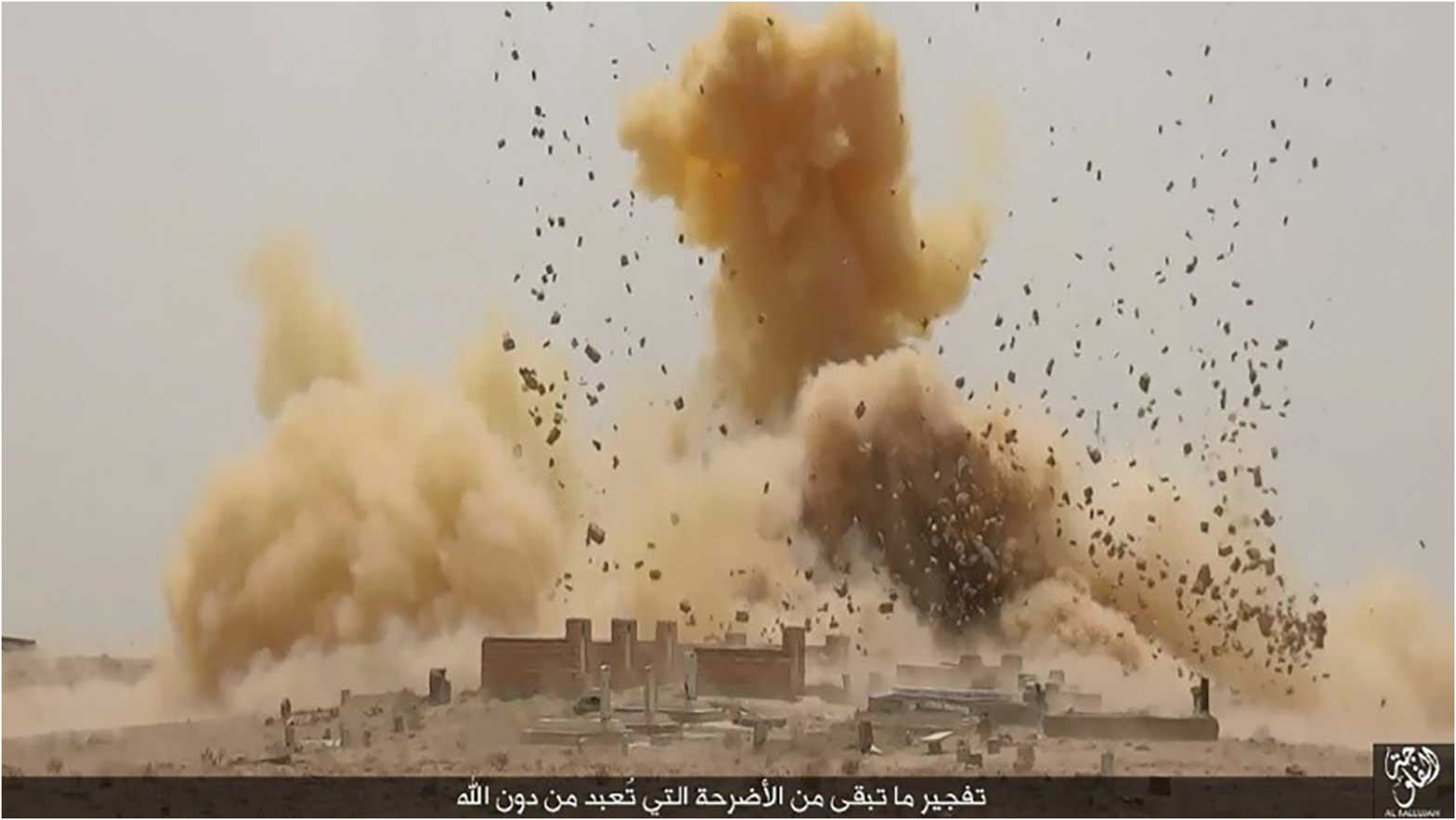
Our data highlight a need for further investigation into the motivations underlying, and reactions to, heritage events. The greatest support towards ISIS was generated by a suicide bombing at the Balili mosque in Yemen on 24 September 2015. The second largest amount of support was generated by the destruction of at least six shrines in Fallujah, Iraq, shown in images circulated on 10 August 2015 (e.g. Figure 6), yet so little is known about the shrines that they could not be identified by scholars with in-country contacts (Danti et al. Reference Danti, Ali, Cuneo, Kaercher, Burge, Barnes Gordon and van Gessel2015b: IHI 15-0091). The greatest increase in tweet volume, by more than 40 000 on 26 October 2015, was linked to two events: ISIS reportedly tied three men to columns in Palmyra and detonated explosives; and in Saudi Arabia, a suicide bomber attacked a mosque (that again could not be identified in English or Arabic media). In comparison, the other events at Palmyra never reached more than 5600 tweets, and no other suicide bombing or attack on a Saudi site reached even that. There was, however, no significant change in sentiment. Why these sites had such an effect remains a puzzle.
Destruction of an unnamed Sufi shrine in Fallujah, Iraq. The image is one of 19 circulated by ISIS’s Bureau of Propaganda for the District of Fallujah on Justpaste.it, 10 August 2015. The caption translates as: “The detonation of the remains of shrines where they worship without god” (translation A. Sinclair).

Finally, there are implications for how the international community responds to these phenomena. Given how few attacks are mediatised for public consumption, it seems unlikely that a ‘no response’ policy will prevent all destruction: a response may, however, encourage a mediatised release. There is only one case (the walls of Nineveh) where refuting damage may have led to its subsequent realisation. Although given the recurrent damage across the site (intentional destruction, construction damage and looting), Ninevah’s walls may eventually have been destroyed regardless. There is some evidence, however, that our focus on ancient sites may encourage further destruction: “In-country sources […] have overheard Isil [ISIS] commanders comment that attacking the ancient monuments ‘makes the whole world’ talk about them” (ASOR, in Felch & Varoutsikos Reference Felch and Varoutsikos2016).
Protecting heritage requires us to move beyond the buildings and engage with the communities that use them. We should look for the local significance in global values, and consider heritage not only from our own perspective, but also from local, Arabic and Islamic perspectives (e.g. UNESCO 2001). Only then can we hope to counter this threat to both archaeological sites and the social cohesion of the region that created them. As other groups copy ISIS’s strategies, these issues can only become more urgent.
“Daesh are the enemy of mosques, even if they blew up in thousands in every mosque, we swear to God that we will never stop worshiping, they are mistaken if they think that we afraid of death” (Tweet, 10 August 2015).
Acknowledgements
Data for this paper were collected as part of the Endangered Archaeology in the Middle East and North Africa Project (EAMENA), Oxford University. This work relied on the voluntary translation by Waseem Albahri, Omneya Abdel Barr, Rand Assad, Jumanah El-Assad and Isber Sabrine. Thanks also go to Bastien Varoutsikos for comments on the initial conference paper presented at BANEA 2017, and Michelle de Gruchy for comments on the draft. Analysis of Twitter data was conducted through the analytical platform VOICES Analytics® of VOICES from the Blogs (http://www.voices-int.com/).
Supplementary material
To view supplementary material for this article, please visit https://doi.org/10.15184/aqy.2018.134