Introduction
Carbapenem-resistant Acinetobacter baumannii (CRAB) causes life-threatening infections with a high disease burden. Reference Sati, Carrara and Savoldi1 CRAB carriers and their contaminated surroundings are major sources for CRAB-related healthcare-associated infections. Multimodal strategies for countering CRAB are based on transmission by contact. 2 Nevertheless, during our routine infection control monitoring, we noticed that intensive care unit (ICU) patients’ bed linens (bed sheets, pillow covers, and quilt covers) were changed immediately once visibly soiled or at least weekly, considering the frequent soiling observed in practice, by regular staff (nurses’ aides). We conducted a 2-time-point controlled investigation in our ICU to examine CRAB transmission when replacing bed linens.
Methods
This study was performed in a 50-bed ICU of our hospital in January 2025 and was approved by the Ethical Committee of West China Hospital. Rectal swabs (Gongdong, Zhejiang, China) were collected for all patients within 3 days of admission in ICU and thereafter once a week during their ICU stay as part of routine infection control practice for screening carbapenem-resistant organisms including CRAB because its intestinal colonization is well documented. Reference Sahin, Ocal and Bombaci3 All swabs were streaked onto CHROMagar Acinetobacter plates (CHROMagar, Paris, France) containing 4 mg/L meropenem and cultured at 37°C for 2 days. Reference Wei, Feng and Lin4 Pink colonies were picked and identified using matrix-assisted laser desorption/ionization time-of-flight mass spectrometry (MALDI-TOF; Bruker, Billerica, MA). Minimum inhibitory concentrations (MICs) of meropenem for obtained colonies were determined using broth microdilution of Clinical and Laboratory Standards Institute. 5
We selected a 4-bed room (bed no. 9–12), where 2 patients with CRAB (bed 9/12) and 3 (bed 9/10 /11) with intubated ventilation were present for air sampling on January 21. Petri dishes (90 mm diameter) containing CHROMagar Acinetobacter agar and 4 mg/L meropenem were settled around each bed (at the head, on both sides, and at the foot of the bed) at 20 cm from the bedsides and a height 0.5 m from the floor. Each lidless settled petri dish was exposed for 1 hour Reference Sönnergren, Strömbeck, Aldenborg and Faergemann6 to passively collect sedimentation when no bed linens changing in the room. These dishes were then removed, and new ones were placed at the same sites. Afterward, bed linens were immediately replaced for the patient of bed 12. The new plates were exposed for 1 hour since the beginning of bed linens changing. All plates were incubated at 37°C for 2 days. Pink colonies were counted, picked, and identified using MALDI-TOF.
One CRAB isolate recovered from rectal swabs at the closest date to the air sampling day from each patient, and all isolates from air samples were selected for whole genome sequencing using NovaSeq 6,000 platform (Illumina, San Diego, CA). Reads were assembled into draft genomes using SPAdes v3.15.4. Antimicrobial resistance genes were identified using ResFinder (https://genomicepidemiology.org/). Sequence type was assigned by querying the multilocus sequence typing database (https://pubmlst.org/bigsdb?db=pubmlst_abaumannii_seqdef). Capsule (KL) typing was performed using Kaptive v3.2.1. The core genome single nucleotide polymorphisms (SNPs) were determined using Snippy v4.6.0 (https://github.com/tseemann/snippy). The potential transmission clone was defined using a cutoff of 13 pairwise SNPs as previously reported. Reference Maldonado-Barrueco, Rubio-Mora and Bloise7 All draft genomes were deposited in GenBank under project PRJNA1372397.
Results
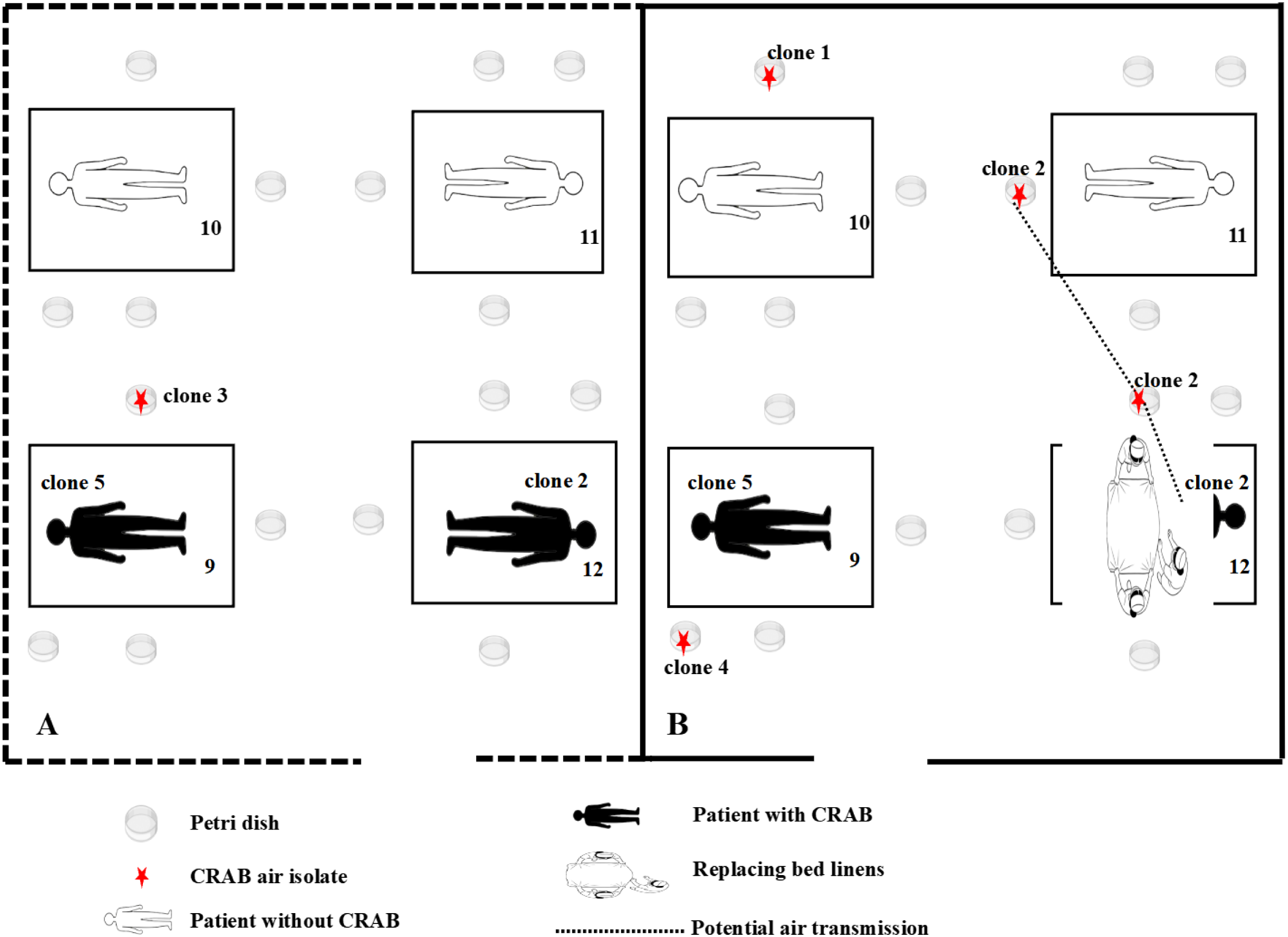
Thirty-two air samples were collected, and 5 (15.6%, 5/32) grew CRAB. Notably, only 1 colony was seen in each positive agar plate. CRAB was detected in only 1 (6.3%, 1/16) air sample before bed linen replacement (Figure 1A). In contrast, 4 (25.0%, 4/16) samples grew CRAB since replacing bed linens (Figure 1B).
Air sampling in the ICU room (bed no. 9 to 12). (A) Air sampling when no bed linens were replaced; (B) Air sampling during replacing bed linens for patient of bed 12. There were 7 carbapenem-resistant Acinetobacter baumannii (CRAB) isolates including 2 from patients and 5 from air samples, which could be assigned to 5 clones. Notably, 3 isolates, 091295, 091297, and 091384, belonged to a clone (clone 2). This suggests dust-driven transmission of CRAB related to bed linen replacing.

Figure 1. Long description
The diagram illustrates air sampling in an ICU room with beds numbered 9 to 12. Panel A shows air sampling when no bed linens are being replaced, while Panel B shows air sampling during the replacement of bed linens for the patient in bed 12. The diagram includes Petri dishes, patients with and without CRAB, CRAB air isolates, and the process of replacing bed linens. It highlights the potential air transmission of CRAB clones, with specific clones labeled as clone 1, clone 2, clone 3, clone 4, and clone 5. The diagram suggests that dust-driven transmission of CRAB is related to the activity of replacing bed linens.
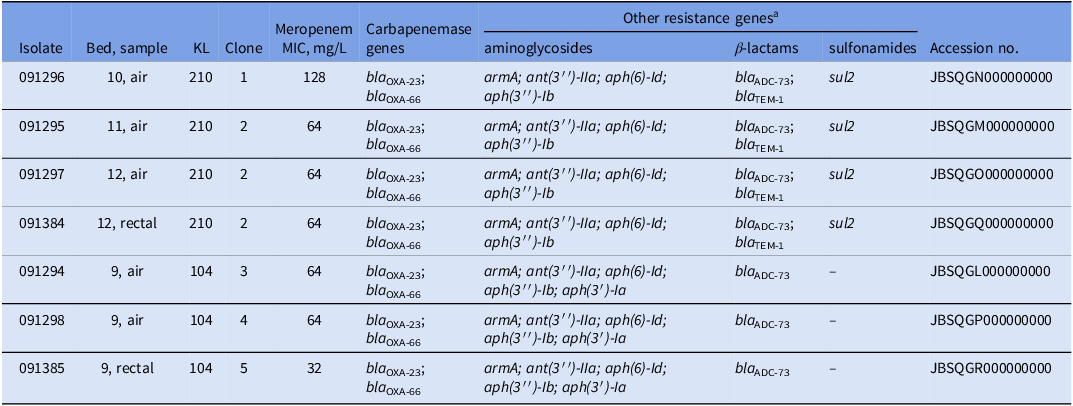
The 5 isolates from air and 2 from rectal swabs of patients (bed 9 and 12) belonged to ST2 but were of 2 capsular types, KL104 (n = 3) and KL210 (n = 4), carried carbapenemase genes bla OXA-23 and bla OXA-66 and were assigned to five clones using the cutoff of ≤13 SNPs (Table 1 and Figure 1). The 4 ST2-KL210 isolates belonged to clone 1 (n = 1) or clone 2 (n = 3, with 6–13 pairwise SNPs) comprising 1 from patient of bed 12 and 2 from air (Figure 1B). In contrast, the 3 ST2-KL104 isolates belonged to different clones, clone 3–5 with 16–46 pairwise SNPs.
Carbapenem-resistant Acinetobacter baumannii of sequence type 2 from air and patient

Table 1. Long description
The table presents data on carbapenem-resistant Acinetobacter baumannii isolates, detailing various attributes. It includes information on the isolate, bed sample, KL clone, meropenem MIC in milligrams per liter, carbapenemase genes, other resistance genes for aminoglycosides, beta-lactams, and sulfonamides, and accession numbers. The table has 7 rows and 9 columns, with headers for each attribute. Notable entries include isolates from bed 10, air sample, KL clone 210, with meropenem MIC values ranging from 64 to 128 milligrams per liter, and various carbapenemase genes such as blaOXA-23 and blaOXA-66. Other resistance genes include armA, ant(3’’)-IIa, aph(6’)-Id, aph(3’)-Ib, aph(3’)-Ia, and blaADC-73, blaTEM-1, sul2. The accession numbers for these isolates are also provided.
a All 9 isolates also have genes mediating resistance to chloramphenicol (catB3 and cxpE), fosfomycin (abaF), macrolides (mph(E) and msr(E)), quinolones (oqxB), tetracycline (tet(B)), and trimethoprim (dfrA40).
Discussion
We found air contamination with CRAB was common in the patient room, especially when replacing soiled bed linens. CRAB air isolates in our study could be detected around patients with or without CRAB as previously reported. Reference Shimose, Masuda and Sfeir8,Reference Mousa, Schwartz, Carmeli and Nutman9 Although these CRAB exhibited clonal diversity, we identified 1 case of CRAB transmission related to replacing bed linens, at a distance exceeding 1 meter. Inadvertent shaking during the replacement could probably release dusts containing CRAB into air, causing hidden dust-driven transmission from CRAB carriers to their surroundings. This suggests that prudence needs to be applied for linen replacing and alternatives such as use of disposable diapers for incontinence and nursing pads for conditions like drooling and hemorrhage may be considered. In addition, when replacing bed linens is truly necessary, gentle care without shaking should be implemented, and mobile screens could be used to limit dust dispersal.
There are limitations of our study. First, only 1 patient room was investigated. This was a pilot study, and we reported the finding for alerting healthcare workers, in particular those worked in ICU, for the risk of dust-related transmission of CRAB by bed linen replacing. Second, the size of CRAB-containing air particles was not measured. It remains unclear that such particles could fall into the category of droplet or aerosol. Third, the patients were not followed up to demonstrate whether the dust-related CRAB caused infection or colonization. Fourth, active sampling using impingers or impactors may be needed to verify the aerosolization of CRAB during linen replacing. We conducted air sampling with and without linen replacing and we did not observe coughing and airway suctioning during linen replacing. However, concurrent respiratory cultures and additional surface sampling are required to definitively exclude CRAB respiratory aerosolization and the impact of environmental disturbances. Despite these limitations, we highlighted a hidden airborne, likely dust-driven, route of CRAB transmission contributed by bed linen replacing, which needs to be improved in practice to mitigate the threat of CRAB. Future studies of airborne or dust dissemination route for other multidrug-resistant organisms such as Clostridiodes difficile and Candida auris are warranted.
Acknowledgments
None.
Financial support
This work is supported by grants from the National Key Research and Development Program of China (grant no. 2023YFC2308804 and 2024YFE0106200) and Chengdu Bureau of Science and Technology (grant no. 2025-YF06-00019-HZ). These funding institutions did not involve in the study except providing financial support.
Competing interests
All authors report no conflicts of interest relevant to this article.