


1 Introduction
Homorganic nasal–stop (NT) sequences are ubiquitous in the world’s languages. Phonological alternations are common in this context, providing a continuing topic of investigation for phonologists and phoneticians alike. Surveys like Herbert (Reference Herbert1986), Rosenthal (Reference Rosenthal1989), Steriade (Reference Steriade1993) and Hyman (Reference Hyman2001) demonstrate that, while a wide range of phonological processes are found in the NT context, the most common process is for the postnasal stop to become voiced, neutralizing the NT/ND contrast: {NT, ND} → ND. The phonetic naturalness of postnasal voicing has been established in work like Ohala & Ohala (Reference Ohala and Ohala1991, Reference Ohala and Ohala1993), Hayes & Stivers (Reference Hayes and Stivers2000) and Solé (Reference Solé, Vigário, Frota and Freitas2009, Reference Solé, Solé and Recasens2012). Recent phonological analyses of NT alternations like Pater (Reference Pater, Kager, van der Hulst and Zonneveld1999) and Nasukawa (Reference Nasukawa2005) directly formalize [voice] as the preferred laryngeal feature for obstruents in the postnasal context. In Nasukawa’s Element Theory approach, nasality and voice are phonetic realizations of the same phonological element [nasal], linking [nasal] to an obstruent results in voicing. Pater (Reference Pater, Kager, van der Hulst and Zonneveld1999) proposes the O(ptimality)T(heory) constraint in (1), which optimizes a range of strategies to eliminate surface NT sequences, including voicing of obstruents in postnasal position:

However, as Hyman (Reference Hyman2001) demonstrates in some detail, constraints like *NT in (1), which were developed to formalize the phonetic naturalness of postnasal voicing, cannot account for the range of less common but still frequent fortition processes (e.g. aspiration) which occur in the NT context. In these cases, the postnasal laryngeal contrast in the obstruent is enhanced, rather than neutralized, leaving the postnasal obstruent voiceless, e.g. NT → NTh; ND → ND. Indeed, Pater (Reference Pater, Kager, van der Hulst and Zonneveld1999: fn. 4) concedes that *NT like that in (1) has nothing to say about this kind of data.
We argue in this paper that postnasal voicing and postnasal fortition can be given a unified account in a framework which crucially refers to the perceptual cues involved in the laryngeal contrasts of plosives. Instead of integrating these perceptual considerations directly as markedness constraints in the phonological grammar module (as is usual in functional phonological approaches/Optimality Theory), we argue for a strict division between phonetics and phonology. In this, we follow earlier criticism of OT markedness constraints in general (see e.g. Haspelmath Reference Haspelmath1999, Reference Haspelmath2006), as well as criticism of the place of phonetic knowledge in phonology. (See e.g. Hyman Reference Hyman2001 and Solé Reference Solé, Vigário, Frota and Freitas2009 for discussion of this topic specifically for nasal–obstruent sequences.) Following Boersma (Reference Boersma1997, Reference Boersma1998, Reference Boersma2007), we employ phonetic representations that are distinct from phonological surface representations and evaluate them by means of phonetic restrictions formalized as perceptual Cue constraints. As perceptual considerations naturally play a role in the phonology, the perceptual cue model enriches the traditional generative grammar approach, which modelled the production process only, by including the comprehension process. We will show that an advantage of this enriched approach is that it allows postnasal voicing and postnasal fortition to be related through an OT factorial typology defined by reranking perceptual Cue constraints with phonological Faithfulness constraints.
The paper is structured as follows. In Section 2, we present data illustrating the range of postnasal laryngeal alternations we aim to account for in our analysis. In Section 3 we show how an analysis based on perceptual cues straightforwardly accounts for all the data. Section 4 critically examines alternative approaches, both representational and with phonetically grounded constraints. We show that only an approach based on perceptual cues straightforwardly accounts for the complete range of data. Section 5 concludes.
2 The data: A survey of postnasal laryngeal patterns
In this section we survey the data we intend to account for in our analysis. We begin our survey with languages that illustrate postnasal voicing of voiceless stops. This is the most common laryngeal alternation in the NT context, widely attested in the languages of the world. It is found in languages as geographically diverse as Japanese, Terena, Quichua, Zoque, some Italian dialects, as well as in numerous Bantu and other Niger-Congo languages (see e.g. Kadima Reference Kadima1969; Herbert Reference Herbert1986; Ohala & Ohala Reference Ohala and Ohala1991, Reference Ohala and Ohala1993; Pater Reference Pater, Kager, van der Hulst and Zonneveld1999; Hyman Reference Hyman2001; Nasukawa Reference Nasukawa2005; Solé Reference Solé, Vigário, Frota and Freitas2009; Choti Reference Choti2014). We illustrate postnasal voicing with data from Kimatuumbi (Bantu P13, Tanzania; Odden Reference Odden1996: 89, 91):Footnote [2]

However, in a number of languages with a T vs. D contrast, the voicing contrast is not neutralized postnasally. Rather, it is enhanced by aspirating the voiceless stop. We find postnasal aspiration in some dialects of Icelandic (Helgason Reference Helgason2001). It is particularly well documented for Bantu languages: examples include Kongo (Meinhof Reference Meinhof1932: 158; Hyman Reference Hyman2001: 170), the Ndau dialect of Shona (Mkanganwi Reference Mkanganwi1972), and Chimwiini (Kenstowicz & Kisseberth Reference Kenstowicz and Kisseberth1977: 211). Hinnebusch (Reference Hinnebusch and Herbert1975), Kerremans (Reference Kerremans1980: 169), Herbert (Reference Herbert and Fisiak1985) and Huffman & Hinnebusch (Reference Huffman and Hinnebusch1998) discuss a number of further examples.Footnote [3] Postnasal aspiration is illustrated with data from Kongo (Bantu H16, Congo-Kinshasa, Congo-Brazzaville):

Some Malawian Bantu languages, like Cinsenga, Chichewa (Miti Reference Miti2001) and Tumbuka (Vail Reference Vail1972), have a three-way contrast {Th, T, D} for stops and affricates. This is illustrated below for Tumbuka (Bantu N21, Malawi; Vail Reference Vail1972 and elicitation notes):

Postnasally, the aspiration contrast neutralizes, so that one finds only voiced stops and aspirated stops in this context. As in the Kongo pattern, the outputs enhance the voicing contrast:

Outside the Bantu language family, a similar postnasal neutralization pattern is found in Lizu (Chirkova & Chen Reference Chirkova and Chen2013), a Tibeto-Burman language spoken in the Sichuan Province of the People’s Republic of China. Like Tumbuka, Chichewa and Senga, it has a three-way contrast {Th, T, D} for stops and affricates. Prenasalization, which is contrastive, occurs only before the voiced and the voiceless aspirated sounds {ND, NTh}.
Zulu and other Nguni languages (Doke Reference Doke1961) also have a three-way laryngeal contrast for non-labial stops, including clicks: {Th, T, T̤} (T̤ stands for a voiceless depressor consonant, and D̤, employed below, for a voiced depressor consonant).Footnote [4] This is illustrated in the data from Zulu (Bantu S42, South Africa; Chen & Downing Reference Chen, Downing, Eloridieta, Frota and Prieto2011):

Note that this set of laryngeal contrasts is more complex than in the other languages, as there are three voiceless stop series: aspirated, plain (variably ejective) and voiceless depressors. As noted since at least Doke (Reference Doke1926), the contrast between plain and aspirated is neutralized postnasally, in favour of the plain (variably ejective) series, as shown in the following example (from Halpert Reference Halpert, Hoole, Bombien, Pouplier, Mooshammer and Kühnert2012):Footnote [5]

We have restricted our data to synchronically transparent alternations in the laryngeal quality of postnasal stops that are phonetically motivated by the perceptual contrast of plosives in postnasal versus non-postnasal context.
For synchronically opaque alternations, we follow Hyman (Reference Hyman2001) in assuming that an additional diachronic stage of phonologization took place that obscured the motivation of perceptual contrast. This is, for instance, the case in Zezuru Shona, where /N-pasa/ → [mhasa] ‘10-mat’ developed via a stage where the obstruent following the nasal was aspirated (Hinnebusch Reference Hinnebusch and Herbert1975), as can still be seen in Ndau Shona: /N-pasa/ → [mp hasa] Ndau Shona → [mhasa] Zezuru Shona (Mkanganwi Reference Mkanganwi1972). Deletion of the postnasal obstruent which triggers the postnasal aspiration renders Zezuru synchronically opaque. A case of a non-opaque process that we did not include in our analysis is Sotho-Tswana (Hyman Reference Hyman2001, Coetzee & Pretorius Reference Coetzee and Pretorius2010), where postnasal devoicing of the voiced plosives occurs, e.g. /N-dís-á/ → [ntísá] ‘watch me!’. According to Hyman (Reference Hyman2001: 157–165), this ‘phonetically unnatural’ synchronic process is the result of several diachronic developments: In early Sotho-Tswana, voiced stops in other than postnasal position changed into approximants, which was followed by a stage in which voiced plosives in general were avoided, turning the postnasal voiced plosives into voiceless plosives. A later re-introduction of the voiced plosives /b/ and /d/ via approximant hardening resulted in a present-day phonological avoidance of voiced plosives in postnasal position only, which cannot be motivated by the perceptual contrast between plosives in postnasal contexts compared to other contexts.Footnote [6]
To sum up this section, we have provided data illustrating four different synchronically transparent patterns of laryngeal alternations in the NT context. In languages with a two-way laryngeal contrast, we have shown that not only voicing contrast neutralization – the typologically most common option – but also enhancement can be found. The two patterns are illustrated in (8) and (9), respectively.

In languages with a three-way laryngeal contrast – {Th, T, D} or {Th, T, T̤}, like Tumbuka and Zulu, respectively – we saw that the voicing contrast is maintained. What neutralizes is the aspiration contrast, in favour of aspirated stops in Malawian languages like Tumbuka, but in favour of the plain unaspirated stops in Nguni languages like Zulu. These two patterns are presented in (10).

In the following section we will provide a unified formal account for all four patterns.
3 An analysis based on perceptual cues
We propose that perceptual cues to laryngeal contrasts account for the four patterns described in the previous section. Before developing the analysis (Section 3.3), we first introduce the framework in which it is cast (Section 3.1) and the perceptual cues that are relevant for the analysis (Section 3.2).
3.1 The grammar model
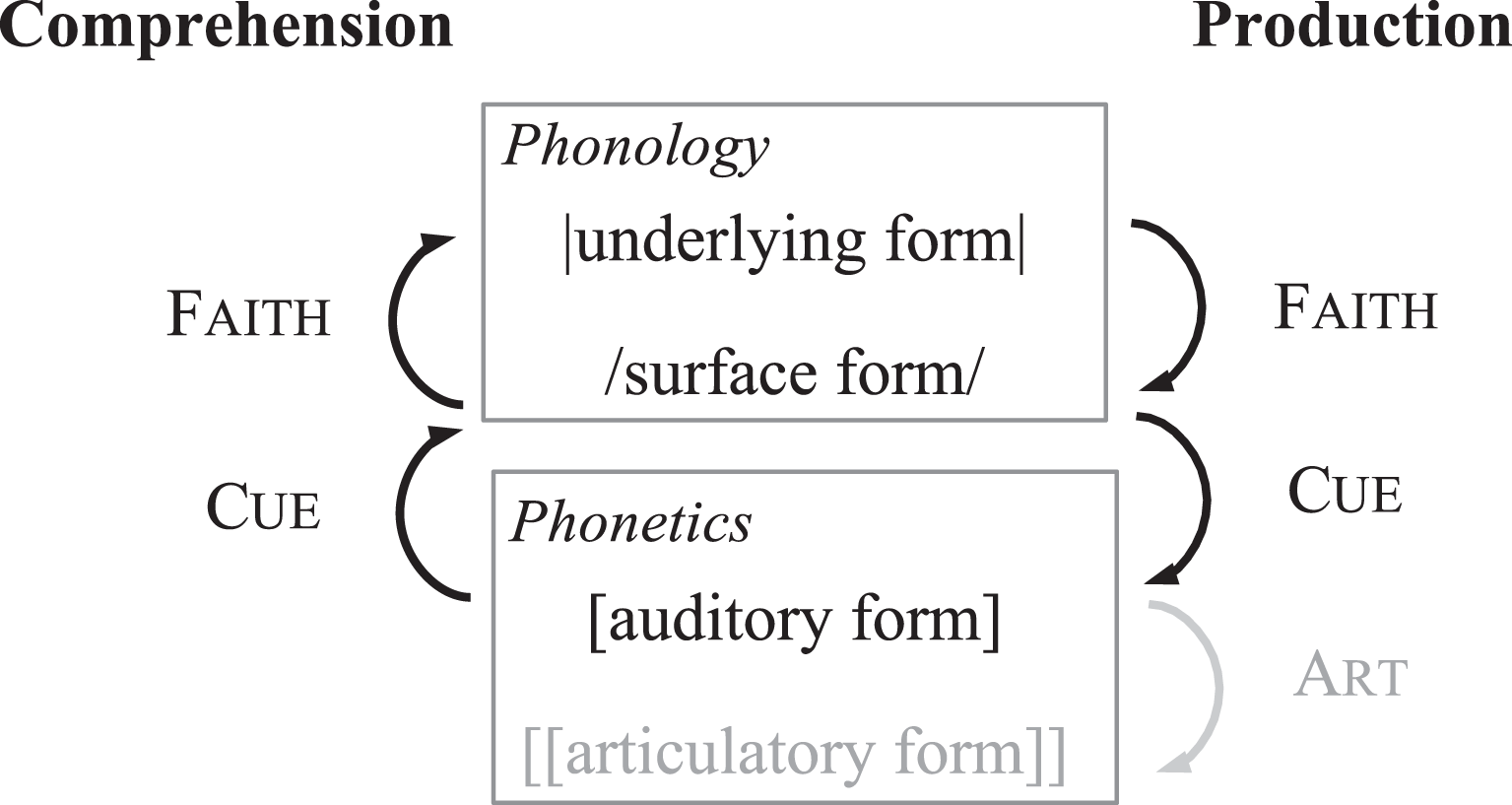
In the present account, we employ the Bidirectional Phonetics and Phonology grammar model developed by Boersma (Reference Boersma2007; henceforth BiPhon). The phonological module of the BiPhon model is very similar to traditional generative phonological theory (as put forward in Chomsky & Halle Reference Chomsky and Halle1968) in so far as it is separate from phonetics and maps phonological underlying form onto phonological surface form. What differs from traditional generative approaches is that the phonological module is not restricted to the production process but also includes the process of comprehension. We therefore assume that the reverse mapping from surface to underlying form is also part of the grammar. Both mappings are evaluated by standard-OT Faithfulness constraints, which, due to their formalization, can be used to compare both underlying to surface form and surface to underlying form, i.e. they are bidirectional. This is represented in the upper part (the phonological module) of Figure 1.
The BiPhon model (Boersma Reference Boersma2007) as applied in the present article (the represenation and mapping in grey are not used).

For the phonological representation of laryngeal contrasts, we employ the privative features [voice] and [spread glottis] for voicing and aspiration, respectively (see Beckman, Jessen & Ringen Reference Beckman, Jessen and Ringen2013 for definition and motivation of these features). For the three-way laryngeal contrast in Nguni languages like Zulu, involving depressor consonants, we employ the feature [slack voice] for ǀT̤ǀ (following Chen & Downing Reference Chen, Downing, Eloridieta, Frota and Prieto2011). Our analyses thus involve the Faithfulness constraints Faith(voice), Faith(spread glottis) and Faith(slack voice).
In addition to phonology, BiPhon includes the phonetics module in its grammar model (lower part of Figure 1). The interface between phonetics and phonology is formalized by Cue constraints (Escudero & Boersma Reference Escudero, Boersma, Arunachalam, Kaiser and Williams2003), which map an auditory form onto a surface phonological form in the perception process; see the left side of Figure 1. The same Cue constraints are used in the production direction, where they map the surface phonological representation onto the auditory form; see the right side of Figure 1.Footnote [7] The production process involves a further mapping of the auditory form onto an articulatory form. This mapping, which is performed by Art(iculatory) constraints, and the articulatory form itself, are not relevant for the present analysis and therefore presented in grey in Figure 1. However, it should be noted that in this model articulation is considered secondary, as spoken language can be acquired solely on the basis of perceptual input, and auditory forms can often be achieved by several different articulations but not vice versa (see e.g. Hamann Reference Hamann, Kula, Botma and Nasukawa2011: 223 for a discussion).
Note also that in this model there is a strict distinction between the auditory form (in square brackets, [x]), which is phonetic, and the phonological surface form (between slashes, /x/) that is relevant to phonology. This distinction will be crucial in understanding the analyses which follow. Underlying phonological forms are represented between pipes (e.g. ǀxǀ).
As the evaluation of phonology and phonetics occurs in parallel in the BiPhon model, Cue constraints interact with the phonological Faith constraints in both processing directions.Footnote [8]
3.2 Perceptual cues to laryngeal contrasts
In the following, we restrict our discussion of auditory information to laryngeal cues for plosives and ignore perceptual cues to the place of articulation (such as formant transitions, burst frequency, etc.) as they are not relevant for our argument. In postnasal position, [T] has the weakest laryngeal cues of all the plosives (Ohala & Ohala Reference Ohala and Ohala1993; Solé Reference Solé, Vigário, Frota and Freitas2009, Reference Solé, Solé and Recasens2012), as it does not have any unique perceptual cues.Footnote [9] This is highlighted in the table in (11) (distinctive cues in boldface):

Notice that [NT] shares with [ND] absence of aspiration noise and weak burst amplitude, while in the non-nasal context [T] would have a strong burst amplitude (sharing this with [Th]). [NT] and [NTh] share a silent closure phase (i.e. the absence of voicing). The use of these cues in the perception of postnasal plosives is discussed and illustrated in the remainder of this section.
In Tableau (12) we formalize the use of the auditory cue [silent closure] in the perception of a postnasal plosive.

In contrast to traditional OT tableaux, such a perception tableau has an auditory form (e.g. [NT], or specifically [silent closure]) as input, and surface phonological forms (e.g. /NT/) as output candidates. As we are not concerned with phonological contrasts yet, the tableau contains only Cue constraints. Since we are focussing on silent closure, only Cue constraints referring to this auditory cue are included in (12), namely those disallowing the mapping of the silent closure onto any of the three surface candidates under consideration: /D/, /T/ or /Th/.Footnote [10] Note that the Cue constraints in this and the following tableaux are not specific to the postnasal context, but hold for plosives in all contexts. The ranking of these three constraints as given in (12) is based on the listener’s experience of silent closure as a cue to the three plosives. As silent closure is never a cue for /D/, the Cue constraint *[silent closure]/D/ is high ranked. Voiceless aspirated and voiceless non-aspirated stops (especially in position other than postnasal), on the other hand, are both cued by silent closure, thus the respective Cue constraints are not ranked with respect to each other. The ranking of Cue constraints is learned by the listener/learner on the basis of the frequency of input auditory forms and their connection with surface phonological forms. The acquisition of a Cue constraint ranking on the basis of input distribution can be modeled with the Gradual Learning Algorithm (GLA; Boersma Reference Boersma1997), as done by e.g. Boersma & Hamann (Reference Boersma and Hamann2008). The rankings are thus language specific, but here assumed to be identical in languages that employ the same cues and involve the same laryngeal contrasts.Footnote [11]
In Tableau (12), the candidate /ND/ violates the high-ranked Cue constraint *[silent closure]/D/: ‘Do not map a silent closure in the auditory form onto a voiced plosive in the surface form’. The two Cue constraints penalizing the mapping of [silent closure] onto /T/ and /Th/ are lower ranked but not ranked with respect to each other, therefore both /NT/ and /NTh/ are winners.
As shown in the next tableau, the cue [weak burst] alone is also not sufficient to lead to accurate perception of a voiceless stop in postnasal context:

In this tableau, we only have Cue constraints that refer to [weak burst]. Their ranking is motivated by the fact that the weak burst is always a cue for /D/, while for /T/ it is only a cue in non-nasal context, and it never cues /Th/. As a result, plosives with a weak burst are perceived as voiced, independent of their context.
One must combine the [silent closure] and [weak burst] cues to yield an ‘accurate’ percept of [NT] as /NT/, as shown in the following tableau:

As we can see from these perception tableaux, [NT] is perceptually ‘unstable’ in a language where /T/ is contrastive because the /T/ in this position has no unique cue, and its two necessary cues might not always be available (due to background noise).Footnote [12] This is different for the auditory form [ND] with [voicing] as a unique (and also quite salient) cue compared to the other two postnasal laryngeal contrasts,Footnote [13] as illustrated in (15):

Voicing during closure is thus an auditory cue that excludes both voiceless categories /T/ and /Th/, as exemplified in (15).
The auditory form [NTh] also has a unique perceptual cue, namely [aspiration noise], which is sufficient for its perception as surface /NTh/:Footnote [14]

We are now familiar with formalizing the perception process of laryngeal plosive contrasts with the help of Cue constraints in OT tableaux, and also with the fact that certain cues are less reliable than others, as reflected in the ranking of the respective constraints. Before we can move on to use these Cue constraints and their ranking to account for the four patterns described in Section 2 above, we need to take a closer look at the ranking, how it came about, and what it implies for the production process (i.e. when realizing an underlying laryngeal postnasal contrast). For this purpose, a summary of all Cue constraints and their rankings for laryngeal contrasts in stops introduced above is given in (17):Footnote [15]

As we can see in this overview, those constraints are ranked lowest that penalize a combination of a surface form with its frequently occurring, salient auditory cue, e.g. *[weak burst]/D/ (recall that in the acquisition process, the learner demotes those Cue constraints against frequently encountered cue–phonological category pairings with the help of the GLA).Footnote [16] We can also see that there is no Cue constraint connecting only /T/ with a cue in this lowest stratum; the two Cue constraints uniquely connecting /T/ to a cue are ranked in the middle. It is exactly this middle ranking of the Cue constraints for /T/ that expresses the fact that the auditory cues for the voiceless plosive are not unique and therefore not as strong as those for the voiced or the aspirated plosive. We will see in the analysis below that if we use these Cue constraints and their rankings in the production direction, candidates with /NT/ and its weak cues will be disfavoured (as they violate these middle-ranked constraints), while candidates with strong cues such as /ND/ and /NTh/ will be favoured (as they only violate low-ranked constraints).
It is important to note that the use and saliency of these cues, and thus the respective constraints and their rankings, strongly depends on the cues employed for further phonemic contrasts in the languages we are looking at. As we shall see in the discussion of Nguni languages like Zulu below, aspiration is not necessarily a strong cue to laryngeal quality in languages where other stop types (like clicks or ejectives) have similar or even more salient perceptual cues.
Since we sometimes find neutralization and sometimes enhancement of contrasts in the same postnasal context, it is obvious that the Cue constraints in (17) alone are not sufficient but interact with Faith constraints relevant to laryngeal contrasts. Phonological neutralization occurs if a Faith constraint is ranked lower than the Cue constraints. Phonetic enhancement occurs when Faith constraints are ranked higher than the Cue constraints. We demonstrate in the next section how this interaction accounts for the range of the four attested patterns introduced in Section 2.
3.3 Perceptual cues motivate patterns of laryngeal alternation
We begin with pattern 1, illustrated in (8) above, a language like Kimatuumbi, with a two-way laryngeal contrast that neutralizes in postnasal position. (Recall that this is typologically the most frequently occurring pattern and the best studied.) We saw above in (13) that [NT] is misperceived as /ND/ in cases where only [weak burst] is present as cue. However, an occasional misperception due to weak cues is not sufficient to account for neutralization. For that, we have to look at the production process, since production represents the point of view of the speaker, who is implementing (or failing to implement) lexical contrasts. Let us first see what happens if phonologically no neutralization is taking place, and the speaker phonetically implements the phonological surface category /NT/ with the Cue constraints and their mappings as established in the perception process, see Tableau (18). Input to this tableau is a surface form (marked / /) and output candidates are auditory forms ([ ]).

In the production direction, the constraint *[voicing]/T/ is read as ‘Do not realize a surface /T/ with voicing’ (because then it will be perceived as surface /D/, as we saw in the perception tableau (15)). This high-ranked constraint is violated by the output form [ND] with voicing. The constraint *[weak burst]/T/ is violated by both [ND] and [NT], because their weak burst is not a good cue for /T/; rather it cues /D/. (Recall from the discussion in Section 3.2 that it is the particularly weak burst in the production of NT that leads to misperception as ND.) The winning candidate for the phonetic implementation of /NT/ is thus the auditory form [NTh]. As we can see from this tableau, phonetic implementation alone, i.e. the reverse of the perception process formalized in Section 3.2, does not give us the neutralization process observed in pattern 1 languages, but rather an enhancement of postnasal laryngeal contrast via aspiration. Therefore, the observed neutralization must include a phonological component, i.e. the mapping from an underlying form ǀNTǀ onto a surface form /ND/, because only that leads to productive phonological alternations. The phonological neutralization {NT, ND} → ND that occurs in pattern 1 languages is assumed to involve a Faith(voice) constraint that is lower ranked than the Cue constraints. The production tableau in (19) shows this neutralization of the underlying phonological form ǀNTǀ by simultaneously evaluating the mapping of underlying to surface form (with Faith constraints, in boldface) and the mapping from surface to auditory form (with Cue constraints (as done separately in Tableau (18)). In this tableau and all following production tableaux, Faith constraints are given in boldface. Input to the tableau formalizing full (because phonetic and phonological) production is the underlying form, output candidates are pairs of surface and auditory forms.

We can see in this tableau that none of the phonologically faithful candidates with a surface form /NT/ (candidates 4–6) are optimal. Candidate 4 and 5 both violate *[weak burst]/T/ and candidate 4 additionally violates *[voicing]/T/. Candidate 6 violates the Cue constraint *[aspiration]/T/ because aspiration is a better cue for /Th/ than for /T/, and therefore not ideal for the realization of a /T/. Thus, the weakness of the cues for the postnasal voiceless plosive determines the choice of the surface phonological form and thus the winning candidate in production. As a result, candidate 1 wins even though it violates the Faith(voice) constraint (and therefore neutralizes the contrast with underlying ǀNDǀ). Note that in this analysis, the high-ranked Cue constraints evaluating the phonetic form take over the role of a markedness constraint such as *NT, which has been employed in phonology-only OT analyzes such as Pater (Reference Pater, Kager, van der Hulst and Zonneveld1999), Warner (Reference Warner2002), Zsiga, Gouskova & Tlale (Reference Zsiga, Gouskova and Tlale Boyer2006), and Gouskova et al. (Reference Gouskova, Zsiga and Boyer2011).
In pattern 2 languages with a two-way laryngeal contrast, like Kongo, illustrated in (9) above, voicing contrasts are enhanced by aspirating postnasal voiceless stops, rather than neutralized. This pattern is accounted for with the same Cue constraint ranking as before. However, Faith(voice) is now high ranked, which disallows merger in production:

In pattern 2 languages, high-ranked Faith constraints rule out candidate 1, with a non-faithful surface form /ND/, and candidates 5–7, with non-faithful /NTh/. Amongt the faithful candidates with a surface /NT/, the one that is realized with aspiration in the auditory form is optimal (as we saw already in the phonetic implementation tableau in (18)). The strong burst that co-occurs with aspiration in this candidate obviously does not violate *[weak burst]/T/ and therefore avoids confusion with /ND/. On the contrary, the contrast between /ND/ and /NT/ is phonetically enhanced by aspiration.
In Tableau (20) above we can observe that a low-ranking of Faith(spread glottis) would provide us with the winning candidate /NTh/[NTh] (candidate 7), i.e. a phonologically aspirated form.Footnote [18] This candidate does not differ in its auditory form from the winning candidate 4, and thus provides us with a possible alternative (phonological instead of a perceptual) analysis of the data. Both solutions are learnable on the basis of the data, and from computer simulations of the acquisition of similar ambiguous (i.e. phonetic or phonological) processes with the GLA (nasal place assimilation of coronals, see Boersma Reference Boersma2008; vowel nasalization in nasal context, see Keijer Reference Keijer2014) we know that the present situation would result in approximately half of the learners postulating a phonetic analysis (candidate 4), and half a phonological one (candidate 7).
Next we turn to pattern 3 languages, illustrated in (10), with a three-way laryngeal contrast and with neutralization of the aspiration contrast in the postnasal context, while the voicing contrast is maintained. We begin with a language like Tumbuka (pattern 3a), where the aspiration contrast neutralizes postnasally in favour of aspiration. We use again the same Cue constraints and ranking. However, this time Faith(spread glottis) is low ranked, which correctly results in neutralization of aspiration, as shown in the next two tableaux.

As in the case of pattern 1 languages (Tableau (19)), it is again a low-ranked Faith constraint that accounts for neutralization. As in the case of enhancement of voicing contrasts in pattern 2 (Tableau (20)), avoidance of a weak burst in the realization of /T/ (and /Th/) in the auditory form makes aspiration optimal for postnasal voiceless stops.
The same output candidate /NTh/[NTh] wins when the input form is ǀNThǀ. In this case, of course, the winning candidate does not violate low-ranked Faith(spread glottis):

Zulu and other Nguni Bantu languages, pattern 3b languages in (10), seem to be problematic for our proposal, as they neutralize the aspiration contrast in favour of the plain series: {NT, NTh}→ NT. What makes Zulu different? Zulu, like Xhosa and other Nguni Bantu languages, shows optional ejection of the plain voiceless stops (see Doke Reference Doke1926, Giannini et al. Reference Giannini, Pettorino and Toscano1988, also Jessen Reference Jessen2002 for Xhosa), which results in a rather strong burst.Footnote [19] Furthermore it has a series of clicks with the same laryngeal contrasts as the stops. The dental and lateral clicks show affricated releases which mask aspiration noise. This makes aspiration a less reliable perceptual cue to Th than in languages without such clicks. The plain voiceless stops, on the other hand, have been shown in Jessen’s (Reference Jessen2002) phonetic study of plosives in Xhosa – a closely related Nguni language – to have a strong cue, namely, long closure duration, especially in postnasal position. A plain voiceless plosive in postnasal position thus seems to have stronger, unique perceptual cues than its aspirated counterpart in Zulu.
Another complication is that, instead of a series of voiced plosives, Zulu has a series of voiceless depressor stops T̤ that are cued by a lowering of the pitch in the following vowel across all contexts (Doke Reference Doke1926, Traill et al. Reference Traill, Khumalo and Fridjhon1987, Chen & Downing Reference Chen, Downing, Eloridieta, Frota and Prieto2011). These voiceless depressors are realized as voiced depressors postnasally.
The analysis of Zulu/Nguni plosives (including clicks) therefore requires a different set of perceptual cues than the other language types (distinctive cues boldface):

Compared to the languages with patterns 1, 2, and 3a, the [NT] in pattern 3b languages has a unique, strong cue, namely a long closure duration, as we can see in the following tableau:

On the other hand, [NTh] has no unique salient cue in this language type, as its aspiration is perceptually almost identical with the affrication noise that is present in dental and lateral clicks, and also functions as a cue to the place of articulation of these clicks. The following tableau illustrates this by including the dental clicks (Kǀ) and lateral clicks (Kǁ) as candidates and also Cue constraints referring to these clicks:

Furthermore, [NTh] shares a strong burst cue with a plain voiceless plosive in postnasal position when the latter is realized with ejection: [NT’]. In addition to Cue constraints referring to this [strong burst], we also employ [low f0] constraints in the following analysis to formalize the accurate perception of [ND̤]. As Faith constraints, we employ Faith(spread glottis) for aspiration and Faith(slack voice) for depressor consonants.Footnote [20]
The next two tableaux exemplify this analysis of neutralization in the phonetic and phonological production of ǀNTǀ and ǀNThǀ in Zulu/Nguni. In Tableau (26), the input form is the underlying ǀNTǀ, and the candidate with the faithful surface representation /NT/ and the auditory form [NT] is the winner:

Why doesn’t an auditory form with strong burst and aspiration noise win in this case (as in language patterns 2 and 3a, above)? In languages of pattern 3b, all candidates with a strong burst and aspiration in the auditory form (i.e. candidates 5 and 8) violate one of the middle-ranked Cue constraints, *[strong burst]/T, Th/, because this cue is shared by aspirated and ejected plosives. A realization with aspiration can therefore lead to perceptual confusion. The winning auditory form [NT], on the other hand, has a salient and unique cue, [long closure], which prevents it from being perceptually confused with anything else.
Ranking Faith(spread glottis) below these Cue constraints is what optimizes neutralization of the aspiration contrast. This is clearly demonstrated in the production tableau for ǀNThǀ given in (27):

In both production tableaux for Zulu/Nguni, we see again that a low-ranked Faith constraint, in this case Faith(spread glottis), optimizes phonological merger, while the higher-ranked Cue constraints select the optimal output of this merger (namely an output with unambiguous perceptual cues).
To sum up, our analysis can provide a unified account of the four attested language types – namely patterns 1, 2, 3a and 3b, above – by employing a model that allows the interaction of perceptual Cue constraints with phonological Faithfulness constraints. The parallel evaluation of phonology and phonetics yields the correct results, making phonetically-grounded markedness constraints superfluous.
We should mention that our proposal predicts a further pattern: a language with three laryngeal contrasts (with cues as in languages of pattern 1, 2 and 3a), but where low-ranked Faith(voice) results in the merger of ǀNTǀ and ǀNDǀ to /ND/[ND]:

This type appears to be unattested, and it is a matter of future research to account for this gap.Footnote [22]
4 Alternative accounts
The advantages of the account of postnasal laryngeal alternations based on perceptual cues developed in the preceding section become clear when we compare it with both representational and phonetic constraint-based alternatives. As we show in this section, these alternatives fail to account for the same range of postnasal alternations.
4.1 Feature-based representational approaches
Both postnasal voicing and postnasal fortition pose problems for representational feature theories. While postnasal voicing might seem like a straightforward case of assimilation – nasals are voiced, and the following obstruent assimilates to the voicing of the nasal – implementing an assimilation analysis is not as simple as it seems. (See Nasukawa Reference Nasukawa2005 for a recent review of this topic.) The essential problem is that nasals, like other sonorants, are non-contrastively voiced. As a result, as work like Itô, Mester & Padgett (Reference Itô, Mester and Padgett1995) point out, in many frameworks, [voice] would not be a lexically specified feature for nasals. Leaving nasals unspecified for [voice] correctly predicts that they are not subject to Lyman’s Law (Lyman Reference Lyman1894) in Japanese, which disallows the occurrence of more than one voiced consonant within phonological words, blocking voicing of the initial consonant of the second member of a compound (Rendaku):

Yet, nasals trigger voicing of a following homorganic obstruent in Japanese, a process which seems to motivate specifying a [voice] feature on the nasal, e.g. /kam + ta/ → [kanda] ‘chewed’ (Nasukawa Reference Nasukawa2005: 3). Further, this featural approach provides no explanation for why only homorganic nasals, but not other sonorants (also inherently voiced), trigger voicing assimilation in following obstruents.
It is to address problems like these that Nasukawa (Reference Nasukawa2005) develops an alternative account of the featural relationship between nasals and [voice]. The approach is cast in the Element Theory of featural representation (see e.g. Harris & Lindsey Reference Harris, Lindsey, Durand and Katamba1995), and aims to formalize the many links between nasality and voicing, not only postnasal voicing but also phenomena such as the spontaneous prenasalization of voiced stops found in some dialects of Japanese.Footnote [23] (See, too, Solé Reference Solé, Vigário, Frota and Freitas2009.) The essence of the proposal is that nasality and voicing are two phonetic manifestations of a single featural element, [N] (nasal). The feature [N] has nasality as its primary phonetic manifestation. [N] is realized as obstruent voicing when it is linked to a complement (non-primary) tier, under the proper licensing conditions. Placing the nasal Element [N] on a separate tier from the voicing accounts for why nasals do not interact with Lyman’s Law, as shown in (29e), above: only voicing tier [N] is targeted. Linking [N] to both a (homorganic) nasal and a following obstruent would provide one licensing context for [N] to be realized as obstruent voicing. Linking voicing to nasality accounts for why other sonorants do not trigger voicing assimilation.
A problem that Nasukawa’s (Reference Nasukawa2005) proposal shares with other theories of feature representation, though, is that it has nothing to say about postnasal fortition. While postnasal voicing can be expressed as the common phonological process of assimilation to the nasal’s voicing (however formalized), the aspiration feature on a postnasal obstruent is not provided by the featural context (Hinnebusch Reference Hinnebusch and Herbert1975). That is, since aspiration is not a feature of nasal consonants, it cannot be motivated by assimilation in Nasukawa’s approach or in others that we know of. Furthermore, it is unclear what representational or featural motivation there could be in any feature theory for inserting an aspiration feature (i.e. a non-default laryngeal feature) specifically in the NT context. A similar problem arises in trying to account for postnasal de-aspiration (in favor of ejectives) in Zulu and other Nguni languages.
4.2 Approaches based on phonetically-motivated constraints
Pater’s (Reference Pater, Kager, van der Hulst and Zonneveld1999: 3) seminal work proposes the OT markedness constraint in (1) above, repeated for convenience in (30), to account for the cross-linguistic generalization that it is marked for obstruent stops to be voiceless (T) following a homorganic nasal consonant (N):

Pater (Reference Pater, Kager, van der Hulst and Zonneveld1999: 312–313) argues that *NT is phonetically grounded (in the sense of Archangeli & Pulleyblank Reference Archangeli and Pulleyblank1995). Articulatorily, a voiceless consonant following a nasal requires a very quick raising of the velum otherwise velar leakage during the stop will occur (Huffman Reference Huffman993: 310).Footnote [24] Perceptually, even a slight velar leakage during the voiceless stop (due to a delay in velum raising) is likely to be interpreted as voiced stop or sonorant (Ohala & Ohala Reference Ohala and Ohala1991: 213; Solé Reference Solé, Vigário, Frota and Freitas2009, Reference Solé, Solé and Recasens2012). And in terms of acquisition, a sequence of nasal plus voiceless stop is acquired later than a sequence of nasal plus voiced stop (Smith Reference Smith1973).
As is expected of an OT markedness constraint, *NT can be satisfied in several ways. Pater (Reference Pater, Kager, van der Hulst and Zonneveld1999) discusses four rescue mechanisms, providing data from Austronesian, African and other languages: ‘postnasal voicing’, i.e. a neutralization of the voicing contrast postnasally: {NT, ND} → ND; ‘nasal substitution’, i.e. the voiceless stop is realized as a nasal: NT → N; ‘nasal deletion’: NT → T; and ‘denasalization’: NT → TT. He furthermore argues that all of these processes are the outcome of an interaction of *NT with several Faithfulness constraints. A further rescue mechanism, namely aspiration of the postnasal voiceless stop, NT → NTh, is mentioned by Pater (Reference Pater, Kager, van der Hulst and Zonneveld1999: fn. 4). As he concedes, though, postnasal enhancement of a voicing contrast cannot be accounted for by *NT. Inserting an aspiration feature would not only violate Faithfulness, but the output would also still violate *NT. In short, while Pater’s *NT improves on the representational approaches discussed in Section 4.1 above in successfully accounting for a wider variety of repairs in the NT context and the directionality of postnasal voicing, it shares with the representational approaches its failure to account for languages which show postnasal enhancement of voicing contrasts.
Halpert (Reference Halpert2010, Reference Halpert, Hoole, Bombien, Pouplier, Mooshammer and Kühnert2012) proposes an alternative OT account of the same range of laryngeal alternations in stops following homorganic nasals that we account for. It is, in fact, the only alternative we know of which takes as its goal to provide a unified account for postnasal voicing and postnasal fortition. The central claim of Halpert’s proposal is that place assimilation in homorganic nasal–consonant (NC) sequences involves overlap of all of the articulatory gestures (including laryngeal gestures) of the stop in a homorganic sequence, not only the place gestures (Browman & Goldstein Reference Browman and Goldstein1989, Reference Browman, Goldstein, Kingston and Beckman1990), due to temporal reduction of a homorganic NC sequence.Footnote [25] Avoiding overlap to satisfy phonological markedness constraints can, however, lead to misalignment or reduction of input laryngeal gestures in the output NC sequence. Different strategies to satisfy markedness constraints are optimized in different languages, as usual in OT analyses, by a factorial typology defined by different rankings of markedness constraints with the gestural alignment constraints and with Faithfulness constraints.
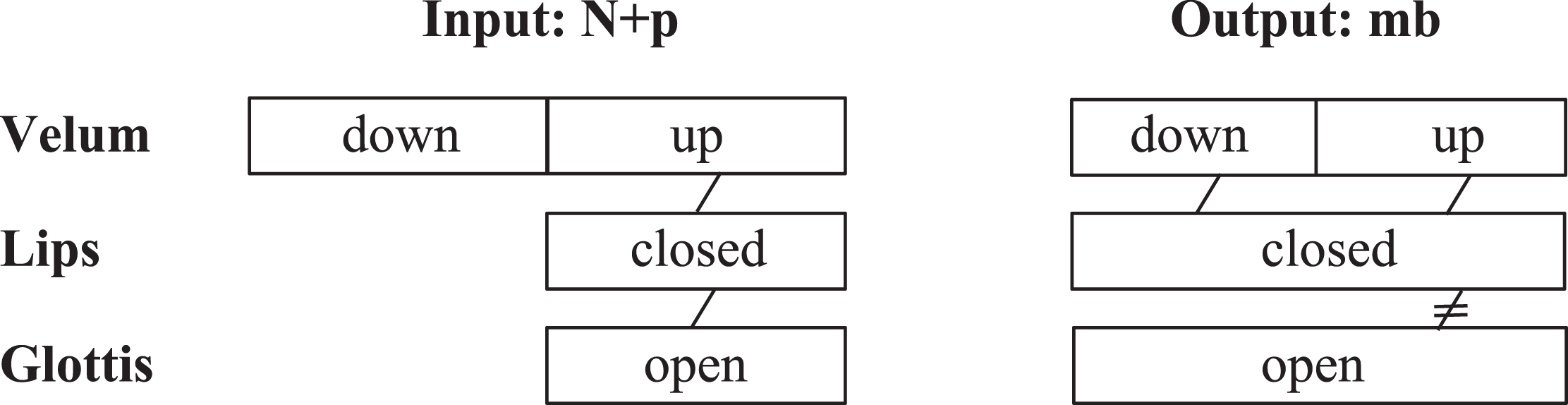
Halpert’s (Reference Halpert2010, Reference Halpert, Hoole, Bombien, Pouplier, Mooshammer and Kühnert2012) gestural account of postnasal voicing neutralization is schematized in Figure 2. In the output diagram, all gestures for the NC sequence are left- and right-aligned with each other (that is, the gestures satisfy alignment constraints). However, aligning the open glottis gesture for a voiceless consonant with the left edge of the NC sequence violates a markedness constraint on voiceless nasals  . To satisfy this markedness constraint, the open glottis gesture deletes (violating Faithfulness), resulting in voicing throughout the NC sequence.
Halpert (Reference Halpert2010): Avoid markedness at the expense of Faithfulness(open glottis) by deleting offending gesture.

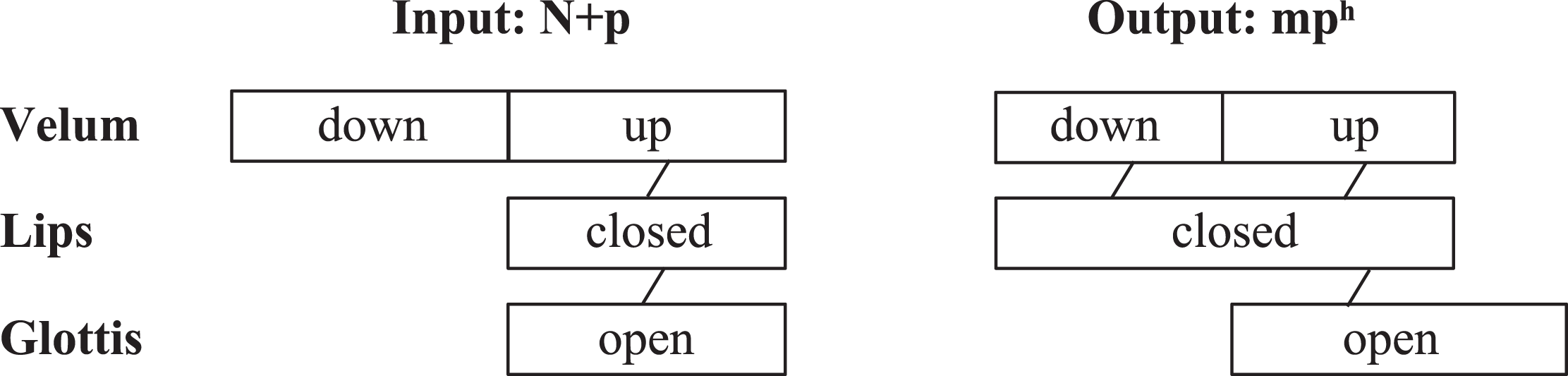
The gestural overlap account of NT → NTh follows the same logic, see Figure 3. In this case, though, the markedness constraint on voiceless nasals is satisfied in a different way. To avoid overlap with the nasal, the open glottis gesture for the voiceless consonant in the NC sequence violates the constraint optimizing left alignment of the open glottis gesture with the oral closure gesture for the NC sequence. Misalignment allows the open glottis gesture to be preserved in the output. It maintains its intrinsic duration, spilling over past the oral closure release and yielding aspirated Th.
Halpert (Reference Halpert2010): Avoid markedness at the expense of alignment by misaligning the offending gesture.

Note that for the misalignment account of postnasal aspiration to work, the open glottis gesture in the output must be longer with respect to the velum closure than in the input. This follows from Halpert’s assumption that gestures have an intrinsic duration. The nasal and stop closures are both temporally reduced as a result of aligning with the oral closure gesture, to maintain the intrinsic duration of the closure gesture. The glottis gesture, when it is not left-aligned with the closure gesture, spills past the closure release to maintain its intrinsic duration.
Neutralization of NTh (e.g. NT → NTh) in a language with a three-way laryngeal contrast presumably would have the identical motivation as the simple postnasal aspiration in a two-way laryngeal contrast language illustrated above. The open glottis gestures for both the plain and the aspirated voiceless consonant fail to left-align with the NC sequence to avoid overlap with the nasal. The open glottis gesture maintains its intrinsic duration and spills over past the stop release in the temporally reduced NC sequence to yield postnasal aspiration.
While this account is very elegant, it is not without problems. First, to produce a voiceless stop postnasally, the velum must be raised early and the stop gesture must be relatively long (Huffman Reference Huffman993, Solé Reference Solé, Vigário, Frota and Freitas2009). How, then, could the laryngeal gesture (open glottis) of the voiceless stop spill over to give aspiration if voiceless obstruent stop duration is long? (As we have seen, Halpert crucially assumes the velum closure gesture is shortened in the NC sequence.) Indeed, as Huffman & Hinnebusch (Reference Huffman and Hinnebusch1998) argue, gestural re-alignment alone is not sufficient to account for postnasal aspiration of an underlyingly voiceless stop. An additional aspiration gesture is required. Halpert (Reference Halpert2010, Reference Halpert, Hoole, Bombien, Pouplier, Mooshammer and Kühnert2012), in fact, concedes this, by representing underlying aspirated stops with a glottal gesture (wide glottis) different than the derived ones (misaligned open glottis). Further, as Halpert notes, it is unclear how the articulatory misalignment approach straightforwardly accounts for postnasal neutralization of aspiration in Zulu. Recall that in Zulu, aspiration is lost (and optionally replaced by ejection) in the postnasal context. But why should loss of aspiration (wide open glottis gesture) result in a plain voiceless stop or an optional ejective in Zulu while loss of voicelessness (open glottis gesture) in languages like Kimatuumbi results in a voiced stop? One would expect deletion of the input glottis gesture to result in the same default output glottis gesture in both cases. Furthermore, this account misses a generalization, as it ignores the role of perception in motivating realignment of articulatory gestures. Voiceless nasals are marked because they are hard to perceive; the postnasal NT vs. ND contrast is also hard to perceive without enhancement of the voiceless consonant. And lastly, the gestural realignment account makes no principled distinction between phonetics (articulation) and phonology: the articulatory gestures are evaluated by phonological Faithfulness constraints, thereby reduplicating phonetic knowledge in the phonological component. For these reasons, the perceptual cue analysis presented here is to be preferred over an articulatory-phonological account.
5 Conclusion
As we have shown, an analysis of alternations involving voiceless consonants in the postnasal context by perceptual cues interacting with phonological Faithfulness constraints accounts not only for neutralization of laryngeal contrasts, in favour of voicing, it also accounts for enhancement of contrasts by aspirating postnasal voiceless stops. Moreover, it provides an account why voicing and aspiration should be two preferred outputs for voiceless stops postnasally: these two laryngeal qualities typically have unique and salient perceptual cues.
We have shown that a formalization of the perceptual motivation together with phonological requirements is preferable to accounts that simply refer to the phonetics and claim that formal accounts do not add to the discussion (see e.g. Solé Reference Solé, Vigário, Frota and Freitas2009), because a formalization provides us with testable predictions (such as the predicted but not yet attested fourth type of languages). Our analysis is also preferable to phonetically-motivated phonological OT approaches such as Pater’s *NT and Halpert’s misalignment approaches, which reduplicate phonetic knowledge in the phonology (see e.g. the criticism of markedness constraints by Haspelmath Reference Haspelmath2006), while failing to make predictions about the phonetic output. In our analysis, the Cue constraints employed are independently needed to model the phonetics–phonology interface, and the ranking of these constraints is learned on the basis of the auditory input in language acquisition (and is thus influenced by cues used for other phonemic contrasts within the same language). In that respect our analysis is superior to alternative perceptual approaches that use universal, phonological constraints whose only task is to evaluate the acoustic difference between segments (e.g. Flemming’s Reference Flemming2002 Mindist constraints; Steriade’s Reference Steriade2001 p-map).
Furthermore, our proposal is more explanatory than the alternative phonetic approach appealing to gestural re-alignment (e.g. Halpert Reference Halpert2010, Reference Halpert, Hoole, Bombien, Pouplier, Mooshammer and Kühnert2012) sketched in Section 4.2, because it predicts which gestures should not overlap, namely those that result in the loss of relevant perceptual cues, and it predicts the choice of rescue mechanisms (on the basis of the perceptibility of cues and the number of phonological contrasts).
In short, perception is primary; articulation follows. The analysis based on perceptual cues captures this in the most direct way, accounting for the widest range of postnasal laryngeal effects.