Political science as a discipline lacks any convention on the order in which authors should be listed in co-authored publications. As a result, the order of authors' surnames currently provides no information to other scholars, hiring and promotion committees, and other reviewers about the relative contributions of each collaborator. This lack of information impedes the allocation of proper credit for scholarly contributions. Moreover, in collaborations between junior and senior colleagues, or other asymmetric status hierarchies, the absence of both information and any convention tends to favor more established scholars; this makes it more difficult for graduate students, untenured professors, and other vulnerable co-authors to negotiate for and receive appropriate credit. Listing authors by relative contribution is both more informative and fair. In publications where one author provides the necessary research funding, or a faculty member is not only a co-author but also a dissertation or other academic advisor, it is also appropriate to designate that collaborator as “last” or “senior author.” In all cases, articles should carry a short statement indicating the division of labor between the co-authors, even or especially if the contributions are equal.
The discipline of political science should adopt the convention of listing authors by relative contribution/senior author. The American Political Science Association (APSA) could easily create the appropriate convention by enforcing this policy in its journals. As both the premier professional association in the discipline and the publisher of one of its top journals, the APSA is an agenda setter that other journals, and practice more generally, will quickly follow. Other professional associations, especially those like the International Studies Association, the Midwest Political Science Association, and others that also control leading journals should adopt this convention as well.
NO CONVENTION IN POLITICAL SCIENCE
Collaborative research in political science has been steadily growing. According to the APSA Working Group on Collaboration, in 1956–1965, less than 10% of the articles published in 10 top journals in the field were co-authored. In 1996–2005, 40% of the articles in these same journals were co-authored, and 54% of the articles in the American Political Science Review (APSR), the American Journal of Political Science (AJPS), and the Journal of Politics (JOP), arguably the top three discipline-wide journals, were co-authored. Only the field of political theory, where only 5% of recent articles are co-authored, appears to remain outside this trend.Footnote 1
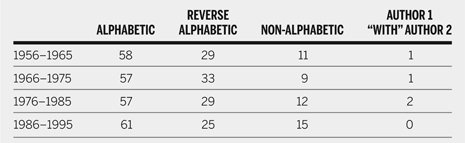
While the number of collaborative publications has been increasing, there is no strong trend in author-surname order. The working group identifies four principal models currently used for listing authors: (1) alphabetical order; (2) order of contribution; (3) random or sometimes reverse alphabetical order, especially in repeated collaborations; and (4) subdividing authorship across different publications, with some joint and some separate publications covering different pieces of a collaborative project. Models 3 and 4 are difficult to measure in any systematic way, since it's hard to identify all parts of collaborative undertakings. Nonetheless, we can calculate the proportion of co-authored articles that are published listing authors by (1) alphabetical order, (2) reverse alphabetical order, (3) non-alphabetic order, and (4) connected by with rather than and, denoting clearly unequal contributions. Data for the APSR, AJPS, and JOP aggregated by the same decades as in the working group report for comparability are presented in table 1.
Author Surname Order, 1956–2005 (as a percent of all co-authored research articles in the APSR, AJPS, and JOP)

Today, nearly two-thirds of co-authored articles list authors alphabetically, indicating that this is the dominant form of surname order in political science. At the same time, there is considerable variation, with reverse alphabetical order being the second most common form. Connecting authors by with rather than and is rarely used. There has been a slight trend toward alphabetical listing of authors over the last two decades. These data confirm that political science lacks any clear convention on author-name order. Put differently, if there is any convention favoring the alphabetic ordering of surnames, it is often ignored or even violated. While alphabetical ordering is the most frequent, there does not appear to be any agreement in the discipline that authors should be listed this way.
Other disciplines, of course, use different models and sometimes do have clear conventions. In the physical sciences, medicine, engineering, and other so-called hard sciences, the hegemonic model is to list authors by relative contribution with the senior author last, typically the laboratory director, the principal investigator on the grant, or the advisor in the case of publications with students. In these fields, senior author is an important and distinguished position nearly equal in status to the first author. Among the social sciences, psychology uses the relative-contribution/senior-author model, as do fields more closely related to the physical sciences, such as cognitive science, linguistics, and biological anthropology. Economics uses alphabetical ordering, but occasionally with senior authors listed last when the first author is a job candidate or a former student.Footnote 2 By comparison with political science, depending on various counts, more than 85% of all articles in economics list authors by alphabetical order (Einav and Yariv Reference Einav and Yariv2006, 168, Efthyvoulou Reference Efthyvoulou2008, 1268; Engers et al. Reference Engers, Gans, Grant and King1999).Footnote 3 Communications, sociocultural anthropology, and sociology are like political science in lacking any fixed practice but also lean toward alphabetical ordering.
In political science, as elsewhere, hiring, promotion, and professional distinction are tied more or less directly to perceived scholarly contributions. Although important publications will benefit all collaborators—just as a tide lifts all boats—at the margin there is always some tradeoff in assessing the relative contributions of multiple authors to any scholarly work.Footnote 4 If some co-authors get more credit than they deserve, other co-authors necessarily get less credit for their contributions. Indeed, the more important the publication, the greater the stakes in allocating credit across authors. Our goal as a discipline should be, I believe, to apportion credit for scholarly research as accurately as possible and in proportion to actual contributions. No system will be perfect. But as a general rule, conventions that provide more information more transparently ought to be preferred to those that provide less.
THE TYRANNY OF THE ALPHABET
Although frequent in political science, alphabetical listings of authors are uninformative and, in practice, unfair. The effects of author surname order have been closely analyzed in economics, where the convention of alphabetical listing prevails. Economists with surnames whose first letter falls early in the alphabet are significantly more likely to receive tenure in top 10 economics departments, are significantly more likely to become members of the Econometric Society (the discipline's principal honorary society), and, to a lesser extent, are more likely to win the Clark Medal and the Nobel Prize (Einav and Yariv Reference Einav and Yariv2006; see also Efthyvoulou Reference Efthyvoulou2008). Economists with early surnames also publish more articles, most likely due to reputational effects (Van Praag and Van Praag Reference Van Praag and Van Praag2003).Footnote 5 Surprisingly, these name-order effects exist even though the convention of alphabetical listing of authors is, in fact, well known by those in the discipline. Economists “know better” than to allocate professional rewards to those whose surnames happen to begin with letters early in the alphabet, but they do so anyways.Footnote 6 By contrast, there are no comparable name-order effects in psychology, where the relative contribution/senior author convention prevails (Einav and Yariv Reference Einav and Yariv2006). The available evidence strongly suggests that alphabetical listing of authors arbitrarily but significantly favors those scholars with early surnames. When it comes to a career in academia, to borrow the title of an article on this topic, it is far better to be named Darwin than Wallace (Tregenza Reference Tregenza1997)!
Alphabetical listing of authors also provides less information about relative contributions than some alternatives. This is especially problematic in those disciplines, like political science, where listing authors alphabetically is common but not a convention. Authors now choose to list themselves alphabetically (1) to indicate that they have, in fact, contributed equally to a publication; (2) when they have contributed unequally but not so disproportionately as to warrant a break with broad practice; (3) when they perhaps mistakenly believe that alphabetical order is the convention; or (4) when their actual contributions actually follow in alphabetical order. Unfortunately, these very different conditions are observationally equivalent—or indistinguishable from one another without further information. Contributions following the same order as the alphabet is actually a common condition in two-author teams, and thus causes significant problems in distinguishing between options 1 or 2 and 4. Indeed, in several collaborations in which I have been involved with graduate students, I have wanted to signal that I was the senior author and was actually listed second (last). While I was involved in the article deeply enough to warrant co-authorship, primary credit was really due to the student. But in each case because my collaborator had a surname that preceded mine in the alphabet, the final result appeared that we were equal co-authors of the article, or at least could be perceived as such. The same problem would hold for any convention of reverse alphabetical listing. Listing authors alphabetically provides little information and, whether unwittingly or not, tends to obscure the contributions of those involved.
The lack of information in alphabetical listings, in turn, tends in practice to benefit more senior scholars in collaborations with asymmetrical status. Co-authors rarely enter into collaborations on equal footing. The working group found that in co-authored papers presented at the annual meeting of the APSA between 2002 and 2006, nearly 58% were between graduate students and faculty or between untenured and tenured faculty. Senior scholars can add real value to papers. Often, they are the primary authors who conceive the paper, develop the theory, design the research, and write the first draft, but do so in association with one or more junior colleagues who may have special and necessary skills. Other times, however, senior scholars are more aloof and direct a paper but are not as deeply involved in the day-to-day work. This is appropriate. Despite the fact we work with our minds, political science (and academia more generally) is still a craft that is best learned through apprenticeship. Yet, because “learning by doing” is so important, when information is scarce we tend to award disproportionate credit to the senior scholar, who we assume drew upon personal experience to produce a successful publication. This is especially the case the closer the research is to the senior scholar's recognized area of past publication. We rule out, or at least discount, the possibility that a senior scholar might learn more from a graduate student than vice versa, even in a area where the senior scholar has previously published—a very common experience, in my case at least. Ambiguity tends to reward the already successful member of any collaborative team. It should come as no surprise to political scientists that power is at work in professional collaborations, and that the most frequent form of author listing we use—alphabetical listing—tends to favor those who already have power.
A BETTER MODEL: LISTING BY RELATIVE CONTRIBUTION/SENIOR AUTHOR
Listing authors by order of relative contribution is more informative. This is not by accident, as the convention is actually intended to communicate to a broad audience each individual's role in the collaboration. If Author Z does the majority of work on a particular paper, and Author A plays a more minor role, listing them as Author Z and Author A clearly signals this disparity. If Authors K and L contribute equally, they can be listed as Author K and Author L. Paradoxically, alphabetical listing of authors sends a clear signal of equality of contribution only when the convention is that authors are otherwise listed in order of relative contributions.Footnote 7 Importantly, the more authors who are listed on a paper, the greater the information surname order provides. Listing authors by relative contribution may be a blunt instrument. No convention of surname ordering is perfect. Echoing Winston Churchill's old quip about democracy, ordering by relative contribution may be the worst rule except for all known alternatives. That it is non-arbitrary, informative, and typically fair, however, may explain why it has been adopted in every discipline except economics that has a clear convention.
In listing authors by relative contribution, I would also favor listing senior authors last, when appropriate. This special position recognizes the distinctive—if often indirect—contributions of a scholar who has trained and intensely mentored the author(s) or funded the research in whole or part. This is a sufficiently established practice in other disciplines that its meaning and intent are reasonably clear. Although not eliminating them, it also acknowledges and renders more transparent the power relationships that often lie in unequal collaborations. Listing senior authors last, in turn, does not eliminate that possibility that a senior scholar can be listed as first author if, in fact, the contribution is significant enough to warrant it.
Since no alternative is perfect, each article even under a relative-contribution/senior-author model should also include a statement of actual contribution. This might follow at the end of the reference list or in a first footnote. This style is used in several psychology journals. Such statements might include the following forms:
• Authors listed J, B, and N: Author J was primarily responsible for drafting this article. Author B collected the data and analyzed the statistical results. Author N was the senior author. Authors J and N shared equally in the origin and design of the project.
• Authors listed E, A, and Y: Author E conceived the project and is primarily responsible for drafting this article. Author A researched and wrote the case study on X. Author Q researched and wrote the case study on Y.
• Authors listed R and D: Author R is the first author of this article, which follows directly from her dissertation research. Author D is the senior author.
• Authors listed A, B, and C: Author A, Author B, and Author C contributed equally to this article.
A relative-contribution/senior-scholar convention not only gives credit where credit is due, but it will, I expect, facilitate and enhance further collaboration. Under an alphabetical rule, authors may be reluctant to bring additional collaborators onto their project for fear of diminishing the credit received for their own work. If someone with expertise for, say, an additional case study could be added to a team and appropriately acknowledged without detracting from the major effort of the first author, such invitations would be more readily extended. In turn, authors with late surnames would be more eager to engage in collaborative work knowing that they will not be relegated to the “et al.”Footnote 8 A relative-contribution/senior-author model should largely eliminate these skewed incentives. Similarly, if those who developed a new data set or coded a new variable could receive due recognition for their work by co-authorship, they might be more willing to make their data available sooner.Footnote 9 Getting appropriate credit for one's own contributions is likely to promote rather than inhibit collaboration.
Conventions are normally hard to create because they are based on the actions and beliefs of many individuals. In this case, the APSA can play a major role in setting a convention on the listing of authors through its journals. Requiring all articles published in the APSR, Perspectives on Politics, and PS: Political Science and Politics to list authors by order of relative contribution/senior author would have an immediate impact on standards for the discipline as a whole.Footnote 10 I expect other journals would quickly follow this lead. But even if the APSA cannot act—as our largest professional association it is also the most diverse and, therefore, possibly slow to move—other professional organizations and journals should adopt the relative-contribution/senior-author model. If enough other publications begin listing by order of relative contribution, the right convention will eventually be established.
BUT WHAT IF WE DISAGREE?
Precisely because author-order does matter for professional rewards, it raises difficult and sensitive interpersonal issues, including the potential for disagreements and conflicts between authors. One counterargument to listing authors by relative contribution is that apportioning credit is hard and personally sensitive. For fear of ruining professional friendships, and because it does not actually provide information, we avoid these potentially painful discussions and let the tyranny of the alphabet prevail. In short, we use ambiguity to avoid interpersonal conflict. There are four responses to this counterargument.
First, other disciplines have succeeded in establishing professional norms that do deal with these sensitive interpersonal issues. While political scientists admittedly are not the most socially adept set of individuals on the planet, I cannot imagine that we are worse on average at negotiating interpersonal relationships than our physical science colleagues. Second, in the absence of any clear convention, each set of co-authors must reinvent the wheel, often at considerable cost and sometimes creating personal animosity. A rule—almost any rule—would actually help reduce conflict. Third, alphabetical order does not necessarily avoid conflict, but can leave authors who believe they have been denied appropriate recognition hurt and resentful—and less likely to collaborate in the future, especially with those same colleagues.
Finally, and most important, by forcing discussion of status into the open, a convention of relative contribution/senior author actually strengthens the hand of more junior or other vulnerable scholars. Sometimes collaborations between junior and senior scholars or other pairings in which there are status and professional hierarchies are handled ethically (see below) and, troublingly, sometimes handled in ways that inappropriately reinforce those hierarchies. Most senior scholars are generous in apportioning credit. It is in their interests to develop a reputation as a good collaborator and to promote the careers of junior colleagues associated with them, both of which should increase their number of other collaborators and publications over time. There will always be abuses, however, especially from “white bulls,” a double entendre so named for Zeus's disguise in seducing Europa (Kwok Reference Kwok2005). My experience suggests that senior scholars who insist upon first authorship when it is unwarranted or otherwise claim too much credit are well known among their graduate students, departments, universities, and professional colleagues, who in turn then discount all of their publications. Once earned, the reputation of being a white bull is hard to live down. Self-interest and a large measure of internal policing will generally serve to limit abuses. Nonetheless, in those cases where status hierarchies make the attribution of appropriate credit difficult, a clear convention will actually help protect professionally vulnerable scholars and increase the likelihood that their contributions are given due credit. Junior collaborators cannot stand up for their rights if those rights are ambiguous or ill-enforced elsewhere. If listing authors by order of contribution is a convention, junior scholars will stand on firmer ground and can, at least, force senior collaborators to justify any claims for disproportionate credit. In addition, the option of senior-author status may permit senior scholars to yield more readily and concede first-author position to their junior colleagues—a major reason, I suspect, why this amendment to the rule of listing surnames by relative contribution has become standard in so many fields.
We can also minimize conflict by learning from best practices in those fields where the convention is established. Surname order should be discussed early in any prospective collaboration so that expectations are clear for all involved. At the same time, the collaborators should be open to changing the order of names should work on the project evolve in a different direction than originally anticipated, or if other obligations pull authors away from the division of labor initially envisioned. Author-name order should always be open to renegotiation, especially as the work load changes over the course of a particular project. The APSA (or other professional associations) should also exert leadership in developing general guidelines about author-name order that can then be used to structure discussions among collaborators.
But precisely because these are sensitive professional issues often fraught with status inequalities, disagreements will arise. The APSA and other professional associations that publish journals should also create impartial mechanisms for resolving disputes that may arise between co-authors. I do not expect many conflicts to escalate to this level. In the first instance, it will inevitably fall to the senior scholar, if there is one, to lead the discussion of name order among the collaborators and to adjudicate disputes if they arise. As noted above, there are strong incentives for senior scholars to be generous in allocating credit in collaborative relationships. Yet, in cases where disputes cannot be resolved internally, and especially when junior colleagues are locked in abusive status hierarchies, special mechanisms for dispute resolution may be necessary. All research universities and most colleges have an ombudsman or mediator experienced in dealing with such disputes. These should be used as a first official step. In cases where the authors' institution(s) lacks suitable mediators or may not be impartial, however, a professional association publishing a journal must be prepared to offer its good offices to help resolve disputes, with, perhaps, the authority to determine the order of authors in its publications after hearing from all sides and conducting further investigations of its own, if necessary. As an ideal, redacted copies of all decisions ought to be made publicly available as precedents for collaborators to consult in the future. Over time, once a convention of relative contribution/senior author is established firmly in the discipline, the number of disputes should decline.
CONCLUSION
As the primary professional association of political scientists in the United States, the APSA is well placed to take up the issue of author-surname order and set a convention for the discipline. If it fails to act, other professional associations ought to rise to the challenge. The current muddle hurts all scholars, except those who consistently free ride on the efforts of their generous colleagues. Those most harmed by the lack of any convention are vulnerable junior scholars collaborating with senior scholars: without a standard or practice that defines their rights as co-authors or any means of signaling their contributions, they are most likely to be taken advantage of by unscrupulous or simply unwitting senior colleagues.
To the extent that we as a profession favor through practice the alphabetical ordering of surnames in publications, like our cognate discipline of economics, we are at risk of adopting the wrong convention. Alphabetical listing provides less information and is more unfair than listing authors by relative contribution and, where appropriate, senior author. More information and a more fair allocation of credit will stimulate greater collaborative research and benefit the discipline—and all of us—in the long run.