Morphological processing influences lexical processing in both alphabetic languages (e.g., Bertram, Schreuder, & Baayen, Reference Bertram, Schreuder and Baayen2000; Fowler, Napps, & Feldman, Reference Fowler, Napps and Feldman1985; Marslen-Wilson, Tyler, Waksler, & Older, Reference Marslen-Wilson, Tyler, Waksler and Older1994; Taft, Reference Taft1981, Reference Taft1994) and morphosyllabic languages, primarily Chinese (Peng, Ding, Wang, Taft, & Zhu, Reference Peng, Ding, Wang, Taft and Zhu1999; Zhou & Marslen-Wilson, Reference Zhou and Marslen-Wilson1995; Zhou, Marslen-Wilson, Taft, & Shu, Reference Zhou, Marslen-Wilson, Taft and Shu1999). In most of these studies, the focus has been on words or word parts that prime subsequent words. For example, decision might prime decide because of the root word (Fowler et al., Reference Fowler, Napps and Feldman1985). In compound words, a shared morpheme can also serve as a prime (e.g., Zhou et al., Reference Zhou, Marslen-Wilson, Taft and Shu1999). For example, 華 麗 (waa4 lai6, prosperous-beautiful, magnificent) could prime 華 貴 (waa4 gwai3, prosperous-precious, luxurious) because both words share the morpheme 華. (waa4, prosperous). In these and perhaps all previous studies of morphological processing, however, there is some overlap in the prefixes, suffixes, or other morphemes shared across the prime and target words (e.g., Libben, Gibson, Yoon, & Sandra, Reference Libben, Gibson, Yoon and Sandra2003). In print, these words share letters or Chinese characters in common. In the present study, we asked whether priming, either positive or negative, might occur across words sharing the same morphological structure but without any morphemes in common, a question to which little attention has been given thus far, especially in Chinese. Although it is unclear whether such a study is possible in English or other alphabetic languages, we studied this using the rich compounding morphology of Chinese, a language in which different lexical compounding structures are common.
Chinese compound words comprise several different substructures, including the subordinate, coordinative, subject–predicate, verb–object, and verb/adjective complement (Kuo & Anderson, Reference Kuo and Anderson2006). In comparison, in English, subordinate compounds are predominant (e.g., Katamba, Reference Katamba1993). In the present study, we focused only on the subordinate and coordinative structures, because these two structures are among the most common and easiest to identify in Chinese words (e.g., Yuan & Huang, Reference Yuan and Huang1998). In subordinate compounds, the second morpheme is the head that expresses the main meaning of the word, and the role of the first morpheme is to modify the second morpheme. For example, in the word 汽 車 (hei3 ce1, gas-car, automobile), the second morpheme 車 (ce1, car) indicates the main meaning of the word, and the first morpheme modifies the second morpheme and indicates what kind of car/vehicle this word expresses. Coordinative lexical compounds, by comparison, are those in which the two morphemes have the same role in indicating the meaning of a given word. The component morphemes in coordinative compounds have the same lexical properties, and also have either similar or opposite meanings. For example, in the word 花 草 (faa1 cou2, flower-grass, plant), the meaning of the word is derived equally and jointly from the two morphemes comprising it. These morphemes are parallel and have the same role in the word.
The issue of how words with parallel versus different grammatical structures affect their processing is perhaps best explored in Chinese. In Chinese, most words are compounds consisting of two or more morphemes. Although English and other alphabetic languages also have compound words (e.g., snowman, toothpaste, handkerchief), Chinese has a relatively high prevalence of such compound words (>70% in Chinese according to the report of the Institute of Language Teaching and Research in China, 1986). Moreover, in Chinese, there is a one-to-one-to-one correspondence across syllable, character, and morpheme, which means that in most cases, one morpheme corresponds to one syllable in oral language and one Chinese character in print. For example, in the word 籃 球 (laam4 kau4, basket-ball, basketball), each of the two morphemes has a given pronunciation (consisting of two syllables, lan2 and qiu2, spoken as a single word) and also a given written form (i.e., the characters 籃 and 球 together). These features make morphemes in either oral or written language easy to identify, even without the processing of morphological rules.
There were two primary purposes of the present study. We sought to replicate the “pure” semantic priming effect found in previous work (e.g., Zhou et al., Reference Zhou, Marslen-Wilson, Taft and Shu1999; Zwitserlood, Reference Zwitserlood1994) on lexical processing. We expected that semantically related words would positively prime one another. In addition to this replication, we tested whether the morphological structures of words (i.e., coordinative vs. subordinate) would influence semantic priming of them, showing an independent structure effect. In mainland China, compounding structures are explicitly analyzed and taught separately in high school. However, this kind of teaching does not occur in Hong Kong. Thus, in order to control the influence of knowledge on processing of compounding structures, only Hong Kong Chinese college students were recruited.
METHOD
Participants
Twenty-four Hong Kong Chinese college students (14 males, 10 females) participated in this study as a requirement to fulfill hours in an introductory psychology course. All participants were native Cantonese speakers who had normal or corrected to normal vision and were right handed.
Materials
Sixty-nine subordinate and 77 coordinative high-frequency disyllable Chinese compounds were selected from the corpus as the pool of targets. The word frequencies of all materials used in the present study were based on the data set compiled by Da (Reference Da, Zhang, Xie and Xu2004), which included more than 32 million modern Chinese characters forming words. All the target compounds selected in the present study were in the top 6,000 of the data set (average frequency = 0.1208), because, as suggested by Da (Reference Da, Zhang, Xie and Xu2004), the top 6,000 word sets should correspond to the vocabulary size of middle level Chinese language learners. Some other high-frequency compounds were generated as the pool of primes corresponding to these potential targets in four priming conditions. (The average frequency of the selected primes was 0.1014.) These priming conditions were those in which (a) targets and primes have both related meanings and comprise the same compounding structure (SMSS); (b) targets and primes have related meanings, but their compounding structures differ (SMDS); (c) targets and primes have unrelated meanings, but they have the same compounding structure (DMSS); and (d) targets and primes have neither related meanings nor similar compounding structures (DMDS). No difference was found among the four priming conditions in word frequency for selected target word, F (3, 57) = 0.97, or prime word, F (3, 57) = 1.23, p = .306. Two Chinese compounding structures were compared: the coordinative and subordinate structures.
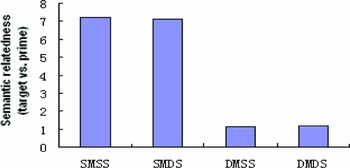
The formal materials selected were those that had clearly identified compounding structures. Initially, 10 college students not participating in the formal experiment were asked to assess the semantic relatedness of the target and specific primes on a 10-point scale (0 = totally unrelated, 10 = very related). In the SMSS and SMDS conditions, the targets and corresponding primes had related meanings; in the DMSS and DMDS condition, the targets and primes had unrelated meanings. Based on the criteria, a total of 61 real-word targets (32 subordinate words, 29 coordinative words) were selected. In the 2 (Compounding Structure: Subordinate and Coordinative) × 4 (Priming Conditions: SMSS, SMDS, DMSS, and DMDS) two-way analysis of variance, there was a significant main effect of priming condition, F (3, 3) = 364.80, p < .001, in the rated semantic relatedness between target and prime (as seen in Figure 1). Neither the main effect of compounding structure nor the interaction effect was significant. One can see from Figure 1 that those words grouped into related and unrelated meanings were rated similarly on semantic relativity. Examples of real-word materials used in the present study are shown in Table 1.
The semantic relatedness of targets and primes in the four different priming conditions: SMSS, related meaning and same structure; SMDS, related meaning and different structure; DMSS, different meaning and same structure; DMDS, different meaning and different structure. [A color version of this figure can be viewed online at journals.cambridge.org/aps]

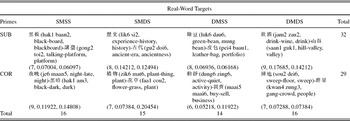
Summary of the real-word targets and primes used in the present study

Note: Each cell contains an example of the prime-target pairs. The number of pairs, prime frequency, and target frequency in each of these pairs are shown in parentheses. SMSS, related meaning and same structure; SMDS, related meaning and different structure; DMSS, different meaning and same structure; DMDS, different meaning and different structure; SUB, subordinate; COR, coordinative.
In this pilot study, compounding structures of the words in the target pools were also assessed by the college students. They were first asked to select the structures of the words presented to them from several alternatives, including subordinate, coordinative, and others not included in the present study (i.e., verb–predicate, subject–predicate, verb/adjective + complement, and others). Their answers were compared with the actual structures of the words. Moreover, they were also asked to rate how difficult it was to identify the specific structures on a 10-point scale of difficulty (0 = very difficult, 10 = very easy). The selected words were those with structures that could be identified relatively more accurately and more easily, along with other selection criteria. The average percentage of correct ratings for subordinate compound words was 81.42%, whereas for coordinative words this average rate was 90.41%. Both of these are relatively high, even though the difference in ratings between the two compounding structures was significant, t (58) = 2.86, p < .01. Furthermore, judgment ratings of difficulties also varied. Subordinate words were judged to be significantly more difficult to identify compared to coordinative words (for subordinate words the average score was 6.52, and for coordinative words the average score was 7.89), t (58) = 6.66, p < .001. In the absence of data to the contrary, we must assume that these differences in ratings reflect actual differences in processing of these types of compounds given their similarities in frequency. Moreover, the semantic transparencies of the materials were assessed by 45 additional college students, with 15 of them each assessing one-third of the materials, on a 10-point scale (0 = easy to infer the word meaning from the morphemes, 10 = difficult to infer the word meaning from the morphemes). No significant difference was found in semantic transparency between the subordinate and coordinative structures in these ratings (subordinate: M = 7.24, coordinative: M = 6.76), t (59) = 1.36, p = .180.
Apart from the real-word targets, 60 nonword targets were also generated, based on the real words in the target pool. The semantic and structural relations between these real words that were used for generating nonword targets and their corresponding primes also followed the same design as for the real-word targets: they were distributed across both subordinate and coordinative structures and the four priming conditions. With a change of one character of the two-character real words, the new combination of the two characters did not have a clear or common meaning in everyday spoken Chinese (nonsense words). For example, the nonword target 春 崗 (ceon1 gong1, spring-post) came from the real word 春 風 (ceon1 fung1, spring-wind, spring breeze) by changing the second character.
Apart from the materials used in the formal experiment, 20 other pairs of items were used for practice items. Of these, half were real words, and the other half were nonwords. In the practice trials, the targets and primes shared neither semantic nor structural information. Moreover, 6 other pairs of fillers were used at the beginning and after the break in the middle of the formal experiment. In all prime–target pairs no constituent morpheme was shared across pairs. All materials are available from the authors upon request.
Procedure
Because in the present study different items were used in the four priming conditions, in order to counterbalance the variance yielded by the nature of the different items, participants were asked to carry out both experiments with and without primes. Half of the participants completed the no-prime experiment first, and the other half carried out the priming experiment first. All materials were presented in songti at the center of the computer screen in a 38-point font size. The order of the formal materials was randomized by the program.
In the priming experiment, participants were asked to judge whether the second stimulus they saw on the computer screen was a word or nonword as quickly and as accurately as possible by pressing the different buttons on the keyboard with forefingers (the right SHIFT key for “yes” response and the left SHIFT key for “no” response). The dominant hand (in the present experiment, the right hand) was used for the “yes” response. For each trial, first a fixation signal “ + ” was given at the center of the screen for 300 ms; this was followed by the onset of a prime after 300 ms at the same place. The prime was presented for 200 ms, followed immediately by the target for 1500 ms. There was a 2-s interval between the offset of each target and the onset of the next fixation signal. After being given instructions, participants first saw the 20 practice pairs. There were two 2-min breaks, one at the beginning and one in the middle of the formal experiment. In the no-prime section, the procedure was the same as in the priming experiment, with the only difference being that there was no prime in this section. The complete experiment lasted for about 45 min for each participant.
The experimental software DMASTER, developed by Ken and Jonathan Forster, was used to design the program and record participants' reaction times and errors.
RESULTS
Three subjects were excluded: two because they showed high error rates, and the other one because the reaction times on most items were particularly long, especially in the no-prime condition (>2 standard deviations). The average of correct answers for the remaining 21 subjects was 96.5%, and the rate of correct answers by items was 96.4%. The following analyses are based only on participants' reaction times for the real-word targets.
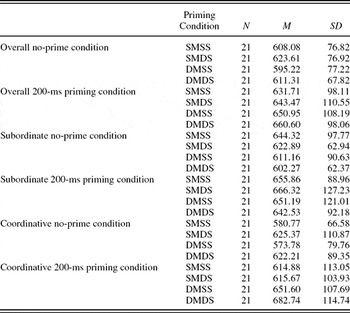
The mean reaction time for each condition was calculated, with all errors and response times shorter than 200 ms or longer than 2000 ms removed from the data. These are displayed in Table 2. In order to control the natural variances of the compound words used in different priming conditions, differences across reaction times (RT) were calculated as the difference scores of no prime compared to each priming condition (SMSS, SMDS, DMSS, DMDS): difference score = RTno prime − RT200ms. Variance analyses were then conducted based on these difference scores twice: once with subjects and the other with items as the random variable. A significant main effect in priming condition was found in the subject analysis, F 1 (3, 60) = 3.01, p < .05, but not in the item analysis, F 2 (3, 3) = 1.06, p = .482. Post hoc tests showed that the difference between the SMSS and DMDS conditions was significant in the subject analysis, t 1 (20) = 2.52, p < .05, and marginally significant in the item analysis, t 2 (30) = 1.92, p < .10. The difference between SMDS and DMDS was not significant, t 1 (20) = 1.53, p > .10; t 2 (29) = 1.46, p > .10. The difference between the DMSS and DMDS conditions was also not significant, t 1 (20) = 0.36, t 2 (28) = 1.14, p > .10. A marginally significant interaction effect was also found, F 1 (3, 60) = 2.72, p = .053; F 2 (3, 53) = 2.20, p < .10. Variance analyses were then conducted for the two structures separately. There was a significant main effect of priming for coordinative words, F 1 (3, 60) = 4.49, p < .01; F 2 (3, 25) = 3.80, p < .05; but not for subordinate words, F 1 (3, 60) = 0.85; F 2 (3, 25) = 0.55. Post hoc tests showed that the difference between the SMDS and DMDS for coordinative words was significant in the subject analysis and marginally significant in the item analysis, t 1 (20) = 2.78, p < .05; t 2 (12) = 2.09, p < .10. The difference between SMDS and SMSS was marginally significant in the subject analysis, but not significant in the item analysis, t 1 (20) = 1.74, p < .10; t 2 (14) = 3.45, p > .10. The difference between the SMSS and DMDS conditions was not significant, t 1 (20) = 1.51, p = .141; t 2 (14) = 1.49, p = .158. The difference between DMSS and DMDS was also nonsignificant, t 1 (20) = 0.62; t 2 (11) = 0.88.
Descriptive results for specific conditions

Note: SMSS, related meaning and same structure; SMDS, related meaning and different structure; DMSS, different meaning and same structure; DMDS, different meaning and different structure.
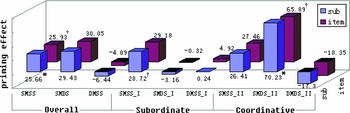
Coordinative words with similar meanings were positively primed. However, when the semantic information and structure information were combined together, the positive priming effect of semantic information was inhibited by the shared structure information between primes and targets. In contrast, for the subordinate words, a marginally significant difference was found between the SMSS and DMDS conditions in the subject analysis, t 1 (20) = 1.8, p < .10; t 2 (14) = 1.45, p > .10. In contrast to the findings for the coordinative compound words, these results indicated that there was a positive priming effect in the SMSS condition when the processing of targets was primed both semantically and in terms of morphological structure. Because in the lexical decision task, participants were required to process the semantic information, the present results showed that for subordinate Chinese compounds the structure information can facilitate semantic processing, whereas for the coordinative Chinese compounds, the structure information can inhibit semantic processing. All the priming effects are shown in Figure 2.
The priming effect in each of the priming conditions: SMSS, related meaning and same structure; SMDS, related meaning and different structure; DMSS, different meaning and same structure; DMDS, different meaning and different structure. Note: the priming effect was calculated by subtracting the score on DMDS from the difference scores in the other three priming conditions. *There was a significant difference between the specific priming condition and the DMDS condition (i.e., the priming effect). †Marginally significant. [A color version of this figure can be viewed online at journals.cambridge.org/aps]

DISCUSSION
In the present study, using a visual priming lexical decision paradigm, morphological structure processing of both Chinese subordinate and coordinative compounds was investigated. For subordinate Chinese compound words, results showed that only when the primes were related to the targets both semantically and in terms of morphological structure did these primes facilitate the lexical processing of target words, reflecting an interaction between semantic information and morphological structure information. The single activation of semantic information only was not sufficient to prime the lexical representation of target compounds, and the shared morphological structure information strengthened the weight of the link between primes and targets in the mental lexicon. In contrast, for coordinative Chinese compounds, a different pattern was found. A significant priming effect was found in the SMDS but not in the SMSS condition. The positive priming effect in the SMDS condition indicated that for coordinative Chinese compounds, semantic information alone could activate the lexical representation of targets. The nonsignificant priming effect for the SMSS condition might have been caused by the inhibition of morphological structure information for coordinative Chinese compounds. Overall, pilot testing revealed that the Chinese coordinative structure was relatively easier to identify compared with the subordinate structure, perhaps because for coordinative words the lexical properties of the component morphemes are relatively consistent, in that they tend to have either similar or opposite meanings. In contrast, for subordinate compounds, there is a higher possibility that the meanings of the morphemes differ substantially from this synonym–antonym dichotomy, perhaps making it relatively more difficult to identify this structure. We think that this may be a potential core reason for the dissociation of the priming effect patterns in the present study. Because the subordinate structure tends to be more opaque, identification of words with this structure likely depends more on semantic information of the whole word. Thus, in this structure, because the relationship between lexical processing and morphological structure processing is relatively tight, the processing of morphological structure provides a helpful cue for lexical processing. However, because the coordinative structure is relatively transparent, it may be processed relatively independently from semantic information of the whole word. It is likely that only the processing of the lexical properties and semantic information of component morphemes are necessary for identifying the coordinative structure. If the processing of morphological information is strengthened by the prime, such processing may compete for cognitive resources with and inhibit lexical processing of the target.
However, are there any other possible explanations for the present results? One alternative concerns the lexical properties of the primes and targets in the two different structures. Almost all subordinate Chinese compounds are nouns, whereas coordinative compounds could be nouns, verbs, or adjectives. Thus, in the coordinative structure condition, if the lexical properties of primes and targets were different, during the lexical processing, participants would have to process across primes and targets, which might contribute to the inhibition effect. At the same time, however, when rechecking the materials for this possibility, we found that for the coordinative structure in the SMSS condition only one of nine prime–target pairs shared different lexical properties. Thus, the inhibition effect from the present study is relatively unlikely to have been caused by different lexical properties between primes and targets.
The present study suggests that the processing of compounding structures is important for Chinese compound word recognition. In lexical processing, the processing of morphological structures has an auxiliary role, either positively or passively. In the Chinese language, it is relatively difficult to identify the exact meaning and syntactic position of a single word or morpheme without context. The representation of morphological structure may facilitate processing and comprehension of Chinese compound words. For example, in the Chinese word 認 知 (jan6 zi1, know-understand, cognition), without a representation of a specific morphological structure it will be difficult to understand the meaning of the whole word and even the morphemes in this word. 認 could mean know or identify, that is, a verb. However, 知 could also mean either knowledge, which is a noun, or understand, which is a verb. If the structure of 認 知 is identified as a subordinate compound word, then the word should be explained as known knowledge; but if the structure of it is determined to be coordinative, then the word should be understood as know and understand, which is the real meaning of this word. The representation of the specific morphological structure of this word will thus facilitate the lexical access and comprehension of this word. Moreover, there are also some reversible compound words in Chinese, of which the two-character word pairs differ only in the order of their constituent characters, for example, 領 帶 (leng5 daai3, collar-belt, tie) versus 帶 領 (daai3 leng5, take-lead, guide). For these words, the processing of morphemes is not enough to obtain the exact meaning of the whole word, because the reversible word pair contains the same characters. In previous work, college students processing these reversible compound words demonstrated activation of semantic information of the reversed-order words as well (Zhang et al., Reference Zhang, Zhuang, Ma, Yu, Peng and Ding2004). Thus, morphological structure representation may be critical to inhibit the interference and facilitate the activation of the correct semantic information. Future research should investigate the relationship between morphological structure processing and lexical processing across different kinds of Chinese compound words. In some other languages, such as English, German, and French, compound words are relatively frequent. Therefore, the representation of compounding morphological structure may also be important for lexical processing of compound words in these languages. For example, in the word toothpaste, the representation of morphological structure facilitates understanding of the word as a kind of paste, but not a kind of tooth. Some researchers (e.g., Clark, Gelman, & Lane, Reference Clark, Gelman and Lane1985) have demonstrated that even very young children could understand and manipulate the compounding morphological structure, for example, using car-smoke but not smoke-car to stand for exhaust and using plant-man but not man-plant to stand for gardener. These examples imply that the representation of compounding morphological structure may be important for understanding and producing compound words. Future research should further explore the influence of compounding morphological structures on lexical processing in other languages.
In the present study, we explored natural language processing. Thus, in order to control the influence of explicit knowledge on Chinese compound morphology, the participants recruited in the present study were Hong Kong Chinese adults. In mainland China, the compounding structures are formally taught in middle school. Therefore, some questions for future work include the following: What is the pattern of the influence of compounding structure processing on lexical processing of Chinese compounds in Chinese adults who explicitly learn to identify different compounding structures? Could such explicit compounding structure knowledge facilitate the activation of compounding structure during lexical processing? What would compounding structure processing look like in mainland Chinese children who have not learned this explicit structure knowledge? All of these questions are worthy of future exploration. Moreover, although we controlled several factors that might possibly impact the results, such as the word frequency, the difficulty in identifying the specific compounding structures, and the semantic transparency of the words, there might be other confounding factors that we did not consider, such as the word classes of either morphemes or words, and the thematic roles of the modifiers in the subordinate compounds. In future studies, more strict selection of materials might be considered to control these. The limited sample size in the present study caused relatively large variance, which also limited the strength of the results. Despite these limitations, however, the present study highlighted the importance of morphological structure processing for examining semantic processing of Chinese compound words. These findings should serve as a catalyst for future research on the association of morphological structure and lexical processing.
ACKNOWLEDGMENTS
This study was partially supported by Hong Kong government RGC Grant 448907 (to C.M-C.). We are grateful for the comments of the editor and two anonymous reviewers on a previous version of this work.