Introduction
A safe food supply is essential to the survival of humankind. As people have multiplied and technology has advanced, the food supply has evolved from a base of local consumer production to large-scale integrated production and distribution practices. Consumers are unaware of the origin and processing of their food. Similarly, most producers are unaware of the variety of potential public health hazards that are transmissible by food. Although information regarding foodborne hazards is widely available from many sources, especially regarding hazards such as bacteria and chemical residues, there is limited information on foodborne parasites (Dorny et al., Reference Dorny, Praet, Deckers and Gabriel2009; Gupta et al., Reference Gupta, Khan and Santra2009). Both consumers and producers rely on government regulations and oversight for guidance and protection. However, there has been complacency which could be due to a lack of technological know-how for control strategies and further aggravated by the complacency in standards and policies for food safety.
Several studies mentioned that environmental contamination with parasites via animal host defecation contributes significantly to ongoing transmission in agricultural settings. Animals play an important role in the transmission of parasites to humans, in fact, animal hosts play an obligatory part in the lifecycles of certain human helminths. Recently, molecular tools for interrogating relationships between morphologically similar helminths infecting humans and animals have revealed zoonotic infection reservoirs (Torgerson and Macpherson, Reference Torgerson and Macpherson2011). For example, the transmission of Ascaris suum from pigs to humans occurs worldwide in agricultural settings (Betson et al., Reference Betson, Nejsum, Bendall, Deb and Stothard2014). Also, a high proportion of human hookworm infections in Asia are attributable to canine hookworm species (Jourdan et al., Reference Jourdan, Lamberton, Fenwick and Addiss2018). However, the contribution of foodborne zoonotic transmission to the overall burden of parasitic infection and the relative importance of different animal and environmental reservoirs remains poorly understood. Zoonotic transmission is likely to be important in the Philippines, where many people depend on livestock production and integrated farming. This has significant implications for zoonotic parasite transmission, especially in rural communities, where poor agricultural practices provide a high risk of disease transmission (Betson et al., Reference Betson, Alonte, Ancog, Aquino, Belizario, Bordado, Clark, Corales, Dacuma, Divina, Dixon, Gourley, Jimenez, Jones, Manalo, Prada, Van Vliet, Whatley and Paller2020).
Moreover, foodborne diseases (FBD) have been on the rise globally in the past recent years and parasites have been implicated as one of the aetiological agents. Eating green leafy vegetables is vital to a healthy and balanced diet. However, these have been linked to foodborne parasitic diseases. Most leafy greens are grown outdoors and are exposed to soil, animals and water, all of which can be a source of parasite contamination. In addition, leafy greens, such as lettuce, are eaten raw and the cooking process to kill potential biological hazards is eliminated in the process, thus, further posing health risks. In the Philippines, the contribution of fresh produce in FBD is poorly understood, thus the true dimension of the problem is unknown. This study aimed at providing science-based evidence on the need to address issues concerning farming practices that pose threats to farmers and consumers’ health particularly in poor-resource communities in the country.
Material and methods
Study site and sampling design
The study sites were selected farms in Laguna, Philippines which is part of the CALABARZON (Region IV-A) region and located 30–60 km south of Metro Manila, Philippines. It is the third-largest province in Region IV-A and known to produce and supply large quantities of fresh produce. Four farms were selected study sites based on the following criteria: (a) must be within the range of 200–20 000 m2; (b) fresh produce is for commercial purposes and (c) fresh produce include green leafy vegetables such as lettuce. Some of the selected farms were practising organic farming while others were conventional but also used animal manure as fertilizers. A certified organic farm located outside the sampling district area was included to serve as a reference farm for comparison. Hence, a total of five farms were considered in the study.
Vegetable collection and processing
The farm produce samples collected include lettuce varieties, cabbages, cucumbers and tomatoes. One sample unit is equivalent to 100 g of each vegetable type randomly collected from the farms. The number of vegetable samples collected from each farm was based on the size of the vegetable farming area. The vegetable planting area was divided into plots measuring 1 m2 and were numbered from 1 to 100. The five points were randomly selected based on the number generated by a calculator. For example, ten vegetable samples were collected from a farm which approximately measures 200 m2. The samples were placed individually in properly labelled sealed bags and were brought immediately to the laboratory for processing and analysis. Samples were then processed through the sedimentation technique. Briefly, the vegetable samples were cut into small pieces and put into a 1000-mL beaker containing 400 mL of 0.95% NaCl solution. The solution was stirred for about 10 min and the vegetable samples were removed and discarded. Subsequently, the remaining saline solution was left overnight for sedimentation to take place; after which, the supernatant was discarded carefully using suction until about 100 mL of the residue remained in the beaker. The remaining residue was transferred into test tubes and centrifuged for 10 min at 3000 rpm. After centrifugation, the supernatant was discarded and about 1 mL remained in the test tube. The remaining residue at the bottom of the tube was then mixed thoroughly and a drop was placed on a glass slide, dyed with Lugol's iodine and examined microscopically in 200× and 400× magnification. Three readings were done for each sample (Uga et al., Reference Uga, Hoa, Noda, Moji, Cong, Aoki, Rai and Fujimaki2009).
Soil collection and processing
Soil samples were also collected from the same farms. The number of samples collected from each farm were also based on the size of the vegetable farming area as mentioned above. Soil samples were processed through a modified floatation technique developed by Horiuchi and Uga (Reference Horiuchi and Uga2016). Approximately 200 g of a sample at 5 cm depth (topsoil) were collected from the farms and were contained in sealable plastic bags. These were transported to the laboratory for analysis. Soil samples were then air-dried before processing. The dried soil was strained using a 125-μm mesh sieve. Two grams of fine soil were transferred in a calibrated test tube and added 6 mL of distilled water, mixed thoroughly using a vortex mixer (Seoulin Bioscience, Korea), then centrifuged at 1800 rpm for 10 min. The supernatant was decanted after centrifugation. Then 8 mL of 1.2 specific gravity sucrose solution was added to the soil sediments, mixed, then centrifuged at 1800 rpm for another 10 min. After which, using a 10-mL syringe, 1.3 specific gravity of sucrose solution was slowly added up to the brim to form an upper meniscus to allow flotation of parasite eggs or cysts that may be trapped in the soil samples. A coverslip was carefully placed on the mouth of the tube to collect the upper meniscus of the sucrose solution. This was then placed on a glass slide and observed at 100×, 200× or 400× magnification using a compound light microscope (Nikon, Japan) for identification of the presence of parasite eggs, cysts or larvae. Photos and size of specimens were taken using a digital microscope camera (OptixCam, China) and parasite elements were measured using a Toupview software (ToupTek Photonics, China).
Water collection and processing
Water sources in the farm include tap water from the municipal district office, spring water and groundwater. A triplicate of a ten-litre water sample was collected from the identified water sources present in each farm using sterile plastic water bottles. The samples were transported to the laboratory and processed in accordance with Method 1623.1 designated by the United States Emergency Protected Areas (USEPA, 2001). Each sample was filtered using Whatman Nucleopore Track-Etch Membrane with a defined pore size of 1 μm. After filtration, the materials on the filter were eluted with distilled water and the elute was then concentrated by centrifugation under 1500 rpm for 10 min. The resulting supernatant was then decanted, and the remaining residue was pipetted and stored into sterilized Eppendorf tubes.
The water samples were subjected to immunofluorescence assay test (IFA) for the determination of the parasite count. Crypto/Giardia-cel IF test, an in vitro direct immunofluorescence test kit, was used to allow simultaneous detection of Cryptosporidium oocysts and Giardia cysts (Cellabs Pty. Ltd., Sydney/Australia). The water samples were processed according to the manufacturer's directives.
Survey on knowledge, attitude and farming practices of farmers and farm owners
During the collection of the samples, survey interviews of the farmer and farm owners were conducted to document some of the management practices in the farms. The survey interviews were done to determine the possible association of knowledge, attitudes and practices (KAPs) in farming practices with the occurrence of parasite contamination in the farms. Farm owners and farm managers were asked to be interviewed with informed consent.
Data analysis
Parasite prevalence was calculated as the number of positive samples divided by the total number of samples multiplied by 100. Mean density was calculated as the number of parasites eggs/cyst/oocyst/larvae divided by the total number of positive samples. The comparison of the parasite prevalence (%) and mean density of the parasites observed among the various environmental samples from the farms was analysed by Chi – square test statistics while the comparison of mean densities of parasites among different vegetable types and among different water sources was analysed by Kruskal Wallis H Test using Quantitative Parasitology 3.0 software and IBM SPSS software (IBM® SPSS® Statistics 2016, Version 24.0). Moreover, an association of the farming practices with a prevalence of contamination and mean density of parasites were analysed using point-biserial correlation. The normality of the data was ascertained using Shapiro–Wilk test. All the data were revealed to be not normally distributed, thus non-parametric tests were employed. All statistical analyses were set at 95% level of confidence and P values less than 0.05 was considered significant.
Results
Parasite contamination of vegetables
A total of 29 out of 168 (17.3%) vegetable samples collected from the four selected farms and the reference farm were found contaminated with parasites. The parasites detected in the samples were nematode parasites such as strongylid/hookworm egg or larvae, ascarid and Toxocara sp. eggs and protozoan Balantidium coli cysts.
Vegetable samples were categorized into leafy vegetables (cabbage and lettuce) and fruit vegetables (tomato and cucumber). Lettuce varieties were found contaminated with red ruby lettuce variety having the highest prevalence of parasite contamination (83.3%) followed by an iceberg (66.7%) and romaine (50.0%) varieties; while cucumber showed the lowest at 12.5% (Table 1). Other fresh produce was not contaminated such as cabbage and tomatoes. Statistical analysis showed significant differences in the prevalence between leafy vegetables and fruit vegetables (P = 0.002); while parasite mean densities showed otherwise (P = 1.000) in farms positive with parasites.
Prevalence and density of parasites recovered from leafy and fruit vegetables from selected farms (F) in Laguna Province, Philippines

* P < 0.05 – significant; RF –reference farm (a certified organic farm located outside the sampling district area).
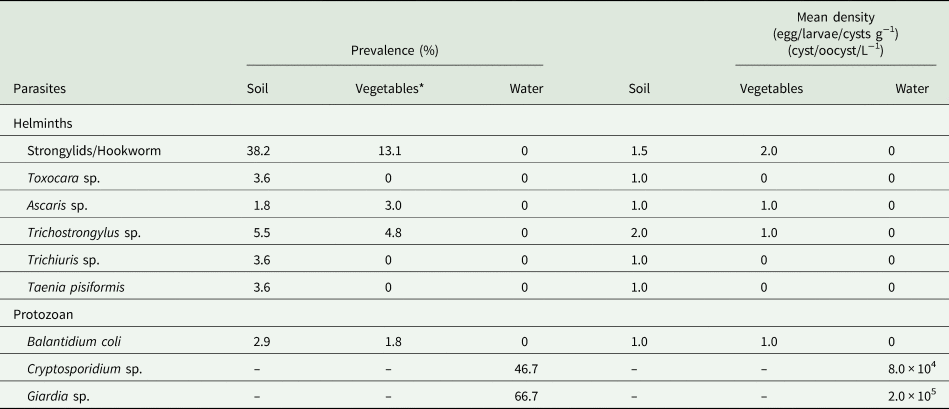
Comparison of the prevalence of parasite contamination and mean density of parasites recovered from vegetables is shown in Table 2. It revealed strongylids/hookworms with the highest prevalence (13.1%), followed by Toxocara sp. (4.8%), Ascaris sp. (3.0%) and B. coli (1.8%). The highest mean density was also observed in strongylids/hookworms at 6 egg/larvaeg−1. Statistical analysis showed a significant difference among the prevalence of these parasites (P = 0.0001).
Parasites recovered from vegetables and environmental samples of selected farms in Laguna Province, Philippines

(–) – Immunofluorescence assay (IFA) not performed.
* P < 0.05.
Parasite contamination of farm soils
A total of 26/55 (47.3%) soil samples were contaminated with at least one parasite. Parasites observed include stronglylid/hookworm larvae (38.2%), Trichostrongylus sp. egg (5.5%), Toxocara sp. egg (3.6%), Trichuris sp. egg (3.6%) and Taenia pisiformis egg (3.6%), B. coli cyst (2.9%) and Ascaris sp. egg (1.8%) (Table 2). Only strongylid/hookworm larvae were observed in the reference farm. Overall, the strongylids/hookworms showed the highest mean density (3 egg/larvae g−1). Interestingly, there was no significant difference observed between the prevalence of parasites (P = 0.123) and mean density (P = 0.850) in farm soils between the study sites/vegetable farms and the reference farm (Table 3).
Parasite contamination of vegetables and environmental samples from selected farms (F) in Laguna Province, Philippines

* P < 0.05 – significant.
a Mean density: oocyst/cyst/ L−1; RF – Reference farm.
Parasite contamination of water samples
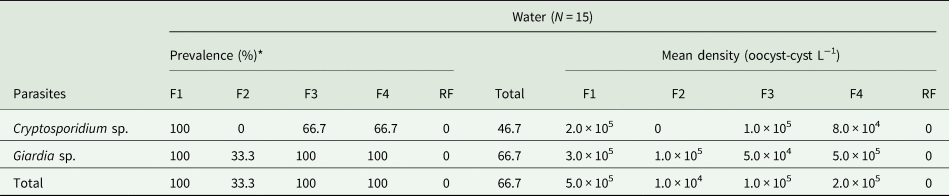
The prevalence of parasites and mean density among farms are shown in Table 4. For the four selected farms, it revealed contamination with Giardia spp. (66.7%) and Cryptosporidium spp. (46.7%); the prevalence of contamination among the different farms was significant at P = 0.002, while the mean densities were not significant at P = 0.272. It is interesting to note that these protozoan parasites were not observed in the reference farm. Also, all water samples did not show contamination with soil-transmitted helminth (STH) eggs.
Prevalence and density of Cryptosporidium spp. oocyst and Giardia spp. cyst in water samples from selected farms (F) in Laguna Province, Philippines

* P < 0.05; RF – Reference Farm.
Moreover, a survey revealed that each farm had a single type of water source. The identified water sources include pumped groundwater, district water supply and spring water sources. Among the types of water sources, spring water source showed the highest prevalence for Cryptosporidium sp. (77.8%) and Giardia (100%) (difference not significant at P = 0.085). The pumped groundwater samples were found contaminated at 33.33%, but only Giardia sp. were observed with a mean density of 1.0 × 10⁵. While the district water supply was found to be free of these parasites. Moreover, STH parasite eggs or larvae were not observed in all water samples.
Knowledge, attitude and practices (KAP)
Almost all of the farms included in the study were organic farms, except Farm 4 which was conventional. However, all farms revealed the use of animal manure as an additional nutrient supplement for crops. Moreover, common among these farms were the presence of roaming animals (stray dogs and cats, rodents, livestock). Some farms also accept visitors for local tourists to experience a harvest of fresh produce.
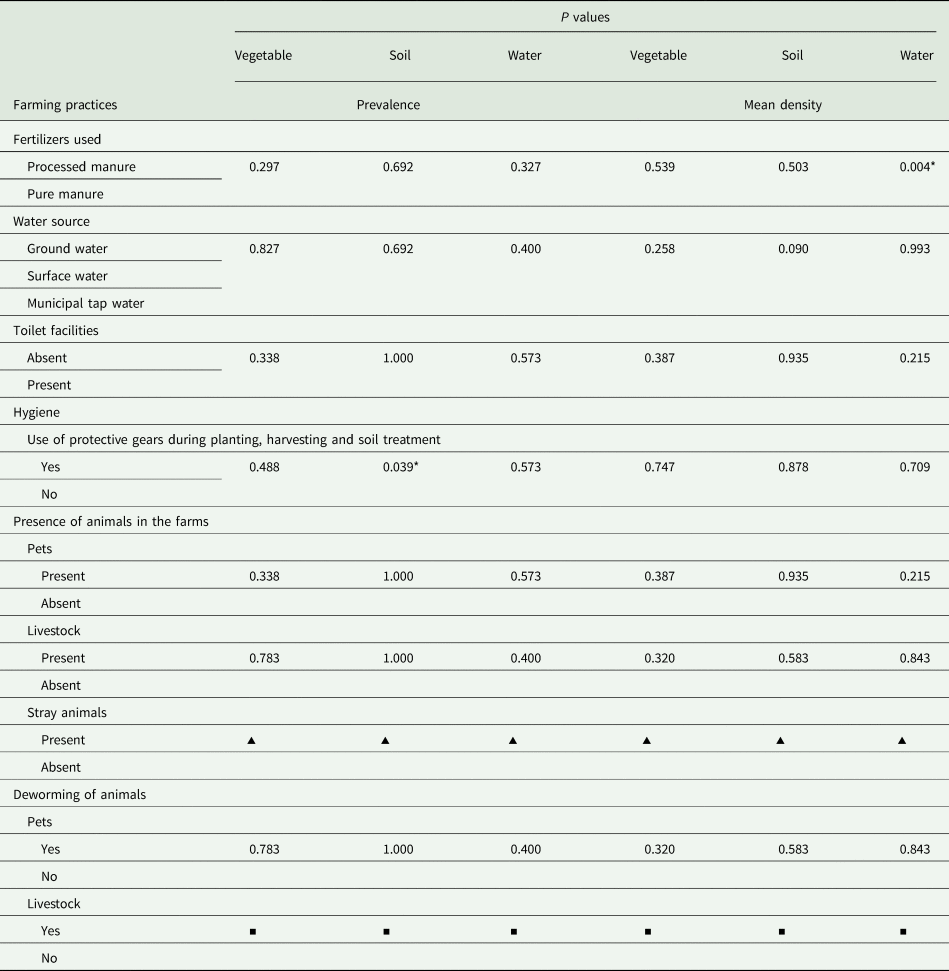
A survey was conducted to document some farming practices and associate these with the prevalence of parasite contamination in the farms (Table 5). Factors such as the use of fertilizer, water source and farm sanitation and hygiene practices were documented. Statistical analysis showed a significant association between soil contamination and workers’ hygiene and sanitation practices (P = 0.039). Moreover, the use of animal manure as fertilizer was associated with water contamination (P = 0.004). It was also revealed that farmers do not de-worm their pets and livestock.
Association of farming practices with prevalence and mean density of parasites contaminating vegetables, soil and water samples in selected vegetable farms

* P < 0.05 – significant.
▴■ Cannot be computed because at least one variable is constant – stray animals present in all farms; no deworming of livestock animals in all farms.
Discussion
Several studies have been conducted on the epidemiology of FBD and revealed leafy vegetables as one of the leading food types associated with foodborne illnesses. Several studies have also been done in the Philippines reporting vegetable contamination with parasites (De Leon et al., Reference De Leon, Monzon, Aganon, Arceo, Ignacio and Santos1992; Su et al., Reference Su, Mariano, Matti and Ramos2012; Ordoňez et al., Reference Ordoňez, Paller, Goh and Lim2016; Vizon et al., Reference Vizon, Battad and Castillo2019). However, there is a dearth of studies describing the dynamics of parasite contamination and transmission at the farm level in rural farms. In this study, four vegetable farms and one reference farm were examined for the prevalence of parasite contamination. Results revealed that parasites were found contaminating soils, water and vegetables from the selected farms. Most of these were common parasites of humans, domestic animals, including rodents such as Ascaris, strongylids, hookworms, Toxocara, Trichuris, Balantidium, Cryptosporidium and Giardia.
It is interesting to note that leafy vegetables, particularly lettuce, were found more contaminated with parasites. Other studies also reported lettuce contamination (Adamu et al., Reference Adamu, Adamu and Mohammed2012; Adanir and Tasci, Reference Adanir and Tasci2013; Eraky et al., Reference Eraky, Rashed, Nasr, El-Hamshary and El-Ghannam2014; Ordoňez et al., Reference Ordoňez, Paller, Goh and Lim2016; Ferreira et al., Reference Ferreira, Caldart, Freire, Mitsuka-Breganó, De Freitas, Miura, Mareze, Martins, Urbano, Seifert and Navarro2018; Vizon et al., Reference Vizon, Battad and Castillo2019). Parasite contamination of lettuce can be attributed to its broad and large surface area which allows more contact with contaminated soil and water. The uneven surfaces could also allow parasites’ eggs, cysts and oocyst to easily trap on the surface as compared to the smooth-surfaced vegetables such as tomatoes and cucumber. Leafy vegetables are also grown in closer proximity to the ground which could lead to a higher risk of contamination due to frequent contact with soil and runoffs. However, no parasites were detected from cabbage, tomatoes and Chinese cabbage (pechay). It was observed that outer leaves of cabbage and Chinese cabbage were removed during harvest; while tomatoes have smooth surface reducing the chance of attachment by parasite forms. Some cucumbers were also found contaminated which could be due to possible unhygienic handling of farmworkers as revealed in the KAP analysis.
Several studies also reported contaminated lettuce with parasites that could come from faeces of livestock or animal manure fertilizers (Gupta et al., Reference Gupta, Khan and Santra2009; Adamu et al., Reference Adamu, Adamu and Mohammed2012; Adanir and Tasci, Reference Adanir and Tasci2013; Maikai et al., Reference Maikai, Baba-Onoja and Elisha2013; Eraky et al., Reference Eraky, Rashed, Nasr, El-Hamshary and El-Ghannam2014; Adenusi et al., Reference Adenusi, Abimbola and Adewoga2015; Luz et al., Reference Luz, Barbosa, De Carvalho, Resende, Dias and Martins2017; Woldetsadik et al., Reference Woldetsadik, Drechsel, Kerait, Itanna, Erko and Gebrekidan2017). Variation in the prevalence of parasite contamination in vegetables can be attributed to the state of the vegetables before the examination (pre-washed or unwashed) and/or post-harvest practices. It could also be due to the sensitivity of parasitological techniques employed.
Soil samples from the farms were also collected and examined for the possible presence of parasites. The result of the study revealed a 47.3% prevalence of parasite contamination in soil samples. This is relatively higher compared to other studies at 31–36.4% contamination in house yards and public parks (Paller and De Chavez, Reference Paller and De Chavez2014; Zibaei et al., Reference Zibaei, Bahadory, Cardillo and Khatami2017). However, a study by Horiuchi et al. (Reference Horiuchi, Paller and Uga2013) showed higher contamination in soils in public and residential areas in a rural village in Laguna, the Philippines at 71%. The presence of parasites contaminating soils in the study sites is indicative of faecal contamination from animals as the farms practised integrated farming. However, the limitation of this study was that no molecular analysis was performed to confirm the specific species of parasites detected to identify the point source. Thus, a molecular analysis will be considered in future studies.
Parasite contamination was also compared with a reference farm located outside the sampling areas of Laguna Province. The reference farm is a certified organic farm and a macro enterprise as opposed to smallholder farms selected in the current study with lower standards of farming practices. Surprisingly, the prevalence and mean density of parasites in the reference farm (50.0%; 2 egg/larvae g−1 soil) were not statistically different (P = 0.85) from the study sites (46.7%; 3 eggs/larvae g−1 soil). (P = 0.85). The results suggest that contamination with parasites in farm soils may be attributed to the presence of animals among all the farms surveyed. The presence of roaming animals such as dogs, cats and rats increases the chance of parasite contamination due to open defecation. Moreover, the study revealed that some farming practices such as the use of animal manure as fertilizer contribute to parasite contamination. Animal manure is a good form of fertilizer, but if not treated or composted properly could pose a health hazard to consumers. Manure from poultry, cattle and pigs are commonly used organic fertilizers in the study sites.
Among the parasites recovered strongyle/hookworm eggs/larvae were the most commonly detected in vegetable and soil samples. Strongylid and hookworm eggs and larvae are difficult to differentiate microscopically. The ova are usually thin-shelled and the larvae have pointed ends. The abundance of strongyle/hookworm in the environment could be due to faecal contamination from animals. There are several species of Strongylids and hookworms that parasitize humans and other animals such as those from rats, pigs and other livestock. A study by Castillo and Paller (Reference Castillo and Paller2018) observed 100% occurrence of Angiostrongylus cantonensis in rodents from Nueva Ecija, Philippines. The intrusion of rodents and other wildlife in farms could also be a source of contamination (Lo et al., Reference Lo, Fernandez, de Luna, de Guia and Paller2021). Moreover, cattle, pigs and goats are well-known reservoir hosts of Trichostrongylus sp. which was observed in the farms. This parasite may contaminate vegetables through contaminated soils or the use of contaminated water and manure fertilizers. This parasite is now considered as zoonotic.
Another parasite contaminating soils in the farms was Toxocara sp. This parasite is a prevalent parasite of dogs (T. canis) and cats (T. cati). Several studies reported Toxocara soil samples in schools, house yards and playgrounds (Paller and De Chavez, Reference Paller and De Chavez2014; Tudor, Reference Tudor2015; Baneth et al., Reference Baneth, Thamsborg, Otranto, Guillot, Blaga, Deplazes and Solano-Gallego2016). The presence of stray cats and dogs that roam around and open defecate in farm areas account for the presence of Toxocara sp. Also, the presence of taenid eggs in soils may be due to the presence of rats in the farms. Trichuris sp. or whipworms were also found contaminating soils in the farms. It may be transmitted by roaming animals such as dogs (T. vulpis) and by using pig manure (T. suis); these two species are also infective to humans. Trichuris trichiura is also one of the leading STH infections in the Philippines along with hookworm infection (Soares Magalhães et al., Reference Soares Magalhães, Salamat, Leonardo, Gray, Carabin, Halton, McManus, Williams, Rivera, Saniel, Hernandez, Yakob, McGarvey and Clementis2015; Owada et al., Reference Owada, Lau, Leonardo, Clements, Yakob, Nielsen, Carabin and Soares Magalhães2018). A study by Paller and Babia-Abion (Reference Paller and Babia-Abion2019) revealed farm soil contamination with Trichuris sp. in Northern Luzon of the Philippines. The presence of Trichuris eggs in the farms could be due to the use of manure from pigs or due to open defecation of roaming animals such as dogs near the vegetable farming areas.
Water samples used for watering fresh produce were also examined for possible parasite contamination. No helminth parasites were observed in all water samples. However, Cryptosporidium and Giardia parasites were detected in spring water samples at high prevalence. Springwater may be contaminated with animal faeces from agricultural runoffs. Meanwhile, water samples from pumped district groundwater sources were also positive for Giardia, albeit at lower prevalence. Also, substandard and leaky sewage pipelines and the absence of effective wastewater filter systems could serve as focal polluters of groundwater and surface water (Ćirković et al., Reference Ćirković, Uzelac, Klun and Djurković-Djaković2017). However, the district tap water supply of the reference farm was found to be free of waterborne protozoan parasites implying intact and clean water pipelines in the area.
The quality of agricultural water could be a cause of soil contamination and the subsequent contamination of vegetables in the farms. The direct use of water from the mountain spring may contaminate vegetables and soils with pathogens from animals (Maffei et al., Reference Maffei, Batalha, Landgraf, Schaffner and Franco2016; Ordoňez et al., Reference Ordoňez, Paller, Goh and Lim2016; Amoah et al., Reference Amoah, Adegoke and Stenström2018; Ferreira et al., Reference Ferreira, Caldart, Freire, Mitsuka-Breganó, De Freitas, Miura, Mareze, Martins, Urbano, Seifert and Navarro2018; Ybañez et al., Reference Ybañez, Resuelo, Kintanar and Ybañez2018). However, other sources suggest that vegetable contamination is more related to soil contact rather than the contact with water (Blaszkowska et al., Reference Blaszkowska, Kurnatowski and Damiecka2011; Gyawali et al., Reference Gyawali, Khanal and Soares Magalhaes2013; Adekeye et al., Reference Adekeye, Thompson and Awobode2016; Hassan et al., Reference Hassan, Oyebamiji and Idowu2017). Regardless, the use of clean agricultural water is also an important factor to prevent contamination of vegetables.
Both organic and conventional farms in the present study reported that they use manure as organic fertilizers. According to interviews, the animal manures were either bought from the market or from another farm or formulated in their respective farms. Some farms revealed the use of treated composted animal manure such as the addition of effective microorganisms (EM) and Lactobacillus (LABS), while some use sun-dried composted manure before soil application. It was also observed that some farms use untreated manure as fertilizers. The use of improperly processed manure can potentially contaminate soil, water and even vegetable produce, thus posing a health risk to farmers and consumers.
Furthermore, the survey interview revealed poor sanitation and hygiene practices in some farms such as the lack of personal protective equipment during planting and harvest and washing of hands before and after handling crops. Ordoňez et al. (Reference Ordoňez, Paller, Goh and Lim2016) reported a significant association between parasite contamination and some farming practices such as the absence of toilet facilities, deworming practices and the presence of animals in the farm. Although the current study showed high awareness of farmers on biological pathogens, there is little awareness of the technological know-how for control and prevention as well as the understanding of the dynamics of pathogen contamination in the farms.
Conclusion
Results of the present study revealed health risks to farmers and consumers due to poor farm practices in some rural communities. There is a need to review food safety guidelines, that is, the Philippine Republic Act (RA) 10 611 on Food Safety should include a ‘Produce Safety Rule’ to set science-based standards to help ensure that water, soil amendments (e.g. fertilizer or compost), food contact surfaces and other materials that touch produce during growing, harvesting, packing and holding do not contribute to produce contamination. The Produce Safety Rule should also include the promotion of good agriculture practices (GAP) such as addressing animal intrusion into fields and worker hygiene. Also, there have been many claims that eating organic farming increases exposure to biological contaminants in crops. However, this study has found no evidence to support this claim. It is important to realize that both organic and conventional foods must meet the same quality and safety standards. Moreover, providing education and technical assistance to the agricultural sector and other stakeholders is also important, with greater emphasis on the potential impact of adjacent land uses and continued emphasis on the importance of agricultural water quality. Finally, relevant agencies should be focused on promoting good farming practices, communicating risks and conducting research with a multi-faceted approach to help keep leafy vegetables safe for consumers. To prevent possible adverse consequences to public health, it is highly recommended that proactive steps and measures are implemented.
Acknowledgements
The authors would like to thank: The Laguna Provincial Agricultural Office in the Philippines and some selected local government units (LGUs) for providing permits and assistance during sample collection. Also, the Animal Biology Division of the Institute of Biological Sciences, University of the Philippines Los Baños (UPLB) for the facilities and equipment.
Financial support
This work was supported by the National Research Council of the Philippines-Department of Science and Technology (NRCP-DOST).
Conflict of interest
The authors declare there are no conflicts of interest.
Ethical standards
Prior to the conduct of the study, permits to conduct the study were secured from the LGUs through the Provincial Agriculture Office and respective Municipal Agriculture Offices. Moreover, ethics clearance to conduct survey interviews was approved by the University of the Philippines Manila Research Ethics Board (UPMREB) with permit number 2018-201-01.